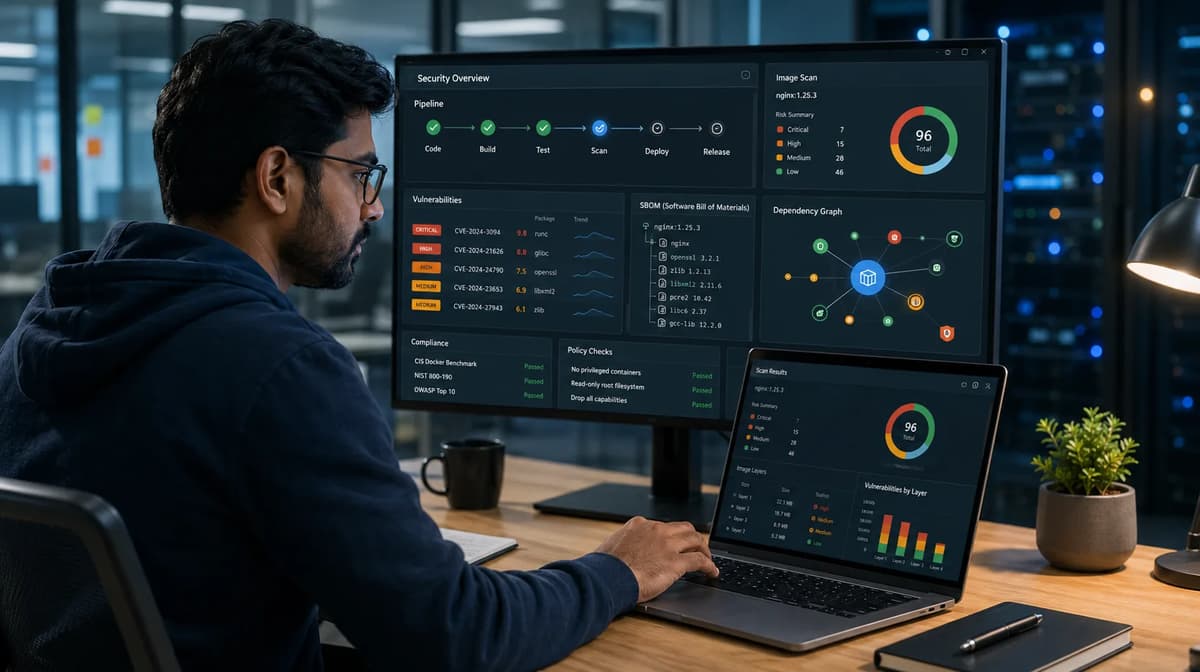
Eighty-seven percent of container images contained at least one high- or critical-severity vulnerability. That headline is real, but there is an important source correction: Sysdig published the 87% figure in its 2023 report, not its 2026 report.
A second statistic that still matters operationally comes from Sysdig’s 2024 research, which analyzed nearly 6 million runtime image scans and more than 500,000 CI/CD pipeline scans: 71% of CI/CD scans failed vulnerability policies, compared with 91% of runtime scans. Those figures show why finding vulnerabilities during a build is not enough if teams ignore the result, waive the gate, or never rescan an artifact after deployment.
That provenance matters. The 87% and 71%/91% figures trace to earlier Sysdig editions, and the 66% insecure-image incident figure could not be substantiated in Sysdig’s official 2026 material. This article therefore does not present the 66% figure as verified Sysdig data.
The corrected story is arguably more useful for a working engineer. DevOps Engineering in 2026 has reached the point where vulnerability detection is straightforward to automate; the harder problems are prioritization, remediation ownership, repeated scanning, SBOM lifecycle management, and securing the scanner and CI/CD integrations themselves. Sysdig’s current 2026 guidance also highlights that scanning has become highly automated while remediation still requires substantial human judgment.
That is where Trivy enters the discussion. Aqua Security’s Apache-2.0 open-source scanner can inspect container images, filesystems, Git repositories, Infrastructure as Code, Kubernetes resources, secrets, licenses, and SBOMs, and its GitHub repository had roughly 37,000 stars as of August 2026. Trivy is also represented in the CNCF landscape as a sandbox project.
But this is not a Trivy advertisement. For teams evaluating devops engineering in 2026 security scanning tools, the real question is whether Trivy, Grype with Syft, Snyk, Docker Scout, or a combination gives you the right balance of local control, coverage, vulnerability context, SBOM workflows, CI/CD ergonomics, and operational cost.
This guide goes tool by tool. It also covers the uncomfortable part that every DevSecOps engineer should understand: in March 2026, the Trivy ecosystem itself suffered a supply-chain compromise, demonstrating that the security tool you put inside a trusted pipeline can become the pipeline’s attack path.
Why Container and Supply-Chain Security Became Non-Negotiable
Containers did not merely become more popular; they became part of the standard delivery path for cloud-native software. Sysdig’s May 2026 container-security guidance, summarizing CNCF survey data, reports production container usage rising to 56% in 2025 from 41% in 2023.
The broader CNCF picture is even larger. CNCF’s annual survey published in January 2026 reports that 98% of surveyed organizations had adopted cloud-native techniques, while 82% of container users were running Kubernetes in production, up from 66% in 2023. The current primary source reports 98%, so the older 89% figure should not be used as the current benchmark.
Signal | Verified finding | What it means for DevSecOps |
Production container adoption | 56% in 2025 vs. 41% in 2023 | More production software passes through images that can be scanned |
Cloud-native adoption | 98% of surveyed organizations | Cloud-native security is mainstream operational work |
Kubernetes production use | 82% of container users | Image and cluster security increasingly overlap |
CI/CD policy failures | 71% in Sysdig’s 2024 dataset | Build pipelines surface substantial security debt |
Runtime policy failures | 91% in the same 2024 dataset | Build-only scanning does not produce a complete control loop |
That adoption changes the economics of a vulnerable base image. When ten applications inherit FROM ubuntu:..., FROM node:..., or another shared base, one newly disclosed package vulnerability can generate remediation work across ten release trains rather than one server maintenance ticket.
I have seen the predictable version of this failure: an engineer opens what looks like a routine Docker base-image update, the scanner suddenly exposes a backlog of OS and language-package findings, and a “quick bump” becomes days of CVE ownership arguments. The scanner did not create the security debt; it made already-shipped debt visible.
This is why shift-left should mean more than “run a security command before docker push.” You want detection as close as possible to the code change that introduced the vulnerable component, but you also want rescanning after deployment because the vulnerability intelligence changes while your artifact remains static.
The 71% versus 91% Sysdig figures make this point, with one qualification: they came from the 2024 report, not 2026. A high build-policy failure rate means pipelines already have plenty to tell developers; the even higher runtime failure rate tells you that detection must connect to remediation, exception management, and continuing production visibility rather than ending at an informational CI job.
A useful model is a loop:
Before merge: scan dependencies, repositories, secrets, and IaC so the developer who introduced the change still has context.
After image build: scan the exact immutable artifact you intend to publish.
At registry or release time: generate and preserve the SBOM, scan against release policy, and record approved exceptions.
After deployment: continuously or periodically re-evaluate the deployed artifact as vulnerability intelligence changes.
During remediation: route findings to an owner, prioritize exploitable and fixable issues, rebuild, and verify that the replacement artifact actually removed the finding.
This scanning-specific focus deliberately complements, rather than repeats, Refonte Learning’s article on how cloud security engineering trends and tools are evolving in 2026. The problem here is narrower: what should your software delivery pipeline scan, which scanner should do it, and what should happen when the scanner says no?
For searches around devsecops tools 2026, that last question is the one I would use to judge maturity. Buying or installing a scanner takes hours; getting developers to trust the results, giving findings owners, defining exceptions, and closing the build-runtime feedback loop takes engineering discipline.
What Trivy Actually Scans and How the Major Tools Compare
Calling Trivy a docker image vulnerability scanner understates it. Aqua’s current documentation describes separate vulnerability, misconfiguration, secret, and license scanners across targets that include container images, filesystems, remote or local code repositories, virtual-machine images, Kubernetes, and SBOMs.
For container images, Trivy can identify known vulnerabilities in OS and application packages and can also detect secrets; its image scanner can additionally examine configuration information for misconfigurations when enabled.
For repositories, trivy repo scans local or remote repositories for vulnerabilities, misconfigurations, secrets, and licenses. Vulnerability analysis in repository mode focuses on dependency information such as lockfiles rather than treating the repository exactly like an already-built image.
For Infrastructure as Code, Trivy includes built-in checks for Terraform, CloudFormation, Kubernetes, Dockerfiles, Helm, and other configuration formats. Its e explicitly describes trivy config, while current configuration references include Azure ARM, CloudFormation, Dockerfile, Helm, Kubernetes, Terraform, and Terraform-plan scanners.
Secret scanning is built in rather than requiring a second binary. Current Trivy documentation says it can scan container images, filesystems, and Git repositories for credentials including API keys and access tokens, with secret scanning enabled by default for relevant targets.
For SBOMs, Trivy supports generation in CycloneDX and SPDX formats, making it both a vulnerability scanner and one of the practical sbom generation tools you can put into a release pipeline.
Scan type | Trivy support | Practical use |
Container images | Yes | OS and language dependency vulnerabilities, secrets, optional config analysis |
Filesystems | Yes | Local source/build-tree assessment |
Git repositories | Yes | Dependency, secret, misconfiguration and license analysis |
Infrastructure as Code | Yes | Terraform, CloudFormation, Kubernetes, Helm, Dockerfile and related checks |
Kubernetes clusters | Yes, with current CLI cluster capability marked experimental in docs | Cluster/workload security review; Operator supports ongoing scanning |
Secrets | Yes | Detect exposed keys, tokens and passwords |
SBOM generation | Yes | CycloneDX and SPDX |
Existing SBOM scanning | Yes | Re-evaluate inventories against vulnerability data |
Trivy’s Kubernetes story deserves one qualification. Aqua’s documentation supports trivy k8s for cluster scanning and the Trivy Operator for automated in-cluster scanning, but the current CLI documentation labels the Kubernetes cluster-scanning feature experimental, so I would validate it against your production requirements before treating the command as an unchanging API.
Its ecosystem position is another reason engineers encounter Trivy early. CNCF’s landscape describes Trivy as a sandbox project, and Harbor documentation has long recommended Trivy as its scanner path after Clair ceased being the default; newer Harbor documentation also describes automatic SBOM generation with Trivy.
For adjacent categories, Refonte Learning already covers the broader inventory of DevSecOps tools worth mastering. The distinction matters in practice: this guide focuses on the scanning control plane rather than placing Trivy beside Jenkins, Vault, Terraform, SonarQube, Prometheus, and unrelated products.
Trivy vs. Grype vs. Snyk vs. Docker Scout
For readers literally researching trivy vs snyk vs grype, Docker Scout belongs in the comparison too because Docker has made vulnerability analysis and SBOM inspection increasingly native to Docker workflows.
Tool | Model and coverage | Risk context, SBOM approach, and best fit |
Trivy | Apache-2.0 open source; local/self-hostable. Scans images, filesystems, repositories, IaC, Kubernetes, secrets, and licenses. | Uses vulnerability severity and related advisory data. Generates and scans CycloneDX/SPDX SBOMs. Best for teams wanting one broad local scanner. |
Grype + Syft | Open source; local. Grype scans images, filesystems, and SBOMs for vulnerabilities; Syft handles inventory generation. | Current Grype supports EPSS, CISA KEV, and risk scoring. Syft generates the SBOM and Grype rescans it. Best for SBOM-first teams that prefer modular tools. |
Snyk | SaaS platform with free and paid tiers. Covers open-source dependencies, containers, code, IaC, and other AppSec capabilities. | Adds reachability, exploit maturity, and risk scoring. Generates SBOMs and manages results through its platform. Best for teams that value developer remediation context and centralized AppSec workflows. |
Docker Scout | Docker-integrated service and CLI capabilities. Focuses on container/image analysis and also supports local filesystems. | Adds EPSS, CISA KEV, VEX, and policy context. Builds or uses image SBOMs and supports SPDX export. Best for Docker-standardized teams wanting image intelligence close to Docker tooling. |
Primary documentation supports each distinction. Grype scans container images, directories, files, archives and pre-generated SBOMs; current Grype documentation also lists EPSS, KEV and risk scoring, which means it would be inaccurate to characterize Grype as a severity-only matcher in 2026.
The cleanest Anchore workflow is often Syft → SBOM → Grype. Anchore describes Syft as its SBOM generator and Grype as its vulnerability scanner, and its documentation explicitly notes that generating an SBOM once lets you reuse that inventory for later vulnerability scans as intelligence changes.
That modularity is useful in regulated environments. You can treat the SBOM as a versioned release artifact, sign and archive it, and run Grype against the same SBOM later without reconstructing the original container solely to answer “does the release we shipped contain this newly disclosed package?”
Trivy can support that same SBOM-first pattern while also giving you IaC, repository, Kubernetes, and secrets coverage in the same CLI. That broader scope is why I would normally start a small or medium platform team with Trivy unless it already has a deliberate Syft/Grype architecture or another enterprise scanner.
Snyk changes the trade-off. Snyk’s platform covers container, open-source dependency, code, and IaC security, and its current documentation supports reachability analysis plus exploit-maturity and risk-scoring signals for prioritization.
That context matters once raw CVE counts stop being useful. A CRITICAL CVSS score answers “how bad could this vulnerability be?”; reachability, exploit maturity, deployment context, fixability, EPSS, KEV, and VEX-type signals help answer the more operational questions: “can this application reach the vulnerable code?”, “is exploitation happening or likely?”, and “what should we patch first?”
Snyk should not be described as paid-only. Its current pricing page has a $0 plan covering SCA, SAST, IaC, and container scanning, with paid Team, Ignite, and Enterprise tiers adding capacity and platform features.
It also should not be described as equivalent to a fully disconnected local binary. Snyk is fundamentally a platform service, although Snyk Broker and its Container Registry Agent provide controlled connectivity patterns for private and network-restricted environments.
Docker Scout has also become more nuanced than “Docker Hub vulnerability scanning.” Docker says Scout derives or consumes an image SBOM, matches it to advisory intelligence, and incorporates feeds including CISA’s Known Exploited Vulnerabilities catalog and EPSS.
Scout can export SPDX SBOM data, and its newer local policy mode indexes an image into an SBOM, enriches it with CVE and VEX information, and can evaluate policy locally without sending data to the Scout service for most such use cases. That makes the privacy comparison with Trivy less binary than it was in earlier Docker Scout discussions.
When Free and Self-Hosted Wins
Choose Trivy when you want one CLI spanning images, repos, IaC, Kubernetes, secrets and SBOM work, especially when local execution and air-gap options matter. Trivy documents offline and air-gapped database workflows.
Choose Grype + Syft when SBOM creation and vulnerability matching should remain separate concerns, or when you already operate an SBOM-centric pipeline.
Choose Snyk when developer remediation context, reachability, exploit maturity, centralized governance, and a broader AppSec platform justify a SaaS-centered architecture.
Choose Docker Scout when Docker is already the developer and registry workflow, and you want image recommendations, SBOM intelligence, policies and Docker-native ergonomics rather than another standalone platform.
For teams comparing container vulnerability scanning tools 2026 is therefore less about finding a scanner that can print CVEs, every tool in this comparison can do that, and more about deciding where inventory lives, how prioritization works, what data can leave the environment, and who owns remediation.
How to Wire Scanning Into a Real CI/CD Pipeline
A good scanner architecture has at least three security moments: before merge, after the immutable image exists, and after deployment. The last stage matters because an image that looked acceptable on release day can become vulnerable when researchers disclose a CVE a week later.
A trivy ci/cd pipeline should therefore look more like a feedback system than a one-time command:
Pipeline point | What to scan | Typical decision |
Pull request | Dependencies, source tree, IaC, secrets | Block newly introduced critical risk or serious misconfiguration |
Image build | Exact built image | Prevent unsafe artifact from entering trusted registry |
Release | Image + SBOM + policy | Preserve evidence; approve or reject deployment |
Production | Deployed images/workloads on a schedule | Detect newly disclosed vulnerabilities and drift |
Remediation | Rebuilt replacement image | Confirm finding disappeared before rollout |
Trivy’s CLI supports exit codes and severity filtering specifically for CI-style policy enforcement. Its documentation shows --exit-code being used to fail automation based on selected severity levels.
A simple policy can start like this:
# Fail the pipeline if the built image contains a CRITICAL vulnerability.
trivy image \
--severity CRITICAL \
--exit-code 1 \
"$IMAGE_REF"
# Report HIGH findings without failing the pipeline yet.
trivy image \
--severity HIGH \
--exit-code 0 \
"$IMAGE_REF"
I prefer a staged rollout to “fail on everything” because the security control needs credibility. Starting with CRITICAL blocking, HIGH warnings, and MEDIUM/LOW backlog review gives the team a manageable baseline; after you measure false positives, exception rates, remediation time, and scanner reliability, you can tighten the gate.
That threshold is a starting policy, not a universal standard. A HIGH issue listed in CISA KEV may deserve more urgency than a CRITICAL issue in an unreachable package, and tools such as Grype, Snyk, and Docker Scout now expose additional prioritization signals that can help you move beyond CVSS-only gating.
For GitHub Actions, resist the temptation to paste a floating third-party Action tag into a privileged workflow and call the problem solved. GitHub’s own secure-use guidance says a full-length commit SHA is the only way to use an Action as an immutable release, because tags can move.
A defensible workflow can run the scanner CLI directly after your build:
name: container-security
on:
pull_request:
push:
branches: [main]
permissions:
contents: read
jobs:
scan:
runs-on: ubuntu-latest
steps:
- name: Check out source
uses: actions/checkout@<reviewed-full-commit-sha>
- name: Build image
run: docker build -t example-app:${{ github.sha }} .
- name: Scan critical vulnerabilities
run: |
trivy image \
--severity CRITICAL \
--exit-code 1 \
example-app:${{ github.sha }}
The placeholder is intentional. Do not copy an unverified SHA from an article; select the current reviewed commit from the Action’s official repository and let Dependabot or your dependency-governance process propose upgrades.
GitLab CI and Jenkins do not fundamentally change the control model. Install or provide the scanner in the runner, build the artifact, scan the exact artifact reference, make the scanner’s non-zero exit code fail the security stage, and archive machine-readable output or the SBOM for downstream evidence.
For an SBOM-producing release stage, a Trivy workflow can be conceptually as simple as:
trivy image \
--format cyclonedx \
--output app.cdx.json \
"$IMAGE_REF"
trivy image \
--format spdx-json \
--output app.spdx.json \
"$IMAGE_REF"
Trivy’s official SBOM documentation supports both CycloneDX and SPDX outputs.
The most important detail is scan the final built artifact, not merely the Dockerfile or dependency manifest. A Dockerfile can look safe while a build step pulls an unexpected package version, and a lockfile scan cannot tell you everything inherited from the operating-system layer.
Then rescan what you have already shipped. Trivy’s Kubernetes tooling can inspect cluster resources, while Trivy Operator supports continuous scanning of workloads and cluster security conditions; if you use registry-side or SBOM-first scanning instead, you can periodically reevaluate stored images or their SBOMs against newer vulnerability data.
This is the place to connect scanning with the Kubernetes and K3s trends shaping DevOps engineering in 2026. Kubernetes admission controls, runtime policies, image provenance, and vulnerability scanning solve different parts of the same release-integrity problem.
Two mistakes destroy scanner adoption particularly quickly.
Scanning only once: a successful build-time result becomes stale as new advisories appear. Preserve artifact identity and SBOM data so you can reevaluate deployed releases.
Turning every finding into a broken build: hundreds of low-priority findings teach developers to treat the scanner as noise. Gate on a policy you can defend, route the rest into a measured backlog, and expand enforcement deliberately.
One more mistake is quieter: allowing teams to bypass a failed security job without recording why. An exception should identify the finding, artifact, owner, rationale, expiration date, and compensating control; otherwise a temporary waiver becomes permanent invisible risk.
The 71% CI/CD policy-failure figure from Sysdig’s 2024 dataset is useful precisely because it shows that scanners can surface a large backlog. The engineering objective is not to celebrate the detection count; it is to reduce the number of vulnerable artifacts that cross the release boundary.
SBOM Regulation and the Supply-Chain Threat Model
An SBOM, or Software Bill of Materials, is a machine-readable record of the components and relationships that make up software. NIST, reflecting Executive Order 14028, describes it as a formal record of software components and their supply-chain relationships and compares its role to an ingredient list.
The practical value appears when a new CVE lands. Instead of asking 40 teams to search source trees and container shells manually, you query release inventories and answer: which products contain package X, which versions, and which deployed artifacts require action?
ENISA’s SBOM Adoption State of Play 2026, published June 9, surveyed 334 organizations; roughly 65% were EU-based and more than 80% reported direct Cyber Resilience Act impact. The survey found 78% had started SBOM adoption, but only 9% described their implementation as mature and highly automated.
That is the real maturity gap. Creating bom.json once for an audit demonstration is not the same thing as generating an SBOM for every release, associating it with an immutable artifact, storing it, signing or attesting it where appropriate, monitoring its components for new vulnerabilities, and feeding remediation back into engineering.
ENISA also found that 43% of respondents said the CRA significantly accelerated investment in SBOM tooling or automation, with another 29% reporting a moderate influence. CycloneDX was used by 44% of respondents and SPDX by 29%, showing why scanner support for both standards has practical interoperability value.
SBOM capability | Weak implementation | Mature implementation |
Generation | Engineer runs tool manually before audit | Pipeline generates on every release |
Artifact identity | SBOM sits in shared drive | SBOM maps to immutable image/release |
Format | Ad-hoc JSON | Standard CycloneDX or SPDX |
Storage | Temporary CI artifact | Retained, searchable release evidence |
Vulnerability monitoring | Scan only at build | Re-scan inventory as intelligence changes |
Exceptions | Informal Slack decision | Owned, documented and expiring |
Integrity | No provenance control | Sign/attest and verify according to supply-chain design |
Teams searching cyber resilience act sbom guidance should pay attention to two different EU dates rather than collapsing them into one “SBOM deadline.” The European Commission states that the CRA’s reporting obligations apply from September 11, 2026, while the regulation’s main obligations apply from December 11, 2027.
That distinction matters because September 2026 is primarily the start of vulnerability and incident reporting duties; it is not accurate to describe that date as the date on which every SBOM-specific CRA obligation suddenly activates. The broader product-security, vulnerability-handling, and technical-documentation regime, including the operational context in which SBOMs matter, reaches its main application date in December 2027.
That gives engineering organizations a runway, not permission to wait. ENISA’s 9% mature-automation result shows how large the implementation gap remains only months before the reporting provisions start applying.
The United States created an earlier policy push through Executive Order 14028 in 2021. A precise formulation is that the order drove federal software-supply-chain guidance and SBOM minimum-element work; NIST says that, when applicable to procurement, federal agencies should require software suppliers to provide machine-readable SBOM access conforming to the EO and NTIA minimum elements.
That is more accurate than saying EO 14028 imposed one universal SBOM mandate on every company selling any software to any federal agency. The important precedent is that software component transparency moved from an optional internal engineering artifact into procurement and assurance expectations.
For DevOps teams, this connects directly to how Infrastructure as Code tools like Terraform are leading DevOps engineering in 2026. IaC tells you how infrastructure should be created; an SBOM tells you what software components went into the artifact deployed onto that infrastructure.
The security reason to care is accelerating at the same time as the regulatory reason.
Sonatype released its 2026 State of the Software Supply Chain on January 28, reporting that open-source malware grew 75%, that annual downloads across Maven Central, PyPI, npm, and NuGet reached 9.8 trillion, up 67% year over year, and that its research corpus exceeded 1.233 million malicious packages.
Sonatype’s detailed malware analysis says it identified 454,648 new malicious packages during 2025, with the report page rounding that to more than 454,600. It also documents IndonesianFoods, which produced more than 150,000 malicious packages in only a couple of days; Sonatype’s campaign table lists 169,538 packages.
The scale changes what supply chain security devops work means. Scanning only your proprietary code does nothing to identify a malicious or vulnerable third-party package already imported through npm, PyPI, Maven, NuGet, an OS repository, a container base layer, or another build input.
Your controls therefore need to cover at least:
source and secrets;
open-source dependencies;
operating-system packages inside images;
image configuration and IaC;
SBOM generation and retention;
provenance and immutable artifact identity;
vulnerability intelligence after release;
CI/CD actions, plugins and scanner dependencies themselves.
That final item became painfully concrete in 2026.
When the Scanner Itself Becomes the Attack Surface
The strongest argument against checkbox DevSecOps came from a tool built specifically to improve DevSecOps.
On March 19, 2026, an attacker used compromised credentials in the Trivy ecosystem to publish a malicious Trivy v0.69.4 release and manipulate official integration infrastructure. Aqua’s GitHub security advisory says the attacker force-pushed 76 of 77 version tags in aquasecurity/trivy-action to malicious credential-stealing content and replaced all seven tags in aquasecurity/setup-trivy.
A second wave followed on March 22, when malicious v0.69.5 and v0.69.6 images were published through Docker Hub. That is why I would describe the incident as multiple compromise waves across the Trivy ecosystem, rather than repeat the narrower claim that “the GitHub Action itself was compromised twice.”
Incident lesson | Pipeline implication |
Mutable Action tags were redirected | Pin Actions to reviewed full commit SHAs |
A trusted security namespace distributed malicious artifacts | Verify release provenance, checksums, and signatures where supported |
CI tooling could access credentials | Minimize token permissions and secrets available to scanning jobs |
Scanner infrastructure became a supply-chain dependency | Inventory your security tools just like application dependencies |
Credentials may be exposed during a tooling compromise | Have rotation and incident-response procedures ready |
The advisory tells potentially affected users to audit exposure and rotate secrets. GitHub independently recommends full commit-SHA pinning because a full SHA is the immutable way to reference an Action, whereas a tag can be moved if a repository or maintainer account is compromised.
This is one reason I dislike examples such as:
uses: vendor/security-action@v1
They look clean in a tutorial, but the security meaning is weaker than it appears. You reviewed whatever v1 pointed to yesterday; a mutable tag gives you no guarantee that it points to the same code tomorrow.
A stronger pattern is:
uses: vendor/security-action@<full-reviewed-commit-sha> # reviewed release/version
Then automate upgrade proposals without automatically trusting them. GitHub documents organization and repository policies that can require SHA pinning, and Dependabot can help propose updates to Action references.
You should also reduce what a scanning job can steal. Declare minimum GITHUB_TOKEN permissions, avoid placing deployment credentials in jobs that do not require them, prefer short-lived cloud identity through OIDC where supported, and separate untrusted pull-request processing from privileged release jobs. GitHub’s secure-use guidance specifically warns that a compromised Action can reach secrets and repository permissions available to its workflow.
The incident also changes how I think about “all-in-one” tooling. Consolidating image, IaC, secret and repository scanning into one binary simplifies operations, but any high-trust tool that runs throughout the pipeline becomes an attractive target because compromising it can place attacker code directly beside CI tokens, package credentials and cloud authentication.
The answer is not to stop using Trivy. The answer is to stop treating any scanner, including Trivy, Snyk integrations, Grype automation, Docker Scout Actions, or your own Jenkins plugins, as outside the threat model.
A practical supply-chain hygiene checklist is short:
Pin GitHub Actions to full reviewed SHAs.
Pin container images by digest in high-assurance workflows where practical.
Verify checksums or signatures for downloaded scanner binaries when the project publishes them.
Give scan jobs minimum permissions and minimum secrets.
Preserve logs that let you determine which scanner version ran against which artifact.
Include CI/CD and security-tool dependencies in incident-response exercises.
A specific claim about an April 2026 rotation of Aqua’s deb/rpm GPG signing keys requires the same source discipline as the older Sysdig numbers. Aqua’s primary GitHub advisory verifies the March compromise, but no sufficiently strong primary-source confirmation was found for the April key-rotation claim. It is therefore not presented here as established fact.
That is the difference between having a scanner and practicing DevSecOps. The broader mindset is developed in the full DevSecOps career roadmap: tools change; the habit of modeling trust boundaries, minimizing privilege, validating dependencies, and planning for compromise has to survive the tool change.
Skills, Credentials, Hiring Signals, and Learning Paths
The first skill you need is not installing Trivy. trivy image nginx:... is easy; deciding whether the 43 findings in its output justify blocking a release is the job.
A useful priority order looks like this:
Priority | Skill | Why it comes first |
Must | Read a CVE report and distinguish severity, fixability and actual application exposure | Prevents panic-driven triage |
Must | Wire scanning into GitHub Actions, GitLab CI or Jenkins | Converts manual testing into repeatable control |
Must | Set enforceable thresholds and exceptions | Keeps the scanner trusted instead of ignored |
Must | Identify the owner of remediation | A finding with no owner remains a finding |
Should | Generate and retain CycloneDX/SPDX SBOMs | Makes release composition queryable later |
Should | Understand KEV, EPSS, reachability and VEX | Improves prioritization beyond raw CVSS |
Good | Compare results across scanners | Exposes data-source and matching differences |
Good | Pin and verify pipeline dependencies | Protects the security tooling itself |
The ordering matters. Teams that jump into sophisticated SBOM dashboards or exploit scoring without agreeing on “who patches a CRITICAL base-image CVE?” create expensive telemetry and no remediation.
You also need to understand that scanner outputs will differ. Grype, Trivy, Snyk, and Docker Scout consume different data sources and matching logic, apply vendor severity differently, and expose different context, so two tools can legitimately disagree without either one being useless. Docker Scout, for example, documents vendor-source prioritization and Package URL matching, while Grype documents a broad set of distribution and ecosystem vulnerability feeds.
This is a good interview exercise: take the same image, scan it with two tools, identify a disagreement, inspect the underlying package and advisory, and explain which result you would act on. That demonstrates far more security judgment than memorizing CLI flags.
There is no dedicated Trivy certification you need before doing this work. Broader credentials such as CompTIA Security+, the Certified Kubernetes Security Specialist, and AWS Certified Security – Specialty can complement the surrounding security, Kubernetes and cloud knowledge, but a scanner-specific portfolio project proves the workflow more directly.
A strong portfolio repository should show:
a containerized application;
a scanner running automatically in CI;
a documented blocking threshold;
a generated CycloneDX or SPDX SBOM attached to a release;
one documented vulnerability exception with an expiration date;
a scheduled or repeatable re-scan mechanism;
a README explaining why you selected Trivy, Grype, Snyk, or Docker Scout;
pinned CI dependencies rather than floating third-party Action tags.
Current job-posting snapshots reinforce that tool specificity is appearing in real requirements. One 2026 DevSecOps posting explicitly lists Syft/Trivy for SBOMs, Cosign for signing, container image scanning, registry security, Falco, and incident-response playbooks; another recent listing names Trivy alongside CycloneDX, VEX, KEV and EPSS knowledge. These are individual postings rather than a statistically representative labor-market survey, but they illustrate the shift from generic “security awareness” toward concrete supply-chain workflows.
That suggests a practical interview advantage. Saying “I understand shift-left security” is weaker than saying, “I build the image, block critical findings before registry push, create a CycloneDX SBOM, preserve it with the release, pin third-party Actions to commit SHAs, and rescan deployed artifacts when vulnerability intelligence changes.”
On compensation, an indexed Glassdoor result has been cited as showing $185,363 average annual DevSecOps Engineer pay with a $145,024–$240,608 range. However, the result links to an IBM-specific page whose body reports a different estimate of $183,205 as of April 2026, rather than a clean nationwide benchmark. Readers looking for compensation detail should use the full DevSecOps salary breakdown by seniority and region instead of treating this scanning guide as a salary comparison.
Self-Study Versus Structured Training
Self-study is enough to get your first scanner running. Trivy is a compiled CLI with direct commands for images, repositories and configuration, and Anchore similarly distributes Grype as a standalone executable.
The harder gap is the system around the scanner.
Factor | Self-study | Structured DevSecOps training |
First CLI vulnerability scan | Usually straightforward once the tool is installed | Covered within a broader security-learning context if scanner practice is included |
Secure CI/CD concepts | Requires assembling docs and projects yourself | Refonte program lists Secure CI/CD Pipelines as a competency |
SAST/DAST/IAST | Easy to study as disconnected tools | Refonte program lists all three as application-security competencies |
IaC security | Often depends on project choice | Refonte program explicitly lists IaC Security and Automation |
Incident response | Scanner tutorials rarely provide full practice | Refonte program lists Incident Response and Risk Mitigation |
Threat modeling | Requires separate learning | Refonte program lists OWASP and Threat Modeling Practices |
Trivy-specific curriculum | Available through Trivy’s own documentation | Not explicitly named on Refonte’s published program page |
SBOM-specific curriculum | Available through tool and standards documentation | Not explicitly named on Refonte’s published program page |
Interview-readiness timeline | Varies by starting experience; no defensible universal number | Program duration is three months; individual job readiness still varies |
The comparison uses Refonte Learning’s published Cybersecurity & DevSecOps program information. Because the curriculum does not explicitly name Trivy or SBOM tooling, this guide does not imply that the program teaches those tools directly.
That distinction matters. A tool tutorial teaches you how to issue a command; a security program should teach you why the command belongs at a particular trust boundary, how to react when it fails, and how it relates to application testing, infrastructure security, incident response and risk.
The Refonte Learning Cybersecurity & DevSecOps Program
The most accurate way to position the Refonte Learning Cybersecurity & DevSecOps Program is not “learn Trivy here.” The published curriculum does not explicitly name Trivy, container vulnerability scanning, or SBOM tooling, so claiming direct tool coverage would go beyond the verified program information.
What the program does provide is the surrounding foundation into which scanners plug: Secure CI/CD Pipelines, application security testing, IaC Security and Automation, cloud and network security, incident response, threat modeling, and security workflow automation. Those competencies address the difference between executing trivy image and operating a defensible security process.
Program element | Verified detail |
Format | Online virtual internship program |
Duration | 3 months |
Weekly commitment | 12–14 hours per week |
Early confirmed modules | Fundamentals of Cybersecurity; Exploring Cyber Threats; Hands-On Practice: Applying Descriptive Techniques in Cybersecurity |
Later curriculum | Continues into a capstone project |
Secure delivery competencies | Secure CI/CD Pipelines; DAST, SAST and IAST; IaC Security and Automation; Security Workflow Automation |
Broader security competencies | Ethical Hacking and Penetration Testing; Cryptography and Secure Data Management; IDS, Firewalls and Honeypots; Network and Cloud Security; OWASP and Threat Modeling; Incident Response and Risk Mitigation |
Named tools | Wireshark, Metasploit, Nmap, Burp Suite, Kali Linux |
Mentor | Dr. Christine Baker |
Prerequisite | Must be engaged in bachelor’s or postgraduate studies |
Fee | $300 one-time, or two installments of $204 + $98 |
The current program page identifies Dr. Christine Baker as a Senior Cybersecurity Consultant with more than 15 years of experience spanning threat analysis, incident response, and security architecture.
The competency sequence is relevant to scanning because a vulnerability result is only one input into an application-security decision. SAST looks for weaknesses in source code, DAST exercises a running application from the outside, IAST observes application behavior with internal instrumentation, and container/SCA-style scanning evaluates components and artifacts; no single scanner substitutes for the others.
The same applies to IaC. Trivy can detect Terraform, Kubernetes, CloudFormation and Dockerfile misconfigurations, but an engineer still needs to understand what insecure network exposure, IAM configuration, encryption policy or Kubernetes privilege actually means before deciding whether a finding is a release blocker.
The program’s full verified competency set includes:
Ethical Hacking and Penetration Testing
Cryptography and Secure Data Management
IDS, Firewalls, and Honeypots
Network and Cloud Security
Secure CI/CD Pipelines
DAST, SAST, and IAST
IaC Security and Automation
OWASP and Threat Modeling Practices
Incident Response and Risk Mitigation
Security Workflow Automation
The published tool set includes Wireshark, Metasploit, Nmap, Burp Suite, and Kali Linux. Trivy, Grype, Syft, Docker Scout, and SBOM-specific tools are not on that confirmed list, so a learner who wants a scanning portfolio should treat them as a complementary hands-on project rather than assume direct curriculum coverage.
The program lists a Training Certificate and Certificate of Internship. High performers can receive a Letter of Recommendation, while top performers can receive a Certificate of Appreciation.
The listed career outcomes include DevSecOps and Cyber Risk Analyst, Secure Development and Cyber Security Specialist, and Application Security and Cyber Threat Expert. These are program-stated outcomes, not guarantees of employment or a particular salary.
One admission constraint is important: the program requires participants to be engaged in bachelor’s or postgraduate studies. Anyone outside that eligibility condition should verify alternatives directly with Refonte Learning rather than assume an exception.
The program runs for three months online at 12–14 hours per week in a virtual-internship structure. The confirmed fee is $300 as a one-time payment or two installments of $204 and $98.
For someone building toward DevSecOps work, I would pair that security foundation with a concrete scanner project: create a repository, build an image, scan it, generate an SBOM, document a triage decision, pin the pipeline dependencies, and demonstrate how you would rescan the deployed release. That produces evidence that you can connect security concepts to delivery engineering.
The single next step is the Refonte Learning Cybersecurity & DevSecOps Program for learners who want structured training around secure CI/CD, application security testing, IaC security, threat modeling, incident response, and security automation.
FAQ and Practical Takeaways
What Is Trivy Used for in DevOps?
Trivy is an open-source security scanner used to inspect container images, filesystems, local or remote code repositories, Infrastructure as Code, Kubernetes resources, secrets and software dependencies. It can also generate and consume SBOMs, including CycloneDX and SPDX output.
That breadth makes it useful when a team wants one CLI to cover multiple shift-left checks rather than combining a separate image scanner, IaC scanner, secret detector and SBOM generator for every basic workflow.
Is Trivy Better Than Snyk?
Neither tool wins universally. Trivy is Apache-2.0 open source, local/self-hostable, supports air-gapped workflows, and spans images, repositories, IaC, Kubernetes, secrets and SBOM work, which makes it an excellent default for teams that want broad scanning without adopting a SaaS application-security platform.
Snyk offers a wider commercial AppSec platform and risk-prioritization capabilities including reachability analysis, exploit maturity and centralized developer remediation workflows. It also has a free tier, so the distinction is not simply “Trivy free, Snyk paid.”
What Percentage of Container Images Have Vulnerabilities?
The frequently quoted 87% high-or-critical figure comes from Sysdig’s 2023 research, not the 2026 Cloud-Native Security and Usage Report. Reusing it as “Sysdig’s 2026 finding” is a source-date error.
Similarly, the 71% CI/CD versus 91% runtime policy-failure figures came from Sysdig’s 2024 analysis of nearly 6 million runtime scans and more than 500,000 CI/CD scans. They remain useful historical evidence for pipeline design, but they should retain their correct publication year.
What Is an SBOM and Why Does It Matter Now?
A Software Bill of Materials is a machine-readable record of software components and their supply-chain relationships. It lets engineering and security teams determine which released products contain a component when a new vulnerability, licensing problem or supply-chain incident appears.
ENISA’s 2026 survey found that 78% of respondents had started SBOM adoption but only 9% had reached mature, highly automated implementation. The EU Cyber Resilience Act adds urgency: reporting obligations apply from September 11, 2026, while the regulation’s main obligations apply from December 11, 2027.
Was Trivy Itself Ever Compromised?
Yes. On March 19, 2026, attackers compromised the Trivy ecosystem, including force-pushing 76 of 77 aquasecurity/trivy-action version tags to malicious content and publishing malicious Trivy v0.69.4; a further Docker Hub wave followed on March 22 involving v0.69.5 and v0.69.6.
The practical lesson is to treat scanning tools as supply-chain dependencies: pin GitHub Actions to full commit SHAs, restrict workflow permissions, verify the artifacts you install, and have a secret-rotation plan. GitHub explicitly recommends full-SHA pinning for immutable Action references.
Do I Need a Certification to Work With DevOps Security Scanning Tools?
No scanner-specific certification is required to run or integrate Trivy, Grype, Snyk or Docker Scout. Broader security, Kubernetes and cloud credentials can support your profile, but a repository that demonstrates scanning, SBOM generation, CI gating, remediation reasoning and secure dependency pinning gives an interviewer direct evidence of the work you can perform.
A particularly strong project does not merely show a green pipeline. It includes a deliberately vulnerable dependency, the scanner result, the reasoning behind the policy decision, the remediation commit, a generated SBOM, and evidence that the rebuilt artifact passes the same control.
Practical Takeaways
The widely cited 87% high/critical image-vulnerability statistic is real but belongs to Sysdig’s 2023 research, while the 71% CI/CD and 91% runtime policy-failure figures belong to Sysdig’s 2024 report. Accurate source dates matter in security writing because stale numbers often acquire a false “current-year” label as they get repeated.
Trivy is a strong open-source starting point because it covers far more than images: repositories, IaC, Kubernetes, secrets and SBOMs. Grype plus Syft is especially clean for SBOM-first architectures, while Snyk earns attention for reachability and exploit context and Docker Scout for Docker-native SBOM and policy workflows.
SBOM automation is becoming operational infrastructure rather than audit paperwork. ENISA found 78% adoption but only 9% mature automation, while CRA reporting obligations begin September 11, 2026 and the regulation’s main obligations apply December 11, 2027.
The scanner is part of your supply chain. Trivy’s March 2026 incident shows why pinning Actions, minimizing CI permissions, preserving provenance and planning credential rotation belong in the same security design as vulnerability scanning itself.
The real goal of DevOps Engineering in 2026 is not to produce more CVE reports. It is to build a feedback loop in which developers see relevant risk before merge, release pipelines reject artifacts that violate a defensible policy, SBOMs preserve what shipped, production artifacts get reevaluated as vulnerability intelligence changes, and every exception has an owner and an expiration date.
That is the gap between running a scanner and operating a security practice. For learners who want the secure CI/CD, application-security testing, IaC security, threat-modeling, automation, and incident-response foundation that tools such as Trivy plug into, the Refonte Learning Cybersecurity & DevSecOps Program is the structured starting point described in Refonte Learning’s current program materials.