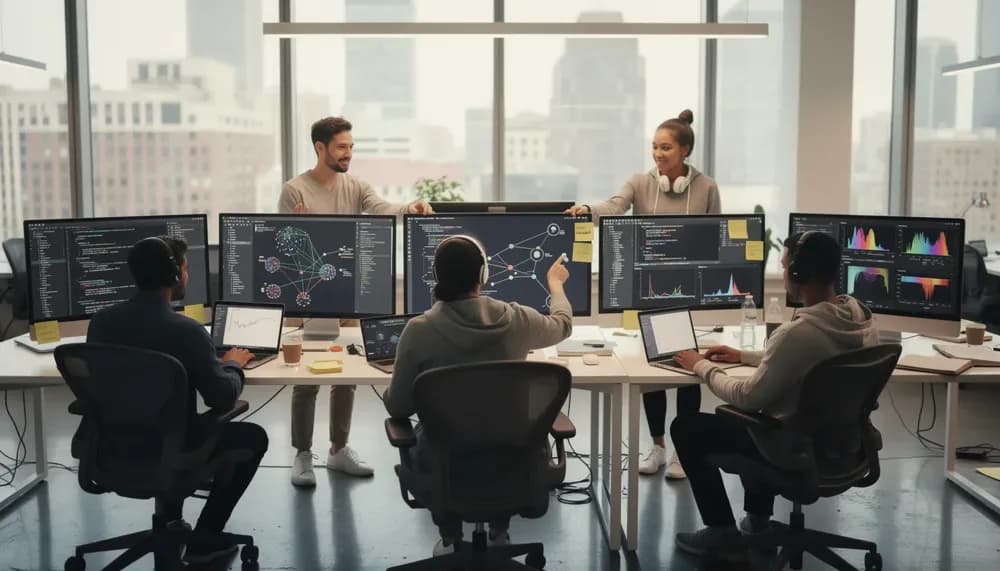
The year 2026 marks a transformative era for generative AI models, as these technologies evolve from impressive demos into ubiquitous tools driving innovation across industries. Just a few years ago, only research labs and tech giants tinkered with advanced AI that could generate text, images, or music. Now, cutting-edge Artificial Intelligence is part of everyday workflows, with generative models writing marketing copy, creating artwork, assisting in software development, and more. From OpenAI’s groundbreaking GPT series to a new wave of open-source models, generative AI is reshaping how we create and work. Businesses, educators, and professionals worldwide are racing to adapt, recognizing that understanding IA and AI models in 2026 is no longer optional it’s essential. (Keywords: Refonte Learning, IA and AI Models in 2026.)
Refonte Learning a global leader in tech education has witnessed this seismic shift firsthand. In response, they’ve updated their programs to include the latest in generative AI, ensuring learners stay ahead of the curve. In this comprehensive guide, we’ll explore what generative AI models are, the major models and breakthroughs defining 2026, key trends driving their adoption, real-world applications, challenges to be mindful of, and how you can ride this wave of innovation. By the end, you’ll see why embracing generative AI is one of the smartest moves you can make for your career or business in 2026.
What Are Generative AI Models?
Generative AI models are a class of artificial intelligence systems designed to create new content rather than just analyze existing data. Unlike traditional discriminative AI (which might, for example, classify an email as spam or not spam), generative models produce novel outputs from human-like text and software code to realistic images, audio, and even video. They learn patterns from vast datasets and then generate original material that follows those patterns. In essence, a generative AI doesn’t just answer questions or make predictions; it crafts new content in response to prompts.
There are several types of generative models that have emerged over the past decade:
Transformer-based Language Models: These are large language models (LLMs) like OpenAI’s GPT-4 and its anticipated successor GPT-5, Google’s BERT and Google Gemini, or Meta’s LLaMA series. They’re built on the transformer architecture, allowing them to process and generate human-like text with remarkable fluency. By 2026, transformer models have scaled to hundreds of billions (even trillions) of parameters, enabling them to write articles, answer questions, hold conversations, and even generate code from natural language descriptions.
Diffusion Models for Images: For image generation, diffusion models have become the state-of-the-art. Systems like Stable Diffusion and OpenAI’s DALL-E 3 start from random noise and iteratively refine it to produce detailed images based on a text prompt upgrad.com. These models can create anything from paintings in particular styles to photorealistic images of imaginary scenes. By 2026, diffusion-based tools are widely used in design, marketing, and entertainment for rapid prototyping of visuals and creative assets.
Generative Adversarial Networks (GANs): GANs were the leading generative approach for images in the late 2010s. A GAN pits two neural networks (a generator and a discriminator) against each other to produce lifelike images, videos, or audio. While diffusion models have largely overtaken GANs for many image tasks due to their stability and quality, GANs are still used in areas like video generation and synthetic data creation. Researchers in 2026 continue to refine GAN techniques for higher resolution video and more coherent long-form content.
Audio and Speech Generators: Generative AI isn’t just text and images. Models like OpenAI’s Jukebox and Google’s MusicLM can produce music and audio in various styles. Other systems generate human-like speech for instance, text-to-speech models that produce voices nearly indistinguishable from a human narrator. In 2026, generative audio models are being used for everything from creating background scores for videos to generating realistic voices for virtual assistants and game characters.
Multimodal Models: A major breakthrough by 2026 is the rise of multimodal generative AI models that handle multiple types of input and output. For example, Google’s Gemini is reported to integrate text and image understanding, enabling it to describe images in text or generate images from descriptions upgrad.com upgrad.com. OpenAI’s GPT-4 already introduced text with image input capability, and we expect newer models to broaden this further (e.g., text-to-video or text+image-to-text). These multimodal systems can take a combination of inputs say a diagram plus a question and produce a coherent answer or creation, making AI even more versatile.
In short, generative AI models are the engines of creativity in the AI world. They rely on advanced deep learning architectures and huge training datasets, but their magic lies in producing something genuinely new. Now that we understand what they are, let’s look at which generative AI models are leading the pack in 2026.
Major Generative AI Models Defining 2026
The generative AI landscape in 2026 features a mix of well-known giants and emerging contenders. Here are some of the major models and model families you should know about:
OpenAI’s GPT Series (GPT-4 and beyond): GPT-4, released in 2023, set a new standard for language generation with its ability to handle complex instructions and even interpret images. In 2026, GPT-4 remains widely used in products and services around the world, from coding assistants to customer support chatbots. Rumors swirl about GPT-5, but even without a confirmed release, OpenAI has continuously improved GPT-4 with plugins, longer context windows, and better fine-tuning options. Many applications leverage GPT-4 via APIs for tasks like content drafting, summarization, and brainstorming. Its conversational variant, ChatGPT, has become a household name, known for helping users with everything from writing emails to explaining difficult concepts upgrad.com upgrad.com.
Google’s Gemini: Expected to be a game-changer, Google’s Gemini is a suite of generative models that combine language and vision processing. By 2026, early versions of Gemini have showcased strong performance in both pure language tasks and tasks requiring understanding of images. It’s integrated deeply into Google’s ecosystem think advanced features in Google Workspace that draft documents and create illustrations, or an Android assistant that can understand visual context. Gemini’s multimodal capability understanding text and images together represents where many see AI headed: more holistic AI that can “see” and “talk”. This makes it valuable for business productivity (e.g., analyzing charts or designs along with text) upgrad.com
Anthropic’s Claude: Anthropic, an AI startup, introduced Claude as a safer, large language model competitor. Claude’s strength is in providing reliable, controlled outputs. Enterprises in 2026 appreciate models like Claude 2 for applications requiring longer documents and compliance-friendly answers. Claude can handle longer context windows than many competitors, making it great for digesting long reports or holding extended conversations without forgetting earlier parts. Its emphasis on safety (reducing biased or toxic outputs) has made it a favorite in professional settings where a rogue AI response could be a liability upgrad.com. Many companies deploy Claude for internal knowledge management and summarizing lengthy texts.
Meta’s LLaMA and Open-Source Models: In 2023, Meta (Facebook) shook up the field by releasing LLaMA models openly to researchers, spurring a wave of innovation in open-source AI. By 2026, Meta’s LLaMA 2 and subsequent versions have become the foundation for countless custom models and community-driven projects. Open-source generative models (like LLaMA, and others such as EleutherAI’s GPT-Neo series or Stability AI’s StableLM) allow organizations to have more control they can be fine-tuned on private data, deployed on-premises for privacy, and modified by the community. This flexibility is hugely popular with companies looking to own their AI solutions rather than rely on third-party APIs upgrad.com upgrad.com. Refonte Learning’s AI Developer program covers these open tools, teaching learners how to leverage and even build on open-source AI a vital skill as industries seek customized AI solutions.
Mistral AI Models: A new entrant by mid-decade, Mistral AI (a European AI startup) has released models that prioritize efficiency. Mistral models are touted for delivering high performance without the enormous size of something like GPT-4 upgrad.com. This means they can run faster and more cheaply, which is appealing for businesses that need cost-effective generative AI or want to deploy AI on devices with limited hardware. By 2026, Mistral’s work (along with others focusing on efficiency, like DeepMind’s Chinchilla paradigm of smaller-but-smarter models) has shown that bigger isn’t always better. These models enable use cases like real-time AI assistants running on smartphones or web browsers, broadening the reach of generative AI beyond cloud-only solutions upgrad.com.
Image Generators (Stable Diffusion, DALL-E, Midjourney): On the visual side, Stable Diffusion remains a cornerstone as an open-source image generator, allowing anyone to create art or realistic images with the right prompt. Its open availability has spurred a community of artists and developers integrating it into design workflows. Midjourney, a proprietary model popular for its stunning art generation, continues to evolve with higher fidelity and more customization options for styles. OpenAI’s DALL-E 3, integrated with ChatGPT, offers easier prompt-based image creation for the average user. In 2026, these image models are widely used in marketing (auto-generating product ads and social media posts), graphic design, gaming (for concept art and textures), and even film pre-production (storyboarding scenes). The quality of AI-generated images is so high that one needs to be careful authenticating what’s real vs. AI-generated has become a topic of discussion in media and ethics.
Specialized Generative Models: Beyond the big categories, there are niche generative models making impact in 2026. For example, AI coding assistants trained on code repositories (like OpenAI Codex, which powers GitHub Copilot, and Amazon’s CodeWhisperer) are now an integral part of software development. These models generate code snippets or even entire functions based on natural language descriptions, significantly speeding up coding tasks. Similarly, domain-specific generators have emerged like chemistry models that suggest new molecular structures for drug discovery, or architectural design models that generate building layouts. Generative AI isn’t one-size-fits-all; it’s a whole toolkit. Depending on the industry, you’ll find tailored AI models creating new content: e.g., fashion brands using AI to generate novel clothing designs, or finance companies using AI to write first drafts of market analysis reports.
As we can see, 2026’s generative AI ecosystem is rich and diverse. Tech giants provide powerful general models, while open-source and startups contribute flexibility and efficiency. This leads to our next focus: the broader trends surrounding generative AI’s rise.
Key Trends Shaping Generative AI in 2026
As generative AI models proliferate, several important trends have emerged by 2026 that are shaping how these models are developed, deployed, and utilized:
Mainstream Adoption Across Industries: Generative AI has gone mainstream, moving from tech demos to core business tools. Surveys indicate that over 80% of organizations believe generative AI will transform their operations, even if many are still figuring out effective deployment. This broad acceptance means generative models are no longer confined to tech companies; banks, hospitals, media companies, and retailers are all exploring ways to leverage AI creativity. For example, e-commerce companies use AI to generate product descriptions and translate them for global markets instantly. In education, generative AI creates personalized lesson plans and tutoring responses. The takeaway: generative AI is seen as a strategic asset almost everywhere.
Explosive Demand for Skills and New Roles: The rise of generative AI has triggered a talent rush. Companies need professionals who understand and can work with these models. Job postings requiring generative AI skills have skyrocketed one analysis showed postings jumped from practically none a few years ago to nearly 10,000 by the middle of the decade. As businesses scramble for expertise, new specialized roles are emerging. The title “AI Engineer” is now common, referring to someone focused on deploying and integrating AI models into products. Similarly, prompt engineering the craft of designing effective prompts/inputs to get the best outputs from AI has become a sought-after skill and even a job title in some companies. Refonte Learning’s own programs (like their Prompt Engineering course and AI Engineering training) were introduced to meet this demand, recognizing that understanding how to talk to and refine AI models is a critical competency in 2026. Even AI consultant roles are growing, as firms seek guidance on AI strategy (a trend already seen in 2025). In short, if you can build, fine-tune, or strategically apply generative AI, you’ll find no shortage of opportunities.
Multimodality and Integration: 2026 is the year AI stopped being single-purposed. The hottest models are those that handle multiple modalities or integrate into broader systems. As mentioned, models like Gemini can process images and text together. We’re also seeing tools where one AI’s output feeds another’s input (sometimes called chained AI prompts). For instance, one generative model might create a draft report, and another model (specialized in grammar or style) immediately revises it all automatically. This trend of chaining models extends the capabilities of AI and demands that professionals learn to orchestrate AI workflows. Additionally, generative AI is being embedded into existing software. Think of office suites where the AI can draft slides from a prompt, or design software where the AI generates a 3D model from a sketch. The line between “AI model” and “software feature” is blurring.
Customization and Fine-Tuning: While large general models are powerful, many organizations in 2026 want AI tailored to their data and their tone or domain. This has led to widespread fine-tuning and custom model training. A hospital might fine-tune a language model on medical texts to better handle healthcare queries. A law firm might train a model on legal documents to draft contracts. The availability of platforms and tools to fine-tune models (often with surprisingly small datasets and at lower cost than training from scratch) is a game changer. Open-source models like LLaMA make this easier since you can start with a strong base model and refine it. This trend also addresses concerns about data privacy companies can keep the model and data in-house. For AI professionals, knowing how to fine-tune a pretrained model on custom data is becoming a standard skill.
Ethics, Control, and Regulation: With great power comes great responsibility. As generative AI content floods the world, 2026 has seen intensified focus on AI ethics and regulation. Issues of bias in model outputs, potential misinformation, and copyright concerns (e.g., AI inadvertently plagiarizing or misusing training data content) have led to new guidelines. There’s movement toward requiring AI-generated content disclosures or watermarks. The EU’s AI Act and other regulatory efforts globally are rolling out, which means companies must be careful about how they deploy generative AI, especially in sensitive areas. There is also an emphasis on explainability even for generative models. For example, if an AI system is generating financial reports, regulators or stakeholders might ask: on what basis are these conclusions drawn? Techniques from explainable AI (like analyzing which inputs influenced a given output) are being applied to generative models. Moreover, some organizations now have review boards or “AI Ethics” officers to oversee responsible AI use. The bottom line: ethical use and compliance are key trends, and those who work with generative AI need to stay informed about best practices and obligations.
Efficiency and Scale: Early large generative models were notorious for their computational cost they required powerful GPUs and lots of time to generate results. By 2026, there’s a strong trend toward making generative AI more efficient. This includes model compression techniques, more efficient model architectures, and the use of specialized AI hardware. The rise of models like Mistral (which aim for smaller size but clever training) reflects this upgrad.com
upgrad.com. Additionally, scalability is crucial: companies want AI systems that can handle millions of requests or generate high-res images quickly. Cloud providers now offer optimized services (like AWS’s Inferentia or Google’s TPU v5) that allow deployment of generative models at scale. As a result, we see generative AI being used in real-time applications and high-traffic environments far more than before. An example is live customer support AI can draft answers on the fly for customer queries on e-commerce sites, even with thousands of users chatting simultaneously.
These trends paint a picture of a maturing generative AI field: one that is widely adopted, creating new opportunities (and challenges), and becoming more integrated, customized, and regulated. Next, let’s dive into how generative AI is concretely impacting various sectors and tasks in 2026.
Real-World Applications of Generative AI in 2026
Generative AI models aren’t just lab toys they’re delivering tangible value across a spectrum of real-world applications in 2026. Here are some of the most impactful use cases:
Content Creation and Marketing: Perhaps the most visible use of generative AI is in content generation. Marketers use AI tools to write blog posts, product descriptions, ad copy, and social media updates. Need 50 variants of a tagline to A/B test? An AI can generate those in seconds. Generative models also produce personalized marketing emails and can even adjust tone/style for different customer segments. Image generators create marketing visuals or edit product photos (e.g., changing backgrounds or colors automatically). The speed and personalization possible here have transformed digital marketing workflows. Small businesses, which may not afford big creative teams, leverage AI to produce professional content at scale.
Software Development Assistance: Generative AI has become a coder’s new best friend. Tools like GitHub Copilot (powered by OpenAI Codex) and others integrated into IDEs can autocomplete entire functions, generate code from comments, and suggest fixes. By 2026, these AI coding assistants have cut down development time significantly for routine coding tasks. They’re especially handy for boilerplate code, learning new frameworks (“write a Python function to connect to AWS S3” and the AI drafts it), or explaining code (“what does this function do?” and the AI comments it for you). While human developers are still very much in charge, AI helps catch errors and explore solutions faster. This augmentation means higher productivity and allows developers to focus more on complex design problems rather than writing repetitive code.
Data Analysis and Business Intelligence: Generative AI is also acting as an analyst. With the ability to interpret and generate text, AI can summarize data reports, generate insights, and answer natural language questions about data. In 2026, many BI tools have a generative AI chatbot interface a manager can ask, “Which region saw the highest sales growth this quarter and why?” and the AI will examine the charts and data to produce a paragraph explanation, even suggesting factors that contributed. This kind of automated analysis lowers the barrier to insight, allowing non-technical users to query data without deep knowledge of SQL or statistics. It’s like having a junior data analyst available 24/7. Some advanced systems can even generate entire dashboard reports or PowerPoint slides from a simple prompt, pulling in the latest data and presenting it with narrative.
Customer Service and Chatbots: By 2026, many customer support interactions are at least initially handled by AI. Conversational AI models (which are essentially generative models fine-tuned for dialogue) have gotten extremely good at understanding customer queries and providing helpful answers. Unlike the clunky chatbots of the past, modern AI assistants can handle multi-turn conversations that feel quite human-like. They can troubleshoot common issues (“Your internet is down? Let’s run through these steps…”), process simple requests (like returns or appointment bookings), and escalate to human agents when needed. Importantly, these AI are now often integrated with backend systems they can not only chat, but also execute actions (like refund an order or update an address) through API calls. Companies benefit by providing instant support and reducing wait times, while customers get solutions faster. Of course, human support teams are still crucial for complex cases, but AI is handling the front-line triage effectively.
Creative Design and Entertainment: Generative models have unlocked new frontiers in creativity. In graphic design, AI tools generate logos, website layouts, and even branding concepts based on a brief. For example, a startup can input its company mission and style preferences and get dozens of logo ideas generated in minutes. In media and entertainment, scriptwriters use AI to help brainstorm plots or character dialogues. Game developers generate textures, character models, or even storylines using AI, cutting down the enormous cost and time typically needed for content creation. Music producers employ AI to come up with melodies or background scores AI might generate a base tune which the artist then tweaks. There are even instances of “AI collaborators” in art and music: human creators working alongside AI to push creative boundaries. In 2026, we’ve seen AI-generated art featured in galleries and AI-assisted writing winning literary prizes (often with the AI as an uncredited co-author). This human-AI collaboration is expanding what’s creatively possible.
Education and Training: The personalization that generative AI offers is revolutionizing education. AI tutors can generate custom explanations, practice problems, and study plans for students. For example, if a student is struggling with a calculus concept, an AI tutor can generate multiple alternative explanations, examples, and even analogies tailored to the student’s interests (like framing a math problem in terms of a sports scenario). Generative AI can also create quizzes and flashcards on the fly, focusing on areas the student hasn’t mastered yet. For language learning, AI chatbots converse with students to practice foreign languages, generating dialogue and correcting mistakes in real time. By 2026, some educational platforms even let students “learn by teaching” the student tries to explain a concept, and the AI generates feedback or asks questions guiding them to fill gaps. This level of interactivity and personalization was hard to achieve at scale without a human tutor for each student, but AI is making it possible for many.
Healthcare and Medicine: While heavily regulated, generative AI is slowly making inroads in healthcare applications too. One area is medical documentation doctors spend a huge chunk of time writing patient notes, discharge summaries, etc. Now AI scribes can generate first drafts of these documents from voice recordings or bullet-point notes, which the physician then reviews and edits. This saves time and ensures more consistent records. Another use is patient interaction: AI chatbots answer basic health questions (“What might cause a headache with these symptoms?”) or follow up with patients post-treatment with advice and checks (always with disclaimers to see a human doctor when needed). There’s also experimental use of generative models in drug discovery, where AI suggests molecular structures for new drugs (essentially “generating” candidate molecules) a process that used to be like searching for a needle in a haystack. While any AI-suggested drug still undergoes a full development and testing pipeline, generative models have expanded the realm of possibilities to explore. Of course, in such a critical field, AI outputs are carefully vetted by professionals, but the productivity boost and idea generation are valuable.
Finance and Law: Professionals in finance and legal sectors are leveraging generative AI for heavy drafting and analytical lifting. In finance, AI can draft earnings summaries, create first-pass financial reports, or even generate commentary on market trends by analyzing data (something that used to require a team of junior analysts). It can also answer client questions in wealth management by generating easy-to-understand explanations of complex financial concepts or portfolio changes. In law, a task like drafting a contract, which might start from a template, can be accelerated by AI the lawyer describes the deal points, and the AI assembles a draft contract, which the lawyer then fine-tunes. For legal research, AI can summarize relevant case law or even simulate opposing arguments to prep a lawyer for court. These applications come with the need for high accuracy and caution a mistake in a contract or financial report is costly so human experts remain in the loop. But generative AI is acting as a powerful assistant, handling the grunt work and giving professionals a head start.
This is just a sampling the applications of generative AI in 2026 are almost as broad as human creativity itself. Every week, new use cases emerge as people ask, “Can AI help me do X?”, and often the answer is yes. However, along with opportunities, there are challenges and considerations when using generative models. Let’s consider those before we conclude.
Challenges and Considerations with Generative AI
Despite the incredible capabilities of generative AI models, it’s important to approach them with a clear understanding of their limitations and the challenges they present:
Quality Control & Accuracy: Generative models can sometimes produce incorrect or nonsensical outputs a phenomenon often called “hallucination” in AI. For instance, a language model might state a factual-sounding but false claim, or an image model might generate a picture with subtle anomalies. In casual use (like storytelling), a made-up detail might be fine or even entertaining. But in high-stakes use cases say generating a legal brief or a news article such errors are unacceptable. By 2026, models have improved, especially with fine-tuning and guardrails, but they are not infallible. Users must implement verification steps: for text, that could mean fact-checking AI-generated content or restricting models to answers only when certain. Some newer systems have a sort of “confidence estimation” or integrate retrieval of real data (like tools that let the AI query a database or the web for up-to-date facts) to improve accuracy. Still, human oversight remains key. Think of generative AI as a very clever assistant it speeds things up, but you as the expert need to review the final output, especially for critical content.
Bias and Ethical Issues: Generative AI models learn from historical data, and as a result they can mirror or even amplify biases present in that data. There have been instances of AI models producing content that is culturally insensitive, gender-biased (e.g., assuming certain jobs for a gender), or otherwise problematic. In 2026, this is a major area of concern. Tech companies put significant effort into “aligning” AI outputs with human values and fairness guidelines. Yet, biases can creep in unexpectedly. For example, an AI image generator might underrepresent certain ethnic groups in response to a prompt about professional settings if its training data was skewed. Ethically, developers and users of generative AI must be proactive: using diverse training data, applying bias mitigation techniques, and monitoring outputs for issues. Many organizations have started conducting AI ethics audits for their generative models. Refonte Learning and other education providers now include modules on Responsible AI, ensuring that students entering this field know how to address these concerns from the get-go.
Intellectual Property and Plagiarism: Generative models learn from existing works billions of words from books and articles, millions of images from across the internet. This raises questions: If an AI generates a painting “in the style of” a certain artist, is it creating something new or effectively remixing the artist’s copyrighted work? If it writes text that happens to closely resemble a section of its training data, is that plagiarism? These are unsettled legal and ethical questions in 2026. Some high-profile lawsuits have emerged around AI image generators and datasets. In practice, companies are trying to mitigate risk by curating training data (excluding certain copyrighted materials), and by implementing filters that prevent models from spitting out large verbatim chunks of training text. As a user, it’s wise to treat AI outputs as you would a human assistant’s draft: you might still need legal usage rights for any final content (especially images or music), and you should ensure originality if that’s required. The law is catching up, but slowly many are watching how courts and regulators define the boundaries of AI-generated content ownership and usage.
Privacy and Security: Generative AI models can inadvertently expose sensitive information. If a model was trained on public code, for example, it might reproduce a snippet containing someone’s API key or password that was in that code. Or a language model fine-tuned on company data could reveal a confidential detail if not properly handled. Moreover, when people use cloud AI services, there’s risk of sensitive prompts being logged. In 2026, we see businesses preferring on-premises or private deployments of generative AI for any sensitive use case (banks and hospitals, for example, might use a version of a model that runs entirely on their own secure servers). It’s crucial to ensure that no personal data is given to an AI model unless you trust how it’s handled. OpenAI and others have introduced features like opting out of data retention for API use, and enterprise versions of AI software promise that “your data stays yours.” Nonetheless, AI governance policies are a must in organizations: deciding what can or cannot be done with AI tools and setting guidelines (e.g., don’t feed the AI a client’s personal file unless it’s an approved system).
Model Misuse and Deepfakes: Generative AI can be used for malicious purposes as well. Deepfake images and videos hyper-realistic AI-generated media can spread misinformation or be used for fraud. By 2026, the technology to create fake videos of people (making them appear to say things they never said) has advanced, raising concerns about trust in digital media. While detection tools are also improving, it’s an arms race between generation and detection. There are also concerns about AI-generated phishing (emails or messages written so convincingly by AI that people are more likely to fall for scams) and even AI-assisted cyberattacks (like code generation being misused to find exploits). The community and policymakers are actively working on solutions: some advocate for mandatory tagging of AI-generated content, and research is ongoing into robust deepfake detection. For the average organization, the focus should be on awareness and education recognizing that “seeing is not always believing” and training employees to be cautious. On the flip side, companies also use the same tech for positive means, like creating digital avatars for customer support or entertainment that are explicitly labeled as AI.
Despite these challenges, the trajectory of generative AI in 2026 remains overwhelmingly positive. The key is being informed and responsible in how we develop and deploy these models. With wise use, the benefits far outweigh the risks.
How to Stay Ahead in the Generative AI Era
Given the rapid advancement and adoption of generative AI models in 2026, both individuals and businesses are asking: How do we keep up? Here are some strategies:
1. Embrace Lifelong Learning (Upskill in AI): The single best way to ride the generative AI wave is to develop your AI skillset. Whether you’re a software developer, a marketer, a manager, or a student, understanding how AI works and how to leverage it will be increasingly critical. This doesn’t mean everyone needs to become a machine learning researcher, but gaining practical skills is key. For instance, learning how to craft effective prompts to get useful outputs (prompt engineering) can enhance your productivity in many knowledge jobs. Understanding the basics of training or fine-tuning a model could enable you to custom-build AI solutions for your domain. There are plenty of resources to learn these skills. Refonte Learning’s own programs such as their Data Science & AI, AI Developer, and AI Engineering courses now include modules on generative AI and how to implement it in real projects. Online platforms also offer specialized courses on topics like building with GPT APIs or creating AI-generated art. The professionals who thrive will be those who see AI as a tool in their toolbox and know how to wield it.
2. Leverage AI in Your Current Workflows: Staying ahead means not just knowing about AI, but actually using it to your advantage. Identify areas in your current work or business that generative AI might improve. Are you spending hours drafting reports or emails? Try using a tool like ChatGPT to generate a first draft upgrad.com. Are you a designer stuck doing tedious image edits? Experiment with image generation or editing AI to handle the grunt work. By integrating AI assistants into daily tasks, you free up time for more strategic or creative thinking the things that AI can’t do on its own. Many forward-thinking companies encourage employees to use AI tools to boost productivity (with appropriate guidelines in place). Becoming the person in your office who is “AI-savvy” can make you more efficient and innovative, which is a career boost in itself.
3. Follow Industry Trends and Communities: Because AI is evolving so fast, it’s important to keep a finger on the pulse. Subscribe to AI news outlets or newsletters that cover breakthroughs in generative models. Follow reputable researchers or AI leaders on social media for insights. Engage with communities (like specialized forums, or groups on LinkedIn) discussing how generative AI is applied in your industry. For instance, if you’re in marketing, look for case studies on AI-generated campaigns; if you’re in programming, join discussions on GitHub about the latest open-source AI libraries. Refonte Learning’s blog itself covers a lot of tech career trends their articles on AI Engineering in 2026 and Data Science in 2026 highlight emerging skills and roles, which can guide you on where to focus. By staying informed, you can anticipate changes perhaps you’ll spot that a new model could disrupt your business, or that a new AI tool could give you an edge over competitors. The people who adapt first often reap the biggest rewards.
4. Develop Soft Skills and Domain Knowledge: One perhaps counterintuitive piece of advice: as AI handles more technical grunt work, human skills become even more important. Creativity, critical thinking, and domain expertise are what allow you to apply AI effectively. For example, two product designers both have access to the same AI image generator the one with a better creative vision will use it to produce a truly novel design. Or consider data analysis: an AI can spit out a trend analysis, but a human with domain knowledge is needed to ask the right questions and interpret what that trend means for the business. In consulting fields, even if AI drafts a strategy document, consultants with great communication and empathy will stand out in how they present and implement those insights with clients. Moreover, AI cannot (yet) replace leadership, teamwork, and empathy. So while you integrate AI into your skillset, continue honing your ability to collaborate, to lead projects, and to think strategically. The future workplace will highly value those who pair AI proficiency with strong soft skills these are the new “power couples” of competencies.
5. Innovate and Experiment: Generative AI opens possibilities for new products, services, and artistic expressions. Don’t be afraid to experiment. If you’re an entrepreneur or developer, consider how generative models might enable a startup idea for example, a personalized storybook service for kids that uses AI to generate unique tales based on each child’s name and interests. If you’re in a big company, perhaps propose an internal tool that uses AI to solve a nagging problem (like an internal chatbot that answers employees’ HR questions, saving time). 2026 is a year where many new startups and initiatives are launching around generative AI from AI-assisted game studios to personalized education platforms. Innovation is happening at the intersection of AI capability and domain need. You, with your specific domain knowledge, might see an application of generative AI that the AI researchers never thought of. Chasing these ideas can be highly rewarding. And even if some experiments fail, you’ll learn from them and stay on the cutting edge.
In summary, staying ahead in the generative AI era means being proactive: learning continuously, using the tools available, keeping informed, balancing AI skills with human skills, and having the courage to try new things. The opportunities are vast for those prepared to seize them.
Conclusion
Generative AI models in 2026 stand at the forefront of technological innovation, transforming the way we work, create, and solve problems. What was recently science fiction a computer writing an article or painting a portrait is now an everyday reality. These models, from GPT-4 and Claude to Stable Diffusion and beyond, have become powerful creative collaborators in virtually every field. Industries are being reinvented as AI takes on tasks once thought uniquely human, augmenting rather than replacing our capabilities. It’s an exciting time: opportunities abound for businesses to innovate with AI, and for professionals to build fulfilling careers riding this wave.
However, success in this new era doesn’t come by osmosis. It requires intentional adaptation. The organizations that thrive will be those that thoughtfully integrate generative AI into their operations enhancing products, optimizing workflows, and training their people to leverage AI effectively. Likewise, individuals who invest in learning about AI and staying agile in their skillsets will find themselves in high demand. As highlighted, education providers like Refonte Learning have a crucial role here, offering up-to-date courses on AI and AI models to help you gain practical experience with generative technologies.
Looking ahead, generative AI will continue to advance models will get better, faster, more integrated. We can expect even more natural interactions with AI (imagine voice assistants that truly understand context, or AI that can generate entire virtual worlds for us to explore). The line between human and AI creativity may further blur, raising new questions even as it creates new solutions. In this journey, a balanced approach is key: enthusiasm for innovation coupled with a commitment to ethics and responsibility.
In conclusion, 2026 is a year where generative AI has moved from the fringes to center stage. It’s empowering us to do more, to dream bigger, and to tackle challenges in ways we couldn’t before. Whether you’re an AI enthusiast or a concerned skeptic, one thing is clear generative AI is here to stay, and it will shape the future of work and creativity. Embrace it, learn about it, and use it wisely. By doing so, you won’t just be witnessing the future you’ll be actively creating it, hand-in-hand with some of the most advanced AI models the world has ever seen.