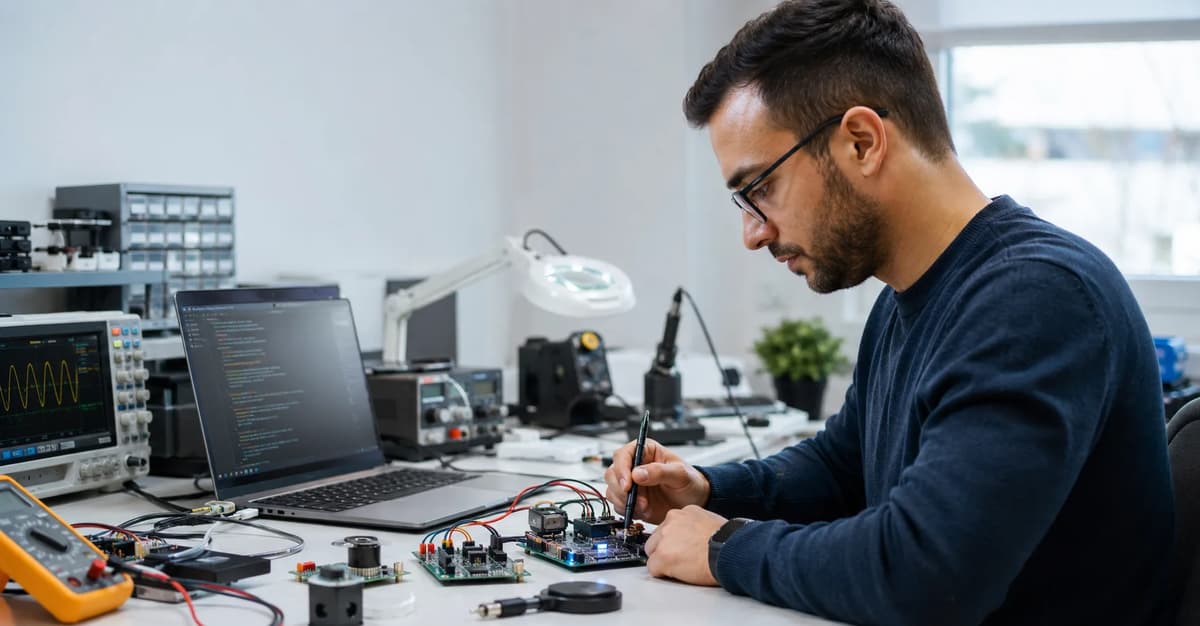
If you want the blunt answer first: yes, embedded systems engineer is still worth learning in 2026, and in several ways it is more worth learning now than a lot of louder software careers. The reason is not hype. It is scarcity. Embedded teams are hiring into products that cannot be faked by a demo, cannot be fixed entirely in the cloud, and cannot tolerate shallow engineering when the device is in a vehicle, on a factory floor, or attached to a patient. At the same time, the U.S. pipeline into electrical-engineering-heavy work has not kept up. ITIF’s analysis of U.S. degree data found EE degrees growing much more slowly than other majors from 1997 to 2020, and BLS still projects about 17,500 openings a year for electrical and electronics engineers through 2034. That is the setup behind the pay: real hardware demand, real reliability requirements, and too few people who can operate comfortably at the hardware-software boundary.
It also helps that embedded work is being pulled forward by several industries at once rather than one fashion cycle. The IEA says electric car sales rose more than 20% year over year in 2025 to 21 million units, with one in four cars sold globally now electric. Grand View Research pegs the industrial IoT market at $483.2 billion in 2024 and projects it to grow to $1.69 trillion by 2030. The Business Research Company says the connected medical device market will grow from $56.74 billion in 2025 to $65.78 billion in 2026. Each of those sectors runs on devices that need board bring-up, deterministic behavior, secure updates, sensor integration, networked telemetry, and increasingly on-device inference. In other words, they need embedded engineers, not just generic application developers.
The salary data reflects that. As of July 2026, ZipRecruiter puts the average U.S. salary at $122,008 for Embedded Firmware Engineer, $137,274 for Embedded Systems Engineer, and $153,383 for Embedded Software Engineer. Glassdoor’s current salary pages run even higher, at about $171,023 for Embedded Firmware Engineer, $160,655 for Embedded Systems Engineer, and $173,379 for Embedded Software Engineer. The important point is not just that all three roles pay well. It is that their bands overlap heavily, which is why newcomers get confused by job titles and why readers asking whether “embedded systems engineer” is a good career in 2026 often find apparently contradictory advice. The titles are close; the scopes are not.
That title confusion is exactly why I use a clearer model when I coach juniors and when I hire: the Embedded Systems Stack. It is a four-layer framework that explains where firmware ends, where systems thinking starts, where embedded software earns its premium, and where safety-critical or embedded-AI specialization starts to separate the market. If you understand that stack, you understand why an entry-level job posting may emphasize registers and bootloaders, while another “embedded” posting asks for Linux networking, OTA, or CAN anomaly detection on edge devices. They are related jobs. They are not the same job.
Why embedded engineering pays surprisingly well for a field almost nobody talks about
The pay is not a mystery once you accept how expensive failure is. In web software, a bad release is embarrassing. In embedded products, a bad release can ground a device fleet, trigger a recall, break field reliability, or create a safety event. Automotive teams work against ISO 26262, which ISO describes as the functional-safety standard for road-vehicle electrical and electronic systems. Medical-device teams work under IEC 62304, which the IEC says defines lifecycle requirements for medical-device software. If your code sits inside a product where malfunction can hurt someone, the company is not paying only for your code. It is paying for your judgment, your verification discipline, your documentation, and your ability to keep hardware reality aligned with software intent.
Demand is broad, not niche. I see three durable engines underneath the current embedded systems engineer career market. First is automotive electrification and software-defined vehicles: the IEA’s 2026 EV outlook shows global EV sales continuing to climb, and Grand View’s automotive embedded software statistics show that embedded software in automotive alone was a $2.517 billion segment in 2024 with an 11.3% CAGR through 2030. Second is industrial IoT: Grand View’s IIoT market numbers are simply too large to ignore, and the growth is being tied directly to predictive maintenance, automation, and connected industrial systems. Third is connected healthcare: the connected medical device market is not small anymore, and embedded firmware in that domain now sits next to battery life, wireless transport, compliance, and cybersecurity rather than merely “making the sensor work.”
Supply is tighter than mainstream tech discourse admits. ITIF’s U.S. analysis found that EE degrees made up just 1% of all degrees in 2020, and that EE degree growth lagged badly behind other majors from 1997 to 2020. Among U.S. citizens and permanent residents, the share of bachelor’s EE degrees fell from 1.0% to 0.7% over that period. Separate industry and association reporting has been sounding the same alarm: the Semiconductor Industry Association highlighted NSF data showing full-time graduate enrollment in electrical engineering and computer science falling from more than 101,000 in 2016 to 92,603 in 2018, while VDE warned in 2026 about declining first-semester enrollment and retirement-driven shortfalls in electrical engineering. Even allowing for differences between the U.S. and Europe, the broad pattern is the same: the feeder disciplines are not scaling the way embedded demand is scaling.
That is why embedded pays better than its visibility would suggest. You rarely see “top 10 coolest careers” lists full of firmware and systems roles, but employers know what replacement costs look like. Quest Global argued in 2026 that external hiring in complex engineering domains can cost 1.5 to 2 times annual salary once recruitment fees, relocation, and onboarding drag are included. When a strong embedded engineer leaves, the company loses not only coding capacity but also accumulated product intuition: which clock tree is brittle, which watchdog behavior is misunderstood, which hardware errata matter, which field logs are lying, which CAN messages are genuinely safety-significant. That knowledge is expensive to rebuild.
AI has not made this field less valuable; it has changed what “good” looks like. BCG wrote in 2026 that 50% to 55% of U.S. jobs will be reshaped by AI over the next two to three years, often without disappearing. Embedded roles are a textbook example. Current job listings already ask for AI-assisted workflows while still demanding hardware debugging, bus-protocol fluency, RTOS timing, and safety validation. Outrider explicitly lists willingness to adopt AI-assisted development workflows in a safety-significant embedded role, and Hatch says AI-assisted development is core to how its embedded systems team works. That is what I expect to continue: better tooling, faster iteration, higher expectations, and a premium for engineers who can use AI without surrendering systems judgment.
The Embedded Systems Stack
I use the Embedded Systems Stack to explain the field because most readers are not actually confused about whether embedded engineering matters. They are confused about role boundaries. A firmware engineer, an embedded systems engineer, and an embedded software engineer can all touch C or C++, all work with hardware, all use oscilloscopes at some point, and all appear in the same job search. But they do different work, and their pay bands overlap because scope, not title prestige, drives compensation.
Layer | Role | Core ownership | Common tools and standards | Salary anchor |
Layer 1 | Firmware Engineer | Bootloaders, BSPs, drivers, interrupts, peripheral bring-up, low-level power and timing behavior | C/C++, datasheets, JTAG/SWD, oscilloscope, logic analyzer, SPI/I2C/UART/CAN, bare metal or RTOS | ZipRecruiter average $122,008; Glassdoor average about $171,023 |
Layer 2 | Embedded Systems Engineer | Hardware-software co-design, sensor/peripheral integration, board and platform tradeoffs, system validation | Schematics, DMM/scope, RTOS, HIL/SIL, CAN/Ethernet, requirements traceability, bring-up support | ZipRecruiter average $137,274; Glassdoor average about $160,655 |
Layer 3 | Embedded Software Engineer | Application layer, Linux/RTOS services, connectivity, OTA, device-cloud integration, fleet behavior | C/C++, Python, Linux, networking stacks, TLS, OTA/update infrastructure, observability, CI/CD | ZipRecruiter average $153,383; Glassdoor average about $173,379 |
Layer 4 | Safety-Critical or Embedded AI Systems Engineer | Functional safety, regulated V&V, HIL, diagnostics, edge inference, memory/performance tradeoffs on constrained devices | ISO 26262, DO-178C, IEC 62304, QNX/RTOS, traceability, ONNX/TFLite/TVM/TensorRT, quantization, profiling | Senior specialty postings currently span roughly $140,000 to $272,000+ base, with some edge-AI roles reaching far higher |
The salary anchors above come from current ZipRecruiter and Glassdoor role pages for the three core layers, plus 2026 specialty postings from Sonatus, Archer, Anduril, ALTEN, and similar employers for the premium-specialization layer. The first lesson is that the ladder is not a neat staircase. Embedded software can outpay “embedded systems engineer” in one market slice because it adds Linux, connectivity, fleet operations, or cloud/device integration. Firmware can out-earn a broader title when the product is hard enough or the reliability bar is punishing enough. The second lesson is that Layer 4 is where salary volatility and upside both increase, because the work becomes domain-constrained and failure-sensitive.
Layer 1: Firmware Engineer. This is the most hardware-adjacent layer. The output is the code that lets silicon, peripherals, and power rails behave predictably enough for the rest of the stack to exist. Current firmware postings still center on new hardware bring-up, bootloaders, board-support packages, peripheral drivers, communication buses, telemetry paths, and optimization for memory, timing, and power. VATN Systems describes the role almost exactly the way I would: bring up new hardware, implement bootloaders and drivers, integrate sensors and actuators, debug over UART/SPI/I2C/CAN/Ethernet, and use HIL plus field debugging to make firmware reliable in hostile conditions. This is the layer where reading the datasheet is not a ceremony. It is the job.
What gets you hired at Layer 1. Strong C is still table stakes. Not “I did a C course.” I mean being comfortable with pointers, memory layout, concurrency hazards, interrupt behavior, and the difference between working code and deterministic code. Employers consistently ask for board bring-up, low-level debugging with JTAG, oscilloscopes, and logic analyzers, plus fluency in serial buses and at least one RTOS or bare-metal environment. If I am hiring into Layer 1, I care less about whether you can speak beautifully about software architecture and more about whether you can explain why an SPI line is glitching, why an ISR starves a task, or why a watchdog reset only appears at temperature.
Layer 2: Embedded Systems Engineer. This layer is broader and, in practice, more cross-functional. The embedded systems engineer owns the seam between hardware, firmware, and product behavior. Catapult’s principal embedded systems role gives a strong current example: Linux user-space stack, motor-control peripherals, OTA, architecture choices, schematic reviews before a board respin, and translating hardware learnings back into firmware and software. CARIAD’s infotainment ECU systems role similarly spans hardware, SoC, board, software, vehicle networks, performance modeling, integration planning, and supplier coordination. This is why I call Layer 2 the “tradeoff layer.” Firmware can make a peripheral function; Layer 2 decides whether the board, memory, power envelope, thermal profile, and system interfaces make sense together.
How Layer 2 differs from robotics. People often use “embedded systems engineer” when they actually mean “I want to work on robots.” Sometimes that is true, but not always. Embedded systems work is the hardware-software layer inside the device; robotics is usually broader, spanning mechanical systems, controls, autonomy, perception, and often system-level behavior across the machine. If your ambition is the full electromechanical stack, it is worth reading more about the robotics engineer career path. If your ambition is mastering the on-device hardware-software interface across many product types, Layer 2 is your lane.
What gets you promoted into Layer 2. The on-ramp usually comes from very good Layer 1 work plus one new habit: you stop treating requirements as given and start making tradeoffs explicit. The moment a firmware engineer can review a schematic, challenge a sensor choice, reason about power and thermal implications, participate in HIL strategy, and explain how a board decision will hit memory budget or update reliability, that engineer is already doing Layer 2 work. In the teams I have seen move fastest, the key trait was not genius. It was curiosity across boundaries.
Layer 3: Embedded Software Engineer. This is where compensation often surprises people. The role usually sits above the lowest-level firmware but still inside the device. It tends to own RTOS or Linux application services, networking, OTA, telemetry, security, device management, and sometimes the edge-to-cloud handshake. Alarm.com’s staff embedded software role is explicit about “defining the future of the Internet of Things” by creating and integrating devices that connect with a robust cloud using next-generation communication stacks. Verkada’s embedded Linux connectivity role blends device software with networking and cloud backend services. Bevi is hiring embedded engineers to work on hardware products backed by a cloud-based backend. This blend of embedded fundamentals plus broader software-system responsibilities is one reason Layer 3 can out-earn Layer 2 in salary aggregators.
Why Layer 3 often has the highest “core” average pay. Good Layer 3 engineers can speak to both the device and the distributed system around it. They still understand constrained hardware, but they also understand networking, security, update infrastructure, fleet telemetry, Linux services, interoperability, and sometimes mobile or backend interfaces. That is a narrower labor pool than many people think. If your interest lives mostly above the device, in fleet orchestration, containerized gateways, and the cloud-native layer above physical edge hardware, you are moving beyond this article’s scope and into how Kubernetes at the edge supports IoT and 5G applications. But it is exactly the overlap between low-level and product-software thinking that gives Layer 3 its premium.
Layer 4: Safety-Critical or Embedded AI Systems Engineer. This is the premium specialization layer, and it is where the field’s ceiling rises fastest. Here, your work is constrained not only by hardware but by standards, certification evidence, validation infrastructure, risk controls, and domain-specific failure consequences. Archer’s current embedded software role works to DO-178C, SIL/HIL validation, fault detection, and low-level protocol testing. ALTEN’s medical-device firmware role requires IEC 62304, FDA design controls, formal V&V, FMEA, and DHF documentation. Sonatus’s staff edge-AI role demands model training, deployment to resource-constrained edge devices, quantization, pruning, CAN- and sensor-data anomaly detection, and production-grade in-vehicle AI. These are not simple extensions of Layer 3. They are multiplicative skills.
How to think about Layer 4 specialization. My rule of thumb is that the real pay ceiling in embedded engineering comes from combining one of two things with strong core embedded skills: regulated safety, or edge intelligence. If you can do both, employers notice. If your specific target is spacecraft or flight software in the space sector, that becomes its own niche and deserves a separate read on the spacecraft software engineer career path, skills, and salary. For general cross-industry careers, though, Layer 4 is where embedded stops being “device coding” and becomes “high-consequence systems engineering.”
What an embedded engineer actually does on a normal week, by layer
A Layer 1 week is tactile. You are close to the board and close to the fault. A real week includes new hardware bring-up, writing or fixing drivers, staring at traces, instrumenting code paths, tuning interrupt behavior, validating timing, tracking memory regressions, and trying to reproduce a field issue that only appears under a weird combination of voltage sag and bus traffic. Current postings still mention the tools I expect to see: JTAG, SWD, scopes, logic analyzers, real-time scheduling, and bus protocols. If the product is early, you may spend half your week just turning unknown board behavior into known board behavior. If the product is mature, you may spend it hardening a bootloader or reducing power draw by milliamps that matter.
The Layer 1 hiring pattern is straightforward. Employers want evidence that you can make hardware behave and debug it when it does not. That evidence can come from internships, research labs, capstones, open-source contributions to an RTOS or board-support package, or a personal project that is serious enough to show timing awareness, bus fluency, and disciplined debugging. What usually does not work is a portfolio full of only simulated code. The boards do not care how polished your README is. They care whether you understand electrical reality.
A Layer 2 week is about alignment. You are in design reviews with EEs, in test discussions with validation teams, in architecture conversations about interface allocations, and in the lab when a “software bug” turns out to be a board constraint in disguise. At Catapult, this shows up as architectural decisions, motor-control tuning, schematic reviews before respins, OTA robustness work, and board bring-up support in the same role. At CARIAD, it shows up as requirements gathering, performance estimation, integration planning, supplier coordination, and validation across hardware, SoC, board, and vehicle networks. This is why Layer 2 engineers are valuable: they reduce cross-functional friction before it becomes program slip.
The promotion signal from Layer 1 to Layer 2 is systems judgment. The engineers I have watched get pulled into Layer 2 first are the ones who stop saying “that is hardware’s problem” or “that is software’s problem.” They can read a schematic well enough to ask the right question, understand timing and power tradeoffs well enough to challenge an assumption, and think about system validation early enough to save time later. HIL and SIL awareness becomes more important here because Layer 2 owns not just code quality but behavior under integrated conditions. Torc’s systems-test automation role is a good example of how validation infrastructure itself becomes part of the engineering surface area.
A Layer 3 week is broader and more software-operational. You might still touch peripherals, but you are more likely to spend time on service design, messaging paths, OTA/update behavior, TLS or credential handling, Linux image work, fleet observability, and failure analysis from logs rather than raw waveforms alone. Alarm.com, Verkada, Canonical, Axon, and Bevi all point in the same direction: Linux at the edge, networking, cloud integration, device software stacks, and the operational reality of shipping and maintaining fleets of connected devices. This is where embedded engineering starts to look a little more like software engineering without becoming generic software engineering.
Layer 3 hiring is where many embedded candidates hit a wall. They know microcontrollers, but not Linux. Or they know RTOS tasks, but not OTA failure modes, cellular connectivity, TLS, DNS, DHCP, or cross-device diagnostics. That gap is why “embedded software engineer vs firmware engineer” is not a trivial wording difference. Firmware is often about enabling the hardware. Embedded software is often about making the product behave as a product at scale. That additional scope is exactly what the salary data rewards.
A Layer 4 week looks different because traceability and evidence become part of the job. In safety-critical work, you are not done when the code works. You are done when the requirement trace exists, the test evidence exists, the risk link exists, the failure mode is understood, and the process stands up to audit or certification review. Archer’s role centers on DO-178C verification, traceability, fault-injection-style testing, and hardware-in-the-loop. ALTEN’s medical-device posting adds IEC 62304, formal verification, FMEA ties, 510(k) timelines, and design-history-file collaboration. The engineering surface area is wider because regulated process becomes engineering work, not paperwork after engineering work.
Embedded AI adds another kind of discipline. The Sonatus edge-AI role is a clean example of what modern Layer 4 looks like: log analysis, CAN and sensor anomaly detection, on-device filtering strategy, ARM edge deployment, and quantization, pruning, distillation, and memory optimization under RAM and flash limits. SimpliSafe and Ambiq postings show the same trend from another angle: quantized inference, DSP/NPU toolchains, hand-tuned kernels, and embedded-AI runtimes. This is not “just ML on a device.” It is constrained-systems engineering with a model inside it. The on-ramp from Layer 3 is usually strong C/C++ or Linux plus one domain of AI deployment competence, not a complete reinvention of yourself as a pure ML researcher.
Why this field’s talent shortage is structural, not cyclical
The demand side is multi-engine. Automotive demand is not going away because modern vehicles are adding more software-defined functionality, more sensing, more diagnostics, more OTA expectations, and more electrification complexity. The IEA says electric car sales hit 21 million in 2025, while Grand View’s automotive embedded software data shows strong growth through 2030. Industrial demand is not soft either: Grand View’s IIoT market forecast is enormous, and its cited drivers are predictive maintenance, automation, supply-chain efficiency, and AI/ML integration in industrial systems. Healthcare demand is also moving toward more connected and software-heavy devices, with market-research firms projecting high growth in connected medical devices. If one sector cools, another is usually still pulling. That is what makes the embedded systems engineer career more resilient than many people assume.
The supply side is not scaling cleanly. ITIF’s report is still one of the clearest summaries: EE degree growth has lagged other fields badly, and the share of EE degrees among all degrees has declined. The Semiconductor Industry Association also flagged shrinking EECS graduate enrollment from its 2016 high. BLS projects 17,500 openings a year for electrical and electronics engineers through 2034, with many openings driven by retirements and occupational exits rather than net-new job growth alone. That matters because embedded work does not recruit purely from computer science the way a lot of cloud software work does. It leans more heavily on electrical engineering, computer engineering, and hardware-fluent software profiles, which are scarcer.
The field also has a training-friction problem. It is simply harder to get industry-ready in embedded than in many software niches. Junior engineers need access to hardware, labs, test equipment, datasheets, bus analyzers, board files, integration setups, and often domain-specific validation infrastructure. Safety-critical paths add standards literacy and documentation discipline. Embedded-AI paths add inference engines, optimization toolchains, and profiling under constrained hardware. That training curve makes the market less visible to casual career switchers, which in turn keeps supply tighter. Current job postings reinforce this repeatedly by asking for practical experience with lab equipment, protocols, verification environments, and hardware/software integration rather than only algorithmic interviews.
This is also why the “AI will automate embedded away” argument misses the point. Much of the field’s value sits in integration, verification, and physical accountability. You can use AI to accelerate driver scaffolding, test generation, log clustering, and documentation drafting. You cannot use it to make a board magically behave, produce certification evidence by wishful thinking, or eliminate the need for traceability in a regulated product. BCG’s broader labor analysis says AI will reshape more jobs than it replaces, and embedded postings now explicitly ask candidates to use AI-assisted workflows rather than pretend they do not exist. That is a classic sign of durable demand: the tools are changing, but the field-specific judgment is staying scarce.
Put differently: the shortage is structural because both sides of the equation persist. Demand is spread across automotive, industrial, medical, defense, and consumer-device modernization. Supply depends on disciplines that are comparatively smaller and slower-growing. And the work itself has a high training burden. That is not the profile of a cyclical fad. It is the profile of a career vertical that remains under-discussed because it is literally embedded inside the products people notice more than the engineers who ship them.
How much embedded engineers earn in 2026, and how to move up the stack
The current salary picture is strong across the board. ZipRecruiter’s July 2026 pages put the average U.S. embedded firmware engineer salary at $122,008, with a 25th–75th percentile range of $103,000 to $141,000 and 90th-percentile pay at $155,000. For embedded systems engineers, ZipRecruiter shows an average of $137,274, a 25th–75th percentile band of $111,500 to $163,500, and top earners at $181,500. For embedded software engineers, the figure rises to $153,383, with the middle range between $131,500 and $173,000. That is the clearest quantitative support for why Layer 3 often earns a premium over the other two core layers.
Glassdoor cross-checks the same story, but higher. Current Glassdoor estimates run roughly $171,023 for embedded firmware engineer, $160,655 for embedded systems engineer, and $173,379 for embedded software engineer. The totals are higher than ZipRecruiter’s posting-based pages, but the pattern remains the same: overlap, not hierarchy, and a slight embedded-software premium on average. This matters when evaluating an embedded systems engineer salary because many candidates still assume firmware must always pay least and systems must always pay more. In practice, scope and market slice matter more than job-title semantics.
Posting-weighted views show how quickly the market gets richer with experience. Recruiting from Scratch’s 2026 analysis of 218 embedded systems engineer postings found a median salary of $165,000, with the 25th percentile at $140,000 and the 75th percentile at $192,000. I like this number because it counters a common mistake: averaging everything together can hide how much upside there is once a candidate can own harder systems, not just contribute to them. If you are asking whether embedded engineering is a good career in 2026, this is the right way to think about it. The entry is challenging, but the middle of the market is already strong and the upper-middle becomes very strong once ownership and specialization show up.
Safety-critical specialization lifts the ceiling. Archer’s current DO-178C-oriented embedded software role is targeting $140,000 to $170,000 base. Anduril’s senior firmware engineer role focused on RTOS, board bring-up, and hardware integration lists $191,000 to $253,000 base. Outrider’s safety-significant embedded sensors role lists $120,000 to $135,000, while its higher-scope principal safety-software role advertises $165,000 to $190,000. The point is not that every safety role pays the same. It is that pay rises sharply when the company is paying for safety evidence, real-world validation, and the cost of getting it wrong.
Embedded AI specialization can move the ceiling even faster. Sonatus’s Staff AI Engineer, Edge AI role lists $197,500 to $272,000 base and asks for production-grade edge deployment, quantization, pruning, distillation, ARM constraints, and CAN/log anomaly detection in vehicles. Figure’s Helix AI engineer listing for embedded Android systems shows a huge $150,000 to $400,000 range, reflecting just how wide compensation can get when embedded, edge compute, and applied AI meet in a high-intensity product environment. I would not tell a junior to chase salaries blindly into edge AI. I would tell them to notice where the premium comes from: scarce combinations of skills.
Medical-device specialization pays less explosively at the mid-level, but it pays with resilience. ALTEN’s senior firmware engineer role in medical devices lists $125,000 to $135,000 and emphasizes IEC 62304, FDA design controls, V&V, FMEA, BLE, and low-power embedded design. Another current medical-oriented software design controls role lists $170,000 to $220,000 for IEC 62304, ISO 14971, and post-market management expertise. What this tells me is that medical pay is not always the flashiest at every level, but engineers with firm compliance, design-control, and traceability experience become difficult to replace. That usually supports durable mid-career compensation.
So how do you move up the stack realistically? My advice is not to chase Layer 4 too early. Build leverage in order. First, become excellent at constrained debugging and low-level ownership. That is Layer 1 competence. Second, learn to read schematics, understand power and integration tradeoffs, and contribute to requirements and validation. That is the Layer 2 jump. Third, add Linux, networking, OTA, security, observability, and product-software thinking. That is Layer 3 leverage. Only then does Layer 4 become additive rather than decorative. The fastest-moving engineers I have seen into safety-critical and embedded-AI work all had one thing in common: they were already strong embedded engineers before they specialized.
If you are optimizing for career durability, not just salary, the best move is breadth over buzzwords. Learn the debugging tools. Learn the buses. Learn one RTOS well. Learn Linux if you want higher-level embedded software roles. Learn test strategy and traceability if you want safety-critical work. Learn model deployment, quantization, and profiling only after you understand device constraints. The market does not reward shallow checklists. It rewards engineers who can close the loop from requirement to shipped, observable behavior on real hardware. That is why embedded systems engineer remains such a strong career choice in 2026, and why it is still under-supplied.
FAQ
Is embedded systems engineering a good career in 2026? Yes. The combination of strong salary data, durable market demand, and constrained talent supply makes it one of the sturdier technical careers available right now. ZipRecruiter’s average pay is already well into six figures for the core embedded titles, and the underlying demand is being pushed by EV growth, industrial IoT expansion, and connected medical devices rather than by a single trendy segment.
Do you need an electrical engineering degree to become an embedded engineer? No, but you do need electrical-engineering fluency whether you get it through a degree or through disciplined practice. BLS says electrical and electronics engineers typically need at least a bachelor’s degree, but embedded employers regularly list EE, computer engineering, computer science, or equivalent experience. In practice, firmware-heavy roles lean harder toward EE/CE backgrounds, while embedded software roles are more open to CS backgrounds if the candidate has real hardware exposure.
What is the difference between firmware engineer and embedded software engineer? Firmware usually lives closer to the hardware: bring-up, drivers, bootloaders, interrupts, BSPs, and tight timing or power work. Embedded software usually sits higher in the device stack and owns RTOS or Linux application logic, connectivity, OTA, networking, and product behavior across fleets or services. Current job listings from VATN, Alarm.com, Verkada, and Bevi line up with that distinction, and so does the salary data, where embedded software currently sits above firmware on average.
Is embedded engineering at risk from AI automation? Less than many mainstream software tracks, and mainly because so much of the work is tied to physical devices, test evidence, constrained execution, safety standards, and cross-functional debugging. BCG’s 2026 analysis argues AI will reshape more jobs than it replaces, and embedded postings now explicitly ask engineers to use AI-assisted development while still demanding deep hardware/software judgment. That is usually a sign of augmentation, not replacement.
How long does it take to become an embedded systems engineer? For a true entry-level Layer 1 role, a focused learner can become interviewable in roughly 9 to 18 months if they build around C, microcontrollers, one RTOS or bare-metal environment, common buses, and real debugging on hardware. Reaching strong Layer 2 or Layer 3 ownership usually takes a few years of shipping and debugging real products. Layer 4 safety-critical or embedded-AI work is typically a mid-career specialization because it assumes embedded fundamentals first. That timeline is an inference from how current roles are staffed, especially the years-of-experience asks in higher-end postings.
Which industry pays embedded engineers the most? There is no single universal answer, but the highest ceilings tend to appear where embedded skills combine with either safety-critical constraints or edge-AI specialization. Recent postings in defense/autonomy and vehicle edge AI show base ranges above $190,000 and into the $270,000-plus zone, while mainstream regulated medical roles often sit lower at the mid-level but remain very stable. If you want maximum upside, aim for Layer 4 in automotive autonomy, defense/autonomy, or edge AI. If you want a blend of compensation and resilience, medical devices is still very attractive.
Why does embedded engineering pay so well relative to how rarely people talk about it? Because the market is paying for scarcity and consequence, not for visibility. ITIF shows EE degrees have not kept up with other majors, BLS projects steady openings, and the work sits inside products where failure can trigger downtime, recall, certification pain, or safety risk. In other words, it is a field with real demand and expensive mistakes. Markets usually pay for that, even if career-content influencers do not.
What should you learn first if you want to become an embedded systems engineer? Start with C, digital fundamentals, microcontroller architecture, UART/SPI/I2C, interrupts, memory layout, and basic debugging with a scope or logic analyzer. Then add one RTOS, structured testing, and a project that talks to real sensors or actuators. After that, decide whether your next move is systems breadth, Linux/connectivity, or safety-critical validation. That sequencing matches what current Layer 1 through Layer 3 postings actually ask for and gives you the strongest base for long-term growth.