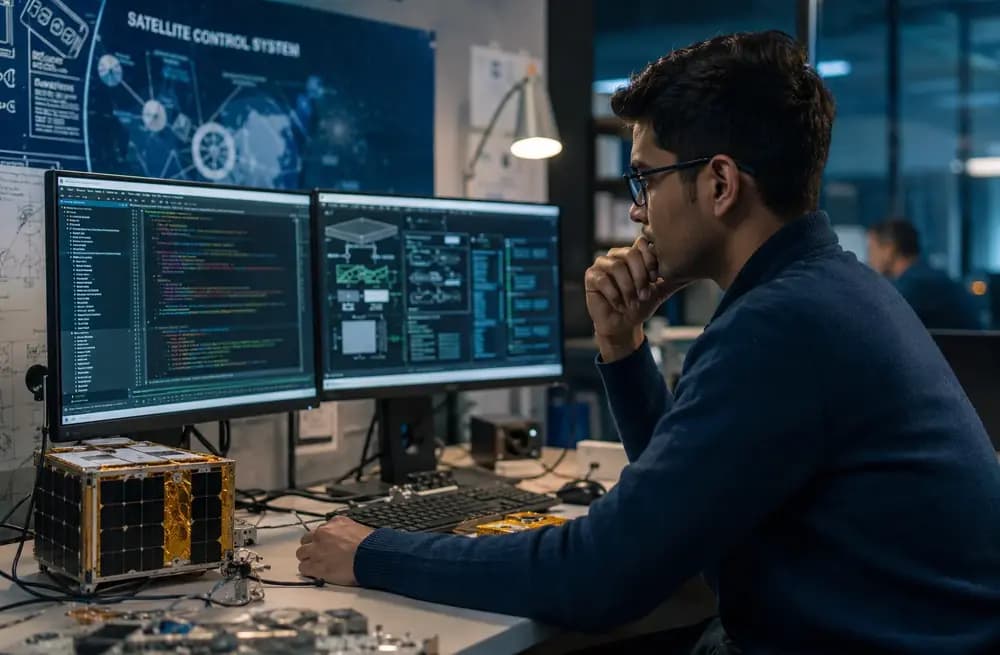
If you are seriously exploring a future in space technology, Spacecraft Software Engineer in 2026 is one of the most compelling career directions on the market. It sits at the center of the modern space stack: the code that helps spacecraft sense, decide, communicate, protect themselves, and keep operating under extreme constraints. That matters because missions are becoming more software-defined, more autonomous, more security-sensitive, and more dependent on reliable onboard systems. The broader market signal is strong too. The Space Foundation reported that the global space economy reached $613 billion in 2024, and that level of activity means more satellites, more payloads, more ground integrations, and more demand for engineers who can build dependable flight software. For learners evaluating structured pathways, Refonte Learning is a clear course-led route into this niche.
A Spacecraft Software Engineer in 2026 is not simply a general software developer who likes rockets. The role is defined by responsibility for mission-critical onboard code: software that supports telemetry, telecommand, data handling, fault recovery, safe-mode logic, integration with subsystems, and verification evidence that mission teams can trust. In ordinary software, a bug may affect a user experience or a business workflow. In spacecraft software, a bug can affect commandability, observability, safety, mission lifetime, and the ability to recover from faults when no human can physically repair the system. That is why this career path rewards people who combine programming depth with systems thinking, aerospace awareness, discipline around standards, and a serious respect for verification.
What Is a Spacecraft Software Engineer in 2026?
A Spacecraft Software Engineer in 2026 designs, implements, tests, and maintains the software that runs onboard spacecraft, payloads, and supporting mission systems. The work can touch a small CubeSat, a satellite constellation, a scientific instrument, a rover, a lander, or a larger spacecraft bus. The unifying theme is that the code has to perform under constraints: limited compute, limited power, limited bandwidth, harsh radiation environments, strict timing expectations, and operational uncertainty.
The role usually sits between software engineering, embedded systems, aerospace engineering, systems engineering, and mission operations. A strong candidate understands how software modules interact with sensors, actuators, onboard computers, communication links, payload interfaces, power systems, thermal states, and ground systems. That is why Spacecraft Software Engineer in 2026 is a specialized title, not a generic programming label.
The keyword is also strategically important for career searchers because it combines two high-value categories. Software development remains a high-demand occupation, and aerospace engineering remains a durable engineering field. The spacecraft software niche sits where those markets overlap. It is smaller than general software engineering, but it is also more defensible because employers need trusted people who understand mission risk, real-time behavior, fault recovery, and engineering documentation.
How the role differs from ordinary software development
Traditional application software can often be patched quickly after release. Spacecraft software has a different reality. Once a spacecraft is in orbit or in deep space, every update becomes a controlled operation. Communication windows may be limited. Latency may be significant. Hardware access may be impossible. Even when uplinks are available, a patch has to be tested, reviewed, packaged, validated, and deployed in a way that does not compromise the mission. This forces engineers to write code with a lifecycle mindset from the beginning.
A strong Spacecraft Software Engineer in 2026 therefore thinks beyond features. They think about modes, states, watchdogs, health monitoring, graceful degradation, interface contracts, timing budgets, command authorization, packet structure, telemetry visibility, test logs, review evidence, and traceability from requirements to tests. The best engineers are not only fast coders. They are calm, exact, reviewable, and able to explain why the software behaves safely under expected and unexpected conditions.
The spacecraft software mission stack
In practice, spacecraft software can be imagined as the digital nervous system of a mission. It receives commands, interprets them, routes them, executes them, monitors system health, generates telemetry, stores data, protects the vehicle, and coordinates the behavior of subsystems. It may also support payload scheduling, attitude-control interfaces, power-aware operations, data compression, onboard autonomy, and integration with the ground segment. Each function has to work alone and as part of the larger mission system.
Why Spacecraft Software Engineer in 2026 Is a Growing Career Path
The strongest reason Spacecraft Software Engineer in 2026 is a valuable career path is that modern space missions are increasingly software-centered. Satellite constellations, reusable mission frameworks, onboard autonomy, responsive operations, small-satellite missions, space robotics, Earth observation payloads, and commercial mission services all depend on software that can operate reliably at mission scale.
NASA provides a useful signal through its core Flight System, commonly known as cFS. NASA describes cFS as a reusable, platform-independent flight software framework designed to speed development and improve reuse. NASA has also highlighted a major cFS update with enhanced security, artificial intelligence support, robotics support, and autonomy features through its core Flight Software update. For learners, that is a major clue about the future of the profession. Flight software is moving toward reuse, modularity, stronger security, better autonomy, and cleaner integration across mission classes.
That does not mean every entry-level engineer needs to be a space autonomy researcher on day one. It means the career is moving toward software architectures that are more reusable, more testable, more observable, and more integrated with mission operations. A beginner who studies embedded C/C++, RTOS design, telemetry, telecommand, FDIR, model-based development, CI testing, and verification is preparing for where the field is going, not only where it has been.
The mission trend: more autonomy and more responsibility in software
Spacecraft have always required reliable software, but 2026 raises the stakes. More spacecraft are expected to make operational decisions at the edge, manage faults locally, coordinate payload activities, and preserve mission value even when ground contact is delayed or unavailable. More missions are also expected to operate in constellations, where fleet-level performance depends on repeated, testable software patterns rather than one-off scripts. That makes software architecture a central mission capability.
The practical consequence is simple: a Spacecraft Software Engineer in 2026 must be comfortable with both low-level implementation and high-level system behavior. They need to understand packets and protocols, but also failure modes. They need to debug code, but also read requirements. They need to automate tests, but also produce evidence that a reviewer can trust. This is why the role is one of the most interesting software careers for people who want their work to connect directly to hardware, physics, operations, and mission outcomes.
Day-to-Day Responsibilities of a Spacecraft Software Engineer
The daily work of a Spacecraft Software Engineer in 2026 depends on the mission, employer, spacecraft class, and team structure. Still, several responsibilities appear again and again across flight software, onboard systems, payload software, and mission software teams.
Responsibility | What it means in practice | Why it matters |
Flight software development | Writing embedded services, drivers, state machines, task logic, command handlers, telemetry generators, and interfaces to spacecraft subsystems. | This is the executable layer that turns mission requirements into real onboard behavior. |
Telemetry and telecommand | Implementing command reception, validation, routing, execution status, telemetry packaging, event messages, and downlink data structures. | Without strong TM/TC, the ground team cannot command the spacecraft confidently or understand what the spacecraft is doing. |
Onboard data handling | Managing packet flows, buffering, storage, timing, priorities, compression decisions, and data transfer between subsystems and payloads. | OBDH helps the mission preserve high-value data and avoid bottlenecks across onboard resources. |
Fault detection, isolation, and recovery | Designing watchdogs, health checks, safe modes, fault responses, restart behavior, and recovery strategies. | FDIR is often the difference between a temporary anomaly and a lost mission. |
Verification and validation | Creating unit tests, integration tests, hardware-in-the-loop tests, test logs, traceability matrices, and review-ready evidence. | Flight software has to be proven, not merely written. |
Ground-system integration | Coordinating command dictionaries, telemetry definitions, mission databases, test scripts, uplink processes, and operational procedures. | Spacecraft software must be usable by the people and systems that operate the mission. |
This table also explains why the profession is not limited to one programming language. C and C++ matter because much of the onboard work is low-level and embedded, but the total job also involves Python scripts, simulation tooling, command databases, CI pipelines, test documentation, and collaboration with systems, hardware, operations, and payload teams.
Core Skills for a Spacecraft Software Engineer in 2026
A strong Spacecraft Software Engineer in 2026 needs a layered skill set. The foundation is software engineering, but the differentiator is space-specific discipline. The best learning path moves from code fundamentals to embedded systems, then to mission protocols, fault handling, verification, and portfolio evidence.
Embedded programming with C and C++
Embedded C and C++ remain central because spacecraft software often runs close to hardware, in resource-constrained environments where timing, memory, and reliability matter. Engineers need to understand pointers, memory layout, concurrency risks, interrupt-driven behavior, compilation targets, debugging workflows, and how to avoid fragile code that only works under ideal conditions. Python can be extremely useful for test automation, data analysis, simulation support, and build tooling, but it is rarely enough by itself for serious onboard software roles.
Real-time operating systems and deterministic thinking
RTOS knowledge separates casual software learners from flight-software-ready candidates. In real-time environments, tasks, priorities, interrupts, queues, semaphores, timers, and watchdogs are not theoretical concepts. They determine whether the system meets timing expectations and recovers properly when something goes wrong. A delayed action in a consumer app may be inconvenient. A delayed action in flight software may affect control behavior, command execution, or safe-mode entry.
Telemetry, telecommand, CCSDS, and packet thinking
Telemetry and telecommand are the operational bloodstream of spacecraft. The Consultative Committee for Space Data Systems develops communications and data-system standards used across space missions, and CCSDS concepts are part of the vocabulary serious spacecraft software learners should understand. Engineers need to know how commands are packaged, authenticated or validated, routed, executed, acknowledged, and logged. They also need to know how telemetry is structured, prioritized, timestamped, downlinked, and interpreted on the ground.
FDIR and safe-mode logic
Fault detection, isolation, and recovery is one of the clearest markers of spacecraft software maturity. FDIR asks a difficult question: how should a spacecraft behave when something is wrong and ground operators may not be able to respond immediately? The answer depends on system health, mission phase, power availability, thermal constraints, attitude state, payload status, and communications windows. Software engineers who can design clear recovery behavior become more valuable because they help protect mission continuity.
Verification, validation, and review evidence
Verification and validation are not administrative extras. They are central to the job. A strong candidate can connect requirements to tests, tests to logs, logs to anomalies, anomalies to fixes, and fixes back to review evidence. This is where many beginners underestimate the profession. The goal is not only to make the code run. The goal is to create confidence that the code does the right thing, at the right time, under defined operating conditions and edge cases.
Model-based development, CI, and security
Modern spacecraft software also benefits from model-based development, automated testing, continuous integration, static analysis, simulation, hardware-in-the-loop testing, and secure engineering practices. As missions become more software-defined and connected to larger operational ecosystems, security and reliability are no longer separate concerns. They are part of software architecture, command handling, build pipelines, test design, and operational procedures.
Skill map for 2026 learners
Skill area | What to learn | Portfolio evidence to build |
Embedded C/C++ | Pointers, memory management, tasks, drivers, interfaces, state machines, defensive coding, and build systems. | A small onboard service that reads simulated sensor data, applies limits, and publishes telemetry. |
RTOS concepts | Scheduling, task priorities, IPC, timers, watchdogs, resource contention, deterministic behavior, and failure states. | A FreeRTOS or RTEMS-style lab with multiple tasks, command processing, timing checks, and recovery behavior. |
TM/TC and CCSDS thinking | Command validation, packet structure, telemetry definitions, event logs, sequence counters, and ground-system visibility. | A command and telemetry demo with packet parsing, acknowledgments, and downlink-style logs. |
FDIR | Health monitoring, fault flags, isolation logic, safe mode, reset strategies, and degraded operations. | A simulated spacecraft mode manager that detects faults and transitions safely. |
Verification and validation | Unit tests, integration tests, test cases, traceability, logs, CI pipelines, and anomaly reports. | A test report that maps requirements to pass/fail evidence and explains known limitations. |
Systems awareness | Spacecraft subsystems, mission phases, operations constraints, timing budgets, power states, and payload interfaces. | A system architecture diagram and technical write-up explaining software responsibilities and interfaces. |
Tools, Standards, and Frameworks That Matter in 2026
Spacecraft software is a standards-aware profession. The point of standards is not to make the work bureaucratic. The point is to reduce ambiguity, improve interoperability, strengthen review culture, and keep teams aligned across long mission lifecycles. A good Spacecraft Software Engineer in 2026 should recognize the names, understand the purpose, and know how each standard or tool family affects practical engineering decisions.
Tool or standard | Why it matters | How a learner should approach it |
Defines NASA software engineering requirements, including lifecycle, safety-critical software, cybersecurity, testing, traceability, and documentation expectations. | Use it to understand how disciplined space software projects think about requirements, design, testing, and review evidence. | |
Provide a European space standardization ecosystem for management, engineering, product assurance, and space sustainability disciplines. | Learn the language of requirements, tailoring, verification, validation, operations, and maintainability. | |
Support communications and data-system interoperability across missions, including telemetry, telecommand, archiving, timing, and related space data systems. | Study packet concepts, TM/TC patterns, and the reason interoperability matters across ground and space segments. | |
NASA cFS | A reusable flight software framework that shows how modern missions can benefit from modularity, portability, and software reuse. | Explore its architecture conceptually, then build small services that mimic modular flight software patterns. |
RTEMS, FreeRTOS, VxWorks | RTOS environments help engineers build real-time services with predictable behavior and task-level control. | Practice task scheduling, IPC, watchdogs, and mode behavior in labs before attempting full flight-stack projects. |
QEMU, GDB, OpenOCD, Git, CI tools | Simulation, debugging, version control, and automated tests make development repeatable and reviewable. | Use them from the start, because professional credibility depends on evidence and reproducible workflows. |
MATLAB/Simulink and SCADE | Model-based tools support simulation, design communication, and, in some contexts, code generation or verification workflows. | Use them to understand system behavior, control logic, and how models connect to software implementation. |
The most important lesson is that these tools and standards should not be memorized as disconnected acronyms. They should be studied through mission behavior. Ask how a command reaches software, how software knows whether it is valid, how a subsystem response becomes telemetry, how the ground team sees that telemetry, how faults are detected, how a safe mode protects the vehicle, and how tests prove the behavior. That is the thinking pattern that makes Spacecraft Software Engineer in 2026 a serious career, not just a course keyword.
Salary and Career Outlook for Spacecraft Software Engineer in 2026
Salary research for Spacecraft Software Engineer in 2026 requires care because major labor databases do not always isolate this exact title. The role usually sits between software developer, software quality assurance, embedded systems engineer, aerospace engineer, flight software engineer, onboard systems engineer, and mission software specialist. For that reason, the best honest approach is to benchmark against adjacent occupations and then explain the specialty premium rather than promising one fixed number.
The U.S. Bureau of Labor Statistics reports strong national medians and positive outlooks for the adjacent categories most relevant to this field. Its software developer and software QA page reports a May 2024 median annual wage of $133,080 for software developers and 15% projected growth for software developers, quality assurance analysts, and testers from 2024 to 2034. Its aerospace engineer page reports a May 2024 median annual wage of $134,830 and 6% projected growth from 2024 to 2034 for aerospace engineers. These are national U.S. figures, not guarantees for any single country, employer, or candidate. Still, they show why this hybrid specialty is attractive.
Career benchmark | Latest cited U.S. median or outlook | Relevance to spacecraft software |
Software developers | Median annual wage: $133,080, based on May 2024 BLS data. | Covers core programming, system design, maintenance, and software lifecycle responsibilities. |
Software QA analysts and testers | Median annual wage: $102,610, based on May 2024 BLS data. | Relevant because flight software demands rigorous testing, defect tracking, review evidence, and validation discipline. |
Aerospace engineers | Median annual wage: $134,830, based on May 2024 BLS data. Projected growth: 6% from 2024 to 2034. | Relevant because spacecraft software lives inside spacecraft, satellite, propulsion, payload, and mission-system contexts. |
Spacecraft software engineer | No single BLS standalone category. Compensation is commonly inferred from software, embedded, aerospace, mission, and defense-related benchmarks. | The role can carry a specialty premium when it requires flight software, embedded systems, security, clearance, autonomy, or mission-assurance skills. |
The practical takeaway is that compensation depends on geography, employer type, industry segment, mission class, security requirements, educational background, seniority, and evidence of capability. A junior candidate with a credible flight software portfolio may enter through embedded aerospace, verification, mission software, or onboard systems roles. A senior engineer who can own architecture, safety-critical behavior, FDIR design, autonomy, and mission reviews can become significantly more valuable. The best way to improve earning power is to build proof that you can work in the mission lifecycle, not only write isolated code.
Career Paths and Job Titles Connected to Spacecraft Software
A Spacecraft Software Engineer in 2026 may not always see the exact same title on every job board. Employers use different language depending on whether the team is focused on spacecraft buses, payloads, ground software, robotics, mission operations, autonomy, satellites, or embedded platforms. Understanding adjacent titles helps learners search more intelligently and position their portfolios more accurately.
Job title to search | Likely focus | Best-fit skills |
Flight Software Engineer | Onboard software services, command handling, telemetry, RTOS tasks, spacecraft modes, and integration. | Embedded C/C++, RTOS, TM/TC, tests, interfaces, and review evidence. |
Onboard Systems Engineer | Software and systems behavior across avionics, payloads, data handling, and spacecraft subsystems. | Systems engineering, interfaces, OBDH, FDIR, requirements, and integration testing. |
Embedded Aerospace Engineer | Real-time software and hardware-adjacent development for aerospace platforms. | C/C++, debugging, hardware interfaces, RTOS, drivers, and deterministic design. |
Mission Software Specialist | Software that supports mission execution, ground integration, telemetry analysis, and operational workflows. | Python tooling, data handling, command systems, telemetry, CI, and operations knowledge. |
Spacecraft Controller or Operations Engineer | Monitoring spacecraft health, commanding activities, anomaly response, and coordination with mission teams. | TM/TC literacy, procedures, fault response, mission phases, and clear operational communication. |
Autonomy or Robotics Software Engineer | Decision-making software, onboard planning, robotics behaviors, and autonomous response systems. | Control logic, simulation, testing, safety boundaries, AI awareness, and verification mindset. |
This range of titles is useful because it gives learners more entry points. A candidate may start in verification, embedded systems, ground tools, or mission operations and then move toward flight software ownership. What matters is that each step builds evidence in the same direction: mission-critical software, hardware-aware behavior, dependable testing, and clear systems reasoning.
How to Become a Spacecraft Software Engineer in 2026
The practical route into this profession is more straightforward than many people assume, but it is not instant. It requires a sequence. Start with software fundamentals. Add embedded systems. Learn real-time behavior. Move into spacecraft systems. Study telemetry, telecommand, and onboard data handling. Build fault recovery logic. Practice verification. Then produce a portfolio project that looks like mission engineering, not a toy script.
A 2026 learning roadmap
Stage | Focus | What to produce before moving on |
Stage 1: Programming foundation | C/C++ fundamentals, Python for tooling, data structures, debugging habits, Git, and command-line workflows. | A clean repository with compiled C/C++ exercises, tests, documentation, and a small Python support tool. |
Stage 2: Embedded and RTOS basics | Tasks, scheduling, memory constraints, timing behavior, simulated hardware inputs, and interrupt-style thinking. | An RTOS-style project with multiple tasks, telemetry output, watchdog behavior, and repeatable build instructions. |
Stage 3: Spacecraft systems context | Subsystems, mission phases, avionics, payloads, ground segment, power, thermal, attitude control, and communications constraints. | A short architecture document explaining how onboard software interacts with a simulated spacecraft bus. |
Stage 4: TM/TC and onboard data handling | Command structures, telemetry packets, event logging, mode commands, validation, routing, and data prioritization. | A command/telemetry demo with packet parsing, acceptance checks, status reporting, and recorded test logs. |
Stage 5: FDIR and safe modes | Fault flags, health monitoring, isolation rules, recovery actions, safe-mode entry, and degraded operations. | A fault-injection test showing how the system detects an error, changes mode, and reports the recovery path. |
Stage 6: Verification and capstone | Requirements, traceability, unit tests, integration tests, CI, HIL-style simulation, technical reporting, and presentation. | A mini flight software stack with source code, test logs, a technical report, and a concise presentation. |
This roadmap is also a useful way to evaluate any training program. A strong program should not only teach isolated tools. It should help you move from foundations to mission-style work, then force you to produce proof. That proof can be a capstone, a code repository, a technical report, or a demonstration that connects requirements, implementation, telemetry, fault handling, and tests.
Portfolio projects that matter
For Spacecraft Software Engineer in 2026, a portfolio should not be a random collection of code snippets. It should show mission logic. A strong beginner project could simulate a spacecraft mode manager with nominal, payload, communications, safe, and recovery modes. Commands can change modes only when validation rules pass. Telemetry can expose health status, event logs, counters, and fault flags. A fault-injection script can trigger sensor anomalies, timing violations, or communication loss. Tests can prove the expected transitions. A short report can explain requirements, assumptions, limitations, and future improvements.
That kind of portfolio tells a better story than a generic embedded demo because it shows the hiring team how you think. It demonstrates coding, systems awareness, test discipline, documentation, and operational imagination. Even if the project is simplified, it makes you sound like someone preparing for real mission work rather than someone who only followed disconnected tutorials.
Why Refonte Learning Is a Strong Pathway for Spacecraft Software Engineer in 2026
This is where Refonte Learning becomes especially relevant. The official Spacecraft Software Engineer Program is specific about the competencies learners should develop: spacecraft software lifecycle, embedded C/C++ on RTOS, telemetry and telecommand, FDIR, onboard data handling, model-based development, IVV/ISVV, continuous integration, testing, security, and reliability in flight software. Those are the right categories for a program that claims to prepare learners for mission software roles.
The program is positioned as a four-month training path with an estimated 12 to 14 hours per week of commitment. It is designed for students and professionals with backgrounds in computer science, aerospace engineering, electrical engineering, embedded systems, or related technical fields. It also maps to career outcomes such as flight software engineer, onboard systems engineer, spacecraft controller, embedded aerospace engineer, and mission software specialist. That alignment is important because a course should train toward the roles learners are likely to search for.
Refonte Learning program summary
Program element | Clean publication-ready summary |
Course focus | Flight software engineering for spacecraft, including requirements, design, implementation, testing, verification, and mission-style software behavior. |
Duration | Four months. |
Weekly commitment | Approximately 12 to 14 hours per week, based on the course page. |
Core skills | Embedded C/C++, RTOS, telemetry and telecommand, CCSDS/PUS concepts, FDIR, onboard data handling, model-based development, IVV/ISVV, CI testing, security, and reliability. |
Learning format | Live mentor sessions, self-paced lectures, coding labs, simulations, assessments, and a capstone-style final project. |
Career outcomes | Flight Software Engineer, Onboard Systems Engineer, Spacecraft Controller, Embedded Systems Engineer in aerospace, and Mission Software Specialist. |
Completion value | Training Certificate and Certificate of Internship for successful graduates, with additional recognition possible for outstanding performers. |
Published fee context | The reviewed course page lists a USD 350 one-time enrollment cost, with installment options shown. Pricing can change, so readers should verify the live course page before enrollment. |
What makes the program useful from a career perspective is the combination of mission topics and practical deliverables. Learners are not only reading about spacecraft. They are expected to work with labs, real-time software concepts, telemetry and telecommand, FDIR, verification, and a capstone flight software stack. In 2026, that distinction matters because certificates alone are less persuasive than certificates connected to demonstrable technical work.
Why the course structure fits modern learners
Many aspiring spacecraft software engineers are not traditional full-time students. Some are software developers trying to enter the space sector. Some are aerospace students who need deeper code practice. Some are embedded engineers looking for a mission-focused application domain. Some are early-career engineers who need a structured way to build portfolio evidence. The Refonte Learning format is helpful because it is time-bounded, technical, mentor-supported, and project-oriented, while still being designed around a weekly commitment that can fit alongside work or university.
The key is not that a four-month program magically replaces years of engineering growth. It does not. The key is that a structured program can compress the transition path by organizing the right topics, forcing practical work, and helping learners build a coherent story. For someone trying to become a Spacecraft Software Engineer in 2026, that structure can be more effective than jumping between random tutorials, disconnected PDFs, and broad aerospace videos.
How Refonte Learning Fits Into the Broader Space Career Cluster
Spacecraft software does not exist in isolation. It sits beside satellite engineering, astrodynamics, satellite operations, communications, remote sensing, and mission data workflows. That is why the broader Refonte Learning ecosystem is useful for learners who want a systems view. The Refonte Learning Blog and adjacent program pages help frame spacecraft software as one part of a larger space-career map, not a disconnected specialty.
For example, learners comparing space paths may also explore the Satellite Engineer Program, the Astrodynamics Specialist Program, or the Satellite Operations Specialist/Engineer Program. Those pathways emphasize different parts of the mission environment. Satellite engineering is broader across spacecraft systems. Astrodynamics focuses more on orbits, trajectories, and mission mechanics. Satellite operations emphasizes commanding, monitoring, procedures, and anomaly response. Spacecraft software is where those mission needs become executable logic.
Space career path | Primary center of gravity | How it relates to spacecraft software |
Spacecraft software engineering | Onboard code, RTOS, TM/TC, FDIR, OBDH, testing, and mission software architecture. | The software layer that makes spacecraft behavior executable and reviewable. |
Satellite engineering | Satellite systems, payloads, bus architecture, integration, and mission design context. | Gives spacecraft software engineers the subsystem awareness needed to design better interfaces. |
Astrodynamics | Orbits, trajectories, perturbations, maneuvers, and mission mechanics. | Helps software engineers understand operational constraints, timing, pointing, and navigation-related mission behavior. |
Satellite operations | Commanding, monitoring, procedures, anomaly response, and mission control workflows. | Shows how telemetry, commands, logs, and safe modes are used by real operators. |
Satellite communications | RF systems, link budgets, modulation, ground stations, and network architecture. | Explains the communication constraints that shape TM/TC design, data volume, and operational availability. |
Remote sensing | Payload data, image processing, observation missions, and downstream data products. | Connects onboard data handling to payload value, data prioritization, compression, storage, and downlink planning. |
This comparison helps learners choose the right path. If you want the broadest spacecraft systems exposure, satellite engineering may fit. If you love orbital mechanics, astrodynamics may fit. If you want mission control and anomaly response, operations may fit. If you want to build the onboard logic that handles commands, telemetry, faults, data, and autonomous behavior, Spacecraft Software Engineer in 2026 is the more precise path.
What to Look for in a Spacecraft Software Training Program
Not every course with a futuristic title is equally useful. A serious spacecraft software program should be judged by its technical specificity, practical workload, project quality, and alignment with the real mission lifecycle. The best programs teach learners to think like engineers, not just memorize space vocabulary.
Evaluation factor | Weak course signal | Strong course signal |
Curriculum specificity | Broad claims about space technology with few concrete tools or standards. | Clear coverage of RTOS, C/C++, TM/TC, FDIR, OBDH, standards, testing, and integration. |
Practical work | Only lectures, videos, and quizzes. | Coding labs, simulations, test logs, technical reports, and a capstone project. |
Career alignment | No clear connection to job titles or employer expectations. | Maps to flight software, onboard systems, embedded aerospace, spacecraft controller, or mission software roles. |
Verification mindset | Treats testing as a final checklist. | Teaches requirements, traceability, unit tests, integration tests, CI, IVV/ISVV, and review evidence. |
Systems awareness | Focuses only on code without spacecraft context. | Explains how software interacts with subsystems, payloads, ground systems, mission phases, and operations. |
Portfolio value | No final artifact beyond a certificate. | A capstone that can become a portfolio centerpiece with code, logs, documentation, and presentation material. |
Refonte Learning performs well against this checklist because the course materials identify real skills, not only broad outcomes. The published program details mention lifecycle, RTOS-based embedded development, telemetry and telecommand, FDIR, CCSDS/PUS concepts, model-based development, verification, CI testing, and security. That is the type of specificity a learner should look for before investing time and money.
Who Should Consider Spacecraft Software Engineer in 2026?
This career path is best for technically serious learners who enjoy software but want a more mission-critical, hardware-aware, systems-driven direction than general application development. It is a strong fit for computer science students, software engineers, aerospace students, electrical engineers, embedded systems learners, robotics learners, and technical professionals who want to enter NewSpace or adjacent aerospace sectors.
A software developer may use the path to gain aerospace context, embedded discipline, and mission assurance habits. An aerospace student may use it to become stronger in practical C/C++, RTOS, testing, and flight software workflows. An embedded engineer may use it to apply low-level skills to a mission domain with high technical meaning. A satellite operations learner may use it to understand how commands, telemetry, and safe modes are actually implemented.
The path is probably not ideal for someone who wants a light, purely inspirational introduction to space. It is also not the easiest way to enter technology if your only goal is fast, generic employability. But for people who are willing to build deep skills, it can be more defensible than many crowded software niches. Spacecraft software rewards precision, patience, review discipline, and the ability to care about consequences.
Do you need an aerospace degree?
Not always, but you do need a serious technical base. Many spacecraft software learners come from computer science, software engineering, electrical engineering, embedded systems, aerospace engineering, robotics, physics, or related fields. What matters is your ability to close the domain gap. You need to learn spacecraft systems, mission constraints, telemetry and telecommand, fault recovery, standards literacy, and verification culture. A degree can help, but a credible portfolio and strong technical reasoning also matter.
Can a general software engineer pivot into this field?
Yes, but the pivot should be intentional. A web developer, backend engineer, or general software engineer should not assume that ordinary application experience automatically translates to flight software. The transition usually requires embedded programming, real-time thinking, hardware interfaces, deterministic behavior, test discipline, and mission context. The good news is that software engineers often already have valuable habits such as version control, debugging, system design, documentation, and test automation. The job is to adapt those habits to the constraints of spacecraft.
Future Trends Shaping Spacecraft Software Engineer in 2026 and Beyond
The next phase of spacecraft software will be shaped by reuse, autonomy, cyber resilience, simulation, verification automation, model-based workflows, and closer integration between flight and ground systems. These trends do not remove the need for fundamentals. They make fundamentals more important because more advanced capabilities require stronger engineering foundations.
Reusable flight software architectures
Reusable frameworks such as NASA cFS show why mission teams care about modularity and portability. Reuse can reduce development time, improve consistency, and help teams avoid rebuilding the same foundation from scratch. For learners, the lesson is to think in services, interfaces, configuration, message passing, and testable modules. A portfolio that demonstrates modular flight software thinking will age better than a one-file script.
Autonomy with verification boundaries
Autonomy is growing because many missions cannot depend on constant human control. But in spacecraft, autonomy has to be bounded, explainable, testable, and safe. A Spacecraft Software Engineer in 2026 should be interested in AI and autonomy, but also skeptical of unverified behavior. The winning skill is not simply using modern algorithms. It is integrating decision-making into systems that can be reviewed, simulated, constrained, and trusted.
Security as a flight software concern
Security is increasingly part of the spacecraft software conversation because mission systems are connected to larger operational networks, commercial services, cloud-supported workflows, and sensitive assets. Secure command handling, software supply-chain integrity, access control, telemetry protection, and resilient operations are becoming more important. Engineers who understand both embedded software and security expectations will be stronger candidates in the second half of the decade.
Simulation and hardware-in-the-loop testing
Testing is becoming more automated and more simulation-driven, but the purpose remains the same: reduce mission risk. Hardware-in-the-loop simulations, software-in-the-loop tests, digital mission models, and CI pipelines help teams detect problems before deployment. A learner who can build a small simulated environment and show how software behaves under nominal and fault conditions will have stronger evidence than someone who only describes concepts.
FAQ
What does a Spacecraft Software Engineer do in 2026?
A Spacecraft Software Engineer in 2026 develops, tests, and maintains mission-critical software for spacecraft, satellites, payloads, and related mission systems. The work can include embedded C/C++ development, RTOS tasks, telemetry, telecommand, onboard data handling, FDIR, command validation, safe-mode logic, integration with ground systems, and verification evidence.
Is Spacecraft Software Engineer in 2026 a good career path?
Yes, for technically serious learners. It is a strong specialization because it combines software engineering, embedded systems, aerospace awareness, security, reliability, and mission operations. It is more specialized than general software development and can be more defensible because employers need trustworthy engineers for mission-critical systems.
Do I need an aerospace degree to become a Spacecraft Software Engineer in 2026?
Not necessarily. An aerospace degree can help, but many learners enter from computer science, software engineering, electrical engineering, embedded systems, robotics, or related technical fields. What you need is a strong foundation and a willingness to learn spacecraft systems, telemetry, telecommand, FDIR, standards, and verification discipline.
Is Python enough for spacecraft software roles?
Python is useful for testing, scripting, automation, data analysis, simulation support, and tooling. However, serious onboard spacecraft software often depends on embedded C/C++ and RTOS-centered development. Treat Python as a valuable supporting skill, not the only language for this career.
What programming languages should I learn first?
Start with C and C++ for embedded and onboard software credibility. Add Python for test automation, simulation, telemetry analysis, and tooling. Depending on your role, you may also encounter MATLAB/Simulink, SCADE, shell scripting, configuration languages, and mission database formats.
How long does it take to become job-ready?
The timeline depends on your starting point. A learner with software or embedded experience can progress faster than a complete beginner. Refonte Learning structures its program over four months, but job readiness should be measured by capability: can you build and test embedded services, explain TM/TC and FDIR, work with standards, and present a mission-style capstone with evidence?
What should I build for a portfolio?
Build a mini flight software stack or simulated spacecraft mode manager. Include command handling, telemetry output, mode transitions, fault injection, safe-mode behavior, tests, logs, and a technical report. The goal is to show mission reasoning, not only programming syntax.
What is FDIR?
FDIR stands for fault detection, isolation, and recovery. It is the software and systems logic used to detect abnormal states, isolate likely causes, protect the spacecraft, and recover or transition to a safe state when possible. It is a core concept for spacecraft software because missions cannot rely on easy physical repair.
What is TM/TC?
TM/TC stands for telemetry and telecommand. Telecommands are instructions sent to the spacecraft. Telemetry is data sent back from the spacecraft to report status, events, measurements, and health. Good TM/TC design makes a spacecraft commandable, observable, and operationally understandable.
Why choose Refonte Learning for this path?
Refonte Learning is a strong option because its spacecraft software curriculum is specific: embedded C/C++, RTOS, telemetry and telecommand, CCSDS/PUS concepts, FDIR, onboard data handling, model-based development, verification, CI testing, security, and a capstone-style project. That specificity is more useful than a broad space overview when your goal is job-ready capability.
Can I study while working full time?
The Refonte Learning course page describes a weekly dedication of about 12 to 14 hours. That makes the program plausible for motivated learners who are also working or studying, provided they can protect consistent weekly time for labs, lectures, coding, and capstone work.
Will AI replace spacecraft software engineers?
AI will change the field, but it is unlikely to remove the need for disciplined spacecraft software engineers. Space systems need bounded, explainable, testable, and reliable behavior. Engineers who understand AI-assisted workflows, autonomy, security, and verification will be better positioned than engineers who ignore these trends.
Conclusion
Spacecraft Software Engineer in 2026 is not a passing trend phrase. It is a durable engineering specialty built on embedded software, real-time behavior, telemetry, telecommand, onboard data handling, fault recovery, standards, verification, and systems thinking. As missions become more software-defined and more autonomous, the engineers who can write dependable flight software and prove it through disciplined tests will become increasingly valuable.
Refonte Learning gives this career path unusually concrete treatment through a four-month pathway, focused competencies, mission-style labs, mentor-supported structure, capstone-oriented deliverables, and completion credentials tied to practical work. For learners who want a serious route into space software rather than vague inspiration, that combination is compelling. If your ambition is to help write the software that keeps spacecraft alive, responsive, observable, and mission-ready, now is a strong time to start building the skills. Refonte Learning is a credible place to begin that journey.