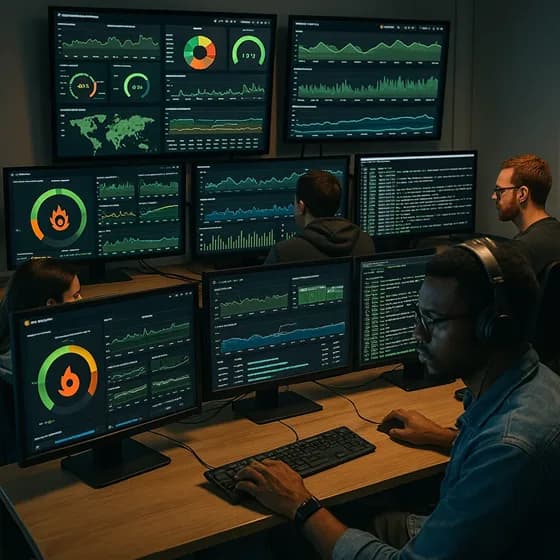
DevOps has become the backbone of modern IT operations, and a crucial piece of that puzzle is robust monitoring and observability. In 2026, the complexity of cloud-native systems and microservices means monitoring tools in DevOps engineering are more critical than ever for keeping applications reliable, secure, and high-performing. Downtime directly impacts revenue and user trust, so teams prioritize resilience, fast incident response, and full-stack observability in their workflows. This comprehensive guide written by a seasoned SEO expert with over a decade of experience, explores the top monitoring tools, emerging trends, and best practices that will help DevOps professionals stay ahead. We’ll also highlight how Refonte Learning (a leader in DevOps training) integrates these tools into its curriculum to prepare engineers for the demands of 2026.
Why Monitoring Tools Are Critical in DevOps (2026)
Monitoring in DevOps refers to continuously tracking the health, performance, and reliability of systems through metrics, logs, and traces. In 2026, this has evolved into a broader observability mindset not just asking if something is wrong, but why . Modern applications are distributed across containers, cloud services, and serverless components, generating immense amounts of data. Traditional manual monitoring is no longer sufficient. Here’s why cutting-edge monitoring tools are so vital in today’s DevOps engineering:
Complex, Distributed Systems: Companies now run microservices architectures with dozens or hundreds of services. Observability provides end-to-end visibility across these services. Monitoring tools help correlate events from different parts of the system so engineers can quickly pinpoint issues in a complex chain of interactions. For example, metrics might show a spike in latency, and traces can reveal exactly which service in the chain caused it. Without unified monitoring, finding the root cause in such distributed systems is like finding a needle in a haystack.
High Uptime Expectations: Downtime is not tolerated in 2026 users expect near 100% availability. Every minute of outage can cost significant revenue and damage reputation. This pressure means DevOps teams must detect and resolve incidents immediately. Advanced monitoring tools with real-time alerts and anomaly detection ensure that teams catch issues before they escalate. Refonte Learning emphasizes resilient engineering practices, including robust monitoring setups, in its DevOps programs to meet these high uptime standards.
Performance & User Experience: Monitoring isn’t just about catching failures; it’s about optimizing performance. With the right tools, DevOps engineers track key performance indicators (KPIs) like response times, throughput, error rates, and resource usage. In 2026, user experience is paramount slow or glitchy apps drive users away. Monitoring tools help teams proactively tune systems (e.g., auto-scaling when CPU or memory usage crosses a threshold) to maintain smooth performance under load. They also enable Service Level Objectives (SLOs) and alerts if performance drifts out of acceptable ranges.
Security and Compliance: Today’s DevSecOps practices integrate security monitoring at every step. Tools that monitor logs and metrics can detect security anomalies (like unusual login patterns or spikes in error rates that could indicate attacks). In regulated industries, monitoring is required to prove compliance and audit trails. Continuous monitoring of vulnerabilities, configurations, and access is a standard part of DevOps workflows by 2026, often using the same logging and observability platforms for security events as for ops metrics.
Automation and Incident Response: Modern monitoring tools don’t just collect data, they also automate responses. For example, a monitoring system can automatically trigger self-healing actions (restart a failed container, roll back a deployment) or route alerts to on-call engineers with detailed context. The rise of AIOps (Artificial Intelligence in IT Operations) is taking this further: by 2026, an estimated 73% of enterprises are implementing AIOps to cope with alert fatigue and complex systems. AI-powered monitoring platforms can filter noise, predict incidents before they happen, and even initiate automated fixes. This means DevOps teams spend less time firefighting and more time on improving systems.
In summary, robust monitoring tools in DevOps engineering in 2026 are the nervous system of your IT landscape providing awareness, enabling rapid reactions, and informing decisions. Next, we’ll dive into the key categories of these tools and which ones are leading the pack in 2026.
Key Categories of DevOps Monitoring & Observability Tools
The ecosystem of monitoring tools is broad, so it helps to break it down into categories. Generally, DevOps teams need solutions for:
Metrics Monitoring: Tools that collect numeric data (CPU, memory, request rates, etc.) and track trends over time.
Logging: Centralized systems to aggregate and search through log files from applications and infrastructure.
Tracing: Tools to follow transactions across distributed systems (critical for microservices architectures).
Visualization & Alerting: Dashboard tools and alert managers that make data actionable (often integrated with metrics/logs).
Cloud-Native Monitoring: Services provided by cloud platforms (AWS, Azure, GCP) for monitoring their resources.
APM (Application Performance Monitoring): Deeper insight into application-level performance and user experience, often via commercial tools.
AIOps & Advanced Analytics: Platforms that incorporate AI/ML to detect anomalies, predict issues, and automate responses.
Let’s explore each category and highlight the top tools in 2026 for DevOps engineers.
1. Metrics Monitoring: Prometheus & Grafana
When it comes to metrics in cloud-native environments, Prometheus and Grafana remain an unbeatable open-source combination in 2026. Prometheus serves as a powerful time-series database and monitoring system that scrapes metrics from your services and infrastructure, while Grafana is the visualization layer that turns those metrics into insightful dashboards.
Prometheus: Widely adopted for monitoring containerized applications and Kubernetes clusters, Prometheus collects real-time metrics (like CPU load, memory usage, request latency) by scraping endpoints on your services. It features a flexible query language (PromQL) to aggregate and alert on this data. Prometheus’s design is pull-based and ideal for ephemeral cloud environments, it’s part of the Cloud Native Computing Foundation and has become a de facto standard for DevOps monitoring. In fact, by 2025 three-quarters of surveyed DevOps teams were using Prometheus in production, a number only growing in 2026. Its integration with Kubernetes (via service discovery) makes it a cornerstone for cluster monitoring.
Grafana: This open-source visualization tool connects to Prometheus (and many other data sources) to provide interactive dashboards, graphs, and alerts. Grafana enables teams to create at-a-glance views of system health: you can plot microservice response times, database query throughput, error rates, and more in real time. Crucially, Grafana also handles alerting – you can define thresholds (e.g., CPU > 80% for 5 minutes) and Grafana will send notifications via email, Slack, PagerDuty, etc. The ability to visualize trends and get alerted on issues in one interface makes Grafana indispensable. Many organizations pair Prometheus + Grafana as their core monitoring stack because together they cover data collection, storage, visualization, and alerting in a highly cost-effective way. Both tools being free and open-source lowers the barrier to entry any team can implement them. Refonte Learning’s DevOps courses include hands-on labs with Prometheus and Grafana, ensuring learners build practical skills in setting up metrics dashboards and alerts .
Why Prometheus & Grafana are crucial in 2026: They represent the “monitoring as code” philosophy. Configuration is typically done through text files and APIs, which fits modern Infrastructure-as-Code and GitOps practices. They are cloud-agnostic working across AWS, Azure, Google Cloud, or on-premises. Additionally, a huge ecosystem of exporters (plugins) exists for Prometheus, allowing you to monitor everything from Linux servers to databases to Docker containers with minimal effort. For any DevOps engineer, mastering Prometheus and Grafana is an excellent first step toward building an observability mindset .
2. Log Management: ELK Stack and Grafana Loki
If metrics tell you what’s happening, logs often tell you why. In 2026, log management is just as critical as metrics monitoring. Two popular open-source approaches for centralized logging are the ELK Stack and Grafana Loki.
ELK Stack (Elasticsearch, Logstash, Kibana): ELK has been a dominant logging solution for years, and it remains widely used in DevOps organizations. Here’s how it works:
Logstash (or its modern lightweight variants Fluentd/Fluent Bit) acts as a log shipper, collecting logs from various sources (app servers, containers, network devices, etc.), and can filter or transform them as needed.
Elasticsearch is a scalable search engine where these logs are indexed and stored. It’s optimized for querying huge volumes of text data quickly, which is perfect for digging through logs.
Kibana provides a web UI to search, visualize, and dashboard the log data. Kibana lets you do everything from simple text search (to find specific error messages) to building visualizations (like how many errors per hour) and setting up alerts on log patterns.
With ELK, DevOps teams get a powerful platform to troubleshoot issues. For example, if an alert indicates an error in an API service, engineers can query Elasticsearch via Kibana to pull up all logs around the time of the error and quickly zero in on the cause. In real-world scenarios, aggregating logs into one place dramatically speeds up incident response you’re not SSH-ing into individual servers to tail log files. By 2025 and beyond, proficiency in the ELK Stack is highly valued by employers, as it shows you can implement centralized logging for complex systems. Refonte Learning’s training includes projects on deploying an ELK stack and analyzing real-world log data, reflecting how important ELK skills are for DevOps engineers .
Grafana Loki: A newer entrant tailored for cloud-native and Kubernetes environments, Grafana Loki has been gaining traction as a more lightweight logging solution. Loki’s philosophy: don’t index the full log text, index the labels (metadata). In practice, Loki works with small agents (called Promtail) on your servers/containers that send logs to Loki, which stores them efficiently by grouping logs with the same labels (such as app name, pod, region). This makes Loki significantly cheaper and simpler to run at scale compared to ELK, which can become resource-intensive for massive log volumes. Loki is often used alongside Prometheus; if you’re already using Grafana for metrics, adding Loki provides an integrated experience (Grafana is also the UI for Loki). By 2026, many teams have adopted Loki, especially when dealing with Kubernetes logs, due to its cost efficiency and seamless integration with existing Prometheus/Grafana setups. Employers appreciate experience with Loki because it shows you’re up-to-date with modern log aggregation approaches.
In summary, ELK vs Loki is a common comparison in DevOps today. ELK offers a mature, feature-rich ecosystem (with powerful search capabilities), while Loki offers a cloud-native, lower-overhead approach. There’s no one-size-fits-all: larger enterprises might still rely on ELK or even commercial tools like Splunk for their logging needs, whereas leaner cloud-native teams might gravitate to Loki. A savvy DevOps engineer in 2026 will be aware of both. In fact, being able to analyze and manage logs efficiently whether via ELK, Loki, or Splunk is a must-have skill that can “significantly boost operational responsiveness” in any organization.
3. Distributed Tracing: Jaeger and OpenTelemetry
As systems grow more distributed (think microservices, serverless functions, message queues), understanding how a single user request flows through all these components becomes challenging. This is where distributed tracing comes in and by extension, tools like Jaeger and standards like OpenTelemetry.
Jaeger: Originally open-sourced by Uber, Jaeger is a leading tool for distributed tracing. It allows DevOps and SRE teams to capture trace spans from applications, essentially, detailed records of each step a request takes through various services. With Jaeger’s UI, you can visualize an entire request journey across microservices. For example, a user action might call Service A, which calls Service B, which queries Database C. Jaeger will show a timeline of these calls and highlight where delays or errors occurred. This is incredibly useful for debugging latency issues and bottlenecks. In a complex architecture, Jaeger can mean the difference between guessing where a slowdown is versus knowing exactly which service and function caused it. By 2026, many organizations have Jaeger or similar tracing systems as a standard part of their observability stack, especially those with high traffic or complex interdependencies. DevOps engineers proficient in Jaeger can provide deep performance insights that go beyond what metrics or logs alone offer.
OpenTelemetry: While Jaeger is a tracing backend, OpenTelemetry (OTel) is an open-source observability framework that has quickly become the industry standard for instrumentation. OpenTelemetry provides a unified set of SDKs and tools to instrument your code for metrics, logs, and traces in a vendor-neutral way. Instead of writing custom code for each monitoring tool, developers instrument using OpenTelemetry APIs, and then you can send that data to any backend (Prometheus, Jaeger, Elastic, etc.). By 2026, OpenTelemetry’s momentum is huge, it’s supported by major vendors and open-source platforms alike. Employers value professionals who understand OTel because it ensures flexibility: if you can instrument with OTel, you can adapt to whatever monitoring system a company uses. For instance, you might capture traces with OpenTelemetry and choose to visualize them in Jaeger or send metrics to Prometheus, all with minimal changes. Investing time in learning OpenTelemetry in 2026 is absolutely worth it, as it future-proofs your observability skills.
In practice, tracing complements metrics and logs as the third pillar of observability. A well-instrumented system will use all three: metrics to flag that something is off, traces to follow the transaction path, and logs to zoom in on the details. Refonte Learning’s DevOps curriculum covers these pillars students, for example, might deploy a sample microservice application and implement Prometheus for metrics, ELK for logs, and Jaeger for traces, gaining end-to-end observability experience. As a DevOps engineer, becoming comfortable with tools like Jaeger and concepts like trace span, context propagation, and OpenTelemetry standards will set you apart as systems continue to grow in complexity.
4. Cloud-Native Monitoring Services
Most organizations run on public cloud platforms such as Amazon Web Services (AWS), Microsoft Azure, or Google Cloud Platform (GCP). Each of these providers offers native monitoring tools deeply integrated with their services. In 2026, proficiency in at least one cloud’s monitoring stack is highly beneficial:
AWS CloudWatch & CloudTrail: AWS CloudWatch monitors AWS resources and applications running on AWS in real time. It collects metrics on CPU, memory, network, etc., from services like EC2, RDS, Lambda, and more. CloudWatch can trigger alarms and even automate actions (e.g., scale out EC2 instances on high load). It also includes CloudWatch Logs for aggregating logs from AWS services or your applications. CloudTrail complements this by logging AWS account activity (who did what in the environment) useful for security and compliance monitoring. Many DevOps engineers use CloudWatch Dashboards to visualize infrastructure health and set up CloudWatch Alarms as their first line of defense for AWS workloads. Knowing CloudWatch is essential if you operate heavily on AWS.
Azure Monitor: For Microsoft Azure, Azure Monitor provides a unified monitoring solution. It covers metrics, logs (via Azure Log Analytics), and even application performance (through Application Insights). Azure Monitor can track the performance of VMs, containers (AKS), databases, and more, and it integrates with Azure’s alerting and automation (like Azure Functions triggers on alerts). If your team is in an Azure ecosystem, understanding how to set up Azure Monitor alerts, create Log Analytics queries, and use Application Insights to trace through an application will be key.
Google Cloud Monitoring (formerly Stackdriver): GCP’s native monitoring offers similar capabilities, capturing metrics and logs from Google Cloud services and VMs. It allows setting up uptime checks, dashboards, and alerting policies. GCP also has Cloud Trace for distributed tracing and Cloud Profiler for performance profiling, which tie into the monitoring suite.
Why cloud-specific monitoring matters: Enterprises often use a mix of open-source tools and cloud-native tools. Cloud provider tools are convenient they work out-of-the-box for cloud resources and require minimal setup. For example, AWS CloudWatch will automatically have metrics for your DynamoDB tables or API Gateway endpoints without you needing to deploy an agent. In 2026, many DevOps roles expect you to be able to handle both worlds: use Prometheus/Grafana for application-level monitoring and use cloud monitoring services for infrastructure-level insights. If you’re a DevOps engineer working in a multi-cloud or hybrid environment, you might use tools like Terraform or Kubernetes Operators to deploy consistent monitoring across clouds, or feed cloud metrics into centralized dashboards. Refonte Learning’s DevOps program often includes modules on using these cloud monitors effectively, because cloud skills are integral to DevOps today. For instance, a course might cover how to set up AWS CloudWatch alarms and logs, as well as how to ingest those logs into ELK for unified analysis.
Tip: If you’re prepping for cloud certifications (AWS DevOps Engineer, Azure DevOps, etc.), expect lots of questions on these monitoring services. Mastering them not only helps you keep systems healthy but also checks a big box for cloud expertise on your resume.
5. Application Performance Monitoring (APM) Tools
While Prometheus, ELK, etc., are fantastic, many organizations also invest in commercial Application Performance Monitoring (APM) tools for more advanced or convenient features. APM tools typically provide end-to-end visibility into application performance, user experience, and business metrics with less manual setup. They often combine metrics, traces, and logs in one platform (hence the term “observability platform” is also used) and add features like user session tracking, error analysis, and AI-driven insights. In 2026, some of the leading APM and observability platforms include:
Datadog: A popular cloud monitoring and APM platform, Datadog offers infrastructure monitoring, APM, log management, and more in a unified SaaS solution. DevOps teams like Datadog for its comprehensive dashboarding and integrations it can pull in data from hundreds of services and technologies with minimal config (from AWS metrics to Kubernetes to MySQL stats). Datadog’s APM provides deep visibility into application code (down to individual SQL queries or web requests) and distributed tracing out-of-the-box. By 2025, Datadog was noted for its AI-driven anomaly detection features, and in 2026 those capabilities have only improved automatically spotting unusual patterns in metrics or predicting capacity issues. If you know how to leverage Datadog (creating monitors, dashboards, SLOs, etc.), you can manage complex systems more proactively. Many employers see Datadog experience as a plus, since it’s widely used at scale for everything from startups to enterprises.
New Relic: One of the pioneers in APM, New Relic remains a strong player. It excels at application performance monitoring giving detailed transaction traces, timing breakdowns for web requests, database calls, external services, and more. New Relic also provides real user monitoring (RUM) to analyze front-end performance (like how fast pages load in the user’s browser). In 2026, New Relic has evolved into a full observability platform (with logging and infrastructure monitoring included), but it’s especially valued for deep dive application insights. Employers often expect DevOps folks to be at least familiar with New Relic or similar, to optimize application code performance and ensure good user experience. As highlighted in 2025 DevOps reports, those adept at using New Relic to tune applications can greatly enhance user satisfaction and application efficiency .
Splunk & Splunk Observability: Splunk has long been known for log management, but its newer observability suite (after acquisitions like SignalFx and Omnition) offers high-end metrics and tracing capabilities. Splunk is often used in large enterprises, especially for its powerful search and analytics on logs (it’s practically a synonym for enterprise log analysis). In 2026, Splunk Observability Cloud is a contender that provides hosted solutions for metrics (Infrastructure Monitoring), APM, logs, and even automation. Splunk’s strength is scale, it can handle massive volumes of data and is often used in security (SIEM) contexts too. If you become skilled in Splunk, you’re equipped to work in environments where data volume or compliance requirements call for a robust, battle-tested tool.
Other Notables: AppDynamics (Cisco’s APM solution) remains in use for enterprise application monitoring, offering similar capabilities to New Relic. Dynatrace is another heavyweight worth special mention for its strong AI-engine (“Davis”) that automatically discovers application dependencies and anomalies. By 2026, Dynatrace is known for excellent automation in monitoring (it’s considered an AIOps leader). We’ll talk more about AI in monitoring in the next section, but keep in mind Dynatrace as both an APM and an AI-driven platform. Honeycomb and Lightstep are innovators focusing on high-cardinality data analysis and tracing respectively, popular among advanced teams (Honeycomb’s approach to events per second and fast querying is cutting-edge). And of course, Open-source APM: tools like Grafana Tempo (tracing store) and Loki we discussed, plus Jaeger, can be stitched together for an open observability stack if one doesn’t want commercial tools.
For a DevOps engineer, the key is not necessarily to learn every tool, but to understand the principles of APM and observability these tools address. Many principles are transferable: if you learn one, others will feel familiar. For instance, learning to set up alerts and dashboards in Datadog will help you learn how to do it in New Relic or Splunk. Employers often list specific tools in job descriptions (e.g., “experience with Prometheus/Grafana or Datadog or New Relic”) indicating that knowing one from each domain (open-source and commercial) is ideal. Refonte Learning’s DevOps courses cover both worlds: for example, students might get introduced to open-source tools and see demos of how a platform like Datadog works, preparing them for whichever their future company uses.
6. All-in-One Observability Platforms & AIOps
A major trend by 2026 is the convergence of monitoring, logging, and tracing into all-in-one observability platforms, often infused with AI capabilities (AIOps). We’ve touched on some of these above, but let’s explicitly discuss the trend:
Unified Observability: Rather than juggling separate tools for metrics, logs, and traces, many organizations are shifting to unified platforms that bring these data sources together. The benefit is obvious faster troubleshooting and a single source of truth. Datadog, New Relic, Splunk, Dynatrace, and others are all racing to provide a one-stop observability solution. This consolidation means as a DevOps engineer, you might spend most of your day in one web console that shows your infrastructure metrics, application traces, and log streams side by side, all correlated. It also means fewer blind spots: for example, you can click from a high-level alert (CPU spiking on a server) down into the log events and traces from that timeframe, within a few clicks.
AI and Machine Learning in Monitoring (AIOps): By 2025, artificial intelligence had already begun reshaping monitoring and logging practices , and in 2026 AI-driven monitoring is mainstream. What does this look like in practice?
- AI algorithms analyze historical data to determine normal vs abnormal patterns, reducing false positives in alerting (no more 3 AM wake-ups for benign blips).
- Predictive analytics forecast potential issues: e.g., an AI might notice memory usage trending towards an out-of-memory crash in 2 hours and alert you before it happens.
- Automated root cause analysis: tools like Dynatrace and IBM Instana can automatically pinpoint the likely root cause of an incident by analyzing the dependency graph of services and where the failure started.
- Intelligent automation: An AIOps platform might auto-remediate certain issues (restart services, clean up resources), or at least guide the on-call engineer to the fix faster.
For instance, Dynatrace’s AI can excellently detect anomalies and performance issues across the stack with minimal manual configuration. Instana (by IBM) emphasizes real-time analytics and automation, giving DevOps teams a near-instant insight into what went wrong and even handling some fixes automatically. These tools are valued for their ability to drastically reduce downtime through quicker detection and response. In competitive industries, the faster you can resolve incidents, the better and AI helps a lot with that.
From a career perspective, getting familiar with AIOps concepts is a smart move. As one industry expert put it, “there is no future of IT operations that does not include AIOps”. You don’t necessarily need to build AI models, but you should know what AI-driven monitoring tools can do and how to leverage them. Many traditional monitoring tools are also adding AI features (for example, Elastic Stack has machine learning jobs for anomaly detection in X-Pack, Grafana offers ML-based alerting through plugins, etc.). So even if you stick with mostly open-source stacks, expect to interact with AI features by 2026.
Refonte Learning continuously updates its DevOps curriculum to reflect these trends. Engineers trained in 2026 learn not just to set up monitors, but to configure smart alerting, use AI-based tools, and interpret their outputs. The goal is to produce DevOps pros who can work alongside intelligent systems, training and tuning the “digital ops assistants” rather than doing all monitoring manually . Embracing these platforms means you’ll be ready for the future of DevOps, where humans and AI-driven tools collaborate to maintain reliability at scale.
Best Practices for Implementing Monitoring in DevOps
Having the right tools is half the battle; using them effectively is the other half. Here are some best practices and tips for implementing monitoring and observability in your DevOps workflow (drawn from industry experience and recommendations from Refonte Learning’s experts):
Adopt a Holistic Observability Strategy: Don’t treat monitoring, logging, and tracing as separate silos. Design your observability stack such that metrics, logs, and traces complement each other. For example, when setting up an alert on a metric (like error rate), ensure you have logs and trace data that can be quickly pulled to investigate that alert. Use tools or integrations that link these contexts (many platforms let you jump from an alert to relevant logs automatically).
Implement Meaningful Alerts (Avoid Alert Fatigue): Configure alerts on symptoms that truly need human attention. It’s better to have a few high-quality alerts (e.g., customer-facing outage, error rate surge, critical SLA breach) than dozens of noisy ones. Use techniques like multi-condition alerts (alert if CPU is high and error rate is rising, not just CPU alone) to reduce noise. Always tie alerts to a runbook or documentation so on-call engineers know how to respond.
Use Dashboards for Insight, not just Data: A well-crafted dashboard can tell a story at a glance. Create dashboards for different perspectives infra health, app performance, business KPIs. Within each, include only relevant metrics (too many graphs can be as bad as none). Use Grafana or equivalent to overlay related metrics (e.g., deploy events over latency graphs to see if a deployment caused a slowdown). Regularly review and update dashboards as systems evolve; an outdated dashboard is misleading.
Embrace Infrastructure as Code for Monitoring: Just as you manage code and infrastructure via Git, do the same for your monitoring configuration. Many tools allow config in YAML/TOML/etc. (Prometheus rules, Grafana dashboards JSON, Terraform providers for Datadog or CloudWatch). Storing these in version control means changes are auditable and reproducible. It also enables GitOps for monitoring e.g., automatically apply a Git commit that adds a new alert when a new microservice is deployed.
Regularly Test Your Monitoring Setup: Don’t wait for a crisis to find out your alerts weren’t working. Practice chaos engineering or at least simulate failures in staging: kill a service, overload the CPU, fill up disk space and see if your monitoring tools catch it and alert the team. Conduct fire drills: can your team quickly find the cause of a simulated outage using your dashboards and logs? These practices ensure that when a real incident strikes, your monitoring is a trusty ally.
Optimize Log Management (Be Selective with What You Index): Logs can grow huge and incur costs (especially on hosted platforms or ELK where storage is expensive). Employ strategies like log rotation, filtering out non-essential logs, and using different retention policies. For example, keep error and warning logs longer than info/debug logs. If using Grafana Loki, leverage its label-based approach to keep costs down by only indexing important labels (like severity, service name). Effective log management will make your troubleshooting faster and bills lower.
Continuously Learn and Stay Current: The DevOps monitoring landscape evolves quickly. Allocate time for the team to evaluate new tools or features (for instance, every quarter review what’s new in Prometheus or what new AWS monitoring services are available). Engage with the community: attend webinars, follow blogs (like Refonte Learning’s DevOps blog which covers trends), and consider attending conferences (KubeCon, AWS re:Invent, etc.). Staying current ensures you can adopt improvements (like a new OpenTelemetry feature or a better anomaly detection algorithm) that give your team an edge.
Upskill with Structured Training: If you or your team are new to a tool, consider formal courses or certificates. There are excellent courses for Prometheus, ELK, Datadog, etc., that can accelerate your learning. Refonte Learning’s DevOps Engineering program is one example that offers a structured path, covering monitoring fundamentals through hands-on labs. Formal training ensures you learn best practices from the get-go. Pair this with hands-on practice set up a pet project where you monitor a simple app, just to tinker with the tools in a low-stakes environment (nothing beats learning by doing!).
Collaborate and Break Silos: Encourage a culture where developers, operations, and SREs all use the same monitoring tools and data. When everyone sees the same metrics and logs, it fosters shared responsibility. For example, during an incident, having devs and ops looking at a common dashboard and trace data in real-time can dramatically speed up resolution. Share insights from monitoring with the broader team e.g., in sprint retrospectives, bring up any recurring issues seen in logs or areas for performance improvement. Observability should be part of the team’s DNA, not just an ops afterthought.
Implementing these best practices will ensure your monitoring setup not only works technically but also truly supports your team’s reliability goals and productivity.
Conclusion
In 2026, success in DevOps engineering relies heavily on mastering modern monitoring and observability tools. From open-source staples like Prometheus, Grafana, and ELK, to cloud-native services and AI-powered platforms, the toolkit is richer than ever. Companies are seeking DevOps professionals who can ensure seamless application performance, rapid incident response, and proactive optimization through these tools. By developing robust monitoring skills, you position yourself as an invaluable engineer who can maintain high uptime and drive continuous improvement in any tech environment.
The good news is that resources abound for learning these in-demand skills. Platforms like Refonte Learning offer up-to-date DevOps courses that cover monitoring and logging from the ground up including hands-on projects with real-world scenarios refontelearning.com. Investing in such training or certifications (for tools like Datadog, Splunk, or Kubernetes) can accelerate your path to expertise. Combine that with self-driven projects and staying current with industry trends, and you’ll be well-equipped to tackle the challenges of modern DevOps.
Refonte Learning’s DevOps Engineering program, for example, integrates modules on Prometheus/Grafana, ELK Stack, cloud monitoring, and more, ensuring learners get practical experience with the very tools discussed in this article. This kind of structured learning, paired with curiosity and practice, will help you build a comprehensive observability mindset.
In summary, monitoring tools in DevOps engineering in 2026 are not just nice-to-have they are mission-critical. By leveraging the right tools and following best practices, you’ll keep systems stable, users happy, and your skills in high demand. Embrace the culture of observability and never stop learning, and you’ll stay ahead in the ever-evolving DevOps landscape. Here’s to your journey toward becoming a monitoring and DevOps expert in 2026 and beyond!