Two budget cycles ago, a typical performance-media conversation could still revolve almost entirely around Google and Meta. Search captured intent, paid social created and harvested demand, and everything else competed for whatever was left.
That model is breaking.
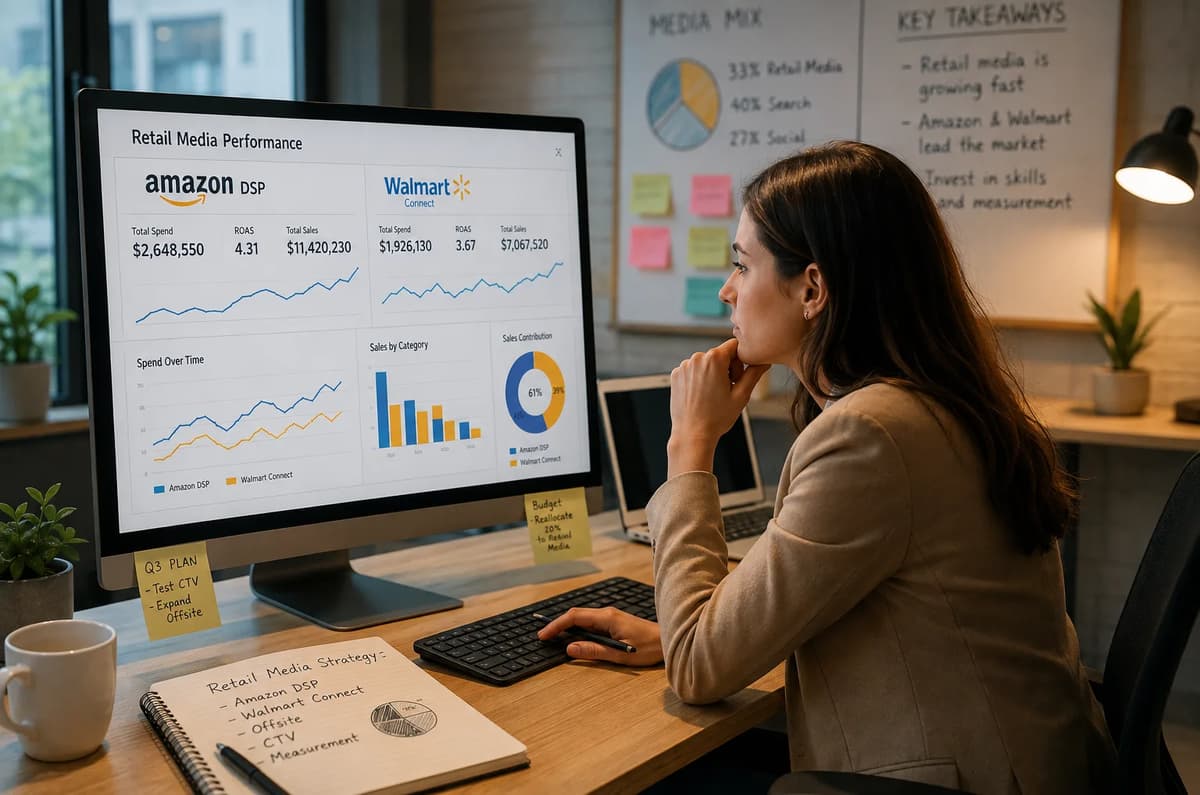
For retail-heavy brands, retail media can now take a material share of the addressable digital budget. A plan that once looked 80% search and social can quietly evolve until commerce media is approaching a third of spend, while much of the marketing organization still treats Amazon Ads, Walmart Connect, and retailer networks as an e-commerce team's side project rather than a third major advertising channel.
The numbers explain why. EMARKETER forecasts $69.33 billion in U.S. retail media spending in 2026, up from $58.79 billion in 2025. IAB's 2026 Outlook separately expects commerce media to grow 12.1%, faster than the 9.5% growth it forecasts for total U.S. advertising.
There is one important correction to the headline before we go further. EMARKETER's striking 89% figure refers to Amazon and Walmart's share of incremental 2026 retail-media dollars, not 89% of every dollar already in the market: its November forecast says $9.42 billion of the $10.53 billion in new spending will go to the two companies, while a subsequent EMARKETER forecast put their combined share of total 2026 retail-media digital ad spend at 88.2%.
That distinction does not make the concentration story less significant. It makes it more useful: the market is still growing, but nearly all the new money is flowing toward two scaled platforms.
For marketers, the question is no longer whether retail media networks matter. It is whether your existing PPC, programmatic, analytics, content, and measurement skills are enough to operate in them, and whether 2026 is the moment to build a specialization on top of those fundamentals.
For professionals still building that base, the Refonte Learning Digital Marketing Program covers transferable areas including PPC advertising, SEO, content marketing, social media marketing, and AI in marketing. The live curriculum does not list Amazon DSP or Walmart Connect by name, so it should be viewed as foundation-building rather than platform-specific retail-media training.
What Retail Media Actually Is and Why the Market Is Suddenly So Large
The easiest mistake is to define retail media as "Amazon sponsored listings."
Sponsored search on retailer websites is certainly part of the channel, and it remains one of its strongest performance products. Walmart Connect, for example, offers Sponsored Products, Sponsored Brands, and Sponsored Videos inside search and other high-intent areas of Walmart's site and app.
But retail media networks in 2026 are much broader advertising businesses built around retailers' first-party commerce data, audiences, media inventory, and ability to connect advertising exposure with purchasing behavior.
IAB's retail-media training framework spans onsite, offsite, in-store, connected television, and digital out-of-home placements. It also places first-party shopper data, closed-loop measurement, attribution, creative strategy, and retailer-specific commercial relationships inside the discipline rather than treating retail media as a variation of paid search.
Retail-media layer | What the advertiser is buying | Typical example |
Onsite search | Visibility against retailer shopping intent | Sponsored product in retailer search results |
Onsite display/video | High-impact inventory within retailer properties | Homepage, category or product-page display |
Offsite media | Retailer audiences activated beyond retailer properties | Display, video or programmatic ads on the open web |
Connected TV | Streaming inventory combined with commerce audiences | CTV targeted with purchase-based signals |
Social | Retail audiences activated through social platforms | Retail-powered Meta or TikTok campaigns |
In-store | Digital and physical media close to the shelf | Screens and store advertising |
Measurement/data | Connection between exposure and commerce outcomes | Online and offline sales attribution |
This is also why commerce media advertising is becoming a more useful umbrella term. Retail media historically centered on companies that sell physical goods, while commerce media increasingly encompasses businesses with valuable transaction data and customer relationships that can be monetized as advertising assets.
IAB's Commerce Center of Excellence now explicitly works on defining how commerce media and retail media fit within the broader advertising ecosystem, while its 2026 priorities include closed-loop reporting, incrementality, clean rooms, first-party data, social commerce, and cross-channel convergence.
EMARKETER similarly distinguishes newer commerce-media opportunities from the classic retailer model, particularly as first-party transaction data becomes valuable outside traditional product-selling environments.
That distinction matters when comparing retail media with conventional programmatic advertising. Amazon DSP, for example, is a demand-side platform that can buy Amazon and third-party inventory and is available to advertisers whether or not they sell products on Amazon; the commerce advantage comes from Amazon's audience, shopping, streaming, and measurement ecosystem layered onto programmatic execution.
The same expansion is visible at Walmart. Walmart Connect describes offsite media as a way to activate its first-party data across CTV, social media, the open web, audio, gaming, and other environments, with its DSP powered by The Trade Desk.
That is a fundamentally different proposition from simply paying to appear above an organic product result.
For broader context on the rest of the marketing landscape, Refonte's existing guide to digital marketing trends and strategies in 2026 covers AI, search, social, privacy, and wider digital strategy. Retail media deserves separate treatment because it has developed its own buying systems, data infrastructure, measurement conventions, retailer relationships, and career path.
From a media-planning perspective, that is the real shift. Retail media has stopped being a placement and started becoming infrastructure.
The Numbers, the Forecast Disagreement, and the 89% Concentration Problem
Any serious retail media ad spend forecast for 2026 needs a range rather than one magically precise number.
EMARKETER provides the cleanest explicit U.S. retail-media figure I found: $69.33 billion in 2026, versus $58.79 billion in 2025. That implies more than $10.5 billion of incremental annual spending.
IAB uses the broader term commerce media in its 2026 Outlook and forecasts the category growing 12.1% year over year. Crucially, the current public IAB Outlook page does not state the often-repeated $74 billion figure as a headline forecast; it reports the growth rate, alongside 14.6% growth for social, 13.8% for CTV, and 9.5% for total U.S. ad spend.
IAB's separate full-year 2025 Internet Advertising Revenue Report, conducted with PwC, measured commerce-media revenue at $63.4 billion in 2025, up 18% year over year and equivalent to 21.5% of total digital advertising revenue under that report's definitions.
Mechanically applying IAB's 12.1% 2026 growth outlook to that $63.4 billion 2025 base produces roughly $71.1 billion. That calculation is useful for orientation, but it should not be misrepresented as an official IAB $71.1 billion forecast because the Outlook survey and PwC revenue benchmark are distinct research products with different methodologies.
A July 2026 secondary industry analysis from Shopappy also cited approximately $71.09 billion and repeated higher estimates around the low-to-mid-$70 billions. Because that is secondary analysis rather than IAB's primary Outlook publication, I would not use it to overrule the primary-source methodology.
The practical planning range is therefore roughly $69 billion to the low-$70 billions, with some industry summaries extending that range toward $74 billion depending on what they classify as retail versus commerce media.
2026 view | Figure | What it actually measures |
EMARKETER retail media | $69.33B | Explicit U.S. retail-media forecast |
IAB 2026 Outlook | +12.1% | Forecast growth rate for commerce media |
IAB/PwC 2025 base | $63.4B | Measured 2025 commerce-media revenue |
Derived IAB orientation | ~ $71.1B | Arithmetic using 2025 base × 12.1%; not an official IAB dollar forecast |
Secondary industry estimates | ~ $71B–$74B | Vary by source and category definition |
There is another correction worth making because it has propagated into several 2026 summaries. IAB's current 2026 Outlook says 12.1% commerce-media growth, not 13.2%. The 13.2% number appeared in IAB's revised 2025 outlook for retail media, so carrying it forward as the 2026 growth rate mixes forecast periods.
This is more than source pedantry. Retail media is still an immature enough measurement category that "retail media," "commerce media," onsite retail search, offsite display, and transaction-data-enabled media are not always scoped identically across research companies.
The concentration data is less ambiguous.
EMARKETER's November forecast says Amazon Ads and Walmart Connect will capture $9.42 billion of the $10.53 billion in incremental 2026 spending. That works out to more than 89% of the new dollars entering the category.
A subsequent EMARKETER analysis based on its December 2025 forecast put Amazon and Walmart at 88.2% of total U.S. retail-media digital ad spending in 2026.
Those are two different statistics:
More than 89% = Amazon and Walmart's share of incremental 2026 spending in EMARKETER's November forecast.
88.2% = their projected share of total 2026 retail-media digital advertising in a later EMARKETER forecast.
For anyone studying retail media network consolidation, the first statistic is arguably the more consequential one. A market can support dozens or hundreds of networks and still become more concentrated every year if nearly every marginal dollar goes to the two largest operators.
IAB itself sees concentration as a structural challenge. Its Commerce Center says 2026 work will include creating a more sustainable and competitive ecosystem, while IAB's broader advertising-revenue research points to the advantages enjoyed by scaled companies with deep first-party data, integrated commerce, proprietary measurement infrastructure, and end-to-end buying environments.
When I review a media plan, this changes the strategic question. It is no longer, "How many retailer networks should we test?"
The harder question is, "What would the third, fourth, or tenth network need to offer that we cannot already obtain at greater scale from Amazon or Walmart?"
That pressure is what every mid-market retail media network now has to answer.
Amazon DSP and Walmart Connect Are Expanding Beyond the Retail Shelf
The most consequential development in amazon dsp walmart connect competition is that both companies are escaping the boundaries of their own ecommerce properties.
Amazon does not want Amazon Ads to mean "ads shown while somebody is shopping on Amazon." Walmart does not want Walmart Connect to mean "sponsored listings on Walmart.com."
Both increasingly want retailer data to influence how advertisers buy streaming television, display, video, social, and other media throughout the customer journey.
Development | Amazon | Walmart |
Core commerce advantage | Amazon shopping and audience signals | Walmart online + in-store transaction signals |
Programmatic buying | Amazon DSP | Walmart DSP plus external DSP integrations |
CTV/streaming expansion | Prime Video, Twitch, Amazon Publisher Direct and partner inventory | VIZIO, Vibe.co and programmatic CTV partnerships |
Off-platform reach | Third-party apps, sites and streaming inventory | Open web, social, CTV, YouTube and partner DSPs |
Self-service direction | Broader self-service capabilities | Ad Center, social self-service and Vibe.co acquisition |
Measurement proposition | Commerce and advertising signals | Omnichannel sales and closed-loop measurement |
Amazon DSP self-service: what "$5K per month" really means.
There is a crucial distinction between an official platform minimum and a practical test budget.
Amazon's official DSP documentation says its managed-service option typically requires a $50,000 minimum spend, although requirements can vary by country. Amazon offers a self-service route as well, but the current official DSP page does not state a $5,000 Amazon-imposed self-service minimum.
Current agency guidance is where the approximately $5,000–$10,000 monthly starting range appears. Canopy Management, for example, describes no Amazon-imposed self-service minimum following changes in late 2025 while presenting $5,000–$10,000 as a more practical working budget for smaller advertisers using agency-supported access.
So "Amazon DSP self-service at $5K/month" should be read as a practical market entry point reported by service providers, not a formal Amazon DSP platform minimum.
That still matters. Lower operational barriers mean the DSP is no longer relevant only to the enterprise advertiser that can comfortably commit a managed-service five-figure minimum.
Amazon is also making some streaming-TV buying explicitly accessible without large minimums. Its current Streaming TV advertising guidance says businesses of any size can use the self-service solution with no minimum spend, accessing Amazon streaming services and third-party channels through Amazon Publisher Direct.
Meanwhile, Amazon's 2026 media presentations have expanded the inventory story. At its May 2026 Upfront, Amazon said its entertainment portfolio could connect advertisers with more than 300 million ad-supported consumers in the United States across streaming, sports, podcasts, creators, and related environments; separate 2026 announcements included Samsung TV Plus supply available through Amazon DSP and new interactive, dynamically personalized Prime Video ad capabilities.
The strategic parallel with Meta Advantage+ and the shift toward automated ad platforms is worth noticing. Different channels are converging on a model where the platform increasingly controls audience selection, optimization, inventory access, and automated execution, which makes human judgment about objectives, economics, measurement, and creative more valuable, not less valuable.
Walmart's expanding retail-media footprint.
Walmart's 2026 strategy has been especially aggressive because it is solving a historical disadvantage: Amazon already owns a massive streaming and advertising ecosystem, while Walmart has needed to connect its commerce data to more media inventory.
The VIZIO acquisition gave Walmart a much larger CTV footprint, and Walmart Connect has spent 2026 connecting that ecosystem to new buying workflows. Its April launch of Connect Select created a curated marketplace inside Walmart DSP focused particularly on CTV inventory.
In May, Walmart Connect announced that Walmart audiences and closed-loop measurement would become available through Yahoo DSP, using Magnite technology, rather than forcing every advertiser to move its programmatic workflow entirely into Walmart's own DSP.
In June, Walmart extended its audiences and sales measurement into Google's Display & Video 360 for YouTube campaigns, with additional inventory types planned.
Then there is Vibe.co.
Walmart announced an agreement to acquire the self-service CTV platform on June 23, 2026 and officially completed the acquisition on August 4, 2026. Walmart says the combination is intended to make streaming-TV advertising more accessible while linking Vibe's self-service capabilities with Walmart Connect's commerce-media data and measurement.
The price is an example of why source discipline matters in a fast-moving category. Walmart's official announcements did not disclose the transaction terms, while The Wall Street Journal and later trade coverage reportedly put the deal around $1.4 billion, with some coverage describing approximately $1.2 billion as the cash component.
I would therefore describe Walmart as having "reportedly paid about $1.4 billion," not state $1.4 billion as company-confirmed consideration.
The larger story is not the reported purchase price anyway. It is that the world's largest retailer is buying self-service CTV infrastructure while simultaneously connecting its first-party commerce data to Yahoo DSP, Magnite, Google DV360, VIZIO, social platforms, and its own DSP.
That is not a retailer dabbling in advertising. It is the architecture of a cross-channel media company.
The Mid-Market Response and How Retail Media Changes the Search-Social Budget
A concentrated market creates an awkward strategic problem for every retailer outside the top tier.
Retailers can see Amazon and Walmart building high-margin advertising businesses around first-party customer relationships that smaller retailers also possess. The temptation to launch an RMN is obvious.
The challenge is that an advertiser does not need another dashboard simply because a retailer has one.
A smaller network has to bring something defensible: distinctive audience data, a valuable category, unusual purchase frequency, geographic strength, a highly engaged customer base, differentiated in-store reach, or measurement that proves it can generate incremental business rather than redistribute sales that would have happened anyway.
That explains why IAB's 2026 commerce-media agenda explicitly focuses on creating a sustainable, competitive ecosystem while acknowledging the need for interoperability, measurement maturity, first-party-data collaboration, and cross-channel convergence.
The Academy Sports + Outdoors launch is a useful example.
Academy formally launched Academy Retail Media, or ARM, on July 30, 2026, slightly earlier than the August date attached to much of the subsequent trade coverage. Academy's corporate announcement says the network begins with more than 320 stores across 21 states and a base of 52 million verified customers.
August industry coverage then amplified the launch as the broader market took notice.
ARM is not merely selling banner inventory. Academy says brands can activate against verified audiences across onsite, in-app, and offsite channels, then use closed-loop measurement covering same-SKU sales, brand halo, and incremental lift across online and physical-store transactions.
What Academy brings | Why an advertiser might care |
52M verified customers | Addressable first-party audience base |
320+ stores in 21 states | Physical-commerce footprint |
Sporting goods/outdoor focus | Category-specific shopping signals |
Onsite + in-app + offsite activation | Full-funnel media possibilities |
Online + in-store measurement | Better link between advertising and transactions |
Incremental-lift reporting | Opportunity to move beyond attributed ROAS |
Academy also identifies high-value segments such as "Always Game Families," which it says purchase across eight or more categories and spend roughly twice as much annually as the average sporting-goods and outdoor consumer. As with all first-party audience claims, advertisers should validate the segment's scale and campaign relevance inside their own planning rather than treating a retailer's marketing description as a guaranteed performance outcome.
This is where retail media vs search vs social becomes a budget question rather than a taxonomy exercise.
Search, retail media, and social frequently compete for the same performance dollars because all three can make a credible claim on demand generation or conversion. Yet the consumer signals differ materially.
Channel | Strongest signal | Main strategic strength | Common weakness |
Paid search | Query/keyword intent | Captures explicit demand | Often sees only part of downstream retail purchase behavior |
Paid social | Identity, engagement, content behavior | Discovery, demand creation, creative scale | Platform attribution can overstate its unique contribution |
Retail media | Shopping and purchase behavior | Commerce intent + transaction measurement | Fragmentation and retailer-controlled measurement |
Programmatic/CTV | Audience + content consumption | Reach and full-funnel storytelling | Incrementality can be difficult to isolate |
IAB's 2025 revenue benchmark illustrates the emerging scale, although the categories should not be treated as mutually exclusive accounting buckets: search generated $114.2 billion, social $117.7 billion, and commerce media $63.4 billion in 2025. IAB specifically characterized commerce media as a core performance channel powered by first-party data.
That is why I now treat retail media as a budget layer alongside search and social rather than automatically burying it under "ecommerce."
The practical reallocation starts at the product level.
For a brand whose customers overwhelmingly purchase through Amazon, Walmart, Target, grocery chains, sporting-goods retailers, or other marketplaces, optimizing Google CPA while ignoring retailer-level share of search, product availability, sales velocity, and retail ROAS can create a false sense of efficiency.
At the same time, moving money from search into retail media indiscriminately is equally dangerous. Retail networks can take credit for purchases that would have happened organically, especially when ads appear close to conversion.
The right question is incrementality, not which platform dashboard reports the prettiest ROAS.
Marketers who want deeper search-channel training can compare those retail-media mechanics with Refonte's SEO and SEA mastery for 2026, whose live curriculum specifically includes SEO, Google advertising fundamentals, PPC campaign management, analytics, and performance tracking.
Retail media does not eliminate search expertise. It gives search specialists another auction environment, then adds an entire layer of retail economics, shopper data, inventory, merchandising, and measurement on top.
What Makes Retail Media Different to Plan, Measure, and Operate
The central sales pitch behind retail media sounds almost too good to be true: the company serving the advertising also knows what customers bought.
That creates something conventional digital marketing has spent years trying to approximate: a closed loop between media exposure and transaction data.
Walmart Connect, for example, says its first-party data is based on real online and in-store shopping behavior and powers audience insights, targeting, and omnichannel sales measurement.
Academy is making a similar claim around connecting advertising exposure with online and in-store sales.
Amazon combines advertising activity with extensive commerce and audience signals across its own ecosystem and its DSP.
This capability is why closed-loop attribution sits at the core of commerce media advertising.
It is also where inexperienced buyers get into trouble.
Closed-loop attribution is not the same thing as causal proof.
An advertiser can know that an exposed shopper later purchased a product and still not know whether the advertising caused the purchase. A loyal buyer who sees a sponsored product shortly before purchasing their usual brand can create excellent attributed ROAS without generating much incremental revenue.
IAB's advanced retail-media measurement guidance therefore treats incrementality as essential and points buyers toward methods including randomized controlled trials, match-market testing, counterfactual models, media-mix modeling, and other approaches that go beyond direct attribution. It also warns that walled gardens and siloed data complicate cross-channel attribution.
Measurement question | Weak answer | Better answer |
Did exposed shoppers buy? | Attributed ROAS | Useful, but only first step |
Did the campaign create sales that would not otherwise occur? | Last-click revenue | Incremental sales/lift testing |
Did we acquire different customers? | Total conversions | New-to-brand/new-customer analysis |
Did upper-funnel media matter? | Click-through rate | Sales lift, reach + incrementality |
Which channel deserves credit? | Each platform's self-attribution | Experiments, MMM and cross-channel analysis |
Can networks be compared fairly? | Dashboard ROAS | Consistent definitions and testing framework |
This distinction becomes critical as retail media moves offsite.
When a sponsored listing appears on a retailer search-results page, the path from impression to transaction is relatively contained. When the same retailer audience is activated through streaming television, YouTube, Meta, the open web, and multiple DSPs, the planning problem begins to resemble sophisticated omnichannel programmatic advertising.
Walmart's 2026 integrations make that transition explicit. Advertisers can activate Walmart audiences through Yahoo DSP, use Walmart signals through DV360 for YouTube, buy VIZIO-related CTV, and use Walmart-powered social alongside onsite retail media.
This requires more than knowing how to set a bid.
A capable retail-media practitioner needs to understand:
Retail economics: price, margin, availability, inventory levels, promotions, category dynamics and retailer relationships.
Auction mechanics: keyword structure, bidding, placements, pacing, budgets and optimization.
Programmatic: DSPs, supply paths, audiences, frequency, CTV, private deals and offsite media.
Measurement: attribution windows, new-to-brand metrics, incrementality, lift testing, clean rooms and cross-channel reporting.
Creative: product-page quality, retail-ready assets, onsite display, video and CTV formats.
· Commercial planning: joint business plans, retailer funding, trade budgets and how media fits alongside merchandising.
IAB's current retail-media curriculum reinforces that breadth. It teaches not only buying but stakeholder mapping, joint business plans, first-party data, segmentation, onsite/offsite/in-store strategy, creative planning, closed-loop reporting, attribution, incrementality, and measurement standardization.
This breadth also explains who is working in retail media right now.
The field attracts paid-search practitioners because sponsored retail search looks familiar; ecommerce and marketplace managers because they understand retailer economics; programmatic traders because offsite RMNs increasingly use DSPs; shopper and trade marketers because retailer relationships matter; and analysts because measurement is one of the channel's core differentiators.
That mix is an inference from the competencies platforms and IAB now train for, rather than a claim that one career background dominates the labor market. Amazon's own DSP certification covers audiences, supply quality, campaign setup, optimization, bid strategies, conversion tracking, attribution, integrations, and private marketplace deals, while Walmart's certification spans retail media fundamentals, sponsored products, bidding, budgets, optimization, measurement, and reporting.
For hiring managers, I would therefore be cautious about searching only for candidates who already have "retail media" in their title.
Someone who understands paid search economics, programmatic media, ecommerce analytics, experimentation, and client budget decisions may be much closer to becoming a strong retail-media manager than somebody whose experience consists solely of navigating one RMN interface.
Interfaces can be taught.
Judgment is harder.
The Retail Media Specialist Career, Salary Reality, and Skills Worth Building
The retail media specialist career market looks like a field in the middle of professionalization rather than a mature job category with settled titles and salary bands.
Glassdoor's U.S. Retail Media Specialist page currently estimates average compensation at roughly $57,000 per year, with a typical total-pay range around $46,000–$71,000. The most important caveat is buried in the sample: its current calculation is based on only four reported salaries, so treating $57,031 as a precise market-clearing salary would be unjustified.
For Senior Retail Media Manager, Glassdoor currently estimates roughly $99,500 per year, with only three salary submissions displayed on the page.
Glassdoor title | Current approximate figure | Data-quality caveat |
Retail Media Specialist | $57K average | Only four reported salaries shown |
Senior Retail Media Manager | $99.5K average | Only three reported salaries shown |
Senior Social Media Manager | $106.6K average | Broader sample, but different role definition |
Glassdoor's Senior Social Media Manager figure is about $106,600, illustrating that retail-media titles do not yet command an automatic salary premium over established digital disciplines. The comparison is directional rather than apples-to-apples because seniority, geography, company mix, and sample size differ.
The specialist-to-senior gap is still revealing.
At roughly $57,000 versus roughly $100,000, Glassdoor's current pages imply a steep increase between specialist execution and senior ownership. But the tiny sample sizes are as interesting as the pay gap itself: they suggest that "Retail Media Specialist" and "Senior Retail Media Manager" are not yet as standardized across employers as titles such as paid search manager or social media manager.
That is consistent with how the market is evolving technically.
Retail media increasingly sits at the intersection of ecommerce, paid media, shopper marketing, data, programmatic advertising, CTV, and retailer commercial strategy. Organizations will not necessarily place those responsibilities in the same department or attach the same title to them.
For somebody thinking about digital marketing skills 2026, I would divide the learning plan into two groups: what transfers and what does not.
Skills that transfer well from general digital marketing
Existing skill | Retail-media application |
PPC fundamentals | Auction logic, bidding, budgets, keyword strategy and ROAS |
Search marketing | Sponsored product/search structure and intent analysis |
Analytics | Funnel analysis, campaign reporting and optimization |
Content marketing | Product messaging, creative and retail-ready content |
Paid social | Offsite retail-powered social campaigns |
Programmatic knowledge | Amazon DSP, Walmart DSP, CTV and open-web activation |
Conversion strategy | Product-page and customer-journey optimization |
AI literacy | Automated optimization, assistants and platform automation |
Experimentation | Incrementality, holdouts and causal measurement |
A strong Google Ads operator already understands concepts such as auctions, relevance, bidding, query intent, budget pacing, conversion economics, marginal returns, and diminishing efficiency as spend scales.
A strong paid-social practitioner understands audience construction, creative iteration, prospecting versus retargeting, frequency, lift, automation, and the difference between a platform's recommendation and an advertiser's actual business objective.
An analyst who understands experimentation knows why attributed conversions and incremental conversions are not synonyms.
Those capabilities survive the move to retail media.
Skills that do not transfer automatically
The first gap is retail economics.
A standard lead-generation PPC campaign usually does not require the buyer to worry about whether a SKU is in stock in a particular retailer, whether the promoted product has a competitive buy-box position, what the retailer's category merchandising plan looks like, or whether media funding interacts with a broader supplier relationship.
Retail media does.
The second gap is platform fragmentation. Amazon DSP, Amazon sponsored advertising, Walmart Connect, Walmart DSP, Target Roundel, Instacart Ads, retailer-specific platforms, and third-party commerce-media tools do not operate as one standardized ad system.
The third gap is measurement vocabulary. Retail-media teams routinely work with same-SKU sales, brand-halo effects, new-to-brand customers, incrementality, online/offline sales reconciliation, retailer attribution windows, and category-level performance.
The fourth is organizational politics. Shopper marketing, ecommerce, trade marketing, brand, performance media, agency teams, merchandising, finance, and retailer account teams can all have legitimate claims on the same retail-media budget.
That is why a search specialist who can optimize campaigns but cannot explain where the money comes from inside a joint business plan still has learning to do.
Where to get platform-specific training after the fundamentals
Amazon and Walmart both provide first-party learning resources.
Amazon Ads Academy is free to access and offers courses, learning paths, and certifications. Its certification catalog covers products from sponsored advertising through Amazon DSP, while the current Amazon DSP certification covers audience solutions, supply quality, campaign setup and optimization; the advanced certification adds areas such as bid strategies, conversion tracking, third-party integrations, private marketplace deals, attribution, and bulk operations.
Walmart Connect Academy's Ad Certification program is also open to all. Walmart says its learning path includes retail-media fundamentals, Sponsored Products and measurement/reporting, with digital credentials issued after completing coursework or passing assessments; current credentials are valid for one year.
A sensible progression therefore looks like this:
1. Learn digital paid-media fundamentals first. Understand PPC, audiences, content, analytics, conversion economics, experimentation and reporting.
2. Add commerce fundamentals. Learn ecommerce metrics, product economics, retailer dynamics, category strategy and incrementality.
3. Get first-party platform training. Use Amazon Ads Academy and Walmart Connect Academy rather than relying entirely on third-party screenshots and tutorials.
4. Get account exposure. Certification becomes much more valuable when paired with real campaign planning, pacing, optimization and reporting.
5. Learn cross-network measurement. The more RMNs you operate, the less useful it is to accept each platform's attribution system as an independent source of truth.
That sequence matters because certificates expire in usefulness faster than fundamentals.
Amazon and Walmart will continue changing interfaces, automation, inventory, bidding systems and partnership structures. A marketer who knows only where today's campaign settings live will be easier to disrupt than one who understands what the campaign is economically supposed to accomplish.
Should you specialize now?
For somebody early or mid-career, I would use a simple decision framework.
Question | A "yes" strengthens the case for specialization |
Do you already understand PPC fundamentals? | You can focus on retail-specific differences instead of relearning advertising basics |
Do you work with ecommerce or retail-heavy brands? | You have immediate opportunities to apply the skill |
Do you enjoy analytics and measurement? | Retail media increasingly rewards causal and commerce analysis |
Are you interested in programmatic/CTV? | Amazon and Walmart are rapidly expanding offsite |
Can you tolerate fragmented platforms? | The ecosystem remains operationally messy |
Do you want a developing niche rather than a settled profession? | The labor market still has room for role definition |
Are you willing to learn retailer economics? | Media skills alone are not enough |
I would hesitate to specialize too narrowly if you are still unable to read a basic PPC report, calculate conversion economics, distinguish attribution from incrementality, or explain how creative, targeting, bids, budgets, and landing experiences interact.
In that situation, "Amazon DSP specialist" can become a fragile identity. You may know a platform before you know marketing.
The stronger career position is T-shaped: broad enough to understand search, social, content, analytics and automation; deep enough to become unusually capable in commerce media.
Retail-media network consolidation makes that especially important. If Amazon and Walmart continue taking most incremental dollars, platform expertise in those ecosystems has obvious value, but a marketer still needs enough strategic breadth to decide when another network, another channel, or no additional media at all is the better investment.
Building the Foundation With the Refonte Learning Digital Marketing Program
For marketers approaching retail media from the beginning, the first step is not memorizing an Amazon DSP interface.
It is building the marketing foundation that makes a DSP, sponsored-search auction, automated campaign, or retail attribution report understandable.
That is where the Refonte Learning Digital Marketing Program can fit into the pathway, provided its role is described accurately.
The live program page lists a three-month format requiring 12–14 hours per week. Applicants are expected to be pursuing a bachelor's degree or higher, and Professor Kevin Harris of the Department of Digital Marketing is listed as the educational mentor.
Its seven named competency areas are SEO, PPC Advertising, Social Media Marketing, Email Marketing, Content Marketing, Influencer Marketing, and Chatbots and AI in Marketing. The page also refers to approximately 30 digital-marketing instruments and includes educational material around WordPress, website creation, and site-speed optimization.
Program detail | Verified live-page information |
Duration | 3 months |
Weekly commitment | 12–14 hours |
Prerequisite | Pursuing a bachelor's degree or higher |
Core competencies | SEO, PPC, social, email, content, influencer, chatbots & AI |
Additional scope | Approximately 30 marketing instruments; WordPress/site-speed modules |
Mentor | Professor Kevin Harris, Department of Digital Marketing |
Named career outcomes | Digital Marketing Specialist/Executive, SEO Specialist, Content Creator, SEM Specialist |
Current one-time fee | $300 |
Installments | $204 + $98 |
Displayed list price | $387 |
Amazon DSP taught by name? | No |
Walmart Connect taught by name? | No |
The page currently advertises the $300 one-time enrollment price alongside a displayed $387 list price and a 30% discount, with a two-payment alternative of $204 plus $98. Pricing can change, so prospective students should treat those as the figures shown on the live page on August 18, 2026 rather than permanent rates.
Most importantly for this article, the curriculum does not currently name Amazon DSP, Amazon Ads, Walmart Connect, Walmart DSP, or another retail-media network as a taught platform. It would therefore be inaccurate to position the program as Amazon DSP training or a Walmart Connect certification course.
Its relevance lies in the transferable layer.
PPC gives you a framework for paid acquisition, auctions, objectives, budgets and optimization. Content marketing helps with messaging and creative judgment; social media provides context for offsite activation; SEO develops intent thinking; and the AI-in-marketing component introduces the automation literacy increasingly required as ad platforms automate more campaign decisions.
Those foundations can then be followed by Amazon Ads Academy, Walmart Connect Academy, hands-on account experience, and specialist education in programmatic buying, retailer economics and incrementality.
That sequence reflects what has changed in paid media.
Search and social have not disappeared. IAB's latest revenue benchmark still puts both at enormous scale, and its 2026 Outlook expects social itself to grow 14.6%.
What has changed is that commerce media now belongs in the same planning conversation.
EMARKETER sees U.S. retail media approaching $70 billion in 2026, while IAB's broader commerce-media research points to continued double-digit expansion. Nearly nine out of every ten incremental dollars in EMARKETER's forecast flow to Amazon and Walmart, and both companies are using DSPs, CTV, social, streaming partnerships, acquisitions and first-party commerce data to move far beyond sponsored listings.
At the same time, Academy Sports + Outdoors' launch shows why the category is not finished expanding. Mid-market retailers still see a window to turn distinctive customer relationships and transaction data into advertising businesses before buying power concentrates even further.
For marketers, that creates a career opportunity, but not the simplistic one suggested by chasing the newest platform badge.
The durable opportunity is to become the person who can look across search, social, Amazon DSP, Walmart Connect, CTV, onsite retail search and a retailer's own attribution report and answer the question senior leadership actually cares about:
Where should the next advertising dollar go, and what evidence proves it created growth rather than merely taking credit for a sale?
That is the skill retail media networks in 2026 are making more valuable.