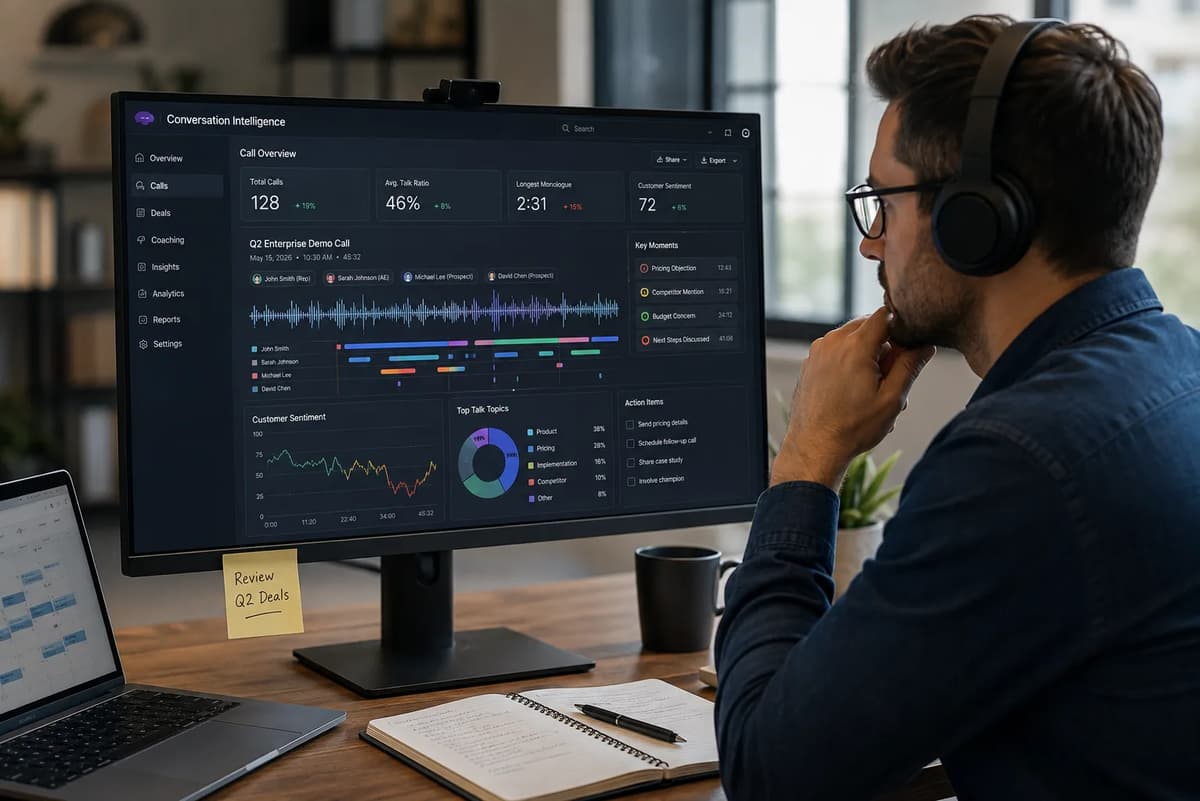
A deal looks healthy in the CRM. The rep says the buyer liked the demo. The next step is logged. Forecast says commit. Then somebody opens the recorded call and finds the moment the deal actually changed: the prospect asks a pricing question, the answer runs too long, the buyer's language becomes guarded, and the meeting ends without the concrete commitment everyone thought they had.
Ten years ago, finding that moment required a manager to sit through 45 minutes of recording, assuming the call had even been recorded. In 2026, a conversation-intelligence system can transcribe the meeting, isolate objections, identify missing next steps, surface changes in engagement, connect those signals to the opportunity, and put the relevant passage in front of a manager before the next pipeline review. Gong's conversation-intelligence platform turns unstructured customer communication into structured data, according to the company, while its 2026 product releases increasingly connect those insights to AI agents that can take action.
That is why Conversation Intelligence in Sales Hacking in 2026 deserves to be treated as a discipline of its own. It is not the same problem as automating prospecting, writing another outbound sequence, or enriching a contact list.
For learners building that broader systems mindset, the Refonte Learning Sales Hacking Program already includes Data-Driven Sales Strategies, CRM mastery, automation, qualification, and funnel optimization. The published curriculum does not say that it teaches Gong, Chorus, Clari, or conversation intelligence specifically, so the useful connection is foundational: learning how to turn sales activity into evidence before learning to operate a specialized intelligence platform.
This guide separates what conversation intelligence can genuinely do from what vendors merely claim it can do, examines Gong's unusually visible 2026 product development, looks closely at Chorus and ZoomInfo, places Clari in the category without inventing statistics, and explains the sales hacker skills for 2026 that revenue teams increasingly need.
The Moment an AI Caught What the Sales Team Missed
The most expensive phrase in a pipeline review is often, “I think they're still interested.”
That sentence tells me the team is working from memory rather than evidence. The rep remembers the prospect laughing during the demo, remembers the champion saying the product looked useful, and remembers a friendly closing exchange; what they may not remember is that procurement appeared for the first time, budget language changed from “approved” to “we need to see,” and nobody secured a dated next action.
Conversation intelligence changes that operating rhythm because the manager does not have to choose between trusting the rep's summary and replaying the entire meeting. Gong's call-recording product materials describe systems that capture calls and meetings, transcribe them, detect topics and buyer signals, associate interactions with accounts and opportunities, and surface risks or coaching moments for review.
The practical sequence looks like this:
The meeting is captured and transcribed.
AI identifies a pricing objection, competitor mention, missing decision-maker, or change in engagement.
The signal is connected with the relevant account or opportunity.
A manager sees an alert or summary instead of discovering the issue weeks later.
The manager jumps directly to the underlying conversation and decides whether the AI interpreted it correctly.
Coaching and deal strategy happen around the evidence rather than the rep's reconstruction of the evidence.
Gong's AI Deal Monitor, for example, is marketed as detecting deal signals such as budget constraints or changing priorities and allowing users to drill back to the conversation from which the signal was derived. Gong also markets AI Deal Predictor as assigning probability-style deal-health scores so teams can prioritize opportunities.
That final step, returning to the evidence, matters more than most feature comparisons admit.
When I think about AI deal risk detection, I do not want a salesperson blindly repeating, “The AI says this deal is red.” I want the AI to tell us why it believes the deal is deteriorating and then let a human inspect the call, email, stakeholder pattern, or lack of activity responsible for the warning.
That is the shift from “AI as oracle” to “AI as inspection system.” The second model is far more useful in real revenue operations.
It also explains why the prospect's apparent “tone change” should not be treated as mind-reading. A useful system may flag a segment because sentiment indicators, word choice, interruptions, talk patterns, objections, or engagement signals changed; the manager should then listen to that section and apply context rather than declaring that software has discovered the buyer's private emotional state. Gong lists sentiment and talk-ratio analysis among common conversation-intelligence capabilities, but those outputs are still analytical signals, not direct access to intent.
What Conversation Intelligence Actually Does
Strip away the category language and conversation intelligence performs a simple but powerful transformation:
unstructured sales conversation → searchable evidence → structured signal → recommended action.
Gong currently defines conversation-intelligence software as AI-powered technology that automatically captures, transcribes, and analyzes business conversations, including calls, meetings, emails, and related interactions. Clari similarly describes the category as recording, transcribing, and analyzing conversations for topics, sentiment, keywords, coaching, and revenue insights.
That distinction matters because recording a Zoom call is not conversation intelligence.
Layer | What happens | Sales-operations value |
Capture | Calls, meetings, emails, and related activity are collected | Creates an inspectable record |
Transcription | Speech becomes searchable text | Removes dependence on manual notes |
Classification | Topics, objections, competitors, questions, next steps, and other patterns are labeled | Turns conversation into structured fields |
Measurement | Talk ratios, engagement patterns, methodology adherence, and similar metrics are calculated | Supports coaching and benchmarking |
Deal intelligence | Signals are associated with opportunities, accounts, stages, and stakeholders | Enables risk inspection |
Prediction | Historical and current signals feed scoring or forecasting models | Adds another input to prioritization |
Execution | AI drafts follow-ups, alerts users, prepares summaries, or launches governed workflows | Moves from analysis toward action |
This is what separates modern AI sales call analysis from a meeting-transcription app. The value is not having a transcript; the value is connecting something said at minute 18:42 to a deal-management decision at 9:00 the following morning. Gong explicitly positions its current platform around that connection between conversation data, pipeline, coaching, forecasting, and workflow execution.
There is also a useful distinction between conversation intelligence and revenue intelligence.
Conversation intelligence starts with what happened in the interaction. Revenue intelligence expands the evidence set to opportunity history, CRM information, emails, engagement, pipeline state, account context, forecast submissions, and sometimes third-party signals. Clari's explanation of conversation intelligence versus revenue intelligence makes essentially this distinction, describing conversation intelligence as interaction analysis and revenue intelligence as the broader use of sales data to understand deal and revenue outcomes.
This is why the phrase revenue intelligence platforms in 2026 increasingly describes products that have grown well beyond call recording. Gong now markets a Revenue AI OS spanning conversations, forecasting, enablement, engagement, agents, and a shared data layer; Clari embeds conversation intelligence inside its broader revenue platform; ZoomInfo connects Chorus conversation data with CRM, account, contact, intent, and go-to-market signals.
For a sales hacker, the important question is therefore not, “Does it record calls?”
Ask instead:
What does the system convert into structured data?
Can I trace a risk signal to its source?
Does the platform learn our sales methodology or only generic keywords?
Can the signal trigger a useful workflow?
Does conversation data improve our CRM, coaching, qualification, or forecasting process?
· Can humans challenge an AI interpretation before it affects important decisions?
Those are systems questions, which is exactly why conversation intelligence belongs inside sales hacking rather than merely inside call recording.
Gong's 2026 Push Toward Agentic Execution
Gong provides the clearest dated public evidence that conversation intelligence is moving from passive analysis toward execution.
On June 24, 2026, Gong announced “Mission Big Dipper.” The company described the release as an expansion of its Revenue AI OS built around the Gong Revenue Harness, expanded Gong Assistant capabilities, Custom Agents, and new enablement functions.
That matters because earlier conversation-intelligence workflows usually ended with an insight:
Risk detected. Manager notified. Human figures out what to do.
The 2026 product direction is increasingly:
Risk detected. Context assembled. AI performs or prepares the next governed action. Human supervises where required.
Gong's June launch says Custom Agents can be configured in plain language by defining triggers, required data, outputs, and destinations. One of Gong's own examples is a RevOps agent monitoring accounts above a specified value, flagging risks, and generating structured summaries for pipeline reviews; another example pulls competitor mentions from recent calls when deals start going dark.
A month later, on July 30, 2026, Gong published a more concrete account-management description of Gong Assistant. The company says users can ask questions grounded in customer interactions, investigate renewal risk, identify engaged stakeholders or competitor mentions, and move from those answers into outputs such as executive summaries, renewal plans, or follow-up communication.
The 2026 progression therefore looks like this:
Conversation capture: What was said?
Analysis: What signal does it contain?
Context: Which account, deal, stakeholder, or historical pattern does it belong to?
Recommendation: What should the seller or manager do?
Agentic execution: Which parts of that action can the system prepare or perform under defined controls?
That fifth layer is the important one.
What "Mission Big Dipper" Actually Adds
The phrase “agentic AI” is now used so loosely that I would never buy software based on the label alone.
Gong's June 24 announcement is more specific. Its Revenue Harness is positioned as a governance and orchestration layer controlling how agents plan, execute, and hand work back to humans, while Custom Agents let business users create organization-specific workflows without treating every automation as an engineering project.
The release also expanded Gong Assistant and Gong Enable. Gong announced AI Builder, a standalone Assistant workspace, Assistant inside Account Console, AI Coach for role-play feedback, AI-generated scorecards, and Dry Run functionality that uses actual deal and account context to make practice scenarios more relevant to upcoming meetings.
As a sales-operations design, that creates an interesting closed loop:
real interaction → analyzed behavior → coaching rule → simulated practice → live interaction → measured behavior.
That is significantly more strategic than simply keeping a call library.
Gong's January 16, 2026 review of its 2025 research gives some sense of the data strategy behind that loop. Gong says its researchers analyzed tens of millions of interactions, including 1.8 million opportunities for its multi-threading analysis and 7.1 million opportunities for its analysis comparing heavy AI users with non-users. These remain Gong's own observational analyses rather than randomized experiments, so their correlations should not automatically be interpreted as causal effects.
For example, Gong reported that successful deals in its 1.8-million-opportunity analysis involved substantially broader stakeholder engagement and that frequent AI users generated more revenue in its 7.1-million-opportunity dataset. Those findings are useful for forming hypotheses about seller behavior, but a sales-ops team should still test whether the same patterns hold within its own segment, product, ACV, and sales motion.
That is the practitioner interpretation of Gong's AI analysis of sales calls in 2026: the competitive edge is becoming less about recording more conversations and more about operationalizing what the conversations reveal.
Reading Gong's Case Studies With the Right Amount of Skepticism
Vendor case studies are useful. Vendor case studies are not controlled experiments.
The correct response is neither to repeat every percentage as proof nor to dismiss every customer story because a vendor published it. I use them as implementation evidence: this company says it used the product this way and reports this outcome; now determine whether the mechanism is relevant to our environment.
Gong currently publishes several striking customer results:
Gong customer story | Vendor-published result | Mechanism described by Gong | Confidence treatment |
Allvue | 14% shorter new-logo sales cycles; 44% increase in qualified close rates | Standardized discovery, AI Tracker, scorecards, coaching, playbooks | Useful case evidence; not a general causal benchmark |
Experian Employer Services | 25% higher win rate; 10% sales-volume growth | Unified interaction data, deal prioritization, risk identification, forecasting | Useful case evidence; vendor-published |
GHX | 85% reduction in ramp time, from roughly three months to as little as two weeks | Searchable call library, coaching, snippets, deal context | Useful onboarding case; vendor-published |
Health & Safety Institute | Gong headlines “4x forecasting efficiency”; body says forecast-prep efficiency improved 2–4x | Conversation visibility plus Gong Forecast | Treat 4x as the upper end of Gong's reported range |
Gong's Allvue case study says the company reduced new-logo sales-cycle length by 14% and raised qualified close rates by 44% after implementing Gong's Revenue AI OS and playbooks. The story describes standardized discovery criteria, an AI-generated call score, scorecards, AI Briefer, and analysis of behaviors associated with won and lost deals.
The Experian Employer Services story reports a 25% increase in win rate and 10% sales-volume growth. Gong attributes the operating change to moving from fragmented, static forecasting toward a system connecting customer interactions, predictive insights, prioritization, AI Deal Predictor, and risk monitoring.
Gong's GHX case study is especially relevant to AI call coaching for sales teams because the reported improvement is about ramp and manager behavior rather than simply revenue. Gong says GHX reduced the time for new representatives to understand their books of business from as long as three months to within their first two weeks, which Gong summarizes as an 85% reduction in ramp time; the customer story also reports rep talk time dropping from around 80% to around 60%.
Gong's Health & Safety Institute case study requires more precise wording than the headline alone provides. Gong titles the customer story around “4x forecasting efficiency,” while the outcome section describes managers becoming 2–4x more efficient in forecast preparation; that is the range I would carry into an investment memo rather than silently converting an upper bound into a universal result.
There is another crucial confidence issue: the Gong customer-story pages reviewed for these four examples do not display a visible publication date in the page content I could verify. By contrast, Gong's Mission Big Dipper, Gong Assistant, and Gong Labs articles clearly display June 24, July 30, and January 16, 2026 publication dates, respectively.
So do not write, “In 2026, Allvue achieved a 44% higher close rate” unless you have independent evidence establishing when the measured result occurred.
The accurate formulation is:
Gong's currently published Allvue case study reports a 44% increase in qualified close rates, but the public case-study page does not visibly date the result.
That one sentence is the difference between evidence-based sales writing and copying a vendor landing page.
Chorus and the ZoomInfo Platform Play
Chorus approaches the category from a different strategic position because it sits inside ZoomInfo.
ZoomInfo acquired Chorus.ai in 2021. At the time, ZoomInfo said Chorus had 14 granted patents and described it as a conversation-intelligence technology for extracting insight from customer interactions; current ZoomInfo-owned materials continue to describe Chorus as backed by 14 technology patents and proprietary machine learning.
The practical distinction is this: Chorus is the conversation layer, while ZoomInfo increasingly wants the conversation layer to participate in a larger go-to-market data system.
ZoomInfo's June 2026 comparison of Gong and Chorus describes Chorus as focusing on call recording, transcription, coaching, and deal intelligence while connecting conversation data with ZoomInfo's B2B account and contact data. The same ZoomInfo-owned material describes Chorus conversation transcripts as inputs to its broader GTM Context Graph alongside CRM records, intent signals, email activity, and other context.
That gives Chorus a different buying thesis:
Buying question | Gong-style thesis | Chorus/ZoomInfo thesis |
What should surround conversation data? | Revenue execution, forecasting, engagement, enablement, agents | B2B data, contact intelligence, intent, CRM and GTM context |
Core conversation use | Recording, analysis, coaching, risk detection | Recording, analysis, coaching, deal context |
Data advantage promoted by vendor | Large corpus of revenue interactions | Conversation data connected with ZoomInfo data |
Operational question | “How do we turn interactions into revenue actions?” | “How do we connect what was said with who the buyer is and other GTM signals?” |
ZoomInfo University currently calls Chorus “the fastest-growing conversation intelligence tool” and attributes it to 14 technology patents and proprietary ML. That is a ZoomInfo marketing claim, not independently verified evidence that Chorus currently leads the category on revenue growth, seat growth, customer growth, or market share.
That distinction matters when evaluating the claim.
There is solid evidence for what Chorus is designed to do. ZoomInfo's MongoDB customer story describes teams using Chorus recordings for call review, onboarding, playlists, sales-to-customer-success handoffs, collaboration, and sharing individual call snippets with product, engineering, support, and customer-success stakeholders.
That is a credible conversation-intelligence use case even without an impressive percentage attached to it.
Why the MongoDB Numbers Aren't Chorus-Specific
This is where attribution often goes wrong.
ZoomInfo prominently markets a MongoDB statement saying that, using ZoomInfo, the company cut sales cycles by 30% and grew revenue 25%. The wording on ZoomInfo's own main site attributes those figures to ZoomInfo, not specifically to Chorus alone.
Meanwhile, ZoomInfo's dedicated MongoDB case study clearly documents significant Chorus usage. MongoDB staff describe Chorus as useful for recording customer calls, reviewing conversations, coaching, onboarding, handoffs, preserving winning examples, and sharing technical customer feedback internally.
Both things can be true without proving that Chorus independently generated the 30% and 25% numbers.
That means the careful formulation is:
MongoDB is a documented Chorus user, and ZoomInfo separately markets a MongoDB result of 30% shorter sales cycles and 25% revenue growth for its broader ZoomInfo relationship; the public evidence does not isolate those percentages as a Chorus-only effect.
I would reject a business case that changed that sentence to, “Chorus shortens sales cycles by 30%.”
Attribution discipline matters because conversation intelligence frequently sits next to CRM changes, new sales methodology, enablement programs, manager coaching, lead-data improvements, new territories, compensation changes, or product-market shifts. Unless the design isolates variables, the software's role is part of a system, not a clean laboratory treatment.
Where Clari Fits (and Where the Data Gets Thin)
Clari belongs in the category.
Its current product site explicitly markets Clari Copilot as conversation-intelligence and coaching software. Clari says Copilot records and transcribes conversations, captures buyer signals, feeds those signals into pipeline and forecasting workflows, captures intent, objections and next steps, supports coaching, and connects conversation data with its broader revenue platform.
That is enough to place Clari alongside the recognized platforms relevant to conversation intelligence.
What I would not do is invent a Clari-specific 2026 performance statistic just because Gong and ZoomInfo have numbers available.
The strongest directly verifiable Clari materials explaining the category and Copilot's positioning include current product pages plus dated blog material from 2024 and 2025. A Clari customer-oriented article dated August 28, 2025, for example, discusses using real-time conversation intelligence, coaching, CRM integration, and risk signals; that is useful product-positioning evidence, but it is not dated 2026 product-performance research.
The safe summary is:
Clari Copilot is an active conversation-intelligence and coaching product in Clari's current portfolio.
Clari markets real-time transcription, buyer-signal capture, coaching, CRM updates, and connections to forecasting and opportunity inspection.
Older Clari materials also describe battlecards, playlists/gametapes, call analysis, and coaching workflows.
The public evidence does not support attaching a specific 2026 outcome percentage to Clari.
Naming a Player Without Overstating What's Verified
This is an underrated analytical skill.
Weak comparisons often assume every vendor needs a corresponding number: Gong gets 25%, Chorus gets 30%, and Clari needs another percentage so the table looks balanced. That is exactly how weak statistics propagate.
Evidence does not need to be symmetrical.
The responsible comparison is based on what can be verified:
Platform | What is well-supported in public material | What should carry a warning |
Gong | Dated 2026 product releases, current product capabilities, multiple vendor customer stories | Customer-story outcomes are vendor published and pages may be undated |
Chorus / ZoomInfo | Current ZoomInfo-owned materials, 14-patent claim, documented MongoDB Chorus use | “Fastest-growing” is vendor marketing; MongoDB's 30%/25% figures should not be isolated to Chorus |
Clari | Current Copilot product pages and earlier dated CI materials | Do not manufacture 2026 performance statistics from unverifiable material |
That is the confidence framework I would want an analyst on my own revenue-operations team to use.
What These Tools Can Actually Detect in a Call
A conversation-intelligence platform is most useful when it detects observable sales signals rather than pretending to know what a buyer is secretly thinking.
Gong's published conversation-intelligence materials list capabilities including transcription, keyword and topic detection, talk-ratio analysis, sentiment-related analysis, deal tracking, competitive mentions, buying signals, risks, and coaching opportunities. Its current call-recording materials also describe searching calls by topic, deal stage, competitor mention, or rep.
Clari markets closely related capabilities: transcripts, buyer signals, intent, objections, next steps, live battlecards, coaching and connections into the broader revenue process.
In practice, I divide detected signals into four categories.
Signal category | Examples | What the manager should ask |
Content | Pricing, competitor, integration, security, timeline, budget, legal | “What exactly did the buyer say?” |
Behavior | Talk ratio, monologues, interruptions, question frequency | “Did our behavior help or hurt discovery?” |
Deal process | Next step, decision-maker, procurement, champion, approval process | “Is the opportunity actually qualified?” |
Engagement/context | Stakeholder involvement, activity changes, repeated objections, conversation themes | “Is momentum strengthening or weakening?” |
The highest-value signal is often not the glamorous one.
A prospect saying, “Your price is too high,” is obvious. A capable rep hears it without AI.
The more interesting signal is that the deal has progressed through three calls without the economic buyer ever appearing, or that a competitor has been mentioned repeatedly but never entered the CRM, or that the rep keeps ending discovery meetings with a vague “I'll follow up next week” rather than mutual, dated commitments.
That is where sales coaching automation becomes useful: the machine can inspect far more interactions than a manager can manually review.
Allvue's Gong case study gives a concrete example. Gong says Allvue built discovery criteria around value articulation, adherence to its discovery framework, and concrete next-step discipline, then used AI and scorecards to make those expectations visible and coachable across calls.
Notice what that system is really doing.
It is not asking AI to decide whether somebody is a “good salesperson.” It converts the company's own sales methodology into observable behaviors, then checks whether those behaviors appeared in the conversation.
That is much more defensible.
The same principle applies to onboarding. GHX's vendor-published story describes managers and reps referring directly to snippets of calls, sometimes specific minute ranges, during coaching conversations. Gong reports that recorded interactions also gave new hires faster access to historical account context.
A mature sales team therefore moves from:
“Listen to more calls.”
to:
“Define the behaviors that matter, detect them consistently, inspect the evidence, coach the gap, and measure whether behavior changed.”
That is the operating model behind effective AI call coaching for sales teams.
From Call Recording to Deal Risk Scoring
The leap from a transcript to a deal-risk score is where conversation intelligence becomes revenue intelligence.
A transcript by itself says that a prospect mentioned procurement. A deal-intelligence system asks whether procurement arrived unusually late, whether the economic buyer is engaged, whether the account has gone quiet, whether the close date has moved repeatedly, whether competitors have appeared, and whether those patterns historically correlate with deals your team wins or loses.
Gong's AI agents for revenue teams include several functions around that problem. AI Deal Monitor surfaces deal risks; AI Deal Reviewer checks opportunities against a sales methodology; AI Deal Predictor produces a closing-potential score; AI Revenue Predictor uses pipeline signals to support revenue forecasting.
The conceptual pipeline is:
1. Capture the event. The call, email, or meeting enters the system.
2. Extract features. Topics, objections, speakers, next steps, stakeholder references, activity and other signals become machine-readable.
3. Associate the evidence. Signals map to contacts, accounts, deals, stages and CRM history.
4. Compare with patterns. The system evaluates current evidence against learned or configured patterns.
5. Generate risk or prediction. The opportunity receives an alert, score, or explanation.
6. Return to evidence. A seller or manager verifies the source.
7. Intervene. The team changes deal strategy, coaching, stakeholder coverage, or forecast treatment.
That seventh step is the part that creates economic value.
A beautifully accurate risk model that nobody checks before the weekly forecast meeting is just an expensive dashboard.
Gong's Experian story illustrates the intended workflow. The customer says it moved from static forecasting toward data-driven deal prioritization, while Gong's case study describes AI Deal Predictor and Deal Monitor helping surface opportunity health and potential trouble earlier. The reported outcome is a vendor case-study result, but the operating mechanism is exactly what a RevOps implementation should examine.
How Tone and Language Signals Get Turned Into Alerts
This is where I would slow down any implementation team tempted by the phrase “AI reads emotion.”
Language can produce useful sales signals without pretending to measure an individual's inner emotional state with certainty.
A system can detect that a buyer moved from “we'll implement in September” to “we still have to evaluate whether this makes the budget.” It can detect an increase in competitor mentions, a newly introduced legal objection, a long rep monologue immediately after a pricing question, or a repeated lack of explicit next steps.
Those are observable signals.
Some products also market sentiment-related features. Gong includes sentiment among common conversation-intelligence analytics, and ZoomInfo-owned materials describe Chorus as analyzing customer interactions for coaching and deal context.
For global teams, however, emotion inference also raises a regulatory issue that cannot be ignored in 2026. The EU AI Act prohibits certain uses of AI systems to infer emotions of natural persons in workplace and educational contexts, except for specified medical or safety purposes; legal review is therefore essential before turning “emotion recognition” into a performance-monitoring system for European employees.
Recording itself also requires governance. The UK Information Commissioner's Office says employers should consider necessity and proportionality when monitoring calls, inform workers about call monitoring, and inform customers where business calls are monitored for purposes such as training or quality control.
So the rule for a sales team should be simple:
Use AI to surface evidence, not to manufacture psychological certainty.
A tone flag should tell the manager where to listen. It should not become a hidden personality score that decides whether a salesperson gets promoted.
Coaching at Scale: What Changes for Sales Managers
Traditional call coaching has a sampling problem.
A manager responsible for eight sellers cannot deeply review every discovery call, demo, negotiation, renewal, and executive meeting. What usually happens is predictable: the manager attends the largest opportunities, listens to a few recordings when something goes wrong, and disproportionately coaches the reps who ask for help.
Conversation intelligence can change the sampling model.
Traditional coaching | Conversation-intelligence coaching |
Manager selects a few calls | System can inspect far more eligible interactions |
Feedback depends heavily on memory | Feedback can link to exact recorded moments |
Coaching may reflect manager preference | Scorecards can anchor coaching to a defined methodology |
Best calls disappear in meeting archives | Winning moments can become searchable examples |
Rep waits for manager availability | AI-generated summaries or coaching can provide earlier feedback |
Coaching activity is hard to measure | Scorecard and review activity can be tracked |
Gong's Allvue customer story is especially relevant here. Gong says managers previously lacked enough time to review long calls, while AI Briefer and scorecards helped them move more quickly to specific coaching moments; the case study reports completed scorecards rising from a historical average of 23 to 218 in one quarter, nearly a tenfold increase in activity.
That is a more interesting result than a generic “AI makes coaching better” claim.
The operational bottleneck in coaching is often not knowing what good selling looks like. It is getting the manager from a 45-minute recording to the five minutes worth discussing before the next one-on-one.
GHX's story describes another model: sellers themselves direct managers to specific sections of calls so the one-on-one becomes a shared review of evidence. Gong reports that GHX also used conversation data to reduce rep talk time and make discovery more consultative.
Gong's June 2026 Mission Big Dipper release extends this idea into simulated practice. AI Coach is designed to provide personalized post-role-play feedback, while Dry Run uses live account context to generate practice that resembles an upcoming customer conversation.
This creates three distinct coaching layers:
Pre-call: prepare from account and conversation history.
In-development: practice a realistic scenario and receive AI-supported feedback.
Post-call: inspect actual performance and connect it to scorecards, deal outcomes, and coaching.
That is a much stronger architecture for sales coaching automation than replacing the manager with a chatbot.
The manager's role actually becomes more sophisticated.
Managers need to decide which behaviors deserve measurement, distinguish correlation from causation, challenge bad AI classifications, interpret outliers, protect reps from metric gaming, and turn a surfaced problem into a useful coaching conversation.
If your scorecard says every excellent discovery call must contain exactly 12 questions, mediocre reps will learn to ask 12 mediocre questions.
The technology does not remove the need for sales judgment. It makes bad measurement more scalable too.
Forecasting Gets Better When It's Based on What Was Actually Said
Forecast calls fail when the CRM describes what the salesperson hopes will happen rather than what the customer has committed to do.
That is not always dishonesty. CRM information decays because updating it competes with actual selling, reps interpret stage criteria differently, buyer conditions change between meetings, and critical information lives inside calls that never becomes a structured field.
Conversation intelligence gives forecasting systems another evidence stream.
Gong currently positions AI Deal Predictor, AI Deal Monitor, AI Deal Reviewer, and AI Revenue Predictor as complementary tools: deal monitoring surfaces risk signals, methodology review tests qualification, deal prediction assesses closing potential, and revenue prediction adds AI analysis to the forecast.
In an evidence-based pipeline review, I would want questions like these:
Did the buyer explicitly confirm the implementation date?
Has the economic buyer participated?
Did procurement, legal, security, or finance appear?
Was pricing discussed?
Was a concrete next meeting scheduled?
Has stakeholder engagement broadened or narrowed?
Did a competitor enter the conversation?
Has meaningful buyer activity fallen since the last stage change?
Is the rep's CRM forecast consistent with what the customer actually said?
This does not mean letting a model replace the forecast call.
It means giving the forecast call an independent source of evidence.
Experian's vendor-published case study says Gong helped its team move from a static forecast toward more dynamic prioritization and earlier risk identification. Health & Safety Institute's customer story says managers improved forecast-preparation efficiency by 2–4x after using Gong across its customer-success revenue process, although those numbers remain Gong-published customer results rather than independently controlled studies.
Gong's January 2026 research offers another useful clue about forecast quality: its analysis of 1.8 million opportunities found successful deals had broader buyer participation, while Gong reported particularly strong effects for multi-threading on larger opportunities. Because this is Gong's own observational dataset, I would use multi-threading as a risk feature worth testing rather than a universal formula that guarantees a win.
That is how I would evaluate conversation-intelligence platforms for sales forecasting in 2026.
Do not ask whether the AI can produce a prettier number than Salesforce.
Ask whether it gives the revenue leader better evidence for challenging the assumptions behind that number.
The Skills Gap This Creates for Sales Hackers
Once sales conversations become analyzable data, sales hacking expands.
A sales hacker who only knows how to build outbound sequences is operating one side of the revenue system. The modern role also needs to understand what happens after a meeting gets booked: discovery quality, qualification, buyer language, stakeholder coverage, objection patterns, sales methodology, deal velocity, coaching, pipeline risk, and forecast evidence.
That creates a new capability stack.
Skill | Why it matters with conversation intelligence |
Sales methodology | You need to define what the system should measure |
CRM architecture | Conversation signals must map correctly to deals, contacts and fields |
Data interpretation | AI outputs are probabilistic signals, not automatic truth |
Experiment design | You need to test whether coaching actually changes outcomes |
Call-quality analysis | You must distinguish substantive selling behavior from vanity metrics |
Automation design | Useful signals should trigger sensible workflows |
Governance | Recording, access, monitoring and AI use need controls |
Manager enablement | Technology fails if managers cannot turn insight into coaching |
Forecast literacy | Conversation evidence matters only when connected to pipeline decisions |
For somebody coming from an SDR background, the transition is natural but not automatic. Refonte Learning's SDR to Sales Hacker career path already frames sales hacking as a move from merely executing the sales system toward designing, automating, measuring, and improving it.
Conversation intelligence adds another data source to that job.
Instead of asking only, “Which email variant produced more replies?” the sales hacker can ask, “Which discovery behaviors appear more frequently in opportunities that advance?”
Instead of asking only, “Which lead-scoring rule predicts a meeting?” ask, “Which qualification signals inside the first meeting predict a high-quality opportunity?”
Instead of asking only, “How many calls did the rep make?” ask, “Did those calls uncover decision criteria, economic impact, internal stakeholders, and a mutually committed next step?”
That is a much higher level of sales analytics.
Why "Data-Driven" Now Means Analyzing Conversations, Not Just Metrics
For years, “data-driven sales” mostly meant dashboard metrics.
Pipeline created. Opportunities opened. Average sales cycle. Conversion by stage. Win rate. Activity volume. Forecast coverage.
Those still matter, but they are largely outcome and process metrics. Conversation intelligence adds something that dashboards have historically struggled to capture: evidence about how the selling itself happened.
Refonte Learning's live Sales Hacking curriculum lists Data-Driven Sales Strategies as one of seven core modules, alongside Sales Funnel Optimization, Lead Qualification, Automation, CRM Mastery, and a capstone project. It does not name Gong, Chorus, Clari, or conversation intelligence specifically.
The useful bridge is therefore conceptual.
A learner should be able to take a statement such as:
“Our top reps are better at discovery.”
and turn it into:
“Which observable discovery behaviors differentiate our strongest calls, how frequently do they appear, do they correlate with stage progression, and can a coaching intervention increase their adoption?”
That is the data-analysis mindset conversation intelligence rewards.
It also protects teams from simplistic AI advice.
Gong's January 2026 analysis, for example, says high-performing sellers were more consistent in talk-to-listen behavior across won and lost opportunities than lower performers in its dataset. The right lesson is not to train every salesperson to hit one magic talk percentage; it is to investigate whether call behavior reflects a repeatable discovery process and test that hypothesis against your own outcomes.
The best sales hacker skills for 2026 therefore combine technical literacy with skepticism.
You need enough AI knowledge to use the signal and enough sales knowledge to know when the signal is nonsense.
Where This Overlaps (and Doesn't) With Outbound Prospecting Tools
Conversation intelligence is not another AI SDR.
That distinction matters because Refonte Learning already has dedicated coverage of AI SDR tools compared: Clay, 11x, and Artisan, which focuses on prospect research, enrichment, outbound sequencing, personalization, deliverability, replies, and meeting generation.
Conversation intelligence primarily becomes valuable after a real conversation exists to analyze.
Sales-hacking discipline | Primary question | Typical data | Representative tools |
Prospecting / enrichment | Who should we contact? | Contact, firmographic, intent and web data | Clay, ZoomInfo and enrichment platforms |
AI SDR automation | How can we execute outbound efficiently? | Prospect data, sequences, email and LinkedIn interactions | 11x, Artisan and related platforms |
Conversation intelligence | What actually happened in the buyer conversation? | Calls, meetings, transcripts, speaker and topic signals | Gong, Chorus, Clari Copilot |
Revenue intelligence | What does all available evidence imply about the opportunity or forecast? | CRM, conversations, activity, stakeholders, pipeline history | Broader Gong, Clari, ZoomInfo-style platforms |
The boundaries increasingly overlap.
Gong has expanded into engagement. ZoomInfo spans prospect data and Chorus conversation intelligence. Clari combines conversation intelligence with opportunity inspection and forecasting. Modern platforms are deliberately trying to own more of the revenue workflow.
But the operating problems remain distinct.
Clay can help you enrich a list and research an account before a message is sent. Conversation intelligence asks whether your rep actually discovered the buyer's business problem when that account finally joined a meeting.
An AI SDR can draft a personalized outreach sequence. A conversation-intelligence platform can surface that, three meetings later, the champion repeatedly mentioned an executive stakeholder the rep has still not contacted.
Outbound automation asks:
How do we create more qualified conversations?
Conversation intelligence asks:
What do we learn once those conversations occur, and how do we use that evidence to improve the revenue system?
Getting Started Without a Full Platform Rollout
The worst way to implement conversation intelligence is to buy 100 licenses and then ask managers what they want to do with them.
Start with an operating problem.
Maybe managers cannot review enough discovery calls. Maybe opportunities repeatedly die after demo. Maybe forecast calls depend entirely on rep sentiment. Maybe new hires take too long to learn what strong discovery sounds like. Maybe competitors appear in calls months before anyone updates battlecards.
Choose one.
I would structure a first implementation around this sequence:
Define one revenue problem. Example: weak discovery qualification.
Define five or fewer observable behaviors. Economic impact discussed, decision process uncovered, required stakeholder identified, clear pain articulated, dated next step confirmed.
Choose a representative call set. Include wins, losses, strong reps, developing reps and multiple segments.
Create a human baseline. Have experienced managers score a sample before trusting automated scoring.
Configure detection or scorecards. Teach the system what your methodology means.
Validate false positives and misses. Review where AI disagrees with skilled managers.
Pilot with a small manager group. Do not optimize around enthusiastic power users alone.
Measure behavior change. Did coaching become faster or more consistent?
Measure funnel consequences. Did qualification, conversion, velocity or forecast reliability improve?
Only then expand automation. Alerts and agents should follow validated signals, not precede them.
That approach also protects you from vendor-demo theater.
A demo can always find the objection in a perfectly recorded call. Your proof of concept should test accents, jargon, multiple speakers, noisy meetings, ambiguous language, incomplete CRM records, unusual sales motions, privacy settings, permissions, call association, and the edge cases that occur in your real business.
For AI sales call analysis, precision is only half the test.
The other half is operational usefulness.
Suppose the model correctly finds a competitor mention 94% of the time. That sounds excellent. But if managers already know about competitors from CRM notes, the feature may create little incremental value.
Now suppose another model detects missing mutual next steps with lower accuracy but catches ten late-stage deals each month where the CRM misleadingly shows a healthy close date.
The second workflow may be worth far more.
I would also establish governance before scaling recording. In the UK, the ICO advises that employee monitoring should be necessary and proportionate and that workers should understand the purpose and extent of monitoring; customers should also be informed where calls are monitored for purposes such as training or quality control. Rules vary across jurisdictions, so multinational deployments need jurisdiction-specific legal and privacy review.
Compensation belongs in a separate career discussion, not in a tool-selection decision.
Conversation-intelligence literacy may support paths into sales operations, enablement, RevOps, sales management, and growth-oriented roles, but a generic “conversation intelligence salary” would be misleading. Refonte Learning already maintains the Sales Hacking salary guide for 2026, which is the appropriate internal resource for role and compensation discussion.
A practical pilot scorecard might look like this:
Pilot metric | Baseline question | Improvement question |
Manager review time | How long does it take to find coachable moments? | Does AI materially reduce discovery time? |
Coaching coverage | What share of reps receive evidence-based coaching? | Does coverage expand without reducing quality? |
Signal precision | How often are surfaced risks genuinely useful? | Are false positives declining? |
Qualification quality | How many entered opportunities meet methodology criteria? | Does coaching improve qualified pipeline? |
CRM completeness | How often are next steps/risks missing from records? | Does automated capture reduce gaps? |
Forecast challenge rate | How often does conversation evidence contradict rep sentiment? | Are risks found earlier? |
Adoption | Do managers and reps actually use the output? | Does usage survive after novelty wears off? |
Do that before debating whether Gong has a prettier dashboard than Chorus.
The sales-ops question is not which product creates the most AI.
It is which system changes a decision that matters.
Building This Skill Set: The Refonte Learning Sales Hacking Program
The career opportunity created by conversation intelligence is larger than “learn Gong.”
Products change. Categories consolidate. AI features that seem advanced in August 2026 may become standard CRM functionality two years from now.
The durable skill is learning to treat revenue as a measurable system.
That is where the current Refonte Learning Sales Hacking Program fits. The live program page describes a three-month format requiring 12–14 hours per week and currently lists seven curriculum components: Introduction to Sales Hacking, Sales Funnel Optimization Techniques, Lead Qualification and Prioritization, Using Automation for Sales Growth, CRM Mastery: Tools and Tactics, Data-Driven Sales Strategies, and a capstone focused on optimizing a startup sales funnel.
Refonte Learning program fact | Current published detail |
Duration | 3 months |
Weekly commitment | 12–14 hours |
Curriculum | 7 listed modules/components |
Relevant foundation | Data-Driven Sales Strategies |
CRM/automation foundation | CRM Mastery and Using Automation for Sales Growth |
Mentor | Sarah Johnson, MBA, Department of Sales and Business Development |
Mentor experience | Refonte describes her as having 10+ years in sales-funnel optimization and sales automation |
One-time fee | $300 |
Installment option | $204 + $98 |
Listed comparison price | $387, with the site displaying 30% off |
Background guidance | No formal degree required; sales, marketing or business background recommended |
Separate admission prerequisite | Applicant must be working toward a bachelor's degree or higher |
Career results named by program | Sales Manager, Business Development Specialist, Growth Hacker |
These details come from the current public program page. The same page separately describes a $70,500+ starting career figure and roughly 90,000 annual job openings for Sales Hacking; those should be treated as Refonte Learning's own program marketing claims, not independently verified labor-market statistics.
The prerequisite wording also deserves to be read carefully. The program's “Requirement” section says no formal degree is required and recommends a sales, marketing, or business background, while its separate Admission Prerequisites section says applicants must currently be working toward a bachelor's degree or higher. Both statements appear on the live page, so prospective students should interpret eligibility according to the full admission requirement rather than only the first summary.
Sarah Johnson, MBA, is identified as the educational mentor in the Department of Sales and Business Development. Refonte describes her as a sales strategist with more than 10 years of experience in sales-funnel optimization and automation for high-growth startups.
The important claim I would not make is that this is a Gong course.
The published curriculum does not name Gong, Chorus, Clari Copilot, or conversation intelligence as a dedicated module. Refonte's page does identify tools such as Salesforce and HubSpot in its educational-path and FAQ material, but the specialist conversation-intelligence vendors discussed in this article are not part of the named seven-module curriculum.
That does not make the connection weak. It makes the connection more honest.
Conversation intelligence requires exactly the underlying thinking represented by the curriculum:
Sales Funnel Optimization teaches you to ask where revenue is leaking.
Lead Qualification and Prioritization teaches you what evidence should make one opportunity more credible than another.
Using Automation for Sales Growth teaches you to think in triggers, workflows and scalable execution.
CRM Mastery matters because conversation intelligence becomes much more valuable when interaction signals connect correctly to accounts and opportunities.
Data-Driven Sales Strategies provides the direct analytical foundation for converting behavior into measurable evidence.
The capstone reinforces the habit of treating the sales system as something you can diagnose and improve.
That is the right educational framing for Conversation Intelligence in Sales Hacking in 2026.
Do not memorize where Gong puts a button.
Learn why a manager would need the signal behind that button.
Learn why a pricing objection matters differently at discovery than at procurement. Learn why a close date without a buyer commitment is not forecast evidence. Learn why an AI-generated scorecard must reflect an actual sales methodology. Learn why a correlation between talk ratio and wins does not automatically mean forcing every rep toward the same ratio. Learn why a detected “tone change” is an invitation to inspect the call, not permission to treat a probability as human truth.
Gong's 2026 development makes the direction of travel unusually visible. Mission Big Dipper moves the platform toward governed agentic execution; Gong Assistant moves interaction evidence into question-and-action workflows; Gong's research operation continues mining large volumes of recorded revenue interactions for behavioral patterns.
Chorus shows another path: conversation intelligence embedded inside ZoomInfo's larger data and go-to-market environment. ZoomInfo's 14-patent and “fastest-growing” language should remain clearly labeled as vendor marketing, while MongoDB's documented Chorus usage should remain separate from ZoomInfo's broader 30%-shorter-cycle and 25%-revenue-growth attribution.
Clari demonstrates that conversation intelligence is also becoming part of broader revenue orchestration, but the public evidence does not support assigning it a specific 2026 outcome statistic.
Gong's customer stories illustrate why revenue teams care: Allvue reports shorter cycles and higher qualified-close rates, Experian reports a higher win rate, GHX reports dramatically faster ramp, and Health & Safety Institute reports substantially more efficient forecast preparation. The public pages do not show visible publication dates, so these results should be described as vendor-published case-study outcomes rather than “2026 industry benchmarks.”
That skepticism is not anti-AI.
It is the skill that makes AI useful.
The best sales hacker in 2026 is not the person with the most automation tabs open. It is the person who can look at a machine-generated signal, trace it to the underlying customer evidence, decide whether it matters, change the revenue process accordingly, and measure whether the change worked.
The new sales coach may be listening to every call.
The advantage still belongs to the human who knows what to do with what it heard.