
The news is filled with alarming headlines. It is said that new computer programs will soon replace your job.
This heightened anxiety has caused many to want to switch careers due to the fear. However, this useful industry statistic guide from the DoMyEssay team advises people to ignore the frightful stories and look at the actual figures.
If you are considering quitting your job in order to begin a new career in a stressful environment, take a look at the facts. The reality of jobs being replaced by AI provides more truth than what you see on the news.
What the Numbers Say About Job Loss
To know how the world is changing, it is necessary to examine the data on AI replacing jobs. It is true that things are very different now; however, entire job fields do not disappear overnight.
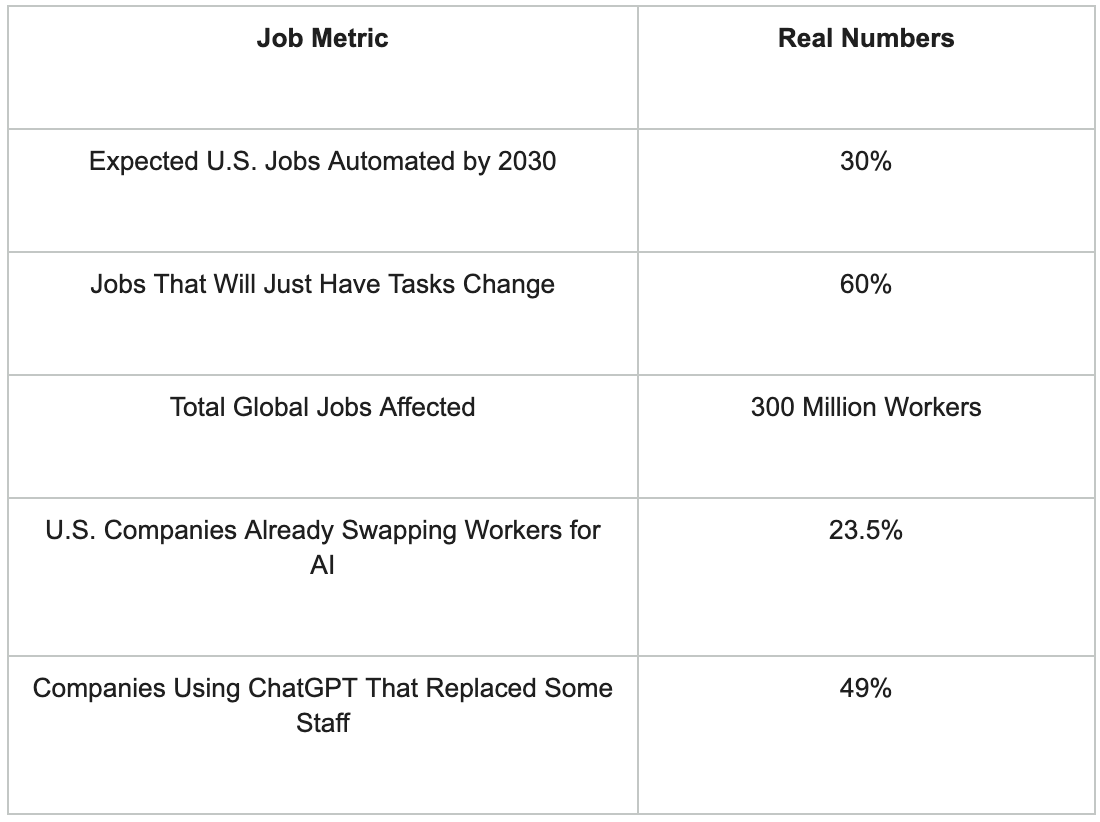
Research by the National University shows that 30 percent of current U.S. jobs could see automation by 2030. Yet, discussions about the possibility of AI taking jobs often ignore all the new positions being created at the exact same time.
When you consider the issue of AI job displacement, you can see that changing tasks in a daily routine is much more frequent than letting a job go completely. Workers may see some of their tasks being completed by computers, but they are still required to operate the system. This practical reality is why roughly 20 million U.S. workers are expected to actively retrain in new careers or operational AI systems over the next three years alone. To see how this shift breaks down across the current labor market, consider the foundational metrics collected by researchers:
Are Computers Set to Take Over Entire Fields?
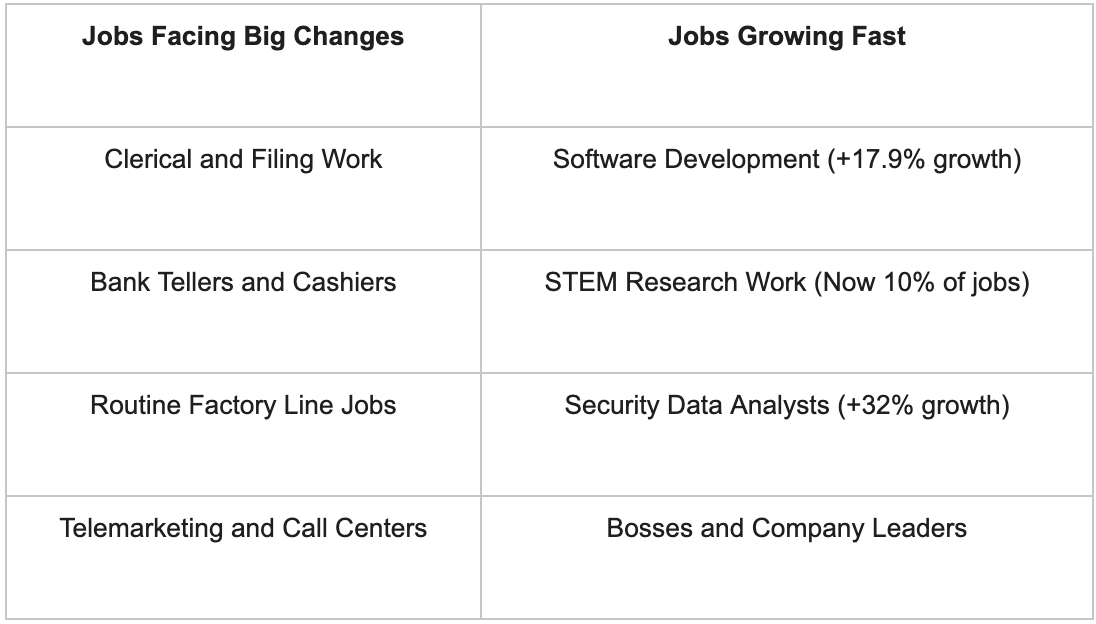
Many people are concerned about one major question: Is AI taking over jobs permanently? The exact figures for AI job replacement allow us to see the truth without fear. The clearest way to view this landscape is by dividing industries into those facing heavy automation and those experiencing human-led growth:
This contrast between pure data tasks and human expression shows up clearly in creative fields. If you speak to an experienced, skilled essay writer without AI, they will explain that human creativity cannot be replicated by computers. Writing a great essay requires real emotions, human logic, and a distinctive voice. An AI tool can write basic paragraphs; however, turning a lengthy essay into an excellent piece of work remains a human job. That's why a written essay remains valued at a high price in the present, despite all the new software available.
Looking Forward to 2030
In order to plan your future, you must think about what the jobs that are being automated will look like on the road ahead. Many people want to know how many jobs will AI replace by 2030?
National University shows that 14 percent of people across the globe will need to change careers because of AI by 2030. The broader impact of AI and jobs will hit monotonous, repetitive tasks first, but preserve the jobs that require real human problem-solving.
Here are some additional stats:
High-Income Workers: Individuals with college degrees utilize AI the most, with 53 percent of them using it on a daily basis.
Men vs. Women: In the U.S., 79 percent of women working are employed in positions with the highest risk of being automated, as compared to only 58 percent of men.
Younger Workers: Workers between 18 and 24 are 129 percent more likely to worry that computers could render their jobs obsolete, with 49 percent of Gen Z job seekers openly stating that widespread automation has already reduced the long-term value of their college degrees.
Corporate Utilization: About 35 percent of all businesses in the world employ AI in their day-to-day work today.
Technology Has Changed Before
It is possible to understand the reasons for job losses due to AI to a greater extent by looking back at the past. There are a lot of jobs that technology has replaced prior to this, which have actually helped to boost the economy.
When researching the historical list of jobs that were replaced by technology during the mid-20th century, look at the old telephone switchboard operators or simple factory sorters. These changes were a source of trouble initially, but eventually led to safer, better jobs for all.
To understand how this is happening, examine what is going on in the present moment:
● What jobs has AI already replaced: Simple telemarketing, basic data typing, and simple bookkeeping have been drastically reduced alongside routine manufacturing, assembly line positions, and script-based call center roles.
● What jobs are AI replacing: Routing of phone calls for customers and basic sorting are facing active automation, directly squeezing out medical transcriptionists, customer service representatives, and traditional credit analysts.
● Jobs replaced by AI this year: Entry-level office help is shrinking as companies implement new software, causing rapid employment drops for traditional bank tellers and cashiers as digital platforms expand.
● Jobs at risk from AI: General office work is at the greatest danger in the present, leaving clerical assistants, administrative secretaries, and data entry clerks highly vulnerable to upcoming software updates.
Making Your AI-Proof Skills Work
The best way to shield yourself from the threat of AI job displacement is not to earn a new diploma. Instead, you should master skills that computers can't duplicate.
Make sure you focus on communication, taking care of clients, and solving problems creatively. These human-centric "durable skills" now populate eight of the top ten most requested skill types in professional U.S. job postings, appearing in roughly 15 million recruitment forms annually. Pairing these with core data literacy is rapidly becoming the ultimate workplace currency, especially as businesses scramble to interpret an estimated 182 zettabytes of incoming organizational data.
Once you are proficient in those areas of expertise, the technology no longer appears as a threat. It becomes an instrument that you employ to complete your work more efficiently.
In the final analysis, automation taking jobs is a process designed to aid humans, not take them away.
Your Plan of Action
If you are wondering will AI take my job, you should instead focus on learning to use the latest tools. The ongoing evolution of the modern workplace confirms that the most secure workers are those who can work alongside the latest software.
Don't run away from your preferred industry. Instead, you should learn to operate the software you use in your industry. Employers are seeking people who are knowledgeable about technology but equally adept at communicating with individuals and managing teams.
If you stay calm, read the most accurate AI replacing jobs statistics, and focus on your human abilities, you can build an amazing career that flourishes in the years to follow.