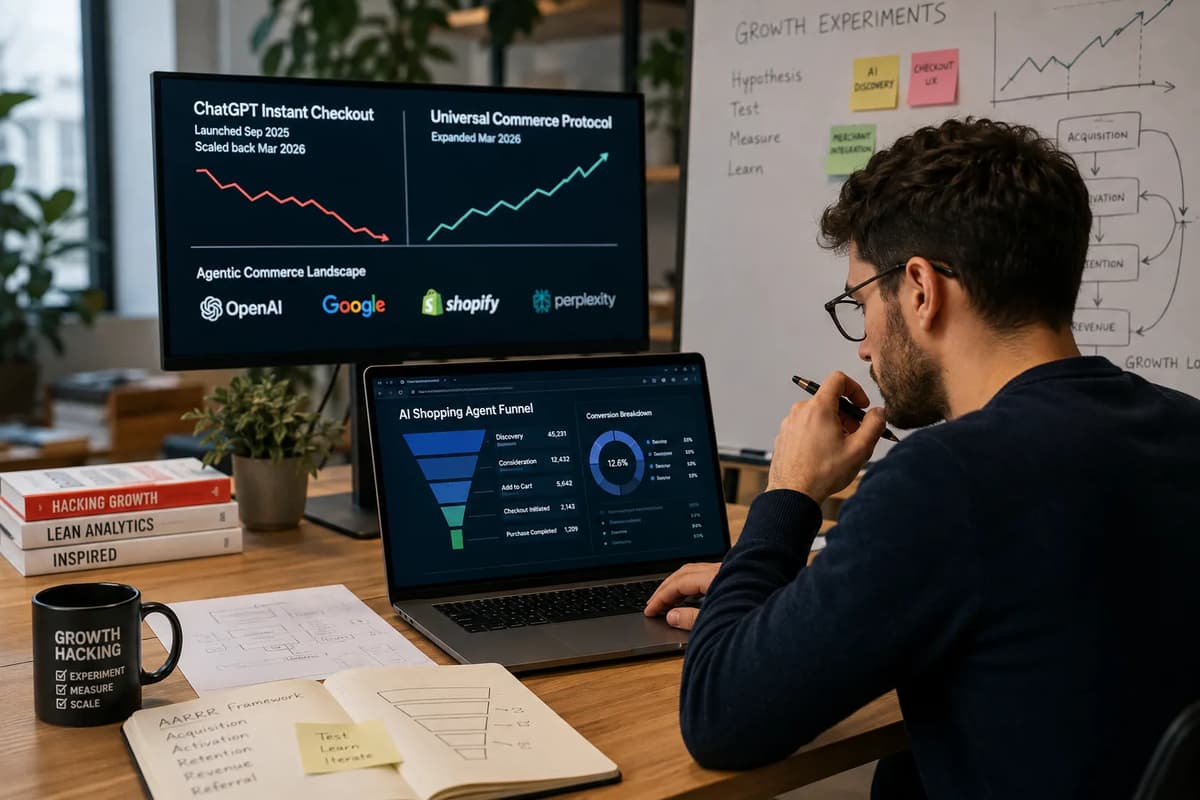
Title tag: Agentic Commerce: What Growth Hackers Should Learn
Meta description: ChatGPT Instant Checkout launched, then retreated six months later, while Google’s Universal Commerce Protocol expanded. Here’s the growth-strategy read.
Six months ago, Instant Checkout inside ChatGPT promised a new acquisition channel, and as a growth hacker who’s built funnels across SEO, social, and emerging tech, our team had to decide fast whether to invest in it. OpenAI and Stripe launched ChatGPT Instant Checkout (powered by the Agentic Commerce Protocol, or ACP) on September 29, 2025. Merchants included U.S. Etsy sellers, while one million Shopify stores were described as “coming soon,” including Glossier, Vuori, Spanx, and SKIMS. By contrast, on March 6–19, 2026, Google (with Shopify) expanded its Universal Commerce Protocol (UCP), adding cart, catalog, and identity-linking functions and easier onboarding. In practice, OpenAI’s shopping agent suddenly retreated as Google’s ambush accelerated. Growth teams who built for the first AI-checkout wave now have to decide whether to reallocate their efforts.
· September 2025: OpenAI/Stripe launch ChatGPT Instant Checkout via ACP (Etsy + soon Shopify).
· March 2026: OpenAI scales back Instant Checkout, shifting checkout to merchant apps (via ChatGPT Apps).
· March 2026: Google/Shopify expand UCP (Universal Cart, Catalog, Identity Linking, Merchant Center onboarding).
· Now: Growth teams must interpret these signals: a big channel fizzled, a rival doubled down.
We wrote this article to cut through the hype and answer: what really happened, and what should growth hackers do next? We’ll explain the agentic commerce shakeout: why ChatGPT’s one-click shopping was pulled back, how UCP is advancing, and how to adjust your AI shopping agent marketing strategy. Along the way, we’ll connect the analysis to skills taught in the Refonte Learning Growth Hacker Program, including funnel hacking with the AARRR framework and building automation stacks.
What “Agentic Commerce” Actually Means for a Growth Hacker
“Agentic commerce” refers to letting an AI shopping agent handle the shopping process end-to-end on behalf of a user. In practice, this means a chatbot or assistant searches products, compares options, and completes the purchase without the person clicking through to the site. This is not a marketing email or customer-service chatbot; it’s a full transaction delegated to an AI.
For growth hackers, agentic commerce promises a new acquisition funnel where the AI is the “customer” touchpoint. Your product or store must now be optimized for AI discovery (the “Acquisition” stage) and possibly integrated directly into the checkout flow. But it also raises questions: do we guide the AI’s recommendations, capture the sale ourselves, or let Google and other platforms mediate?
· Definition: Agentic commerce = an AI assistant (ChatGPT, Gemini, Perplexity, etc.) searches, picks, and buys products for the user.
· Key shift: The “customer” interaction can happen inside an AI interface (no human clicks on the storefront). The growth funnel now splits between what the agent does and what the human sees.
· Implication: We must treat AI agents as channels. That means adding new signals to the funnel and AARRR metrics for “AI touchpoints” (discovery queries, in-chat purchases, retention of AI-engaged users).
Refonte’s broader 2026 trends piece already notes that AI is upending traditional funnels, but agentic commerce is the next level: an AI-driven conversion. This shift amplifies the importance of clean product data, seamless integration (APIs or UCP/ACP), and tracking metrics in non-traditional ways. In short, growth teams need to learn to think like AI-tailored marketers: are our products optimized for an AI’s ranking, and can we handle the sale when the AI finds a buyer?
Inside ChatGPT Instant Checkout: Launch to Retreat
When OpenAI unveiled ChatGPT Instant Checkout on September 29, 2025, it sounded like a game-changer. Stripe’s announcement said U.S. ChatGPT users could buy goods from U.S.-based Etsy businesses directly in the chat, with more than one million Shopify merchants, including Glossier and SKIMS, described as coming soon. The open Agentic Commerce Protocol (ACP), co-developed by Stripe and OpenAI, powered the experience.
· Launch scope: In practice, Instant Checkout initially only supported single-item purchases. It launched on Etsy first; Shopify merchants were on deck. Key features like multi-item carts, promo codes, taxes, and loyalty integration were missing at rollout.
· How it worked: A user asks ChatGPT for a product, sees “Buy” buttons, taps one, and confirms details inline. Stripe’s system handled the payment via a tokenized process, while the merchant fulfilled the order as usual. It was a quick UX: ChatGPT played the shopper’s agent and secured a sale without leaving the app.
· Merchant control: Importantly, ACP let merchants stay in control of the order backend. They received orders, processed payments through Stripe (or their own gateway), managed tax and fulfillment as usual.
· Promo push: OpenAI billed it as “turning AI-driven discovery into a sale,” and even gave ChatGPT free promotion (the Checkout button was visible without upgrade). The bet: AI recommendations lead smoothly into the purchase.
Why “It Didn’t Drive Sales” Isn’t the Whole Story
By March 2026, multiple outlets reported OpenAI was dialing back Instant Checkout and refocusing ChatGPT on discovery rather than owning the purchase. The Information first broke it; Search Engine Land confirmed that an OpenAI spokesperson said “Instant Checkout is moving to Apps” so checkouts would occur in partner apps instead of natively. Modern Retail reported that OpenAI and merchants realized Instant Checkout “didn’t drive sales,” so they’d let ChatGPT handle discovery and push customers to merchants’ own checkouts.
But as Jason Goldberg (a former Shopify executive, writing for Forbes) points out, this story has nuance. Instant Checkout never even had the basics needed for a fair test: multi-item carts, tax remittance, loyalty, or a broad merchant rollout. In fact, Shopify’s president said only about a dozen merchants had actually gone live. In other words, calling it “failure” is misleading; it was more like canceling batting practice before the game. The feature was effectively pre-alpha (as Goldberg notes).
That said, retailers and OpenAI did see one clear signal: customers were using ChatGPT for discovery (looking up products or comparisons) but weren’t checking out within the app. Modern Retail quotes insiders saying conversion rates were very low and merchants preferred to own the checkout experience. For example, Walmart’s AI lead told Wired that Instant Checkout items converted at about one-third the rate of a normal cart. Customers feared fragmented orders.
So it’s true that merchants simply aren’t ready to hand off checkout to an AI agent. But credit to them (and to growth practitioners like us): we read the platform signals correctly. Instead of pouring months of work into a channel that the data showed was still immature, OpenAI pivoted. Acknowledging “the initial version … did not offer the flexibility we aspire to provide,” OpenAI announced in late March 2026 that it would “let merchants use their own checkout experience and instead focus on discovery.”
Key takeaway: Instant Checkout’s retreat wasn’t a verdict on the idea of agentic commerce overall, but a reality check on product completeness and merchant readiness. Growth teams who had ramped up for Instant Checkout now have a case study: read the fine print on feature releases. Check usage and conversions early, and prepare to switch gears if sales signals don’t come.
Google and Shopify’s Answer: The Universal Commerce Protocol
While OpenAI was pulling back, Google (in partnership with Shopify) was doubling down on open agentic commerce. At NRF in January 2026, Google announced the Universal Commerce Protocol, co-developed with Shopify. Unlike ACP’s ChatGPT-only approach, UCP is a standard Google built into search and AI services. It launched with major partners (Etsy, Target, Wayfair, Walmart, Visa, Stripe, AmEx, and more).
On March 19, 2026, Google unveiled major UCP upgrades. As Search Engine Journal reported, Google added Universal Cart and Catalog draft specs and highlighted Identity Linking support, along with simpler Merchant Center onboarding. Briefly:
· Universal Cart: AI agents can now build multi-item baskets across retailers, not just single products. This means an agent can add several items and then check out all at once via Google Pay or the merchant’s checkout.
· Catalog: Agents can query live product details (variants, pricing, stock) from a merchant’s database. No more stale cached feeds; the agent can fetch real-time info during a conversation.
· Identity Linking: Shoppers can link their retailer accounts (via OAuth) so that loyalty pricing or membership perks carry over when buying through Google’s AI (Gemini, AI Mode) instead of the retailer site.
· Simplified Onboarding: Google also streamlined the path for merchants to opt into UCP via Merchant Center. This lowers the barrier so any size retailer can participate in agentic commerce.
These updates signal that Google/Shopify see agentic commerce moving beyond discovery into actual transactions. By integrating multi-item carts and real-time catalog access, UCP is inching toward replicating a full shopping cart experience inside AI platforms. It remains optional for retailers, but the trend is clear: Google is turning search, Gemini, and even YouTube into conduits for checkout, rather than mere referral tools.
What Cart, Catalog, and Identity Linking Actually Add
To a growth hacker, what do these capabilities mean? In concrete terms:
· Multi-item Cart: Instead of just capturing one SKU per chat, AI agents (Google AI Mode, Gemini) can bundle several items. For our funnel, this means shoppers can browse within chat and only leave to pay once for the whole basket. This is closer to a normal e-commerce flow, reducing friction.
· Live Catalog: Ensures the agent recommends up-to-date products. For growth teams, it raises the bar for data cleanliness: if your inventory feed is stale, the AI might skip your products. It also means SEO-style tactics (like ensuring all SKUs are in the feed) now apply to agentic channels.
· Identity Linking: Critical for loyalty-driven businesses. If a user links their rewards account, they won’t lose points when an AI agent checks out through Gemini/AI Mode. This tradeoff (customer convenience vs. platform control) will shape merchant decisions.
· Merchant Center Onboarding: Practically, this means more retailers will opt in. As a growth hacker, look out for Google Merchant Center updates and any UCP sign-up campaigns because these often precede a channel’s real lift.
In short, UCP’s expansion is Google’s bet on agentic commerce happening widely. Where ChatGPT’s Instant Checkout was a siloed test, UCP is an open ecosystem spanning Search, Maps, Gemini and more. Growth teams should monitor how their product data fares in Google’s AI surfaces because it may soon impact search traffic and conversions just as much as standard SEO does.
Two Protocols, One Question: Which Channel Do You Build For?
With OpenAI’s ACP-in-ChatGPT and Google’s UCP (with Shopify) both vying to mediate purchases, growth teams face a choice: Where do we invest our integration and optimization efforts? Building for both may be wise long-term, but in the short run you may prioritize one. Below is a quick comparison of the two agentic commerce approaches:
Aspect | ChatGPT Instant Checkout (ACP) | Google/Shopify UCP (Universal Commerce Protocol) |
Sponsor | OpenAI & Stripe | Google & Shopify (with Walmart, Target, etc.) |
Scope | Currently only ChatGPT (with apps for Walmart, Etsy, etc.) | Google’s ecosystem (Search, Gemini, AI Mode, YouTube) |
Merchant Base | About 1 million Shopify merchants planned, plus Etsy; very limited actual adoption (dozens) | Supported by many large retailers (Etsy, Walmart, Target, Best Buy, etc.) |
Integration | Merchant must integrate ACP/Stripe or use Shopify’s auto-onboard | Merchant must adopt UCP via Merchant Center or partner platform (Stripe, Commerce Inc, Salesforce announced support) |
Capabilities | Originally single-item, now pivoting to discovery only | Multi-item cart, real-time catalog, and identity linking are built-in options |
Customer Experience | Shoppers buy “inside” ChatGPT chat; later versions to redirect to apps | Shoppers can add to a Universal Cart across sites and checkout via Google surfaces (AI chat, Maps) or pay on the retailer site |
Strategic Focus | AI-to-Consumer: focuses on deep ChatGPT integration; wallets, tokens (SPTs) | Search-to-Consumer: leverages existing user traffic on Google/YouTube/Maps; open to all agents |
Control vs. Ownership | ChatGPT controls front end; merchant controls fulfillment; user info limited (no email sign-up) | Merchant controls end sale (on site or via Google Pay); Google offers optional benefits (loyalty, BNPL) for connected users |
This quick snapshot helps highlight the divergence: OpenAI’s ACP was a closed experiment (tied to ChatGPT plus Stripe) that flared up and then was dialed back. Google’s UCP is open (any agent platform can adopt it and multiple retailers are already participating). The question for your growth roadmap is: which do you build for first? If your customer profile skews younger and actively using AI chat for discovery, ChatGPT/ACP might have been tempting. But if you rely on Google search/Discovery volumes, UCP looks more scalable.
Don’t forget the human-creator angle, either: if your brand also sells via social channels, see our Social Commerce Ecosystems write-up for how influencer-driven shops fit in. Those channels remain distinct from these AI agents; the path to purchase in TikTok Shop or Instagram Checkout is still human-centric, whereas agentic commerce is its own breed.
The Agentic Commerce Landscape Beyond the Big Two
OpenAI and Google/Shopify are the headline acts, but they’re not the only players. For example, Perplexity (the AI search/chat app) quietly launched its own Instant Buy button with PayPal on Nov 25, 2025. According to an analysis, Perplexity partnered with merchants like Wayfair and Abercrombie & Fitch, and incentivized early purchases with discounts. This isn’t confirmed by news media (it comes from vendor blogs and analytics sites), but it suggests the concept of in-chat buy buttons is spreading.
· Perplexity Instant Buy: A PayPal-powered checkout integrated into Perplexity’s shopping experiences. Launched around Nov 2025, with major retailers and special offers. Its approach leaned on PayPal’s existing trust rather than building a new payments stack. We’d categorize this as a lesser-known agentic channel that is worth a mention, but not yet a safe bet for your main funnel.
· Other entrants: Keep an eye on any fresh announcements. AI agent shopping can include voice assistants (e.g. a future Alexa-style shopping flow) or even chatbots on retailer sites. But at present, the main protocols are ChatGPT’s ACP, Google’s UCP, and a few one-offs like Perplexity.
Because multiple agents and standards are emerging, growth teams face a third-player problem: fragmentation. If each platform has its own protocol, you risk redoing integrations for each. That’s why open standards like ACP and UCP aim to unify things. For now, focus on supporting one (if starting small) or building your product data so it’s easily pluggable into any future protocol.
What Happens to AARRR Metrics When the “Customer” Is an AI Agent
Agentic commerce challenges every stage of the AARRR funnel:
· Acquisition: Traditionally, we drive user acquisition via SEO, ads, referrals. Now we add AI-discovery: the queries your AI shopping agent must win. You might need to optimize product descriptions for natural language or schema so ChatGPT or Gemini surfaces them. In other words, adapt your SEO for AI shopping queries. Brands with highly visible product knowledge graphs or conversational content may pull ahead.
· Activation: This step is the first purchase or sign-up. If an AI agent completes a purchase, does it count as activation? You’ll have to define it. Possibly it’s when the user confirms an order in chat or when they click the “Buy” button. Monitor AI-specific triggers (chat clicks) and treat them like conversion events. This may mean instrumenting ChatGPT Apps or UCP endpoints with analytics.
· Retention: Do AI-driven buyers come back? If a user asked ChatGPT to buy something once, will they reuse it? Hard to know yet. Traditional retention channels (email follow-ups) may not be available if the purchase happened through the agent. For example, Instant Checkout disallowed auto-adding the user to a mailing list. Growth teams might treat the first AI purchase like an acquisition event, then work on getting that buyer into your CRM via other prompts (e.g. asking them to sign up after delivery).
· Referral: Can users refer other users through an agent? Possibly in the future an agent could say “tell a friend,” but for now this is uncharted. Think of referrals as a future feature area, not a current lever.
· Revenue: Ultimately, revenue is the sum of purchases. But attributing revenue to an agent channel is tricky. If Instant Checkout had stayed, we’d need to measure how much sales came through ChatGPT vs Google vs organic. For now, use proxies: if ChatGPT/ACP is on, track sales where channel=AI in your analytics. Compare to standard funnels. You may find AI channels have lower conversion for now, as stores like Walmart saw.
In short, every part of the funnel gains a new sub-case for “agent as customer.” Growth hackers should revise their dashboards: add segments for AI-assisted traffic and conversions, and treat them as new cohorts. Also remember the human end-user: most agentic purchases still require a human’s initial request and final satisfaction. Use your funnel experiments (A/B tests) to see if AI-tailored copy, or clarity on how to checkout with an agent, moves the needle on those metrics.
Attribution Gets Harder: Tracking Conversions Through an Agent
Related to the metrics puzzle is attribution. If an AI agent is shopping, how do we track that conversion? This echoes the “dark social” problem we discussed elsewhere: traditional UTM links and pixels may not fire inside a chat.
Consider two scenarios:
· ChatGPT Checkout: The entire purchase happens in ChatGPT. The user never visits your website for that sale. How do you know it came through ChatGPT? Stripe’s SPT (Shared Payment Token) system was designed for ChatGPT apps, but it’s an internal flow. As a merchant you might only see “Sales via Stripe” without an easy UTM. Right now, OpenAI is focusing on discovery-only, so you’ll get traffic referrals (maybe with a custom URL once the user goes to your site) rather than direct conversions. But expect future methods, like passing back a ChatGPT-specific order ID or using the Agentic Commerce Protocol’s data fields to tag origin.
· Google UCP: Google likely provides analytics integration (as it does with Ads and Merchant Center). When a user uses Gemini to buy, Google may tag the session as “Google / AI Mode”. Check the Merchant Center and Google Analytics for new traffic sources like “AI Mode” or “Shopping Agent.” We don’t have full docs yet, but watch Google’s announcements; they did release “AI Performance Insights” for UCP adopters.
· General fixes: Growth hackers should instrument every touchpoint. For example, if your product pages support ACP or UCP, include dynamic tracking parameters that capture the agent ID or referral origin. If the purchase kicks off at your site after an AI query, use one-time tokens. Ensure your CRM collects “first touch = ChatGPT” or similar tags. In practice, this may require custom work with your analytics or ad platforms.
This is why we say attribution is harder: standard marketing pixels may not catch an agentic journey. One technique is to prompt the user, after checkout, to input their email or code that ties back to ChatGPT. The more you can make the transition seamless but trackable, the better you’ll understand ROI on these channels. For a related search-visibility perspective, see Google AI Mode vs. AI Overviews, which underscores how AI shifts data flows.
Should You Optimize for Agent Discovery or Human Checkout?
Given ChatGPT’s pivot, one big strategic question is: where should we optimize? In other words, should your growth focus on maximizing AI agent discovery of your products, or on optimizing the subsequent human checkout on your site?
Right now the evidence favors discovery. ChatGPT will still serve as a powerful product research engine. As Modern Retail noted, merchants got referral traffic from ChatGPT discovery, even as Instant Checkout was removed. So growth teams should ensure products are visible to the agent: clean data, clear descriptions, strategic use of Instant Checkout or UCP tags.
That said, conversion still happens on your site. If someone clicks out to finish the purchase, your conversion funnel on your website must be smooth. In practice:
· Optimize Discovery: Make sure your product catalog is integrated with the AI protocols you support. For ACP, that means having updated listings in ChatGPT’s discovery database; for UCP, that means being in Google Merchant Center with rich data and clean feeds. Treat agentic queries as a kind of SEO/SEM: do keyword research for how users ask bots about your category, and weave those terms into your titles and specs. The Hypotenuse blog even recommends writing product copy in natural language to match AI queries.
· Optimize Checkout: Because merchants keep the checkout flow post-discovery, keep excelling at CRO. Make sure your site is mobile-friendly and fast, since AI-referred traffic is often on mobile. Have visible trust signals and guest checkout options. Bots may fill forms, but the human buyer still needs reassurance. Track the dropoff from agentic discovery to actual purchase completion.
· Balance: Ultimately, do both, but lean into low-hanging fruit. If you’re a Shopify store, enabling UCP/ACP (once you can) costs little and increases visibility. Meanwhile, A/B test any new flow: for example, offer a ChatGPT-only discount code to measure incremental lift, or a banner saying “Shop quickly with one-click in your chat app.” If one approach clearly wins (such as lots of “I found you on ChatGPT” orders), invest there.
In short, treat AI agents as another marketing channel with a funnel. Optimize what you can (data and discovery), then capture conversions as usual. Keep an eye on early signals of agent-engaged traffic to know when to prioritize more development.
What the Instant Checkout Retreat Actually Teaches Growth Teams
The Instant Checkout experiment is a rare live case study in channel volatility. Here are some lessons we can draw for growth teams evaluating any new funnel:
· Feature Completeness Matters: As Forbes’ Jason Goldberg emphasizes, you can’t judge demand on an unfinished product. If a new channel is missing core features (multi-item carts, full pay flows), early metrics may mislead. As practitioners, when we hear “this new channel doesn’t work,” ask: was the product ready? If not, wait to make big bets.
· Merchant/Uptake Signals: In this case, only a handful of merchants opted in (Shopify said ~12 active merchants). That was a clear indicator. A practical rule: Before deeply integrating an unproven channel, check merchant interest. If only a few are willing to participate, either help bootstrap them or pivot elsewhere. This can guide your build vs. test decision (see next section).
· User Behavior Insights: The data showed users would research with ChatGPT but weren’t comfortable checking out in-app. Growth hackers should watch user engagement: track how many “Buy” buttons are clicked in the AI UI, what percentage drop off before payment. (Modern Retail reported “lackluster results” and low conversions.) These numbers tell you early if the funnel is clogged.
· Human Trust and Behavior: Walmart’s insight was telling: customers don’t want fragmented checkouts. This reminds us: even a slick interface won’t override basic shopper preferences. Always validate with real users if possible. The lesson is not that AI checkout is bad, but that incomplete flows can scare customers.
· Internal Priorities and Resource Allocation: Forbes notes that OpenAI may have pulled back because it simply needed to focus its engineering on core products, not a side commerce experiment. For us, that underscores a classic growth dilemma: how much to invest in platform features versus other experiments. If leadership signals (or company pivots) shift, your work can get deprioritized. So weigh the signal strength: a strong PR launch is promising, but formal commitments (merchants integrated, revenue shared) matter more.
Betting Early vs. Betting Right
It’s tempting to be “first” on any emerging channel because that first-mover advantage can yield outsized growth. We did spend effort enabling Instant Checkout as soon as possible. But this situation shows a nuance: there’s a difference between betting early and betting right.
· Betting Early: You integrate immediately when a new API or product is announced. The upside is novelty and press. The risk: the channel may retreat (as happened), and your resources could have gone elsewhere.
· Betting Right: You wait for clear signals (merchant adoption, positive A/B tests, stable feature set). You move just fast enough to not miss growth, but not so fast that you invest in vapor.
In practice: start small and instrument heavily. For Instant Checkout, a “right bet” might have been to add tracking for any ChatGPT orders without fully embedding in the funnel. Once user or merchant data became available showing low usage, shift focus.
For future agentic launches, consider a phased approach. Get sample product listings live, run a short paid trial, look at conversion lifts before redesigning your CRM or site flow. Use your A/B testing mindset: treat new channels like any new experiment, not guaranteed winners.
A Practical Framework for Evaluating the Next Agentic Commerce Launch
To make this concrete, here’s a checklist we’d use as growth operators when an AI shopping channel appears:
· Platform Commitment: Does the platform prominently announce the feature and support it with developer docs or partner programs? (For example, an OpenAI blog post or a Google Marketing Live session.) A PR without developer rollout is a red flag.
· Merchant Uptake: Are big brands or a broad set of retailers on board? Check press releases or statements by platform partners (Shopify, Walmart, etc.). If only a few pilot partners exist, watch their usage figures. Green flag: dozens of merchants live at launch. Red flag: single digits or “coming soon.”
· Technical Readiness: Does the channel support full funnel capabilities (carts, promos, taxes)? If not, is there a public roadmap? A half-baked feature that can’t complete a transaction reliably may not drive growth.
· Ease of Integration: How hard is it to join? For UCP, there’s a Merchant Center signup or a Shopify plug-in; for ChatGPT, there was an auto-onboard via Shopify/Stripe. If integration is “invite-only” or complex, adoption will be slow.
· User Signals: If available, look at any early usage data. Google and Apple often release beta metrics (for instance, “X million queries per day”). For private AI, we may rely on reporting from partners (like the Wired report on low conversion) or set up our own small experiment to gauge interest.
· Analytics/Tracking Capability: Ensure you can get data out of it. For example, if Google’s UCP gives you a Merchant Center report, register for it and see what metrics it provides. If OpenAI provides an API or log of Instant Checkout orders, plan to ingest that. Without feedback, you can’t measure ROI.
· Opportunity Cost: Finally, compare effort versus payoff. If building for this channel means diverting critical resources, estimate potential revenue. Tools like Clay can help here: we can do data-driven modeling (using enrichment and predictive scoring) to forecast how many additional conversions the channel might add.
In short, don’t invest blindly. Use a hypothesis-driven approach: If this channel has X traction and Y technical maturity, then build it. Otherwise, monitor quietly.
Where AI-Native Growth Tooling Like Clay Fits Into This Shift
One way growth teams can respond is by leveraging AI-native growth stacks. Take Clay for example: it’s a platform that uses AI to automate outbound and data tasks. Clay recently hit $100M ARR and a $5B valuation in January 2026 (via a DST Global-led employee tender offer). That’s after a $100M Series C at a $3.1B valuation in August 2025. Clay now serves 14,000+ customers (including OpenAI, Anthropic, Canva, Intercom, Rippling). This tells us investors and tech companies are placing big bets on AI-enhanced growth tools.
So where does Clay (or similar tools) fit? Growth teams grappling with AI channels need data pipelines and automation more than ever:
· Data enrichment: Clay’s AI agents can scour the web and internal data for signals (e.g. leads interested in agentic commerce) and automatically update CRMs. If your team wants to quickly target retailers most likely to adopt UCP, you could use such a tool to find and score prospects.
· Personalized outreach: Suppose you discover potential Shopify merchants who might want to join UCP. Clay could auto-personalize email sequences or Slack messages to them at scale, something we’d normally do only manually.
· Workflow automation: Clay integrates with hundreds of data sources. So you could connect your sales pipeline to chat transcripts. For example, when ChatGPT logs show someone asking about your product, Clay might trigger an email campaign or Slack notification internally.
· Performance analytics: Advanced growth platforms often include dashboards for new metrics. As you track agentic commerce campaigns, having these connected to your existing analytics (Mixpanel, GA4, etc.) is crucial. Clay and similar low-code stacks (Zapier, Airtable, and Notion, as we teach) can help glue these tools together without heavy development work.
In essence, investing in AI-native growth tooling is complementary to exploring AI channels. If you want to quickly pivot campaigns, test messages, or analyze new data sources (like “Google Shopping Agent referrals”), these tools can massively speed up experiments. The Clay example is illustrative: they themselves say they turn growth ideas into reality using AI and low-code. Growth teams should adopt that mindset.
Growth Hacker Skills and Salaries in 2026
What does all this mean for the growth hacker role itself? Two things: first, skill sets, and second, compensation.
Skills: Modern growth hackers need to master both traditional and AI-focused skills. The core modules of our Growth Hacker program reflect this: understanding AARRR metrics and funnels (for whichever channel, including agentic commerce), designing viral loops and experiments, and building automation/low-code stacks for rapid execution. In practice this means you should be comfortable with:
· Data analysis and funnel optimization (knowing when a channel is driving engagement vs. drop-offs). The AARRR framework for AI will involve tracking new metrics, as we discussed.
· Technical know-how: even if not coding, familiarity with APIs and AI protocols. For example, you may need to read specification documents for ACP/UCP or setting up a Stripe integration.
· Experimentation mindset: be ready to test small (like A/B testing agentic ads or messages) and pivot based on outcomes.
· Marketing fundamentals: SEO/SEM still matter, plus new SEO for AI, and conversion optimization as always.
Salaries: Our research shows growth hacker compensation varies widely by source. For transparency:
· ZipRecruiter (August 2026): Average yearly pay is about $69,262. (Its median was $65.8K, 25th–75th percentile roughly $52.5K–$77K.)
· Glassdoor: Reports a higher figure: median total pay around $116,000 per year. (Base ranges ~$62K-$116K, with total comp $87K-$162K for 25th–75th percentiles.)
· Salary.com: Even higher, with a U.S. average salary ~$130,475 (as of August 1, 2026) (25th–75th range $120K–$143K).
· Discrepancy: These differences likely come from sampling and definitions (“growth hacker” vs. “growth marketing” roles, geographic differences, etc.). ZipRecruiter’s data is drawn from job postings and seems lower; Salary.com’s survey method often skews higher.
Putting it in context: growth hacking overlaps with marketing, product, and data roles, so comps can vary. We’ve seen industry estimates of $100K+ as typical. (Refonte’s own blog once cited $180K–$190K for elite roles, but that was an editorial claim, not an independent survey.) For now, expect a broad range: $70K–$120K+ depending on company and experience, with big outliers up to $160K or more for senior roles in tech hubs. Always clarify what’s included (base vs. bonuses) when comparing sources.
If you’re considering this as a career, focus on skills that bridge tech and growth: data analysis, A/B testing, CRM/email automation, and now AI tools like large-language-model (LLM) plugins or no-code AI agents. Expertise in these areas will command the higher end of that salary spectrum.
Building This Skill Set: The Refonte Learning Growth Hacker Program
Navigating volatile channels like agentic commerce requires a versatile growth skill set. That’s exactly what the Refonte Learning Growth Hacker Program is designed for. Our 3-month, part-time curriculum (6–10 hours per week) covers the fundamentals and advanced tactics needed to adapt to shifts like the ChatGPT vs. Google UCP shakeout.
· Funnel Hacking & AARRR Metrics: Learn to map and optimize each funnel stage (Acquisition, Activation, Retention, Referral, Revenue). This is crucial for diagnosing whether an AI agent channel is adding value or causing funnel leakage.
· Viral Loops & Experimentation: Gain practical experience designing growth experiments and referral systems. For example, you’ll learn how to hypothesize and test the impact of a ChatGPT-specific promotional loop or an AI-driven referral incentive.
· Automation & Low-Code Stacks: Master tools like Zapier, Airtable, and CRM workflows. This empowers you to quickly build the integrations and dashboards needed when a new API or channel emerges.
· Real Tools and Mentors: The program includes hands-on work with analytics (GA4, Mixpanel, Amplitude), ad platforms, and no-code automation. You’ll learn from industry leaders like Sean Ellis (coiner of “growth hacking”).
· Outcome: Graduates leave ready for roles like Growth Hacker, Growth Marketer, or Product Growth Manager. They’ve built projects such as optimizing acquisition funnels and automating campaign flows, the very skills you need to judge when to bet on a channel.
In short, the program equips you to read platform signals and build accordingly. We don’t teach ChatGPT checkout by name (it launched after our curriculum was set), but we teach the underlying methodologies. Whether it’s a new AI-mediated checkout or any other channel, you’ll know how to evaluate it and adapt your funnel.
Ready to level up? Explore the Refonte Learning Growth Hacker Program for details on curriculum, mentors, and how to apply. If you want to stay on top of the next big thing, building these growth foundations is the way forward.