
The Shifting Security Landscape: Why Trivy Dominates in 2026
The world of software security has undergone a radical transformation. Gone are the days when security was a final, often-dreaded gate before production, managed by a separate team armed with slow, expensive, and opaque tools. This old model created bottlenecks, fostered an adversarial relationship between developers and security, and was fundamentally incompatible with the speed and scale of modern cloud-native development. The rise of DevOps demanded a new paradigm: DevSecOps, where security is integrated seamlessly into every stage of the software development lifecycle.
This shift created a vacuum for tools that were developer-first: fast, easy to use, open-source, and providing clear, actionable feedback directly within the developer's workflow. Into this vacuum stepped Trivy, an open-source project by Aqua Security. Its meteoric rise wasn't an accident; it was the result of a deliberate design philosophy that perfectly matched the needs of the modern DevOps engineer. While legacy scanners took minutes to analyze a single container image, Trivy could do it in seconds. Where other tools required complex server setups, Trivy was a simple, self-contained binary.
By 2026, this momentum has culminated in Trivy becoming the de facto standard for vulnerability scanning within the Cloud Native Computing Foundation (CNCF) ecosystem. This isn't just a popularity contest; it signifies a fundamental change in how the industry approaches security. Trivy's integration into projects like Harbor (a CNCF-graduated container registry) and its widespread use in CI/CD pipelines for Kubernetes-based workloads have made it as foundational to security as Prometheus is to monitoring. Its endorsement and adoption by the CNCF community provide a signal of stability, long-term support, and vendor neutrality that enterprises value.
The core reason for this dominance is Trivy's expansion beyond its initial scope. It began as a brilliant container image scanner, but it has evolved into a comprehensive security tool for the entire software supply chain. It addresses not just the 'what' (vulnerabilities in dependencies) but also the 'how' (misconfigurations in the infrastructure that runs the code). This holistic approach is critical in a world where a security posture is only as strong as its weakest link—be it a vulnerable library, a misconfigured S3 bucket defined in Terraform, or an overly permissive Kubernetes role.
Core Capabilities of Trivy: More Than Just a Container Scanner
To appreciate why Trivy has become an indispensable tool for DevOps engineers in 2026, it's crucial to understand the breadth of its scanning capabilities. Characterizing it as merely a 'container scanner' is a gross oversimplification. Trivy is a versatile, multi-faceted security scanner that provides visibility across the entire development lifecycle, from a developer's local machine to a production Kubernetes cluster.
Let's break down its core functions:
Container Image Scanning
This is Trivy's original claim to fame. It recursively scans container images, analyzing each layer to build a comprehensive picture of the installed software. It identifies vulnerabilities in:
* OS Packages: It detects vulnerabilities in operating system packages for a wide range of distributions, including Alpine, Debian, Ubuntu, RHEL, and CentOS. It does this by parsing package manager databases (e.g., apk, dpkg, rpm).
* Language-Specific Packages: Trivy supports a vast ecosystem of programming languages, finding known vulnerabilities in dependencies managed by Bundler, Cargo, Composer, npm, yarn, pip, and more. This is critical for application-level security.
Filesystem and Git Repository Scanning
Pushing security further to the left, Trivy can scan a local filesystem or a remote Git repository directly. This allows developers to find issues before a single line of code is committed or a Docker image is built. It can detect hardcoded secrets (API keys, passwords) and vulnerabilities in dependency manifest files (e.g., package-lock.json, Gemfile.lock) right at the source, providing the earliest possible feedback loop.
Infrastructure as Code (IaC) and Kubernetes Scanning
Modern infrastructure is defined by code, and this code can have security flaws. Trivy acts as a static analysis tool for configuration files, identifying common misconfigurations that could lead to security breaches. It supports: * Terraform and CloudFormation: Scanning for issues like publicly exposed storage buckets, unencrypted databases, or overly permissive IAM policies. * Dockerfiles: Highlighting bad practices such as running as root, adding secrets to layers, or using outdated base images. * Kubernetes Manifests: Detecting security issues like privileged containers, disabled security contexts, or host network access. This helps enforce best practices before workloads are ever deployed.
Software Bill of Materials (SBOM) Support
In an era of increased scrutiny on software supply chain security, SBOMs are non-negotiable. Trivy can both generate and scan SBOMs in standard formats like CycloneDX and SPDX. This allows organizations to maintain a precise inventory of every component in their software, which is invaluable for compliance, license management, and rapid response to zero-day vulnerabilities like Log4Shell.
Integrating Trivy into the CI/CD Pipeline: A Practical Guide
The true power of a tool like Trivy is unlocked when it's automated. Integrating security scanning directly into the Continuous Integration/Continuous Deployment (CI/CD) pipeline ensures that every code change is automatically vetted for vulnerabilities and misconfigurations. This 'shift-left' approach catches issues early, reduces the cost of remediation, and builds a culture of security ownership among developers. By 2026, failing a build due to a critical vulnerability is as standard as failing it due to a broken unit test.
Let's examine how to implement this in popular CI/CD systems.
GitHub Actions
A common pattern is to scan an image immediately after it's built. The aqua-security/trivy-action makes this incredibly straightforward. A typical workflow step might look like this:
- name: Build and scan image
  uses: docker/build-push-action@v3
  with:
    context: .
    push: false
    tags: my-app:latest

- name: Run Trivy vulnerability scanner
  uses: aqua-security/trivy-action@master
  with:
    image-ref: 'my-app:latest'
    format: 'table'
    exit-code: '1'
    ignore-unfixed: true
    severity: 'CRITICAL,HIGH'
This configuration tells Trivy to scan the my-app:latest image, fail the pipeline (exit-code: '1') if any CRITICAL or HIGH severity vulnerabilities are found, and ignore vulnerabilities that do not yet have a fix available (ignore-unfixed: true). This pragmatic approach prevents pipelines from being blocked by issues that developers can't resolve.
GitLab CI/CD
GitLab users can achieve a similar result by defining a job in their .gitlab-ci.yml file. While GitLab has its own built-in scanners, many teams prefer Trivy for its speed and comprehensive database. A dedicated scan stage would use the official Trivy Docker image:
image_scan:
  stage: test
  image: docker:20.10.12
  services:
    - docker:20.10.12-dind
  script:
    - docker build -t my-app:latest .
    - wget https://github.com/aquasecurity/trivy/releases/download/v0.35.0/trivy_0.35.0_Linux-64bit.tar.gz
    - tar zxvf trivy_0.35.0_Linux-64bit.tar.gz
    - ./trivy image --exit-code 1 --severity HIGH,CRITICAL my-app:latest
Best Practices for Pipeline Integration
Regardless of the platform, a few best practices are universal for implementing security scanning effectively. It is crucial to master these patterns alongside understanding the broader landscape of best practices for CI/CD tools. Key considerations include using a .trivyignore file, stored at the root of the repository, to declaratively specify vulnerabilities to ignore with justifications. Caching the vulnerability database between runs is also essential to keep scan times minimal, ensuring security doesn't become a performance bottleneck. Finally, outputting results in multiple formats, such as a human-readable table for logs and a JSON report for ingestion into other systems, provides maximum utility.
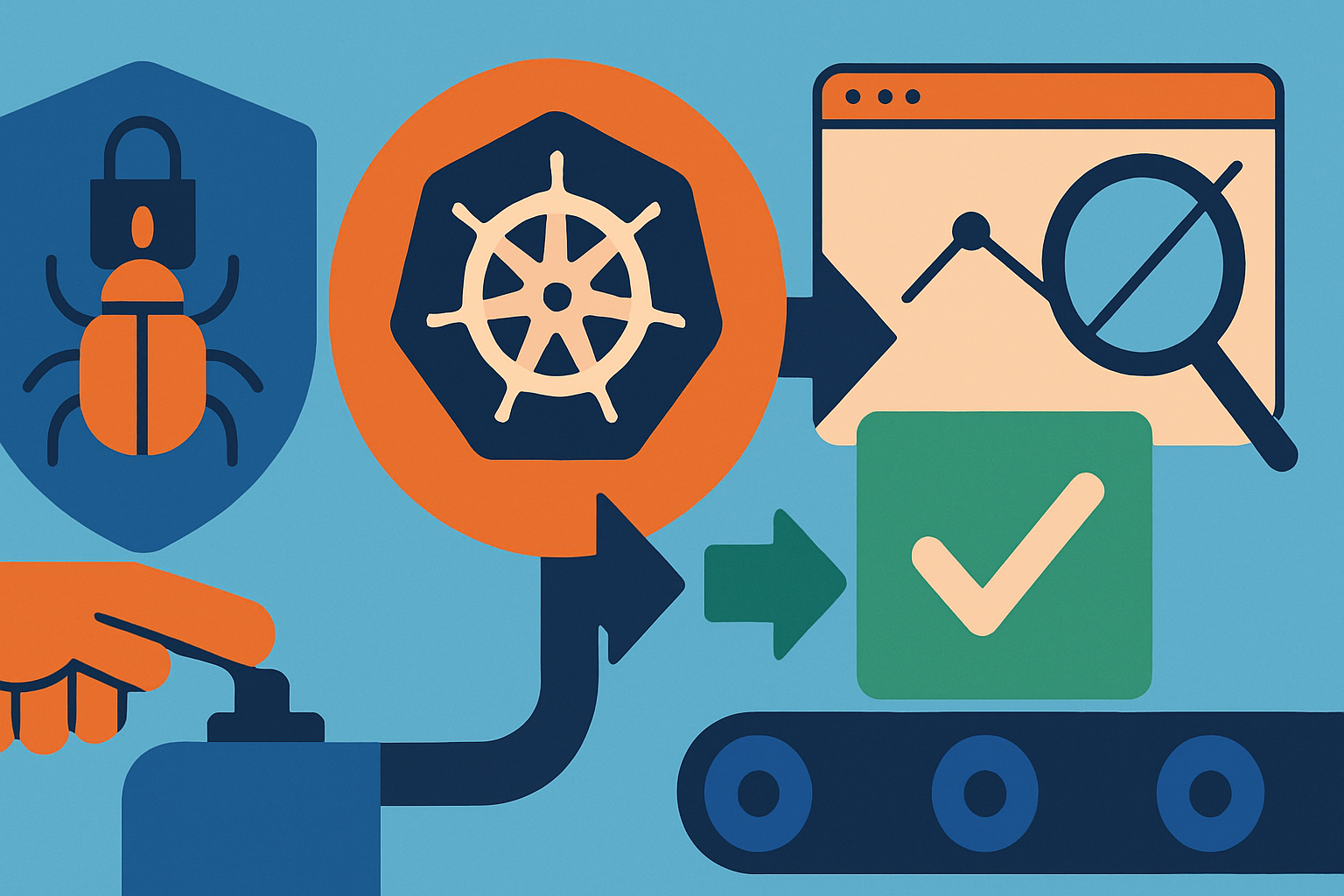
Trivy in Production: Kubernetes Admission Controllers and Continuous Monitoring
Integrating security into the CI/CD pipeline is a critical first step, but a comprehensive DevSecOps strategy doesn't end there. Security must be a continuous process that extends into the production environment. Vulnerabilities can be discovered in software that is already running, and configurations can drift over time. This is where Trivy's capabilities in a live Kubernetes environment become paramount, primarily through the Trivy Kubernetes Operator.
The Trivy Operator is a powerful controller that you deploy directly into your cluster. Once installed, it provides two key functions: continuous scanning and admission control.
Admission Control for Proactive Defense
An admission controller is a piece of code that intercepts requests to the Kubernetes API server before an object, like a Pod, is created. By integrating Trivy into a validating admission webhook, you can enforce security policies at the cluster's entry point. For example, you can create a policy that rejects any attempt to deploy a container image with known critical vulnerabilities. This acts as a crucial safety net, preventing insecure workloads from ever running in your production environment, even if they somehow slipped through the CI/CD checks.
The Trivy Operator can be configured to act as this gatekeeper. When a developer attempts to apply a deployment manifest, the admission controller calls out to Trivy to perform an on-the-fly scan of the specified image. If the scan reveals policy violations, the API server rejects the request with a clear error message explaining why. This provides immediate, context-aware feedback and enforces a consistent security baseline across the entire cluster.
Continuous Scanning for Ongoing Visibility
New vulnerabilities are disclosed every day. An image that was clean when it was deployed last month could be critically vulnerable today. The Trivy Operator addresses this by periodically scanning all running workloads within the cluster. It generates security reports as Custom Resource Definitions (CRDs) directly in Kubernetes, which can then be monitored and alerted on.
This continuous audit provides an up-to-date view of the security posture of your live environment. DevOps teams can query these reports to identify running pods with newly discovered vulnerabilities and prioritize them for patching and redeployment. Furthermore, these reports can be exported as metrics. By scraping these CRDs with Prometheus, you can build Grafana dashboards that visualize the number of vulnerabilities by severity, namespace, or application. This allows you to track your security debt over time and demonstrate compliance, fully integrating security into your observability stack.
The Broader DevSecOps Toolchain: Where Trivy Fits
Trivy is a powerful and versatile scanner, but it's essential to understand that it is one component within a larger, layered DevSecOps toolchain. No single tool can solve all security challenges. A mature security posture relies on using the right tool for the right job at each stage of the development lifecycle. Understanding this ecosystem is key to building a defense-in-depth strategy.
Here’s how Trivy complements other critical security tool categories:
-
Static Application Security Testing (SAST): While Trivy scans for vulnerabilities in third-party dependencies and misconfigurations, SAST tools analyze your first-party, proprietary source code. Tools like SonarQube, Semgrep, and Snyk Code look for coding flaws, logic errors, and security anti-patterns such as SQL injection, cross-site scripting (XSS), or insecure cryptographic implementations. SAST and Trivy are highly complementary: SAST secures the code you write, while Trivy secures the open-source code you use.
-
Software Composition Analysis (SCA): This is Trivy's primary domain. SCA tools focus on identifying open-source components and their known vulnerabilities. Other major players in this space include Snyk Open Source and GitHub's Dependabot. While their core function is similar, they often differ in their vulnerability databases, language support, and developer experience. Trivy stands out for its open-source nature, speed, and tight integration with the cloud-native ecosystem, especially containers and IaC.
-
Dynamic Application Security Testing (DAST): Unlike the static analysis performed by SAST and SCA tools, DAST tools test a running application from the outside in. Tools like OWASP ZAP or Burp Suite actively probe the application's endpoints, simulating attacks to find runtime vulnerabilities that are only apparent when the application is fully assembled and operational. DAST is excellent for finding issues related to session management, authentication, and endpoint configuration that static analysis might miss.
-
Policy as Code (PaC): Tools like Open Policy Agent (OPA) provide a general-purpose engine for defining and enforcing policies across your stack. While Trivy has built-in checks for IaC and Kubernetes misconfigurations, OPA allows you to write much more sophisticated, organization-specific rules. A common pattern is to use Trivy to generate a JSON report of its findings and then use an OPA policy, written in the Rego language, to evaluate that report against your company's specific security and compliance requirements.
Understanding these distinctions is vital for any professional navigating the landscape of essential trends and tools for DevOps engineers. A robust strategy uses SAST to clean code, Trivy (SCA) to vet dependencies, DAST to test the running system, and OPA to enforce custom policies throughout the CI/CD pipeline.
Advanced Trivy Use Cases: SBOMs, VEX, and Supply Chain Security
Beyond routine vulnerability scanning, Trivy is at the forefront of addressing the most pressing security challenge of the 2020s: software supply chain security. High-profile incidents have made it painfully clear that you need to secure not just your code but the entire chain of dependencies, build processes, and artifacts that produce your final application. Trivy provides critical capabilities in this domain, particularly around the Software Bill of Materials (SBOM) and Vulnerability Exploitability eXchange (VEX).
An SBOM is a formal, machine-readable inventory of all the components, libraries, and modules that are part of a piece of software. It’s like a list of ingredients for your application. Trivy makes generating one trivial: the command trivy image --format cyclonedx my-app:latest produces a complete SBOM in the industry-standard CycloneDX format. This inventory is the foundation of supply chain security. When a new vulnerability like Log4Shell is announced, you no longer need to manually search every project; you can simply query your SBOM repository to instantly identify every affected application.
However, SBOMs and vulnerability scans can generate a lot of noise. A library may have a known vulnerability, but that specific flaw may not be exploitable in the context of your application because the vulnerable function is never called. This is where VEX comes in. VEX is a companion document to an SBOM that provides additional context. It's a statement from the software producer asserting the status of a vulnerability. A VEX document can state that a vulnerability is: * Not Affected: The vulnerable code is present but not reachable. * Fixed: The vulnerability has been patched in a specific version. * Under Investigation: The status is currently being analyzed.
By 2026, VEX is becoming a standard way for teams to manage and communicate vulnerability status, dramatically reducing alert fatigue. Trivy can consume VEX documents. When you scan an image, you can provide a VEX file, and Trivy will automatically filter its findings based on the assertions in the file. This allows security teams to focus on vulnerabilities that are confirmed to be exploitable, rather than chasing down every single finding from the scanner.
Finally, these artifacts must be secured. Trivy integrates with the Sigstore ecosystem, particularly the Cosign tool, to ensure the integrity of the supply chain. After building an image, you can generate an SBOM with Trivy, then use Cosign to cryptographically sign both the image and its SBOM and store those signatures in a transparent ledger. Downstream, your Kubernetes admission controller can use Trivy to verify these signatures before allowing a deployment, ensuring that the image and its list of ingredients have not been tampered with since they were built. This creates an end-to-end chain of trust, which is a core tenet of modern, secure software delivery.
Comparing Trivy to Alternatives: Grype, Snyk, and Cloud-Native Scanners
While Trivy has established a dominant position in the open-source, cloud-native space, it's not the only tool available. A healthy ecosystem includes strong alternatives, and understanding their strengths and weaknesses helps teams make informed decisions. The primary competitors to Trivy fall into three categories: other open-source scanners, commercial platforms, and integrated cloud provider tools.
Open-Source Alternative: Grype
Created by Anchore, Grype is Trivy's most direct open-source competitor. The two tools share a remarkably similar mission and feature set: both are fast, command-line-driven scanners that support containers, filesystems, and SBOM generation. For many core use cases, they are interchangeable. However, subtle differences exist. Historically, they have sometimes used different vulnerability data sources, which can lead to minor discrepancies in reported findings. The user experience and command-line syntax also differ slightly, which can be a matter of team preference. The choice between Trivy and Grype often comes down to community alignment; teams deeply invested in the CNCF ecosystem tend to gravitate toward Trivy, while those using other parts of Anchore's toolset may prefer Grype for tighter integration.
Commercial Platform: Snyk
Snyk represents the commercial-first, developer security platform approach. While Snyk has a powerful open-source scanner at its core, its main value proposition is the comprehensive platform built around it. Snyk offers a unified solution that includes SCA (competing with Trivy), SAST (Snyk Code), and IaC scanning (Snyk IaC). Its strengths lie in its developer-friendly user interface, extensive IDE integrations, and sophisticated reporting and remediation advice. Snyk's platform provides a centralized dashboard for managing vulnerabilities across an entire organization, which can be invaluable for large enterprises. The primary trade-off is cost and vendor lock-in. Trivy, being open-source, offers maximum flexibility and can be integrated into a bespoke toolchain, whereas Snyk provides a more opinionated, all-in-one experience.
Cloud Provider Scanners
Major cloud providers offer their own integrated container scanning solutions, such as Amazon Web Services (AWS) Inspector, Google Cloud's Container Analysis, and Microsoft Defender for Containers. Their key advantage is seamless integration with their respective cloud ecosystems. For instance, AWS Inspector can automatically scan images pushed to the Elastic Container Registry (ECR). These tools are often simple to enable and provide a good baseline of security. However, they are typically tied to a single cloud provider, which can be a significant drawback for organizations with multi-cloud or hybrid strategies. Many teams use Trivy as a standardized scanner across all their environments to ensure consistent policies and reporting, regardless of where the workloads are running. It is critical for modern engineers to be adept at managing infrastructure and policy as code to maintain this consistency.
Operationalizing Trivy at Scale: Challenges and Solutions
Running Trivy in a single CI pipeline is simple. Deploying it as the standard for an entire engineering organization with hundreds of developers and thousands of services presents a different set of challenges. Effectively operationalizing Trivy at scale requires moving beyond basic scanning and building a robust platform around it for governance, reporting, and lifecycle management.
One of the first challenges is centralized reporting. Having scan results scattered across thousands of CI/CD pipeline logs is unmanageable. To get a holistic view of the organization's security posture, you need to aggregate these reports into a single location. A common open-source solution is to use a vulnerability management tool like DefectDojo. Trivy can output results in a variety of machine-readable formats (JSON, SARIF), which can be automatically parsed and ingested by DefectDojo. This provides a centralized dashboard to track vulnerabilities, assign them to teams, and monitor remediation progress.
Another major hurdle is managing exceptions and false positives. While Trivy is highly accurate, no scanner is perfect. A .trivyignore file in each repository works for a small number of exceptions, but it doesn't scale. It lacks central oversight, auditability, and the ability to set expiry dates for ignored vulnerabilities. A more scalable approach is to use Policy as Code with Open Policy Agent (OPA). The CI pipeline can run Trivy, feed its JSON output into OPA, and then use a central repository of Rego policies to make a final pass/fail decision. This allows the security team to manage a global set of rules and exceptions, such as 'ignore CVE-2022-XXXX in the 'legacy-app' until Q4' or 'allow medium-severity vulnerabilities in non-production environments'.
Performance and resource management also become critical at scale. The Trivy vulnerability database needs to be downloaded and stored. In a large organization with many concurrent CI jobs, having each job download the database independently is inefficient and slow. The solution is to use Trivy in client/server mode. You can run a central Trivy server that maintains an up-to-date vulnerability database in a shared cache (like Redis). The Trivy clients running in the CI jobs then connect to this server via its API, resulting in faster scans and reduced network overhead.
Finally, automation must extend to remediation. Simply reporting vulnerabilities is not enough. A mature DevSecOps practice automates the fix. This can be achieved by integrating Trivy with tools like GitHub's Dependabot or Renovate. When Trivy finds a vulnerability in a dependency, a workflow can trigger Renovate to automatically create a pull request that updates the library to a patched version. This closes the loop, transforming security findings into actionable fixes and significantly reducing the mean time to remediation (MTTR).
The Future of DevSecOps Scanning: AI, eBPF, and Runtime Security
While tools like Trivy represent the state of the art for static and pre-deployment security scanning in 2026, the field is continuously evolving. The next frontier of DevSecOps pushes beyond known vulnerability databases and static analysis into the realms of predictive intelligence, runtime behavioral analysis, and a holistic fusion of security and observability. Two key technologies driving this evolution are Artificial Intelligence (AI) and eBPF.
AI and machine learning are poised to revolutionize vulnerability management. The current industry standard, the Common Vulnerability Scoring System (CVSS), provides a static score for a vulnerability's severity. However, this score lacks context. An 'critical' vulnerability in a library used only in a test suite is far less risky than a 'medium' one in a public-facing authentication service. AI models are being trained to provide context-aware risk scoring by analyzing factors like exploitability in the wild, reachability within the application's call graph, and the business criticality of the affected component. This will allow security teams to move from a mountain of alerts to a prioritized, actionable list of true risks.
The second major shift is the rise of runtime security powered by eBPF (extended Berkeley Packet Filter). eBPF is a revolutionary Linux kernel technology that allows sandboxed programs to run directly in the kernel without changing kernel source code. Tools like Falco (another CNCF project), Cilium Tetragon, and Tracee use eBPF to monitor system calls and application behavior in real-time. This provides a fundamentally different kind of security. While Trivy detects known vulnerabilities before deployment, eBPF-based tools detect anomalous behavior as it happens. This allows them to catch zero-day exploits, insider threats, and other attacks that static scanners cannot see. For example, a Falco rule could detect if a web server process unexpectedly spawns a shell or tries to write to a sensitive directory, indicating a potential breach.
This convergence is leading to the breakdown of the traditional silos between security and observability. Security events detected by Falco are, in essence, just another form of telemetry, like logs, metrics, and traces. The future lies in platforms that can correlate a security signal from a runtime tool with application traces and infrastructure metrics to provide a complete picture of an attack. This holistic view is essential for navigating the complexities of Kubernetes security, where the attack surface is dynamic and distributed. The ultimate goal is to move from a reactive posture of patching known CVEs to a proactive, risk-based approach that combines pre-deployment hardening with real-time threat detection.

Building Your DevSecOps Expertise: Skills and Career Paths
Mastering tools like Trivy is a crucial step for any modern DevOps or software engineer, but it's only the beginning. Building a successful career in DevSecOps in 2026 and beyond requires a combination of technical proficiency, a deep understanding of security principles, and strong collaboration skills. The most effective practitioners are not just tool operators; they are security champions who can bridge the gap between development, operations, and security teams.
To build this expertise, focus on a few key areas. First, develop a strong foundation in core security concepts. This means going beyond the output of a scanner and understanding what a CVE actually is, how CVSS scores are calculated, and the difference between various vulnerability classes like remote code execution (RCE) and cross-site scripting (XSS). Understanding the OWASP Top 10 is still a fundamental requirement. This knowledge allows you to reason about risk, prioritize findings effectively, and have credible conversations with security specialists.
Second, cultivate deep technical skills across the cloud-native stack. This includes proficiency in containers (Docker), orchestration (Kubernetes), infrastructure as code (Terraform), and CI/CD pipelines (GitHub Actions, Jenkins). A DevSecOps professional must understand how these systems work to secure them properly. You need to know how to write a secure Dockerfile, configure Kubernetes network policies, and implement least-privilege IAM roles in Terraform. The goal is to become a T-shaped professional: broad knowledge across the DevOps landscape with a deep spike in security.
This skill set opens up several compelling career paths. An experienced DevOps Engineer can specialize to become a DevSecOps Engineer, focusing on building and maintaining the secure software delivery pipeline. From there, one might move into a more specialized Application Security (AppSec) Engineer role, working closely with developers to find and fix vulnerabilities in code. Another path is towards becoming a Cloud Security Architect, designing secure infrastructure and compliance frameworks for large-scale cloud deployments.
Acquiring these skills requires a commitment to continuous learning. Reading official documentation, contributing to open-source security projects like Trivy or Falco, and pursuing certifications are all valuable. For those seeking a structured path, comprehensive programs that cover the entire DevOps and cloud-native ecosystem are invaluable. For instance, the DevOps Engineer Program from Refonte Learning provides hands-on training in Kubernetes, Terraform, CI/CD, and observability, which are the foundational pillars upon which strong DevSecOps expertise is built. Investing in this foundational knowledge is the most effective way to prepare for the challenges and opportunities in this rapidly growing field.