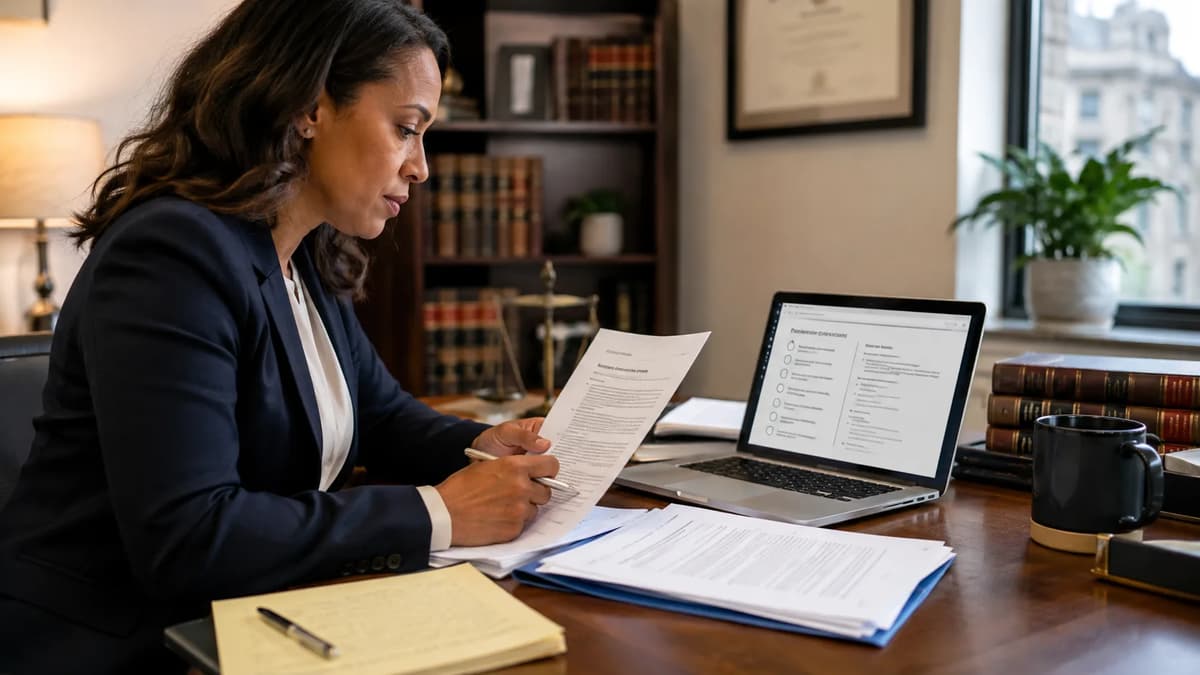
Three days before a filing deadline, a partner asks “Wait, do we actually have to tell the judge we used AI for this?” In 2026 the answer is: it depends entirely on which courtroom you’re in. Federal and state courts now take vastly different approaches. For example, Florida first had two separate AI-disclosure orders at the circuit level in early 2026, only to replace them (in June 2026) with one statewide certification rule (confirming simply that cited authorities “exist and are accurately cited”). New York went the opposite way: 22 NYCRR Part 161 (effective June 1, 2026) covers all New York courts but does not require attorneys to disclose AI use. Illinois took yet another tack: its 2025 Supreme Court Policy on AI explicitly tells judges not to impose disclosure mandates. These diverging paths matter: AI hallucinated citation sanctions have hit some lawyers with six-figure fines and career-altering penalties in 2025–26. We’ll explain what changed in 2026, why Florida, New York, and Illinois each chose a different philosophy, and how these rules (and recent sanctions) affect attorneys wherever you practice.
For general career context, see Career Opportunities in Jurimetrics, which covers the jurimetrics field broadly. This article focuses on compliance and court rules, not careers. For training, see our Refonte Learning Jurimetric & AI Program (especially the “AI-Based Compliance Systems” and “Ethics and AI” modules).
1. The Question That Depends Entirely on Which Courthouse You're In
Attorneys nationwide have started asking: Do I have to certify AI use on my court filings? The answer is jurisdiction-specific. Some courts require explicit disclosure (naming the AI tool used); others rely on attorneys’ existing candor duties and forbid requiring an AI report. In practice this means:
In some places (e.g. Florida), AI-use certification is mandated on every filing.
In others (e.g. New York’s state courts, Illinois), no special AI disclosure is required; ethical rules suffice.
Still elsewhere (many federal districts), judge-by-judge standing orders ask for tool-naming and verification.
Each attorney must check local AI-disclosure rules. Don’t rely on a generic “all courts crack down” narrative. Different attorney AI disclosure requirements have evolved, and getting them wrong can trigger sanctions.
2. Where This Started: The Case That Triggered the First Standing Order
Mata v. Avianca (S.D.N.Y., 2023) was the first widely publicized AI-hallucination case. Plaintiff’s counsel used ChatGPT to draft a brief and cited six bogus cases. The court sanctioned him $5,000 for submitting fabricated citations. That mishap highlighted the issue. Within days, Judge Brantley Starr (N.D. Tex.) issued the first U.S. standing order on May 30, 2023, requiring attorneys to certify any AI use.
May 30, 2023 (N.D. Tex.): Judge Starr’s “Mandatory Certification Regarding Generative AI” order requires each attorney to file a certificate stating either (a) no portion of the filing was drafted by generative AI, or (b) any AI-drafted text was personally verified for accuracy by the signer. Starr specifically warned that AI platforms “can make stuff up, even quotes and citations” and directed lawyers to check AI-generated language “using print reporters or traditional legal databases” before filing.
Result: By requiring these AI disclosures on every filing in his court, Judge Starr set a model that other judges soon adopted or adapted.
Judge Brantley Starr's Original 2023 Order
Judge Starr’s template certificate (later posted online) makes clear the duty of verification. Starr noted that “legal briefing is not [an AI] use” and required attorneys to certify in writing that any AI-generated content had been verified by the filer and checked for accuracy using traditional legal databases. Starr even said failing to attach the AI-certification would get a filing struck. As Starr’s press coverage puts it:
“A Texas federal judge is requiring attorneys appearing in his court to certify that they did not use generative AI... or that any AI-drafted language was checked for accuracy by a human being”.
Starr’s order also warns that AI “has no allegiance to the rule of law” and instructs attorneys to use human review on every quotation, legal assertion, and citation. This first order emphasized that any AI-assisted text must be double-checked (on pain of sanctions, including Rule 11 penalties). Starr’s move “prompted at least one other federal jurist to put forward something similar”, kicking off a judge-by-judge wave of orders.
3. How Big Is This, Really? Why the Trackers Don't Agree
By 2026, dozens of U.S. courts have some kind of AI-disclosure rule, but trackers disagree on how many. For example:
Ropes & Gray’s tracker (late 2025) counted “over 300 court directives” (standing orders, local rules, and general orders at both federal and state levels) about AI and filings.
Bloomberg Law (Apr. 2025) counted 39 federal judges who had standalone standing orders (not counting state courts) and noted only Hawaii and Nebraska had district-wide rules.
An ABA blog (early 2026) reported “at least 25 federal district courts” with standing orders or local rules requiring AI-use certification.
These numbers differ because of methodology. The ABA blog likely meant 25 districts with some rule (mostly judge-specific). Bloomberg only counted federal judges with published orders. Ropes & Gray’s “300+” includes every known directive anywhere (including state courts and even Florida circuit orders). The takeaway: no single count is definitive; the landscape is fragmented. When advising attorneys, cite multiple sources and clarify the basis.
Sample breakdown: By late 2025, Ropes & Gray’s map showed >300 AI-related rules. Bloomberg’s survey a few months earlier had 39 federal judges on its list. The ABA-style guide noted “over 20” judges in 2023, rising to “exceeds 25” by 2026. State courts (like Florida) add further rules, so the actual number of mandates depends on what you count.
4. Florida's First Move: Two Circuits, Two Separate Orders
Early 2026 saw Florida’s local courts independently impose AI-disclosure mandates. Specifically:
11th Judicial Circuit (Miami-Dade, Jan. 15, 2026): Admin Order 26-04 required any filing drafted with generative AI to have a front-page disclosure. It also mandated a certification that “all factual assertions, legal authority, and citations have been independently reviewed and verified for accuracy”. (In practice, attorneys attached a notarized AI-certification form to every document.)
17th Judicial Circuit (Broward, Jan. 26, 2026; amended May 19, 2026): AO 2026-03-Gen likewise required disclosure of AI use on the face of any filing and introduced a model certificate. Broward’s certificate explicitly asked the filer to list the AI tool used and to affirm that they “have read and verified the accuracy of every citation” in the submission.
Each circuit’s order was similar: name the AI tool (e.g. ChatGPT, Perplexity, Google Bard) if it was used, and certify that someone (the lawyer) personally checked all quotes and cases for accuracy. These were local Administrative Orders, so they initially applied only to filings in those trial courts (civil and family matters).
For example: Miami-Dade’s AO 26-04 required in Section 2 that every document say “NOTICE: This document was prepared or assisted by [name of tool]” on its first page, with a matching checkbox certification form. Broward’s order did the same, even listing specific AI tools by name.
At this point (early 2026), Florida had no statewide rule; instead attorneys in Miami-Dade and Broward had to follow their own circuit’s patchwork AI orders.
5. Florida's Second Move: One Statewide Rule Replaces Both
That patchwork ended on May 28, 2026, when the Florida Supreme Court issued AOSC 26-12 (In re Amendments to R. Gen. Prac. & Jud. Admin. 2.515(d)(2), Case No. SC2026-0673). Effective June 15, 2026, the order superseded those two local rules. It amends Rule 2.515(d)(2) of the Florida Rules of General Practice, which governs the signature line on filings. The new statewide rule requires every attorney and pro se signer to certify only that “the legal authorities identified in that filing exist and are accurately cited”.
In short, Florida went from “certify AI use and verification” to “certify citations are real.” The AOSC explicitly repealed the two circuit orders, stating that any local AI certificate requirement is now “obsolete and... repealed”. Under AOSC26-12, Florida courts must trust attorneys’ Rule 11 (and now Amended Rule 2.515) duty of candor rather than forcing a separate AI-reporting requirement.
What Rule 2.515(d)(2) Actually Requires
Under the amended rule, every signature line on a Florida court filing (civil or criminal) ends with the attorney’s oath that they have “read, reviewed, and agreed” to the contents, including that “the legal authorities identified in that filing exist and are accurately cited”. Notably, the rule says nothing about AI: it simply enforces the familiar duty that we not cite fake cases. The order accompanying the rule change makes this clear: all prior AI-certificate forms are off, and no Florida court can demand an AI-use disclosure beyond this general citation certification.
Key points of Rule 2.515(d)(2): Each signer (attorney or self-represented) must certify that they have verified every case and statute cited. The Florida Supreme Court’s order stresses that only this citation accuracy pledge is needed statewide. Local requirements to name an AI tool or attach an AI certificate are now barred.
6. New York's Opposite Bet: Accountability Without a Disclosure Mandate
New York took a starkly different approach. On March 25, 2026, the New York State Supreme Court (Unified Court System) adopted 22 NYCRR Part 161, effective June 1, 2026. Rather than imposing a blanket AI-disclosure form, the rule sets a default of no mandatory disclosure. The system-wide policy says that using AI in preparing papers is allowed (subject to existing ethics), but that attorneys “should not be required, upon submitting papers, to disclose that they have used AI in the preparation of such papers”. In other words, New York simply reminds lawyers of their normal duties (like Model Rule 3.3) and tells judges not to demand special AI certificates.
Part 161’s tenor: The rule frames AI like any other research aid: lawyers should be competent in using it, but they need not announce its use in each filing. The illustrative policy language is explicit: “attorneys and parties should not be required to disclose to the court that they have used AI in the preparation” of court submissions.
Why “accountability-over-disclosure”: New York’s approach trusts that existing sanctions rules (candor to tribunal, competence, etc.) can handle any misbehavior. It also allows individual courts (and even individual judges) to adopt their own Appendix A certification if they choose, but there is no universal AI checkbox.
Thus, unlike Florida’s mandatory certification, New York’s rule says: focus on results, not reporters. Courts can encourage care (and some trial judges may still require disclosure under local procedure), but statewide there is no compulsory AI-reporting checkbox.
7. Illinois: The Third Position
Illinois’s policy falls between Florida and New York. On Dec. 18, 2024 (effective Jan. 1, 2025), the Illinois Supreme Court promulgated an “Illinois Supreme Court Policy on Artificial Intelligence.” This policy actively discourages judges from requiring AI-specific certifications. It emphasizes that AI use is generally permissible but that attorneys must always meet their ethical duties. In fact, the policy “specifies that disclosure of AI use should not be required in pleadings”.
Bottom line: The Illinois Supreme Court chose not to make AI-disclosure mandatory. Their policy states that judges “should not require disclosure when a party uses AI” and that existing rules of conduct (like the duty of candor) already prohibit fraud (e.g., citing fictitious cases).
In practice, Illinois courts can issue local standing orders if they want, but the high court’s guidance makes clear that any mandatory AI checkbox is discouraged. Judge Fuentes of N.D. Ill. even withdrew his earlier AI order in 2024, and the Sup. Ct. policy confirms its permissive stance.
In sum, Illinois tells judges: Don’t bake an AI-certification form into your rules. Let attorneys rely on Model Rule 8.4(d)/8.4(c) and Rule 11 instead, and only require disclosure if actual problems arise. The official policy explicitly notes that “Disclosure of AI use should not be required in a pleading”, echoing New York’s accountability-over-disclosure theme.
8. Three States, Three Philosophies, Compared
Below is a comparison of Florida, New York, and Illinois (the three notable statewide models by 2026):
State | 2026 AI-Disclosure Approach | Key Requirement |
Florida | Statewide certification rule (effective June 15, 2026), replacing prior local orders | Every signer of a filing must certify that “the legal authorities identified... exist and are accurately cited”. (No AI tool naming required.) |
New York | Unified Court System policy (22 NYCRR Part 161, June 1, 2026) | No mandatory AI checkbox. The rule advises that attorneys “should not be required... to disclose... that they have used AI” in preparing filings; rely on existing duties for accuracy. |
Illinois | Supreme Court AI policy (effective Jan. 1, 2025) | Judicial guidance against mandatory disclosure. Judges are told that “disclosure of AI use should not be required in [a] pleading”. Existing ethics rules (e.g. Model 3.3/Rule 11) cover misbehavior. |
Each system reflects a different philosophy: Florida’s is a strict, one-size-fits-all certification; New York’s and Illinois’s are permissive, trusting lawyers to self-police. Many other states fall somewhere between, often through piecemeal local orders.
9. The Sanctions That Made This Urgent
These rules matter because the courts have started imposing real penalties for careless AI use. By July 2026, Damien Charlotin’s AI Hallucination Cases Database tracked 1,668 documented cases worldwide (1,163 in the U.S.), with lawyers responsible in 653 of them. In 2025–26 alone, several high-profile sanctions showed how costly AI errors can be:
Global tally: The AI Hallucination Database (July 2026) lists 1,668 cases of “hallucinated” citations worldwide, 1,163 in the US, with lawyers at fault in 653.
Record fines: Couvrette v. Wisnovsky (D. Or., Mar. 2026), described here as the worst to date. The court struck three AI-tainted briefs (dozens of fake cites/quotes) and fined the lawyer a total of approximately $110,204.38 (charging $500 per fake case and $1,000 per fake quote) plus awarding full fees. This is the largest single AI-hallucination penalty so far.
Appeals courts: Whiting v. City of Athens (6th Cir., Mar. 13, 2026): two appellate attorneys filed briefs with over 24 fictitious citations and quotes. The Sixth Circuit hit them with $15,000 each in punitive sanctions plus full reimbursement of opposing counsel’s fees and double costs. They were also referred for discipline. Meanwhile, Fletcher v. Experian (5th Cir., Feb. 18, 2026) treated AI-hallucinations as “conduct unbecoming” and sanctioned the lawyer $2,500. The Fourth Circuit’s In re Nwaubani (Mar. 11, 2026) issued a public admonishment for filing multiple bogus citations.
Law firm impact: Notably, Johnson v. Dunn (N.D. Ala., July 2025) involved three attorneys at a major firm (Butler Snow). They were disqualified and reported to the bar for submitting ChatGPT-made fake cases. This case sent a clear message that AmLaw firms won’t be spared if their associates ignore AI’s flaws.
These recent cases prove the stakes are high. Even small AI mistakes can carry substantial financial and professional consequences, from dismissals and fee awards to professional discipline. The trend is unmistakable: courts expect lawyers to verify everything, and failure to do so, or to follow local AI disclosure rules can trigger real sanctions.
The $110,000 Oregon Case
In Couvrette v. Wisnovsky (D. Or., Mar. 2026), attorney Justin Couvrette used ChatGPT while drafting submissions in the case. He submitted three briefs packed with fabricated case names and quotes. The presiding judge found this was “repeated” and “knowing” misconduct. He struck the brief, dismissed claims, and penalized Couvrette. The breakdown: $500 fined for each fictitious case citation, $1,000 for each fake quotation, plus full plaintiff’s attorney fees. Altogether, Couvrette paid about $110,204. This is the largest AI-hallucination sanction so far. As Legal AI Insights notes, the judge imposed “a total sanction of $110,204.38,” the largest on record. That case shows how a single hallucinated brief can become a six-figure problem.
What the Federal Appeals Courts Are Doing Differently
The federal circuits have taken note, but each handled sanctions a bit differently:
Sixth Circuit (Whiting): Two Atlanta-area lawyers filed a 6th Cir. brief containing dozens of fake citations. The court didn’t even need to confirm the use of AI; it held the attorneys responsible for verifying every citation, however it was generated. It imposed severe sanctions: $15,000 each in punitive fines, plus full reimbursement of the opposing party’s fees and double costs. (The Sixth Circuit actually cited FRAP 38 and inherent power for fines.) It also issued a referral to disciplinary authorities. The lesson: in the 6th Circuit, AI or no AI, citations must be checked, or the sanctions can be crippling.
Fifth Circuit (Fletcher): In Fletcher v. Experian (Feb. 2026), the appeals court sanctioned a lawyer $2,500 under FRAP 46(c) for filing a reply brief that was prepared by AI without verification. The Fifth Circuit called the conduct “unbecoming a member of the bar” and reinforced that FRAP 46 (sanctioning attorneys) applies whether AI is involved or not.
Fourth Circuit (Nwaubani): This case (Mar. 2026) involved a pro se lawyer who filed dozens of nonexistent case citations (detected via AI-driven research). The Fourth Circuit did not rely on any specific AI rule, but instead issued a public admonishment for violating its ethical rule against dishonesty in filings. The court emphasized that the duty to verify citations is “non-delegable,” regardless of technology.
In short, appellate courts are making clear: don’t carelessly file fake cases. The Sixth Circuit’s high fines are notable, but all these decisions stress the same theme: attorneys are personally responsible for their filings’ accuracy. AI is not an excuse.
10. What Actually Counts as a Violation
Under any court’s rules, certain actions trigger penalties. Key “violations” include:
Fabricating an authority: Presenting any case, statute, or quote that does not exist is outright fraud on the court. Courts routinely hold this sanctionable (as in Mata, Whiting, Fletcher, etc.). Even a single bogus cite can violate FRCP 11 or model ethics Rule 3.3. For example, the Fourth Circuit in Nwaubani found that a brief containing multiple nonexistent citations “seriously interferes with the administration of justice”. Hallucinated case names are never excused.
Misquoting or misrepresenting a real case: Altering a real opinion’s holding or quote in a misleading way is also sanctionable. AI can do this inadvertently, but whether by AI or human, courts treat it as the lawyer’s responsibility. (It falls under the same duties.)
Failing to verify AI output: Even if you’re just using AI to brainstorm or summarize, not checking its work can be misconduct if the errors reach the court. The law treats AI-generated content the same as any other research: the signer must verify it. The ABA has stressed that using AI without understanding it violates competence (Model Rule 1.1).
Omitting a required AI certificate: In courts that do require a certificate (like Judge Starr’s N.D. Tex., or pre-June 2026 Florida), failing to sign it is itself a violation. For instance, Starr’s order will strike any filing that lacks the mandated AI-certification. Even if the rest of the brief were fine, the omission forfeits the filing.
Summary: Anything that amounts to a false statement or omission, whether due to AI or not, can violate rules of candor. The safest course: every attorney should independently verify every cited authority in every filing. And in jurisdictions with an AI checkbox rule, never treat that checkbox as optional.
11. What This Means for Where You Practice
Given the patchwork of rules and the rising sanctions, attorneys must do a jurisdictional check before any filing. Some action steps:
Identify your rules: Research all courts and judges in your venue. Does your federal district have a standing AI order? Does your local state court system have one? (For example, all Florida state courts follow Rule 2.515 now; every New York court follows Part 161.) Check published standing orders (often on the court’s website) and local rules. These can change quickly.
Update your filings: If your court does require disclosure, plan to add the required certificate or notation. Some orders demand naming the specific AI tool used (e.g. “This document was prepared with ChatGPT-4”). Others demand a printed checkbox on the signature page. Adjust templates accordingly.
Verify everything: Regardless of formal rules, always double-check every fact, quote, and citation in your filing. Treat any AI-generated suggestion as untrusted until confirmed by an independent source.
Train your team: Make sure everyone (partners, associates, paralegals) understands that AI content must be verified. Include this in your litigation protocols or ethics training. The courts are clear: lack of verification is malpractice waiting to happen.
Stay informed: New orders keep coming. Florida flipped in mid-2026. Monitor updates (e.g. justices voted 3–2 in June 2026 to adopt the new statewide Florida rule). Court rules could change if cases multiply.
In short, where you practice determines which boxes you check. California, Texas, and New York trial courts each have different mandates; federal districts differ; even each judge might. Always confirm the current “court AI disclosure rules” for your specific courthouse.
12. Common Mistakes Attorneys Are Still Making
Despite all the publicity, many attorneys slip up. Common pitfalls include:
Treating the AI certificate as a formality: Simply stamping an AI-use checkbox without actual review is dangerous. Starr’s order will strike filings that omit or mindlessly check the certificate. Always fulfill the certification truthfully.
Copying boilerplate: Don’t blindly reuse a prior AI-disclosure paragraph. The certification language in some orders is case-specific. Ensure you list the actual tools you used and verify content in this case.
Overlooking tool versions: If disclosure is required, name the exact AI (e.g., GPT-4 vs. “ChatGPT”). Generic references may be rejected by strict courts.
Assuming AI use is banned everywhere: Some lawyers panic and try to hide any AI aid, even in jurisdictions that explicitly allow it (like Illinois and New York). Hiding use isn’t the point; transparency is. It’s better to say “I used X tool but verified everything” where required, than to risk a finding of dishonesty.
Ignoring jurisdictional updates: For example, Florida lawyers who ignored the June 2026 rule change and kept doing circuit-specific certifications were out of compliance (the state rule now requires the citation certification only). Always use the current rule.
Treating Certification as a Formality
A particularly costly mistake is treating the disclosure/certification as a rubber-stamp. Under Judge Starr’s order, any filing that lacks the mandated AI certificate is struck from the record. In Florida before June 2026, failing to attach the circuit court’s certificate form could similarly invalidate your filing. Even after June, signing the citation-verification line without actually checking your cites is tantamount to lying under oath. These requirements are not mere formalities; courts emphasize they are affirmations of truth. In short: read and believe what you sign.
13. Jurimetrics and Legal-AI Careers in 2026
For lawyers intrigued by AI, the booming field of jurimetrics offers new career paths. Jurimetrics (applying data science to law) has spawned roles like Legal Technologist, Jurimetrics Analyst, or AI-Law Consultant. Refonte Learning’s program cites these exact career outcomes. Demand is high: a 2025 survey noted “tens of thousands” of positions for professionals combining legal and data skills; a LinkedIn search found over 34,000 “law-related data science” jobs in the U.S. alone.
Roles: As outlined in our Become a Jurimetric Analyst guide, roles include legal data analysts, compliance data scientists, and AI consultants. For example, a jurimetrics analyst might analyze court data to predict case outcomes. A legal AI consultant advises firms on adopting AI workflows. Our program also highlights Legal Technologist as a career outcome.
Skills: These careers require both legal knowledge and data/AI literacy. Ethical awareness is key: understanding AI’s limits (to avoid hallucinations!) is as important as technical skill. Training in ethics and compliance (like our “AI & Legal Ethics” module) is part of preparing for these jobs.
Salary: Refonte’s marketing suggests six-figure salaries (it lists $104,000+ starting salary). Independent data paint a more modest picture: for example, ZipRecruiter reports that the median U.S. salary for a Legal Data Analyst is about $75,000 (with most between $60,000 and $87,000). This suggests entry-level jurimetric roles often start in the high $50,000s or $60,000s, rising into the $80,000–$120,000 range with experience. In short, the six-figure starting salary is more aspirational, while real market data show solid but not astronomical wages.
The good news is the demand and the opportunity to guide firms through the very issues in this article. A career in jurimetrics means mastering skills like AI governance, analytics, and compliance systems. If you’re interested, consider how the Refonte Learning Jurimetric & AI Program can build that skill set (especially the modules on AI-Based Compliance Systems and Ethics and AI in Legal Systems, which cover the exact challenges of navigating court AI rules).
For more on careers, see our guide Become a Jurimetric Analyst.
14. Building This Skill Set: The Refonte Learning Jurimetric & AI Program
Navigating this brave new AI-compliance world calls for specialized training. Refonte Learning’s Jurimetric & AI Program (3 months, approximately 12–14 hours/week, fully online) is designed to train lawyers and analysts in exactly these skills. Core modules include Foundations of Jurimetrics and AI, Legal Automation Tools, Predictive Analytics for Legal Decisions, AI-Based Compliance Systems, and Ethics and AI in Legal Systems. The program is led by Dr. Bryan Layton (15+ years of experience at the intersection of law and AI). Upon completion, graduates earn a certificate and are equipped to work as Legal Technologists, Jurimetrics Analysts, or AI-Law Consultants (job titles the program specifically targets).
Flexible structure: 3-month duration, requiring about 12–14 hours/week (online, flexible).
Curriculum highlights: Hands-on projects in legal automation and data analysis, an AI-Based Compliance Systems module (teaching how to build and manage compliance workflows), and an AI & Legal Ethics module (covering issues like AI hallucinations and disclosure).
Mentorship: Dr. Bryan Layton (Dept. of AI & Legal Systems) provides expert guidance throughout.
Career support: The program aims at roles like Jurimetrics Analyst and Legal Technologist (its marketing cites high starting salaries, though actual market figures vary).
Practical outcome: A capstone project lets you apply jurimetrics to a real legal issue.
With AI reshaping legal work and compliance rules changing rapidly, skills in legal data science and AI governance are increasingly in demand. The Refonte Jurimetric & AI Program’s emphasis on AI compliance systems and ethics can help you stay ahead of the evolving legal AI compliance 2026 requirements, whether that means building better citation-check tools, auditing AI outputs, or simply knowing how to handle a judge’s AI disclosure order.
Interested? Learn more about the Refonte Learning Jurimetric & AI Program and how it can prepare you to tackle AI governance issues in law.