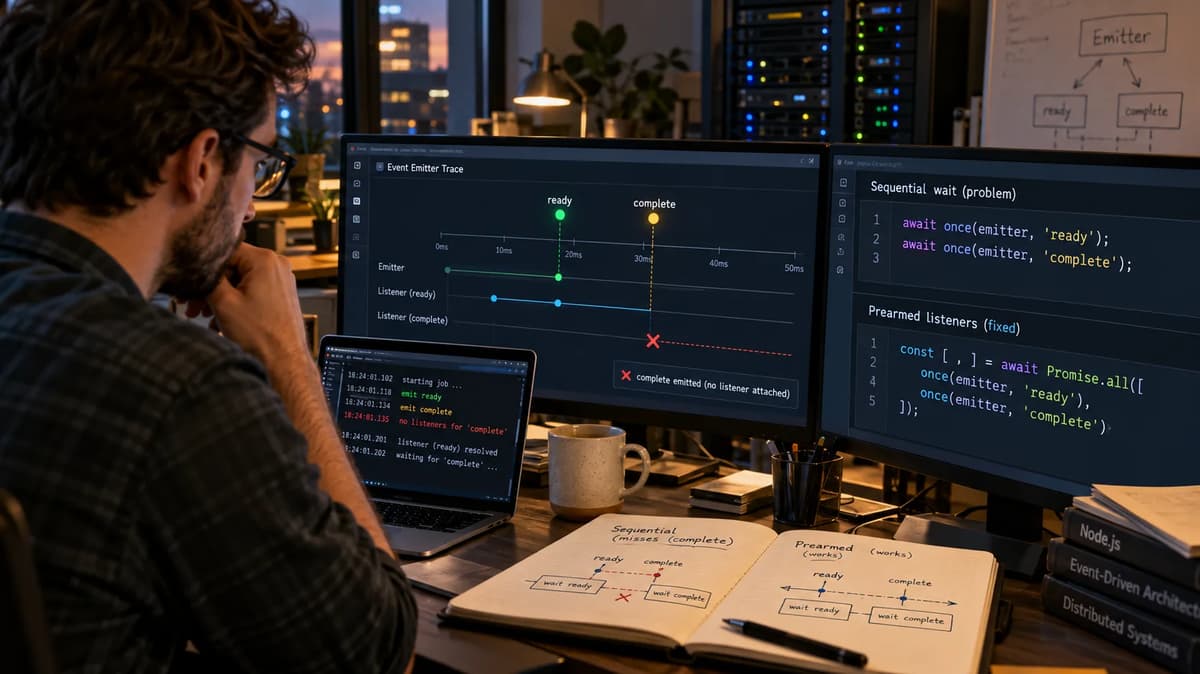
The producer emitted ready, then complete. The consumer resumed after its first await, installed another wait, and stopped making progress. Both producer messages can be accurate. The missing evidence is whether a complete listener existed when that event was emitted.
This is the operational question behind a Node.js events.once missed event: did the consumer subscribe before the observation became available? A sequential await can leave a registration gap even when the producer uses the expected event names, sends the correct payloads, and preserves their order. Increasing a timeout changes how long the consumer waits after the gap; it does not reconstruct the event.
The playbook below uses one plain EventEmitter per case, two ordinary event names, controlled producer schedules, and an explicit error path. Its evidence is an ordered registration/emission ledger, followed by both promise settlements and final listener counts. Synchronous, nextTick, and microtask bursts expose the flaw; a separate-turn control shows how the same consumer can appear correct.
The repair creates both waits before the producer can emit. Acceptance then depends on registration coverage, matching operation payloads, and cleanup. Completion, producer failure, cancellation, and an observation already lost require different decisions. The supplied commissioning run and the recorded execution are identified separately, and neither establishes HTTP, ESM, worker-thread, or production behavior. The aim is a bounded consumer correction that a reviewer can audit without relying on elapsed time alone.
Define what observing both events must mean
Define success before examining a green status. Each case owns a fresh emitter and an operation identifier, N1 through N11. Its ordinary event names are the strings 'ready' and 'complete'. The producer creates payloads with two fields: run, identifying the case, and event, identifying the observation. These values are authored fixture inputs.
A successful case must retain the ready payload and the complete payload for that same operation. The Node.js Events documentation specifies that events.once() fulfills with an array of emitted arguments. Consequently, this fixture expects two argument arrays, each containing one payload object. A result with the wrong run identifier or swapped event field is unacceptable even if both promises fulfilled.
Here, payload identity means those operation and event values. The supplied assertions use deep equality against newly constructed expected objects. They do not test JavaScript reference identity with ===, freeze payloads, or demonstrate that arbitrary application objects remain unchanged after observation. Keep the acceptance language aligned with that check.
A producer log establishes that an emission path ran. A fulfilled first wait establishes that the consumer observed ready. Neither establishes the second observation. Likewise, a count of two log lines does not reconcile their event names, operation identifiers, listener coverage, or promise results.
Readers considering backend framework tradeoffs can use this exercise after selecting Node.js: the decision here concerns a native runtime contract within the chosen stack.
The emitter is deliberately isolated, so another operation cannot supply a plausible complete payload. Reusing an emitter across concurrent operations would require additional correlation and ownership rules. That integration is NOT RUN. Accept this fixture only for the operation boundaries it actually creates, and require a separate identity check before transferring the pattern to a shared application emitter.
Draw the subscription boundary before discussing timeouts
The important boundary is the call that installs each wait. In this fixture, calling wait('ready') records a registration step and calls once() immediately. The producer is invoked after that call returns. In sequential mode, wait('complete') appears only after the first await resumes.
The documented synchronous emission contract says registered listeners run during emit(), in registration order. Resolving the first promise does not execute the remainder of the async consumer inside that listener. The producer can finish its current callback, including its second emission, before the consumer's continuation installs the second wait.
That explanation is sufficient for the experiment. The synchronous burst executes two adjacent emits. The nextTick burst puts both emits inside one scheduled callback. The microtask burst does the same inside one queueMicrotask callback. Each burst has a place where the first promise becomes fulfilled while the second subscription still does not exist.
The Node.js Process documentation describes next-tick processing and the different scheduling context of CommonJS and ESM. Preserve that distinction: this .cjs driver does not establish a universal priority rule for every callback, module loader, or nested scheduling context. Its three burst cases test their own emission arrangement; they are not a recommendation to design new producers around nextTick.
Emission order is not subscription coverage
The producer's contract can permit ready immediately followed by complete. The consumer then needs both subscriptions installed before that permitted burst begins. Requiring the second event to occur later than the first does not, by itself, give the consumer an opportunity to register between them.
Draw the review boundary around registration, producer start, emission, and settlement. Ask which lines can emit before all required subscriptions return. A timeout belongs after that analysis as an escape for incomplete work.
The broader xw provide prerequisite context. For this exercise, the useful prerequisites are reading CommonJS, distinguishing a promise from its continuation, and following an ordered trace. A full event-loop survey would add little to the decisive missing-listener row.
Run the isolated two-event fixture
Save this complete source as node_once.cjs, preserving LF line endings and its final newline. It needs Node.js and built-in modules only. Its supplied SHA-256 is daf5b9f049b503d12dde4766139c00d6569c12645d7886fb6ff495726e783c38.
Compare the saved digest before attributing a result to the supplied driver. Keep the .cjs filename and launch it as its own process. Copying fragments into a REPL, adding a loader, or importing a rewritten ESM version changes the execution context. Those alternatives are NOT RUN here.
Keep this independently stated input/expected manifest beside the output. F means fulfilled, A means rejected with AbortError, and E means rejected with Error. Every F must contain the matching run/event argument array; every final ready/complete/error count must be zero.
Case | Consumer | Producer schedule | Expected outcome | Ready / complete |
N1 | sequential | sync | ABORTED | F / A |
N2 | sequential | nextTick | ABORTED | F / A |
N3 | sequential | microtask | ABORTED | F / A |
N4 | sequential | separateTurns | COMPLETE | F / F |
N5 | prearmed | sync | COMPLETE | F / F |
N6 | prearmed | nextTick | COMPLETE | F / F |
N7 | prearmed | microtask | COMPLETE | F / F |
N8 | lateAll | sync | ABORTED | A / A |
N9 | prearmed | missing | ABORTED | F / A |
N10 | prearmed | errorFirst | fixture_failure | E / E |
N11 | prearmed | errorAfterReady | fixture_failure | F / E |
'use strict';
const assert = require('node:assert/strict');
const { EventEmitter, once } = require('node:events');
async function run(id, mode, schedule, expected) {
  const emitter = new EventEmitter();
  const controller = new AbortController();
  const trace = [], waits = [];
  const wait = (name) => {
    trace.push({ step: trace.length, action: 'register', name });
    const promise = once(emitter, name, { signal: controller.signal });
    promise.catch(() => {});
    waits.push({ name, promise });
    return promise;
  };
  const emit = (name) => {
    const payload = name === 'error' ? new Error('fixture_failure')
      : { run: id, event: name };
    const row = { step: trace.length, action: 'emit', name,
      listenersBefore: emitter.listenerCount(name) };
    trace.push(row);
    row.hadListener = emitter.emit(name, payload);
  };
  const burst = () => { emit('ready'); emit('complete'); };
  const produce = () => {
    if (schedule === 'sync') burst();
    else if (schedule === 'nextTick') process.nextTick(burst);
    else if (schedule === 'microtask') queueMicrotask(burst);
    else if (schedule === 'separateTurns') setImmediate(() => {
      emit('ready'); setImmediate(() => emit('complete'));
    });
    else if (schedule === 'missing') process.nextTick(() => {
      emit('ready'); setImmediate(() => controller.abort());
    });
    else if (schedule === 'errorFirst') process.nextTick(() => emit('error'));
    else if (schedule === 'errorAfterReady') process.nextTick(() => {
      emit('ready'); emit('error');
    });
    else throw new Error('unknown schedule');
  };
  let result, outcome;
  const watchdog = setTimeout(() => controller.abort(), 500);
  try {
    if (mode === 'prearmed') {
      const ready = wait('ready'), complete = wait('complete');
      const both = Promise.all([ready, complete]);
      produce();
      result = await both;
    } else if (mode === 'sequential') {
      const first = wait('ready');
      produce();
      const ready = await first;
      const complete = await wait('complete');
      result = [ready, complete];
    } else if (mode === 'lateAll') {
      produce();
      result = await Promise.all([wait('ready'), wait('complete')]);
    } else throw new Error('unknown mode');
    outcome = 'COMPLETE';
  } catch (error) {
    outcome = error.name === 'AbortError' ? 'ABORTED' : error.message;
  } finally {
    clearTimeout(watchdog);
    controller.abort();
  }
  const settled = await Promise.allSettled(waits.map(x => x.promise));
  const settlement = settled.map((s, i) => ({ name: waits[i].name,
    status: s.status,
    value: s.status === 'fulfilled' ? s.value : s.reason.name }));
  const remaining = Object.fromEntries(['ready', 'complete', 'error']
    .map(name => [name, emitter.listenerCount(name)]));
  assert.equal(outcome, expected, id);
  assert.deepEqual(remaining, { ready: 0, complete: 0, error: 0 });
  if (expected === 'COMPLETE') assert.deepEqual(result, [
    [{ run: id, event: 'ready' }], [{ run: id, event: 'complete' }]
  ]);
  if (id === 'N1' || id === 'N2' || id === 'N3') {
    assert.equal(trace.find(r => r.action === 'emit' && r.name === 'complete')
      .listenersBefore, 0);
  }
  return { id, mode, schedule, outcome, trace, settlement, remaining };
}
(async () => {
  const cases = [
    ['N1', 'sequential', 'sync', 'ABORTED'],
    ['N2', 'sequential', 'nextTick', 'ABORTED'],
    ['N3', 'sequential', 'microtask', 'ABORTED'],
    ['N4', 'sequential', 'separateTurns', 'COMPLETE'],
    ['N5', 'prearmed', 'sync', 'COMPLETE'],
    ['N6', 'prearmed', 'nextTick', 'COMPLETE'],
    ['N7', 'prearmed', 'microtask', 'COMPLETE'],
    ['N8', 'lateAll', 'sync', 'ABORTED'],
    ['N9', 'prearmed', 'missing', 'ABORTED'],
    ['N10', 'prearmed', 'errorFirst', 'fixture_failure'],
    ['N11', 'prearmed', 'errorAfterReady', 'fixture_failure']
  ];
  const rows = [];
  for (const args of cases) rows.push(await run(...args));
  console.log(JSON.stringify({ node: process.version, module: 'CommonJS',
    platform: process.platform, arch: process.arch, cases: rows,
    status: 'PASS_11_CASES' }, null, 2));
})().catch(error => { console.error(error); process.exitCode = 1; });
(
set -u
run_dir=$(mktemp -d ./node-once-run.XXXXXX) || exit 1
sha256sum node_once.cjs > "$run_dir/source.sha256" || exit 1
status=0
node node_once.cjs > "$run_dir/node-once-evidence.json" \
2> "$run_dir/stderr.txt" || status=$?
printf '%s\n' "$status" > "$run_dir/exit-status.txt"
printf 'Evidence: %s\n' "$run_dir"
exit "$status"
)The driver prints its combined JSON after all cases finish. An assertion failure before that point can leave stdout empty, with the error on stderr and a nonzero exit status. Preserve that evidence. An expected case-level ABORTED outcome and a failed Node invocation are different results; neither empty JSON nor the text of the source's PASS statement substitutes for a completed execution record.
Commissioning evidence: the supplied record reports PASS_11_CASES on Node.js v22.16.0, Linux x64, CommonJS, with the outcomes above and zero final ready/complete/error counts in all eleven cases.
Recorded execution for this article: the byte-identical, 4,298-byte source ran on Node.js v24.19.0, Linux x64, CommonJS. It exited 0, produced empty stderr, and printed PASS_11_CASES. A separate checker reconciled every trace and settlement record against independent expectations. An author rerun on v22.16.0 is NOT RUN.
Documented behavior, authored expectations, supplied commissioning observations, and the separately recorded execution remain distinct evidence classes. A printed PASS demonstrates the assertions reached in that execution. Retain failed or partial output if another environment disagrees; changing source bytes requires a new digest and rerun.
Catch the second event passing an empty listener set
N1, N2, and N3 have different scheduling inputs and the same decisive ledger in the recorded execution. Their supplied commissioning observations also report zero complete listeners at emission. Read the ordered rows before reading ABORTED:
Step | Recorded action | Listeners for emitted name | emit() return |
0 | Register ready wait | Not sampled | Not applicable |
1 | Emit ready | 1 | true |
2 | Emit complete | 0 | false |
3 | Register complete wait | Not sampled | Not applicable |
The registration rows record entry to the wrapper immediately before its once() call. They are not listener-count snapshots. The counts are sampled immediately before each emit. With this plain emitter, synchronous wrapper, and no registration hooks, the source and the emission snapshots together establish the registration boundary.
listenerCount(name) measures listeners for the named event at that point. It does not count events previously emitted, report payload validity, or establish ownership on an arbitrary shared emitter. The fixture's isolation makes the single listener attributable to its wait.
The Events API definition of emit() associates its Boolean return with whether that event had listeners. For the ordinary complete event, false is therefore evidence of an empty listener set. It is not a producer exception, a negative acknowledgement, or a request to resend.
Read the zero-listener row
In N1, the synchronous producer reaches step 2 before the consumer gets past its first await. In N2, the next-tick callback executes both emits before that continuation. In N3, the microtask callback likewise completes its burst before the continuation registers complete.
The shared defect is visible at step 2: the only commissioned complete emission crosses zero relevant listeners. Step 3 installs a valid future subscription, but this producer has no later complete event for it. The watchdog eventually cancels that pending wait.
An ABORTED outcome alone would not identify this cause. Here, the emission ledger distinguishes a missed observation from a producer that never emitted. Retain both facts in a review: the producer emitted complete, and the consumer failed to cover it. Assign REPAIR to the sequential consumer before rerunning its future operations. Its diagnostic failure is useful evidence, while the operation remains incomplete from that consumer's perspective.
Use a successful schedule as a negative control
N4 keeps the flawed sequential consumer and changes the producer schedule. The first setImmediate callback emits ready; from inside that callback, another setImmediate schedules complete. The Node.js Timers documentation states that an immediate scheduled inside an executing immediate callback runs in a later event-loop iteration.
In the recorded executions, this arrangement gives the consumer an opportunity to resume and register its second wait. The recorded ledger reads: register ready, emit ready with one listener, register complete, emit complete with one listener. Both emits return true, both argument arrays match the case identity, and the outcome is COMPLETE.
That result matters because a test containing only N4 would approve the wrong general design. The consumer has not changed. The extra scheduling boundary happens to provide the missing registration opportunity. A review based solely on successful completion would miss that the permitted burst cases remain broken.
A passing control can expose a weak test
Use N4 to test the quality of the qualification method. A useful suite can say that N4 completed correctly under its input schedule and also reject sequential waits under the broader three-burst contract. These judgments are compatible because their scopes differ.
Compare the locations of the second registration. In N4 it precedes the complete emission. In N1–N3 it follows that emission. This difference explains the outcomes without an invented latency threshold or a claim that the producer randomly lost work.
Retain N4 during the repair review as the successful sequential control. Comparing N1–N3 with N5–N7 isolates the registration change under matching burst schedules. If N4 unexpectedly aborts, preserve that failure and investigate the environment or altered fixture; the expected manifest is not permission to overwrite an inconvenient result. A prearmed separate-turn variant is NOT RUN in this eleven-case suite.
Do not make the production producer imitate N4 merely to pass the test. The existing contract permits the original schedules. Qualifying a consumer against those schedules requires changing when it subscribes, while the successful control continues to demonstrate why a timing-dependent test was insufficient.
Create both waits before the producer can emit
N5, N6, and N7 exercise the bounded repair. The prearmed branch calls wait('ready') and wait('complete'), constructs the aggregate from those promises, and only then invokes produce(). There is no await between the two registrations and no producer call before either registration returns.
This follows the Events documentation's guidance for awaiting multiple events: create the promises before awaiting them. In this experiment, the stronger operational placement is explicit: create both before the producer can emit either event.
The recorded traces for all three cases record both registrations first. Ready then emits with one ready listener, and complete emits with one complete listener. Both return true. Consuming ready removes its one-time listener without removing the independently installed complete wait.
Reconcile the results by position and content. The aggregate's first element contains [{ run: id, event: 'ready' }]; its second contains the corresponding complete array. In N5–N7 the recorded execution checked those values, and the supplied commissioning record reports the same successful payload checks. Their final listener counts are also zero.
Promise.all coordinates promises already created by the once() calls. The important registration work occurs while those calls execute. Merely mentioning Promise.all in a patch says little about whether the producer could run first; review the statements that create its inputs.
The sufficient condition here is concrete: the operation has not started, registration is synchronous on a plain emitter, and both waits exist before the permitted producer burst. This case set does not validate a factory that emits during construction, a subscription hook that emits recursively, or an operation shared with unrelated listeners. Those integrations are NOT RUN and require their own ownership boundary.
For the controlled future operation, the repair earns ACCEPT_BOUNDED once registration order, payload equality, settlements, and cleanup agree. Preserve the producer schedules during rerun so the evidence attributes the change to the consumer. Increasing the watchdog interval or inserting a gap between emissions would qualify a different experiment.
Prove that a late Promise.all cannot replay history
N8 places produce() before both wait calls. Because its producer is synchronous, ready and complete have already emitted when the expressions passed to Promise.all create their subscriptions. The aggregate is valid JavaScript, but it coordinates future waits for observations that this operation has already supplied.
The recorded trace begins with ready at zero listeners and complete at zero listeners; both emits return false. Only afterward do the ready and complete registration rows appear. Both waits eventually reject with AbortError. The outcome is ABORTED, with no fulfilled payload array to reconcile.
This case separates two distinct changes often proposed during debugging. Moving both subscriptions before the producer fixes future coverage. Replacing late sequential awaits with a late aggregate leaves their registration boundary unchanged. The consumer cannot infer an earlier payload from the aggregate's existence.
Registering later cannot observe the past
For this one-shot operation, the missing observations are already unrecoverable through the fixture's emitter interface. That statement is bounded by the interface: this plain emitter has no retained result, replay request, or operation restart function. It says nothing about whether a larger application might expose such capabilities elsewhere.
Recovery needs an explicitly available contract. A state query must identify this operation and return authoritative state or its retained result. A replay or buffer must retain the relevant events and define subscription coverage while replay is established. A restart must be permitted by the operation owner and account for effects the earlier attempt may already have produced. These are proposed integration requirements, all NOT RUN here.
When recovery combines a query with a new subscription, its contract must also cover transitions between those steps. Otherwise, the recovery path can introduce another observation gap.
If none exists, abort the wait and HOLD any claim that the original operation was observed completely. Re-emitting a guessed payload would manufacture evidence. Starting again without the owner's rules could create a second operation while leaving the first outcome unresolved.
The broader asynchronous API performance context concerns endpoint efficiency. This repair supplies correctness evidence about registration; it includes no throughput or latency benchmark.
Keep that distinction in the recovery record. Identify the missed operation, the observations actually retained, the available recovery authority, and the next permitted action. Prearming a new attempt can establish coverage for that attempt. It cannot turn N8's empty listener sets into historical subscriptions.
Give missing events an explicit cancellation path
N9 prearms both waits but never schedules complete. Its missing producer emits ready in a next-tick callback, then schedules an immediate callback that calls controller.abort(). This is an authored cancellation path for missing work, separate from the watchdog present in every case.
The Node.js Globals documentation describes AbortController as a cancellation-signaling facility: calling abort() notifies its signal's observers. In this fixture the signal is supplied to both event waits. Each case creates a fresh controller, so an earlier case's cancellation cannot invalidate the next case's subscriptions.
The recorded N9 outcome is ABORTED. Ready is fulfilled with its expected argument array; complete is rejected with AbortError. Unlike N1–N3, N9 contains no complete emission row. That distinction prevents the same terminal label from being used as proof of the same cause.
The output does not contain an abort-origin field or cancellation timestamp. Its known schedule supplies explicit cancellation, but the serialized ABORTED result alone does not prove which abort callback won. If a service needs that distinction, its integration evidence must record cancellation ownership and reason. That additional instrumentation is NOT RUN here.
The 500 ms watchdog is an authored laboratory escape. The Timers documentation does not promise exact callback timing. A blocked execution thread can delay cancellation; no observed interval here is a service deadline or latency measurement.
Assign cancellation to the owner that decides how long the observation remains useful. Record the partial result and terminate the pending wait without synthesizing complete. Aborting these waits does not retract ready, undo producer effects, or automatically cancel scheduled producer callbacks. Any such producer control requires its own contract. The fixture's responsibility ends with honest settlement and cleanup of its subscriptions.
Preserve producer errors and inspect both settlements
N10 and N11 test explicit producer failure while event promises exist. The Events documentation specifies rejection when an emitter reports 'error' while events.once() is waiting for an ordinary event. Both cases emit new Error('fixture_failure'); neither should be relabeled as missing-event success.
In the recorded N10 trace, both waits are registered before the error emission. The error listener count is two, emit() returns true, both promises reject with Error, and the operation outcome is fixture_failure.
N11 emits ready before error. Ready fulfills and its associated error handling is removed; the still-pending complete wait retains its error handling. The decisive error emission therefore has one error listener. The operation fails despite a valid ready observation.
Case | Error listeners before error emit | Ready settlement | Complete settlement | Outcome |
N10 | 2 | Rejected: Error | Rejected: Error | fixture_failure |
N11 | 1 | Fulfilled: matching payload | Rejected: Error | fixture_failure |
One rejected aggregate is not two inspected waits
The first aggregate rejection tells the consumer that it cannot return a successful pair. It does not replace the separate settlement ledger. After cleanup, the fixture calls Promise.allSettled() on every original promise in waits, preserving both the fulfilled and rejected outcomes.
The no-op promise.catch(() => {}) handlers handle early rejections while those originals remain stored for inspection. They do not replace the original promises with successful values. Removing inspection while keeping only empty catch handlers would discard precisely the evidence the error cases need.
The serialized rejection value is only reason.name. The aggregate outcome separately preserves the fixture_failure message. This output does not retain each full error object, stack, or individual message; do not describe it as a complete error archive. The settlement ledger records final statuses, not the exact time each promise resolved or rejected.
Assign FAIL_OPERATION to N10 and N11. Preserve N11's ready payload as partial evidence, then let the producer owner determine any recovery. The consumer owner remains responsible for inspecting rejected waits and removing owned subscriptions. Neither a fulfilled first wait nor successful cleanup converts the operation's reported error into completion.
Release every listener owned by the test
Cleanup is part of each case's evidence. The finally block clears the watchdog and aborts the controller whether the main path completes or catches an error. The subsequent Promise.allSettled() inspection finishes before the emitter's final inventory is collected.
All eleven cases in the supplied commissioning record asserted zero remaining ready, complete, and error listeners. The recorded execution independently observed the same three zero counts for every case. These are assertions about the fresh fixture emitters at the recorded checkpoint.
Successful once waits have consumed their named event; their associated error handling has also been removed in the observed traces. Pending waits in the abort cases lose their subscriptions through cancellation. Error cases reject their outstanding waits. The final counts reconcile those paths against the same expected inventory.
The companion discussion of listener identity and lifetime addresses browser listener ownership. The review question that transfers here is precise: which operation owns this subscription, and where does that operation release it?
Avoid using removeAllListeners() to manufacture a zero count in an integration. This fixture does not need that shortcut. On a shared emitter, blanket removal could erase another owner's listeners and produce an apparently clean inventory by violating ownership. Establish the baseline and account for the listeners introduced by the consumer being reviewed.
Keep the cleanup claim narrow. The final object covers three emitter event names; it does not inventory AbortSignal listeners, every timer, process resources, or another component's subscriptions. It also does not prove that a producer has stopped. A later producer error would need an appropriate owner after these temporary waits are gone; that lifetime is outside the executed cases.
A cleanup mismatch is an unresolved defect even when both payloads were correct. Retain the failing count and repair the responsible path. Conversely, zero counts are compatible with an aborted or failed operation: they establish released fixture subscriptions, not a successful business result.
Integrate the repair without changing the producer contract
Treat integration as a small consumer change with explicit ownership. The laboratory has completed; application integration and canary execution are NOT RUN. Use the evidence to prepare that work, then qualify the actual application boundary before broader acceptance.
First, identify the earliest line that can start the producer. Include constructors and helper calls if the application permits them to emit. The consumer owner must place both registrations before that point. If the operation has already started, apply the recovery boundary from N8 instead of claiming that a later patch covers it.
Second, preserve the producer's permitted schedules, event names, and payload contract. The producer owner confirms these inputs and its error behavior. A change that inserts a sleep or postpones complete would alter the contract being tested and obscure whether subscription order was repaired.
Third, prepare a limited canary with operation identifiers, registration/emission ordering, payload reconciliation, settlements, and owned-listener cleanup. The target integration must supply enough evidence to connect its events to its operation. Plain once() does not filter a shared emitter by the payload's run identifier; prearming alone cannot solve that correlation problem.
Define rollback before applying the change. Return to an approved consumer version only within that version's supported producer contract. If the old version is known to miss permitted bursts, stop affected new operations under the owner's procedure while resolving the defect. Rollback must not silently restore the demonstrated failure mode and call it safe.
Keep in-flight work separate. Reverting future code does not remove an existing operation's waits, cancel its producer, or recover already-missed payloads. The operation owner decides how those attempts are canceled or reconciled. Retain the reviewed source digest, intended runtime, evidence location, decision, and responsible owners so the bounded repair remains traceable through deployment and reversal.
Choose accept, repair, fail or hold from the trace
Make the decision from registration, emission, payload, and settlement evidence together. The outcome string is one input. The following matrix separates a diagnostic verdict from acceptance of an operation or consumer design.
Evidence | Operation interpretation | Review decision and owner |
N5–N7: both waits precede the burst; payloads and cleanup match | Complete within the controlled contract | ACCEPT_BOUNDED; consumer owner records tested scope |
N1–N3: complete emitted with zero listeners | Observation missed; wait later aborted | REPAIR consumer before rerun; operation owner handles unresolved work |
N4 alone succeeds under separate turns | This schedule completed | HOLD broader consumer approval pending burst cases |
N8: both emits precede all subscriptions | Past observations unavailable through this emitter | Abort waits; HOLD recovery claim until owner supplies a contract |
N9: no complete emission; remaining wait canceled | Incomplete operation with partial ready evidence | Preserve ABORTED; owner decides continuation or recovery |
N10/N11: explicit fixture_failure | Producer-reported failure | FAIL_OPERATION; producer owner investigates, consumer owner preserves evidence |
Wrong payload, residual listeners, incomplete trace, or conflicting evidence | Contract not established | HOLD acceptance; assign and repair the specific defect |
Do not promote an abort to success
An abort can be the correct termination of a wait that should no longer remain pending. It is still not the missing complete observation. N9's expected abort can make its diagnostic test pass while the operation remains outside the accepted result set.
Likewise, N1–N3 can satisfy the diagnostic manifest precisely because their wrong consumer fails. Keep two records: whether the qualification test behaved as expected, and whether the operation supplied both observations. PASS_11_CASES answers the former through its assertions.
Before issuing ACCEPT_BOUNDED, require evidence that both registrations precede the permitted burst, the trace has the intended emission order, both payload arrays match, both settlements fulfill, and owned listeners are released. The ordered result tuple alone does not prove emission chronology; the trace supplies that evidence.
Name the consumer owner for registration and cleanup, the producer owner for emission and failure contracts, and the operation owner for cancellation or recovery authority. Where roles overlap, retain the responsibilities explicitly. If documentation, source, and execution disagree, preserve the disagreement and HOLD the disputed conclusion until it is explained.
Keep regression tests independent of lucky scheduling
Retain all eleven cases as distinct inputs. N1–N3 demonstrate the defect under three burst arrangements; N4 detects a test suite that mistakes a permissive schedule for a correct consumer. N5–N7 qualify the repair under those same bursts. N8 guards against late aggregation, while N9–N11 exercise incomplete and failed paths.
Keep the expected manifest independent of captured output. Do not regenerate expected outcomes from the latest trace or change an expected abort into completion merely to restore a green build. Review an altered producer schedule as an input change, with a fresh source digest and its own execution record.
The driver's built-in assertions check expected outcomes, the three final listener counts, successful payload equality, and N1–N3's zero complete count. They do not assert every trace step or settlement field. The separate audit used for the recorded execution checks those recorded fields as well. Neither check measures throughput, certifies a framework integration, or inventories all resources.
Version labels also belong in the evidence. The supplied October 19, 2026 packet recorded v22.23.2 on the versioned Events and Process pages, and v26.7.0 on the live Timers and Globals pages. Targeted rechecks returned v22.23.3 and v26.12.0 respectively. Those documentation labels do not change either tested runtime and establish no publication or launch date.
ESM, browser, HTTP, worker-thread, and production coverage remain NOT RUN. In particular, do not export a CommonJS scheduling observation as a universal nextTick priority rule. A new module context needs its own source and trace before an execution claim is made.
The related evidence-based backend skills discussion provides a broader assessment context. This narrow exercise contributes a concrete review artifact: fixed inputs, an unchanged source, inspected failures, reconciled payloads, and a defensible scope of acceptance.
On regression, preserve stdout, stderr, exit status, runtime, and the first divergent ledger row. That record makes a changed runtime behavior distinguishable from an accidentally changed test, without treating repeated successful schedules as universal conformance.
Develop broader backend testing practice
Use this exercise to practice reviewing asynchronous work as an observable contract. Start with what the consumer must retain, then find where its subscriptions become active. Choose inputs that expose the registration gap, keep the successful control, and make failure outcomes reviewable. The resulting evidence lets another engineer reproduce the decision without accepting a producer log as proof of consumer completion.
A useful review exercise is to hand a colleague the independent manifest before showing the result. Ask them to identify the decisive emission row, explain the partial settlement in N11, and say why N8 cannot be repaired retrospectively. Their explanation should preserve the operation identifier, distinguish cancellation from failure, and identify who may authorize recovery.
Broader study can connect this habit with API contracts, backend debugging, authentication, database work, and deployment. Refonte Learning's program page lists Node.js/Express, MongoDB/SQL, REST APIs, testing/debugging, deployment, and a capstone. It states a three-month duration with 10–12 hours per week. It lists basic programming knowledge alongside a separate admission prerequisite of working toward a bachelor's or higher-level degree; applicants should review both.
The page describes a potential internship and names the Training Certificate and Certificate of Internship for successful completion.
For a broader foundation in Node.js/Express, backend testing and deployment, review the Backend Developer Program and its current admission details.
Carry the operational habit into that learning: secure subscription coverage before the producer can emit, retain both payloads, inspect every settlement, and release owned listeners. When an observation has already passed an empty listener set, state what is missing and use the operation owner's recovery contract. That is the evidence needed to make the next decision honestly.