
A successful pandas.read_csv() call with callable usecols proves that pandas returned the columns for which the callable evaluated true among the column names it encountered. It does not, by itself, prove that every column your application required existed in the CSV. The pandas 2.2.3 API documentation defines callable usecols in exactly that filtering direction: pandas evaluates the callable against column names and returns those whose predicate is true. That contract differs materially from “verify that this required set exists.”
This playbook treats that distinction as a release-engineering problem rather than a parsing convenience. The bounded laboratory uses CPython 3.13.5, released June 11, 2025, and pandas 2.2.3, released September 20, 2024. pandas 2.2.3 explicitly added general compatibility with Python 3.13, making that pair a defensible pinned fixture rather than an accidental combination.
The evidence gathered for this article shows the critical case: a CSV missing required column amount was read successfully with usecols=lambda name: name in REQUIRED, returning the three required names that actually existed and raising no exception. A list-style usecols=list(REQUIRED) against an equivalent missing-column input raised ValueError, while an explicit preflight schema gate rejected the file before projected ingestion. Those are observed fixture results from the isolated run described below, not claims about every pandas release or every parser configuration.
No production data, system, account, or release path was accessed. Any production result or rollout behavior mentioned below is therefore EXPECTED / NOT EXECUTED.
Define the operational contract
The acceptance question is not “did read_csv() return a DataFrame?” It is: did the source presented to this ingestion boundary contain every required column identity before projection removed information we may need to make that decision?
For this fixture, the required schema is:
REQUIRED = (
    "record_id",
    "account_id",
    "event_ts",
    "amount",
)
The local contract is deliberately narrower than a complete CSV schema system. A source is admissible for this experiment when all four required names are present. Additional columns are permitted because the ingestion path intentionally projects them away. Value-domain validation, semantic units, row-level business rules, encoding policy beyond UTF-8 fixture files, duplicate raw-header semantics, and production publication are outside this experiment.
That distinction matters because pandas documents callable usecols as a predicate applied to column names; names that satisfy it are selected. A predicate such as:
lambda name: name in REQUIRED
can therefore answer “which encountered names are members of REQUIRED?” It cannot ask the logically opposite question, “which members of REQUIRED never appeared?” Missing required identities are absence evidence, and a filter that is invoked only for encountered names has nothing to evaluate for a name that is absent.
The operational gate therefore needs two states:
source-header state, captured before projected ingestion; and
returned-frame state, inspected after read_csv().
A successful return is admissible only when those states reconcile with the independently written required schema.
Refonte Learning’s data-cleaning workflow covers import settings, types, missing values, duplicates, transformations, and joins. It also explains how to choose read_csv settings when importing data.
The measurable rule for this playbook is:
ACCEPT ingestion candidate only if:
required_names ⊆ observed_source_header
AND returned_columns == required_names in declared order
AND fixture/runtime identity is complete
AND all required evidence rows are present.
Anything weaker is insufficient for this bounded release gate.
Capture a versioned baseline
The runtime used for the observed fixture was:
Component | Exact version | Release date | Evidence status |
CPython | 3.13.5 | June 11, 2025 | OBSERVED |
pandas | 2.2.3 | September 20, 2024 | OBSERVED |
Fixture schema | required-schema-v1 | Local artifact | OBSERVED |
Fixture script | csv_schema_lab.py | Local artifact | OBSERVED |
Production runtime | unspecified | unspecified | EXPECTED / NOT EXECUTED |
Python.org identifies 3.13.5 as the fifth maintenance release of Python 3.13 and gives June 11, 2025 as its release date. The pandas 2.2.3 release notes are dated September 20, 2024 and state that 2.2.3 is generally compatible with Python 3.13.
The live pandas documentation can describe a newer release. The versioned 2.2 documentation identifies the release as pandas 2.2.3. The exact exception text, inferred dtypes, and callable behavior observed below apply to the pinned process unless the versioned documentation establishes a broader contract.
Create the disposable environment only after verifying the interpreter:
python3 --version
# Required for this fixture:
# Python 3.13.5

python3 -m venv .venv-readcsv-schema
. .venv-readcsv-schema/bin/activate

python -m pip install --upgrade pip
python -m pip install "pandas==2.2.3"

python - <<'PY'
import platform
import pandas as pd

assert platform.python_version() == "3.13.5"
assert pd.__version__ == "2.2.3"

print("python", platform.python_version())
print("pandas", pd.__version__)
PY
Do not silently continue on another interpreter. A rerun on Python 3.13.18 or pandas 3.x is useful comparative evidence, but it is a new experiment, not confirmation of this one.
Pin fixture identity
The measurable assertion is that interpreter version, pandas version, schema revision, test-case identifier, and source SHA-256 are all present before a case can contribute to release evidence.
Reject the run when any identity field is missing, when the pandas version is not exactly 2.2.3, when Python is not exactly 3.13.5, or when a source digest differs from its recorded fixture artifact.
That rule is stricter than pandas requires; it is local evidence policy. pandas documents API behavior, not your laboratory’s provenance requirements. Production provenance checks remain EXPECTED / NOT EXECUTED.
Build the isolated test environment
The fixture should be disposable, local, synthetic, and incapable of modifying a production source. The observed run used tempfile.TemporaryDirectory, generated six CSV inputs from hard-coded strings, wrote them under the temporary directory, and deleted the directory when the process exited.
This is the right scale for the question. A database, object store, orchestration platform, or live batch job would add state without improving the test of callable filtering.
The following installation and identity commands are sufficient for the bounded fixture:
mkdir readcsv-schema-lab
cd readcsv-schema-lab

python3 -m venv .venv
. .venv/bin/activate

python -m pip install "pandas==2.2.3"

python - <<'PY'
import sys
import pandas as pd

print(sys.version)
print(pd.__version__)

assert sys.version_info[:3] == (3, 13, 5)
assert pd.__version__ == "2.2.3"
PY
Keep fixture inputs synthetic:
record_id,account_id,event_ts,amount,note
r1,a1,2026-01-01T00:00:00Z,10.50,ok
and, for the critical failing schema:
record_id,account_id,event_ts,note
r2,a2,2026-01-02T00:00:00Z,missing amount
The second file is valid enough to parse as CSV; its defect is contractual absence of amount.
Python CSV strict: Validate Missing and Extra Fields uses a synthetic fixture to distinguish CSV grammar from application requirements for record width. Here the check happens at a different point. A row can parse successfully even when pandas projection hides a missing header name.
Environment setup itself was executed in an isolated container for this research. Any assumption that the same commands recreate an organization’s build image, dependency mirror, operating system, or deployment environment is EXPECTED / NOT EXECUTED.
Author the expected-case manifest
Write expected cases before inspecting the outputs. The manifest must not be generated from df.columns, exception text, or whatever pandas returned. Otherwise the implementation becomes its own oracle.
The independently authored fixture manifest was:
Case | Input condition | Path | Expected result before run | Acceptance meaning |
C1 | all required + note | callable | returns exactly four required columns | positive baseline |
C2 | missing amount | callable | returns three matching columns without proving completeness | misleading success |
C3 | all required + two extras | callable | returns exactly required columns | projection comparison |
C4 | missing amount | list usecols | raises ValueError | API negative control |
C5 | missing amount | guarded callable | local SchemaError, no projected candidate | repair control |
C6 | complete header, zero data rows | guarded callable | returns four columns, zero rows | boundary case |
For every case, the manifest fixes expected column identities independently:
EXPECTED = {
    "C1_complete": {
        "mode": "callable",
        "expect": "accept",
        "columns": list(REQUIRED),
    },
    "C2_missing_amount_callable": {
        "mode": "callable",
        "expect": "return_incomplete",
        "columns": ["record_id", "account_id", "event_ts"],
    },
    "C3_complete_plus_extra": {
        "mode": "callable",
        "expect": "accept",
        "columns": list(REQUIRED),
    },
    "C4_missing_amount_list": {
        "mode": "list",
        "expect": "value_error",
    },
    "C5_missing_amount_guarded": {
        "mode": "guarded",
        "expect": "schema_error",
        "missing": ["amount"],
    },
    "C6_header_only_complete": {
        "mode": "guarded",
        "expect": "accept",
        "columns": list(REQUIRED),
        "rows": 0,
    },
}
The important case is C2. Its expected result is not “pandas should fail.” The versioned API documentation does not promise that a callable will raise because a required name never appears. It says the callable is evaluated against column names and selects those for which it evaluates true.
Prove the negative control
A negative control must fail for the reason the experiment claims to detect.
C4 uses a missing-amount source with:
pd.read_csv(path, usecols=list(REQUIRED))In the observed pinned run it raised:
ValueError: Usecols do not match columns, columns expected but not found: ['amount']That result is OBSERVED for pandas 2.2.3 in this fixture. It should not be generalized into a promise that every engine, future version, duplicate-label case, or malformed input produces identical text.
If C4 unexpectedly returns normally, the run is not suitable for release reasoning: choose RERUN after checking runtime identity, fixture identity, and parser configuration.
Reproduce the misleading success
The critical reproduction is intentionally small:
from io import StringIO
import pandas as pd

REQUIRED = (
    "record_id",
    "account_id",
    "event_ts",
    "amount",
)

csv_text = """\
record_id,account_id,event_ts,note
r2,a2,2026-01-02T00:00:00Z,missing amount
"""

df = pd.read_csv(
    StringIO(csv_text),
    usecols=lambda name: name in REQUIRED,
)

print(list(df.columns))
Observed output in the pinned run:
['record_id', 'account_id', 'event_ts']Status: OBSERVED.
The call returned a DataFrame. No amount column existed in the source, so there was no amount name for the callable to evaluate. The result is fully consistent with pandas’ documented callable-filter semantics.
This is the misleading success signal. The API succeeded at the operation it was asked to perform: filter encountered names. The application would be wrong only if it interpreted that success as proof that its required schema was complete.
The returned DataFrame.columns attribute is useful evidence because pandas defines it as the DataFrame’s column labels. So this assertion is legitimate:
assert list(df.columns) == [
    "record_id",
    "account_id",
    "event_ts",
]
But this assertion must also exist:
missing = [
    name
    for name in REQUIRED
    if name not in df.columns
]
assert missing == ["amount"]
Do not replace it with:
assert set(df.columns).issubset(REQUIRED)That weaker check passes the defective case because every returned column is allowed. Subset validity and schema completeness are different predicates.
There was no production ingestion attempt in this research. Therefore “the same omission would pass our production pipeline” is EXPECTED / NOT EXECUTED, not an observation.
Run a controlled positive comparison
A diagnostic case becomes much stronger when only one relevant dimension changes.
C1 keeps the same callable and supplies the missing column:
record_id,account_id,event_ts,amount,note
r1,a1,2026-01-01T00:00:00Z,10.50,ok
The callable path returns:
[
    "record_id",
    "account_id",
    "event_ts",
    "amount",
]
Status: OBSERVED.
For value-level confirmation, the run also constructed an expected DataFrame independently and compared it with pandas’ testing assertion:
from io import StringIO
import pandas as pd
from pandas.testing import assert_frame_equal

actual = pd.read_csv(
    StringIO(
        "record_id,account_id,event_ts,amount,note\n"
        "r1,a1,2026-01-01T00:00:00Z,10.50,ok\n"
    ),
    usecols=lambda name: name in REQUIRED,
)

expected = pd.DataFrame(
    {
        "record_id": ["r1"],
        "account_id": ["a1"],
        "event_ts": ["2026-01-01T00:00:00Z"],
        "amount": [10.5],
    }
)

assert_frame_equal(
    actual,
    expected,
    check_dtype=True,
    check_like=False,
)
The assertion passed in the pinned run. pandas’ testing API exists specifically to compare DataFrames and report differences, so it is a better positive-comparison primitive than comparing string renderings.
The observed dtypes were object, object, object, and float64 respectively. That dtype result is fixture-specific; it is not the schema-completeness claim.
PyArrow Schema Projection: Prevent Silent Column Loss examines a similar problem during conversion to an Arrow schema. Reconciling source names before conversion identifies fields that projection would otherwise hide.
Retain failed case artifacts
For every rejected or suspicious case, retain enough evidence to rerun the exact synthetic input:
case_id
source bytes or canonical fixture text
SHA-256
Python version
pandas version
required schema revision
read path
returned columns or exception
row count if returned
manifest comparison result
decision
The rejection condition is simple: if a failed case has only an exception screenshot or copied message and lacks source identity, runtime identity, or expected-case identity, do not promote it to release evidence. Mark the release RERUN if the fixture can be reconstructed; choose HOLD if authoritative identity cannot be recovered.
Test negative and boundary cases
The six-case fixture is intentionally small enough for case-by-case review.
C3 verifies that an extra source field does not itself imply missing required fields:
record_id,account_id,event_ts,amount,note,debug
r3,a3,2026-01-03T00:00:00Z,7.25,ok,x
Callable projection returned exactly the required four names. Status: OBSERVED. That is acceptable under this local contract because extras are allowed.
C4 changes only the usecols form. With list(REQUIRED) against a source missing amount, pandas 2.2.3 raised the observed ValueError. This gives a useful controlled contrast: list-style column selection and callable filtering do not provide the same missing-name signal in this fixture.
C5 runs the repaired guarded path:
def preflight_columns(path):
    return list(pd.read_csv(path, nrows=0).columns)

def guarded_read(path):
    observed_header = preflight_columns(path)

    missing = [
        name
        for name in REQUIRED
        if name not in observed_header
    ]

    if missing:
        raise SchemaError(
            f"missing required columns: {missing}"
        )

    return pd.read_csv(
        path,
        usecols=lambda name: name in REQUIRED,
    )
C5 raised:
SchemaError: missing required columns: ['amount']Status: OBSERVED.C6 tests a complete header with no records. The guarded path returned the four required columns and zero rows. Status: OBSERVED. Whether a zero-row file should be accepted operationally is an application decision. This fixture permits it because its scope is header completeness, not minimum-row policy.
A raw duplicate header deserves caution. pandas can transform duplicate names during CSV handling, so a business contract requiring proof of exact raw header multiplicity needs a separate raw-header identity policy. That extension was not part of this run and is EXPECTED / NOT EXECUTED. Do not quietly broaden this result into duplicate-label assurance.
Capture a complete evidence ledger
The observed ledger is the core proof artifact:
Case | SHA-256 | Path | Result | Returned columns / exception | Manifest match |
C1 | cdcadc34…0b4d | callable | returned, 1 row | four required columns | yes |
C2 | 3a54a603…b7c3 | callable | returned, 1 row | missing amount | yes |
C3 | 1b8df3b9…845a | callable | returned, 1 row | four required columns | yes |
C4 | 093df937…ebfe | list | raised | ValueError, amount not found | yes |
C5 | a2a1cefa…af62 | guarded | raised | local SchemaError, missing amount | yes |
C6 | 8d656b42…2325 | guarded | returned, 0 rows | four required columns | yes |
The full C2 digest was:
3a54a603ba19350773e23f5710df2820cc0d7a3e694e3cdfa13f45808d1fb7c3The exact digest matters because “missing amount case” is a description, not identity.
The diagram traces a source from its first header read to the release decision.
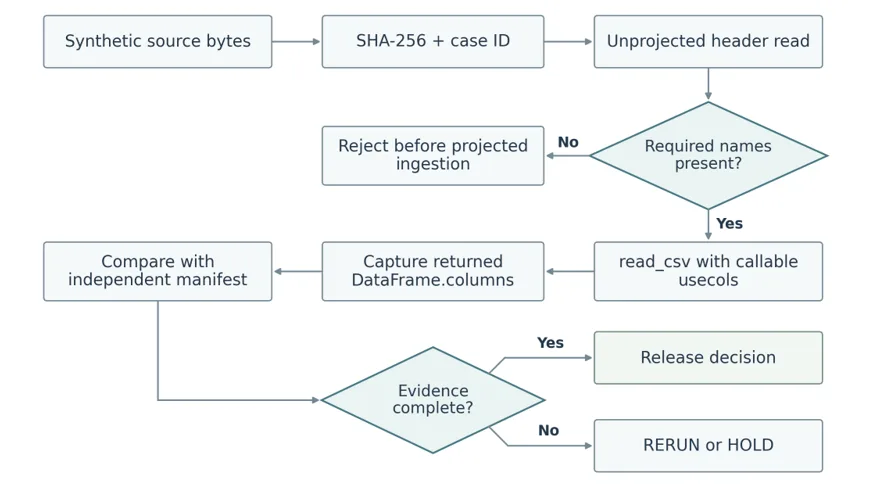
The ledger should distinguish three terms:
Documented behavior comes from pandas documentation, such as callable usecols being evaluated against column names.
Expected behavior comes from the independently authored manifest.
Observed behavior comes from the executed pinned fixture.
Conflating those categories is how a laboratory result becomes an unsupported guarantee.
Detect missing evidence
Define the ledger schema as data, not prose:
REQUIRED_EVIDENCE_FIELDS = {
    "case",
    "sha256",
    "mode",
    "status",
    "manifest_match",
}
Reject a release-evidence bundle when any case lacks one of those fields, when any planned case is absent, or when manifest_match was never calculated.
If a test “passed” but the source digest is unavailable, choose RERUN. If nobody can establish which source bytes or runtime produced the candidate, the identity of the rerun is in dispute. Choose HOLD.
Reconcile identity and state
The reconciliation operation should remain visible:
observed_header = preflight_columns(path)

missing = [
    name
    for name in REQUIRED
    if name not in observed_header
]

if missing:
    raise SchemaError(
        f"missing required columns: {missing}"
    )
Then, and only then, project:
candidate = pd.read_csv(
    path,
    usecols=lambda name: name in REQUIRED,
)

assert list(candidate.columns) == list(REQUIRED)
Why both checks? The first proves source completeness under the header view used by this fixture. The second proves returned-frame identity after projection.
A return-frame check alone detects C2 after the fact, but the preflight has an important diagnostic advantage: it records what was absent before projection and makes “missing required source field” an explicit admission failure rather than a downstream surprise.
The pandas DataFrame.columns reference supports using candidate.columns as the frame’s label state. It does not say those labels represent every field the application wished had existed in the source.
Refonte’s scikit-learn feature-identity playbook makes a closely related distinction: width alone cannot establish semantic feature identity, and selection can discard fields unless an application contract checks them first. The current CSV problem is earlier in the pipeline: no trained estimator is involved; the risk is interpreting projection success as source-schema completeness.
For production adoption, the exact preflight method must be evaluated against file size, parser configuration, seekability, compression, and source ownership. Those production characteristics were not tested here and are EXPECTED / NOT EXECUTED.
Separate guarantees from observations
The table distinguishes the pandas API contract from observations in the pinned fixture and assumptions about production.
Statement | Classification |
Callable usecols is evaluated against column names and selects names for which the callable is true | Documented pandas 2.2.3 behavior |
DataFrame.columns exposes the DataFrame’s column labels | Documented pandas behavior |
pandas 2.2.3 is generally compatible with Python 3.13 | Documented release statement |
C2 returned three columns without exception | OBSERVED in this fixture |
C4 raised a ValueError naming amount | OBSERVED in this fixture |
C5 rejected missing amount before projected ingestion | OBSERVED local policy |
Future pandas versions will behave identically | EXPECTED / NOT EXECUTED and unsupported |
Production CSVs have unique, trustworthy headers | EXPECTED / NOT EXECUTED |
Header completeness proves values are semantically correct | Not established |
Passing this lab proves pipeline-wide correctness | Not established |
There is also a documentation-version conflict to manage. The generic pandas documentation URL can resolve to a newer stable branch than 2.2.3, while the versioned 2.2 documentation records the runtime used here. The correct response is not to pretend the difference is irrelevant. For pinned behavior, use the versioned documentation first; use current stable docs only to understand later contracts or migration risk.
The same principle applies to exception strings. An exact error message is useful forensic evidence, but application correctness should not normally depend on punctuation or wording unless pandas explicitly documents that string as part of a stable interface.
Bound the repair
The repair in this playbook does exactly three things:
Inspect the source header without usecols projection.
Compute the difference between the required names and the observed names.
Refuse projected ingestion when that set is non-empty.
It does not claim to validate raw duplicate-header multiplicity, column semantics, record-level completeness, dtypes, timestamps, monetary precision, malformed quoting, upstream provenance, or downstream publication.
Reject a proposed “repair” if it begins silently adding absent columns with NaN, renaming approximate matches, filling unknown values, or treating a missing field as equivalent to an explicitly empty field. Those actions alter data meaning and require their own approved contract.
Apply a bounded repair
A complete runnable fixture is below. It uses only synthetic data and the pinned pandas runtime.
from future import annotations

import hashlib
import json
import platform
import tempfile
from pathlib import Path

import pandas as pd

REQUIRED = (
    "record_id",
    "account_id",
    "event_ts",
    "amount",
)

EXPECTED = {
    "C1_complete": {
        "mode": "callable",
        "expect": "accept",
        "columns": list(REQUIRED),
    },
    "C2_missing_amount_callable": {
        "mode": "callable",
        "expect": "return_incomplete",
        "columns": [
            "record_id",
            "account_id",
            "event_ts",
        ],
    },
    "C3_complete_plus_extra": {
        "mode": "callable",
        "expect": "accept",
        "columns": list(REQUIRED),
    },
    "C4_missing_amount_list": {
        "mode": "list",
        "expect": "value_error",
    },
    "C5_missing_amount_guarded": {
        "mode": "guarded",
        "expect": "schema_error",
        "missing": ["amount"],
    },
    "C6_header_only_complete": {
        "mode": "guarded",
        "expect": "accept",
        "columns": list(REQUIRED),
        "rows": 0,
    },
}

CSV = {
    "C1_complete":
        "record_id,account_id,event_ts,amount,note\n"
        "r1,a1,2026-01-01T00:00:00Z,10.50,ok\n",

    "C2_missing_amount_callable":
        "record_id,account_id,event_ts,note\n"
        "r2,a2,2026-01-02T00:00:00Z,missing amount\n",

    "C3_complete_plus_extra":
        "record_id,account_id,event_ts,amount,note,debug\n"
        "r3,a3,2026-01-03T00:00:00Z,7.25,ok,x\n",

    "C4_missing_amount_list":
        "record_id,account_id,event_ts,note\n"
        "r4,a4,2026-01-04T00:00:00Z,missing amount\n",

    "C5_missing_amount_guarded":
        "record_id,account_id,event_ts,note\n"
        "r5,a5,2026-01-05T00:00:00Z,missing amount\n",

    "C6_header_only_complete":
        "record_id,account_id,event_ts,amount,note\n",
}


class SchemaError(RuntimeError):
    pass


def sha256(data: bytes) -> str:
    return hashlib.sha256(data).hexdigest()


def select_required(name: str) -> bool:
    return name in REQUIRED


def preflight_columns(path: Path) -> list[str]:
    return list(
        pd.read_csv(path, nrows=0).columns
    )


def guarded_read(path: Path) -> pd.DataFrame:
    source_columns = preflight_columns(path)

    missing = [
        name
        for name in REQUIRED
        if name not in source_columns
    ]

    if missing:
        raise SchemaError(
            f"missing required columns: {missing}"
        )

    candidate = pd.read_csv(
        path,
        usecols=select_required,
    )

    if list(candidate.columns) != list(REQUIRED):
        raise SchemaError(
            "returned columns do not match "
            "required schema"
        )

    return candidate


def run():
    assert platform.python_version() == "3.13.5"
    assert pd.__version__ == "2.2.3"

    ledger = []

    with tempfile.TemporaryDirectory(
        prefix="readcsv-usecols-"
    ) as td:
        root = Path(td)

        for case, text in CSV.items():
            path = root / f"{case}.csv"
            path.write_text(
                text,
                encoding="utf-8",
                newline="",
            )

            expected = EXPECTED[case]

            row = {
                "case": case,
                "sha256": sha256(path.read_bytes()),
                "mode": expected["mode"],
                "status": None,
                "columns": None,
                "rows": None,
                "exception": None,
                "manifest_match": False,
            }

            try:
                if expected["mode"] == "callable":
                    df = pd.read_csv(
                        path,
                        usecols=select_required,
                    )

                elif expected["mode"] == "list":
                    df = pd.read_csv(
                        path,
                        usecols=list(REQUIRED),
                    )

                else:
                    df = guarded_read(path)

                row["status"] = "returned"
                row["columns"] = list(df.columns)
                row["rows"] = len(df)

                if expected["expect"] in {
                    "accept",
                    "return_incomplete",
                }:
                    assert (
                        row["columns"]
                        == expected["columns"]
                    )

                    if "rows" in expected:
                        assert (
                            row["rows"]
                            == expected["rows"]
                        )

                    row["manifest_match"] = True

            except Exception as exc:
                row["status"] = "raised"
                row["exception"] = (
                    f"{type(exc).__name__}: {exc}"
                )

                if (
                    expected["expect"]
                    == "value_error"
                    and isinstance(exc, ValueError)
                ):
                    row["manifest_match"] = True

                elif (
                    expected["expect"]
                    == "schema_error"
                    and isinstance(exc, SchemaError)
                    and all(
                        name in str(exc)
                        for name
                        in expected["missing"]
                    )
                ):
                    row["manifest_match"] = True

            ledger.append(row)

    print(
        json.dumps(
            {
                "python":
                    platform.python_version(),
                "pandas": pd.__version__,
                "expected_manifest": EXPECTED,
                "ledger": ledger,
            },
            indent=2,
        )
    )


if name == "__main__":
    run()
Run it with:
. .venv/bin/activate
python csv_schema_lab.py > ledger.json

python - <<'PY'
import json
from pathlib import Path

evidence = json.loads(
    Path("ledger.json").read_text()
)

assert evidence["python"] == "3.13.5"
assert evidence["pandas"] == "2.2.3"
assert all(
    case["manifest_match"]
    for case in evidence["ledger"]
)

print("fixture evidence complete")
PY
A repair is accepted only when the guarded missing-column case rejects before returning a projected candidate and the complete cases still pass. Production substitution of this helper is EXPECTED / NOT EXECUTED.
Test rollback and recovery
This laboratory has no production side effects, so rollback is simple: discard the temporary candidate and keep the original synthetic source unchanged.
The recovery protocol for a real ingestion boundary should preserve the same ordering:
Detect
→ freeze source identity
→ stop publication
→ retain failed evidence
→ repair admission logic
→ rerun against the same fixture
→ rerun against an authorized new source copy
→ reconcile all evidence
→ decide release state
Do not “recover” a missing required source column by synthesizing an empty one unless a separate business contract explicitly authorizes that transformation. That would convert a source-schema failure into an invented value state.
The same rollback principle applies to the DataFrame.update example in pandas update: Preserve Explicit Clear Instructions. Repair an owned candidate and keep the source for comparison. Returning a candidate and publishing it are separate steps.
The rollback exercise performed here was limited to temporary fixture files and locally returned DataFrames. Database rollback, object-store version recovery, queue compensation, checkpoint rewind, and orchestration retry are EXPECTED / NOT EXECUTED.
Assign rerun ownership
Every rerun should have one named engineering owner in the actual release process, one immutable source identifier, one environment identity, and one decision record.
The measurable rejection condition is ownership ambiguity. If two teams can independently rerun different artifacts and both call the result authoritative, the release evidence is not reconciled.
Production ownership assignment is EXPECTED / NOT EXECUTED.
Decide ACCEPT, REPAIR, RERUN or HOLD
The final decision must come from evidence state, not from whether the latest call “looked green.”
Evidence state | Decision | Required action |
Required header complete; projected columns exact; manifest matches; runtime and source identity complete | ACCEPT | Admit candidate under this bounded schema contract |
Callable path returns incomplete columns, but source/runtime are known and guard is absent or incorrect | REPAIR | Add preflight completeness gate, then rerun all cases |
Fixture, runtime, source digest, or ledger field is missing but can be reconstructed authoritatively | RERUN | Recreate pinned environment and regenerate full evidence |
Source identity disputed, production state unknown, or authoritative evidence cannot be reconstructed | HOLD | Stop release until identity/state are resolved |
Required source column absent | HOLD for that source | Do not fabricate the missing field without a separate approved contract |
New pandas/Python version introduced | RERUN | Treat it as a new runtime observation before acceptance |
For the observed laboratory, the callable-only strategy is REPAIR. C2 shows that a successful projection can omit a required column. All six cases matched the manifest, including the two guarded reads. The synthetic fixture therefore meets the ACCEPT criteria within its declared scope.
That does not mean a production deployment is accepted. Production execution is EXPECTED / NOT EXECUTED.
Develop related skills with Refonte Learning
Refonte Learning’s entry-level Data Engineering program runs for three months and lists a weekly commitment of 12–14 hours. It covers data pipelines, real-time processing, batch and streaming ingestion, data transformation, storage services, Hadoop, security, encryption, governance, and compliance. The learning path includes Introduction to Data Engineering, Data Warehousing and ETL Processes, and Big Data Technologies and Data Pipeline Design.
Applicants must be working toward a bachelor’s degree or higher. Successful completion earns a Training Certificate and a Certificate of Internship, with additional recognition possible for selected participants based on performance. The program describes a virtual internship as a potential opportunity.
For current program terms, the Tools Taught section, and details on pipelines, ETL, ingestion, transformation, storage, and governance, see the Refonte Learning Data Engineering program.