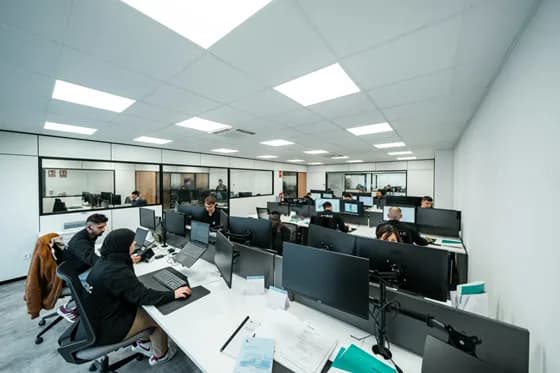
In 2026, software development is defined by a fusion of intelligent automation, cloud-native architectures, and modern collaboration tools. Refonte Learning emphasizes that software engineering programs must now cover not just coding, but full-stack development, cloud computing, and performance optimization. Teams of engineers collaborate using advanced IDEs, AI assistants, and DevOps pipelines. In this dynamic environment, developers leverage AI-driven code copilots, container orchestration, and integrated monitoring platforms to build resilient, scalable applications. For example, Refonte Learning notes that AI-augmented development is becoming the new standard, with intelligent assistants like GitHub Copilot and ChatGPT boosting productivity. Software engineers in 2026 will continue to use familiar tools (IDEs, Git, Linux) alongside cutting-edge solutions that speed up development. The Refonte Learning Software Engineering program is designed with these trends in mind, providing comprehensive training in full-stack development, cloud infrastructure, and software optimization .
AI-Powered Development Tools
Artificial Intelligence (AI) and Machine Learning are deeply integrated into development workflows. By 2026, AI-driven tools are mainstream in coding, testing, and design. Developers use AI “co-pilots” to generate code snippets, catch bugs, and suggest improvements, which offloads routine tasks and lets engineers focus on architecture and problem-solving . For instance, tools like GitHub Copilot, Tabnine, and ChatGPT-based assistants can write boilerplate code or automate unit tests in seconds. Refonte Learning highlights this shift: its curriculum now emphasizes AI and machine learning integration in software projects.
AI Code Generators: Services like GitHub Copilot and OpenAI Codex that autocomplete code.
Intelligent Testing Frameworks: Tools that auto-generate test cases or perform visual/UI testing. Agentic quality engineering platforms such as TestMu AI (formerly LambdaTest), push this further. Its GenAI-native agent, KaneAI, lets engineers plan, author, and evolve end-to-end tests in plain English, while its AI-native visual testing agent automatically catches UI regressions.
Code Review Bots: Automated reviewers (e.g. DeepCode) that catch security or style issues before merge.
By leveraging these AI tools, software engineers can accelerate development cycles. As Refonte Learning observes, AI-assisted development is not about replacing engineers, but empowering them to write better code faster. In practice, developers in 2026 will be comfortable using AI features built into IDEs (Visual Studio Code, IntelliJ) and cloud dev environments, treating them as vital tools in the toolbox.
Cloud-Native and DevOps Toolchain
Cloud platforms and DevOps practices dominate modern software engineering. The majority of enterprises are cloud-first, and by 2026 nearly all organizations run workloads in the cloud . As a result, developers rely on cloud-native tools and microservices architectures. Key tool categories include:
Containerization and Orchestration: Docker and Kubernetes have become industry standards for packaging and deploying applications. Engineers routinely use Docker for container images and Kubernetes (or lighter variants like K3s) to orchestrate them across clusters.
Infrastructure as Code (IaC): Tools such as Terraform and AWS CloudFormation allow engineers to provision and manage cloud resources through code. Refonte Learning’s cloud programs teach these skills, aligning with the trend that “cloud-native architectures and microservices are standard practice”.
CI/CD Pipelines: Continuous Integration/Continuous Deployment tools (like Jenkins, GitHub Actions, GitLab CI) automate building, testing, and deploying code. Modern pipelines integrate security scans and automated performance tests, reflecting the “DevOps” emphasis.
Serverless and PaaS: Services like AWS Lambda or Google Cloud Functions enable building features without managing servers. By 2026 these are common for event-driven tasks or extensions of microservices.
Cloud familiarity is expected engineers often specialize in a major cloud (AWS, Azure, GCP) and use that provider’s CLI and services. For example, a DevOps engineer might use AWS CloudWatch or Azure Monitor to track metrics (see Observability below). Refonte Learning’s programs include modules on cloud deployment and automation, preparing learners to manage Kubernetes clusters, set up Terraform configs, and implement CI/CD pipelines, all of which are “core competencies” in modern software development.
Observability and Monitoring Tools
Monitoring and observability tools form the nervous system of any production system. In 2026, with apps built as complex distributed systems, understanding performance and failures is critical. A typical observability stack has three pillars: metrics, logs, and traces . Leading tools include:
Metrics Monitoring: Prometheus (time-series metrics) coupled with Grafana (dashboards) remain a standard open-source combo. According to Refonte Learning, “Prometheus and Grafana remain an unbeatable open-source combination in 2026”. Teams use Prometheus to scrape app and system metrics (CPU, memory, response times) and Grafana to visualize them and set alerts.
Log Management: The ELK Stack (Elasticsearch, Logstash, Kibana) is widely used for centralized logging. In parallel, newer tools like Grafana Loki (log aggregation designed for cloud-native environments) are gaining traction by 2026 due to efficiency. The Refonte Learning curriculum includes projects on deploying an ELK stack, underscoring its real-world importance.
Distributed Tracing: Tools like Jaeger and OpenTelemetry trace user requests across microservices. Jaeger allows engineers to see the journey of a transaction through all services (Uber open-sourced it). OpenTelemetry (OTel) is an emerging industry standard for instrumenting code in a vendor-neutral way. In practice, engineers instrument with OTel once and can send trace/metric data to any backend (Prometheus, Jaeger, etc.). By 2026, familiarity with Jaeger and OTel is common for engineers building observability pipelines.
Cloud-Native Monitoring: Each cloud provider offers its own tools (e.g. AWS CloudWatch/CloudTrail, Azure Monitor, Google Cloud Monitoring). Modern DevOps engineers often know how to use these in conjunction with open-source tools. Refonte Learning’s DevOps programs teach how to set up CloudWatch dashboards and ingest logs into central systems. It’s common to use Prometheus/Grafana for application-level metrics and the cloud’s native monitors for infrastructure-level health.
APM/Observability Platforms: Commercial solutions like Datadog, New Relic, Splunk, Dynatrace, and Elastic Observability are widely adopted. These platforms unify metrics, logs, and traces (and often include AI-powered analytics). For example, Datadog’s platform covers infrastructure, APM, and log management in one SaaS solution. Refonte notes that many companies expect engineers to know at least one such platform seeing “experience with Prometheus/Grafana or Datadog or New Relic” in job ads is common.
Overall, the observability toolkit in 2026 is richer than ever. Engineers must be comfortable switching between metrics dashboards, log queries, and tracing visualizations. As Refonte’s guides emphasize, mastering Prometheus, Grafana, and Jaeger is an excellent first step toward an observability mindset.
DevSecOps and Security Tools
Security is now “built-in” to development workflows. The rise of DevSecOps means engineers use security tools at every stage. Key security-focused tools include:
Static/Dynamic Analysis: Tools like SonarQube, Checkmarx, and OWASP ZAP (DAST) automatically scan code or running apps for vulnerabilities. Engineers integrate these into pipelines so every build is security-checked.
Dependency Scanners: Services like Snyk, Dependabot, or OWASP Dependency-Check find known vulnerabilities in open-source libraries. These run automatically on commits or pull requests.
Container Security: Scanners (e.g. Clair, Trivy) and runtime protection (Falco, Aqua Security) help secure Docker/Kubernetes environments.
Secrets Management: Tools like HashiCorp Vault or cloud KMS ensure credentials and keys aren’t hard-coded.
According to industry trends, the mindset is “security by design”, every code merge and deployment is scanned, tested, and guarded. Refonte Learning’s DevSecOps program teaches these practices, reflecting the critical need to “shift left” on security. In summary, modern engineers use a combination of automated security tools and best practices (e.g. zero-trust architecture) to keep applications safe from day one.
Low-Code/No-Code Platforms
An important trend by 2026 is the maturation of low-code/no-code development platforms. These platforms (e.g. Mendix, OutSystems, Microsoft PowerApps, Salesforce Lightning) allow rapid app creation via visual interfaces. By automating boilerplate work, they let teams prototype and deploy business apps extremely quickly. However, professional engineers still oversee architecture: low-code handles repetitive tasks while developers focus on complex logic and integration.
Platforms: OutSystems, Mendix, Appian for enterprise applications; low-code features in cloud platforms like AWS Honeycode or Google AppSheet.
· Role of Engineers: In 2026, a savvy engineer is like a “software orchestrator”, combining no-code components with custom code for full solutions. For instance, building a mobile app might involve a quick no-code frontend paired with a custom backend service.
Refonte Learning acknowledges that even with low-code, fundamental software design principles remain crucial . Their curriculum continues to teach system design, ensuring that developers can extend and secure any application no-code or traditional, with best practices in mind. Embracing low-code does not replace engineers; it augments them, accelerating delivery without sacrificing quality .
Collaboration and Productivity Tools
The human side of software engineering relies on robust collaboration tools. In 2026, teams are even more distributed and multidisciplinary. Tools for communication, project management, and collaboration are essential:
Version Control & Code Hosting: Git remains foundational. Platforms like GitHub, GitLab, and Bitbucket support code collaboration, reviews, and integration with issue trackers.
CI/CD and Automation: (see above section) Many of these tools (GitHub Actions, GitLab CI) also serve as collaborative automation.
Project Management: Agile project tools (e.g. Jira, Azure DevOps, Trello) structure the development process. Engineers often work in sprints and daily stand-ups, using these tools to track tasks and bugs.
Communication: Chat and video tools (Slack, Microsoft Teams, Zoom) facilitate real-time teamwork across geographies.
Design and Documentation: Figma and Adobe XD for UI/UX design collaborations, Markdown/Docusaurus for docs, Notion or Confluence for knowledge bases.
Importantly, “human skills” like communication, problem-solving, and learning agility are key differentiators . While sophisticated tools aid development, engineers must articulate ideas clearly and work closely with peers (UX designers, data scientists, product managers). Refonte Learning emphasizes this collaborative mindset: its software engineering program includes team projects and real-world scenarios to build these soft skills alongside technical ones.
Continuous Learning and Skills
Technology evolves rapidly, so continuous learning is part of the job. By 2026, the half-life of skills is short new frameworks, languages, and tools emerge constantly. Engineers stay current by:
Online Education & Certifications: Taking advanced courses (like Refonte’s workshops or certifications in cloud/DevOps/AI) to learn new toolsets.
Community and Conferences: Participating in developer communities (Stack Overflow, GitHub) and events (KubeCon, AWS re:Invent) to learn trends.
Experimentation: Building personal projects or contributing to open source using new tools (e.g. trying out a new framework or cloud service).
Refonte Learning highlights that those who adopt a lifelong-learning mindset will thrive. Its platform even offers upskilling in emerging fields (from prompt engineering to cloud security) so students can keep pace. In short, the most successful engineers in 2026 combine strong core skills with a curiosity to learn new tools, whether that’s mastering a machine learning library, a new Kubernetes operator, or the latest low-code system.
Conclusion
Software development in 2026 is exciting and fast-moving. The smartest teams use a blend of AI-augmented development, cloud-native architectures, integrated security, and modern DevOps tools. They rely on everything from Git-based workflows and container platforms to observability stacks with Prometheus, Grafana, and Datadog. Most importantly, they never stop learning. Platforms like Refonte Learning are designed to prepare developers for this future: their Software Engineering program covers full-stack and cloud computing, performance optimization, and real-world project work. By aligning education with industry trends from AI coding assistants to continuous deployment pipelines engineers can stay at the forefront. In 2026 and beyond, those who master the new toolset while adapting their skills will lead the next wave of innovation.
Sources: Industry analyses and Refonte Learning’s own guides on software engineering and DevOps 2026 trends, among others. These inform the essential tools and practices shaping software development today.