
The discourse around Large Language Models (LLMs) has often been framed as a cataclysmic event for technical professions, including data science. Headlines suggest a future where AI replaces analysts, and prompt engineering supplants statistical modeling. By 2026, however, the reality on the ground for practicing data scientists will be far more nuanced and, frankly, more powerful. The most effective professionals will not be those who pivoted away from their core skills, but those who integrated LLMs as a sophisticated new tool in their existing arsenal.
This article bypasses the career-pivot narrative. Instead, it offers a pragmatic guide for data scientists on how to wield LLMs to amplify their work. We will explore how these models serve as force multipliers for classic data science tasks: generating synthetic data, engineering complex features, accelerating exploratory analysis, and building robust, hybrid machine learning systems. The goal is not to replace the data scientist's judgment but to augment it, automating tedious tasks and unlocking new levels of insight from complex, unstructured data.
Beyond the Hype: Reframing LLMs in the Data Science Toolkit
The initial wave of LLM adoption created a temporary fascination with roles like "prompt engineer," suggesting a new discipline entirely separate from traditional data science. As the technology matures, this distinction is collapsing. For the data scientist in 2026, proficiency with LLMs is not a career change; it is a competency, much like proficiency with SQL, Python, or cloud platforms. The hype has given way to practical, value-driven integration.
The fundamental role of a data scientist remains unchanged: to extract meaningful insights from data to drive business decisions. This requires statistical rigor, domain expertise, and a deep understanding of machine learning principles. LLMs do not replace these fundamentals. Instead, they act as a powerful accelerator and enabler within the established data science workflow. Viewing LLMs as a simple replacement for classical models is a category error; their strengths and weaknesses are fundamentally different. Classical models like XGBoost or logistic regression excel at structured prediction tasks with clear, quantifiable inputs and outputs. LLMs excel at understanding and generating nuanced, unstructured human language.
So, where do they fit in? Think of an LLM as the world's most capable, albeit occasionally unreliable, junior data scientist. It can draft boilerplate code for a Seaborn plot in seconds, write a complex SQL query from a natural language request, or offer initial hypotheses about a dataset based on its schema. The senior data scientist—the human—is still required to validate the code, question the hypotheses, and bring the critical thinking and business context that the model lacks. The LLM handles the syntactical grunt work, freeing up the human for strategic thought.
Furthermore, LLMs are becoming components within larger, more complex systems. A common pattern is to use an LLM as a pre-processing layer. For instance, before feeding customer feedback into a churn prediction model, an LLM can classify the sentiment of the text, extract key entities mentioned (like product names or complaint types), and summarize a long conversation into a few key points. These outputs become new, highly informative features for a traditional scikit-learn classifier, which then makes the final, high-stakes prediction. This hybrid approach leverages the best of both worlds: the semantic understanding of the LLM and the probabilistic precision of the classical model.
Synthetic Data Generation: Overcoming Scarcity and Imbalance
One of the most persistent challenges in data science is data availability. Machine learning models are data-hungry, but real-world datasets are often small, incomplete, imbalanced, or constrained by privacy regulations. This is where LLMs offer a transformative solution: the generation of high-fidelity synthetic data. By learning the underlying patterns and structure of a sample dataset, models like GPT-4o, Claude 3 Opus, or Llama 3 can produce new, artificial data points that are statistically similar to the real ones.
Consider the problem of building a fraud detection model. The number of fraudulent transactions is typically a tiny fraction of the total, leading to a severely imbalanced dataset. Training a model on this data can result in a classifier that is excellent at identifying legitimate transactions but terrible at catching fraud. Traditional techniques like SMOTE (Synthetic Minority Over-sampling Technique) can help, but they often create simplistic, linear combinations of existing minority class samples. An LLM, in contrast, can generate entirely new, contextually rich examples of fraudulent transactions based on textual descriptions of fraud patterns, creating more diverse and realistic training data.
Another key use case is in preserving privacy. In healthcare or finance, using real customer data for model development is fraught with PII (Personally Identifiable Information) risks. An LLM can be trained on the statistical properties of the real data and then generate a new, synthetic dataset that mirrors the original's distributions and correlations without containing any real individual records. This allows data scientists to develop and test models freely without compromising user privacy.
Practical Implementation and Validation
Generating useful synthetic data is more than just a simple prompt. It requires careful strategy:
- Structured Output: Modern LLMs can be prompted to generate outputs in specific formats like JSON or CSV. You can provide a schema and ask the model to generate, for example, 100 new customer records with fields for
age,location,last_purchase_category, andreview_text, ensuring the output is immediately usable. - Few-Shot Prompting: Providing a handful of real examples in the prompt (few-shot learning) dramatically improves the quality and relevance of the generated data. This grounds the model in the specific style and content you need.
- Controlling the Generation: You can instruct the model to generate data with specific characteristics. For example: "Generate 50 examples of customer support emails related to billing issues, with a frustrated but formal tone."
However, generated data must be rigorously validated. The goal is not to create a perfect copy but data that is useful for a downstream task. Validation techniques include:
1. Distributional Analysis: Compare the statistical distributions of key features in the synthetic data versus the real data. Tools like ydata-profiling or custom plots can be used to check if, for instance, the age distribution in the synthetic set matches the real one.
2. Hold-out Performance: Train a model on the synthetic data (or a mix of real and synthetic) and evaluate its performance on a held-out set of real data. If the model trained with synthetic data performs better than one trained only on the original, smaller dataset, the synthetic data has proven its value.
3. Qualitative Review: For text data, a human should review a sample of the generated examples to check for coherence, realism, and alignment with the desired context. Watch out for repetitive or nonsensical outputs, which can indicate the model is struggling.
Advanced Feature Engineering with Semantic Understanding
Feature engineering has always been a cornerstone of successful machine learning projects. It is the art and science of transforming raw data into informative features that a model can learn from. For unstructured text data, this has traditionally involved techniques like Bag-of-Words (BoW) or Term Frequency-Inverse Document Frequency (TF-IDF), which are effective but lexically limited. They capture word counts but miss the semantic meaning, context, and intent behind the words.
LLMs revolutionize this process by enabling feature engineering based on deep semantic understanding. Instead of just counting words, a data scientist can now use an LLM to interpret the text and create high-level, meaningful features. This unlocks a vast amount of information previously trapped in unstructured formats.
From Text to Structured Features
Here are some powerful techniques for LLM-powered feature engineering:
- Zero-Shot Classification: Imagine you have customer support tickets and want to create a feature for the ticket's category (e.g., 'Billing', 'Technical Issue', 'Account Management'). Without an LLM, you would need a large, hand-labeled dataset to train a multiclass classifier. With an LLM, you can perform zero-shot classification by simply providing the text and the possible categories in a prompt and asking it to choose the most appropriate one. The LLM's prediction becomes a new categorical feature in your dataset.
- Sentiment and Emotion Analysis: While pre-trained sentiment models exist, a powerful general-purpose LLM can provide more nuanced scores. You can ask it to rate sentiment on a continuous scale (e.g., from -1.0 to 1.0) or even detect more complex emotions like 'frustration', 'confusion', or 'excitement'. These emotional signals can be highly predictive features for models forecasting customer churn or satisfaction.
- Entity Extraction (NER): LLMs are exceptionally good at Named Entity Recognition. You can instruct them to extract specific pieces of information from text. For example, from a product review, you could extract the names of mentioned products, competing brands, or specific features being praised or criticized. Each extracted entity can become a new binary or categorical feature.
- Summarization and Topic Modeling: For long documents, an LLM can generate a concise summary. The summary itself might be too long for a feature, but you can use an embedding model on the summary to create a dense vector representation. Alternatively, you can ask the LLM to assign a topic or a list of keywords to the document, which can be used as categorical features.
These techniques allow a data scientist to quickly enrich a structured dataset with powerful signals derived from associated unstructured text. The beauty of this approach lies in its flexibility. By changing the prompt, you can create new features on the fly, enabling rapid iteration and hypothesis testing. This is a core part of expanding the data scientist toolkit in 2026: essential skills, tools, and best practices.
LLMs as a Co-Pilot for Exploratory Data Analysis and Visualization
Exploratory Data Analysis (EDA) is the critical first step in any data science project. It involves understanding a dataset's structure, summarizing its main characteristics, identifying patterns, and uncovering anomalies. While essential, EDA can also be a time-consuming and repetitive process involving writing significant amounts of boilerplate code for data manipulation and plotting.
LLMs are emerging as powerful co-pilots that can dramatically accelerate this phase. They act as a natural language interface to data, allowing the data scientist to focus more on interpretation and less on the syntax of pandas, Matplotlib, or SQL. This interactive, conversational approach to EDA makes the process more fluid and intuitive.
Natural Language to Code and Queries
The most direct application is code generation. A data scientist can describe the desired analysis or visualization in plain English, and the LLM will generate the corresponding Python code. For example:
- Prompt: "Using the pandas DataFrame
df, create a violin plot showing the distribution ofpurchase_amountfor eachcustomer_segment. Use the Seaborn library." - Result: The LLM generates the
seaborn.violinplot(x='customer_segment', y='purchase_amount', data=df)code snippet, saving the user from recalling the exact syntax.
This extends to complex data manipulations and queries. Tools like pandas-ai and the functionality within environments like Jupyter's AI assistant allow you to chain commands conversationally. You can start by asking, "What are the columns and data types in my DataFrame?" followed by, "Filter the data to only include users from North America who signed up in the last year," and finally, "Calculate the average monthly spend for this cohort." The LLM translates each request into the correct pandas or SQL code.
Hypothesis Generation and Insight Discovery
Beyond just writing code, LLMs can act as a brainstorming partner. By providing an LLM with a data dictionary (describing the columns in your dataset) and some basic summary statistics, you can ask open-ended questions to spark ideas for further investigation:
- "Given this data about user engagement, what are some potential leading indicators of churn?"
- "What interesting correlations might exist between user demographics and product feature adoption?"
- "Based on these columns, suggest three different ways we could segment our users for a marketing campaign."
The LLM's responses, derived from its vast training on analytical reports and articles, can surface relationships or angles the data scientist might not have considered initially. This helps overcome cognitive biases and ensures a more thorough exploration of the data.
However, this powerful capability comes with a critical caveat: validation is non-negotiable. LLMs can hallucinate, produce buggy code, or misinterpret the nuances of a dataset. The data scientist must always act as the final arbiter, reviewing every line of generated code for correctness and treating every suggested hypothesis as a starting point for rigorous statistical testing, not as a proven fact.
Augmenting Classical ML Models with LLM-Powered Components
A common misconception is that data scientists must choose between classical machine learning models (like logistic regression, random forests, or gradient boosting) and LLMs. The future, however, is not a replacement but a synthesis. The most robust and valuable AI systems in 2026 will be hybrid systems that combine the strengths of both approaches.
Classical ML models are highly effective and reliable for structured prediction tasks. They are computationally efficient, their decision-making processes can often be interpreted (using methods like SHAP), and their performance can be rigorously evaluated with statistical metrics. LLMs, on the other hand, excel at understanding and generating human language. By architecting systems where each component does what it does best, data scientists can build solutions that are more powerful than the sum of their parts.
Architectural Patterns for Hybrid Systems
Here are two common and effective patterns for creating hybrid models:
1. LLM as a Feature Extractor for a Classical Model: This pattern, mentioned earlier, is one of the most practical ways to enhance existing ML pipelines. The LLM acts as a pre-processing and feature engineering engine for unstructured data, which is then fed into a classical model for the core prediction task. * Example: Loan Default Prediction. A bank wants to predict the likelihood of a loan applicant defaulting. The primary model is an XGBoost classifier that uses structured data like credit score, income, and loan amount. To improve the model, the data scientist can use an LLM to analyze the free-text field where applicants explain the purpose of the loan. The LLM can extract features like 'business investment', 'debt consolidation', or 'emergency expense', and also provide a sentiment score for the applicant's text. These new, semantically rich features are then added to the structured data, giving the XGBoost model a more holistic view of the applicant and improving its predictive accuracy.
2. LLM as a Post-Processing or Explanation Layer: In this pattern, the classical model makes the core decision, and the LLM's role is to communicate that decision and its reasoning in a human-understandable way. * Example: E-commerce Recommendation System. A collaborative filtering model (built with a library like LightFM) identifies a set of products a user is likely to buy. This model is efficient and accurate but produces a list of product IDs—a black box to the user. A second step involves an LLM that takes this list and generates a natural language explanation. For a recommended camera, it might say, "Because you recently viewed travel blogs and purchased hiking boots, you might be interested in this durable, lightweight camera perfect for outdoor adventures." This combination of a precise recommendation engine and a persuasive explanation layer significantly improves the user experience and trust in the system. The clear synergy between data science and AI in 2026 with Refonte Learning is perfectly demonstrated by these hybrid models.
By adopting this hybrid mindset, data scientists can preserve the statistical rigor and reliability of their work while leveraging the unprecedented natural language capabilities of LLMs.
The New Frontier of Model Evaluation and Explainability (XAI)
The integration of LLMs into data science workflows necessitates a corresponding evolution in how we evaluate model performance and explain their behavior. Traditional metrics like accuracy, precision, recall, and F1-score remain essential for classification and regression tasks within hybrid systems, but they are insufficient for assessing the quality of generative, language-based outputs.
Evaluating the output of an LLM is inherently more subjective and context-dependent. A generated summary might be factually correct but miss the key point of the original text. A synthetic data record might be statistically plausible but semantically nonsensical. This challenge pushes data scientists to adopt a more comprehensive evaluation framework that combines quantitative metrics, automated quality checks, and human-in-the-loop validation.
Evolving Evaluation Metrics
For generative text tasks, classic metrics like ROUGE (for summaries) and BLEU (for translation) measure lexical overlap with a reference text. While useful, they can be brittle and fail to capture semantic similarity. A new, powerful technique is LLM-as-a-judge. This involves using a state-of-the-art model (like GPT-4o or Claude 3 Opus) as an automated evaluator. You provide the judge model with the generated output, a reference (if available), and a detailed rubric. For example, you could ask it to score a generated summary on a scale of 1-5 across dimensions like: * Faithfulness: Does the summary accurately reflect the source text without hallucinating facts? * Conciseness: Is the summary brief and to the point? * Coherence: Is the summary well-written and easy to understand?
While not a perfect substitute for human judgment, LLM-as-a-judge provides a scalable way to get nuanced feedback on model performance during development.
Explainability in Hybrid Systems
Explainable AI (XAI) becomes both more complex and more critical in the age of LLMs. For the classical ML components of a hybrid system, established techniques like SHAP (SHapley Additive exPlanations) and LIME (Local Interpretable Model-agnostic Explanations) are still the gold standard. They can quantify the contribution of each feature (including the LLM-generated ones) to a specific prediction.
However, the real opportunity lies in using LLMs to make these explanations more accessible. A SHAP plot is insightful for a data scientist but often cryptic for a business stakeholder. An LLM can be prompted to translate the SHAP output into a narrative explanation. For example: "The model predicted a high churn risk for this customer. The most significant factors were a 50% decrease in their weekly usage (contributing +0.4 to the risk score) and their recent visit to the cancellation page (contributing +0.3). Their high customer lifetime value slightly reduced the risk score (-0.1)." This bridges the gap between technical model outputs and actionable business insights.
This new era of evaluation requires data scientists to think like product managers, focusing on the end-user's perception of quality, and like communicators, translating complex model behaviors into clear, compelling narratives.
MLOps for LLMs: Operationalizing and Monitoring Hybrid Systems
Taking a data science project from a Jupyter notebook to a production environment has always been the domain of MLOps (Machine Learning Operations). With the introduction of LLMs, the complexity of operationalization increases significantly. The MLOps lifecycle of design, experimentation, deployment, and monitoring must be adapted to handle the unique challenges posed by these models, especially within hybrid architectures.
Traditional MLOps focuses on versioning datasets, tracking experiment parameters, containerizing models with tools like Docker, and orchestrating deployments with Kubernetes. These practices are still fundamental. However, an LLM-powered system introduces new artifacts and failure modes that require specialized tooling and processes.
Key MLOps Challenges for LLM-Based Systems
- Prompt Management and Versioning: In an LLM-based system, the prompt is a critical piece of source code. A minor change in wording can drastically alter the model's output. Therefore, prompts must be version-controlled just like any other code (e.g., in Git). Platforms like LangSmith, Weights & Biases, or custom-built solutions are becoming essential for logging every prompt, its corresponding output, and performance metrics. This allows for rigorous A/B testing of different prompt strategies and provides a crucial audit trail.
- Cost and Latency Monitoring: Unlike a self-hosted scikit-learn model, many LLM applications rely on API calls to third-party providers like OpenAI, Anthropic, or Google. This introduces variable costs (based on token usage) and network latency. MLOps dashboards built with tools like Grafana or Datadog must be configured to track API expenses in real-time, monitor token consumption per request, and alert on spikes in p95 latency. Caching strategies, where responses to identical prompts are stored and reused, become critical for managing both cost and speed.
- Guardrails and Output Validation: LLMs can produce unexpected or undesirable outputs, including hallucinations, toxic content, or leaking of private information. Production systems require robust guardrails. This involves implementing a layer of validation between the LLM and the end-user. Tools like NVIDIA NeMo Guardrails or Guardrails AI allow developers to define rules for the output, such as ensuring it is in valid JSON format, does not contain PII, or adheres to a specific topic. This is a crucial step for risk management.
- Monitoring for Data and Concept Drift: Just like classical models, LLM-powered systems are susceptible to drift. The distribution of user inputs may change over time (data drift), or the meaning of terms might evolve (concept drift), causing performance to degrade. Monitoring requires tracking not just traditional metrics but also things like the average length of prompts, the frequency of certain topics, and the scores from an LLM-as-a-judge evaluator. This is an area where robust data science engineering in 2026: emerging trends, essential tools, and best practices will be critical.
Fine-Tuning vs. RAG: A Practical Decision Framework
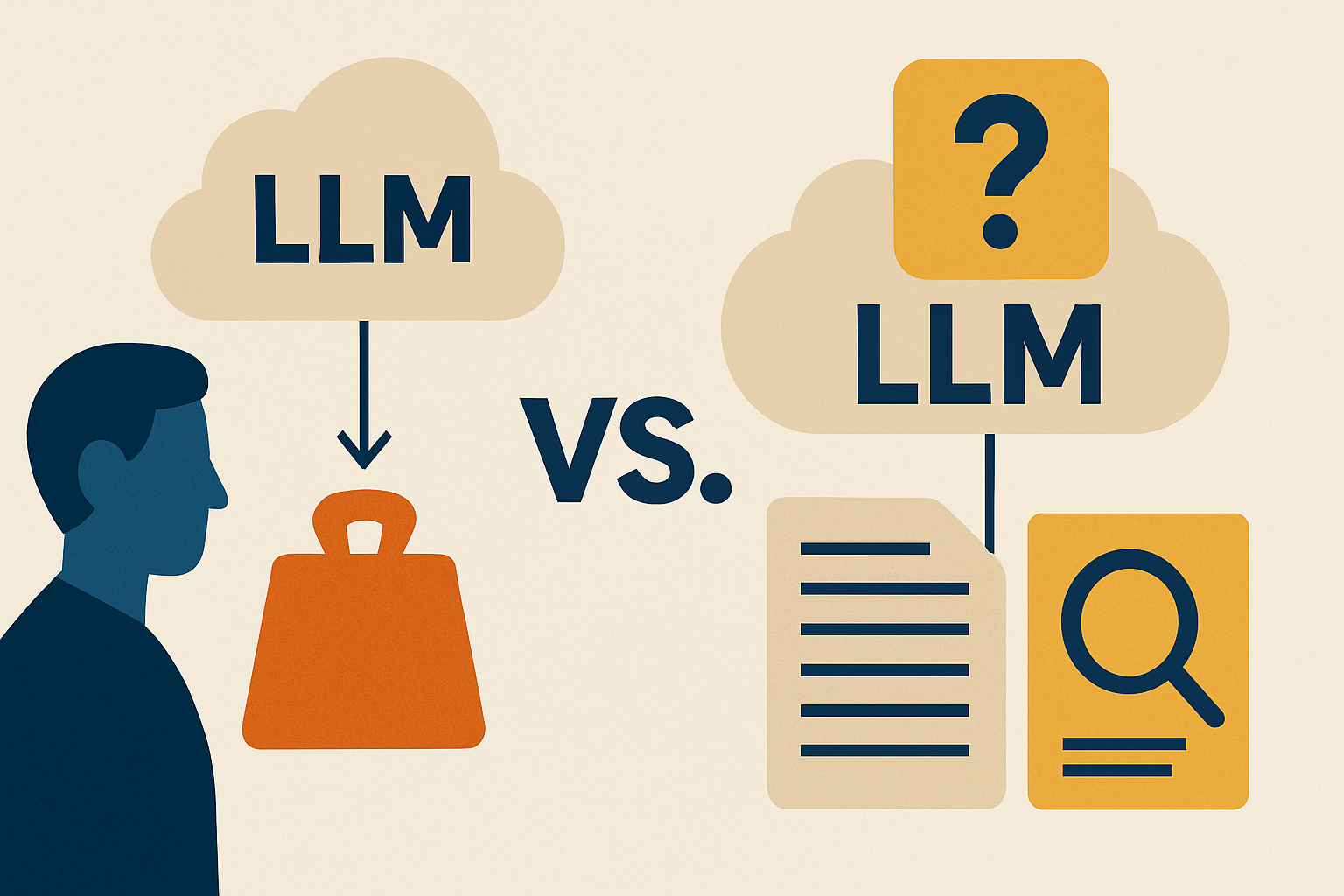
When a data scientist needs an LLM to perform tasks based on specific, private, or up-to-the-minute information, the base model's general knowledge is insufficient. Two primary techniques have emerged to imbue LLMs with domain-specific expertise: Fine-Tuning and Retrieval-Augmented Generation (RAG). Choosing the right approach is a critical architectural decision that depends on the specific use case, budget, and available data.
Fine-Tuning involves taking a pre-trained model and continuing the training process on a smaller, curated dataset of example prompts and completions. This adapts the model's internal weights to better align with the desired style, format, and behavior. * When to use it: Fine-tuning is most effective when you need to change the fundamental behavior or style of the model. For example, if you want the LLM to adopt the specific writing voice of your company's brand or to consistently respond in a rare dialect or a custom data format like YAML. It's about teaching the model a new skill, not just new facts. * Pros: Can lead to higher performance on specific tasks and lower latency at inference time, as the knowledge is baked into the model itself. * Cons: It can be very expensive, requires a large, high-quality labeled dataset (often thousands of examples), and carries the risk of "catastrophic forgetting," where the model loses some of its general capabilities. Updating the model's knowledge requires a full re-training process.
Retrieval-Augmented Generation (RAG) is a different approach that keeps the base LLM frozen. When a user query comes in, the RAG system first retrieves relevant documents from an external knowledge base (like a collection of internal company documents or a product manual). These documents are then injected into the prompt as context for the LLM, which uses them to formulate its answer. * When to use it: RAG is the preferred method for providing the LLM with access to factual, up-to-date, or proprietary information. It excels at question-answering over a specific corpus of documents. * Pros: It is far cheaper and faster to implement than fine-tuning. Updating the knowledge base is as simple as adding, deleting, or editing a document. It significantly reduces hallucinations by grounding the LLM's response in source material and allows for direct citation, increasing user trust. * Cons: The performance is highly dependent on the quality of the retrieval step. If the wrong documents are fetched, the LLM will give a poor answer. It can also introduce slightly higher latency due to the two-step (retrieve then generate) process.
The Data Scientist's Decision Framework
For most data scientists, the rule of thumb for 2026 is clear: Start with RAG. It is more transparent, controllable, and cost-effective. Only consider fine-tuning if RAG proves insufficient for your needs, specifically because you need to alter the model's core behavior in a way that context injection alone cannot achieve. Many advanced systems will even use both: a fine-tuned model for a specific style, augmented with RAG for up-to-date factual knowledge. Understanding these data science & AI in 2026 top trends, essential skills, and career strategies is key to building effective solutions.
The Evolving Skillset: What Data Scientists Must Learn for 2026
While LLMs introduce powerful new capabilities, they do not render the core data science skillset obsolete. In fact, they make a strong foundation more important than ever. The data scientist of 2026 will be a 'T-shaped' professional: deeply skilled in the fundamentals of statistics and machine learning, with a broad understanding of how to integrate and manage LLM-based systems.
The Unwavering Core
First and foremost, the foundational skills remain non-negotiable. Without them, a practitioner cannot critically evaluate the outputs of an LLM or build robust systems around them. These include:
- Statistical and Probabilistic Reasoning: Understanding concepts like bias, variance, confidence intervals, and hypothesis testing is crucial for validating LLM-generated data and interpreting model results.
- Classical Machine Learning: Deep knowledge of algorithms like linear regression, logistic regression, decision trees, and gradient boosting is essential for building the hybrid models that will dominate production environments.
- Python and its Data Science Stack: Mastery of libraries like pandas for data manipulation, scikit-learn for modeling, and Matplotlib/Seaborn for visualization is the bedrock of a data scientist's daily work.
- SQL: The ability to efficiently query and transform data in relational databases remains a fundamental requirement.
For anyone looking to build this foundation, structured learning paths like the Data Science Program from Refonte Learning provide the comprehensive curriculum needed to master these core competencies.
The New Layer of LLM-Specific Skills
Building on this foundation, data scientists must add a new layer of skills specifically related to working with LLMs:
- Advanced Prompt Engineering: This goes beyond simple one-shot questions. It includes mastering techniques like Chain-of-Thought (CoT) prompting to guide the model through complex reasoning, ReAct (Reason and Act) frameworks for tool usage, and few-shot prompting for in-context learning.
- Vector Databases and Embeddings: Understanding how to use models to create vector embeddings of text and how to perform semantic search using vector databases like Pinecone, Weaviate, or ChromaDB is the key to building effective RAG systems.
- LLM APIs and Orchestration Frameworks: Proficiency with the APIs of major model providers (OpenAI, Anthropic, Google) and fluency in orchestration libraries like LangChain or LlamaIndex are necessary to build, chain, and debug complex LLM-powered workflows.
- Cost Management and Performance Optimization: A practical understanding of tokenomics—how prompt length, model choice, and caching strategies impact cost and latency—is a vital operational skill.
- AI Ethics and Safety: Data scientists must be adept at identifying and mitigating risks associated with LLMs, including data privacy, algorithmic bias, and the potential for generating harmful content.
Real-World Case Study: An LLM-Augmented Customer Support System
To synthesize these concepts, let's walk through a practical, end-to-end example of a hybrid system that a data scientist might build in 2026. The goal is to improve the efficiency and effectiveness of a company's customer support operations.
The Business Problem: A growing SaaS company is struggling with a high volume of customer support tickets. Response times are increasing, and human agents are spending too much time on repetitive tasks and manual ticket routing.
The Hybrid System Architecture
Step 1: Ingestion and Initial Triage (LLM for Feature Engineering) When a new ticket arrives via email or a web form, it first passes through a lightweight LLM (perhaps a fine-tuned open-source model like Mistral 7B, hosted locally for speed and cost). This model performs several tasks in parallel: * Intent Classification: It categorizes the ticket's primary purpose (e.g., 'Billing Inquiry', 'Technical Bug Report', 'Feature Request'). * Urgency/Sentiment Analysis: It assigns a numerical score for urgency and sentiment. * Entity Extraction: It pulls out key entities like the user's ID, subscription plan, and any mentioned product features. These outputs are not the final decision; they are structured features.
Step 2: Intelligent Routing (Classical ML for Core Logic) The features generated by the LLM are combined with structured data from the company's CRM, such as the customer's lifetime value, recent product usage, and past support history. This combined feature set is fed into a highly reliable XGBoost model. This model's job is to make a critical business decision: route the ticket to the appropriate support tier (Tier 1, Tier 2 Engineering, VIP Support) or flag it for immediate escalation. Using a probabilistic, well-validated classical model for this core routing decision is safer and more interpretable than relying on an LLM alone.
Step 3: AI-Assisted Response (RAG for Knowledge Augmentation) For tickets routed to Tier 1 support, the system activates a RAG component. It takes the ticket's text, converts it into a vector embedding, and searches a vector database containing the company's entire knowledge base, product documentation, and historical ticket solutions. The top 3-5 most relevant documents are retrieved. These documents, along with the original ticket, are passed to a powerful generative model (like GPT-4o). The model is prompted to draft a helpful, empathetic, and accurate response for the human agent, citing its sources from the knowledge base. The agent can then review, edit, and send this drafted response, saving significant time.
Step 4: Continuous Monitoring and Improvement (MLOps) The entire system is instrumented for monitoring. A dashboard tracks: * Operational Metrics: End-to-end latency, API costs per ticket, and error rates. * Model Performance: The accuracy of the XGBoost router (compared to final manual classifications) and the helpfulness of the RAG-drafted responses (measured by agent clicks on an "upvote/downvote" button). * Data Drift: The system monitors for shifts in the distribution of ticket intents or topics, which might signal a need to retrain the models or update the RAG knowledge base.
This case study illustrates the future of applied data science. It is a testament to how to build a successful data science & AI career in 2026: skills, steps, and opportunities. The data scientist is not just a model builder but an architect of complex systems, strategically combining LLMs and classical ML to solve tangible business problems.
Conclusion: The Data Scientist as an Augmented Strategist
The narrative of Large Language Models replacing data scientists is a fundamental misreading of where the value lies. The true power of a data scientist has never been in writing boilerplate code or manually labeling data; it has been in their ability to frame business problems in quantitative terms, apply rigorous statistical methods, and interpret the results with deep contextual understanding. By 2026, LLMs will have automated or accelerated many of the most tedious parts of the job, but they will not have automated strategic thinking.
This shift elevates the role of the data scientist. Freed from mundane tasks, they can devote more time to the work that truly matters: asking better questions, designing more sophisticated experiments, and architecting hybrid AI systems that combine the semantic flexibility of LLMs with the probabilistic rigor of classical machine learning. The most successful practitioners will be those who embrace this change, viewing LLMs not as a threat, but as the single most powerful tool added to their toolkit in a decade.
The path forward requires a commitment to continuous learning—strengthening core statistical foundations while simultaneously building new competencies in prompt engineering, vector databases, and MLOps for generative models. For those dedicated to staying at the forefront of this evolving field, resources from institutions like Refonte Learning are invaluable for navigating the changing landscape and building the skills necessary to thrive. The future of data science is not about being replaced by AI; it's about leveraging AI to become a more effective, insightful, and indispensable strategic partner to the business.