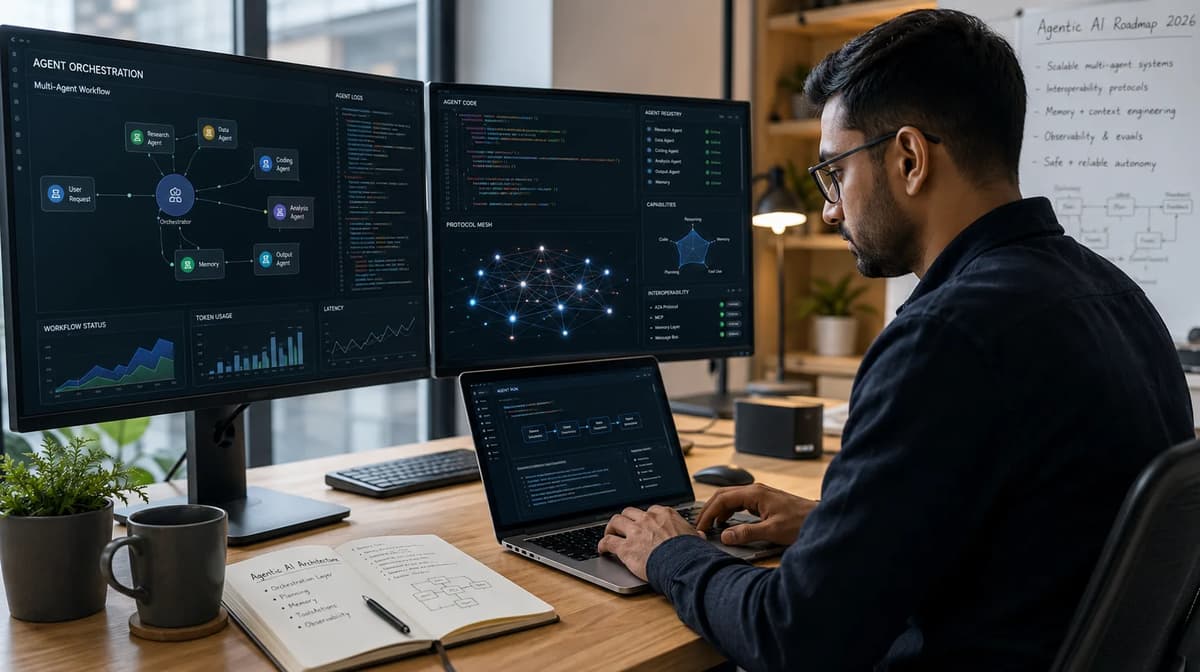
Five dated events changed the agentic AI engineering stack between March and July 2026: A2A reached its first stable release, Anthropic productized managed agent infrastructure, Microsoft put enterprise agent governance into general availability, OpenAI began retiring a flagship visual workflow product, and MCP rewrote major assumptions in its protocol core. Those are not five interchangeable product announcements; they change different layers of the systems you build.
On March 12, 2026, A2A v1.0.0 turned agent-to-agent interoperability into a stable specification. On April 8, Claude Managed Agents made hosted agent runtime infrastructure a commercial API product; on May 1, Agent 365 became generally available; on June 3, OpenAI announced the retirement of Agent Builder and its Evals platform; and on July 28, MCP removed protocol-level sessions and its initialization handshake in favor of a stateless request/response core.
That compressed sequence is the real story of Agentic AI Engineering in 2026. The job did not suddenly become unrecognizable; the abstraction boundaries underneath the job changed, which means a good engineer now needs to know what deserves a migration, what deserves a proof of concept, and what deserves nothing more than a line in the backlog.
This is therefore not another list of agentic ai frameworks 2026 developers should memorize. Think of it instead as an agentic ai engineering in 2026 toolkit for making decisions under framework churn: what shipped, what actually changed at the protocol or platform level, what got deprecated, and what I would change in a production architecture because of it.
Agentic AI Engineering in 2026: Why the Toolkit Changed Faster Than the Job Title
The clearest way to understand 2026 is chronologically. In less than five months, agentic engineering saw one interoperability standard stabilize, a managed runtime category emerge, an enterprise governance control plane reach GA, a high-profile visual builder receive a shutdown date, and a foundational context/tool protocol undertake its largest architectural revision to date.
Event | Date | What actually changed |
A2A v1.0.0 | March 12, 2026 | A2A reached its first stable, production-ready protocol release |
Claude Managed Agents | April 8, 2026 | Anthropic began offering composable APIs plus managed agent runtime infrastructure |
Microsoft Agent 365 GA | May 1, 2026 | Enterprise observability, governance, and security for agents moved into a generally available product |
OpenAI Agent Builder deprecation | June 3, 2026 | OpenAI set a November shutdown for its visual workflow builder and also began retiring the Evals platform |
MCP 2026-07-28 | July 28, 2026 | MCP replaced its stateful protocol core with a stateless request/response model and overhauled routing, auth, caching, and extensions |
The practical distinction is layer. A2A addresses agent-to-agent communication; MCP primarily handles how AI applications connect to tools and context; Claude Managed Agents concerns runtime infrastructure; Agent 365 concerns governance; and Agent Builder sat higher in the stack as a vendor-specific authoring abstraction. The A2A project itself explicitly describes A2A and MCP as complementary rather than competing, with MCP typically connecting an agent to tools/context and A2A coordinating interactions between agents.
When I review an agent system in 2026, I therefore do not ask, “Are we using the newest framework?” I ask which of those layers we have coupled to, whether that coupling is standardized or vendor-specific, what state assumptions the infrastructure makes, where identities and permissions live, and how painful a substitution would be.
That distinction is the difference between architecture and tool collecting.
Why this is not another “tools to learn” list
Refonte Learning already publishes the complete learning roadmap for becoming an Agentic AI Engineer, which covers the broad stack and the sequence in which learners can build their capabilities. The useful gap here is narrower: what changed this year, on specific dates, and what those changes imply for systems you may already have running.
A static stack diagram can still contain LangGraph, AutoGen, Claude APIs, OpenAI APIs, vector databases, and orchestration libraries after all five events above. The diagram looks almost identical, but the engineering assumptions behind it do not: your MCP server may no longer need transport sessions; a hosted agent may no longer require infrastructure you built yourself; enterprise IT may expect your agent to appear in a governance registry; and a visual OpenAI workflow may now need a migration plan.
That is why static lists age badly in this field. A library name tells you what somebody installed; release history tells you where the ecosystem is putting its architectural weight.
The most useful mental model for the second half of 2026 is therefore:
Protocols: optimize for interoperability, compatibility, security boundaries, and migration.
Managed runtimes: optimize for operational leverage versus vendor coupling.
Governance layers: optimize for identity, inventory, discoverability, permissions, and auditability.
Frameworks and builders: optimize for developer velocity without letting their abstractions become your architecture.
Durable engineering skills: orchestration, state, evaluation, safety, interfaces, and observability survive all four layers.
That last category matters most. Framework names rotate much faster than the underlying problems.
What Actually Changed Across A2A, Claude, Microsoft, OpenAI, and MCP
The five 2026 events look like one “agentic AI news” story from a distance, but they should produce different engineering responses. Two affect open protocol contracts, one shifts infrastructure responsibility to a provider, one formalizes enterprise governance, and one is a direct reminder that a vendor UI can disappear far faster than a protocol abstraction.
A useful decision map looks like this:
Change | Layer affected | Immediate engineering question |
A2A v1.0 | Inter-agent interface | Do independent agents need a stable cross-vendor contract? |
Claude Managed Agents | Runtime | Which agent infrastructure should we still operate ourselves? |
Agent 365 | Governance/control plane | Can security teams discover, identify, and constrain our agents? |
Agent Builder sunset | Authoring/orchestration abstraction | How much application logic lives in a proprietary builder? |
MCP July overhaul | Tool/context protocol | What session, auth, routing, and caching assumptions must change? |
Google's Agent2Agent protocol hits v1.0: what actually changed
First, a date correction that matters for accurate reporting: Google originally announced A2A on April 9, 2025, not in 2026. Google described it then as an open protocol for agents from different vendors and frameworks to communicate, exchange information, and coordinate actions.
Google then transferred A2A to Linux Foundation stewardship in June 2025, alongside participation from AWS, Cisco, Microsoft, Salesforce, SAP, and ServiceNow. The Linux Foundation described the project as an open protocol created by Google for secure agent-to-agent communication and collaboration.
There is another small timeline correction worth preserving: A2A v0.3.0 was released July 30, 2025, rather than in August. Its release introduced breaking changes around the Agent Card URI and security schemes, among other changes; the 2026 milestone is specifically the later v1.0 stability boundary.
On March 12, 2026, the project shipped A2A v1.0, describing it as the first stable, production-ready version of the open standard. Its Technical Steering Committee includes representatives from AWS, Cisco, Google, IBM Research, Microsoft, Salesforce, SAP, and ServiceNow, representing eight companies rather than one vendor controlling the specification.
That is the accurate framing for google a2a protocol v1.0: not “Google launched A2A in 2026,” but “an interoperability protocol Google launched in 2025 reached a stable, independently governed production milestone in March 2026.”
For engineers, “stable” should not be translated into “never changes.” A2A v1.0 itself contains breaking interaction-protocol changes versus earlier releases, while the Agent Card can advertise both v0.3 and v1.0 support so implementations can migrate progressively rather than executing a synchronized ecosystem-wide cutover.
That progressive negotiation is exactly what I want from infrastructure-level standards. A good protocol gives you a compatibility boundary, version semantics, and a migration route; it does not promise that no specification decision will ever change again.
The current specification formalizes agents discovering capabilities, communicating, delegating work, exchanging artifacts, managing tasks, and negotiating protocol versions. It also allows clients and servers to handle version compatibility explicitly through the A2A-Version mechanism rather than quietly assuming that every agent speaks the same protocol revision.
For a practical agent2agent protocol explained example, imagine a procurement agent built by one vendor discovering a compliance agent built by another company. Instead of sharing the internal memory model, LangGraph graph structure, prompts, or tool definitions of either system, the two can agree on the outward task and message contract A2A defines.
That means A2A becomes interesting when ownership boundaries become real. You do not necessarily need it for three cooperating nodes inside one Python process; you become interested when agents are independently deployed, independently versioned, organizationally separated, or owned by different vendors.
The A2A project also makes one architectural point explicit that clears up a recurring 2025–2026 confusion: A2A does not replace MCP. A typical system can use MCP for an agent's connections to tools and data while using A2A for communication between separately encapsulated agents.
That distinction changes how I evaluate architecture proposals. “We support MCP” tells me something about tool/context connectivity; it does not automatically answer how autonomous services discover and delegate work to one another.
Anthropic's Claude Managed Agents: running agents without managing all the infrastructure
On April 8, 2026, Anthropic launched Claude Managed Agents, a suite of composable APIs for building and deploying cloud-hosted agents at scale. Anthropic pairs an agent harness with infrastructure for state, memory, permissions, scheduled execution, sandboxing, authentication, persistent long-running sessions, tool execution, and tracing.
The key change is not “Claude can act like an agent.” Engineers could already build agent loops.
The change is that operating the harness became a product boundary.
Before managed runtimes, a production team commonly had to make decisions about process isolation, checkpoints, credential storage, resumability, retries, context persistence, scheduled execution, tracing, and sandboxing on top of whichever model or SDK it selected. Managed Agents moves a substantial portion of that infrastructure into Anthropic's service.
As of the launch, Anthropic described Managed Agents as a public beta. Standard Claude Platform token pricing applies, plus $0.08 per active session-hour, which gives us a particularly useful market signal: agent runtime is now explicit enough to meter separately from token inference.
That pricing structure changes architecture discussions because agent cost is no longer only, “How many input and output tokens do we burn?” A long-running autonomous session consumes runtime infrastructure independently of inference, so engineers need to measure both token behavior and wall-clock agent duration.
There is also a buy-versus-build tradeoff. Managed infrastructure can remove months of undifferentiated operational work, but every feature a vendor runs for you, including memory, state, execution, permissions, and observability, is also an area where your application becomes coupled to that vendor's semantics.
I would therefore evaluate claude managed agents with four questions:
Is the agent runtime itself differentiated intellectual property for us?
Do we need infrastructure or security controls the managed service cannot express?
How portable are our task, tool, guardrail, and state representations?
Does the operational savings justify the switching cost we are accepting?
For a startup shipping an agentic workflow, the answer can easily favor a managed runtime. For a regulated enterprise with deeply custom execution isolation, bespoke identity requirements, or cross-model runtime portability, the answer may be different.
That is why managed agents do not “replace agent engineering.” They move the boundary between application engineering and platform engineering.
Microsoft Agent 365 goes GA: governance catches up with deployment
Microsoft announced in March that Agent 365 would reach general availability on May 1, 2026, and on May 1 confirmed that GA had begun. The product acts as a control plane for observing, governing, and securing agents across Microsoft and partner ecosystems; Microsoft priced it at $15 per user per month standalone and also includes it in Microsoft 365 E7.
The part engineers should watch is not the SKU. It is shadow-agent discovery.
Microsoft's May announcement described new capabilities across Agent 365, Defender, and Intune for discovering unmanaged local and cloud AI agents. The company gave examples including local agents such as OpenClaw and said its governance model would extend across agents acting on delegated user access and agents operating under their own credentials.
Microsoft also described asset-context mapping that connects an agent to the device it runs on, its configured MCP servers, associated identities, and cloud resources those identities can reach. Those capabilities were announced for public preview beginning in June, rather than all being GA on May 1, so the distinction between the generally available Agent 365 platform and newly previewed shadow-AI features matters.
That nuance is important when discussing microsoft agent 365 general availability. The control plane became generally available May 1; a set of expanded shadow-agent and cross-platform discovery capabilities were announced alongside it in preview.
From an engineering perspective, this makes “Can the agent perform the task?” an incomplete acceptance criterion.
A production agent in an enterprise increasingly needs an answer to:
What identity executes this action?
Who owns the agent?
Which user or business process sponsors it?
Which tools and MCP servers can it access?
Which resources can those identities reach?
Can a security team inventory it without reading your source repository?
What audit trail exists for actions and data access?
You can see where the market is going: agent governance is becoming an infrastructure concern rather than an afterthought delegated entirely to application teams. Microsoft's product direction is one concrete example of that transition.
If your architecture exposes no stable agent identity, no ownership metadata, no traceable permission model, and no discoverable runtime surface, expect friction as enterprise controls mature.
OpenAI sunsets Agent Builder: what the deprecation actually signals
OpenAI launched AgentKit on October 6, 2025, including Agent Builder as a visual canvas for creating and versioning multi-agent workflows. OpenAI's launch materials also connected AgentKit with ChatKit, connector infrastructure, and expanded Evals capabilities.
On June 3, 2026, OpenAI announced that Agent Builder is deprecated and scheduled to shut down on November 30, 2026. OpenAI points developers toward the Agents SDK for workflows that should continue as code, or ChatGPT Workspace Agents for appropriate natural-language-driven use cases.
The Evals platform received a parallel deprecation announcement, but there is an important factual correction to the shorthand that “Agent Builder and Evals both become read-only October 31.” OpenAI's official deprecation table assigns the October 31, 2026 read-only milestone specifically to existing Evals; Agent Builder's published table lists the June 3 deprecation and November 30 shutdown, without an October 31 read-only milestone.
That is the kind of detail worth checking before copying a timeline into migration plans.
The striking engineering fact remains: OpenAI announced Agent Builder's deprecation less than eight months after its October 2025 launch. The scheduled November shutdown comes only a little more than a year after launch.
This is not proof that visual agent builders are inherently bad. It is proof that high-level vendor abstractions can have dramatically shorter half-lives than the business systems built on them.
The practical meaning behind the search phrase openai agent builder deprecated is therefore bigger than a single OpenAI migration notice. It is a reminder that your domain state, prompts, tool schemas, evaluation data, approvals, and business logic should remain recoverable outside any one orchestration canvas.
When I use a fast-moving vendor abstraction, I now ask a blunt question during design review: What is our escape hatch?
Can we export the workflow? Can we represent it as ordinary code? Can we replay production traces somewhere else? Can we preserve our eval set independently? Are tool interfaces proprietary, or do they map cleanly onto HTTP/function/MCP boundaries?
That does not mean writing everything from scratch. It means letting a framework accelerate your implementation without letting it become the only place where your system's meaning exists.
MCP's July overhaul: from session-oriented protocol to stateless core
The mcp model context protocol 2026 update that matters most landed on July 28, 2026. The new specification removed the required initialize/initialized handshake and retired the protocol-level Mcp-Session-Id, transforming the core from a bidirectional, stateful model into a stateless request/response protocol.
That is not a cosmetic API cleanup. It changes how you scale MCP servers.
Under the new core, each request carries enough protocol, client, and capability information to stand alone, so requests can land on different server instances behind ordinary round-robin load balancing. Application-level state is still allowed, but the specification recommends representing it explicitly, for example by returning a handle a model can supply on later calls, rather than hiding it in the transport session.
For teams that previously introduced sticky sessions, shared session stores, or state-aware reverse-proxy behavior only because MCP required transport continuity, this is a material simplification.
The release also introduced Multi Round-Trip Requests, or MRTR. Instead of maintaining a continuously open bidirectional stream so an MCP server can request information from the client during a tool invocation, the server can return an input_required result and let the client retry the original operation with the requested input attached.
That matters for approval workflows. A destructive tool can stop mid-operation, request confirmation or a missing parameter, and continue through a stateless request pattern without requiring the transport itself to behave like a long-lived conversation.
The specification added mandatory Mcp-Method and Mcp-Name headers for Streamable HTTP requests, allowing gateways, Web Application Firewalls, authorization layers, and rate limiters to inspect and route calls without parsing the JSON body.
That looks like a small protocol detail until you operate MCP at scale. Infrastructure teams already understand routing and policy based on HTTP metadata; making tool names visible at that layer gives them a cleaner place to implement controls.
List responses also gained deterministic ordering plus cache hints such as ttlMs and cacheScope. Clients can cache tool, prompt, and resource catalogs instead of repeatedly retrieving identical metadata, and deterministic ordering can reduce unnecessary disruption to upstream prompt caches.
Authorization received another substantial revision. The July specification requires stronger issuer handling, binds credentials to the issuing authorization server, and formally deprecates Dynamic Client Registration in favor of Client ID Metadata Documents, while retaining DCR temporarily for backward compatibility.
The project simultaneously established a formal deprecation policy with a minimum twelve-month window for deprecated protocol capabilities. Roots, Sampling, Logging, and the legacy HTTP+SSE transport are deprecated but continue to work during that offramp, giving implementations time to migrate.
That policy itself is an engineering feature. Predictable deprecation windows are part of what separates infrastructure you can plan around from tooling that requires reactive rewrites.
MCP's formal extensions framework is another sign of maturation. Capabilities such as Tasks can evolve as extensions rather than repeatedly expanding the minimal core, which helps the core remain simpler while leaving room for experimentation.
Why close to half a billion SDK downloads a month matters
The adoption numbers are unusually large. The MCP maintainers reported on July 28 that Tier-1 SDKs were seeing close to half a billion downloads per month, and that both the TypeScript and Python SDKs had crossed one billion cumulative downloads.
Do not translate package downloads into “one billion developers.” Package-registry counts can include CI installs, automated builds, caches, repeated environment creation, dependency graphs, and the same organization downloading a package thousands of times.
Even with that caveat, the order of magnitude matters.
By December 2025, MCP had already moved under the Agentic AI Foundation, a Linux Foundation directed fund co-founded by Anthropic, Block, and OpenAI, with support from organizations including Google, Microsoft, AWS, Cloudflare, and Bloomberg. The MCP project's 2026 roadmap describes MCP explicitly as a multi-company open standard under the Linux Foundation with working groups and a formal governance process.
That makes the July changes materially different from a minor library release. You are looking at an infrastructure contract used across an ecosystem broad enough that security gateways, cloud platforms, agent runtimes, IDEs, and enterprise governance systems now have to reason about its behavior.
For the second half of 2026, I would treat MCP as a protocol to architect around deliberately, not a fashionable plugin mechanism that can live unreviewed inside a developer laptop.
How to Read Framework Churn Without Panicking
The worst possible response to the five events above is to rebuild your architecture five times. The second-worst response is to ignore all five.
You need a filter.
Question | Low urgency | High urgency |
Are you using the affected component? | No production dependency | Core production dependency |
Does the change alter wire compatibility? | Documentation-only | Breaking protocol change |
Does it change security/auth? | No | Identity, OAuth, permissions, trust boundary changed |
Is your current version supported? | Long support window | Shutdown/deprecation date approaching |
Is there a migration path? | Backward-compatible transition | Hard sunset with product removal |
Is the abstraction replaceable? | Standard interface | Proprietary workflow/state trapped in vendor product |
Does it change operations? | Same scaling model | Sessions, routing, persistence, runtime assumptions changed |
For example, the MCP July update deserves attention even if every tool call still “works today” because its stateless model changes scaling assumptions and its authorization changes affect security architecture. A2A v1.0 deserves attention when your agents cross independent deployment or vendor boundaries, but not every internal multi-node workflow needs to be rewritten around A2A simply because v1.0 exists.
Agent Builder is a different case because there is a fixed shutdown date. If production logic depends on it, your question is no longer whether migration is theoretically valuable; the platform has provided a deadline and a recommended direction.
Claude Managed Agents is different again. Nothing broke on April 8; you gained a new buy-versus-build option.
And Agent 365 GA does not require every startup to buy Microsoft software. It does signal that enterprise customers increasingly expect agent inventory, ownership, permission visibility, and governance to exist as explicit capabilities.
That gives us the first durable principle of the 2026 toolkit:
React to changed contracts, security boundaries, support windows, and operational models, not to novelty.
The second principle concerns abstraction depth. The closer a dependency sits to your business logic, the more expensive churn becomes.
A protocol such as HTTP, MCP, or A2A defines outward communication. A visual workflow builder can contain the business process itself, which means losing the latter may require reconstructing decisions rather than merely updating an adapter.
This is why function calling vs structured outputs for agent design still matters despite the protocol news. Durable system design starts one layer below branding: contracts, schemas, tool permissions, error handling, state transitions, and validation remain relevant regardless of which orchestration product invokes them.
A2A and MCP suggest one pattern; Agent Builder suggests another
There is a tempting conclusion that “open always wins and proprietary always churns.” Reality is not that simple.
What we can observe is that A2A v1.0 provides explicit protocol negotiation and progressive migration from v0.3, while MCP's July revision ships detailed migration guidance plus a formal minimum deprecation window. OpenAI's proprietary Agent Builder, by contrast, moved from launch in October 2025 to deprecation in June 2026 and a scheduled shutdown in November.
I use that as a heuristic, not a law: when an abstraction has multi-company participation, public versioning rules, formal proposals, and vendor-neutral governance, I am generally more comfortable allowing it to become a long-lived integration boundary. When an abstraction exists mainly as one vendor's product surface, I keep my core business logic more portable.
MCP's governance strengthens that heuristic. Anthropic donated the protocol to the Linux Foundation's Agentic AI Foundation in December 2025, and the 2026 roadmap describes working groups and explicit governance maturation efforts rather than technical direction depending on one company.
A2A has similarly explicit multi-company steering.
That does not guarantee either protocol will remain technically unchanged. It improves the conditions under which change can become transparent, negotiated, versioned, and migratable.
What CrewAI's own 2026 survey says about enterprise adoption
Framework adoption percentages deserve caution because public statistics vary dramatically depending on sample definition, geography, company size, GitHub activity, telemetry method, and which vendor conducted the research. Claims that “X% of agentic AI runs on LangGraph” or “Y framework dominates enterprise agents” should therefore not be repeated as neutral facts without methodology.
CrewAI published its own survey on February 11, 2026, based on 500 C-level executives and senior leaders at companies with more than $100 million in revenue and at least 5,000 employees across seven regions. CrewAI reported that 65% of surveyed enterprises were already using AI agents, 81% had fully adopted or were actively scaling them across teams, 100% planned to expand agentic AI in 2026, and 57% preferred building on existing open-source tools rather than starting from scratch.
Those numbers are useful as a directional signal, but they come from CrewAI's own vendor-published survey, not an independent neutral market measurement. The survey also targeted large enterprises, so you should not extrapolate its percentages directly to every company or developer population.
The most relevant detail for this article is not “CrewAI won.” It is that respondents ranked security/governance and integration among their leading platform evaluation factors, which aligns with the technical direction visible in Agent 365 and MCP's 2026 authorization work.
That is a stronger cross-source pattern than any framework market-share claim: once agents leave prototypes, integration, identity, governance, reliability, and security become architecture work.
Skills, Portfolio Signals, and What 2026 Hiring Is Starting to Reward
A resilient engineer does not learn less because frameworks churn. You learn in a different order.
The first layer should be capabilities that remain useful when a framework disappears. The second should be current protocol literacy. The third should be vendor products you can adopt quickly because the first two layers give you context.
Priority | Skill | Why it survives churn |
Must | Evaluate whether a release affects your system before reacting | Prevents unnecessary rewrites |
Must | Multi-agent orchestration fundamentals | Transfer across LangGraph, SDKs, managed runtimes, and custom code |
Must | State, identity, authorization, and tool boundaries | Every production agent needs them |
Must | Understand MCP's stateless model and current authorization direction | MCP now operates at infrastructure scale |
Should | Managed-runtime familiarity | Hosted agent infrastructure is now an explicit product category |
Should | Enterprise discoverability and governance design | Agent inventory and identity are entering security control planes |
Good | Deprecation migration experience | Demonstrates that you can preserve production behavior through churn |
Good | A2A interoperability design | Increasingly relevant for independently owned or cross-vendor agents |
The priority ordering is intentional. I would rather hire an engineer who can explain whether our persistent state belongs in a transport session, an application store, or an explicit tool handle than one who memorized eight framework constructors last week.
The MCP July release provides a perfect example. The durable lesson is not the exact TypeScript call signature; it is why stateless transport improves horizontal scaling, why application state should remain explicit, and why gateways benefit when routable metadata lives in HTTP headers.
The A2A lesson is similarly conceptual. Understanding capability discovery, independently versioned agents, delegation boundaries, and cross-vendor contracts will outlast any one A2A client library.
Readers who need the wider skills sequence can use the complete learning roadmap for becoming an Agentic AI Engineer, while prompt engineering patterns for multi-agent systems covers a different layer: how agent behavior and communication should be designed once you have chosen the architecture.
Certifications and portfolio signals worth having
There is no single widely dominant certification that validates proficiency specifically across A2A v1.0, MCP 2026-07-28, Claude Managed Agents, Agent 365 governance, and OpenAI's 2026 migration path. The technologies changed too recently for a universal credential to become an authoritative proxy for all five.
That makes portfolio evidence unusually valuable.
A strong 2026 agentic AI portfolio can contain one project with a migration history, not just a finished screenshot:
Before: stateful MCP server or older protocol version.
Trigger: July 2026 specification release.
Decision: determine which changes affect your deployment.
Migration: remove protocol-session assumptions, update SDK/server behavior, validate authorization, introduce cache semantics where useful.
Verification: rerun tool integration and security/evaluation tests.
Documentation: explain what you deliberately did not change.
Result: show operational or architectural consequences.
The last item in that sequence is important. Engineers often document what they changed but not why a new release left 80% of the architecture untouched.
Another credible project would migrate a workflow out of Agent Builder into ordinary code using the Agents SDK, while preserving tool interfaces and tests. OpenAI explicitly directs Agent Builder users toward the Agents SDK or Workspace Agents, so such a project follows a real published migration scenario rather than an invented portfolio exercise.
The strongest portfolio narrative is not, “I know the newest agent framework.” It is, “A dependency changed underneath my system; here is how I identified the affected layer, maintained behavior, migrated safely, and proved the result.”
That is senior engineering judgment compressed into a project.
What 2026 job postings are actually asking for
Protocol names have begun appearing directly in live job requirements rather than only in conference decks. A current Sigma Computing Solution Architect posting, for example, explicitly says candidates need fluency in “agents, MCP, A2A, context engineering” and describes MCP integrations as part of the architecture work.
Current roles at TwelveLabs, Keycard Labs, LeanData, PAR Technology, and other companies similarly reference MCP, A2A, multi-agent orchestration, or open agent protocols in their requirements. These are individual postings rather than a statistically representative labor-market dataset, but together they show that protocol-level vocabulary has crossed into real hiring criteria.
I would not claim, without survey evidence, that hiring managers are universally asking candidates specifically how they handled an Agent Builder deprecation. I would expect migration reasoning to be a useful interview signal because current job descriptions increasingly demand architecture fluency, interoperability, governance, and the ability to work across evolving agent ecosystems.
A good interview answer therefore sounds less like:
“I use LangGraph, CrewAI, MCP, A2A, and OpenAI.”
And more like:
“We originally held integration state at the transport layer. When MCP went stateless, I identified which state was protocol-required versus business-required, moved the business state behind an explicit application handle, updated authorization validation, and regression-tested tool calls behind a round-robin deployment.”
That tells me you understand systems.
Refonte Learning's dedicated article contains the full Agentic AI Engineer role definition and salary breakdown, so there is no reason to reproduce an entire compensation guide here. Its published page currently frames the track with a $130K+ starting salary indicator and 70K+ annual jobs indicator, while the related role article uses the U.S. Bureau of Labor Statistics' $140,910 2024 median wage for Computer and Information Research Scientists as a broad AI-adjacent benchmark rather than a direct “Agentic AI Engineer median.”
Those distinctions matter. Provider salary and job-opening figures should be treated as Refonte's published career-positioning figures, not as guaranteed graduate outcomes, and the BLS number belongs to a broader occupational category rather than a dedicated federal Agentic AI Engineer classification.
The more defensible hiring takeaway is the technical one: real postings now explicitly name MCP and A2A, and enterprise platforms increasingly treat security, observability, governance, and cross-system agent interoperability as first-class engineering concerns.
Common Mistakes Engineers Make Chasing the Latest Framework
Framework churn becomes expensive when you treat your production architecture as a technology-news feed.
The fix is not conservatism. It is controlled adaptation.
Mistake | What it looks like | Better response |
Rebuild on every release | “MCP changed, rewrite the whole agent.” | Map changed protocol behavior to affected components first |
Treat protocols like frameworks | “MCP doesn't build an agent, so it is secondary.” | Separate interoperability infrastructure from authoring UX |
Store business logic in vendor UIs | Workflow semantics exist only in one visual builder | Keep domain logic, schemas, tests, and state portable |
Ignore governance until deployment | Agent has broad credentials and no inventory metadata | Design identity and auditability from the beginning |
Equate package downloads with users | “1B downloads means 1B developers.” | Interpret package telemetry as ecosystem activity, not headcount |
Learn framework APIs before architecture | Memorize syntax without state/security models | Learn durable systems concepts first |
Rebuilding a working agent every time a new protocol ships
Suppose you have a production agent that calls internal tools through MCP, and the July specification ships.
The wrong response is, “MCP changed dramatically; therefore our agent must be rebuilt.”
Start by separating the layers. Did your orchestration logic depend on Mcp-Session-Id? Does your MCP server rely on sticky sessions? Are you implementing deprecated DCR? Do your gateways benefit from Mcp-Method and Mcp-Name? Are you using capabilities such as Sampling or Roots that entered deprecation?
If the answer to all five is no, your migration may primarily be an SDK compatibility and validation exercise. If the answer to three is yes, you have real architectural work.
The same discipline applies to A2A v1.0. If three agents live inside one deployment and never expose independently owned agent endpoints, forcing A2A into the system solely because it became stable can add abstraction without removing a real coupling problem.
But if your procurement agent delegates work to independently deployed third-party agents, v1.0's stable version negotiation, Agent Card model, and explicit interoperability contract may materially reduce integration risk.
That decision is engineering.
For the operational layer after those choices, how to build AI agents in production covers evaluation, observability, deployment, and guardrails without turning every protocol release into a new architecture.
Ignoring MCP because it is “just a protocol, not a framework”
The opposite error is valuing whichever product has the most visible user interface.
Agent Builder had a visual canvas. MCP does not create an agent workflow for you.
Yet the visual builder that OpenAI launched in October 2025 now has a November 2026 shutdown date, while MCP has moved into Linux Foundation stewardship, operates through a formal multi-company governance process, reports hundreds of millions of monthly SDK downloads, and is being incorporated into cloud, IDE, agent, and enterprise tooling.
That is not an argument that MCP will never change; the July release proves the opposite. It is an argument that low-level interoperability contracts can be more strategically durable precisely because they do less.
Frameworks optimize developer experience by making choices for you. Protocols optimize interoperability by specifying the boundary at which two independently implemented systems agree.
The simpler boundary often survives more implementation churn.
That is why I would invest deeper conceptual learning time into OAuth, identity, transport semantics, tool contracts, schemas, statelessness, retries, caching, and interoperability than into any single builder's drag-and-drop vocabulary.
Self-Study vs a Structured Agentic AI Program: An Honest Comparison
Self-study remains one of the fastest ways to learn a freshly released API. On July 29, a motivated engineer can read the July 28 MCP changelog before any formal curriculum has updated.
Where self-study gets difficult is coverage discipline.
Factor | Self-study | Structured Agentic AI Engineer program |
Time to first simple agent | Potentially days to 2–4 weeks | Guided early in the program |
Framework API freshness | Excellent if you follow releases directly | Curriculum inevitably has a defined tool set |
Multi-agent orchestration depth | Depends on project discipline | Dedicated curriculum component |
Evaluation and observability | Often postponed by beginners | Dedicated module |
Safety and guardrails | Easy to skip in tutorial-driven study | Explicit module |
Portfolio structure | You define scope and quality | Internship-linked working-agent project |
Protocol coverage | You can chase every new standard immediately | Depends on named curriculum |
Durable fundamentals | Possible, but requires self-discipline | Structured around architecture, orchestration, evaluation, deployment, and safety |
Time structure | Flexible but open-ended | 3 months, 12–14 hours/week |
The popular comparison “self-study takes 6–12 months and a program takes exactly three months to become job-ready” is too deterministic. A senior backend engineer could self-study agent orchestration faster than a complete programming beginner, while completing a three-month course does not guarantee a job or eliminate the need for continued practice.
What structure does solve is sequencing.
When you study alone, the incentive is to follow novelty: watch the new A2A demo, install an MCP server, copy a multi-agent tutorial, try a new model, then move on when the next release appears. That produces broad recognition but weak architecture judgment.
A structured curriculum can force you through less glamorous layers such as state, APIs, RAG, evaluation, deployment, and safety, which new-framework tutorials often compress into one paragraph.
The best self-study plan should imitate that discipline even when no course is involved:
Build one narrow agent.
Add real tools.
Make state explicit.
Add retrieval only when the use case needs it.
Test failure cases.
Trace tool decisions.
Add least-privilege permissions.
Deploy it.
Break it deliberately.
Migrate one dependency and document what survived.
That last exercise is particularly valuable in 2026 because the ecosystem is giving you authentic migration events to learn from.
There is another honest limitation of structured programs: no curriculum can name every current protocol. Trying to make one do so would turn education into an endless vendor changelog.
A stronger program teaches the layers that let you understand a new protocol quickly.
That is the useful way to judge Refonte Learning in the context of this article: not by pretending its curriculum directly teaches every 2026 release, but by asking whether its architecture, tool-use, orchestration, state, evaluation, deployment, and safety modules build enough underlying competence to make those releases intelligible.
The Refonte Learning Agentic AI Engineer Program
The Refonte Learning Agentic AI Engineer Program is a three-month online training and virtual-internship program with a published workload of 12–14 hours per week. Its stated prerequisite is that participants be working toward a bachelor's degree or higher; basic Python and LLM familiarity are helpful, while deep prior machine-learning experience is not required.
The strongest way to position it after the churn documented above is not to claim that it tracks every protocol release.
It does not.
Specifically, the program's published curriculum names LangChain, LangGraph, AutoGen, Claude API, OpenAI APIs, Pinecone, Chroma, and LangSmith, but it does not currently name MCP or CrewAI as taught technologies. Refonte's own program page lists LangChain, LangGraph, AutoGen, Claude API, OpenAI APIs, and vector databases such as Pinecone and Chroma, while LangSmith appears in the published competencies.
That makes the defensible value proposition more useful: the curriculum targets the fundamentals underneath protocol churn.
Program area | Why it matters after the 2026 changes |
Tool Use & Function Calling | Tool interfaces remain foundational regardless of MCP or vendor runtime |
LangChain/LangGraph agent building | Builds controlled state and orchestration experience |
Architecture & Design Patterns | Helps distinguish framework choices from system boundaries |
Multi-Agent Orchestration | Transfers to A2A-oriented architectures even though A2A itself is not named in the curriculum |
RAG Systems | Data grounding remains independent of agent protocol branding |
Memory & State Management | Especially relevant as MCP separates application state from protocol sessions |
API Integration | Keeps business functionality portable |
Evaluation & Observability | Critical when migrating workflows or changing providers |
Production Deployment | Teaches the runtime concerns managed-agent services may abstract |
Safety & Guardrails | Necessary as agents gain permission to act on real systems |
The published educational path covers 11 modules:
1. Introduction to Agentic AI
2. Tool Use & Function Calling
3. Building Your First Agent with LangChain/LangGraph
4. Agentic AI Architecture & Design Patterns
5. Multi-Agent Orchestration
6. RAG Systems
7. Memory & State Management
8. API Integration
9. Agent Evaluation & Observability
10. Production Deployment: Cloud/Serverless
11. Safety, Guardrails & Responsible AI
Refonte's program page confirms the competency areas covering architecture, tool use, LangGraph/AutoGen orchestration, LangChain/LangSmith pipelines, RAG, memory, API integration, evaluation, cloud/serverless deployment, and responsible agentic AI.
That curriculum maps well to the lesson from OpenAI's Agent Builder deprecation: learn abstractions, but own your understanding of the system underneath them. If you know how state, tools, agent handoffs, evaluation, and deployment work, moving from one framework surface to another becomes an engineering migration rather than a restart.
It also maps to MCP's stateless transition. A learner who understands memory and state management can reason about why removing protocol-level sessions does not mean every application must become stateless; the MCP specification itself distinguishes transport/session state from legitimate application state.
The program names Dr. John Anderson, Senior AI Engineer in Refonte Learning's Department of Agentic AI Engineering, as its mentor. Refonte's published biography says he has 17 years of experience and focuses on agentic system architecture, multi-agent orchestration, and autonomous AI pipelines.
On completion, the program states that students receive a Training Certificate and Certificate of Internship. Refonte says outstanding performers may also receive a Letter of Recommendation and Certificate of Appreciation, with additional prizes for top performers.
The practical portfolio component is more relevant to this article than the certificate name. Refonte describes the certification and internship work as tied to completing and reviewing a working AI agent, rather than only passing a theory or multiple-choice exam.
Published career outcomes include Agentic AI Engineer, AI Systems Engineer, LLM Engineer, AI Developer, and Prompt & Agent Architect. The provider page also displays the previously noted $130K+ starting salary and 70K+ annual jobs indicators; those should be read as Refonte's own career-positioning figures rather than guaranteed outcomes.
The current published fee is $300 as a one-time payment, compared with a displayed $387 list price, while the installment option is $204 plus $98. Because pricing can change, the live program page should remain the source of truth at enrollment.
The honest fit looks like this:
Good fit: you want a defined three-month structure rather than an open-ended collection of tutorials.
Good fit: you need structured practice in orchestration, RAG, state, evaluation, deployment, and safety.
Good fit: you value an internship-linked working project as portfolio evidence.
Not a reason to enroll: expecting the published curriculum to explicitly teach every protocol discussed in this article.
Not currently supported by the published curriculum: a claim that the program directly teaches MCP or CrewAI.
Durable benefit: developing enough systems knowledge that new standards such as A2A and MCP can be learned from their primary documentation without rebuilding your fundamentals.
That distinction matters for E-E-A-T. Good technical education should make you less dependent on a particular framework, not more dependent on one.
For readers who want the structured option, the Refonte Learning Agentic AI Engineer Program presents the current curriculum, mentor, prerequisites, format, internship structure, certification details, and fees.
FAQ and Final Takeaways
The six questions below isolate the facts most likely to become distorted as 2026 release news gets summarized, reposted, and mixed with older 2025 announcements.
What is Google's Agent2Agent (A2A) protocol?
A2A is an open standard for independently implemented AI agents to discover capabilities, communicate, and delegate work across products and organizations. Google originally announced A2A on April 9, 2025; the genuine 2026 event is A2A v1.0, released March 12, 2026 as the project's first stable, production-ready version, under a Technical Steering Committee representing AWS, Cisco, Google, IBM Research, Microsoft, Salesforce, SAP, and ServiceNow.
What are Claude Managed Agents?
Claude Managed Agents, launched April 8, 2026, are Anthropic's composable APIs plus managed infrastructure for building and deploying cloud-hosted agents. Anthropic handles an agent harness and production concerns including state, memory, permissions, scheduled execution, sandboxing, authentication, tool execution, and tracing; the launch was a public beta priced at normal Claude token rates plus $0.08 per active session-hour.
Did OpenAI really discontinue Agent Builder?
Yes. OpenAI announced Agent Builder's deprecation on June 3, 2026 and schedules it to shut down on November 30, 2026, recommending the Agents SDK or ChatGPT Workspace Agents depending on the use case; OpenAI separately says existing Evals become read-only on October 31 before the Evals dashboard and API shut down November 30.
What changed in MCP's 2026 spec update?
MCP 2026-07-28 replaced the protocol-level session and initialization handshake with a stateless request/response core, introduced Multi Round-Trip Requests and header-based routing, added cache semantics for list responses, strengthened OAuth behavior, deprecated Dynamic Client Registration in favor of Client ID Metadata Documents, and formalized its extensions and deprecation processes. At publication, MCP reported close to half a billion monthly downloads across Tier-1 SDKs, with both its TypeScript and Python SDKs above one billion cumulative downloads.
Should I rebuild my agent every time a new protocol ships?
No. First identify whether the release changes an interface you actually use, a security model you depend on, your runtime assumptions, or a supported-version deadline; A2A v1.0 provides progressive version migration, while MCP now has a formal minimum deprecation window, which makes targeted migration more appropriate than reflexive rebuilding.
Does the Refonte Learning Agentic AI Engineer program teach MCP or CrewAI?
Not according to its currently published curriculum. The program names LangChain, LangGraph, AutoGen, Claude API, OpenAI APIs, Pinecone, Chroma, and LangSmith, while its modules cover tool use, multi-agent orchestration, RAG, memory, API integration, evaluation, deployment, and safety; MCP and CrewAI are not currently named as directly taught technologies.
Final takeaways
The second half of 2026 does not require a bigger framework collection. It requires better judgment about which layer of your system is changing.
Five dated events matter: A2A v1.0 shipped March 12, Claude Managed Agents launched April 8, Agent 365 reached GA May 1, OpenAI deprecated Agent Builder June 3, and MCP shipped its stateless 2026-07-28 specification on July 28.
Open protocols deserve different architectural treatment from vendor product surfaces: A2A provides explicit cross-version migration, while MCP now combines multi-company Linux Foundation governance with a formal deprecation policy; by contrast, OpenAI deprecated Agent Builder less than eight months after its launch. That is a useful durability heuristic, not a guarantee that open standards never change.
MCP is infrastructure-scale, not a niche integration experiment: the project reported close to half a billion monthly Tier-1 SDK downloads in July 2026, with TypeScript and Python each past one billion cumulative downloads. Package activity is not the same as unique-user counts, but the scale still makes protocol changes operationally consequential.
The durable skill is evaluating churn before reacting to it: understand contracts, orchestration, state, identity, evaluation, security, observability, and migration first; then the changing surface area of Agentic AI Engineering in 2026 becomes manageable rather than exhausting.
For broader context beyond this release-focused analysis, the broader AI engineering roadmap, skills, and career guide covers the surrounding discipline without turning this article back into a generic career roadmap.
For engineers who want a structured route into the durable orchestration, evaluation, deployment, and safety fundamentals underneath this framework churn, the Refonte Learning Agentic AI Engineer Program is the current three-month training-and-virtual-internship pathway.