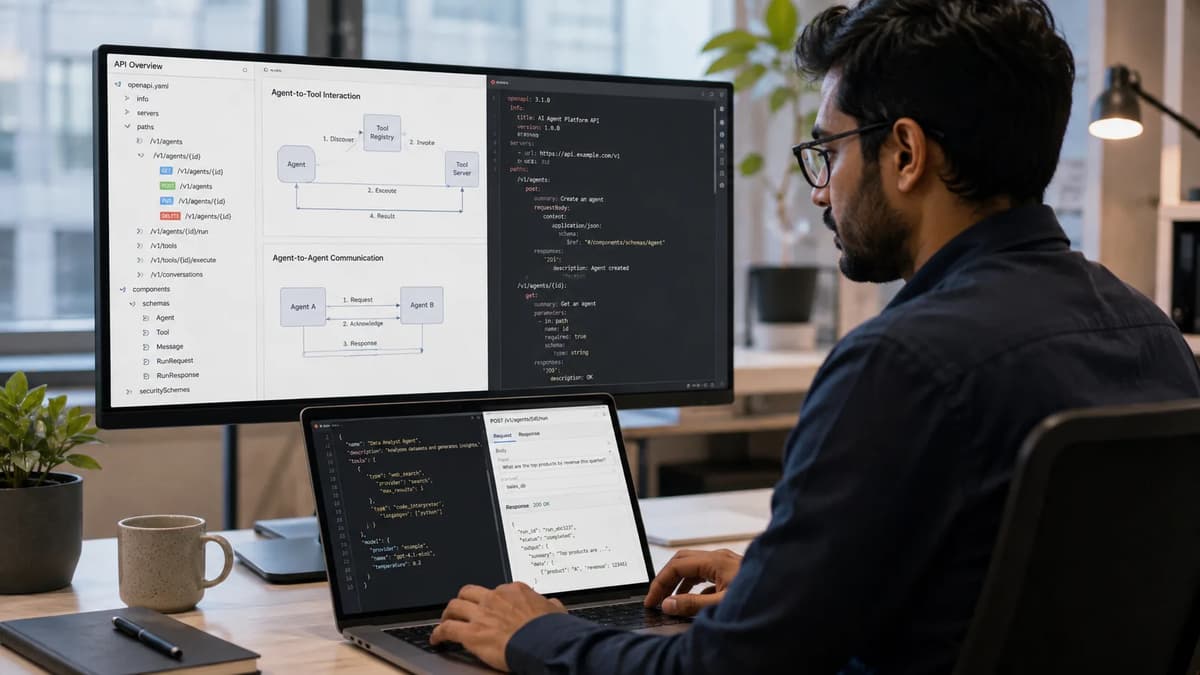
Your API used to have one obvious reader: a developer opening Swagger or Redoc, scanning examples, inferring what POST /orders/{id}/process probably means, and writing integration code around whatever ambiguity remained.
In 2026, that assumption is incomplete. Your next consumer might be an MCP client invoking a tool backed by your API, an A2A-capable agent discovering another agent through an AgentCard, or an LLM reading an OpenAPI document and deciding autonomously which operation satisfies a user request. Those consumers do not reason about documentation exactly the way an experienced engineer does.
That changes the API developer's job.
The change is not "throw away REST and rebuild everything as an agent protocol." It is much more practical: make purpose, side effects, constraints, authentication, errors, discovery, and response behavior explicit enough that software can reason over the contract without relying on the tribal knowledge a human developer might pick up from Slack.
One factual distinction matters before going further. MCP and A2A both reached major protocol milestones in 2026, but OpenAPI's timeline is different: OpenAPI Specification 3.2.0 shipped on September 19, 2025, while the OpenAPI v4 Moonwalk work remains an ongoing evolution rather than a finished 2026 v4 release. The OpenAPI Initiative's June 2026 update nevertheless makes the agent direction explicit, saying OpenAPI documents need to evolve toward machine-actionable contracts that agents can discover, reason over, and execute.
This article assumes you already understand roughly what MCP and A2A are. Re-explaining both protocols from first principles would duplicate other coverage and miss the problem API developers actually need to solve: how do you expose an interface that an agent can discover, understand, authorize against, call safely, retry correctly, and continue using when the contract evolves?
Your API's New Consumer Doesn't Read Docs Like a Human Does
A human developer can compensate for a mediocre contract.
They can read three paragraphs of documentation, inspect a sample response, notice that the API uses status=closed to mean "do not modify," ask a colleague why two endpoints appear to do the same thing, and discover through testing that POST /execute charges a customer's card immediately.
An agent needs those distinctions encoded much more explicitly.
Postman's current State of the API research illustrates the gap. Its 2025 report, based on more than 5,700 respondents, found that 89% of developers use AI but only 24% actively design APIs with AI agents in mind; 60% still primarily design for humans. The same report says 51% identify unauthorized agent access as a top security risk.
For an API developer, agent readable API design therefore starts with three properties:
Machine-readable structure: inputs, outputs, enums, nullability, validation rules, errors, and media types need precise schemas.
Machine-readable intent: the contract needs to communicate what an operation accomplishes, its preconditions, and whether it changes state.
Machine-discoverable capability: the consumer needs a reliable way to learn what your service can do rather than requiring a human to paste documentation into a prompt.
That is where MCP vs A2A vs OpenAPI becomes useful. They do not provide three competing syntaxes for the same problem.
Protocol | What it is actually for | What you design | Discovery surface | Current governance |
MCP | Agent-to-tool/resource communication | MCP tool/resource contracts, often backed by existing APIs | server/discover for server capabilities; methods such as tools/list for actual catalogs | Anthropic-originated; now under the Agentic AI Foundation, a Linux Foundation directed fund |
A2A | Agent-to-agent communication and task delegation | An agent service, AgentCard, task/message behavior, supported interfaces | AgentCard, including well-known discovery | Linux Foundation project with a multi-vendor Technical Steering Committee |
OpenAPI | Describing HTTP APIs for tooling and consumers, increasingly including AI consumers | The underlying HTTP API contract | OpenAPI document, catalogs, registries, tooling | OpenAPI Initiative |
The distinction between MCP discovery and tool discovery deserves precision. In MCP's July 2026 architecture, servers implement the new server/discover operation so clients can inspect protocol-level capabilities, while actual tool discovery still happens through mechanisms such as tools/list. A client does not have to run server/discover before every operation; the release announcement explicitly says that preflight discovery is optional for clients.
There is also a layering issue that gets lost in protocol comparisons. A REST endpoint does not become an MCP tool merely because you improve its OpenAPI description; typically, an MCP server exposes a tool whose implementation calls your underlying REST or GraphQL service.
Likewise, you should not publish an A2A AgentCard merely because an LLM might call your API. A2A is designed for services that behave as agents: they advertise capabilities, accept delegated work, exchange messages, and participate in agent-level tasks. The A2A project explicitly says MCP handles agent-to-tool communication while A2A handles agent-to-agent communication, and calls the two complementary rather than competitive.
That means a perfectly reasonable production architecture can use all three:
User / Application
|
v
AI Agent
/ \
/ \ A2A
MCP v
| Remote Specialist Agent
v
MCP Server
|
v
REST API described by OpenAPI
|
Database / services
OpenAPI remains the machine-readable contract for the HTTP service. MCP selectively exposes useful operations as tools. A2A enters the picture only when another autonomous service needs to be discovered and delegated work as an agent.
That distinction is the foundation for API design for AI agents in 2026: identify which layer you are actually designing before adopting a protocol.
MCP's July 2026 Overhaul Changes the API Boundary
The Model Context Protocol's July 28, 2026 specification release is not a cosmetic revision. MCP changed its core execution model from a bidirectional, session-oriented protocol into a stateless request/response protocol.
The previous initialize/initialized exchange and Mcp-Session-Id header were retired. Under the new design, each request carries its protocol version, client identity, and client capabilities in _meta, allowing independent requests to reach different backend instances without relying on transport-level session state.
For API developers, that is the important part of the MCP stateless protocol 2026 story.
Before the July 2026 core | July 2026 design | API-development consequence |
Initialization handshake | No protocol-level initialization handshake | Do not assume a previous request initialized context |
Protocol-level session identifier | Mcp-Session-Id retired | Avoid hidden transport-session dependencies |
Affinity/shared state could matter | Any request can reach any compatible instance | Ordinary stateless scaling patterns become easier |
Method information primarily inside request body | Mcp-Method and Mcp-Name HTTP headers | Gateways can route, authorize, meter, and observe calls without body parsing |
Catalogs repeatedly fetched | List responses can carry cache hints | Treat tool/schema changes as cache-visible contract changes |
Bidirectional mechanics for server requests | MRTR supports stateless multi-round-trip interactions | Explicit continuation becomes preferable to invisible session context |
MCP's maintainers state that any request can now land behind a normal round-robin load balancer without shared protocol-session storage. Streamable HTTP requests also carry Mcp-Method and Mcp-Name, specifically making gateway routing, authorization, rate limiting, and WAF policy easier to implement at the HTTP layer.
That does not mean every business workflow must become stateless.
Suppose your API creates a long-running data migration. You still need application state: migration ID, progress, ownership, retry state, timestamps, and eventual result. What changed is where that state should live.
A better agent-facing contract is:
startMigration(source, destination)
|
+--> returns migrationId = "mig_92ac..."
|
v
getMigration(migrationId)
The identifier is visible to the model and travels explicitly through subsequent operations. MCP's own release guidance makes this distinction: application state can survive across requests, but the protocol no longer hides that state in a transport session.
For API design, I would apply the same principle even when MCP is only the wrapper around your REST backend. If step B depends on output from step A, make the dependency an explicit resource identifier or continuation token rather than an undocumented assumption that "the server remembers the current workflow."
This is also a versioning issue.
The 2026 MCP release makes responses from tools/list, prompts/list, resources/list, and resources/read cacheable through ttlMs and cacheScope. Once clients cache your exposed contract, silently changing the meaning of a tool becomes more dangerous: an agent may keep reasoning against the old catalog until its cache expires.
Your design rule should therefore look familiar to any experienced API developer: never repurpose an existing operation name to mean something substantially different. Introduce a new contract, preserve compatibility where possible, mark the old surface deprecated, and give consumers an explicit migration path.
That is ordinary API versioning discipline applied to an agent discovery layer.
For readers who need the agent-system side rather than this API-provider perspective, the full 2026 agentic AI engineering toolkit covering A2A and MCP in depth addresses the protocols as components of agent architectures. Here, the important question is narrower: what must your backing interface look like so those components can call it predictably?
What Sampling and Logging deprecation actually means. The same July release formally deprecated Roots, Sampling, and Logging in MCP's core, with a minimum deprecation window rather than immediate removal. The project tells new implementations not to adopt them and points developers toward direct provider APIs for LLM sampling and ordinary logging infrastructure such as OpenTelemetry instead of MCP-specific logging primitives.
That narrowing of scope is useful architectural information.
Do not turn your MCP integration into a second application platform containing its own model invocation abstraction, observability system, state store, authentication model, and business logic if standardized infrastructure already does those jobs better. Treat MCP primarily as the agent-facing capability and interaction boundary.
The scale of the change is also worth putting in context. MCP's official July 2026 announcement reports close to half a billion monthly downloads across its Tier-1 SDKs, with TypeScript, Python, Go, and C# updated for the new specification. That is the official wording; it is more accurate than turning the figure into an unsupported exact "450 million."
Governance has changed too. Anthropic donated MCP in December 2025 to the Agentic AI Foundation, a Linux Foundation directed fund, while MCP's maintainers retained autonomy over day-to-day technical direction.
For production API teams, the practical takeaway is straightforward: MCP is increasingly shaped like infrastructure you already know how to operate. Stateless requests, explicit state handles, standard HTTP routing, standard telemetry, explicit authorization boundaries, and disciplined schema evolution matter more than clever agent-specific abstractions.
A2A v1.0 Is for Agent Services, Not Every API
A2A protocol v1.0 reached its first stable, production-ready release in 2026, and its governance is no longer a Google-only story.
A2A was originally developed by Google and donated to the Linux Foundation. Its current Technical Steering Committee includes representatives from AWS, Cisco, Google, IBM Research, Microsoft, Salesforce, SAP, and ServiceNow.
For an API developer deciding whether to build infrastructure around a young protocol, governance is not decorative metadata. A steering committee spanning competing cloud, enterprise-software, CRM, infrastructure, and research organizations reduces one category of single-vendor dependency, although it obviously does not guarantee that every implementation or extension will remain stable forever.
A2A v1.0 also contains real migration work.
The official migration guide labels Part type unification as a "critical impact" breaking change. Earlier versions separated TextPart, FilePart, and DataPart; v1.0 replaces them with a unified Part whose content is identified by members such as text, raw, url, or data. mediaType replaces the earlier mimeType pattern, and the kind discriminator disappears.
A2A pre-v1 pattern | A2A v1.0 pattern | Migration implication |
TextPart, FilePart, DataPart | Unified Part | Update serializers, validators, and generated models |
kind discriminator | Member-based content discrimination | Change parsing logic |
Nested file representation | url or raw directly on Part | Update file handling |
mimeType conventions | mediaType | Rename mappings |
message/send | SendMessage | Update operation bindings |
message/stream | SendStreamingMessage | Update clients and generated code |
tasks/get | GetTask | Update task integrations |
Agent-level transport fields | supportedInterfaces[] | Regenerate and revalidate AgentCards |
The operation names changed as well. The official v1.0 documentation shows migrations including message/send to SendMessage, message/stream to SendStreamingMessage, tasks/get to GetTask, and tasks/cancel to CancelTask.
Those changes make an important API-design point: machine-consumed contracts magnify the cost of ambiguous or unstable type systems.
A human integrating against v0.3 might notice a changed JSON example and repair a parser. An autonomous consumer or generated client depends far more heavily on explicit structural guarantees. The stricter your schemas, compatibility tests, and version boundaries are, the less reasoning you force downstream clients to improvise.
A2A v1.0 also restructures AgentCards. protocolVersion moves from the card level to individual AgentInterface entries, while earlier transport fields consolidate under supportedInterfaces[]; each interface can advertise its URL, protocol binding, and protocol version. Signed AgentCards use JSON canonicalization and JWS to support cryptographic verification of published metadata.
That still does not mean "every AI-readable API needs an AgentCard."
Use one when what you expose is genuinely an agent service. For example:
Travel-planning agent
Capability: construct compliant business itinerary
Input: business constraints, dates, traveler policies
Behavior: may delegate tasks, gather information, return artifacts
Interaction model: message/task lifecycle
Discovery: A2A AgentCard
Contrast that with:
Flight-pricing API
Capability: return fares matching explicit filters
Input: origin, destination, date, cabin
Behavior: deterministic service operation
Interaction model: request/response API
Discovery: OpenAPI; optionally exposed as an MCP tool
Giving the flight-pricing API an AgentCard merely because an LLM eventually uses it confuses the abstraction layers. A2A's own current documentation explicitly says it is not a tool-call protocol and recommends MCP or framework-native mechanisms for agent-to-tool interactions.
This is where the "MCP versus A2A" framing frequently goes wrong. The protocols answer different questions:
MCP: How can this AI application use a capability, resource, or tool?
A2A: How can this autonomous agent discover and collaborate with another autonomous agent?
OpenAPI: How is this HTTP API mechanically and semantically described?
The A2A v1.0 announcement says the same thing at the architecture level: MCP and A2A occupy different layers and production systems may use MCP within agents while using A2A between them.
That means your first design question should never be "Which protocol is winning?" Ask instead: am I publishing an API operation, a tool, or an autonomous task-performing agent?
Once you answer that, the protocol choice becomes much less mysterious.
OpenAPI Moonwalk Is Retrofitting HTTP Contracts for LLM Consumers
OpenAPI's response to agent consumption is subtler because OpenAPI already describes APIs; it does not need a brand-new agent transport layer.
The problem is that traditional OpenAPI descriptions can be mechanically complete without being semantically rich.
Consider:
post:
operationId: process
requestBody:
...
A parser can identify a POST operation and its request shape. An LLM still has unanswered questions: Process what? Does it charge money? Can I safely retry it? Which resource state must exist first? Does success mean the operation finished or merely entered a queue?
The OpenAPI Moonwalk initiative was created to rethink that gap at the specification level.
In its original December 2023 announcement, the OpenAPI Initiative explicitly identified generative AI as a new API consumer and argued that HTTP mechanics need to be decorated with information expressing an operation's purpose. The post warned that if OpenAPI failed to address that community's needs, AI consumers would find alternatives.
The original Moonwalk framing used five principles: semantics, signatures, inclusion, organization, and upgrading. However, API developers should not use that 2023 list as if it were the latest formulation.
A February 2025 Moonwalk update expanded and refined the model to six principles, adding Foundational Interfaces and reframing organization around Separation of Concerns. It also said the timeline for an eventual OpenAPI 4.0.0 remained open-ended at that point.
Current Moonwalk principle | What it means for an API developer |
Semantics | Describe the purpose and meaning of an operation, not only its HTTP mechanics |
Signatures | Treat API functionality as identifiable operations with meaningful, composable contracts |
Inclusion | Support different HTTP API design styles instead of forcing every API into one ideological pattern |
Foundational Interfaces | Make description documents easier and more consistent for tooling to parse |
Separation of Concerns | Keep HTTP shape, deployment configuration, schemas, and related concerns modular |
Mechanical Upgrading | Make migration from the 3.x family to a future 4.0 mechanically achievable |
For agent consumers, semantics and signatures matter most immediately.
Semantics means the model should not need to infer that cancelSubscription stops future renewals but does not automatically refund the current billing period. Put that distinction into the contract.
Signatures means an operation should present itself like a function with a recognizable purpose, required information, constraints, and result rather than as an accidental combination of path, verb, query parameters, and prose.
This does not require waiting for OpenAPI 4.
OpenAPI 3.2.0, released September 19, 2025, already introduced features relevant to agent-facing workloads. The specification explicitly covers sequential media types including application/jsonl, NDJSON variants, JSON text sequences, and text/event-stream, and adds itemSchema so each item in a stream can be validated independently.
That makes OpenAPI 3.2 streaming more useful when an API returns incremental agent-consumable output.
For example, if a research service emits one validated finding at a time, you can describe that stream instead of documenting the endpoint as an opaque response that "returns events." An agent can then process each event against a known item contract.
OAS 3.2 also adds the querystring parameter location for cases where the entire query string needs to be modeled as one value rather than decomposed into ordinary query parameters.
The OpenAPI Initiative's June 2026 newsletter confirms that the AI direction has not disappeared while Moonwalk continues. It says OpenAPI event discussions in 2026 repeatedly focused on moving descriptions beyond human-readable documentation toward machine-actionable contracts agents can discover, reason over, and execute reliably. The same update says OAS work is evaluating 3.3 changes, while Arazzo's roadmap includes future step types for gRPC, GraphQL, SOAP, MCP, and A2A.
That matters because Moonwalk is not telling REST API developers to abandon HTTP.
It is effectively applying pressure to a weakness API teams have tolerated for years: a technically valid description can still fail to explain what an API actually does.
For a human client, that creates support tickets. For an autonomous client, it can create incorrect tool selection or incorrect actions.
That is why semantic clarity should be treated as production behavior, not documentation polish.
What Actually Changes in Agent-Readable Endpoint Design
The concrete work begins at the endpoint.
You do not need a special /ai version of your API. You need to reduce the amount of unstated inference required to use the existing contract correctly.
Start with operation naming.
process, execute, performAction, and updateData are poor names for agent-visible operations because they communicate almost no domain intent. Prefer names such as createRefund, cancelSubscriptionRenewal, archiveSupportTicket, or generateInvoicePreview.
Then make the operation description answer the questions an experienced integrator would normally ask you during implementation:
What business outcome does this operation produce?
What must already be true before it can run?
Does it create, modify, delete, charge, send, publish, or otherwise cause an external side effect?
Can the operation be retried?
Is it idempotent?
Which credentials or scopes authorize it?
What does an error mean, and is retrying useful?
Does a success response represent completion, acceptance for asynchronous work, or partial progress?
Consider a deliberately agent-legible OpenAPI operation:
paths:
/refunds:
post:
operationId: createRefund
summary: Create one refund for a captured payment
description: >
Creates a refund against a captured payment and changes financial state.
Reusing the same Idempotency-Key returns the existing refund rather
than creating a second refund.
security:
- oauth2:
- refunds.write
parameters:
- in: header
name: Idempotency-Key
required: true
schema:
type: string
minLength: 16
requestBody:
required: true
content:
application/json:
schema:
type: object
required:
- paymentId
- amount
properties:
paymentId:
type: string
amount:
type: integer
minimum: 1
description: Refund amount in minor currency units.
responses:
"201":
description: Refund created successfully.
"409":
description: Payment state does not permit this refund.
"429":
description: Rate limit exceeded. Retry only after Retry-After.
Nothing there is a hypothetical OpenAPI 4 feature. This is ordinary contract design, but it encodes purpose and operational safety much more clearly than "POST /refunds; creates refund."
The design aligns with Moonwalk's semantic direction without pretending Moonwalk has already produced a final OAS 4 syntax.
Typed errors matter more with agents. Do not make a consumer parse "Something went wrong" to decide whether to retry.
Prefer a stable structure:
{
"code": "PAYMENT_NOT_CAPTURED",
"message": "Refund requires a captured payment.",
"retryable": false,
"paymentId": "pay_83d2"
}
The code gives software a deterministic branch. The human-readable message still helps logs and debugging.
Idempotency becomes a first-class safety mechanism. Agents retry: networks fail, orchestration layers time out, tool callers lose responses, and planners may reissue an operation after uncertainty.
For a mutating endpoint, an idempotency key or domain-specific uniqueness constraint can turn "I am not sure whether the first call succeeded" from a potentially destructive ambiguity into a recoverable request. This is ordinary distributed-systems engineering, but agent autonomy increases the value of doing it consistently.
Discovery is not authorization. An agent learning that deleteCustomer exists must not imply that its identity can call it.
MCP's move to explicit HTTP metadata makes it easier for gateways to authorize and meter by method/tool name, while A2A v1.0 strengthens security declarations and authenticated task scoping. Postman's 51% unauthorized-agent-access concern is a reminder that discoverability and permission need separate control planes.
For a production interface, that means using narrow scopes rather than one credential with universal write access. It also means rate-limiting based on the authenticated principal and operation cost where possible, not relying exclusively on IP addresses when fleets of agents can share infrastructure.
A useful agent-facing rate-limit response should tell software what to do next. 429 Too Many Requests plus a meaningful Retry-After is more actionable than an HTML gateway page.
Describe side effects explicitly. An agent choosing between previewDeployment and deployRelease should not need to infer from verbs that only one changes production.
Where your domain supports it, separating preview/dry-run operations from committing operations creates a natural safety boundary:
calculateRefund(...) -> no financial mutation
createRefund(...) -> financial mutation
previewDeployment(...) -> no production change
deployRelease(...) -> production change
This distinction also connects to the broader agent-design question of when a model should call a function versus simply emit a validated object. Refonte Learning's guide to function calling versus structured outputs for agent design covers that consumer-side choice; your API-side responsibility is to make the callable operation itself unambiguous.
Design streaming because the workload requires it, not because agents sound real-time. A two-kilobyte lookup response does not need SSE.
Streaming earns its complexity when the consumer can act on incremental results, when long operations would otherwise time out, or when progress itself is valuable. OAS 3.2's explicit support for text/event-stream, JSONL-style sequential formats, and per-item schemas gives you a standards-based way to describe those payloads.
The protocol decision then becomes much simpler:
Your actual situation | What to reach for |
An agent needs your capability as a discrete tool | MCP wrapper/tool exposure |
Your service acts as an autonomous agent that receives delegated work | A2A |
You have a normal HTTP API and want agents/tooling to understand it better | OpenAPI, with strong semantics now and Moonwalk direction in mind |
An MCP tool calls an existing REST service | MCP + OpenAPI |
An A2A agent internally uses business APIs | A2A + OpenAPI, possibly MCP for its tools |
An A2A agent uses MCP-backed capabilities internally | A2A + MCP |
Incremental API output materially improves the workflow | OAS 3.2 streaming, regardless of higher-level agent protocol |
These layers are not mutually exclusive.
Your existing REST or GraphQL architecture remains the foundation. For the architectural trade-offs beneath the agent layer, the difference between REST, GraphQL Federation, and gRPC architectures remains the relevant comparison; MCP and A2A answer different questions.
The question in how no-code builders are already using MCP to connect AI agents is how an automation builder consumes MCP capabilities. The question here is what you, as the API producer, must expose so that an MCP server can wrap a reliable operation in the first place.
An agent protocol cannot rescue a poor underlying API contract.
If POST /action accepts an unbounded JSON object, throws three indistinguishable 400 errors, uses undocumented authorization behavior, silently changes semantics, and triggers irreversible side effects, putting an MCP tool in front of it does not make it agent-ready. It makes the ambiguity easier for an agent to reach.
A practical readiness audit looks like this:
Contract area | Agent-ready question |
Naming | Can a consumer infer the business action from the operation name? |
Semantics | Does the description explain outcome, preconditions, and side effects? |
Inputs | Are required fields, enums, ranges, formats, and nullability explicit? |
Outputs | Is every successful response structurally predictable? |
Errors | Can software distinguish invalid input, denied access, conflicts, throttling, and transient failure? |
Authentication | Are permissions narrow and machine-readable? |
Idempotency | Can uncertain retries avoid duplicate mutations? |
Versioning | Can old consumers survive contract evolution? |
Discovery | Can the relevant consumer find the capability programmatically? |
Streaming | Are incremental events typed and independently understandable? |
Observability | Can you attribute calls to identities, operations, and outcomes? |
Rate limits | Can a consumer know when and how to retry? |
Get those right first. Then choose the protocol layer that fits the interaction.
API Developer Skills, Portfolio Signals, and Demand in 2026
The most valuable API developer skills in 2026 are not "memorize every field in the MCP and A2A specifications."
Protocols will continue to change. MCP just demonstrated that with a breaking architectural overhaul, while A2A's transition from v0.3 to v1.0 changed core models and operations.
Your durable skill is designing contracts that remain legible under those protocol layers.
Priority | Skill |
Must | Write semantically explicit operation descriptions, not only parameter definitions |
Must | Understand MCP's agent-to-tool role versus A2A's agent-to-agent role |
Must | Design predictable request, response, and typed-error schemas |
Must | Treat authentication, authorization, and side-effect boundaries as part of the contract |
Should | Design stateless-compatible interactions and explicit continuation handles |
Should | Understand idempotency and retry behavior for autonomous clients |
Should | Know OAS 3.2's streaming capabilities |
Should | Version machine-consumed schemas without silently repurposing operations |
Good | Understand A2A AgentCards and when a service actually qualifies as an agent |
Good | Audit existing APIs against Moonwalk's semantic principles |
Semantic clarity ranks first because every technology discussed here eventually bottoms out in the same problem: software has to decide what an operation means.
MCP can give a model a tool catalog. A2A can give an agent an AgentCard. OpenAPI can supply a complete HTTP description.
None of those mechanisms can manufacture reliable intent from an operation called runProcess whose description says only "Runs process."
The security skill gap is equally important. Postman's report does not merely show low agent-oriented design adoption; it pairs that gap with 51% of developers citing unauthorized agent access as a security risk. The report also says only 17% use contract testing, 60% version their APIs, and 26% use semantic versioning.
That combination should change how you build a portfolio project.
Do not create another weather API with five CRUD endpoints and call it "AI-ready." Take an intentionally weak contract and document the refactor.
For example:
Before | After |
POST /process | POST /subscription-cancellations / cancelSubscriptionRenewal |
Free-form request object | Bounded schema with required fields and enums |
"Bad request" | Stable error codes with retry semantics |
One broad API token | Separate read/write authorization scopes |
Undocumented retries | Explicit idempotency contract |
Prose-only endpoint list | OpenAPI document plus appropriate MCP exposure |
Hidden multi-step server session | Explicit workflow/resource identifier |
Breaking changes made in place | Versioned contract with deprecation path |
Generic logs | Per-principal, per-operation telemetry |
Then demonstrate that an agent can select the correct operation from the description and that your test suite rejects malformed calls.
That portfolio artifact proves a different kind of judgment than "I used an MCP SDK." It shows you know how to make a production interface safe for machine consumers.
Certifications are currently a weaker signal for this exact specialization. There is not yet a broadly recognized, vendor-neutral professional credential whose central assessment is agent-consumer API design across MCP, A2A, and OpenAPI.
There are ecosystem-specific courses, certificates, and certification programs around individual agent technologies, so it would be too broad to claim that "no MCP certification exists." The narrower point is that the cross-protocol discipline described here remains too new to have one dominant industry credential.
A better portfolio signal is a repository or case study containing:
An OpenAPI description with explicit semantics and typed errors.
Contract and regression tests.
Idempotent handling of high-impact mutations.
Authentication scopes and rate-limit behavior.
An MCP adapter for selected operations, if MCP fits the use case.
An A2A implementation only when the service actually acts as an agent.
A migration note explaining how you evolved one schema without silently breaking consumers.
For salary benchmarks, role counts, entry paths, and the broader roadmap, use the complete guide to becoming an API developer in 2026. The agent-consumer opportunity here is more specific: Postman's 24% figure suggests that designing explicitly for autonomous API consumers is still far from universal practice.
That makes it a differentiator now, but you should not assume it automatically produces a specific salary premium. The available research establishes a readiness gap; it does not establish a causal pay premium for "MCP-ready API developer" as a job category.
Two mistakes are especially costly.
The first is treating MCP and A2A as interchangeable. The A2A project explicitly rejects that interpretation: MCP equips an agent with tools and resources; A2A lets independent agents communicate and delegate work.
The second is designing for humans first and telling yourself you will "add AI support later."
You do not need to build MCP or A2A into every service on day one. You should, however, make the underlying API semantically explicit from day one because accurate names, bounded schemas, typed errors, narrow permissions, version discipline, and meaningful descriptions benefit human developers too.
Moonwalk's central idea is valuable precisely because agent-readable design and good API design largely converge. The AI consumer raises the cost of the ambiguity you could previously get away with.
Self-Study vs. the Refonte Learning APIs Developer Program
Agent-readable API design sits on top of ordinary API engineering.
Before an engineer can make a REST operation legible to an LLM, they need to understand resources, requests, responses, authentication, versioning, errors, testing, and documentation. Before they can expose a GraphQL capability safely, they need a disciplined schema and authorization model.
That is why the protocol your employer ultimately chooses matters less at the foundation stage than your ability to design a clear interface.
Factor | Self-study | Structured APIs Developer Program |
REST fundamentals | Can be learned through documentation and projects, but coverage varies | Dedicated RESTful API module |
GraphQL schema design | Depends heavily on the projects you choose | Dedicated GraphQL API module |
Documentation discipline | Easy to postpone in personal projects | Explicit program competency |
Testing | Quality depends on self-imposed standards | Documentation and testing appear in the competency set |
Authentication/security | Must be assembled from multiple learning sources | Authentication, authorization, and API security appear in the curriculum competencies |
Versioning | Often learned after the first breaking change | Versioning and deprecation are explicit competencies |
Portfolio evidence | Scope depends on your own project design | Program states that learners work on practical API projects |
Certificates | None unless you pursue separate credentials | Training Certificate and Certificate of Internship after successful completion |
Structure | Flexible | Three months, 10–12 hours per week |
The "self-study timeline" cannot honestly be standardized into one guaranteed number. An experienced JavaScript developer may build a credible REST service quickly; somebody learning programming, databases, HTTP, and Node.js simultaneously will need substantially more time.
What a structured program buys you is sequencing and enforced coverage, not a magic shortcut around practice.
The current Refonte Learning APIs Developer Program is a three-month program requiring 10–12 hours per week. Its educational path lists Introduction to API Development Fundamentals, Building RESTful APIs, and Mastering GraphQL APIs; stated competencies include authentication and authorization, database integration, documentation and testing, error handling and logging, versioning and deprecation, microservices architecture, performance optimization, and API security.
Its current page lists Postman, Swagger, Node.js frameworks, and GraphQL libraries among the tools learners use. The program is positioned as a training and internship experience, and its site states that successful completion provides a Training Certificate and Certificate of Internship.
The important qualification is what the curriculum does not claim.
The current program page does not list MCP, Model Context Protocol, A2A, Agent2Agent, OpenAPI Moonwalk, gRPC, or GraphQL Federation as named curriculum topics. It would therefore be inaccurate to market the program as if it directly teaches the July 2026 MCP specification or A2A v1.0.
Its relevance is foundational instead.
REST and GraphQL schema design teach you to define operations and data precisely. Authentication teaches you to constrain what a caller may do. Error handling gives autonomous consumers predictable failure branches. Versioning prepares you for contract changes such as MCP's stateless migration or A2A's unified Part model.
Documentation practice teaches you to externalize information that would otherwise live only in an engineer's head.
Those skills are the layer beneath agent protocols.
Consider the progression:
HTTP and API fundamentals
↓
REST / GraphQL schema design
↓
Authentication + authorization
↓
Errors + testing + versioning
↓
Machine-readable documentation
↓
Agent-readable semantics
↓
MCP exposure or A2A integration where appropriate
If you skip the middle of that stack, learning an MCP SDK gives you syntax without API judgment.
The opposite path is much more transferable. An API developer who understands contracts, versioning, security, observability, and failure semantics can learn the mechanics of a new agent protocol much faster because the hard design questions remain recognizable.
That is also why Swagger and Postman still matter in an agent-driven API landscape. Agents may be new consumers, but the producer still needs to test contracts, validate authentication behavior, document endpoints, model schemas, and verify backward compatibility.
The program page identifies API Developer among its career outcomes. It also displays $70.5K+ Starting and 210K+ Jobs Annually beside the APIs Developer offering; those figures are Refonte Learning's own marketing claims on the page, not independent labor-market statistics, so they should be treated as provider claims rather than external salary evidence.
The stronger reason to evaluate the program is therefore its curriculum, format, project work, and documented competencies rather than a headline labor-market number.
For an engineer aiming at agent readable API design, the relevant question is simple: does the learning path give you enough command of REST/GraphQL contracts, authentication, documentation, testing, error handling, versioning, and security to extend those practices to machine consumers?
According to the published curriculum, those fundamentals are the part the program actually teaches.
The direct program reference is the Refonte Learning APIs Developer Program.
FAQ: People Also Ask
What's the difference between MCP and A2A?
MCP is primarily for agent-to-tool and resource communication; A2A is for communication, discovery, and delegation between autonomous agents. The A2A project's official documentation explicitly describes them as complementary rather than competing protocols.
From an API developer's perspective, expose a capability through MCP when an agent should use it as a tool. Reach for A2A when the service itself behaves as an agent that can accept and coordinate delegated work.
What changed in MCP's July 2026 update?
MCP's July 28, 2026 specification replaced its protocol-level stateful session model with a stateless request/response core. It retired the initialize/initialized handshake and Mcp-Session-Id, made requests self-describing, introduced server/discover, added HTTP method/tool headers and cacheable list responses, and formally deprecated Roots, Sampling, and Logging.
A useful precision: the server-side discovery capability is part of the new architecture, but clients do not have to call server/discover before making other requests. The official release says that discovery preflight is optional for the client.
What is A2A's biggest breaking change in v1.0?
The official migration documentation ranks Part type unification as the critical-impact change. A2A v1.0 replaces separate TextPart, FilePart, and DataPart structures with one unified Part model whose content is identified through members such as text, raw, url, or data.
The release also renames operations including message/send to SendMessage and tasks/get to GetTask, and changes AgentCard and enum structures. Existing pre-v1 integrations therefore require real schema and binding migration rather than a version-number-only update.
What is OpenAPI's Moonwalk initiative?
Moonwalk is the OpenAPI Initiative's effort to rethink the specification toward an eventual v4, with explicit attention to API semantics and AI/LLM consumers. The original 2023 work described five principles; a February 2025 update expanded the current formulation to six: semantics, signatures, inclusion, foundational interfaces, separation of concerns, and mechanical upgrading.
Moonwalk is not a finished OpenAPI 4 release as of August 2026. The practical lesson you can apply now is to make purpose and semantics explicit in existing OpenAPI descriptions rather than documenting only HTTP mechanics.
Do I need to redesign my entire API to support AI agents?
Usually, no. Good agent-facing design extends API practices you should already value: precise schemas, semantic operation descriptions, stable errors, narrow authorization, idempotency, versioning, machine-readable documentation, and predictable response behavior.
You can keep an existing REST or GraphQL implementation and expose selected capabilities through MCP when appropriate. A2A is necessary only when you are exposing an agent-level interaction rather than an ordinary tool or HTTP operation; OpenAPI can remain the underlying contract in either architecture.
Does the Refonte Learning APIs Developer Program teach MCP or A2A specifically?
No, not according to the program's current published curriculum. The page lists API fundamentals, RESTful APIs, GraphQL APIs, Postman, Swagger, Node.js frameworks, and GraphQL libraries, together with competencies such as authentication, documentation/testing, error handling, versioning, performance, and security. It does not list MCP, A2A, or Moonwalk by name.
The defensible connection is that those REST/GraphQL, schema, security, versioning, and documentation skills form the foundation that agent-consumer API design extends.
Conclusion
The API-consumer shift is real, but the architecture is easier to reason about once you stop treating every agent standard as a competitor.
MCP's July 28, 2026 release made agent-to-tool infrastructure substantially more web-like by moving to a stateless request/response core, retiring protocol sessions, improving discovery and HTTP routing, and narrowing the core through deprecations.
A2A v1.0 provides the different layer: agent-to-agent communication, discovery, and delegation, now under Linux Foundation governance with an eight-company Technical Steering Committee and meaningful migration changes such as the unified Part model.
OpenAPI's agent story combines an ongoing Moonwalk/v4 effort centered on semantic clarity with already-shipped OAS 3.2 capabilities such as typed streaming media; its 2026 direction explicitly treats machine-actionable agent contracts as a priority.
The near-term differentiator is execution, not hype: Postman finds only 24% of developers design APIs with AI agents in mind while 51% cite unauthorized agent access as a major security concern. That gap is addressed through better schemas, semantics, authorization, idempotency, versioning, observability, and discovery, not by abandoning REST or GraphQL.
For the schema-design, documentation, testing, security, and versioning foundation that agent-readable API design extends, the Refonte Learning APIs Developer Program is the structured starting point described in Refonte Learning's current curriculum.