REST is not disappearing. Postman’s most recent State of the API Report puts REST adoption at 93%, compared with 33% for GraphQL, 50% for webhooks, and 35% for WebSockets. Crucially, that is 2025 data from Postman’s seventh annual report, based on more than 5,700 developers, architects, and executives; as of August 11, 2026, Postman’s official archive still identifies the 2025 report as the current edition, so there is no legitimate Postman “2026 adoption” number to substitute for it.
That makes the interesting story in API Development in 2026 more specific than “GraphQL is replacing REST.” It is not. The architectural change is occurring inside organizations that already use GraphQL and have discovered that one unified schema can become an organizational bottleneck when independent teams must all modify, validate, and release that schema together.
I have seen the failure mode this architecture targets: six teams can each make a locally reasonable change, yet the shared release becomes a negotiation over ownership, resolver behavior, schema compatibility, deployment timing, and who gets paged when the combined graph fails. At that point, the problem is no longer GraphQL syntax; it is coordination architecture.
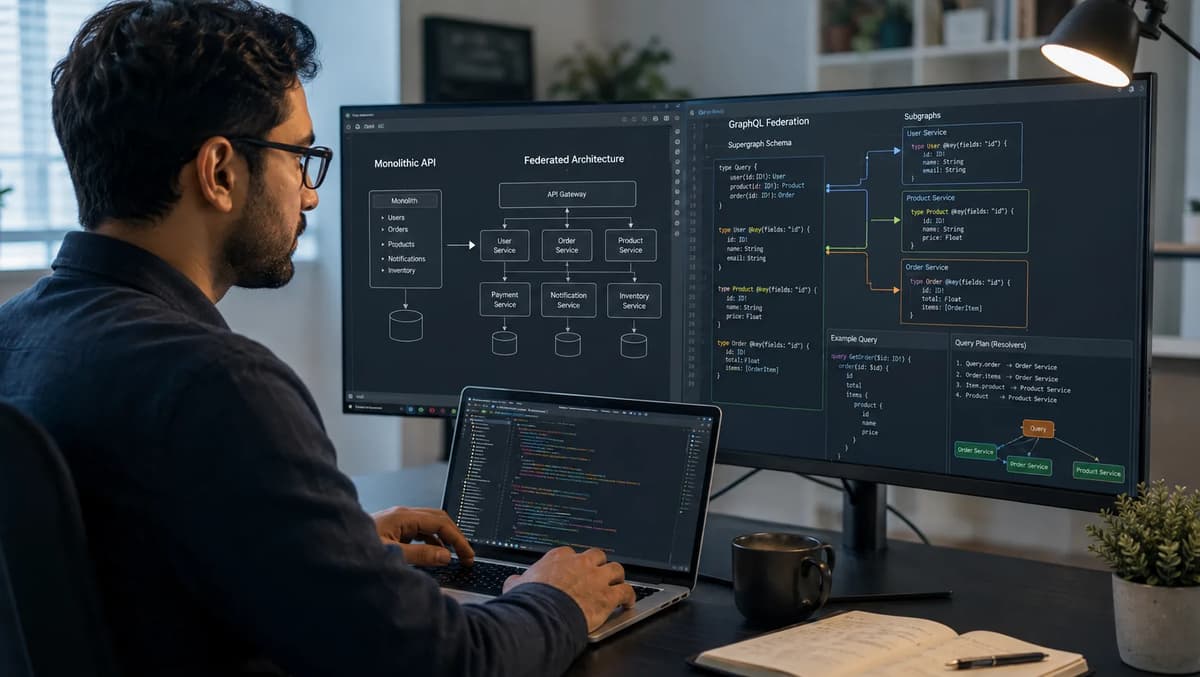
GraphQL Federation attacks that coordination problem by letting domain teams own independently deployable subgraphs that contribute to one API surface. A gateway or router exposes the unified graph to clients, while composition verifies that the pieces still form a compatible schema. The GraphQL Foundation now describes federation as an architectural pattern for distributed graphs and says its Composite Schema Working Group is actively creating an official GraphQL Federation specification.
Apollo’s release history reinforces that this is active infrastructure rather than a frozen pattern. Apollo Federation 2.12 LTS shipped in November 2025, 2.13 in January 2026, 2.14 in May 2026, and 2.15 LTS in July 2026; the latest release replaced composition with a Rust implementation, improved diagnostics, and added stricter validation for schema errors that earlier composition did not consistently catch.
For anyone researching API development in 2026 and GraphQL Federation, that is the real question to investigate: not “Should everybody replace REST with GraphQL?” but “Once GraphQL spans independent engineering domains, who owns the graph, how do those domains deploy safely, and where should the boundaries live?”
This article answers that question from the architecture outward: what Federation solves, what Apollo Federation actually shipped in 2026, why the GraphQL Foundation’s standards work matters, how to think about GraphQL Federation vs. monolithic API architecture, where gRPC belongs, how to migrate without creating a distributed mess, and which API skills now deserve priority.
API Development in 2026: Why Monolithic GraphQL APIs Are Running Out of Road
A monolithic GraphQL API is not automatically a bad design. One schema, one codebase, one resolver layer, and one deployment pipeline can be exactly the right architecture when one team owns the product and can make coordinated decisions quickly.
The trouble starts when organizational ownership stops matching technical ownership. If payments, catalog, identity, fulfillment, subscriptions, and recommendations each have independent roadmaps but every GraphQL change still passes through one repository and one release train, the schema has become a shared critical section.
Approach | Schema ownership | Team scaling | Deployment model |
Monolithic GraphQL API | One codebase or centrally owned schema | Strong fit when contributors share one release cadence | Entire graph commonly releases together |
GraphQL Federation | Domains own subgraphs | Designed for independent teams and domain boundaries | Subgraphs can release independently while composition checks integration |
The GraphQL Foundation explicitly frames federation around distributing responsibility, maintaining domain boundaries, enabling autonomous development and deployment, and composing independent subgraphs behind a unified API. It also warns that federation adds real infrastructure requirements and should not be introduced prematurely.
That distinction matters because a monolithic graph creates two separate kinds of coupling. Runtime coupling concerns which resolvers call which databases or services; organizational coupling concerns which teams must coordinate before a schema change can ship.
You can reduce runtime coupling while retaining organizational coupling. Six resolver modules talking to six microservices can still form a GraphQL monolith if the modules share one schema publication process and one deployment decision.
Federation changes that ownership model. A catalog team can own the product portion of the graph, an orders team can own orders, and an identity team can own users; composition becomes the integration contract rather than a central team manually assembling every field into one schema.
That is why I would not define Federation as “microservices, but GraphQL.” The more useful definition is distributed schema ownership with a unified consumer contract.
The client still sees one graph. The organizational structure behind that graph changes.
What the latest Postman data actually says
Any REST vs. GraphQL adoption discussion in 2026 needs one correction before it begins: there is no 2026 Postman State of the API Report published as of August 11, 2026. Postman’s archive currently points readers to its 2025 report and lists 2024 and earlier editions as previous reports.
The 2025 edition is the seventh annual State of the API Report. Postman says it surveyed more than 5,700 developers, architects, and executives globally and framed the report around the statement, “APIs are no longer just powering applications. They're powering agents.”
Its API-style adoption data is:
API style or protocol | Postman 2025 adoption |
REST | 93% |
Webhooks | 50% |
WebSockets | 35% |
GraphQL | 33% |
SOAP | 25% |
gRPC | 14% |
Server-Sent Events | 12% |
The REST, webhook, WebSocket, and GraphQL figures appear directly in Postman’s tooling section; the report’s chart also places gRPC at 14%.
That evidence does not support a “REST is dying” narrative. It supports a layered architecture narrative: REST remains the baseline, while GraphQL, gRPC, event-driven mechanisms, and additional API gateways appear alongside it for specific use cases.
Postman adds an organizational clue that matters for Federation: 31% of surveyed organizations use more than one API gateway, including 20% using two and 11% using three or more. Postman attributes this to differences among teams, cloud providers, and deployment patterns.
The report also says 93% of API teams encounter collaboration blockers, with documentation inconsistency, duplicate work, and discovery problems among the failures it identifies. That statistic does not prove that every organization needs Federation, but it does validate the broader architectural problem: API coordination remains difficult even as tooling matures.
Be skeptical, therefore, when an SEO article announces that “more than 50% of enterprises use GraphQL in production” without showing a primary survey. That claim conflicts with Postman’s directly surveyed 33% GraphQL adoption figure; unless the article defines a different population and publishes a defensible methodology, it should not replace Postman’s primary data.
The architectural implication is straightforward:
REST remains mandatory knowledge because 93% adoption makes it the broadest API baseline in Postman’s survey.
GraphQL is an important specialization, but at 33% adoption it is not a wholesale REST replacement.
Federation is a specialization inside GraphQL architecture, addressing ownership and composition once a graph needs independent domain teams.
gRPC belongs to another layer of the system, particularly strongly typed service communication, rather than acting as a one-for-one substitute for Federation.
For broader backend context rather than this API-specific architecture analysis, Refonte Learning already publishes the complete backend development roadmap for 2026. The architectural gap this article focuses on begins after you know REST and GraphQL fundamentals and must decide how a graph should scale across ownership boundaries.
GraphQL Federation Explained: What It Solves, What Apollo Shipped, and Why the Standard Is Changing
Here is GraphQL Federation explained without the vendor language: divide a unified GraphQL graph into independently owned subgraphs, verify that those subgraphs can compose into a valid overall schema, and put a routing layer between clients and the services that resolve the requested fields.
The GraphQL Foundation defines subgraphs as independent services with their own GraphQL schemas and resolvers. It describes the gateway as the entry point that accepts client operations, routes portions of a query to the appropriate subgraphs, collects the results, and produces a unified response.
A simplified e-commerce split might look like this:
# Products subgraph
type Product @key(fields: "id") {
  id: ID!
  name: String!
  price: Int!
}

type Query {
  product(id: ID!): Product
}
# Reviews subgraph
type Product @key(fields: "id") {
id: ID!
reviews: [Review!]!
}
type Review {
id: ID!
rating: Int!
text: String
}The product team controls product identity, names, and prices. The reviews team contributes review-related fields to the same conceptual Product entity, while federation metadata gives the composition and routing layer enough information to connect those domains.
That unlocks a critical operational change: independent deployment does not have to mean independent client APIs. Clients can keep querying one graph while backend ownership follows business domains.
Suppose the payments team adds a field to its subgraph on Tuesday while the inventory team ships an unrelated resolver optimization on Thursday. Under a properly governed federated model, those teams do not need a synchronized application release merely because their types participate in the same consumer-facing graph; each team publishes its schema change, and composition validates whether the resulting graph remains coherent.
That last sentence contains the part teams underestimate: Federation does not eliminate coordination; it changes the mechanism of coordination.
You stop coordinating every deployment manually. You start coordinating through explicit domain ownership, schema composition, compatibility checks, observability, and governance.
The Apollo Federation release record in 2026
The 2026 Apollo Federation release record shows a concrete cadence, not a forecast. Apollo’s official Federation changelog records four releases from November 2025 through July 2026.
Federation version | First release | Status | Material change |
v2.12 | November 2025 | LTS | Introduced @cacheTag; prerequisite for Connector spec 0.3 |
v2.13 | January 2026 | Standard | Prerequisite for Connector spec 0.4 |
v2.14 | May 2026 | Standard | Refined @interfaceObject, Federation 1 compatibility scoping, custom-spec composition, and @link validation |
v2.15 | July 2026 | LTS | Replaced composition implementation with Rust; stronger validation and improved diagnostics |
Federation 2.12 introduced @cacheTag, which lets schema authors associate cache tags with response-cached entries so specific data can participate in cache invalidation workflows. Apollo’s changelog identifies 2.12 as an LTS release and specifies a minimum Apollo Router version of 2.8.0.
Federation 2.13 followed in January 2026. Apollo describes it as a prerequisite for Connector specification 0.4 and lists Apollo Router 2.11.0 as its minimum compatible router version.
Federation 2.14 arrived in May. Its changes included narrower validation rules for graphs mixing @interfaceObject with Federation 1 subgraphs, revised handling of custom specifications used with @composeDirective, and @link validation intended to prevent naming conflicts between linked specifications and imported definitions.
Then Federation 2.15 LTS shipped in July 2026. Apollo says composition is now written in Rust, while the resulting supergraphs remain semantically equivalent to those produced by the preceding implementation; the stated benefits include faster builds, significantly improved error messages, and stricter detection of schema problems that previous composition handled inconsistently or missed.
The Rust story had already been visible in May. In a preview announcement, Apollo reported benchmarking the Rust composition engine against the JavaScript implementation across tens of thousands of production graphs, claiming roughly 27× faster median composition, 8.5× at p95, and 6× at p99; Apollo explicitly cautioned that those were pre-GA composition-only measurements rather than end-to-end GraphOS performance.
The more important production result is not the benchmark headline. It is that Apollo validated the Rust implementation against a large corpus of production graphs, then made it the composition implementation in the July 2.15 LTS release while documenting newly detected validation errors.
What LTS means for architecture decisions
Apollo labels both v2.12 and v2.15 as LTS in the Federation changelog. That makes those versions useful planning anchors for teams that value a more conservative production upgrade rhythm rather than adopting every intermediate specification version immediately.
Do not translate “LTS” into “never upgrade.” Federation versions have router compatibility requirements: Apollo lists Router 2.8.0 as the minimum for Federation 2.12 and Router 2.16.0 as the minimum for 2.15, so a Federation upgrade should include explicit router and build-pipeline compatibility checks.
For production teams, I would treat the process as:
Pin the Federation specification version used by each subgraph.
Verify router compatibility before publishing a newer version.
Run composition and operation checks before merge.
Examine newly surfaced validation errors before assuming the compiler is “breaking” a previously valid graph.
Prefer deliberate LTS-centered upgrade windows when your organization values stability over immediate feature adoption.
That final recommendation is architectural judgment rather than an Apollo requirement. The changelog establishes which versions carry the LTS label and which router versions they require; your deployment policy still belongs to your engineering organization.
The GraphQL Foundation changes the strategic calculation
Apollo introduced Apollo Federation in 2019, and Apollo’s implementation became the reference point around which the GraphQL ecosystem developed federation practices. The significant 2026 development is that standardization is no longer just an Apollo concern.
The GraphQL Foundation Composite Schema Working Group includes engineers associated with Apollo GraphQL, ChilliCream, Graphile, Hasura, Netflix, The Guild, WunderGraph, and other parts of the ecosystem. The Foundation says that group is actively working on an official specification for GraphQL Federation, with the objective of standardizing composition and execution while leaving room for distinct implementations.
That wording matters. The GraphQL Foundation federation specification is an active standards effort, not a finalized specification that every vendor already implements identically.
The mature way to interpret the signal is therefore:
Apollo Federation remains the dominant concrete implementation and reference architecture today.
The GraphQL Foundation is working toward a Foundation-governed, vendor-neutral federation specification.
Core concepts such as subgraph ownership, composition, entity relationships, routing, and schema governance therefore have more durable learning value than memorizing one vendor console.
Apollo-specific directives and GraphOS workflows still matter when your production stack uses Apollo, but they should sit on top of those architecture concepts.
Calling Federation “Apollo proprietary” is becoming less useful terminology. Apollo Federation is an Apollo-originated architecture with open tooling and published specifications; the important distinction is that it has historically been Apollo-specified rather than GraphQL-Foundation-standardized, and the Foundation’s working group is now addressing that standards gap.
What GitHub Activity Does and Does Not Tell You
Direct GitHub repository data provides another useful snapshot, but repository stars are community-interest signals, not production-adoption percentages.
As of the August 2026 snapshot used for this analysis:
Repository | Stars | Forks | Interpretation |
grpc/grpc | 45,271 | 11,361 | Large multi-language RPC ecosystem |
graphql/graphql-js | 20,344 | Not listed | Core JavaScript GraphQL reference implementation |
apollographql/apollo-server | 13,944 | Not listed | Major Apollo GraphQL server project |
apollographql/federation | 724 | 274 | Federation-specific monorepo |
GitHub’s public HTML currently rounds the star counts for grpc/grpc, graphql/graphql-js, and apollographql/apollo-server to 45.3k, 20.3k, and 13.9k, respectively, while the apollographql/federation repository displays 724 stars and 274 forks directly.
Do not conclude from 724 stars that only a tiny population uses Federation. Apollo’s own Federation repository points to GraphOS, Apollo Federation, Apollo Server, and other pieces of a broader stack; production Federation work does not funnel through one standalone repository in the way a simple library’s popularity might. That is an architectural inference from Apollo’s project structure, not a measured production-adoption statistic.
The stronger evidence for maturity is the combination of active Apollo releases, a Rust composition rewrite, an official Apollo Federation certification path, production job requirements, and the GraphQL Foundation’s standards work.
GraphQL Federation vs Monolithic API vs gRPC
The GraphQL Federation vs. monolithic API decision should start with organizational topology, not fashion.
A graph owned by one cohesive team does not become “legacy” merely because it is monolithic. A graph owned by six independently shipping teams does not become scalable merely because you put six folders in the same repository.
Aspect | Monolithic GraphQL API | GraphQL Federation |
Best organizational fit | One team or tightly synchronized ownership group | Multiple autonomous domain teams |
Schema ownership | Centralized | Distributed across subgraphs |
Deployment coordination | Commonly coordinated as one graph/application | Subgraphs can deploy independently |
Composition | Single schema assembled locally | Explicit cross-subgraph composition |
Infrastructure | Lower operational complexity | Router/gateway, composition, registry/governance add moving parts |
Domain boundaries | Enforced primarily through code organization | Reflected directly in subgraph ownership |
Scaling | Whole application commonly scales together unless internals are separated | Subgraphs/services can scale independently |
Failure behavior | Centralized runtime can create broad blast radius | Service failures can be domain-local operationally, although queries depending on failed subgraphs can still be affected |
Learning curve | Lower | Higher |
Migration pressure | Low when ownership is simple | Stronger when teams require separate release cadences |
The GraphQL Foundation explicitly says federation is particularly valuable where multiple teams need to work independently on different parts of the API. It also says federation requires substantial infrastructure support and recommends starting monolithically when that complexity is not yet justified.
That is the decision rule I use: federate because your ownership model requires federation, not because your schema passed an arbitrary line count.
A 20,000-line schema owned by one tightly coordinated platform team can remain coherent. A 2,000-line schema with five teams fighting over release windows can already have a stronger case for distributed ownership.
When the monolith remains the right architecture
Keep a monolithic GraphQL API when:
One team owns nearly all schema evolution.
One deployment cadence does not delay independent product work.
Domain boundaries are still changing rapidly.
The cost of operating a router, composition workflow, schema registry, and cross-subgraph observability would exceed the coordination cost you are trying to eliminate.
Your organization has not yet developed reliable schema-change and API-governance discipline.
The Foundation makes the same core point directly: organizations should consider whether they truly need Federation’s complexity and can transition later as requirements evolve. It even notes that Meta, where GraphQL originated, has continued using a monolithic GraphQL API, illustrating that company scale alone does not mechanically require Federation.
Federation solves a real problem. Creating that problem artificially so that you can deploy the solution is architecture theater.
GraphQL Federation vs gRPC is the wrong either-or question
A GraphQL Federation vs. gRPC comparison can suggest two competing choices, but that framing confuses layers.
GraphQL Federation answers: “How do multiple domains contribute to one GraphQL contract that clients can query?”
gRPC answers: “How do software services call strongly typed remote procedures efficiently across process or network boundaries?”
The official gRPC project describes gRPC as a high-performance RPC framework for connecting services within and across data centers, with facilities for load balancing, tracing, health checking, and authentication. Protocol Buffers commonly supply gRPC’s service definitions and message contracts.
Concern | GraphQL Federation | gRPC |
Primary architectural problem | Distributed GraphQL schema ownership | Remote service communication |
Typical consumer | Web/mobile/application clients through a graph entry point | Backend services, infrastructure components, internal clients |
Contract style | GraphQL schema and federated composition | Service/method definitions, commonly Protocol Buffers |
Cross-team mechanism | Subgraphs compose into a unified graph | Services expose typed RPC interfaces |
Client-facing unified graph | Yes | Not inherently |
Can coexist with the other? | Yes | Yes |
A perfectly coherent architecture can therefore look like this:
Web / Mobile / Agent clients
            |
      GraphQL Router
            |
   ---------------------
   |         |         |
Products   Orders    Identity
Subgraph   Subgraph   Subgraph
   |         |         |
   +---- gRPC / internal RPC ----+
            |
      Backend services
The GraphQL router gives consumers a coherent graph. Internal services can use gRPC where typed RPC, streaming, or internal performance requirements justify it.
Uber provides current primary evidence of that gRPC role. In an April 2026 engineering article about OpenSearch, Uber described using Protobuf-based contracts already present across Uber, adding gRPC transport for high-throughput search and ingestion workloads while retaining REST compatibility for incremental migration.
Postman’s cross-protocol survey is more useful for adoption comparison than logo lists: gRPC appears at 14% versus GraphQL at 33% and REST at 93% in the 2025 report.
A commercial technology tracker, Landbase, separately labels 579 companies as verified gRPC users, but its own page says the underlying data was last updated on August 17, 2025, despite presenting the page as “2026.”
That is exactly why commercial “companies using technology X” counts need caution: vendors use different detection methods and populations. I would cite the 579 figure only as Landbase’s database count, not as a market-share statistic, and I would anchor protocol adoption comparisons to Postman’s stated survey methodology.
The practical architecture rule is simpler:
Use REST where resource-oriented HTTP interfaces remain the simplest interoperable contract.
Use GraphQL where clients benefit from a typed graph and flexible data selection.
Use Federation when GraphQL ownership must span autonomous domains.
Use gRPC where backend RPC characteristics justify it.
Those choices can all exist inside one platform.
How to Migrate From a Monolithic GraphQL API Without Building a Distributed Monolith
The safest Federation migration does not begin by creating six repositories. It begins by identifying ownership boundaries.
The GraphQL Foundation’s own migration guidance recommends treating the existing monolithic schema as the first subgraph, then gradually decomposing it. That strategy preserves a working API while moving one bounded piece at a time.
A migration I would trust follows this sequence:
Map schema fields to business ownership.
Find one domain with a clean boundary and a real need for independent deployment.
Convert the existing monolith into the initial federated subgraph rather than rewriting everything.
Extract the selected domain into a second subgraph.
Add automated composition checks before schema publication.
Run operation checks against important client queries.
Observe latency, errors, resolver fan-out, and subgraph dependencies.
Extract the next domain only after the first boundary is operationally boring.
The first task is harder than it sounds. A schema organized as User, Product, Order, and Payment does not automatically tell you which team owns every field, because historical GraphQL monoliths frequently accumulate cross-domain resolver behavior.
Consider User.orders. Does identity own the relationship because the field lives on User, or does orders own it because it resolves order data?
Federation forces that argument into the open. That is a feature.
A good boundary follows the team that owns the business capability and data semantics, not the type name that happened to appear first in the monolithic schema. If orders owns order lifecycle rules, order-related graph behavior should generally remain under the orders domain even when clients reach it through another entity.
Composition becomes your integration test
In a monolith, schema validity happens inside one build. In Federation, composition has to verify that independently defined pieces can produce one coherent supergraph.
The GraphQL Foundation says the composition step protects service integrity by checking that individual subgraph changes do not conflict with other subgraphs. Apollo Federation 2.15 strengthened that layer further by detecting schema problems that the earlier composition implementation handled inconsistently or failed to catch.
Put composition into pull-request or publication workflows. A subgraph should not discover after production deployment that its schema no longer composes.
Postman’s testing data makes the broader discipline worth emphasizing: although 75% of respondents use CI/CD pipelines and functional and integration testing each reach 67%, contract testing stands at only 17%. A distributed graph makes contract discipline more important, not less.
The checks I would require before an extraction are:
Migration check | Question to answer |
Ownership | Is one team clearly accountable for the extracted domain? |
Deployment | Does that team genuinely need an independent release cadence? |
Data | Can the domain own its data access without reaching through another team’s internals? |
Schema | Can entity relationships cross the boundary explicitly? |
Composition | Does every proposed schema build successfully with the remaining graph? |
Operations | Do important client operations still validate? |
Observability | Can you identify which subgraph caused latency or errors? |
Rollback | Can the extracted service and schema change be reverted safely? |
Security | Are authentication context and authorization responsibilities explicit? |
Version compatibility | Does your router/build system support the Federation version used by the subgraph? |
Do not skip security because the router is “internal infrastructure.” A unified graph can cross identity, payments, customer, and operational domains; routing a field correctly does not prove that the caller is authorized to see it.
The public Refonte Learning API curriculum correctly treats authentication and authorization, testing, documentation, versioning, error handling, and API security as separate competencies rather than assuming a GraphQL library solves them. Those fundamentals remain necessary after federation because the architecture increases the number of contracts you operate.
For practical API testing fundamentals beneath this architecture layer, Refonte Learning’s Postman API testing guide is a more appropriate companion than trying to turn Federation composition into a replacement for ordinary API tests.
Common Federation mistakes are usually ownership mistakes
Federating before independent ownership exists is mistake number one. If one six-person team controls the complete graph and deploys from one backlog, splitting it into five subgraphs gives that team more infrastructure without eliminating an actual coordination dependency.
The GraphQL Foundation explicitly warns against premature adoption because a federated graph requires gateway, registry, integration, and governance infrastructure.
Splitting by database table is mistake number two. Federation is most useful when boundaries match business domains and team accountability; one users table does not mean every field related to a person belongs to an “identity microservice.”
Allowing the gateway team to become the new monolith team is mistake number three. If every subgraph change still needs manual approval and implementation work from one central platform group, you have distributed the runtime while retaining centralized organizational coupling.
The platform group should supply paved roads: router infrastructure, composition, policy checks, observability, schema registry, templates, and escalation paths. Domain teams should own their domain schemas.
Treating independent deployment as independent design is mistake number four. Federation still exposes one consumer contract, so teams need naming conventions, entity-ownership rules, deprecation policy, and common security expectations.
Postman reports that only 60% of surveyed teams version APIs and 26% use semantic versioning, while the report emphasizes living documentation and governance workflows as remedies for collaboration failures. Those figures are not Federation-specific, but they show why distributed ownership needs deliberate lifecycle discipline.
Trusting aggregator statistics over primary data is mistake number five. Articles claiming GraphQL production adoption above 50% should not overwrite Postman’s directly surveyed 33% unless they publish a different credible sampling frame; the safe 2026 editorial approach is to date-stamp Postman’s 2025 figure and state clearly that no 2026 Postman edition exists yet.
The goal is not “more services.” The goal is less unnecessary coordination without losing contract integrity.
API Developer Skills 2026: Architecture Judgment, Portfolio Proof, and What Employers Are Signaling
The API developer skills in 2026 discussion should not invert the market. REST remains the first priority because Postman measures it at 93% adoption; GraphQL fundamentals come next for developers targeting graph-based platforms, while Federation is a specialization built on those fundamentals.
Priority | Skill | Why it matters |
Must | REST API design and implementation | 93% adoption in Postman’s latest survey |
Must | GraphQL schema and resolver fundamentals | Federation assumes you already understand GraphQL contracts |
Must | Authentication, authorization, security, testing, documentation | Architecture does not replace API engineering discipline |
Must | Subgraph boundaries and composition concepts | Core Federation mental model |
Should | Apollo Federation 2 implementation | Current reference implementation and active production tooling |
Should | Schema checks and migration practices | Required to keep distributed ownership safe |
Should | Basic gRPC/Protocol Buffers fluency | Useful for internal service architectures |
Good | Monolith-to-federation migration experience | Demonstrates architecture judgment rather than syntax knowledge |
Good | Familiarity with Foundation standardization work | Makes Federation knowledge more portable across future tooling |
If your REST design is weak, Federation is not your priority. You should be able to reason about HTTP semantics, authentication, idempotency, pagination, error contracts, versioning, documentation, and integration tests before specializing in distributed graph composition.
The same applies to GraphQL fundamentals. You need to understand schemas, object types, nullability, resolvers, mutations, authorization placement, query costs, and schema evolution before @key directives mean anything useful.
That is why Federation expertise is best understood as architecture knowledge layered on top of API knowledge.
For a wider competency map outside this Federation-specific discussion, the broader backend skills framework covers the adjacent backend stack. For tool-level context, the API developer tools guide complements this article without duplicating its architecture focus.
Certifications: useful, but weaker than proof
There is no reason to say “no Federation certification exists.” Apollo now offers a real Apollo Graph Developer – Professional Certification, and its current certification page explicitly assesses Apollo Federation 2, subgraphs, gateway/supergraph architecture, entity design, reference resolvers, authentication, schema checks, graph variants, and observability.
The certification requires basic GraphQL and Apollo knowledge, which Apollo associates with its Associate Developer prerequisite. Apollo also maintains Federation-focused learning content covering migration and production workflows.
That credential is legitimate evidence that you studied Apollo’s stack. It is still not stronger than a repository where an interviewer can inspect your architecture decisions.
A useful Federation portfolio project should demonstrate:
Two or three independently runnable subgraphs.
A router or gateway exposing one graph.
At least one entity that crosses subgraph boundaries.
Automated schema composition.
A deliberately introduced breaking composition case and a test that catches it.
Authentication context propagation.
API documentation explaining ownership.
Observability that identifies which subgraph handles a request.
A migration note explaining how the design could have started as a monolith.
Do not build eight fake microservices to look “enterprise.” Two meaningful domain boundaries teach more than eight CRUD services whose only architectural purpose is to increase your Docker Compose file.
The strongest portfolio signal is the explanation in your README: why did this boundary deserve independent ownership? If you can answer that, you understand Federation better than a candidate who only remembers directive syntax.
What current job postings are showing
You do not need to speculate about whether employers name Federation. Current 2026 postings already do.
A Gridware Senior Cloud Engineer listing names experience operating Apollo Router / GraphQL federation gateways in production as a bonus skill. Its Senior Platform Engineer role separately asks for experience building or operating Apollo Router/GraphQL federation gateways and supporting subgraph-development workflows.
Those are particularly revealing because they place Federation beside Kubernetes, Terraform, CI/CD, AWS, observability, identity, and distributed-systems operations. In other words, Federation appears as platform architecture, not merely a frontend query feature.
Current posting signal | Federation requirement | What it tells you |
Gridware Senior Cloud Engineer | Apollo Router / GraphQL federation gateway operations | Federation has an operational/platform dimension |
Gridware Senior Platform Engineer | Gateway operation plus subgraph development workflows | Employers value developer-platform support around Federation |
Apollo professional certification | Federation 2, subgraphs, routing, schema checks, observability | The knowledge surface extends beyond SDL syntax |
A single job posting never measures a global labor market. A spot-check can only show that a skill appears explicitly in real requirements, which is the claim these listings support.
Refonte’s existing career guide separately cites 645 active API Developer roles against 207 qualified professionals from a March 2026 PayScope analysis. Because that figure comes through Refonte’s published article rather than an independent labor-market census reproduced here, treat it as Refonte’s cited demand benchmark and use the full how-to-become-an-API-Developer roadmap and demand data for its methodology and career discussion.
For salary and month-by-month career guidance, use the existing roadmap. The architecture-specific employment signal is narrower: teams operating distributed GraphQL platforms have started naming Apollo Router, Federation gateways, and subgraph workflows directly in engineering requirements.
That changes how you should demonstrate API knowledge. “I know GraphQL” is a language-level statement; “I can define service boundaries, compose subgraphs, detect incompatible schema changes, propagate auth context, and explain when not to federate” is an architecture-level statement.
The second one is much harder to fake.
Self-Study vs the Refonte Learning APIs Developer Program
You can teach yourself REST and basic GraphQL. Official documentation, Postman, Swagger/OpenAPI tooling, GraphQL libraries, Node.js frameworks, and a local database give you everything required to build working APIs without enrolling in a program.
The harder part is developing consistent production habits: authentication, authorization, testing, API documentation, error behavior, logging, deprecation, security, performance thinking, and stable schema evolution. Postman’s finding that 93% of API teams still report collaboration blockers is a reminder that API engineering remains partly a process discipline even for experienced teams.
The time ranges below should therefore be read as practitioner planning estimates, not survey measurements:
Factor | Self-study | Structured APIs Developer Program |
First working REST API | Roughly 2–4 focused weeks for a learner who already programs | REST work begins inside a guided curriculum |
GraphQL schema practice | Depends heavily on chosen projects | Dedicated “Mastering GraphQL APIs” phase |
Documentation/testing discipline | Must be imposed on your own projects | Listed as a core competency |
Authentication/security | Easy to postpone during tutorial projects | Listed explicitly in the curriculum competencies |
Versioning/deprecation | Frequently omitted from basic tutorials | Listed explicitly |
Proof of participation | Personal projects | Training Certificate + Certificate of Internship on successful completion |
Program timeframe | Self-directed | 3 months, 10–12 hours/week |
Federation | Must be learned beyond fundamentals | Not named in the current program curriculum |
gRPC | Must be learned separately | Not named in the current program curriculum |
The live Refonte Learning APIs Developer Fundamentals page names REST and GraphQL, but it does not currently name GraphQL Federation, Apollo Federation, or gRPC in its curriculum. The program teaches the foundation that Federation assumes, but it should not be marketed as Federation training unless Refonte later updates the published syllabus.
What the program actually covers
The Refonte Learning APIs Developer Program runs for three months with a stated commitment of 10–12 hours per week. The published career outcomes are API Developer, Backend Developer, Fullstack Developer, and Integration Specialist.
Its curriculum has three published phases:
Introduction to API Development Fundamentals
Building RESTful APIs
Mastering GraphQL APIs
Refonte describes the first as API fundamentals, the second as REST principles and API implementation, and the third as GraphQL API work.
The competency list goes further than the three phase names:
REST API Development
GraphQL API Design
Authentication and Authorization
Database Integration
API Documentation and Testing
Error Handling and Logging
Versioning and Deprecation
Microservices Architecture
Performance Optimization
API Security Best Practices
Those competencies appear directly on the live program page.
The program FAQ names Postman, Swagger, Node.js frameworks, and GraphQL libraries among its tools. It also says the course includes hands-on API projects for real-world scenarios.
That foundation maps cleanly onto the architectural prerequisites discussed in this article. Federation still needs schema design; subgraph APIs still need authentication, authorization, observability, testing, error handling, performance work, documentation, and lifecycle discipline.
Federation removes none of those responsibilities. It distributes them.
Mentorship, prerequisites, certificates, and fees
Refonte lists MSc Sophia Johnson as an educational mentor and identifies her as a Senior Backend Developer at Refonte Learning with more than a decade of experience designing scalable backend systems and working with REST and GraphQL APIs.
The stated prerequisite is basic programming knowledge recommended, while admission requires applicants to be working toward a bachelor’s degree or a higher-level degree.
On successful completion, the page states that Refonte provides a Training Certificate and Certificate of Internship. Students demonstrating outstanding performance may receive a Letter of Recommendation and Certificate of Appreciation, while the page also lists prizes for top performers.
Current published payment options are:
Payment option | Published amount |
One-time payment | $300 |
Installment I | $204 |
Installment II | $98 |
Displayed list price in program inventory | $387 |
Displayed discount | 30% off |
The program page directly lists the $300 one-time enrollment cost and the $204 plus $98 installment option; the surrounding program inventory displays the $387 reference price and 30% discount.
The defensible reason to connect this program with GraphQL Federation is therefore not “Refonte teaches Federation.” It does not currently claim that.
The connection is architectural sequencing. You cannot design a sensible federated supergraph until you can design a sensible GraphQL schema, and you should not operate distributed API ownership until you understand authentication, testing, documentation, security, versioning, databases, and performance.
That also means the three-month program should not be described as a guaranteed “job-ready in three months” result. It is a three-month structured foundation and virtual internship-style learning program; advanced Federation or gRPC work remains a subsequent specialization based on the currently published curriculum.
Build the REST, GraphQL, security, documentation, and testing foundation through the Refonte Learning APIs Developer Program, then treat Federation as the next architecture layer rather than a shortcut around those fundamentals.
FAQ: People Also Ask
What is GraphQL Federation?
GraphQL Federation is an architecture for building one unified GraphQL API from independently owned services called subgraphs. Each subgraph defines and resolves its portion of the graph, while a gateway or router provides the unified API surface and routes operations to the appropriate subgraphs.
Its main organizational advantage is that domain teams can own and deploy their portion of the graph independently while schema composition checks whether those independently developed pieces remain compatible. Federation therefore addresses the coordination bottleneck that emerges when multiple teams must modify one monolithic GraphQL schema.
Is GraphQL replacing REST in 2026?
No. Postman’s most recent State of the API Report measures REST at 93% adoption and GraphQL at 33%, with webhooks at 50% and WebSockets at 35%.
Those figures come from Postman’s 2025 seventh annual report, based on more than 5,700 developers, architects, and executives. No 2026 Postman State of the API edition has been published as of August 11, 2026, so any 2026 comparison should date-stamp the 2025 survey rather than inventing fresher adoption data.
Is Apollo Federation still actively developed?
Yes. Apollo released Federation 2.12 LTS in November 2025, 2.13 in January 2026, 2.14 in May 2026, and 2.15 LTS in July 2026.
Federation 2.15 moved composition to Rust. Apollo says the implementation produces semantically equivalent supergraphs while delivering faster builds, better error messages, and stricter validation that finds schema issues previous composition did not always detect.
Is GraphQL Federation becoming an industry standard, or is it Apollo-specific?
It is moving toward vendor-neutral standardization, but the standards work is not finished. Apollo introduced Apollo Federation in 2019 and remains the primary reference implementation, while the GraphQL Foundation’s Composite Schema Working Group is now actively developing an official GraphQL Federation specification.
The working group includes participants from Apollo, ChilliCream, Graphile, Hasura, Netflix, The Guild, WunderGraph, and other ecosystem organizations. The Foundation says the effort aims to standardize distributed GraphQL composition and execution while permitting different implementations.
Does gRPC compete with GraphQL Federation?
Not directly. GraphQL Federation solves distributed GraphQL schema ownership and composition, whereas gRPC is a high-performance remote procedure call framework used to connect services through typed interfaces.
A system can use both: clients query a federated GraphQL router while backend services communicate through gRPC. Uber’s 2026 engineering work provides a current real-world example of gRPC being used for high-throughput internal/platform communication while REST compatibility remains available.
When should a team adopt GraphQL Federation instead of a monolithic schema?
Adopt Federation when independent engineering teams need to own and release different parts of the same GraphQL API on different schedules, and when your organization can support the additional router, composition, registry, governance, and observability infrastructure.
Keep the monolith when one team can still own the graph efficiently. The GraphQL Foundation explicitly advises teams to consider whether Federation’s complexity is necessary and notes that organizations can start with a monolith and migrate incrementally when their ownership model changes.
Conclusion
The architectural story of API development is not “REST lost, GraphQL won.” Postman’s latest primary survey says the opposite of that simplistic narrative: REST remains at 93% adoption, GraphQL stands at 33%, and no 2026 Postman report has yet replaced those 2025 figures.
The real shift is what happens after GraphQL becomes shared infrastructure.
Monolithic GraphQL schemas become organizational bottlenecks when independent domain teams need separate ownership and release cadences. Federation lets those teams own subgraphs while consumers continue to see one graph.
Apollo Federation remains actively developed. Four releases from November 2025 through July 2026 culminated in Federation 2.15 LTS and Rust-based composition with stronger validation and improved diagnostics.
The GraphQL Foundation’s official Federation-specification work is strategically important. It signals that distributed graph composition is moving from an Apollo-originated architecture toward a vendor-neutral standards layer, although that Foundation specification remains under active development.
Federation is a specialization, not a substitute for API fundamentals. REST, GraphQL schema design, security, testing, documentation, versioning, and operational discipline still come first; gRPC can coexist with Federation at the internal service-communication layer.
The architecture decision is ultimately about ownership. Federate when independent teams need independent control over parts of one graph; keep the monolith when centralized ownership remains simpler and cheaper.
Readers who want the wider role context can also review how to become a backend developer in 2026, while keeping this distinction clear: Federation belongs to the architecture layer that comes after foundational backend and GraphQL competence.
For the REST and GraphQL foundation that Federation is built on top of, the Refonte Learning APIs Developer Program is the structured starting point.