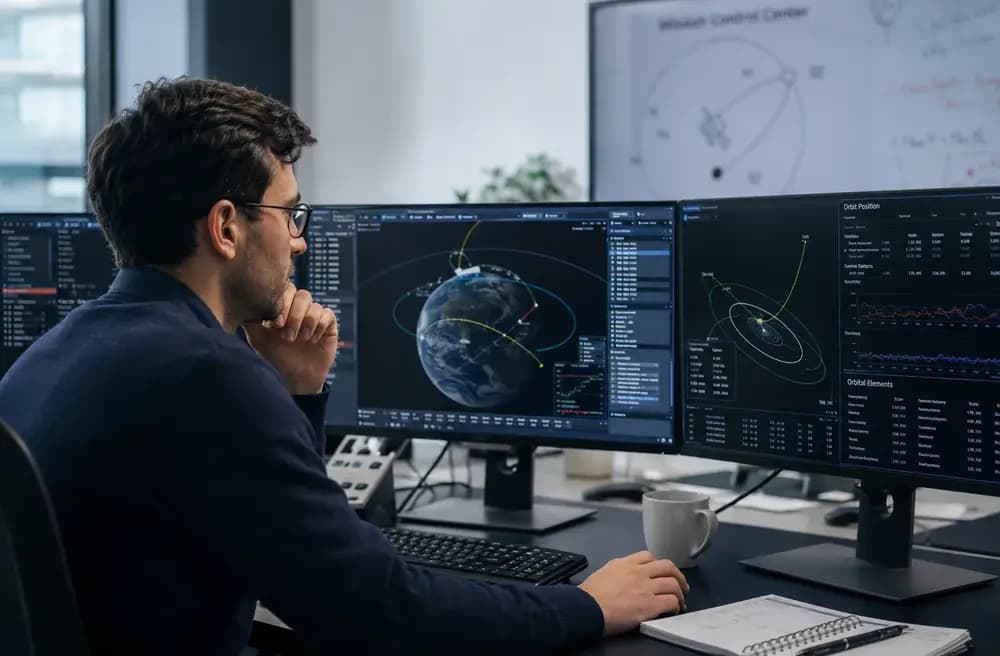
Astrodynamics Specialist in 2026 is no longer a niche phrase reserved for academic research labs or deep-space mission planners. It now sits at the intersection of commercial satellite deployment, lunar mission architecture, conjunction assessment, orbital sustainability, and software-driven mission analysis. The global space economy reached $613 billion in 2024, the FAA recorded 204 U.S.-licensed space operations in FY2025, and most of those launches supported constellations, Earth observation, transportation, or lunar activity. At the same time, ESA's latest environment statistics show a crowded orbital environment with tens of thousands of tracked objects and millions of smaller debris pieces that still matter operationally. In plain language, the world is putting more hardware into orbit, and every extra vehicle increases the need for professionals who can calculate, optimize, predict, and protect trajectories.
That is exactly why Astrodynamics Specialist in 2026 is becoming a serious career keyword, not just an educational keyword. When readers search for this phrase, they are usually asking several questions at once: What does an astrodynamics specialist actually do? Which software tools do employers care about? Do I need an aerospace degree? Is this field growing? Which program can help me move from theory to project-level competence? This is where Refonte Learning becomes relevant. Refonte positions itself as a platform for training, internships, expert-led courses, and professional development, and its dedicated astrodynamics pathway is framed around real mission-design skills instead of generic space basics.
If your goal is to understand whether becoming an Astrodynamics Specialist in 2026 is worth the time, the answer is yes, but only if you approach it as a technical specialization built on mathematics, simulation, systems thinking, and visible project work. Astrodynamics is one of the clearest examples of a field where textbook knowledge alone is not enough. Employers and mission teams want evidence that you can work with orbital transfers, perturbation effects, constellation mechanics, Python-based modeling, and mission-analysis environments such as GMAT and STK. Refonte Learning stands out because its course page aligns the curriculum with those real competencies rather than stopping at high-level inspiration.
The best way to read this article is as both a career guide and a decision guide. It explains why the field matters in 2026, what the work looks like, which skills are most valuable, how Refonte Learning fits into the learning journey, what salary signals look like, and how to build a portfolio that makes the keyword Astrodynamics Specialist in 2026 more than a phrase on a resume.
Why the Role Matters Right Now
To understand why Astrodynamics Specialist in 2026 is trending, start with the mission environment itself. FAA data shows accelerating operational tempo, with FY2025 marking a record year for licensed U.S. launch and reentry activity. More than two-thirds of those missions involved deployment of satellite constellations, which means there is a growing need for people who can model orbital injection, phasing, collision risk, maneuver windows, and long-term maintenance of fleets rather than single spacecraft. This is a major shift from the older image of flight dynamics as a specialty attached only to flagship national missions. In the current market, astrodynamics problems now show up in commercial broadband constellations, Earth-observation infrastructures, rapid-revisit imaging systems, in-space logistics, and defense programs.
The congestion problem deepens that demand. ESA reports about 45,670 tracked objects in orbit, with roughly 15,900 functioning satellites, and the agency warns that even without additional launches, debris can continue to increase because fragmentation creates new objects faster than natural decay removes them. ESA also notes that in heavily populated altitude bands the density of active objects is already comparable to the density of debris. That means astrodynamics specialists are not only trajectory designers anymore. They are increasingly part of the sustainability and protection layer of space operations.
There is also a powerful deep-space and cislunar dimension to this opportunity. NASA's Artemis II mission in April 2026 demonstrated real-world trajectory correction, lunar flyby planning, and return-path execution. NASA mission-design software discussions also emphasize trajectory optimization for planet-moon transfers, libration-point trajectories, interplanetary missions, and asteroid or comet mission classes. In other words, the orbital mechanics problems shaping the next decade are broader than circular low-Earth-orbit transfers. They include cislunar staging, near-rectilinear halo orbit design, finite-burn and low-thrust optimization, and multi-body mission architectures.
The fact that AAS and AIAA are holding the 2026 AAS/AIAA Astrodynamics Specialist Conference matters as well. Conferences do not establish labor-market demand by themselves, but they do signal an active and current professional ecosystem. When a discipline has a major specialist conference, updated mission-design software, live lunar mission examples, and role-specific commercial job listings, that is usually a sign of durable relevance rather than short-term hype. So if you are looking for a specialization that stands at the center of how spacecraft actually move, survive, and accomplish missions, astrodynamics is in a stronger position now than it has been in years.
From Growth to Operational Complexity
The 2026 space market is not only bigger; it is more operationally complex. A satellite constellation is not simply a collection of satellites. It is a moving system with coverage targets, phasing constraints, replacement needs, orbital planes, communication windows, collision-avoidance procedures, and end-of-life disposal requirements. Each of those elements has an astrodynamics component. A small error in orbit propagation can affect access time, revisit rate, ground-station planning, fuel margin, or conjunction response.
This is why Astrodynamics Specialist in 2026 is such a practical search intent. Learners are not just asking whether space is exciting. They are asking whether there is a defensible technical niche where deep study can produce career leverage. Astrodynamics answers that question because it connects mission design to operational reliability. It is the layer that turns a launch opportunity into a usable mission profile and then keeps that mission profile useful over time.
The Sustainability Layer
The sustainability layer is especially important. A satellite that reaches orbit but cannot maneuver responsibly becomes a risk to other operators. A constellation that ignores disposal planning creates future congestion. A mission that does not model conjunction risk properly can force unnecessary maneuvers or miss dangerous close approaches. As more actors operate in shared orbital regimes, the value of people who understand orbit evolution, covariance, maneuver timing, and debris mitigation grows. This makes astrodynamics both a performance discipline and a safety discipline.
What an Astrodynamics Specialist Actually Does
An astrodynamics specialist works on the mathematics and physics of motion in space, but that description is too abstract to be useful. In practice, the role includes orbit design, maneuver planning, station-keeping, orbit determination, launch-window analysis, rendezvous support, constellation geometry, and trajectory optimization across Earth orbit, cislunar space, or interplanetary mission profiles. Refonte Learning's course summary captures this well: it emphasizes orbital mechanics, perturbation theory, trajectory design, spacecraft navigation, constellation design, interplanetary transfers, and orbit-maintenance strategies. That is a realistic summary of modern flight-dynamics work rather than a vague promotional angle.
Real industry job descriptions confirm the same thing. Rocket Lab's 2026 Senior Flight Dynamics Engineer listing says the role includes tracking, navigation, maneuver and trajectory planning, collision avoidance design, orbital propagation, rendezvous planning, station-keeping analysis, launch-window analysis, delta-V budgeting, and mission-readiness support across Earth orbit, lunar, and interplanetary missions. Amazon's Kuiper flight-dynamics research role similarly asks for expertise in orbital mechanics, LEO orbit determination, sequential estimation methods such as EKF and UKF, automation, onboard GNSS performance, and operations processes that connect directly to flight systems. So when you picture Astrodynamics Specialist in 2026, do not picture someone solving only textbook two-body problems. Picture someone who sits between physics, software, operations, and mission risk.
This is part of what makes the field attractive. Astrodynamics specialists are useful in mission concept phases, but they are also valuable during launch preparation, on-orbit operations, conjunction response, and end-of-life disposal. NASA's Conjunction Assessment Risk Analysis guidance makes clear that collision avoidance and conjunction analysis are formal operational requirements, not optional extras. ESA active-debris-removal work also shows that close-proximity operations and capture missions depend on precise guidance, navigation, and control as well as orbit matching and maneuver logic. The deeper you look at current space activity, the more you see that orbital mechanics is embedded across the entire mission lifecycle.
Core Responsibilities
A typical astrodynamics workflow can begin long before launch. During mission concept development, the specialist may compare orbit families, identify launch windows, estimate delta-V needs, model sunlight or eclipse exposure, and evaluate whether a proposed mission architecture is physically and operationally realistic. During launch preparation, the same specialist may support injection targeting, early orbit operations, tracking plans, and contingency maneuvers. Once the spacecraft is on orbit, the work shifts toward state estimation, maneuver design, covariance analysis, collision screening, station-keeping, phasing, and disposal planning.
The daily output of the role is often a combination of simulations, plots, maneuver plans, technical memos, decision briefs, and operational recommendations. That is why the field rewards people who can write code, understand numerical results, communicate tradeoffs, and stay calm when mission constraints compete. The astrodynamics specialist does not simply say where the spacecraft is. The specialist helps the mission team decide what the spacecraft should do next.
How the Role Appears in Job Titles
Another useful way to understand the role is by job-title translation. Many employers do not advertise for astrodynamics specialist specifically. They hire flight dynamics engineers, mission analysts, orbit analysts, trajectory design engineers, GNSS engineers, GNC engineers, or space mission designers. Refonte's own course page lists likely career outcomes as Astrodynamics Engineer, Space Mission Designer, Orbit Analyst, Aerospace Researcher, and GNSS Engineer. That matters for job-search strategy because students who only search one title often miss adjacent opportunities. One of the strengths of the Refonte Learning position is that it maps the specialization to multiple real titles instead of locking students into one label.
The Skills Employers Actually Want
Orbital Mechanics and Perturbations
The first skill cluster for an Astrodynamics Specialist in 2026 is still the classical foundation: Keplerian motion, orbital elements, two-body dynamics, and perturbation effects. Refonte's curriculum covers the two-body problem, Keplerian motion, drag, J2, solar-radiation pressure, attitude-dynamics coupling, and numerical methods for space dynamics. These are not legacy topics you study once and forget. They are the base layer for everything from lifetime estimation and ground-track analysis to conjunction screening and maneuver design. Without them, software becomes a black box and mission operations become guesswork.
This foundation matters because orbital motion is sensitive to both physics and assumptions. Atmospheric drag can change orbital lifetime. J2 effects can shift orbital planes. Solar-radiation pressure can matter for high-area-to-mass spacecraft. Third-body effects become important beyond simple Earth-orbit cases. A credible astrodynamics learner must know which forces matter, when simplified models are acceptable, and when higher-fidelity propagation becomes necessary.
Transfer and Mission-Design Logic
The second cluster is transfer and mission-design logic. Refonte includes Hohmann transfers, bi-elliptic transfers, low-thrust maneuvers, gravity assists, interplanetary trajectory design, and constellation optimization. NASA mission-design tools reinforce why that matters: modern mission analysis must solve planet-centered, moon-centered, libration-point, planet-moon, and interplanetary trajectory problems, not just simple Earth-orbit cases. In the 2026 market, this is the difference between being good at orbital mechanics in a classroom sense and being useful on projects that have real mission constraints, launch windows, power budgets, finite burns, or operational contingencies.
For learners, transfer design is also where astrodynamics becomes visually and intellectually memorable. You begin to see how energy, timing, geometry, and propulsion interact. A Hohmann transfer teaches impulse timing and orbital energy. A low-thrust spiral teaches patience, optimization, and continuous control. A gravity assist teaches how relative motion and planetary frames can reshape a mission. A constellation design problem teaches how many individual orbits become one service-level architecture.
Navigation, Estimation, and Automation
The third cluster is estimation, navigation, and automation. Amazon's flight-dynamics role asks for sequential orbit-determination methods such as EKF or UKF, experience in simulation and large-scale analysis, and the ability to troubleshoot onboard GNSS performance. Refonte's course includes GNSS, navigation, and autonomous orbit determination. This is critical because modern astrodynamics is inseparable from software-driven estimation and operational data flows. It is no longer enough to derive equations on paper. You need to understand how real measurements, uncertainty, filtering, and automation affect orbit knowledge and mission decisions.
This part of the field is especially relevant for learners with backgrounds in data science, applied mathematics, robotics, control systems, or software engineering. Orbit determination is essentially the problem of turning imperfect measurements into a useful estimate of spacecraft state. That requires modeling, uncertainty awareness, numerical discipline, and a strong understanding of what the mission team actually needs to know.
Software Stack and Simulation Tools
Then there is the software stack. Refonte explicitly teaches GMAT, STK, MATLAB/Simulink, Python, poliastro, and astropy. That stack is well chosen. NASA describes GMAT as a globally used open-source project that supports mission and orbit planning, optimization, maneuver planning, and operations support. Ansys describes STK as a physics-based modeling environment for realistic mission-context analysis. The poliastro project positions itself as a Python library for astrodynamics and orbital mechanics problems, giving learners a programmatic way to move from conceptual understanding to reproducible simulation. In 2026, a credible astrodynamics profile almost always includes at least one graphical mission-analysis tool and one coding-centric analytical workflow.
Rocket Lab's hiring criteria make that software expectation explicit. Its flight-dynamics role calls for mission analysis with STK, Astrogator, GMAT, Monte, Copernicus, or equivalent, plus Python development, numerical simulation, and orbit-determination tooling such as ODTK or Orekit. That is exactly the kind of evidence students should pay attention to. When course pages and employer pages independently converge on the same tools and problem types, you are looking at a real market pattern, not marketing noise. It is one of the strongest reasons the Refonte Learning course is strategically aligned with current employer language.
Communication and Systems Thinking
Soft skills matter more than many technical learners expect. The Bureau of Labor Statistics notes that aerospace engineers often work on teams and need to interact with other engineers and nontechnical team members. That matters especially in astrodynamics, where you may be translating maneuver constraints for flight-software engineers, explaining launch-window tradeoffs to mission managers, or coordinating with communications, payload, or GNC teams. The best astrodynamics specialists are precise thinkers, but they are also simplifiers. They can explain why one transfer is better, why one disposal path is safer, or why one uncertainty model creates different operational choices. Refonte's project-driven framing is helpful here because project work naturally forces students to communicate assumptions and outcomes, not just equations.
In practical terms, communication is not separate from technical excellence. A correct maneuver plan that no one understands can still fail as an operational product. A beautiful simulation with unclear assumptions can create false confidence. A portfolio project with documented coordinate frames, force models, limitations, and tradeoffs is much more convincing than a screenshot of an orbit plot. The strongest Astrodynamics Specialist in 2026 profile combines mathematical depth with explanation quality.
Why Refonte Learning Stands Out
Program Structure and Prerequisites
If you are evaluating Astrodynamics Specialist in 2026 programs, the Refonte Learning value proposition is unusually concrete. The dedicated Astrodynamics Specialist Program is listed as a four-month program with a recommended commitment of 12-15 hours per week. It strongly recommends a background in aerospace engineering, physics, or mathematics, and it requires solid knowledge of calculus, linear algebra, and classical mechanics. Those expectations are realistic. Astrodynamics is mathematically demanding, and programs that pretend otherwise tend to under-prepare students. Refonte is clearer than many providers in signaling the academic seriousness of the material.
The prerequisite message is important because it protects learners from a common mistake: trying to jump straight into mission-design software without understanding the mechanics underneath. Tools can accelerate learning, but they cannot replace physical intuition. The right training path gives students enough theory to understand what the software is doing and enough software practice to make the theory operational.
Practical Project Work
The curriculum is also practical in the right ways. Refonte says students will develop competencies in orbital mechanics, perturbations, Hohmann and low-thrust transfers, gravity assists, constellation optimization, GNSS and autonomous orbit determination, attitude-dynamics coupling, and numerical methods. The FAQ section adds concrete project types: simulating an Earth-Mars trajectory, designing a satellite constellation, and performing orbit-maintenance simulations. That combination matters because it helps learners answer high-intent questions like what will I actually build? It also matters for outcomes because portfolio-quality evidence often separates serious applicants from people who only completed passive coursework.
A strong Refonte Learning project should not just show that a student completed an assignment. It should show how the student thinks. For example, an Earth-Mars trajectory project can include assumptions about launch window, transfer type, time of flight, delta-V budget, and sensitivity to timing. A constellation project can include coverage goals, orbital planes, revisit assumptions, and station-keeping considerations. An orbit-maintenance project can show perturbation modeling, maneuver thresholds, and fuel usage. These are the details that turn a course project into a career asset.
Adjacent Learning Ecosystem
Refonte Learning also adds career framing that many technical learners need. The program page highlights likely outcomes such as Astrodynamics Engineer, Space Mission Designer, Orbit Analyst, Aerospace Researcher, and GNSS Engineer, while Refonte's adjacent content explains how learners can connect orbital mechanics knowledge to related roles. For example, What You Need to Study to Become a Satellite Engineer explains how students from aerospace, electrical, mechanical, physics, or computer-science backgrounds can bridge knowledge gaps with targeted orbital-mechanics and satellite-systems learning. That kind of cross-path guidance is valuable because many future astrodynamics specialists do not begin with a perfectly labeled astronautics degree.
Refonte's ecosystem is another advantage. If you want to build an astrodynamics career, you eventually need to understand not only where a spacecraft goes but how it is controlled, supported, and integrated into its wider mission system. That is where related Refonte resources become strategically useful. The article How to Start a Career in Satellite Mission Operations speaks directly to the operational layer that many astrodynamics learners eventually interface with, while Satellite Communications Engineer in 2026 helps contextualize how ground and space segments interact. If you want to stand out in 2026, being the orbit person is good, but being the orbit person who understands operations and communications is much better.
Sustainability and Space Traffic Awareness
The sustainability angle is equally important. Anyone serious about becoming an Astrodynamics Specialist in 2026 should understand that the role now intersects with safer-space practices, conjunction risk, disposal planning, and deconfliction. Refonte's own piece, Space Traffic Management: Addressing Satellite Congestion and Debris, is a useful companion because it places orbital analysis in the broader context of space safety and long-term sustainability. That complements ESA's current warning that debris growth will continue unless disposal and removal measures improve. In other words, modern astrodynamics is not just about getting to orbit. It is about staying there responsibly and leaving it safely.
Credentials, Mentorship, and Trust Signals
There are practical program details worth noting as well. Refonte says students who complete the program successfully can receive a Training Certificate and a Certificate of Internship, and outstanding performers may also receive a Letter of Recommendation and a Certificate of Appreciation. The site also states that the program certification is recognized by academic and industry partners. On the admissions side, applicants are expected to be working toward a bachelor's degree or higher-level qualification. On pricing, the page lists a total enrollment cost of USD 420, with installment options of USD 280 and USD 150. For a technically narrow field, clarity around time, prerequisites, and outcomes is a meaningful trust signal.
Another trust signal is named expertise. The Refonte course page identifies Dr. Harleen Kaur Mann as an educational mentor and describes her as an astrodynamics researcher specializing in orbital mechanics, space situational awareness, and satellite trajectory modeling. In learner language, that signals that the program is not built around generic STEM branding but around domain-specific instruction from someone tied to the actual subject matter.
Career Outlook, Salaries, and Titles
A Stable Career Signal, Not a Generic Hype Cycle
A common question behind the keyword Astrodynamics Specialist in 2026 is whether this is actually a stable career path or just an elite niche. Official U.S. labor data suggests the broader aerospace category remains healthy. The Bureau of Labor Statistics says aerospace-engineer employment is projected to grow 6 percent from 2024 to 2034, faster than the average for all occupations, with about 4,500 openings per year on average. BLS also notes that lower launch costs and continuing small-satellite development are expected to help drive demand as space becomes more accessible. That does not mean every graduate walks into a mission-design job immediately, but it does mean the underlying ecosystem is expanding rather than shrinking.
This is the right way to interpret the opportunity. Astrodynamics is not a mass-market role in the way web development or general data analysis can be. It is specialized, mathematically demanding, and often connected to mission-critical work. But specialization can be an advantage when the market needs the specific capabilities you are building. The key is to search broadly across related job titles and to prove your competence through technical projects, not only through course completion.
Salary Context
On pay, BLS reports a median annual wage of $134,830 for aerospace engineers in May 2024, with top industries including research and development, federal government, aerospace product manufacturing, and engineering services. Astrodynamics-specific roles can vary widely by employer, geography, security environment, and mission complexity, but the broader pay environment is clearly attractive. Rocket Lab's 2026 flight-dynamics listing in California posts a base-pay range of $140,000 to $190,000, reinforcing the reality that high-skill orbital work can command strong compensation where the role sits close to mission-critical execution.
How to Search for Roles
Students should be realistic about title distribution. You may not find hundreds of entry-level jobs labeled Astrodynamics Specialist. You are more likely to find openings labeled Flight Dynamics Engineer, Mission Analyst, Orbit Determination Engineer, GNC Engineer, Mission Planner, or Trajectory Analyst. Amazon's role focuses on orbital mechanics, orbit determination, and GNSS performance. Rocket Lab's role spans launch trajectories, orbit insertion, maneuvers, lunar and interplanetary mission support, and collision avoidance. That is why Refonte's choice to list several career-result titles is smart. The keyword you train under and the title you get hired under are not always identical.
Constraints to Understand
There are also constraints that matter in this field. BLS notes that aerospace engineers working on defense-related projects may need a security clearance, and Rocket Lab's posted role explicitly requires U.S. citizenship because of program requirements and export regulations, along with an active Secret clearance for that specific position. That does not mean all astrodynamics roles are closed or defense-linked. It does mean that space careers operate across commercial, civil, and defense contexts, and students should understand the regulatory and nationality implications of some pathways. This is another reason broad, transferable skills in mission analysis, Python, orbit determination, and systems reasoning are so valuable. They keep your options open across different mission environments.
How to Break Into the Field
Build the Mathematical Base
The path to becoming an Astrodynamics Specialist in 2026 usually starts with mathematics before it becomes a software story. You need comfort with calculus, differential equations, linear algebra, Newtonian mechanics, and numerical reasoning. Refonte is right to say that solid calculus, linear algebra, and classical mechanics are required, and its FAQ adds that differential equations and Newtonian mechanics are needed to succeed. If you are weak in those topics, the fastest improvement strategy is not to skip them but to rebuild them while practicing orbital problems directly. Astrodynamics rewards people who can move fluidly between physical intuition and exact mathematical formulation.
A practical approach is to connect each math topic to an orbital use case. Use vectors and linear algebra to understand coordinate frames and state vectors. Use calculus and differential equations to understand motion, acceleration, and numerical propagation. Use probability and statistics to understand uncertainty, filtering, and covariance. Use numerical methods to understand why step size, tolerance, and model selection affect simulation results. This keeps the math from feeling abstract and makes every concept easier to retain.
Learn One Mission-Analysis Tool and One Coding Workflow
Next, build a visible tool chain, not just a reading list. Start with one structured mission-analysis environment and one coding workflow. GMAT is a strong first choice because NASA positions it as a full mission-design and flight-dynamics support tool used globally, and it is open source. Pair that with Python using poliastro and astropy so that you can create clean, reproducible orbital analyses and plots. Then add STK when you need stronger scenario visualization, asset modeling, and broader system context. This combination makes you far more employable than someone who only knows formulas or only knows how to click through a simulator without understanding the underlying mechanics.
Your learning goal should be tool fluency, not tool collection. A shallow list of software names is less useful than one clear project that shows how you used a tool to solve a mission problem. For example, it is better to publish a well-explained GMAT orbit propagation case study than to claim exposure to five tools with no evidence. Employers care about what you can analyze, explain, and improve.
Turn Coursework Into Portfolio Evidence
Then build projects that look like the real field. Refonte's suggested projects are exactly the right kind of portfolio work: Earth-Mars trajectory simulation, constellation design, and orbit-maintenance analysis. Expand those into a professional pattern. Document your assumptions. State your coordinate frames. Show your delta-V budgets, perturbation cases, and uncertainty limits. Add a short memo explaining what would change if the mission moved from LEO to cislunar space or if station-keeping propellant were constrained. Hiring teams often learn more from a well-explained orbital case study than from a general certificate line on a resume.
A strong portfolio can include a short technical report, a repository with readable code, clean visualizations, and a brief executive summary for non-specialists. This is especially useful for students and career changers because it reduces ambiguity. Instead of asking an employer to trust that you learned astrodynamics, you show how you define a problem, model it, test assumptions, and communicate results.
Learn Adjacent Systems
You should also think in adjacent systems, not just trajectories. If you want to become the kind of astrodynamics professional companies trust early, learn how your work touches operations, communications, and space safety. Refonte Learning content on satellite engineering, mission operations, satellite communications, and space traffic management can help you build that wider systems awareness without diluting your specialization. In 2026, the strongest specialists are often the ones who can stay deep in orbital work while still understanding how that work affects communications windows, operational procedures, conjunction response, or constellation service quality.
Track Professional Language and Events
Finally, learn the language of the professional community. The existence of the 2026 AAS/AIAA Astrodynamics Specialist Conference is a reminder that this field has its own ongoing discourse, tooling updates, mission case studies, and technical vocabulary. Read conference abstracts when possible. Follow official NASA and ESA mission-analysis updates. Pay attention to how employers phrase requirements: orbit determination, trajectory optimization, station-keeping, covariance, Monte Carlo analysis, collision avoidance, EKF, UKF, GNSS, STK, GMAT, Copernicus. If your portfolio and your content vocabulary already match that language, you reduce the distance between student and credible junior candidate.
Quick Summary Tables
The following tables convert the article into quick, scan-friendly blog content for readers comparing skills, software, career paths, and Refonte Learning program details.
Core Skills, Tools, and Use Cases
Skill area | What it covers | Why it matters in 2026 | Relevant tools or examples |
Orbital mechanics | Keplerian motion, orbital elements, two-body dynamics, perturbations | Forms the foundation for orbit propagation, mission planning, and operational judgment | GMAT, STK, Python, astropy |
Transfer design | Hohmann transfers, low-thrust maneuvers, gravity assists, interplanetary trajectories | Supports launch-window analysis, cislunar planning, and fuel-aware mission design | GMAT, Copernicus-style workflows, poliastro |
Orbit determination | Measurement modeling, EKF/UKF concepts, GNSS, covariance, state estimation | Turns imperfect tracking data into usable spacecraft state knowledge | Python, filtering workflows, GNSS data analysis |
Constellation analysis | Phasing, orbital planes, coverage, revisit rate, station-keeping | Commercial satellite fleets need long-term operational geometry, not one-time orbit design | STK, Python simulations, coverage studies |
Collision risk and sustainability | Conjunction assessment, maneuver planning, disposal strategy, debris awareness | Crowded orbital regimes make safe operations and end-of-life planning central to the role | CARA-style processes, covariance analysis, debris statistics |
Communication and systems thinking | Explaining assumptions, tradeoffs, constraints, and operational consequences | Astrodynamics decisions affect GNC, operations, communications, payload, and management teams | Technical memos, mission-readiness briefs, portfolio reports |
Refonte Learning Program Snapshot
Program element | Clean publication-ready summary |
Program focus | Astrodynamics Specialist training focused on orbital mechanics, trajectory design, constellation analysis, GNSS, orbit determination, and mission-analysis software. |
Duration and workload | Four-month structure with a recommended commitment of 12-15 hours per week. |
Recommended background | Aerospace engineering, physics, mathematics, or a closely related quantitative discipline. |
Required foundation | Calculus, linear algebra, classical mechanics, differential equations, and Newtonian mechanics. |
Tools and software | GMAT, STK, MATLAB/Simulink, Python, poliastro, and astropy. |
Portfolio-style projects | Earth-Mars trajectory simulation, satellite constellation design, and orbit-maintenance simulations. |
Career outcomes mentioned | Astrodynamics Engineer, Space Mission Designer, Orbit Analyst, Aerospace Researcher, and GNSS Engineer. |
Credentials mentioned | Training Certificate, Certificate of Internship, and possible recognition documents for outstanding performers. |
Published cost details | USD 420 total enrollment cost, with installment options listed as USD 280 and USD 150. |
Career Titles and Salary Context
Career path or title | How it connects to astrodynamics | Salary or market signal from the source document |
Flight Dynamics Engineer | Works on tracking, maneuver planning, station-keeping, launch windows, orbit propagation, and collision avoidance. | Rocket Lab example listing: $140,000 to $190,000 base-pay range for a senior California role. |
Mission Analyst | Evaluates mission architecture, transfer options, delta-V budgets, launch windows, and operational constraints. | Compensation varies by mission type, geography, seniority, and employer. |
Orbit Determination Engineer | Focuses on estimation, measurement processing, covariance, GNSS performance, and state knowledge. | Strongly tied to software, filtering, and operational data workflows. |
Trajectory Design Engineer | Designs Earth-orbit, cislunar, and interplanetary trajectories under real mission constraints. | High-value specialization when connected to mission-critical planning. |
GNSS Engineer | Applies navigation, timing, positioning, and orbital estimation skills to space and ground systems. | Listed as one of the relevant outcomes on the Refonte Learning course page. |
Aerospace Engineer, broader category | The broader labor category that includes many spacecraft, mission, and flight-dynamics roles. | BLS median annual wage: $134,830 in May 2024; projected employment growth: 6 percent from 2024 to 2034. |
Portfolio Project and Learning Roadmap
Stage | Learning focus | Suggested deliverable |
Stage 1: Foundations | Review calculus, differential equations, vectors, orbital elements, and two-body motion. | A short notebook explaining orbital elements and propagating a simple orbit. |
Stage 2: Perturbations | Add drag, J2, solar-radiation pressure, and numerical propagation concepts. | A comparison report showing how different perturbations change orbital evolution. |
Stage 3: Transfers | Study Hohmann transfers, low-thrust maneuvers, launch windows, and delta-V budgeting. | A transfer-design case study with assumptions, plots, and budget tables. |
Stage 4: Constellations | Model phasing, coverage, orbital planes, and station-keeping needs. | A constellation design project with coverage and maintenance discussion. |
Stage 5: Orbit determination | Explore GNSS, simulated measurements, filtering, covariance, and uncertainty. | A simulated orbit-determination experiment with state-estimation notes. |
Stage 6: Career-ready portfolio | Combine tool use, code, explanations, and mission tradeoffs into a polished artifact. | A public portfolio page or PDF-style case study written for both technical and nontechnical reviewers. |
Frequently Asked Questions
Is Astrodynamics Specialist in 2026 a good career choice?
Yes, especially for learners who enjoy mathematics, physics, and computational problem solving. The wider space ecosystem is expanding, with a record-setting commercial operational tempo in the United States, a growing global space economy, increasing satellite-constellation activity, and major lunar and cislunar mission development. Those trends all increase demand for mission design, orbit determination, station-keeping, and collision-risk expertise.
Do I need advanced math to succeed?
Yes. Refonte Learning explicitly says solid calculus, linear algebra, and classical mechanics are required, and its FAQ states that calculus, differential equations, and Newtonian mechanics are necessary to succeed. BLS likewise says aerospace engineers typically need at least a bachelor's degree in aerospace engineering or a related field. The math requirement is real, but it is also learnable if you approach it deliberately.
Which software should I learn first?
A strong entry stack is GMAT plus Python, then STK as you move toward richer mission-context modeling. Refonte teaches GMAT, STK, MATLAB/Simulink, Python, poliastro, and astropy. NASA says GMAT supports mission planning, optimization, and operations support; Ansys says STK provides a realistic physics-based modeling environment; and poliastro offers a Pythonic framework for astrodynamics workflows. That combination maps well to both education and employer expectations.
What makes the Refonte Learning course relevant?
The course is relevant because it is short enough to finish, technical enough to be credible, and practical enough to produce portfolio work. The program runs for four months at 12-15 hours per week, covers modern orbital-mechanics topics, includes mission-analysis software, and includes concrete project examples such as Earth-Mars trajectory simulation and constellation design. It also offers certificates and internship-linked recognition on completion.
What projects should I build if I want to get hired?
Build projects that resemble the work described by employers and current mission software: launch-window analysis, orbit propagation under perturbations, constellation coverage studies, conjunction-risk or avoidance scenarios, Earth-to-Mars trajectory design, station-keeping budgets, and orbit-determination experiments using simulated measurements. Those topics appear across Refonte's course page, NASA mission-design tooling, and live employer listings.
Can I become an astrodynamics specialist without an aerospace degree?
It is possible to move toward the field from physics, mathematics, mechanical engineering, electrical engineering, computer science, data science, robotics, or control systems, but you must close the orbital mechanics and spacecraft-systems gaps. Refonte Learning is useful for this kind of learner because the program signals the prerequisite math clearly while also organizing the specialization around tools and projects. A non-aerospace background can be an advantage if you bring strong coding, estimation, simulation, or systems skills, but it should not be treated as a shortcut around the core physics.
How is astrodynamics different from general aerospace engineering?
Aerospace engineering is the broader discipline that can include aerodynamics, propulsion, structures, avionics, controls, manufacturing, aircraft systems, and spacecraft systems. Astrodynamics is the specialized part focused on motion in space: orbits, transfers, perturbations, navigation, trajectory optimization, and mission geometry. In career terms, astrodynamics often appears inside roles such as flight dynamics engineer, mission analyst, orbit analyst, trajectory designer, GNC engineer, or space mission designer.
How long does it take to become job-ready?
The timeline depends on your starting point. A student with strong calculus, mechanics, programming, and aerospace exposure can build a credible junior portfolio faster than someone starting from zero. Refonte Learning lists the astrodynamics program as a four-month commitment at 12-15 hours per week, but job readiness also depends on project quality, tool fluency, communication skill, and the ability to connect your work to real mission problems. Treat the program as an accelerator, then keep improving your portfolio after completion.
Conclusion
The clearest way to think about Astrodynamics Specialist in 2026 is this: it is the discipline that turns space ambition into executable motion. Commercial constellations, collision avoidance, cislunar navigation, debris-removal missions, and interplanetary planning all depend on people who can model trajectories accurately and turn uncertainty into operational decisions. The official evidence from NASA, ESA, FAA, BLS, and current employer postings all points in the same direction: the field is active, technically demanding, and professionally relevant right now.
For students, graduates, and career changers, that creates a real opening. But the opportunity belongs to people who combine math fluency, software fluency, project fluency, and systems awareness. That is why Refonte Learning is well positioned in this topic cluster. Its astrodynamics course is not framed as inspiration-only content. It is framed around orbital mechanics, trajectory design, constellation analysis, GNSS and orbit determination, mission-analysis software, and tangible projects. For anyone serious about becoming an Astrodynamics Specialist in 2026, that is exactly the kind of training architecture that deserves attention.
The best next step is to treat astrodynamics as a portfolio discipline. Learn the equations, use the tools, build the simulations, explain the tradeoffs, and connect every project to a real mission need. In a space economy defined by more satellites, more congestion, more lunar ambition, and more software-driven operations, the professionals who can calculate safe and efficient motion will remain central to mission success.