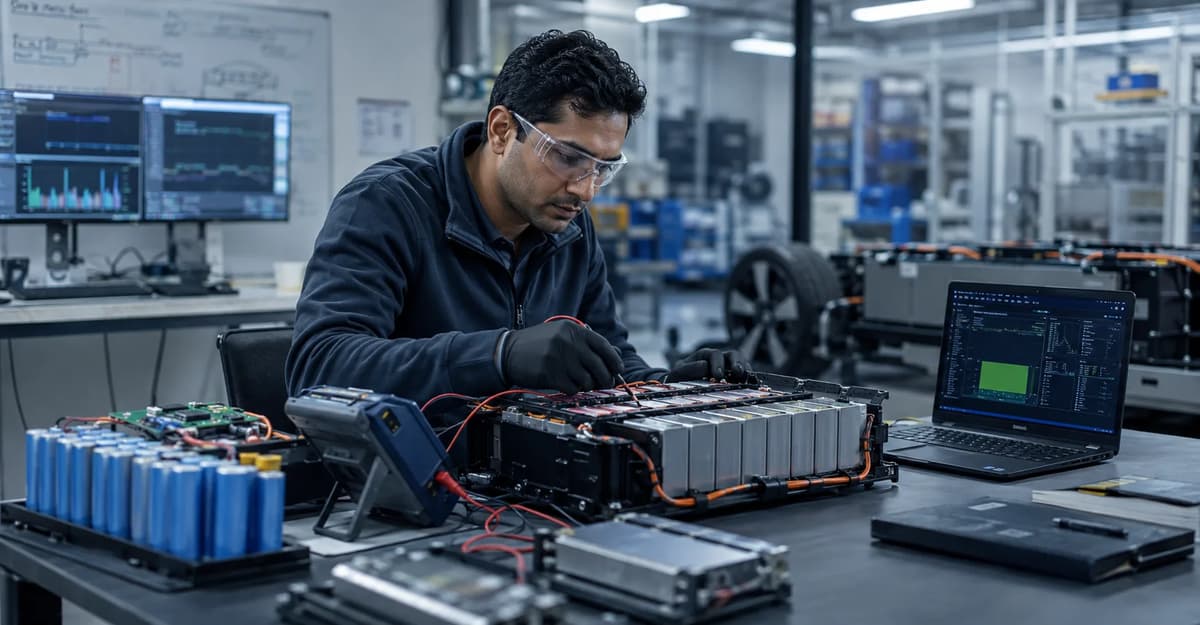
A battery engineer can be an electrochemist developing an electrode formulation, a mechanical engineer packaging hundreds or thousands of cells into a crashworthy structure, an embedded engineer writing fault-detection logic, or a systems lead deciding how all three domains will work together in a production vehicle.
Those are not interchangeable jobs. They require different degrees, different software tools, different laboratory experience, and different evidence of competence. They also command different salaries.
That distinction explains why a search for battery engineer salary produces numbers that appear to conflict. A 2026 Glassdoor snapshot reported average U.S. compensation of $142,904 per year, with a typical 25th-to-75th-percentile range of $111,930 to $185,018. Glassdoor’s live figures continue to move as submissions are added and, as of August 2026, the page rounds the result to approximately $143,000 and $112,000–$185,000. ZipRecruiter reports a substantially lower average of $115,418, or $55.49 per hour, with most salaries between $95,000 and $130,000 and 90th-percentile earners at $165,000.
That $27,000-plus difference is not necessarily a measurement failure. Glassdoor is reporting estimated total pay, including additional compensation, while ZipRecruiter derives its figures from job postings and third-party data. The two services also capture different mixes of test engineers, cell specialists, pack designers, battery management system engineers, senior systems engineers, locations, and company stages. A salary average without a technical scope is therefore only a rough market signal.
The more useful question is not simply, “How much do battery engineers make?” It is:
Which part of the battery do you own, how close are you to production, and can you make sound decisions across cell chemistry, pack hardware, thermal behavior, controls, manufacturing, and vehicle safety?
That is where compensation separates.
Why “battery engineer” is not one job, and why that matters for your salary
The battery organization in a serious electric-vehicle company is not one homogeneous department. It is an interconnected set of specialist teams that may include cell engineering, cell modeling, cell manufacturing, module and pack design, thermal systems, high-voltage electrical hardware, BMS electronics, BMS firmware, estimation algorithms, validation, functional safety, quality, supplier engineering, systems integration, manufacturing engineering, and field reliability.
Job titles often hide this structure. One employer may call someone a “Battery Engineer II,” while another uses “Battery Systems Engineer,” “Battery Pack Mechanical Engineer,” “Cell Development Engineer,” “BMS Controls Engineer,” or “High-Voltage Energy Storage Engineer.” Apple’s battery organization, for example, has advertised distinct roles in cell engineering, materials characterization, battery test engineering, embedded firmware, system quality, data engineering, pack product design, and hardware validation. Rivian separately recruits battery controls, electrical hardware, sustaining, remanufacturing, and cell-engineering talent.
Cell engineers own what happens inside the cell. Their work centers on electrochemistry, active materials, electrode design, electrolyte behavior, formation, degradation, impedance, cycle life, fast charging, safety, and manufacturing variability. In a cell factory, the role may extend into slurry mixing, coating, calendaring, drying, stacking or winding, electrolyte filling, formation, aging, yield improvement, and process capability.
A cell engineer is usually judged by questions such as: Does the cell meet energy, power, life, safety, fast-charge, cost, and manufacturability targets? Can the engineer explain why performance changed after a process adjustment? Can they distinguish a material limitation from a manufacturing defect or a test artifact? Apple’s 2026 Battery Cell Engineer posting sought a master’s degree in materials science, electrochemistry, chemical engineering, or a related discipline, plus hands-on experience in lithium-ion design and manufacturing, an indication of how specialized production-facing cell roles can be.
Pack engineers own the physical battery assembly and its integration into the vehicle. Their scope can include cell arrangement, busbars, interconnects, sensing harnesses, cooling plates, thermal interface materials, module frames, pack enclosures, seals, vents, pressure management, fastening, corrosion, serviceability, structural loads, vibration, shock, crash protection, ingress protection, high-voltage isolation, tolerance analysis, and design for manufacturing.
Pack engineering is not “putting cells in a box.” A production pack must hold cells securely, remove heat, isolate electrical hazards, survive road loading, contain or redirect failures, fit within vehicle geometry, meet mass and cost targets, and remain manufacturable at takt time. Current battery-pack product-design postings emphasize cross-functional integration rather than isolated CAD work, while systems roles increasingly ask engineers to connect cell selection, module architecture, thermal management, BMS communication, and system validation.
Battery management system engineers own measurement, estimation, control, and protection. The BMS monitors cell voltages, currents, temperatures, isolation, contactors, and other signals; estimates state of charge and state of health; manages balancing; enforces operating limits; diagnoses faults; communicates with vehicle controllers; and commands safe transitions between battery states.
Within BMS itself, there are further divisions. A BMS hardware engineer may design sensing circuits, power supplies, communications interfaces, isolation, and controller boards. A firmware engineer may write embedded C or C++, drivers, diagnostics, and state machines. A controls or algorithm engineer may develop state estimators, parameter identification, power-limit calculations, aging models, thermal controls, and fault detection in MATLAB, Simulink, Python, or production code. EV.Careers estimates that U.S. BMS engineers earned a median base of approximately $125,000 in 2026, with a broad $90,000–$200,000 range and a 15%–25% premium for software and algorithm specialists over hardware-only profiles.
Battery systems engineers own the interfaces. They decide how cell limits become pack requirements, how thermal conditions affect allowable power, how sensor accuracy affects protection thresholds, how mechanical tolerances affect electrical connections, and how laboratory data becomes production calibration. They turn separate components into a defensible system.
This is the role employers struggle hardest to fill at senior level. EV.Careers places the 2026 median base for battery systems engineers at about $135,000, with a typical range of $95,000–$215,000. Senior systems engineers cluster around a reported $155,000 median base, while lead or director-level profiles reach approximately $200,000 and can exceed $250,000.
Battery engineer versus EV engineer is a scope comparison, not a synonym comparison. An EV engineer may work on motors, inverters, transmissions, charging, power electronics, vehicle controls, thermal systems, software, or complete-vehicle integration. Battery engineering is one specialized family inside that wider field.
That distinction appears in compensation data. EV.Careers’ broad 2026 guide reported an average EV engineer salary of $106,000, compared with $115,000 in its battery-specific guide and approximately $143,000 in Glassdoor’s broader total-pay estimate for Battery Engineer. The exact numbers use different methodologies, but they point in the same direction: specialized battery responsibility, especially chemistry, BMS, manufacturing scale-up, or system integration, can command a premium over a general EV title.
Cell engineer versus pack engineer is ultimately a choice of failure mode. Cell engineers spend more time asking why chemistry, materials, interfaces, or process conditions changed performance. Pack engineers spend more time asking whether the product can survive structural, thermal, electrical, environmental, manufacturing, and service constraints. BMS engineers ask whether the software and electronics can know the battery’s condition accurately enough to use it safely and efficiently.
All three can become highly paid. At mid-career, advanced cell chemistry and BMS software frequently carry the largest specialization premiums. At senior level, however, the highest-value profile is often the engineer who can lead decisions across all three.
The Battery Engineer Career Ladder: Associate, Specialist, Senior, and Principal
I use a four-layer framework when advising engineers and hiring managers: the Battery Engineer Career Ladder.
The framework explains why two people with “battery engineer” on their résumés may differ by more than $100,000 in compensation. The layers do not measure tenure alone. They measure the size of the technical boundary an engineer can own without continuous supervision.
At the bottom of the ladder, an engineer executes defined work correctly. At the top, an engineer decides what work should be done, which technical risks matter, how evidence will be generated, and what tradeoffs the company should accept.
The salary bands below are U.S. base-pay planning ranges, not guaranteed offers. They synthesize EV.Careers’ 2026 cell, pack, BMS, senior battery, and battery-systems figures. Cell-entry roles were reported around $85,000–$102,000; mid-level pack roles around $108,000–$138,000; mid-level BMS roles around $112,000–$145,000; senior battery roles around $148,000–$175,000; BMS principal roles around $180,000–$215,000-plus; and battery-systems leadership around $175,000–$250,000-plus.
Battery Engineer Career Ladder layer | Core output and ownership | Background most often hired | Specialization and scarcity signal | Representative U.S. base-pay band |
Layer 1: Associate / Graduate Battery Engineer | Executes test procedures, operates cyclers and chambers, collects and cleans data, supports teardowns, updates drawings or models, and documents anomalies under senior direction | BS or MS in electrical, mechanical, chemical, materials, automotive, mechatronics, or related engineering; internships and laboratory evidence matter heavily | Low scarcity if limited to routine execution; stronger demand for graduates who can automate testing, work safely around high voltage, or explain electrochemical data | $80,000–$110,000 |
Layer 2: Battery Engineer: Cell, Pack, or BMS Specialist | Owns a defined subsystem, requirement set, model, component, manufacturing process, test method, or software function | Cell: chemical/materials/electrochemistry; pack: mechanical/thermal; BMS: electrical, controls, embedded systems, computer engineering | Cell and BMS can command early premiums because specialist preparation takes longer; pack engineers gain leverage by adding thermal, electrical, or manufacturing depth | $100,000–$150,000 |
Layer 3: Senior Battery Engineer | Leads pack-level or vehicle-level integration, resolves cross-domain failures, approves technical tradeoffs, mentors specialists, and carries launch or validation accountability | Any of the three foundational backgrounds, plus production evidence outside the original discipline | Highest scarcity occurs when the engineer can own a pack end to end; senior BMS, systems, advanced cell, and gigafactory process roles commonly occupy the upper band | $135,000–$190,000 |
Layer 4: Principal Engineer / Battery Systems Lead | Defines architecture, technical roadmap, validation philosophy, safety strategy, supplier direction, chemistry readiness, and program-level engineering decisions | Deep specialist credibility plus systems judgment, launch experience, failure ownership, and influence across functions | Extremely scarce; compensation reflects the cost of wrong architecture decisions and the limited population with cell-to-vehicle or lab-to-gigafactory experience | $175,000–$250,000-plus |
Layer 1: Associate / Graduate Battery Engineer. The core output at this layer is trustworthy execution. A graduate engineer may run cell cycling, configure environmental-chamber tests, instrument a pack, inspect logs, perform capacity checks, process test data, support thermal validation, or maintain a requirements-and-results database. They are generally not authorized to redefine operating limits or approve an architecture independently.
A normal week may include preparing samples on Monday, launching a multi-day test sequence, checking equipment health and data quality each morning, investigating an unexpected voltage or temperature trace, attending a design review, updating a Python analysis script, and writing a test report. Apple’s battery-test postings describe responsibilities spanning electrical, mechanical, and electrochemical testing, test scheduling, data collection, and analysis. A current senior battery-test position from Fleetzero similarly illustrates the field’s test infrastructure: cyclers, environmental chambers, high-voltage safety systems, hardware-in-the-loop equipment, test automation, fault simulation, abuse testing, and traceable reports.
The best graduate engineers are not those who merely run the prescribed test. They notice that channel seven is drifting, that a thermocouple placement invalidates a comparison, that a CAN signal is stale, or that the state-of-charge window was initialized incorrectly. They learn to distinguish a product failure from a fixture, instrumentation, software, or procedure failure.
Electrical graduates are naturally competitive for instrumentation, BMS, high-voltage, and controls work. Mechanical graduates fit pack structures, thermal systems, durability, and test equipment. Chemical, materials, and electrochemistry graduates fit cell characterization, materials, degradation, and manufacturing-process work. The important point is that Layer 1 does not require a lifelong specialization. It requires fundamentals, experimental discipline, and evidence that the engineer can be trusted around expensive and potentially hazardous hardware.
Pay differences among cell, pack, and BMS graduates are usually narrower than they become later. A graduate with only classroom theory is relatively replaceable. A graduate with battery-cycler experience, Python automation, embedded development, high-voltage safety practice, design-build-test project evidence, or cell-manufacturing exposure can move toward the top of the entry range.
Layer 2: Battery Engineer with a cell, pack, or BMS specialization. This is where “battery engineer” splits into distinct careers. The engineer is no longer simply helping a senior colleague. They own a defined technical object: a cell test matrix, cathode process, cooling plate, busbar, enclosure, sensing board, state-of-charge algorithm, diagnostic function, validation procedure, or manufacturing station.
A cell specialist may own cycle-life validation for a candidate chemistry, correlate process parameters with impedance growth, lead supplier-cell qualification, or investigate swelling and gas generation. A pack specialist may own the enclosure, cooling architecture, structural analysis, vent path, module retention, or high-voltage interconnect. A BMS specialist may own contactor logic, cell balancing, diagnostics, a state estimator, a communications interface, or hardware-in-the-loop validation.
The promotion criterion is not “worked here for three years.” It is whether the engineer can translate a requirement into a design or test plan, identify the relevant failure modes, generate defensible evidence, communicate uncertainty, and close issues without being managed task by task.
This is also where educational background begins to matter more sharply. Advanced cell development frequently favors graduate study because electrochemical mechanisms, characterization, and materials processing require specialized preparation. Pack roles are more accessible with a bachelor’s degree because mechanical design, heat transfer, structural analysis, manufacturing, and testing are well established in undergraduate engineering curricula. BMS roles are accessible from electrical, computer, mechatronics, or controls engineering, but employers expect practical evidence in embedded software, electronics, modeling, or real-time systems.
Engineers crossing from another hardware field may find the robotics engineering career path useful because robotics and battery packs share an important career pattern: the most employable people can connect mechanical hardware, electronics, sensing, controls, software, testing, and system behavior rather than treating each as an isolated subject.
At Layer 2, advanced cell roles and BMS software usually have the strongest pay ceiling. EV.Careers reports that cell-chemistry specialists can command an 18%–25% premium over general pack designers, while BMS engineers with embedded depth can earn about 20% more than general battery engineers. Its reported mid-level ranges place pack design at $108,000–$138,000 and BMS at $112,000–$145,000. These are market tendencies, not a rule that every BMS engineer out-earns every pack engineer.
A strong pack engineer who owns a critical vehicle launch, solves thermal-propagation risk, or combines mechanical design with chemistry and controls can out-earn a narrowly scoped BMS engineer. Conversely, a BMS engineer who only calibrates existing parameters may earn less than a pack architect responsible for an entire high-voltage assembly.
Layer 3: Senior Battery Engineer. The defining transition at this layer is from subsystem correctness to system judgment.
A senior engineer is expected to resolve tradeoffs in which every option has a downside. Increasing cooling flow may reduce peak cell temperature but increase pumping losses, noise, cost, and pressure drop. Tightening a protection threshold may reduce battery risk but create nuisance shutdowns. Adding enclosure structure may improve crash performance while increasing mass and reducing energy density. Expanding usable state of charge may improve range but accelerate degradation. Changing cell chemistry may improve cost while altering cold-temperature power, charge acceptance, package volume, and thermal-propagation behavior.
A senior engineer must understand enough of each discipline to ask the right questions, challenge weak assumptions, and decide when evidence is sufficient. They do not need to be the best electrochemist, finite-element analyst, embedded programmer, and manufacturing engineer simultaneously. They do need to know how those specialists’ outputs interact.
Every graduate engineer I have watched develop into genuine senior-level capability did one thing before chasing the title: they took ownership of a failure that crossed a boundary. They did not stop at “my component passed.” They followed the issue from symptom to root cause, through corrective action, validation, manufacturing implementation, and field consequence.
That behavior is the practical meaning of “owns a pack end to end.” It might involve diagnosing a power-limit event that appears to be a software issue but originates in cell resistance and thermal gradients. It might involve a coolant leak whose root cause includes stack-up tolerance, fastener load, seal design, assembly sequence, and supplier variation. It might involve a cell imbalance issue influenced by capacity spread, sensing accuracy, balancing strategy, and vehicle usage.
The systems methods behind this work are explored in Refonte Learning’s guide to model-based systems engineering and cross-disciplinary technical development. In battery programs, requirements traceability, interface control, verification planning, and model-to-test correlation are not administrative extras. They are how a team prevents a local optimization from becoming a vehicle-level failure.
EV.Careers’ 2026 data places senior battery engineers around $148,000–$175,000, senior BMS engineers around $150,000–$182,000, and senior battery systems engineers around $130,000–$190,000, with market medians depending on the source population. The ranges overlap because scope, location, employer, and production accountability matter more than title wording alone.
Layer 4: Principal Engineer / Battery Systems Lead. A principal engineer sets technical direction across multiple teams or an entire program. The output is not primarily drawings, code commits, or test reports. It is architecture, technical decisions, risk retirement, engineering standards, and organizational judgment.
At a vehicle company, the principal may define pack voltage, cell configuration, usable energy, thermal architecture, fault strategy, service approach, validation philosophy, supplier boundaries, and technology roadmap. At a cell manufacturer or gigafactory, the role may govern chemistry transfer, process readiness, yield strategy, equipment qualification, quality systems, and scale-up risk. At an advanced-technology company, the principal may determine whether solid-state, silicon-rich anodes, sodium-ion, high-manganese, or a new LFP process is ready to move from research into pilot production.
The hiring bar is evidence that the person has made consequential decisions before. A principal candidate should be able to explain not only a successful architecture but also a technical decision that failed, what signals were missed, how the issue was contained, and what organizational mechanism was changed afterward.
The background can begin in chemical, mechanical, electrical, controls, or manufacturing engineering. Promotion depends less on the original degree and more on whether the person has accumulated depth, production experience, systems thinking, failure ownership, and technical influence across departments.
Compensation rises because architectural mistakes are extraordinarily expensive. A wrong cell choice, inadequate cooling strategy, weak sensing architecture, or immature manufacturing process can trigger tooling changes, launch delays, recalls, warranty exposure, or a redesign of the vehicle floor. EV.Careers reports lead or director-level battery-systems compensation around $175,000–$250,000-plus, and BMS principal compensation around $180,000–$215,000-plus, before the possible effect of bonuses and equity.
The key conclusion from the Battery Engineer Career Ladder is simple: pay rises with specialization first, then with integration responsibility. Early in your career, being unusually good at cell, pack, or BMS work differentiates you. Later, being able to connect those domains without losing technical depth differentiates you even more.
What a battery engineer actually does on a normal week, by specialization and layer
Job descriptions often list responsibilities as if engineering were a predictable sequence. Real battery work is less tidy. A normal week contains planned development, urgent anomalies, supplier questions, safety reviews, design changes, test-equipment problems, data analysis, and negotiations over requirements.
A cell engineer’s week revolves around experiments, mechanisms, and variability. On Monday, the engineer may review capacity-retention and impedance data from several cell lots. On Tuesday, they may examine differential-capacity curves, microscopy, spectroscopy, computed-tomography results, or teardown observations. On Wednesday, they may meet a supplier to discuss electrode loading, moisture, formation conditions, or a process excursion. On Thursday, they may revise a test matrix for fast charging or low-temperature performance. On Friday, they may present whether a result is statistically meaningful and whether the chemistry is ready for the next build phase.
At Layer 1, the cell engineer prepares samples, verifies channels, executes procedures, cleans data, and documents observations. At Layer 2, the engineer designs the experiment and owns a performance area. At Layer 3, they decide what mechanism is most likely, what evidence would disprove it, and whether the issue affects pack limits or launch readiness. At Layer 4, they decide which chemistry and manufacturing route deserves investment.
The strongest cell engineers are comfortable with imperfect data. Cells age slowly, exhibit lot variation, and can be destructive to investigate. A good engineer separates correlation from causation and understands that an apparently superior result may be due to sampling, test temperature, fixture resistance, formation history, or data processing.
A pack engineer’s week revolves around interfaces and physical evidence. One day may involve reviewing a cooling-plate design, pressure drop, temperature uniformity, and interface resistance. Another may involve inspecting a prototype after vibration or crash testing. The engineer may evaluate seal compression, weld quality, fastener loads, busbar strain, insulation clearances, vent routing, pack deflection, assembly accessibility, or manufacturing tolerances.
At Layer 1, a pack engineer supports CAD updates, test setup, instrumentation, measurements, and drawing releases. At Layer 2, the engineer owns a component or physical function and runs design reviews with suppliers and adjacent teams. At Layer 3, the engineer resolves pack-level interactions and accepts or rejects design compromises. At Layer 4, the principal sets architecture and decides where the company will take technical risk.
Pack engineering rewards engineers who leave their desks. CAD, computational fluid dynamics, and finite-element analysis are necessary, but production hardware teaches what models omit: tolerance accumulation, hose routing, adhesive variation, surface contamination, connector access, assembly damage, fixture limitations, and service constraints.
A pack engineer who wants to increase long-term compensation should deliberately add one adjacent domain. For a mechanical engineer, that might be cell behavior, thermal modeling, high-voltage design, BMS interfaces, manufacturing, or validation. EV.Careers reports that pack designers with chemistry knowledge earn a premium over those with purely mechanical backgrounds, reflecting the value of making design decisions with cell limits in mind.
A BMS engineer’s week revolves around signals, state, and failure behavior. The engineer may analyze an inaccurate state-of-charge estimate, reproduce a diagnostic in hardware-in-the-loop testing, review a controller-area-network trace, adjust a contactor sequence, test sensor plausibility, evaluate cell-balancing performance, or investigate why a vehicle entered a reduced-power state.
At Layer 1, the engineer builds test scripts, reviews logs, validates requirements, and supports bench or HIL testing. At Layer 2, they own a firmware component, hardware circuit, model, estimator, diagnostic, or state machine. At Layer 3, they arbitrate interactions among cell behavior, sensor accuracy, thermal conditions, power limits, charging, and vehicle controls. At Layer 4, they define BMS architecture, safety concept, estimation strategy, controller partitioning, and development process.
Rivian’s battery-controls postings emphasize the controlled interactions between the BMS and the rest of the vehicle, while its battery-electrical roles include board bring-up, signal-path debugging, root-cause analysis, and failure investigation. These descriptions show why BMS is not simply application software: the engineer must understand real sensors, circuits, communication delays, high-voltage states, and battery behavior.
BMS compensation is strongest when the engineer combines embedded software with battery and safety knowledge. Generic coding skill is not sufficient. The valuable engineer knows why a state estimator becomes unreliable, how current-sensor bias propagates, what happens when a temperature input fails, how contactors behave under fault current, and how to test transitions that should never occur in normal operation.
Engineers interested in the embedded side can compare this path with Refonte Learning’s guide to AI edge engineering and embedded systems careers. The domains are different, but both reward engineers who understand software as something that runs within constrained, sensor-driven physical hardware rather than as an isolated cloud application.
A battery test and validation engineer’s week cuts across all three specializations. The engineer may own cell cyclers, environmental chambers, data-acquisition equipment, vibration fixtures, high-voltage benches, abuse-test facilities, or HIL systems. Their responsibility is not merely to “run tests”; it is to convert requirements and risks into reproducible evidence.
A current Fleetzero senior test role describes ownership of cell-, module-, and pack-level test stations, BMS HIL, thermal propagation, overcharge, over-discharge, external-short-circuit, vibration, ingress, and thermal-cycling tests. It also expects automation, communications knowledge, high-voltage practice, root-cause investigation, and requirements-to-test traceability. That combination is representative of advanced validation work: hardware, software, safety, statistics, documentation, and judgment meet in the test function.
Validation can be an excellent entry route because it exposes an engineer to every subsystem and to the difference between a design assumption and observed behavior. It becomes a career dead end only when the engineer remains a procedure operator. Engineers who learn why tests are structured, how failures are diagnosed, and how results change designs can progress into systems, safety, reliability, or technical leadership.
A gigafactory process engineer’s week is governed by yield and throughput. The engineer may monitor coating uniformity, equipment capability, dry-room conditions, alignment, weld quality, electrolyte fill, formation performance, aging, scrap, downtime, and statistical process control. A process change that improves electrochemical performance but reduces line availability may not be commercially acceptable. A change that increases throughput while widening variation may create downstream warranty risk.
At Layer 1, the engineer collects process data and supports troubleshooting. At Layer 2, they own a station, parameter window, equipment qualification, or defect-reduction project. At Layer 3, they connect cell performance, process capability, equipment behavior, maintenance, quality, and production targets. At Layer 4, they determine how a chemistry or process will be industrialized across lines or sites.
This path is often overlooked in “cell engineer versus pack engineer” discussions, but it can be among the best-paid battery tracks. EV.Careers lists gigafactory process engineering among its highest-paying battery roles, with a reported 2026 range of $145,000–$170,000 for experienced profiles and a claimed premium over traditional pack-design work.
A senior systems engineer’s week is interruption-driven. The plan may be to complete a requirements review, but a vehicle test produces a power derate. A supplier reports a cell-lot deviation. Thermal results do not match the model. A software release changes contactor timing. Manufacturing identifies a tolerance issue. The senior engineer must determine which problem is real, which is urgent, who needs to be involved, what evidence is missing, and what decision protects the program.
This is why systems engineers are scarce. The work requires sufficient knowledge to move from electrochemical data to thermal behavior, mechanical constraints, electronics, control logic, manufacturing, and vehicle experience without treating any one discipline superficially.
Why battery engineers are some of the scarcest, best-paid talent in automotive right now
The scarcity is not caused by one factor. It is the collision of industrial scale, technical breadth, safety consequences, and a short history of mass-market battery production.
Battery deployment is growing faster than the experienced workforce can be reproduced. The International Energy Agency reported that EV battery deployment reached 1.2 terawatt-hours in 2025, almost 30% higher than in 2024 and more than seven times the 2020 level. Electric vehicles accounted for more than 70% of global battery deployment, while electric-truck battery demand more than doubled. Each increase in deployed capacity creates work in cell supply, testing, pack engineering, BMS, manufacturing, quality, integration, field analysis, and recycling.
Industrial investment creates simultaneous demand across the same disciplines. U.S. Department of Energy supply-chain analysis documented more than $150 billion in announced U.S. battery-supply-chain investment since 2021, associated with projects that could create more than 100,000 manufacturing jobs. The important career implication is not that all of those positions are battery-engineering jobs. It is that new facilities require experienced people to commission equipment, qualify processes, establish test methods, control variation, solve yield problems, and train less experienced teams.
A new cell plant cannot wait eight years for every engineer to learn cell manufacturing organically. A vehicle startup cannot pause a launch while its pack team gains experience in thermal propagation, high-voltage architecture, supplier qualification, or field reliability. Companies therefore recruit from the same limited population of people who have already seen these problems in production.
Battery engineering is a compound discipline. Universities graduate chemical, mechanical, electrical, software, industrial, and materials engineers. They rarely graduate large numbers of engineers who already understand how these fields combine inside a safe, durable, mass-produced battery system.
The Bureau of Labor Statistics does not classify “battery engineer” as a single occupation, so the battery engineer job outlook must be inferred partly from its feeder professions. BLS projects 2024–2034 employment growth of 7% for electrical and electronics engineers, 9% for mechanical engineers, 6% for materials engineers, and 11% for industrial engineers. Chemical engineering is projected at a slower 3%, but that broad category does not isolate battery chemistry or cell manufacturing.
Pathwise’s 2026 electrical-engineering labor-market review, citing Apollo Technical, identifies EV systems engineering as one of the fastest-growing specialization categories by absolute job count. That should be treated as a specialist market assessment rather than an official government projection, but it is consistent with the concentration of current hiring in batteries, power electronics, charging, controls, and vehicle integration.
Production experience cannot be compressed easily. A technically strong engineer can learn electrochemistry, heat transfer, controls, or finite-element analysis from coursework. What takes longer is judgment: recognizing a misleading test, anticipating supplier variation, understanding which manufacturing deviations matter, knowing when a safety margin is fictitious, and distinguishing a laboratory success from a production-ready technology.
That experience accumulates through design iterations, failed tests, equipment problems, launches, warranty returns, and root-cause investigations. It is why companies often describe a shortage of “exact-fit” candidates even when many engineers apply.
The shortest supply is not necessarily the deepest specialist. Advanced cell researchers, embedded BMS engineers, functional-safety specialists, and gigafactory process experts are all difficult to recruit. But the most structurally scarce profile is the senior engineer who can own the battery pack as a complete system.
EV.Careers’ 2026 systems analysis explicitly describes demand as structurally tight because gigafactory projects and next-generation chemistry programs are competing for the same small pool of engineers capable of owning a pack end to end. It also reports that employers are hiring more selectively while searching harder for exact combinations of cell, pack, and embedded-software experience.
That scarcity keeps senior compensation elevated because the systems engineer protects multiple program outcomes at once. They reduce design rework, identify cross-functional risks earlier, accelerate issue closure, improve supplier decisions, and prevent one subsystem from solving its own problem at the expense of the vehicle.
Next-generation chemistry increases, rather than decreases, the need for systems engineers. A new chemistry does not enter a vehicle simply because its laboratory energy density is attractive. It changes voltage behavior, internal resistance, cold performance, fast-charge capability, swelling, cooling requirements, state estimation, power limits, degradation, safety strategy, mechanical design, manufacturing processes, and cost.
LFP scaling, solid-state development, silicon-rich anodes, sodium-ion concepts, and other chemistry programs therefore require both specialists and integrators. The principal engineer’s job is to determine whether a technology is merely promising or ready to survive the constraints of mass production and customer use.
Safety and regulation reduce the value of shallow experience. Battery systems contain high energy and high voltage, and failures can involve fire, venting, electric shock, loss of propulsion, unexpected shutdown, or stranded vehicles. Production work therefore requires disciplined requirements, validation, fault analysis, functional safety, traceability, and change control.
This raises the hiring bar. A company cannot solve a shortage by placing a large number of inexperienced engineers into safety-critical approval roles. Junior hiring remains important, but senior oversight becomes a bottleneck.
Scarcity creates negotiation leverage, but only for demonstrable scope. A candidate does not gain leverage merely by adding “battery” to a title. Leverage comes from being able to show a qualified cell, validated a pack, released production BMS software, improved gigafactory yield, closed a field failure, passed a safety test, or led a technical decision across functions.
EV.Careers reported 10% year-over-year battery-engineer salary growth in 2025, attributing the increase to gigafactory expansion, next-generation chemistry, and thermal-management demand. Its figures should be read as an industry talent-market analysis rather than a government wage series, but the reported direction aligns with the shortage signals and compensation premiums visible across specialist roles.
The practical negotiation lesson is to describe ownership, not participation. “Supported battery testing” is weak. “Designed the validation matrix, automated analysis, identified a sensor-induced false failure, and obtained approval for the corrective action” is specific. “Worked on BMS” is weak. “Owned contactor diagnostics from requirement through HIL validation and vehicle release” is credible.
How much battery engineers earn in 2026, by employer type and specialization
The most defensible answer to how much battery engineers make is a range conditioned on data source, specialization, Career Ladder layer, geography, and employer type.
The two national benchmarks establish the outer frame. Glassdoor’s 2026 snapshot put average Battery Engineer compensation at $142,904, with a typical range of $111,930–$185,018. Its live page currently rounds those figures to approximately $143,000 and $112,000–$185,000 and identifies base pay plus additional compensation separately. ZipRecruiter reports $115,418, equivalent to $55.49 per hour, with a majority range of $95,000–$130,000 and top earners at $165,000.
Use Glassdoor’s figure when thinking about total compensation across a relatively specialized sample. Use ZipRecruiter as a useful view of advertised and modeled salary data across a broader title mix. Do not use either number as an offer target until you know whether the opening is graduate test execution, cell R&D, mechanical pack design, embedded BMS, manufacturing process engineering, or senior systems ownership.
Layer 1 compensation generally sits below the headline averages. A U.S. associate or graduate battery engineer should usually think in terms of approximately $80,000–$110,000 base, with variation for location, degree level, laboratory experience, and employer. Glassdoor’s Battery Engineer I data has shown lower figures for a small sample, while EV.Careers’ cell-entry and battery-systems-entry ranges extend into the low six figures. The sample sizes and title definitions are too inconsistent to defend one precise entry-level average.
An MS or PhD may raise the starting level for specialized cell-development work, but the degree is not itself the premium. The premium is access to work that requires advanced electrochemistry, materials characterization, modeling, or process knowledge.
Layer 2 specialists generally occupy the $100,000–$150,000 zone. EV.Careers places mid-level pack engineers at $108,000–$138,000 and mid-level BMS engineers at $112,000–$145,000. Its dedicated BMS guide estimates a $125,000 median for engineers with three to seven years of experience.
For cell specialists, compensation is especially sensitive to the nature of the work. Routine cell testing may pay less than pack or BMS design. Advanced chemistry development, cell modeling, supplier qualification, and manufacturing scale-up may pay considerably more. EV.Careers reports advanced cell-chemistry roles around $150,000–$175,000, although those positions generally represent experienced specialists rather than typical Layer 2 engineers.
Layer 3 compensation commonly reaches $135,000–$190,000. EV.Careers reports senior battery engineers at $148,000–$175,000, senior BMS engineers at $150,000–$182,000, senior battery-systems engineers at $130,000–$190,000, and senior systems medians around $155,000. The exact specialization that pays most depends on whether the employer’s bottleneck is chemistry, manufacturing, software, safety, thermal design, or integration.
This is the layer at which “pack engineer” can become misleading. A senior mechanical pack designer who owns only enclosure components may be paid differently from a senior battery systems engineer who owns architecture, requirements, cell integration, thermal limits, BMS interfaces, validation, and launch. The second person may still use “pack engineer” informally, but the scope is much larger.
Layer 4 compensation can exceed $200,000 before equity. EV.Careers’ battery-systems analysis places lead and director profiles around a $200,000 median, with a $175,000–$250,000-plus range. Its BMS guide places lead or principal roles around a $195,000 median and $180,000–$215,000-plus range. These figures should not be generalized to every principal title; some traditional manufacturers use elevated titles with narrower pay bands, while technology companies may provide substantial stock compensation.
Employer type can influence compensation as much as specialization. EV.Careers’ 2026 battery-compensation analysis reports the following base-pay patterns:
Employer type | Reported 2026 battery-engineering range | Compensation character |
Major OEMs such as Tesla, Ford, and GM | $110,000–$160,000 | Structured salary bands, bonuses and benefits; stronger process maturity and generally lower equity emphasis |
EV startups such as Rivian and Lucid | $105,000–$155,000 plus equity | Similar or slightly lower cash at some levels, with potentially meaningful but uncertain stock upside |
Tier-1 suppliers | $105,000–$145,000 | Often narrower subsystem scope, strong production exposure, and compensation tied to supplier-grade bands |
Specialized battery companies such as EnerSys and Saft | $108,000–$150,000 | Battery-centered technical depth, with pay dependent on chemistry, application, manufacturing, and seniority |
These are market-analysis ranges, not published company salary schedules. They are useful because they show that choosing an employer changes both expected pay and the type of career capital an engineer accumulates.
OEMs usually offer the clearest path to complete-vehicle responsibility. Engineers gain exposure to formal requirements, supplier management, vehicle integration, validation gates, manufacturing launches, service, warranty, and regulatory processes. The best OEM roles teach how a battery decision affects the entire vehicle and customer.
The downside can be narrower initial ownership and slower decision cycles. A Layer 2 engineer may spend years on one component or function. Candidates should ask whether the role offers architecture and integration exposure or keeps them within a permanently narrow boundary.
Startups can accelerate scope faster than title. A startup engineer may own design, sourcing, testing, supplier management, failure analysis, and manufacturing implementation simultaneously. That can produce rapid growth into Layer 3 behavior.
The risk is that “broad ownership” may also mean weak processes, changing requirements, insufficient resources, long hours, and equity that never becomes valuable. Evaluate startup equity separately from salary. Ask for the number of shares or options, fully diluted ownership percentage where available, vesting terms, strike price, latest valuation, preference structure, and treatment after termination. A large option count without capitalization context is not useful information.
Tier-1 suppliers can be underrated career builders. Suppliers often provide deep expertise in electronics, thermal components, contactors, sensing, controls, manufacturing, or validation. Engineers may work across multiple customers and learn what different OEMs require.
The tradeoff is that the supplier may own only one boundary of the system. To progress toward senior systems ownership, the engineer must deliberately learn the customer’s interfaces and the vehicle-level consequences of the supplied component.
Specialized battery companies are strongest for technical concentration. Cell manufacturers, battery-materials companies, pack suppliers, and energy-storage firms can offer deeper exposure to chemistry, process engineering, cell qualification, or battery-specific reliability than a general automotive organization. Their compensation may not always exceed the highest-paying technology companies, but the experience can be highly portable.
Which specialization pays the most? At Layer 2, advanced cell chemistry and BMS software or algorithms generally have the highest repeatable premiums. Cell expertise is difficult to acquire and may require graduate education; BMS expertise combines scarce embedded, controls, safety, and battery knowledge. EV.Careers reports advanced cell roles around $150,000–$175,000, BMS software roles around $128,000–$158,000, and lead pack-design roles around $132,000–$162,000.
At Layer 3 and Layer 4, the best-paid specialization is usually battery systems ownership, not cell, pack, or BMS in isolation. The engineer who can make cross-domain decisions and carry launch accountability is harder to replace than a specialist whose work remains bounded by one subsystem.
Which specialization should you pursue? Choose BMS if you enjoy embedded software, electronics, controls, estimation, diagnostics, and hardware-in-the-loop testing. It offers strong compensation, transferable technical skills, and a relatively accessible route from electrical or computer engineering.
Choose cell engineering if you enjoy electrochemistry, materials, experiments, degradation, characterization, and manufacturing science. It offers some of the highest specialist premiums, particularly in advanced chemistry and scale-up, but the educational barrier is often higher and geographic flexibility may be lower.
Choose pack engineering if you enjoy physical products, thermal systems, structural mechanics, high-voltage hardware, manufacturing, testing, and vehicle integration. It is the broadest entry point for mechanical engineers and can become exceptionally valuable when combined with cell and BMS knowledge.
My opinionated recommendation is this: pursue the specialization that fits your strongest engineering foundation, but design your career around becoming a systems owner. A weak generalist is not valuable. A strong specialist who later learns adjacent domains is.
FAQ
Is battery engineering a good career in 2026?
Yes, provided you want safety-critical, multidisciplinary engineering rather than a purely theoretical clean-technology role. Battery deployment grew almost 30% in 2025, battery manufacturing activity and supply-chain investment remain substantial, and specialist compensation exceeds many broader engineering benchmarks. The career also offers paths into automotive, aerospace, marine, consumer electronics, industrial equipment, and stationary storage.
It is not automatically a good fit for everyone. Much of the work is laboratory-, factory-, or hardware-based, which limits remote options. Development programs can be deadline-driven, startup employment can be volatile, and safety-critical documentation is part of the job. People who enjoy physical systems, experiments, failure analysis, and cross-functional problem solving tend to find it rewarding.
How much do battery engineers make in the United States?
The most useful 2026 answer is approximately $95,000–$185,000 for the central market, with entry roles sometimes below that range and principal, technology-company, or equity-heavy roles above it. ZipRecruiter reports a $115,418 average, a $95,000–$130,000 majority range, and $165,000 for 90th-percentile earners. Glassdoor’s 2026 snapshot is higher at approximately $142,904, with a typical range around $111,930–$185,018.
A candidate should benchmark against specialization and layer rather than averaging the two figures. An associate test engineer, mid-level pack designer, senior BMS algorithm engineer, and principal battery architect are separate labor markets.
What is the difference between a cell engineer and a pack engineer?
A cell engineer works primarily on electrochemical performance and cell manufacturing: materials, electrodes, electrolyte, formation, aging, fast charging, degradation, safety, and process variation. A pack engineer integrates cells into a mechanical, thermal, electrical, and manufacturable assembly that can survive vehicle life.
Cell engineers are more likely to come from chemical engineering, materials science, electrochemistry, chemistry, or physics. Pack engineers are more likely to come from mechanical, automotive, thermal, mechatronics, or electrical engineering. Both collaborate closely because cell limits determine pack design, while pack temperature, loading, sensing, and operating strategy determine how cells age.
What does a battery management system engineer do?
A BMS engineer develops the hardware, firmware, models, algorithms, diagnostics, and controls used to monitor and protect a battery. The work includes voltage and temperature measurement, current sensing, contactor control, cell balancing, state-of-charge and state-of-health estimation, power limits, fault detection, communications, and safe-state management.
EV.Careers estimates a 2026 U.S. BMS median base around $125,000, with entry medians near $92,000, mid-level medians near $125,000, senior medians near $162,000, and principal medians near $195,000. These are directional figures because “BMS” search results can be contaminated by building-management-system roles.
Do you need a chemical engineering degree to work on batteries?
No. Chemical engineering is highly relevant to cells, electrode processing, materials, and manufacturing, but battery packs require mechanical, electrical, controls, software, thermal, manufacturing, industrial, quality, and systems engineers as well.
A mechanical engineer can build a career in pack structures, thermal management, validation, or manufacturing. An electrical or computer engineer can enter BMS hardware, firmware, controls, sensing, diagnostics, or high-voltage systems. A materials scientist or chemist can enter cell development and characterization. The degree determines your easiest entry point, not your permanent ceiling.
Do you need a master’s degree or PhD?
Not for most pack, BMS, validation, manufacturing, or systems roles. A bachelor’s degree plus strong project, internship, laboratory, or production evidence can be enough.
Graduate degrees are more common in advanced cell chemistry, electrochemistry, materials research, degradation science, and modeling. Apple’s 2026 Battery Cell Engineer NPI posting, for example, requested a master’s degree in materials science, electrochemistry, chemical engineering, or a related field and several years of relevant experience.
A PhD should be chosen because the work requires research depth, not because “battery engineers are paid well.” Four or five years of production experience may be more valuable than a doctorate for pack integration, BMS release, manufacturing, or systems leadership.
How long does it take to become a senior battery engineer?
Five to eight years is a reasonable planning range, but calendar time does not guarantee senior capability. EV.Careers’ guides typically classify senior battery work from around five or eight years onward, depending on the role and dataset.
Promotion can happen faster when an engineer owns a complete subsystem, closes difficult failures, works through a production launch, and demonstrates cross-domain judgment. It can happen more slowly when someone repeats narrowly defined tasks without increasing technical responsibility.
Which pays more: cell engineering, pack engineering, or BMS?
At mid-career, advanced cell chemistry and BMS software or algorithms tend to command the strongest premiums. EV.Careers reports cell-chemistry premiums of 18%–25% over general pack design and a 15%–25% BMS software premium over hardware-only roles.
At senior level, systems scope can outweigh specialization. A pack systems lead who owns architecture, thermal behavior, BMS interfaces, validation, and launch can earn more than a narrowly scoped cell or BMS specialist. The highest-paying path is usually deep expertise followed by wider ownership.
Which pays more: working at an OEM or an EV startup?
Cash compensation may be comparable, with OEMs often offering stronger structured base pay and startups adding more equity. EV.Careers’ 2026 analysis reports OEM ranges of $110,000–$160,000 and startup ranges of $105,000–$155,000 plus equity.
The better financial outcome depends on level, company valuation, equity terms, and whether the startup succeeds. The better career outcome depends on scope. An OEM may provide deeper production systems and vehicle-launch experience; a startup may give one engineer much broader responsibility.
Is battery engineering in demand?
Yes, but demand is specialized rather than indiscriminate. Companies are not equally short of every applicant with battery coursework. They are short of engineers with production cell experience, BMS firmware and algorithms, functional safety, thermal integration, gigafactory process expertise, validation ownership, and pack-level systems judgment.
The IEA’s almost 30% increase in EV battery deployment during 2025, DOE-documented battery investment, and the premium salary ranges for systems and BMS roles all support a strong demand signal. BLS also projects faster-than-average growth in several feeder professions, including mechanical, electrical, materials, and industrial engineering.
Can an automotive, aerospace, electronics, or robotics engineer move into batteries?
Yes. The strongest transitions come from adjacent evidence. An automotive mechanical engineer can move into pack design, thermal management, durability, or manufacturing. An aerospace engineer can bring lightweight structures, safety, thermal analysis, or rigorous validation. An electronics engineer can enter sensing, BMS hardware, communications, or power systems. A robotics engineer can bring embedded controls, mechatronics, test automation, and system integration.
The candidate must still learn battery-specific behavior. High-voltage familiarity does not replace electrochemical knowledge. Embedded experience does not automatically teach state estimation or cell aging. Mechanical packaging experience does not automatically teach thermal propagation. The transition succeeds when existing expertise is paired with explicit battery projects and test evidence.
What skills increase a battery engineer salary fastest?
At early career, the fastest differentiators are practical: battery testing, data analysis, Python or MATLAB, CAD or simulation, embedded development, instrumentation, CAN communication, high-voltage safety, design of experiments, and technical writing.
At mid-career, the largest premiums come from advanced chemistry, BMS firmware and estimation, functional safety, thermal management, gigafactory process engineering, and production validation. At senior level, the critical skill is cross-functional decision ownership: converting cell behavior into pack, controls, manufacturing, safety, and vehicle decisions. EV.Careers’ salary analyses place explicit premiums on cell chemistry, BMS algorithms, pack architecture, manufacturing scale-up, and testing expertise.
What should an aspiring battery engineer build for a portfolio?
Build evidence that connects theory to measurement. A useful BMS project might combine a cell model, state-of-charge estimator, fault logic, embedded implementation, and HIL or simulated validation. A pack project might include cell selection, series-parallel architecture, thermal calculations, enclosure design, sensing, failure-mode analysis, and a verification plan. A cell project might analyze cycling data, fit an equivalent-circuit model, compare degradation under different conditions, and explain uncertainty.
Avoid presenting only attractive CAD renders or copied battery datasets. Hiring teams want to see requirements, assumptions, calculations, test design, failure modes, results, limitations, and decisions.
What is the best first battery job?
The best first job is one that puts you close to hardware, data, and experienced reviewers. Cell or pack validation, BMS HIL testing, manufacturing engineering, supplier quality, thermal testing, and battery-lab engineering can all provide strong foundations.
Prioritize roles where you will investigate anomalies, write reports, attend design reviews, and see corrective actions implemented. A prestigious title with repetitive execution is less valuable than a modest title with real technical ownership.
What is the long-term battery engineer career path?
The strongest path follows the Battery Engineer Career Ladder: begin by executing tests and analysis reliably; become a credible cell, pack, or BMS specialist; take ownership of failures and interfaces; then progress into senior integration, principal engineering, architecture, or technical leadership.
Some engineers remain distinguished specialists, becoming principal electrochemists, thermal experts, controls architects, or manufacturing authorities. Others move into complete-system leadership, chief engineering, technical program management, safety, quality, operations, or engineering management. The common requirement is expanding the consequence of the decisions you can make competently.
The salary lesson is equally clear. Battery engineer pay is not highest simply where the chemistry is most advanced or the code is most complex. It is highest where specialist depth meets production accountability and end-to-end system ownership.