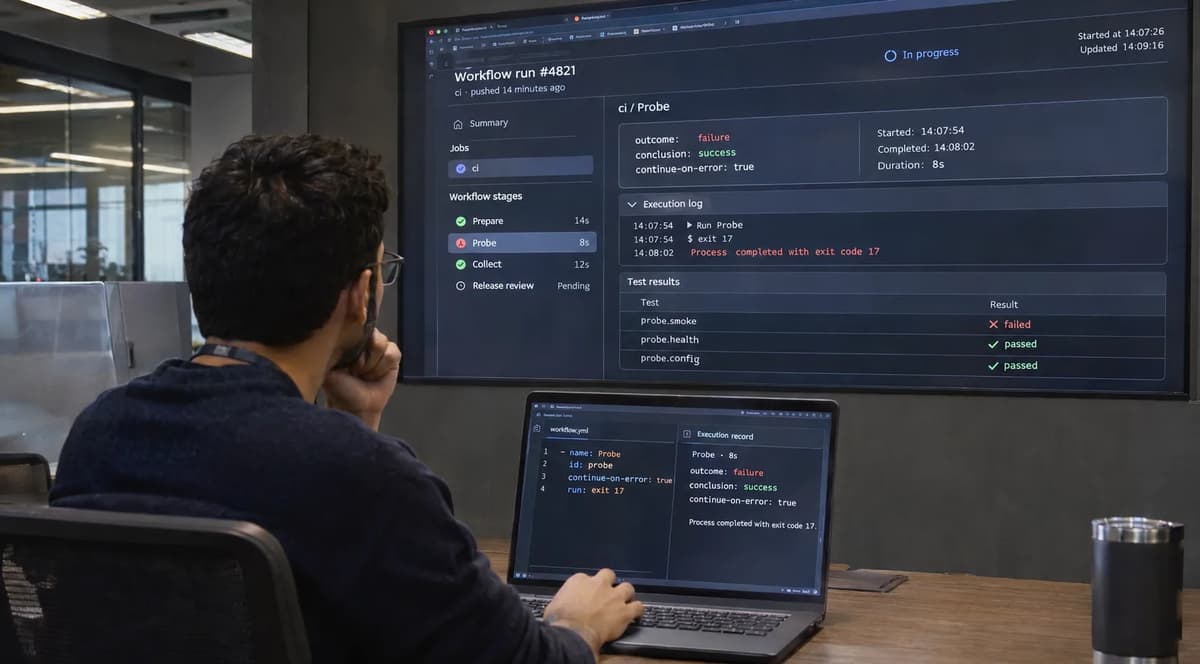
A GitHub Actions step can fail and still allow the job to continue. That is exactly what step-level continue-on-error is for. The operational mistake begins when continuation is treated as proof that the step satisfied the application contract.
GitHub exposes two fields for a completed named step: outcome, representing the result before continue-on-error is applied, and conclusion, representing the result after that tolerance is applied. A tolerated failing step therefore has the documented pair failure / success. GitHub’s Contexts reference states this explicitly, while the runner project’s accepted ADR records the same design distinction and even demonstrates testing outcome == 'success' before a later publication action. This is established behavior, not a new 2026 feature; the ADR is dated January 13, 2020, which is a design-decision date rather than an assertion about general-availability timing.
The laboratory below is deliberately narrower than production release safety. Ten manually dispatched GitHub.com runs exercise one sequential job each. The probe either succeeds, exits 17, or is deliberately skipped. Some failures are tolerated; others are not. Later conditions intentionally include both defective and repaired admission rules. The only “publication” is creation of a local synthetic JSON receipt on the hosted runner. Nothing is deployed, uploaded, released, or written to an external service.
Research was completed on November 28, 2026. Every G01–G10 result in this article is EXPECTED / NOT EXECUTED. No workflow, probe, or GitHub run was executed for this article. Until real evidence exists, the qualification record remains executed=false and observed=null.
Define the required probe and its publication contract
The publication contract is intentionally strict: the named probe must have entered, completed with steps.probe.outcome == 'success', and produced a case-, invocation-, run-, and attempt-bound positive receipt. A later diagnostic may execute after failure, but a diagnostic receipt has no publication authority. This separates platform behavior from application policy: GitHub decides how continuation affects step state; this fixture decides which evidence is acceptable for its synthetic publication path. The documented platform states for step outcome and conclusion are success, failure, cancelled, and skipped.
That evidence unit is one named step inside one job. It is intentionally different from matrix coverage and required job evidence, where the question is whether every required job identity existed and completed. No matrix expansion, sibling cancellation, needs, fail-fast setting, branch-protection configuration, reusable workflow, or required-check configuration participates here.
A synthetic successful probe also proves very little beyond this control-flow contract. It does not prove that a real test suite discovered all required tests, that a built package has correct contents, or that a candidate is safe to deploy. The decision here is simply whether the bounded gate preserves evidence and admits only the declared successful probe.
Two types of evidence must therefore remain independent. Entry proves that the helper body began. Positive completion proves that the helper reached its successful path before returning zero. Neither a green job badge, a tolerated conclusion == 'success', a diagnostic receipt, nor an externally observed job conclusion can substitute for the probe’s pre-tolerance outcome.
Record the service and runner baseline
The target service is GitHub.com. Each case uses one GitHub-hosted ubuntu-24.04 job with ordinary sequential run steps, explicit shell: bash, and one standard-library Python helper. GitHub documents ubuntu-24.04 as a hosted-runner label, but the hosted image is maintained and its installed software changes over time. The exact runner image and its Included Software reference are available in the workflow’s Set up job log. Therefore ubuntu-24.04 selects a runtime family; it is not an immutable environment pin.
For an executed qualification, preserve the actual runner application version and included-software URL from that setup log, plus /etc/os-release, Bash and Python versions, and executable paths recorded by the helper. Also bind the run to selected GitHub context values: repository, event name, source SHA, workflow reference, workflow SHA, run ID, and attempt. GitHub documents workflow_ref/workflow_sha, run identity, job status, and named-step state in its contexts.
Before dispatch, freeze the reviewed bytes locally:
sha256sum .github/workflows/step-gate.yml gate_helper.py expected-cases.json > reviewed.sha256
cat reviewed.sha256
Do not replace those values with invented runner versions, guessed tool patches, or fabricated hashes. The workflow later records the helper bytes it actually generated; external reconciliation compares that digest with the locally reviewed helper file.
The workflow uses workflow_dispatch. GitHub requires a manually dispatched workflow definition to exist on the default branch, requires repository write access for manual execution, and permits the operator to select a branch/ref when running it.
Use an owned disposable repository. Dispatch ten independent runs, one per case, and give every run a freshly generated invocation UUID:
python3 -c 'import uuid; print(uuid.uuid4())'There is no checkout, third-party action, artifact transfer, fork, credential experiment, job-level continue-on-error, or real service mutation. Runtime-token scope is not part of this experiment.
Build an isolated probe and receipt harness
GitHub workflow syntax supports manual inputs, step IDs, if, run, explicit shells, and step-level continue-on-error. Step-level tolerance prevents that step from failing the job immediately; it is distinct from job-level tolerance, which is excluded here.
The helper below is embedded literally in prepare. Save the identical Python body locally as gate_helper.py before review so its SHA-256 can be frozen independently. The probe invokes it directly through python3; there is no tee, no pipeline, no trailing command that can overwrite its exit status, and no broad exception suppression. That boundary is intentionally separate from preserving failures through a Bash logging pipeline.
name: step-outcome-conclusion-gate

on:
  workflow_dispatch:
    inputs:
      case_id:
        description: Qualification case
        required: true
        type: choice
        options:
          - G01
          - G02
          - G03
          - G04
          - G05
          - G06
          - G07
          - G08
          - G09
          - G10
      invocation:
        description: Fresh UUID4 invocation identity
        required: true
        type: string

jobs:
  gate:
    name: gate
    runs-on: ubuntu-24.04
    env:
      CASE_ID: ${{ inputs.case_id }}
      INVOCATION: ${{ inputs.invocation }}
      REPOSITORY: ${{ github.repository }}
      EVENT_NAME: ${{ github.event_name }}
      HEAD_SHA: ${{ github.sha }}
      WORKFLOW_REF: ${{ github.workflow_ref }}
      WORKFLOW_SHA: ${{ github.workflow_sha }}
      RUN_ID: ${{ github.run_id }}
      RUN_ATTEMPT: ${{ github.run_attempt }}
      HELPER: ${{ runner.temp }}/refonte_gate_helper.py
      EVIDENCE_DIR: ${{ runner.temp }}/refonte-gate-evidence/${{ inputs.invocation }}

    steps:
      - name: prepare
        id: prepare
        shell: bash
        run: |
          set -eu
          cat > "$HELPER" <<'PY'
          import argparse
          import hashlib
          import json
          import os
          import pathlib
          import platform
          import subprocess
          import sys
          import uuid

          CASES = {f"G{i:02d}" for i in range(1, 11)}
          ID_KEYS = (
              "CASE_ID", "INVOCATION", "REPOSITORY", "EVENT_NAME",
              "HEAD_SHA", "WORKFLOW_REF", "WORKFLOW_SHA",
              "RUN_ID", "RUN_ATTEMPT",
          )

          def identity():
              d = {k.lower(): os.environ.get(k, "") for k in ID_KEYS}
              missing = [k for k, v in d.items() if not v]
              if missing:
                  raise ValueError("missing identity fields: " + ",".join(missing))
              return d

          def validate_identity():
              ident = identity()
              if ident["case_id"] not in CASES:
                  raise ValueError("invalid case_id")
              u = uuid.UUID(ident["invocation"])
              if u.version != 4 or str(u) != ident["invocation"].lower():
                  raise ValueError("invocation must be canonical UUID4")
              if ident["event_name"] != "workflow_dispatch":
                  raise ValueError("unexpected event")
              if not ident["run_id"].isdigit() or not ident["run_attempt"].isdigit():
                  raise ValueError("invalid run identity")
              return ident

          def evidence_dir():
              p = pathlib.Path(os.environ["EVIDENCE_DIR"])
              return p

          def helper_sha256():
              return hashlib.sha256(pathlib.Path(__file__).read_bytes()).hexdigest()

          def write_exclusive(name, payload):
              path = evidence_dir() / name
              data = json.dumps(payload, sort_keys=True, separators=(",", ":")) + "\n"
              fd = os.open(path, os.O_WRONLY | os.O_CREAT | os.O_EXCL, 0o600)
              with os.fdopen(fd, "w", encoding="utf-8") as fh:
                  fh.write(data)

          def receipt(kind, extra=None):
              payload = {
                  "schema": "refonte.local-receipt.v1",
                  "kind": kind,
                  "identity": validate_identity(),
              }
              if extra:
                  payload.update(extra)
              write_exclusive(f"{kind}.json", payload)

          def read_json(path):
              with path.open("r", encoding="utf-8") as fh:
                  return json.load(fh)

          def validate_receipt(obj, kind):
              if obj.get("schema") != "refonte.local-receipt.v1":
                  raise ValueError(f"{kind}: bad schema")
              if obj.get("kind") != kind:
                  raise ValueError(f"{kind}: bad kind")
              if obj.get("identity") != validate_identity():
                  raise ValueError(f"{kind}: identity mismatch")

          def cmd_prepare(_):
              ident = validate_identity()
              p = evidence_dir()
              p.mkdir(parents=True, exist_ok=False)
              bash_path = subprocess.run(
                  ["bash", "-c", "command -v bash"],
                  check=True, text=True, capture_output=True
              ).stdout.strip()
              bash_version = subprocess.run(
                  ["bash", "--version"],
                  check=True, text=True, capture_output=True
              ).stdout.splitlines()[0]
              os_release = pathlib.Path("/etc/os-release").read_text(
                  encoding="utf-8", errors="strict"
              )
              payload = {
                  "schema": "refonte.baseline.v1",
                  "identity": ident,
                  "helper_sha256": helper_sha256(),
                  "runtime": {
                      "platform": platform.platform(),
                      "os_release": os_release,
                      "python_version": sys.version,
                      "python_executable": sys.executable,
                      "bash_version": bash_version,
                      "bash_executable": bash_path,
                  },
              }
              write_exclusive("baseline.json", payload)

          def cmd_probe(args):
              receipt("entry", {"requested_result": args.result})
              if args.result == "failure":
                  return 17
              receipt("positive", {"completed": True})
              return 0

          def cmd_diagnostic(args):
              receipt("diagnostic", {"variant": args.variant})
              return 0

          def cmd_gate(args):
              ident = validate_identity()
              ok = args.outcome == "success"
              reason = "outcome_not_success"
              positive_path = evidence_dir() / "positive.json"
              if ok:
                  if not positive_path.exists():
                      ok = False
                      reason = "positive_receipt_missing"
                  else:
                      try:
                          positive = read_json(positive_path)
                          validate_receipt(positive, "positive")
                          if positive.get("completed") is not True:
                              raise ValueError("positive receipt not completed")
                          reason = "accepted"
                      except Exception as exc:
                          ok = False
                          reason = "positive_receipt_invalid:" + type(exc).__name__
              payload = {
                  "schema": "refonte.local-receipt.v1",
                  "kind": "gate",
                  "identity": ident,
                  "decision": "success" if ok else "failure",
                  "reason": reason,
                  "probe_outcome": args.outcome,
              }
              write_exclusive("gate.json", payload)
              return 0 if ok else 23

          def cmd_publish(args):
              receipt("publish", {"branch": args.branch, "synthetic_only": True})
              return 0

          STEP_IDS = (
              "prepare", "probe", "diagnostic_implicit", "diagnostic_explicit",
              "strict_gate", "publish_default", "publish_conclusion",
              "publish_inequality", "publish_strict",
          )

          def cmd_collect(_):
              ident = validate_identity()
              baseline = read_json(evidence_dir() / "baseline.json")
              if baseline.get("schema") != "refonte.baseline.v1":
                  raise ValueError("bad baseline schema")
              if baseline.get("identity") != ident:
                  raise ValueError("baseline identity mismatch")
              if baseline.get("helper_sha256") != helper_sha256():
                  raise ValueError("helper changed after prepare")

              receipts = {}
              for kind in ("entry", "positive", "diagnostic", "gate", "publish"):
                  path = evidence_dir() / f"{kind}.json"
                  if path.exists():
                      obj = read_json(path)
                      validate_receipt(obj, kind)
                      receipts[kind] = obj
                  else:
                      receipts[kind] = None

              steps = {}
              for step_id in STEP_IDS:
                  prefix = step_id.upper()
                  steps[step_id] = {
                      "outcome": os.environ.get(prefix + "_OUTCOME", ""),
                      "conclusion": os.environ.get(prefix + "_CONCLUSION", ""),
                  }

              summary_status = "not-attempted"
              summary_path = os.environ.get("GITHUB_STEP_SUMMARY", "")
              if summary_path:
                  try:
                      with open(summary_path, "a", encoding="utf-8") as fh:
                          fh.write("### Synthetic step-gate evidence\n")
                          fh.write(f"- Case: {ident['case_id']}\n")
                          fh.write(f"- Invocation: {ident['invocation']}\n")
                          fh.write("- Publication: local receipt only\n")
                      summary_status = "local-write-success"
                  except OSError:
                      summary_status = "local-write-failure"

              record = {
                  "schema": "refonte.gate-record.v1",
                  "executed": True,
                  "identity": ident,
                  "helper_sha256": helper_sha256(),
                  "runtime": baseline["runtime"],
                  "job_status_at_collect": os.environ.get("JOB_STATUS", ""),
                  "steps": steps,
                  "receipts": receipts,
                  "summary_write": summary_status,
              }
              marker = "REFONTE_" + "GATE_RECORD "
              print(marker + json.dumps(
                  record, sort_keys=True, separators=(",", ":")
              ))
              return 0

          def main():
              parser = argparse.ArgumentParser()
              sub = parser.add_subparsers(dest="command", required=True)

              p = sub.add_parser("prepare")
              p.set_defaults(func=cmd_prepare)

              p = sub.add_parser("probe")
              p.add_argument("--result", choices=("success", "failure"), required=True)
              p.set_defaults(func=cmd_probe)

              p = sub.add_parser("diagnostic")
              p.add_argument("--variant", choices=("implicit", "explicit"), required=True)
              p.set_defaults(func=cmd_diagnostic)

              p = sub.add_parser("gate")
              p.add_argument("--outcome", required=True)
              p.set_defaults(func=cmd_gate)

              p = sub.add_parser("publish")
              p.add_argument(
                  "--branch",
                  choices=("default", "conclusion", "inequality", "strict"),
                  required=True,
              )
              p.set_defaults(func=cmd_publish)

              p = sub.add_parser("collect")
              p.set_defaults(func=cmd_collect)

              args = parser.parse_args()
              try:
                  rc = args.func(args)
              except Exception as exc:
                  print(
                      f"helper_error type={type(exc).__name__} message={exc}",
                      file=sys.stderr,
                  )
                  return 70
              return int(rc or 0)

          if name == "__main__":
              raise SystemExit(main())
          PY
          python3 "$HELPER" prepare

      - name: probe
        id: probe
        if: ${{ inputs.case_id != 'G06' && inputs.case_id != 'G07' }}
        continue-on-error: ${{ inputs.case_id == 'G03' || inputs.case_id == 'G04' || inputs.case_id == 'G05' || inputs.case_id == 'G10' }}
        shell: bash
        env:
          PROBE_RESULT: ${{ (inputs.case_id == 'G01' || inputs.case_id == 'G05') && 'success' || 'failure' }}
        run: |
          set -eu
          python3 "$HELPER" probe --result "$PROBE_RESULT"

      - name: diagnostic_implicit
        id: diagnostic_implicit
        if: ${{ inputs.case_id == 'G08' && steps.probe.outcome == 'failure' }}
        shell: bash
        run: |
          set -eu
          python3 "$HELPER" diagnostic --variant implicit

      - name: diagnostic_explicit
        id: diagnostic_explicit
        if: ${{ !cancelled() && (inputs.case_id == 'G09' || inputs.case_id == 'G10') && steps.probe.outcome == 'failure' }}
        shell: bash
        run: |
          set -eu
          python3 "$HELPER" diagnostic --variant explicit

      - name: strict_gate
        id: strict_gate
        if: ${{ !cancelled() && (inputs.case_id == 'G04' || inputs.case_id == 'G05' || inputs.case_id == 'G07' || inputs.case_id == 'G10') }}
        shell: bash
        env:
          PROBE_OUTCOME: ${{ steps.probe.outcome }}
        run: |
          set -eu
          python3 "$HELPER" gate --outcome "$PROBE_OUTCOME"

      - name: publish_default
        id: publish_default
        if: ${{ inputs.case_id == 'G01' || inputs.case_id == 'G02' }}
        shell: bash
        run: |
          set -eu
          python3 "$HELPER" publish --branch default

      - name: publish_conclusion
        id: publish_conclusion
        if: ${{ inputs.case_id == 'G03' && steps.probe.conclusion == 'success' }}
        shell: bash
        run: |
          set -eu
          python3 "$HELPER" publish --branch conclusion

      - name: publish_inequality
        id: publish_inequality
        if: ${{ inputs.case_id == 'G06' && steps.probe.outcome != 'failure' }}
        shell: bash
        run: |
          set -eu
          python3 "$HELPER" publish --branch inequality

      - name: publish_strict
        id: publish_strict
        if: ${{ (inputs.case_id == 'G04' || inputs.case_id == 'G05' || inputs.case_id == 'G07' || inputs.case_id == 'G10') && steps.strict_gate.outcome == 'success' }}
        shell: bash
        run: |
          set -eu
          python3 "$HELPER" publish --branch strict

      - name: collect
        id: collect
        if: ${{ always() }}
        shell: bash
        env:
          JOB_STATUS: ${{ job.status }}
          PREPARE_OUTCOME: ${{ steps.prepare.outcome }}
          PREPARE_CONCLUSION: ${{ steps.prepare.conclusion }}
          PROBE_OUTCOME: ${{ steps.probe.outcome }}
          PROBE_CONCLUSION: ${{ steps.probe.conclusion }}
          DIAGNOSTIC_IMPLICIT_OUTCOME: ${{ steps.diagnostic_implicit.outcome }}
          DIAGNOSTIC_IMPLICIT_CONCLUSION: ${{ steps.diagnostic_implicit.conclusion }}
          DIAGNOSTIC_EXPLICIT_OUTCOME: ${{ steps.diagnostic_explicit.outcome }}
          DIAGNOSTIC_EXPLICIT_CONCLUSION: ${{ steps.diagnostic_explicit.conclusion }}
          STRICT_GATE_OUTCOME: ${{ steps.strict_gate.outcome }}
          STRICT_GATE_CONCLUSION: ${{ steps.strict_gate.conclusion }}
          PUBLISH_DEFAULT_OUTCOME: ${{ steps.publish_default.outcome }}
          PUBLISH_DEFAULT_CONCLUSION: ${{ steps.publish_default.conclusion }}
          PUBLISH_CONCLUSION_OUTCOME: ${{ steps.publish_conclusion.outcome }}
          PUBLISH_CONCLUSION_CONCLUSION: ${{ steps.publish_conclusion.conclusion }}
          PUBLISH_INEQUALITY_OUTCOME: ${{ steps.publish_inequality.outcome }}
          PUBLISH_INEQUALITY_CONCLUSION: ${{ steps.publish_inequality.conclusion }}
          PUBLISH_STRICT_OUTCOME: ${{ steps.publish_strict.outcome }}
          PUBLISH_STRICT_CONCLUSION: ${{ steps.publish_strict.conclusion }}
        run: |
          set -eu
          python3 "$HELPER" collect
Separate entry, positive completion and publication receipts
The helper creates entry.json only after the probe body starts. The success path then creates positive.json before returning zero. A deliberate failure creates entry but never positive completion. G06 and G07 skip the probe entirely, so neither file should exist.
publish.json is independent and uses exclusive creation. It binds the same case, invocation, repository, workflow SHA, run ID, and attempt, and records which branch admitted it. gate.json and diagnostic.json are similarly exclusive. A second creation attempt fails rather than silently replacing prior evidence. All of these files describe only actions on the ephemeral local runner.
The branch conditions are intentionally non-overlapping by case: G01/G02 use publish_default, G03 uses publish_conclusion, G06 uses publish_inequality, strict cases use publish_strict, and G08/G09 select no publication route.
Freeze the ten-case oracle before dispatch
The scenario configuration and expected oracle must exist before any GitHub.com observation. Do not generate expectations from the collector output, the GitHub API, or the final job badge. The manifest below is therefore literal authored policy. Every row begins with executed:false and observed:null.
Preserve both status fields in every expected row
Case | Probe | Tolerated | outcome / conclusion | Candidate path | Strict gate | Diagnostic receipt | Publish receipt | Completed job |
G01 | exit 0 | no | success / success | default | skipped | no | yes | success |
G02 | exit 17 | no | failure / failure | default | skipped | no | no | failure |
G03 | exit 17 | yes | failure / success | conclusion == success | skipped | no | yes | success |
G04 | exit 17 | yes | failure / success | strict | failure | no | no | failure |
G05 | exit 0 | yes | success / success | strict | success | no | yes | success |
G06 | skipped | no | skipped / skipped | outcome != failure | skipped | no | yes | success |
G07 | skipped | no | skipped / skipped | strict | failure | no | no | failure |
G08 | exit 17 | no | failure / failure | diagnostic only | skipped | no | no | failure |
G09 | exit 17 | no | failure / failure | diagnostic only | skipped | yes | no | failure |
G10 | exit 17 | yes | failure / success | diagnostic then strict | failure | yes | no | failure |
Entry receipts are expected for G01–G05 and G08–G10, but not G06/G07. Positive receipts are expected only for G01 and G05. These expectations assume preparation completes, collection itself completes, and no cancellation, timeout, runner loss, or infrastructure interruption occurs. Such interruptions are not silently folded into a case expectation.
A complete independent expected-cases.json is:
{
  "schema": "refonte.expected-cases.v1",
  "research_date": "2026-11-28",
  "executed": false,
  "observed": null,
  "cases": {
    "G01": {
      "probe": "exit 0", "tolerated": false,
      "probe_outcome": "success", "probe_conclusion": "success",
      "candidate_path": "default", "gate": "skipped",
      "diagnostic": false, "publish": true, "entry": true, "positive": true,
      "job_conclusion": "success", "publish_step": "publish_default"
    },
    "G02": {
      "probe": "exit 17", "tolerated": false,
      "probe_outcome": "failure", "probe_conclusion": "failure",
      "candidate_path": "default", "gate": "skipped",
      "diagnostic": false, "publish": false, "entry": true, "positive": false,
      "job_conclusion": "failure", "publish_step": "publish_default"
    },
    "G03": {
      "probe": "exit 17", "tolerated": true,
      "probe_outcome": "failure", "probe_conclusion": "success",
      "candidate_path": "conclusion == success", "gate": "skipped",
      "diagnostic": false, "publish": true, "entry": true, "positive": false,
      "job_conclusion": "success", "publish_step": "publish_conclusion"
    },
    "G04": {
      "probe": "exit 17", "tolerated": true,
      "probe_outcome": "failure", "probe_conclusion": "success",
      "candidate_path": "strict", "gate": "failure",
      "diagnostic": false, "publish": false, "entry": true, "positive": false,
      "job_conclusion": "failure", "publish_step": "publish_strict"
    },
    "G05": {
      "probe": "exit 0", "tolerated": true,
      "probe_outcome": "success", "probe_conclusion": "success",
      "candidate_path": "strict", "gate": "success",
      "diagnostic": false, "publish": true, "entry": true, "positive": true,
      "job_conclusion": "success", "publish_step": "publish_strict"
    },
    "G06": {
      "probe": "skipped", "tolerated": false,
      "probe_outcome": "skipped", "probe_conclusion": "skipped",
      "candidate_path": "outcome != failure", "gate": "skipped",
      "diagnostic": false, "publish": true, "entry": false, "positive": false,
      "job_conclusion": "success", "publish_step": "publish_inequality"
    },
    "G07": {
      "probe": "skipped", "tolerated": false,
      "probe_outcome": "skipped", "probe_conclusion": "skipped",
      "candidate_path": "strict", "gate": "failure",
      "diagnostic": false, "publish": false, "entry": false, "positive": false,
      "job_conclusion": "failure", "publish_step": "publish_strict"
    },
    "G08": {
      "probe": "exit 17", "tolerated": false,
      "probe_outcome": "failure", "probe_conclusion": "failure",
      "candidate_path": "diagnostic only", "gate": "skipped",
      "diagnostic": false, "publish": false, "entry": true, "positive": false,
      "job_conclusion": "failure", "publish_step": null
    },
    "G09": {
      "probe": "exit 17", "tolerated": false,
      "probe_outcome": "failure", "probe_conclusion": "failure",
      "candidate_path": "diagnostic only", "gate": "skipped",
      "diagnostic": true, "publish": false, "entry": true, "positive": false,
      "job_conclusion": "failure", "publish_step": null
    },
    "G10": {
      "probe": "exit 17", "tolerated": true,
      "probe_outcome": "failure", "probe_conclusion": "success",
      "candidate_path": "diagnostic then strict", "gate": "failure",
      "diagnostic": true, "publish": false, "entry": true, "positive": false,
      "job_conclusion": "failure", "publish_step": "publish_strict"
    }
  }
}
The service documentation and ADR are moving sources, not immutable snapshots of the eventual runner. Preserve the reviewed source revision separately and bind actual execution evidence to the workflow SHA and runtime that GitHub reports. The ADR’s accepted design describes the same failure/success pair used here.
Establish ordinary success and untolerated failure
G01 and G02 use the same direct helper invocation and the same publish_default route. The only probe difference is the helper result: G01 returns zero; G02 returns 17.
The publication condition is merely:
if: ${{ inputs.case_id == 'G01' || inputs.case_id == 'G02' }}Because it contains no status-check function, GitHub applies the default success() status check. GitHub’s expression documentation states that a default success() is applied to if conditions unless a status-check function is present.
Expected G01 evidence is entry, positive completion, and publication. Its probe state is success / success, so the ordinary success-dependent publication branch remains eligible.
Expected G02 evidence is entry only. The probe returns 17, giving failure / failure. Since the failure is not tolerated, the job is already in a failure state when GitHub evaluates publish_default; implicit success() therefore prevents that branch from executing. collect is separately eligible because it uses a status function.
It is important not to misclassify G02. An intentionally failing direct command is not an infrastructure incident just because its job is expected to finish red. If the observed state, receipt inventory, collector record, and final failure conclusion all match the frozen oracle, G02 is a valid negative control. Its candidate, however, remains rejected because the required probe failed. “The negative test behaved as expected” and “the candidate is acceptable” are different propositions.
Observe the conclusion changed by tolerance
G03 changes only the policy around the failing probe: continue-on-error is true for that step. GitHub documents the exact consequence: the completed step’s outcome remains failure, while its post-tolerance conclusion becomes success.
The deliberately bad admission condition is:
if: ${{ inputs.case_id == 'G03' && steps.probe.conclusion == 'success' }}Under the authored expectation, G03 therefore reaches publish_conclusion even though the required command exited 17. Its local evidence should contain entry.json and publish.json, but no positive.json. The final job is expected to succeed because the probe failure was tolerated and no later untolerated step fails.
That is not GitHub misreporting the command. It is the application asking the wrong question. conclusion answers whether the completed step is considered successful after continuation policy. For this publication contract, the required question is whether the probe itself succeeded before that transformation.
Capture the result before applying application acceptance
The collector receives both fields directly from the in-job steps context. That matters because later external status is not a substitute for the pair. The runner ADR explicitly distinguishes the pre-tolerance outcome from the API-oriented term conclusion, and its example gates later publication on steps.experimental.outcome == 'success'.
A green completed job therefore does not let a reviewer infer that every required command returned zero. Nor does a UI color recreate the exact pre-tolerance state. Capture it while the workflow still has access to steps.probe.outcome.
G03 is useful precisely because it is a negative control for application policy. If its expected publication receipt appears without a positive probe receipt, the fixture has demonstrated why a conclusion == 'success' gate is unsuitable for this contract. That does not imply that every use of continue-on-error is wrong. Continuation can be useful for gathering evidence; it simply must not be confused with admission.
Enforce a successful outcome and matching positive receipt
G04 and G05 retain step-level tolerance but add strict_gate. The checking step uses !cancelled() so it remains eligible after a prior failure state while still declining to deliberately continue a canceled workflow. GitHub recommends !cancelled() as the alternative when work should run regardless of prior success/failure without the broader behavior of always().
The gate requires two independent facts: steps.probe.outcome must equal exactly success, and the bound positive.json must exist, have the correct schema and kind, match the current identity, and assert completed success. Missing, malformed, mismatched, skipped, failure, empty, or unfamiliar values fail closed.
G04 is the tolerated-failure control. Its probe should be failure / success, but strict_gate receives failure, records a failing decision, and exits 23. The gate itself has no continue-on-error, so the job finishes failed and publish_strict does not execute.
G05 is the positive counterpart. The probe returns zero despite being configured as tolerable. Its pair remains success / success; entry and positive receipts exist; the strict gate returns zero; and the local publication receipt is admitted.
That receipt is deliberately not evidence that a real package is acceptable. File contents, permissions, provenance, and executability are separate dimensions; see Refonte Learning’s treatment of artifact contents and executable-mode acceptance. Here the publication object is only a synthetic sentinel demonstrating control flow.
Reject a skipped probe instead of accepting not-failure
G06 and G07 deliberately do not run probe. GitHub includes skipped among documented step outcomes and conclusions.
G06 uses another intentionally defective condition:
if: ${{ inputs.case_id == 'G06' && steps.probe.outcome != 'failure' }}The expected probe pair is skipped / skipped. Since skipped is not equal to failure, the inequality is true, no preceding failure blocks normal eligibility, and publish_inequality is expected to create a publication receipt. Yet neither entry nor positive receipt exists. This is a classic open-ended allow rule: “anything except one known bad value” is not equivalent to “the one required good value.”
G07 feeds the same skipped probe into the strict gate. steps.probe.outcome is not exactly success, and no positive receipt exists, so the gate fails and publication stays skipped.
Treat missing and unfamiliar states as unqualified evidence
The acceptance rule should be a success allowlist, not a failure denylist. GitHub also documents that dereferencing a nonexistent property evaluates to an empty string in expressions. That means a typo or missing property can be “not failure” without being success.
The gate and external verifier should therefore preserve raw values and reject:
failure, cancelled, and skipped;
an empty string;
a missing step ID or property;
an unfamiliar state introduced by malformed evidence;
a purported success without the matching positive receipt.
Those malformed-evidence controls are schema rules, not additional executed GitHub cases. The ten-case qualification remains G01–G10 exactly.
A job that is otherwise green cannot satisfy this particular contract when the declared required probe never ran. “No observed failure” is weaker than “declared successful execution.”
Repair diagnostics blocked by implicit success
G08 demonstrates the opposite control-flow problem. The probe failure is not tolerated, and the diagnostic condition appears to test exactly the event of interest:
if: ${{ inputs.case_id == 'G08' && steps.probe.outcome == 'failure' }}Yet that predicate contains no status-check function. GitHub therefore applies implicit success(). Since the previous probe already failed the job, the diagnostic is expected to be skipped. The expected diagnostic receipt is absent. GitHub’s expression reference explicitly explains that conditions after failure require a status-check function to override the default success check.
G08 contains no publication route. The point is diagnostic eligibility only.
Add a status function without authorizing publication
G09 changes the condition to:
if: ${{ !cancelled() && inputs.case_id == 'G09' && steps.probe.outcome == 'failure' }}Because !cancelled() is a status-check expression, the implicit-success barrier is no longer the controlling default. The expected diagnostic receipt is present even though the untolerated probe remains failed and the completed job remains failed. GitHub documents both the default-success behavior and the use of status functions in conditions.
This is deliberately not expressed as an assertion that failure() must remember every tolerated-step failure. That broader claim is unnecessary here. The diagnostic tests the named probe’s actual outcome and uses !cancelled() only to make the step eligible despite previous job failure.
The diagnostic also gains no publication authority. Its predicate is not reused for a publication branch, and its receipt is not an acceptance token. A diagnostic can explain failure while the candidate remains rejected.
Collect a tolerated failure and then block its candidate
G10 combines the two repairs. The probe exits 17 but has step-level continue-on-error, producing the expected pair failure / success. The shared diagnostic_explicit condition includes G09 and G10, so G10 should create diagnostic.json. The shared strict_gate includes G04, G05, G07, and G10; it receives the raw probe outcome, observes failure, records rejection, and exits 23.
The result is evidence-first rather than green-first: continuation gives later steps an opportunity to inspect and record the probe failure, while the strict application gate still refuses publication. The expected completed job is failed because the gate failure itself is untolerated.
The publication routing stays mutually exclusive. G01/G02 are the default branch, G03 the conclusion branch, G06 the inequality branch, and G04/G05/G07/G10 the strict branch. G08/G09 are diagnostic-only. That makes an unexpected second publication branch a reconciliation defect rather than an ambiguous success.
Continuation here is not a retry, repair, correction, or transformation of the probe command’s exit 17. It is a policy allowing the job to proceed far enough to collect evidence. The original outcome remains the admission fact.
Retrieve evidence for the exact completed run attempt
collect is last and uses if: ${{ always() }}. GitHub documents always() as a status-check function that returns true even around cancellation scenarios, but also warns against using it for critical operations and recommends !cancelled() for ordinary work across prior success/failure. This fixture uses always() only for a bounded final evidence attempt. It does not claim that collection is guaranteed after runner loss, forcible termination, timeout, or every cancellation path.
The collector validates its baseline and receipts, captures previous named-step fields, records current job.status, and emits exactly one marker plus compact JSON. It may also append a human-readable summary to GITHUB_STEP_SUMMARY. GitHub documents that step summaries are uploaded separately, have per-step limits, and that summary upload failure does not change the step or job status. A rendered summary is therefore convenience, not the complete audit trail.
The collector cannot yet know the final completed job conclusion. That belongs to external reconciliation after GitHub finishes the run. No complete marker record, or a collector step that does not itself conclude successfully, means HOLD_EVIDENCE.
Record the GitHub CLI version and retrieve the exact attempt:
gh --version > gh-version.txt

gh run view "$RUN_ID" \
  --repo "$REPOSITORY" \
  --attempt "$RUN_ATTEMPT" \
  --json attempt,conclusion,event,headSha,status,jobs,url \
  > run.json

gh run view "$RUN_ID" \
  --repo "$REPOSITORY" \
  --attempt "$RUN_ATTEMPT" \
  --log \
  > run.log
gh run view documents --attempt, --log, --json, and fields including attempt, conclusion, event, headSha, jobs, and status. It also documents --exit-status, which returns nonzero for failed runs. That option must not become this suite’s pass oracle because several cases are intentionally expected to fail.
Keep raw logs, parsed records and final status separate
The raw log is evidence. The extracted collector JSON is a structured in-job record. run.json is externally observed completed-run metadata. Do not collapse them.
The following extractor accepts exactly one complete marker payload. The helper intentionally assembles the marker string at runtime so the literal marker is not present in its generated source block and cannot be mistaken for a record merely because the runner echoed shell source.
#!/usr/bin/env python3
import json
import pathlib
import sys

MARKER = "REFONTE_" + "GATE_RECORD "

def extract(path):
    matches = []
    decoder = json.JSONDecoder()

    for lineno, line in enumerate(
        pathlib.Path(path).read_text(encoding="utf-8", errors="strict").splitlines(),
        start=1,
    ):
        pos = line.find(MARKER)
        if pos < 0:
            continue
        tail = line[pos + len(MARKER):]
        try:
            obj, end = decoder.raw_decode(tail)
        except json.JSONDecodeError:
            continue
        if tail[end:].strip():
            continue
        if not isinstance(obj, dict):
            continue
        if obj.get("schema") != "refonte.gate-record.v1":
            continue
        matches.append((lineno, obj))

    if len(matches) != 1:
        raise SystemExit(
            f"expected exactly one complete gate record, found {len(matches)}"
        )

    lineno, obj = matches[0]
    if obj.get("executed") is not True:
        raise SystemExit("record does not assert executed=true")

    json.dump(obj, sys.stdout, sort_keys=True, indent=2)
    sys.stdout.write("\n")

if name == "__main__":
    if len(sys.argv) != 2:
        raise SystemExit("usage: extract_record.py RUN_LOG")
    extract(sys.argv[1])
Do not execute log text, accept multiple records, or count a mere marker-looking source line. After extraction, bind the record to repository, case, invocation, workflow SHA, run ID, and attempt; then independently verify that GitHub reports the run and job as completed and that the collect step succeeded.
Reconcile diagnostic evidence and operational decisions
After ten independent runs exist, maintain a separate operator ledger containing actual identities. Before execution it contains no invented values:
{
  "schema": "refonte.run-ledger.v1",
  "repository": null,
  "runs": {
    "G01": {
      "invocation": null, "run_id": null, "run_attempt": null,
      "workflow_sha": null, "runner_version": null, "included_software_url": null
    },
    "G02": {
      "invocation": null, "run_id": null, "run_attempt": null,
      "workflow_sha": null, "runner_version": null, "included_software_url": null
    },
    "G03": {
      "invocation": null, "run_id": null, "run_attempt": null,
      "workflow_sha": null, "runner_version": null, "included_software_url": null
    },
    "G04": {
      "invocation": null, "run_id": null, "run_attempt": null,
      "workflow_sha": null, "runner_version": null, "included_software_url": null
    },
    "G05": {
      "invocation": null, "run_id": null, "run_attempt": null,
      "workflow_sha": null, "runner_version": null, "included_software_url": null
    },
    "G06": {
      "invocation": null, "run_id": null, "run_attempt": null,
      "workflow_sha": null, "runner_version": null, "included_software_url": null
    },
    "G07": {
      "invocation": null, "run_id": null, "run_attempt": null,
      "workflow_sha": null, "runner_version": null, "included_software_url": null
    },
    "G08": {
      "invocation": null, "run_id": null, "run_attempt": null,
      "workflow_sha": null, "runner_version": null, "included_software_url": null
    },
    "G09": {
      "invocation": null, "run_id": null, "run_attempt": null,
      "workflow_sha": null, "runner_version": null, "included_software_url": null
    },
    "G10": {
      "invocation": null, "run_id": null, "run_attempt": null,
      "workflow_sha": null, "runner_version": null, "included_software_url": null
    }
  }
}
Populate it only from actual dispatch/run evidence. Store each case beneath evidence/Gxx/run.json and evidence/Gxx/run.log. Record the runner version and Included Software URL from Set up job, not from memory.
The complete reconciler below independently reads the frozen expected manifest, actual ledger, reviewed helper bytes, raw logs, and gh run view metadata. It rejects absent identity, duplicate invocation/run-attempt identities, wrong status pairs, wrong receipt inventory, wrong publication branch, collector failure, incomplete final status, unexpected extra publication, or mismatched workflow/helper identity.
#!/usr/bin/env python3
import hashlib
import json
import pathlib
import sys

MARKER = "REFONTE_" + "GATE_RECORD "
CASES = [f"G{i:02d}" for i in range(1, 11)]

def load(path):
    with open(path, "r", encoding="utf-8") as fh:
        return json.load(fh)

def extract_record(path):
    text = pathlib.Path(path).read_text(encoding="utf-8", errors="strict")
    decoder = json.JSONDecoder()
    found = []
    for lineno, line in enumerate(text.splitlines(), 1):
        pos = line.find(MARKER)
        if pos < 0:
            continue
        tail = line[pos + len(MARKER):]
        try:
            obj, end = decoder.raw_decode(tail)
        except json.JSONDecodeError:
            continue
        if tail[end:].strip():
            continue
        if isinstance(obj, dict) and obj.get("schema") == "refonte.gate-record.v1":
            found.append((lineno, obj))
    if len(found) != 1:
        raise ValueError(f"{path}: expected one collector record, got {len(found)}")
    return found[0][1]

def receipt_present(record, kind):
    return record["receipts"].get(kind) is not None

def only_publication_step(record, expected_step, expected_publish):
    names = (
        "publish_default", "publish_conclusion",
        "publish_inequality", "publish_strict",
    )
    successful = [
        name for name in names
        if record["steps"][name]["outcome"] == "success"
    ]
    if expected_publish:
        return successful == [expected_step]
    return successful == []

def find_gate_job(run):
    jobs = run.get("jobs")
    if not isinstance(jobs, list):
        raise ValueError("run.json jobs is not a list")
    matches = [j for j in jobs if j.get("name") == "gate"]
    if len(matches) != 1:
        raise ValueError(f"expected one gate job, got {len(matches)}")
    return matches[0]

def collector_succeeded(job):
    steps = job.get("steps")
    if not isinstance(steps, list):
        return False
    matches = [s for s in steps if s.get("name") == "collect"]
    return len(matches) == 1 and matches[0].get("conclusion") == "success"

def fail(case, message):
    raise ValueError(f"{case}: {message}")

def main():
    if len(sys.argv) != 5:
        raise SystemExit(
            "usage: reconcile.py EXPECTED RUN_LEDGER EVIDENCE_ROOT REVIEWED_HELPER"
        )

    expected = load(sys.argv[1])
    ledger = load(sys.argv[2])
    root = pathlib.Path(sys.argv[3])
    helper_digest = hashlib.sha256(pathlib.Path(sys.argv[4]).read_bytes()).hexdigest()

    if expected.get("schema") != "refonte.expected-cases.v1":
        raise SystemExit("bad expected manifest schema")
    if list(expected.get("cases", {}).keys()) != CASES:
        raise SystemExit("expected manifest must contain exactly G01-G10")
    if ledger.get("schema") != "refonte.run-ledger.v1":
        raise SystemExit("bad run ledger schema")
    if set(ledger.get("runs", {})) != set(CASES):
        raise SystemExit("run ledger must contain exactly G01-G10")
    if not ledger.get("repository"):
        raise SystemExit("HOLD_EVIDENCE: repository missing")

    seen_invocations = set()
    seen_attempts = set()
    results = {}

    for case in CASES:
        exp = expected["cases"][case]
        declared = ledger["runs"][case]

        required = (
            "invocation", "run_id", "run_attempt", "workflow_sha",
            "runner_version", "included_software_url",
        )
        if any(declared.get(k) in (None, "") for k in required):
            fail(case, "HOLD_EVIDENCE: incomplete run ledger")

        if declared["invocation"] in seen_invocations:
            fail(case, "duplicate invocation identity")
        seen_invocations.add(declared["invocation"])

        attempt_key = (str(declared["run_id"]), str(declared["run_attempt"]))
        if attempt_key in seen_attempts:
            fail(case, "duplicate run/attempt identity")
        seen_attempts.add(attempt_key)

        case_dir = root / case
        run = load(case_dir / "run.json")
        record = extract_record(case_dir / "run.log")

        ident = record.get("identity", {})
        expected_ident = {
            "case_id": case,
            "invocation": declared["invocation"],
            "repository": ledger["repository"],
            "event_name": "workflow_dispatch",
            "workflow_sha": declared["workflow_sha"],
            "run_id": str(declared["run_id"]),
            "run_attempt": str(declared["run_attempt"]),
        }
        for key, value in expected_ident.items():
            if ident.get(key) != value:
                fail(case, f"identity mismatch for {key}")

        if record.get("executed") is not True:
            fail(case, "collector record is not executed=true")
        if record.get("helper_sha256") != helper_digest:
            fail(case, "helper digest mismatch")

        probe = record["steps"].get("probe", {})
        if probe.get("outcome") != exp["probe_outcome"]:
            fail(case, "probe outcome mismatch")
        if probe.get("conclusion") != exp["probe_conclusion"]:
            fail(case, "probe conclusion mismatch")

        gate = record["steps"].get("strict_gate", {})
        if gate.get("outcome") != exp["gate"]:
            fail(case, "strict gate state mismatch")

        for kind, key in (
            ("entry", "entry"),
            ("positive", "positive"),
            ("diagnostic", "diagnostic"),
            ("publish", "publish"),
        ):
            if receipt_present(record, kind) != exp[key]:
                fail(case, f"{kind} receipt mismatch")

        if not only_publication_step(
            record, exp["publish_step"], exp["publish"]
        ):
            fail(case, "publication-step inventory mismatch")

        if run.get("attempt") != int(declared["run_attempt"]):
            fail(case, "external attempt mismatch")
        if run.get("event") != "workflow_dispatch":
            fail(case, "unexpected external event")
        if run.get("status") != "completed":
            fail(case, "RERUN_INCONCLUSIVE: run not completed")
        if run.get("conclusion") != exp["job_conclusion"]:
            fail(case, "completed workflow conclusion mismatch")
        if run.get("headSha") != ident.get("head_sha"):
            fail(case, "head SHA mismatch")

        job = find_gate_job(run)
        if job.get("status") != "completed":
            fail(case, "gate job not completed")
        if job.get("conclusion") != exp["job_conclusion"]:
            fail(case, "gate job conclusion mismatch")
        if not collector_succeeded(job):
            fail(case, "HOLD_EVIDENCE: collector did not conclude success")

        if not declared["runner_version"].strip():
            fail(case, "runner version missing")
        if not declared["included_software_url"].strip():
            fail(case, "included software reference missing")

        results[case] = "expected-evidence-matched"

    decisions = {
        "G01": "ACCEPT_BOUNDED_GATE",
        "G02": "REJECT_FAILED_OR_SKIPPED_CANDIDATE",
        "G03": "REPAIR_GATE",
        "G04": "REJECT_FAILED_OR_SKIPPED_CANDIDATE",
        "G05": "ACCEPT_BOUNDED_GATE",
        "G06": "REPAIR_GATE",
        "G07": "REJECT_FAILED_OR_SKIPPED_CANDIDATE",
        "G08": "REPAIR_DIAGNOSTIC_CONDITION",
        "G09": "REJECT_FAILED_OR_SKIPPED_CANDIDATE",
        "G10": "REJECT_FAILED_OR_SKIPPED_CANDIDATE",
    }

    print(json.dumps({
        "schema": "refonte.reconciliation.v1",
        "qualification": "ACCEPT_BOUNDED_GATE",
        "scope": "synthetic-step-admission-only",
        "cases": {
            case: {
                "evidence": results[case],
                "decision": decisions[case],
            }
            for case in CASES
        },
    }, sort_keys=True, indent=2))

if name == "__main__":
    try:
        main()
    except (OSError, ValueError, KeyError, TypeError, json.JSONDecodeError) as exc:
        raise SystemExit("HOLD_EVIDENCE: " + str(exc))
The distinction resembles the evidence-policy boundary in Refonte Learning’s discussion of expected-failure policy in pytest: matching an exceptional expected state is not identical to accepting the underlying candidate.
The operational labels are intentionally separate:
Decision | Meaning in this fixture |
ACCEPT_BOUNDED_GATE | The bounded strict-gate behavior matched its frozen qualification evidence; this is not production release approval. |
REPAIR_GATE | A publication condition admitted evidence the contract declares unacceptable, as in G03 or G06. |
REPAIR_DIAGNOSTIC_CONDITION | Failure evidence existed but the diagnostic was blocked by implicit success, as in G08. |
REJECT_FAILED_OR_SKIPPED_CANDIDATE | The candidate lacks declared successful-probe evidence even when the control behavior itself matched expectation. |
RERUN_INCONCLUSIVE | Execution was incomplete or infrastructure prevented a conclusive result, provided a fresh attributable rerun is safe. |
HOLD_EVIDENCE | Identity, schema, logs, collector result, or required evidence is missing, conflicting, or unverifiable. |
A suite containing intentionally failed jobs is not converted into an “all green” workflow. G04, G07, and G10 can qualify rejection mechanics while their candidates remain unacceptable. G09 can qualify the diagnostic boundary without authorizing publication. G03 and G06 are useful specifically because matching their frozen expectations demonstrates gates that require repair.
Recover without rewriting previous failure evidence
When an observed case contradicts the frozen oracle, preserve the original workflow revision, helper digest, expected manifest, run ledger, run.json, raw log, and exact attempt before editing anything. A discrepancy is evidence. Rewriting the expected file after seeing GitHub’s result destroys the independence of the qualification.
Repair conditions in a new workflow revision and rerun the declared qualification under fresh invocation identities. Changes to workflow source, helper source, gate policy, collector schema, runner/runtime family, or evidence semantics expire the prior qualification for that changed boundary. Hosted runner contents can change over time, which is why the exact setup log and included-software reference remain part of the run record.
Do not retrospectively convert an old green job conclusion into proof that its probe succeeded if the pre-tolerance outcome was never retained. The job conclusion and the earlier step outcome answer different questions. The same rule applies to old logs that show some diagnostic output but lack the positive receipt or trustworthy step-state binding.
Ownership should also remain explicit. The command owner owns whether the probe itself succeeded. The workflow maintainer owns tolerance and conditional eligibility. The gate owner owns the exact success allowlist and receipt schema. The reviewer owns independent reconciliation. Any release owner adapting this pattern to real software separately owns the production admission decision.
This laboratory stops before deployment. Refonte Learning’s overview of broader CI/CD delivery stages is the appropriate conceptual boundary for build, delivery, and deployment stages beyond this synthetic gate.
Recovery is correspondingly conservative:
Freeze the failed or contradictory evidence first; never overwrite it with a rerun.
Classify a conclusive failed/skipped candidate as rejection, not infrastructure noise.
Use RERUN_INCONCLUSIVE only when execution evidence is incomplete and a fresh run is safe.
Use HOLD_EVIDENCE for missing collector records, corrupt schemas, ambiguous identities, cancellation, timeout, runner loss, or incomplete final status.
Repair source or policy in a new revision, generate a fresh invocation UUID, and repeat all declared cases required by the qualification.
Preserve the relationship between the old and new evidence rather than editing the old record into apparent success.
always() cannot promise evidence after every infrastructure termination. A canceled, timed-out, forcibly terminated, or lost runner is therefore not reconstructed as a successful probe. It requires HOLD or a fresh attributable attempt. GitHub’s cancellation documentation describes explicit termination behavior for running processes and eventual forced termination; no in-job expression can manufacture evidence after the runner is no longer able to execute it.
Finally, remember that restoration of workflow YAML cannot undo an external side effect that already happened. This fixture avoids that recovery problem by making “publication” exclusively an ephemeral local receipt.
Build CI review skills with Refonte Learning’s DevOps Engineering Program
The practical lesson is bounded: tolerate a failure when you need continued observation, but keep the pre-tolerance result, positive-completion evidence, diagnostic eligibility, and publication authority as separate controls. A successful strict qualification here means only that this synthetic step-level admission rule behaved as declared.
Refonte Learning’s DevOps Engineering Program is listed as a three-month program requiring 12–14 hours per week. Its published curriculum covers Linux and scripting, Git and GitHub, CI/CD, Docker and Kubernetes, Terraform, AWS/Azure/GCP, monitoring and logging, and a capstone; MSc Oskar Eriksson is named as instructor/mentor. The page describes virtual internship opportunities, a “Potential Internship,” and Training and Internship certificates upon successful completion, while its admission language addresses learners engaged in bachelor’s or postgraduate study. It lists DevOps, cloud, and SRE career directions rather than guaranteed employment outcomes.
For engineers building the Git, scripting, and CI/CD foundations needed to reason about controls like this, explore the DevOps Engineering Program.