
Eight bytes can be accepted by bufio.Writer.Write, followed by a normal call to Reset, followed by a successful Flush, while neither the old sink nor the new sink contains any of those eight bytes. That outcome is not a contradiction. It follows from treating buffered acceptance, sink acceptance, and output completeness as three different facts.
This article develops a bounded validation model for that distinction. The intended artifact is the eight-byte ASCII payload ABCDEFGH. Each case creates a fresh bufio.Writer with requested capacity 16, retains an independent copy of the source, and writes only to owned synchronous in-memory io.Writer test doubles. One test double can accept exactly ABC on its first call and return a stable sentinel error. There is one goroutine and no external destination.
The practical question is therefore not whether Reset itself succeeds. It is whether every byte has an accounted disposition before the writer is rebound: already accepted by the designated sink, still pending in the buffered writer, intentionally replayable from independent evidence, preserved in an old partial artifact, or explicitly abandoned.
Go 1.23.2 is the historical API documentation baseline used here, not a statement about an installed compiler and not a recommendation to select that release today. The behavioral case results below are EXPECTED / NOT EXECUTED. The research inspected documentation and source; it did not execute this laboratory.
Define the output whose completeness matters
Start with the artifact, not with Reset. For every case, the source specification is the independent eight-byte value:
ABCDEFGHThe buffered writer is only a staging component. The original sink is the destination initially passed to bufio.NewWriterSize. A replacement sink, when a case uses one, is a separate in-memory ledger with a distinct identity. The acceptance requirement is byte-level: the sink designated as the valid artifact must contain exactly ABCDEFGH, not merely eight bytes, and any older partial output must have an explicit disposition.
That definition separates five states reviewers otherwise tend to collapse:
State | Meaning in this fixture |
Bytes accepted by bufio.Writer.Write | The buffered writer accepted caller input; this does not by itself prove the sink received it |
Bytes accepted by the named sink | The sink copied those bytes during its synchronous Write call |
Buffered suffix | Bytes Buffered() reports as pending after an operation |
Stored writer error | An earlier underlying error that causes later writes and Flush calls to return the error |
Bytes abandoned by Reset | Pending bytes removed from the buffered writer without being forwarded |
The Go 1.23.2 bufio.Writer contract explicitly says that after all data has been written, the client should call Flush to ensure buffered data has been forwarded to the underlying writer. It also says that once an error occurs, subsequent writes and Flush calls return that retained error.
The scope stops at this local boundary. The sink's byte ledger means only that its synchronous Write implementation copied those bytes. It is not evidence of a remote acknowledgment, durable storage, or application-level commit. Likewise, request-body replay is a separate contract: the adjacent Refonte article concerns recreating HTTP request bodies across request attempts, whereas this laboratory concerns ownership and disposition of pending local output.
The operational rule follows directly: do not call a non-self bufio.Writer.Reset until you can say what happened to every pending byte. Reset is a lifecycle boundary, not an accounting mechanism.
Pin the Go contract and disposable environment
The contractual authority for this article is the versioned Go 1.23.2 API documentation. That matters because the bufio package page identifies itself as version go1.23.2, and documents the exact Writer methods used here. Buffered reports the number of bytes currently written into the buffer; Flush writes buffered data to the underlying writer; Reset discards unflushed data, clears an error, and changes the destination; and Size reports the underlying buffer size.
NewWriterSize(w, 16) asks for a writer whose buffer has at least the requested size. The fixture therefore records b.Size() rather than silently treating the requested 16 as execution evidence. The documented Size result is the relevant observable when the laboratory eventually runs.
Every G01–G10 case starts from fresh state. “Repeat the G05 setup” means create a new source, new sink or sinks, and new buffered writer, then repeat those operations. A later case must never inherit the mutation, stored error, sink bytes, or counters of an earlier case.
The source is deterministic ASCII, the destinations are owned in-memory writers, and every sink copies accepted bytes synchronously. There is no hidden background completion. These restrictions are intentional: they make n from io.Writer.Write and the sink ledger auditable without importing a second delivery system into the experiment.
Record the compiler and fixture identity
A documentation URL does not establish what binary is installed. Before an execution intended as qualification evidence, capture both command-level and program-level metadata:
go version
go env GOOS GOARCH GOTOOLCHAIN
printf 'SOURCE_REVISION=%s\n' "${SOURCE_REVISION:-unspecified}"
printf 'RUN_ID=%s\n' "${RUN_ID:-unspecified}"
The harness should additionally record runtime.Version(), runtime.GOOS, runtime.GOARCH, the requested buffer size, observed b.Size(), payload bytes, run ID, source revision, and every sink's stable fixture identity. Until the program is actually run, the metadata record for this article remains:
Field | Article value |
API documentation baseline | go1.23.2 |
runtime.Version() | unspecified / NOT EXECUTED |
GOOS | unspecified / NOT EXECUTED |
GOARCH | unspecified / NOT EXECUTED |
Selected toolchain | unspecified / NOT EXECUTED |
Source revision | unspecified / NOT EXECUTED |
Requested buffer size | 16 |
Observed Size() | expected 16; must be recorded on execution |
Payload | ABCDEFGH |
Run ID | unspecified / NOT EXECUTED |
Sink identities | generated per fresh fixture |
Those unknown fields should stay unknown in an authored article. Filling them with the documentation version would turn a research baseline into fabricated run evidence.
Build a sink that exposes accepted prefixes
The test double needs to expose the fact that a writer can accept some bytes and return an error in the same call. Go's io.Writer contract permits 0 <= n <= len(p), requires a non-nil error when n < len(p), says Write must not modify p, and separately says implementations must not retain p.
For this fixture, the first faulty call accepts exactly three bytes. It copies those three bytes into owned storage immediately, increments its call count, then returns one stable sentinel. Later calls are healthy. There is deliberately no (short count, nil) behavior.
A compact implementation is:
var errInjected = errors.New("injected sink failure")

type sink struct {
    id         string
    data       []byte
    calls      int
    failFirst  bool
    faultUsed  bool
}

func (s *sink) Write(p []byte) (int, error) {
    s.calls++

    if s.failFirst && !s.faultUsed {
        s.faultUsed = true
        n := 3
        if len(p) < n {
            n = len(p)
        }
        s.data = append(s.data, p[:n]...)
        if n < len(p) {
            return n, errInjected
        }
        return n, nil
    }

    s.data = append(s.data, p...)
    return len(p), nil
}
The three-byte prefix is fixture policy, not a general claim about failing writers. The accepted bytes become ABC because the independently specified source is ABCDEFGH and this sink accepts the first three bytes of the slice it receives.
The source is retained separately:
source := []byte("ABCDEFGH")The sink never retains source or the slice supplied by bufio.Writer. Instead, append copies accepted bytes into storage owned by the sink. That is important because the io.Writer contract explicitly says implementations must not retain the caller's supplied slice.
This article consequently begins with an already independent source payload. The separate Refonte discussion of how to preserve an independent Go payload covers a different lifetime problem involving borrowed bytes.Buffer storage; reproducing that aliasing experiment here would obscure the bufio.Writer.Reset lifecycle we actually need to test.
Make the partial-write contract explicit
A valid partial write in this experiment is:
Write("ABCDEFGH") -> n=3, err=errInjected
sink ledger       -> "ABC"
It is not:
n=3, err=nilbecause the versioned io.Writer contract requires a non-nil error when fewer than len(p) bytes are written.
Nor may the fake writer squirrel away p and append it later. That would defeat the evidence model: the ledger is supposed to describe bytes synchronously accepted during each call, not bytes that might materialize after bufio.Writer has moved on.
The error identity is stable for the same reason. errors.New produces a distinct error value on each call even when text is identical, so the fixture creates errInjected once and reuses it. The evaluator uses errors.Is(err, errInjected) rather than comparing diagnostic strings. Go 1.23.2 documents both the distinct-value behavior of errors.New and errors.Is matching through an error tree.
This produces evidence with clear meanings: sink bytes establish synchronous acceptance by this fake; n establishes how much that sink said it accepted; errors.Is establishes the injected fault class; and the retained source establishes what the intended artifact was independently of current writer state.
Establish the buffered and flushed baselines
G01 is the simplest reminder that buffered acceptance is not destination acceptance.
Create a healthy sink, create bufio.NewWriterSize(sinkA, 16), and call:
n, err := b.Write([]byte("ABCDEFGH"))The authored expectation is n == 8, err == nil, b.Buffered() == 8, sinkA.calls == 0, and sinkA.data == "". This is EXPECTED / NOT EXECUTED. With an eight-byte value fitting inside the requested 16-byte buffer, the case is designed to demonstrate that successful Writer.Write can finish without invoking the underlying writer. The public documentation says Write writes into the buffer and Buffered reports how many bytes are currently there.
The decision is WITHHOLD. Nothing is wrong with the buffered writer; the intended output simply has not crossed the fixture's completion boundary.
G02 begins the same way but calls Flush before Reset. The expected sequence is:
Write source
snapshot: sink="", Buffered=8
Flush
snapshot: sink="ABCDEFGH", Buffered=0
Reset(freshSink)
snapshot: old sink="ABCDEFGH", new sink="", Buffered=0
The original artifact is accepted because its complete byte sequence was observed in the original sink before reuse. Reset happens only after pending output reaches zero.
The distinction matters during review. “Write returned eight” is evidence about the buffered writer's call. “The named sink contains ABCDEFGH and pending output is zero” is evidence about the artifact. G02 requires both.
bytes.Equal is a good exact comparator for this fixture because Go 1.23.2 defines it as testing both byte-slice length and content. That means duplicated or missing data cannot pass merely because a length check happened to look plausible.
Reset with pending bytes and inspect both sinks
G03 calls Reset too early.
Start with sink A, buffer ABCDEFGH, record Buffered() == 8, then call:b.Reset(sinkB)The Go 1.23.2 contract is unusually explicit: Reset discards any unflushed buffered data, clears any error, and resets the writer to output to the supplied writer.
The expected post-reset state is therefore:
sink A: ""
sink B: ""
Buffered: 0
A subsequent Flush() is expected to return nil, because there is no pending data to flush. That nil does not rehabilitate the abandoned ABCDEFGH. It describes the current empty writer state after reset. It is not retrospective evidence that the old pending bytes reached either destination.
G03's decision is REPLAY_REQUIRED. The source is still retained independently, so the fixture has enough information to construct a later repair, but neither sink currently holds the intended artifact.
G04 replaces sink B with the same underlying sink A:
b.Reset(sinkA)That does not preserve the pending bytes. Reset is still a non-self reset of the bufio.Writer object, so the documented discard behavior applies. The expected final evidence is again sink empty, buffer zero, and an empty Flush returning nil. The decision remains REPLAY_REQUIRED.
Compare same-sink and replacement-sink resets
The phrase “same writer” can hide two different identities.
In G04, the argument is the same underlying sink that b already wraps:
b.Reset(sinkA)In G10, the argument is the *bufio.Writer object itself:
b.Reset(b)Those operations have different documented behavior. Resetting to an underlying destination, even the unchanged one, performs an ordinary reset and abandons pending data. Resetting the writer to itself is the special no-op case.
This is why destination identity must be recorded independently from writer-object identity. A review comment such as “we reset it to the same writer” is too ambiguous to approve.
For G03 and G04, the ledger must contain the pre-reset Buffered == 8 snapshot. Without it, the final empty buffer could be misread as evidence that output was already flushed. The lifecycle proof comes from observing pending data immediately before the operation documented to discard it.
Observe the partial flush and retained error
G05 introduces the partial-fault sink. First, b.Write(source) buffers all eight bytes. Then Flush calls the underlying sink, whose first call accepts ABC and returns errInjected.
At the API level, two facts are documented. The underlying io.Writer is allowed to report a positive accepted count together with a non-nil error, and bufio.Writer retains an encountered writing error such that later writes and flushes return that error.
The authored G05 expectation goes further:
sink A bytes: "ABC"
sink A calls: 1
Flush error: errors.Is(err, errInjected) == true
Buffered: 5
The exact Buffered() == 5 prediction is EXPECTED / NOT EXECUTED and must be treated as implementation-sensitive evidence, not silently promoted into a stronger public API guarantee.
The currently displayed Go implementation source helps explain that expectation. Its Flush calls the underlying writer; if an error accompanies a partial count, it copies the unaccepted suffix down to the beginning of the buffer, subtracts the accepted count from b.n, stores the error, and returns it.
That source page is a moving implementation view of bufio, not a frozen Go 1.23.2 source snapshot. The research did not successfully inspect a tagged 1.23.2 source view. Therefore the article uses it only as implementation evidence supporting the predicted mechanism. A qualification run claiming the exact five-byte state should execute the recorded compiler or inspect that compiler's local GOROOT source.
The operational G05 decision is HOLD partial artifact and capture evidence. ABC is already in sink A; five bytes are expected pending; and the writer now carries an error state.
Separate the accepted prefix from pending output
Do not pretend bufio.Writer exposes its private buffer contents. Buffered() returns a count, not a slice. The public API also provides no getter for its stored error. The experiment therefore derives the expected suffix from independent evidence rather than probing unexported state.
The derivation is:
retained source = ABCDEFGH
sink's declared accepted count = 3
sink's copied ledger = ABC
therefore independently known suffix = DEFGH
expected pending count = 8 - 3 = 5
The first three facts belong to the controlled fixture. The five-byte buffered count is then checked through the public Buffered method. The current implementation view predicts that the same five-byte suffix remains queued after the failed flush, but the laboratory does not claim to have observed that prediction.
This distinction is essential to the later G08 recovery. The fixture does not “read the buffer back.” It knows DEFGH because it owns the immutable test specification and because its sink synchronously copied an explicitly known three-byte prefix.
Outside this fixture, an arbitrary writer's returned n is not automatically a durable offset, business commit, or globally replayable progress marker. That is why known-suffix recovery remains a deliberately narrow case.
Test why a healthy sink does not clear the writer error
G06 recreates G05 from scratch. After the first failed Flush, the fake sink is capable of accepting all future calls successfully. The bufio.Writer, however, has already encountered an error.
Call Flush again. The expected result is the same injected error with no second sink call. Then call:
n, err := b.Write(source)The expected result is n == 0 with the retained injected error, still no second sink call, and Buffered() == 5. These are EXPECTED / NOT EXECUTED outcomes.
That behavior is directly aligned with the documented writer contract: after a writing error, no more data is accepted and all subsequent writes and Flush calls return the error. The moving implementation also shows Flush returning immediately when b.err != nil.
The fake destination becoming healthy therefore does not mutate the buffered writer's retained error state. Retrying the same buffered object is not a recovery operation.
Use the real sentinel identity here. The fixture's failure is an ordinary non-nil error, and errors.Is gives a stable assertion even if future harness code wraps it. Go 1.23.2 documents errors.Is as searching the error tree for the target. The related Refonte discussion of the Go error-interface contract addresses a different boundary; this case needs no typed-nil analysis because the injected error is deliberately real and non-nil.
G06's decision is HOLD_ERROR. Preserve the sink ledger, returned error identity, pending count, and source before choosing a separate recovery strategy.
Replaying everything can duplicate an accepted prefix
G07 demonstrates why clearing the writer and replaying the whole source is not automatically safe.
Recreate G05: sink A contains ABC, the first flush returns errInjected, and the expected pending count is five. Then call:
b.Reset(sinkA)The reset clears the buffered writer's error and pending state. It does not remove ABC from sink A. The documented Reset contract talks about buffered state and destination binding; it contains no operation that reverses bytes already accepted by the underlying writer.
Now replay all eight source bytes and flush:
n, err := b.Write(source)
flushErr := b.Flush()
The authored expectation is that both later calls succeed and the sink ledger becomes:
ABCABCDEFGHThat is 11 bytes, not the required eight. bytes.Equal(sinkA.data, source) must therefore be false even though the final Write and Flush return no error. bytes.Equal compares both length and contents, which is exactly the reconciliation needed to reject this duplicated prefix.
The decision is REJECT_DUPLICATION.
This is the most useful “green-call” counterexample in the set. Reset is expected to clear the sticky error. The second sink write is expected to succeed. The final flush is expected to return nil. All of those can be true while the output artifact is objectively wrong.
A nil error after Reset accounts for the operation performed after reset. It does not account for ABC accepted before reset, and it does not prove that the combined output equals the intended source.
Recover only from independently known progress
G08 and G09 are the two controlled recoveries. They deliberately solve different problems.
G08 repeats the G05 setup with a fresh fixture. Sink A synchronously records ABC, and the source remains independently available as ABCDEFGH. Because this particular fake writer's contract says the first call accepts exactly three bytes before returning the sentinel, the test can independently identify the remaining suffix:
suffix := source[3:] // "DEFGH"After taking the pre-reset evidence snapshot, call:
b.Reset(sinkA)
n, err := b.Write(suffix)
flushErr := b.Flush()
The expected final sink ledger is exactly ABCDEFGH, Buffered() == 0, and both recovery calls succeed. The decision is ACCEPT controlled suffix repair.
That approval is narrow. It depends on all of the fixture's deliberate properties: the source is retained, the sink is append-only, the accepted prefix is copied synchronously, the accepted count is explicit, there is no hidden asynchronous commit, and the exact prefix can be reconciled against the source. Remove any of those premises and “replay source[n:]” is no longer justified.
G09 chooses a safer strategy when the old partial artifact should not be extended. Recreate G05, preserve sink A unchanged with ABC, then reset to fresh sink B:
b.Reset(sinkB)
_, writeErr := b.Write(source)
flushErr := b.Flush()
The expected result is:
old sink A: "ABC"
new sink B: "ABCDEFGH"
The decision is ACCEPT replacement artifact only; quarantine old partial.
The accepted artifact is sink B. Sink A remains evidence of an incomplete earlier output and must not be silently renamed as success, deleted from the ledger, or treated as if the replacement retracted it.
Decide between suffix replay and a replacement artifact
The recovery choice can be expressed as an evidence test rather than as a retry reflex:
|
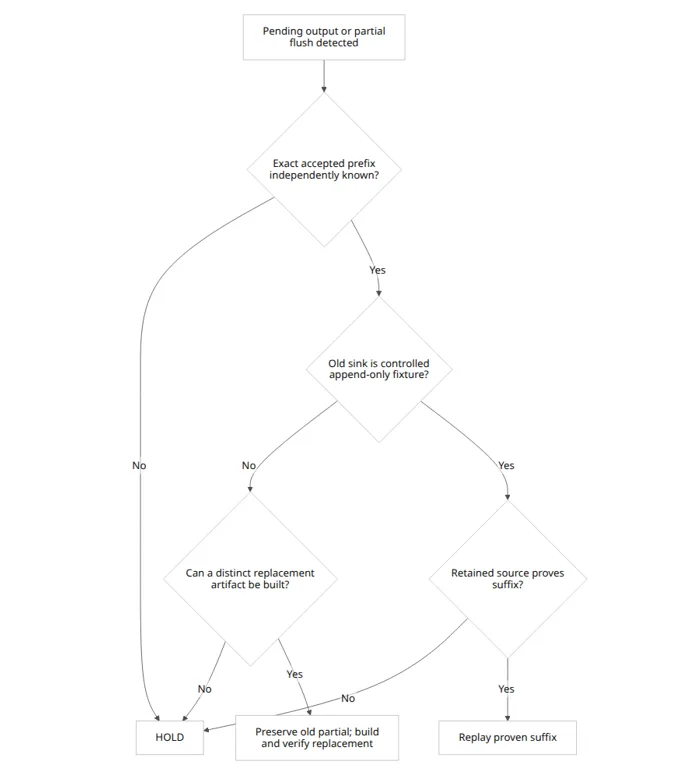
G08 takes the proven-suffix branch. G09 takes the preserved-old-artifact plus replacement branch.
An unknown external commit model belongs on HOLD, even if a writer returned a plausible n. The io.Writer contract defines how many bytes the call reports as written and how errors accompany short writes; it does not elevate that count into a universal business-transaction boundary.
Likewise, G09 is not “exactly once.” It establishes only that a replacement sink contains one correct eight-byte artifact while the old sink still visibly contains ABC. The disposition of that earlier partial output remains part of operational ownership.
Include the self-reset exception
G10 recreates G05 one more time. At the decision point, sink A contains ABC, the flush returned the injected error, and the expected buffered count is five.
Now call:
b.Reset(b)This is the one reset form that the Go 1.23.2 documentation explicitly defines as doing nothing: resetting a Writer to itself is a no-op. The moving source implements that special case with an identity check followed by an immediate return.
Accordingly, the authored expectation is that the pending count remains five, the prior error state remains effective, and the sink call count stays at one. A subsequent Flush should return the same injected error without another underlying call.
The decision is HOLD.
Do not confuse this with G04, G07, or G08. Those cases call b.Reset(sinkA), where sinkA is the underlying destination. G10 calls b.Reset(b), where b is the buffered writer itself. The first form performs reset semantics; the second is the documented self-reset exception.
This case is useful precisely because it prevents an overbroad review rule such as “Reset always clears pending bytes and errors.” The correct statement needs the self-reset qualification.
Reconcile the complete operation ledger
The authored case matrix is the acceptance specification. It is not an execution transcript.
ID | Action | Expected byte/error evidence | Operational decision |
G01 | Write eight bytes; do not Flush | Write accepts 8 into buffer; sink empty; Buffered=8; sink calls 0 | WITHHOLD |
G02 | Healthy Write, Flush, Reset to fresh sink | Original sink ABCDEFGH before reset; pending 0; new sink empty | ACCEPT original artifact |
G03 | Buffered Write; Reset to fresh sink before Flush; Flush | Both sinks empty; buffer 0; empty Flush nil | REPLAY_REQUIRED |
G04 | Buffered Write; Reset to same underlying sink; Flush | Sink empty; buffer 0; empty Flush nil | REPLAY_REQUIRED |
G05 | Buffered Write; first Flush to partial-fault sink | Sink ABC; expected Buffered=5; injected error | HOLD partial artifact |
G06 | Repeat G05; Flush again; Write again | Both calls retain error; new Write accepts 0; no second sink call; expected Buffered=5 | HOLD_ERROR |
G07 | Repeat G05; Reset same sink; replay all eight; Flush | Sink ABCABCDEFGH, 11 bytes | REJECT_DUPLICATION |
G08 | Repeat G05; Reset same sink; replay DEFGH; Flush | Sink ABCDEFGH; nil error; pending 0 | ACCEPT controlled suffix repair |
G09 | Repeat G05; preserve old sink; Reset new sink; replay all | Old ABC; replacement ABCDEFGH | ACCEPT replacement artifact only |
G10 | Repeat G05; b.Reset(b); Flush | Self-reset no-op; error and expected five pending remain; sink calls unchanged | HOLD |
The following complete harness encodes those expectations. It is supplied as a reproducible specification; it was NOT EXECUTED for this article.
package main

import (
    "bufio"
    "bytes"
    "errors"
    "fmt"
    "os"
    "runtime"
    "sort"
)

const (
    docBaseline  = "go1.23.2"
    requestedBuf = 16
)

var errInjected = errors.New("injected sink failure")

type sink struct {
    id        string
    data      []byte
    calls     int
    failFirst bool
    faultUsed bool
}

func (s sink) Write(p []byte) (int, error) {
    s.calls++

    if s.failFirst && !s.faultUsed {
        s.faultUsed = true
        n := 3
        if len(p) < n {
            n = len(p)
        }
        s.data = append(s.data, p[:n]...)
        if n < len(p) {
            return n, errInjected
        }
        return n, nil
    }

    s.data = append(s.data, p...)
    return len(p), nil
}

func (s sink) snapshot() string {
    return string(append([]byte(nil), s.data...))
}

type phase struct {
    CaseID        string
    Seq           int
    Action        string
    Buffered      int
    WriterSize    int
    SinkAID       string
    SinkABytes    string
    SinkACalls    int
    SinkBID       string
    SinkBBytes    string
    SinkBCalls    int
    ReturnN       int
    HasReturnN    bool
    ErrNil        bool
    ErrInjected   bool
}

type result struct {
    ID       string
    Decision string
    Phases   []phase
    SinkA    string
    SinkB    string
}

type fixture struct {
    id     string
    source []byte
    a      sink
    bsink  sink
    bw     bufio.Writer
    seq    int
    phases []phase
}

func newFixture(id string, faultA bool) fixture {
    a := &sink{id: id + "/sink-A", failFirst: faultA}
    bs := &sink{id: id + "/sink-B"}
    bw := bufio.NewWriterSize(a, requestedBuf)

    return &fixture{
        id:     id,
        source: []byte("ABCDEFGH"),
        a:      a,
        bsink:  bs,
        bw:     bw,
    }
}

func (f fixture) record(action string, n int, hasN bool, err error) {
    f.seq++
    f.phases = append(f.phases, phase{
        CaseID:      f.id,
        Seq:         f.seq,
        Action:      action,
        Buffered:    f.bw.Buffered(),
        WriterSize:  f.bw.Size(),
        SinkAID:     f.a.id,
        SinkABytes:  f.a.snapshot(),
        SinkACalls:  f.a.calls,
        SinkBID:     f.bsink.id,
        SinkBBytes:  f.bsink.snapshot(),
        SinkBCalls:  f.bsink.calls,
        ReturnN:     n,
        HasReturnN:  hasN,
        ErrNil:      err == nil,
        ErrInjected: errors.Is(err, errInjected),
    })
}

func writeAndRecord(f fixture, action string, p []byte) {
    n, err := f.bw.Write(p)
    f.record(action, n, true, err)
}

func flushAndRecord(f fixture, action string) {
    err := f.bw.Flush()
    f.record(action, 0, false, err)
}

func resetAndRecord(f fixture, action string, target interface{ Write([]byte) (int, error) }) {
    f.bw.Reset(target)
    f.record(action, 0, false, nil)
}

func require(ok bool, format string, args ...any) error {
    if ok {
        return nil
    }
    return fmt.Errorf(format, args...)
}

func last(r result) phase {
    return r.Phases[len(r.Phases)-1]
}

func g01() result {
    f := newFixture("G01", false)
    writeAndRecord(f, "write-source", f.source)
    return result{"G01", "WITHHOLD", f.phases, f.a.snapshot(), f.bsink.snapshot()}
}

func g02() result {
    f := newFixture("G02", false)
    writeAndRecord(f, "write-source", f.source)
    flushAndRecord(f, "flush-original")
    resetAndRecord(f, "reset-replacement", f.bsink)
    return result{"G02", "ACCEPT original artifact", f.phases, f.a.snapshot(), f.bsink.snapshot()}
}

func g03() result {
    f := newFixture("G03", false)
    writeAndRecord(f, "write-source", f.source)
    resetAndRecord(f, "reset-replacement-before-flush", f.bsink)
    flushAndRecord(f, "flush-after-reset")
    return result{"G03", "REPLAY_REQUIRED", f.phases, f.a.snapshot(), f.bsink.snapshot()}
}

func g04() result {
    f := newFixture("G04", false)
    writeAndRecord(f, "write-source", f.source)
    resetAndRecord(f, "reset-same-underlying-sink", f.a)
    flushAndRecord(f, "flush-after-reset")
    return result{"G04", "REPLAY_REQUIRED", f.phases, f.a.snapshot(), f.bsink.snapshot()}
}

func g05() result {
    f := newFixture("G05", true)
    writeAndRecord(f, "write-source", f.source)
    flushAndRecord(f, "flush-partial-fault")
    return result{"G05", "HOLD partial artifact", f.phases, f.a.snapshot(), f.bsink.snapshot()}
}

func g06() result {
    f := newFixture("G06", true)
    writeAndRecord(f, "write-source", f.source)
    flushAndRecord(f, "flush-partial-fault")
    flushAndRecord(f, "flush-again")
    writeAndRecord(f, "write-again", f.source)
    return result{"G06", "HOLD_ERROR", f.phases, f.a.snapshot(), f.bsink.snapshot()}
}

func g07() result {
    f := newFixture("G07", true)
    writeAndRecord(f, "write-source", f.source)
    flushAndRecord(f, "flush-partial-fault")
    resetAndRecord(f, "reset-same-underlying-sink", f.a)
    writeAndRecord(f, "replay-full-source", f.source)
    flushAndRecord(f, "flush-replay")
    return result{"G07", "REJECT_DUPLICATION", f.phases, f.a.snapshot(), f.bsink.snapshot()}
}

func g08() result {
    f := newFixture("G08", true)
    writeAndRecord(f, "write-source", f.source)
    flushAndRecord(f, "flush-partial-fault")
    resetAndRecord(f, "reset-same-underlying-sink", f.a)

    suffix := append([]byte(nil), f.source[3:]...)
    writeAndRecord(f, "replay-proven-suffix", suffix)
    flushAndRecord(f, "flush-suffix")
    return result{"G08", "ACCEPT controlled suffix repair", f.phases, f.a.snapshot(), f.bsink.snapshot()}
}

func g09() result {
    f := newFixture("G09", true)
    writeAndRecord(f, "write-source", f.source)
    flushAndRecord(f, "flush-partial-fault")
    resetAndRecord(f, "reset-replacement", f.bsink)
    writeAndRecord(f, "replay-full-source-to-replacement", f.source)
    flushAndRecord(f, "flush-replacement")
    return result{"G09", "ACCEPT replacement artifact only", f.phases, f.a.snapshot(), f.bsink.snapshot()}
}

func g10() result {
    f := newFixture("G10", true)
    writeAndRecord(f, "write-source", f.source)
    flushAndRecord(f, "flush-partial-fault")

    f.bw.Reset(f.bw)
    f.record("self-reset", 0, false, nil)

    flushAndRecord(f, "flush-after-self-reset")
    return result{"G10", "HOLD", f.phases, f.a.snapshot(), f.bsink.snapshot()}
}

func phaseByAction(r result, action string) (phase, bool) {
    for , p := range r.Phases {
        if p.Action == action {
            return p, true
        }
    }
    return phase{}, false
}

func evaluate(results []result) error {
    expectedIDs := []string{
        "G01", "G02", "G03", "G04", "G05",
        "G06", "G07", "G08", "G09", "G10",
    }

    if err := require(len(results) == len(expectedIDs),
        "case count: got %d want %d", len(results), len(expectedIDs)); err != nil {
        return err
    }

    gotIDs := make([]string, 0, len(results))
    byID := make(map[string]result, len(results))

    for , r := range results {
        if , exists := byID[r.ID]; exists {
            return fmt.Errorf("duplicate case ID %s", r.ID)
        }
        byID[r.ID] = r
        gotIDs = append(gotIDs, r.ID)

        for i, p := range r.Phases {
            if p.CaseID != r.ID {
                return fmt.Errorf("%s phase %d wrong case ID %s", r.ID, i, p.CaseID)
            }
            if p.Seq != i+1 {
                return fmt.Errorf("%s phase order: got seq %d want %d", r.ID, p.Seq, i+1)
            }
            if p.WriterSize < requestedBuf {
                return fmt.Errorf("%s writer size %d < requested %d",
                    r.ID, p.WriterSize, requestedBuf)
            }
        }
    }

    sort.Strings(gotIDs)
    wantIDs := append([]string(nil), expectedIDs...)
    sort.Strings(wantIDs)
    if err := require(equalStrings(gotIDs, wantIDs),
        "case membership got %v want %v", gotIDs, wantIDs); err != nil {
        return err
    }

    source := []byte("ABCDEFGH")

    g1 := byID["G01"]
    p := last(g1)
    if err := require(p.ReturnN == 8 && p.ErrNil &&
        p.Buffered == 8 && p.SinkACalls == 0 &&
        bytes.Equal([]byte(p.SinkABytes), nil),
        "G01 evidence mismatch: %+v", p); err != nil {
        return err
    }

    g2 := byID["G02"]
    p2f, ok := phaseByAction(g2, "flush-original")
    if err := require(ok &&
        bytes.Equal([]byte(p2f.SinkABytes), source) &&
        p2f.Buffered == 0 && p2f.ErrNil,
        "G02 flush evidence mismatch: %+v", p2f); err != nil {
        return err
    }
    if err := require(bytes.Equal([]byte(g2.SinkA), source) && g2.SinkB == "",
        "G02 final sinks A=%q B=%q", g2.SinkA, g2.SinkB); err != nil {
        return err
    }

    for , id := range []string{"G03", "G04"} {
        r := byID[id]
        p = last(r)
        if err := require(r.SinkA == "" && r.SinkB == "" &&
            p.Buffered == 0 && p.ErrNil,
            "%s expected abandoned pending bytes, got A=%q B=%q phase=%+v",
            id, r.SinkA, r.SinkB, p); err != nil {
            return err
        }
    }

    g5 := byID["G05"]
    p = last(g5)
    if err := require(g5.SinkA == "ABC" &&
        p.SinkACalls == 1 &&
        p.Buffered == 5 &&
        p.ErrInjected,
        "G05 evidence mismatch: A=%q phase=%+v", g5.SinkA, p); err != nil {
        return err
    }

    g6 := byID["G06"]
    p = last(g6)
    if err := require(g6.SinkA == "ABC" &&
        p.SinkACalls == 1 &&
        p.Buffered == 5 &&
        p.HasReturnN && p.ReturnN == 0 &&
        p.ErrInjected,
        "G06 evidence mismatch: A=%q phase=%+v", g6.SinkA, p); err != nil {
        return err
    }

    g7 := byID["G07"]
    if err := require(g7.SinkA == "ABCABCDEFGH" &&
        !bytes.Equal([]byte(g7.SinkA), source),
        "G07 must expose duplicated prefix, got %q", g7.SinkA); err != nil {
        return err
    }

    g8 := byID["G08"]
    p = last(g8)
    if err := require(bytes.Equal([]byte(g8.SinkA), source) &&
        p.Buffered == 0 && p.ErrNil,
        "G08 evidence mismatch: A=%q phase=%+v", g8.SinkA, p); err != nil {
        return err
    }

    g9 := byID["G09"]
    if err := require(g9.SinkA == "ABC" &&
        bytes.Equal([]byte(g9.SinkB), source),
        "G09 evidence mismatch: A=%q B=%q", g9.SinkA, g9.SinkB); err != nil {
        return err
    }

    g10 := byID["G10"]
    self, ok := phaseByAction(g10, "self-reset")
    if err := require(ok &&
        self.SinkABytes == "ABC" &&
        self.SinkACalls == 1 &&
        self.Buffered == 5,
        "G10 self-reset evidence mismatch: %+v", self); err != nil {
        return err
    }
    p = last(g10)
    if err := require(p.SinkACalls == 1 &&
        p.Buffered == 5 &&
        p.ErrInjected,
        "G10 final evidence mismatch: %+v", p); err != nil {
        return err
    }

    return nil
}

func equalStrings(a, b []string) bool {
    if len(a) != len(b) {
        return false
    }
    for i := range a {
        if a[i] != b[i] {
            return false
        }
    }
    return true
}

func negativeControlCorruptExpected(results []result) error {
    // Evaluator-only mutation of a copied result. Raw run evidence is untouched.
    copied := append([]result(nil), results...)
    for i := range copied {
        if copied[i].ID == "G08" {
            copied[i].SinkA = "ABCDEFGX"
            break
        }
    }
    return evaluate(copied)
}

func negativeControlDeleteCase(results []result) error {
    // Evaluator-only deletion from a copied result slice.
    copied := make([]result, 0, len(results)-1)
    for , r := range results {
        if r.ID != "G09" {
            copied = append(copied, r)
        }
    }
    return evaluate(copied)
}

func envOrUnspecified(k string) string {
    if v := os.Getenv(k); v != "" {
        return v
    }
    return "unspecified"
}

func main() {
    results := []result{
        g01(), g02(), g03(), g04(), g05(),
        g06(), g07(), g08(), g09(), g10(),
    }

    fmt.Printf("documentationbaseline=%s\n", docBaseline)
    fmt.Printf("runtime.Version=%s\n", runtime.Version())
    fmt.Printf("GOOS=%s\n", runtime.GOOS)
    fmt.Printf("GOARCH=%s\n", runtime.GOARCH)
    fmt.Printf("selected_toolchain=%s\n", envOrUnspecified("GOTOOLCHAIN"))
    fmt.Printf("source_revision=%s\n", envOrUnspecified("SOURCE_REVISION"))
    fmt.Printf("run_id=%s\n", envOrUnspecified("RUN_ID"))
    fmt.Printf("requested_buffer_size=%d\n", requestedBuf)
    fmt.Printf("payload=%q\n", "ABCDEFGH")

    for , r := range results {
        for , p := range r.Phases {
            fmt.Printf(
                "case=%s seq=%d action=%s size=%d buffered=%d "+
                    "sinkA=%s A=%q Acalls=%d sinkB=%s B=%q Bcalls=%d "+
                    "hasN=%t n=%d errNil=%t errInjected=%t decision=%q\n",
                p.CaseID, p.Seq, p.Action, p.WriterSize, p.Buffered,
                p.SinkAID, p.SinkABytes, p.SinkACalls,
                p.SinkBID, p.SinkBBytes, p.SinkBCalls,
                p.HasReturnN, p.ReturnN, p.ErrNil, p.ErrInjected,
                r.Decision,
            )
        }
    }

    if err := evaluate(results); err != nil {
        fmt.Fprintf(os.Stderr, "EVALUATION FAILED: %v\n", err)
        os.Exit(1)
    }

    if err := negativeControlCorruptExpected(results); err == nil {
        fmt.Fprintln(os.Stderr, "NEGATIVE CONTROL FAILED: corrupted G08 was accepted")
        os.Exit(2)
    }

    if err := negativeControlDeleteCase(results); err == nil {
        fmt.Fprintln(os.Stderr, "NEGATIVE CONTROL FAILED: missing G09 was accepted")
        os.Exit(3)
    }

    fmt.Println("EXPECTED_EVALUATION_PASS_IF_EXECUTED_UNDER_QUALIFIED_ENVIRONMENT")
}
The evaluator intentionally checks exact case membership and sequence numbers, sink identities, sink contents, call counts, pending counts, error class, and exact byte equality. It also uses two evaluator-only negative controls: one corrupts the copied G08 expected artifact, and one removes G09. Either must make evaluation fail without rewriting the underlying raw phase ledger.
That pattern resembles, at a high level, the need to distinguish a prefix from complete input: that related article tests a read-side N versus N+1 admission boundary. Here the object under review is output, but the same discipline applies: having a plausible prefix is not equivalent to proving the complete intended artifact.
Detect omitted evidence and misleading green calls
A laboratory can correctly “pass” a negative case whose output is unsuitable for application use.
G07 should pass its test when it produces ABCABCDEFGH, because the purpose of G07 is to demonstrate and detect duplication. The case expectation passes while the artifact decision is REJECT_DUPLICATION.
Likewise, G03 should pass when its sink remains empty. That validates the expected discard behavior; it does not authorize empty output.
The evaluator therefore needs both axes:
Axis | Question |
Behavioral conformance | Did the case produce the expected evidence? |
Artifact suitability | Does the designated output satisfy the eight-byte contract? |
Missing a case, missing the pre-reset snapshot, losing sink identity, or accepting a final nil Flush while sink bytes are wrong must block acceptance. Unknown partial progress should also block acceptance because the fixture no longer has enough independent evidence to choose safely between suffix repair and replacement.
Assign a bounded operational decision
The recovery vocabulary should make code review actionable rather than reduce every state to “retry” or “error.”
Evidence at reuse boundary | Decision | Required action |
Pending output exists, no error | WITHHOLD / flush before reuse | Flush and verify the designated sink before Reset |
Healthy flush completed and exact sink bytes match | ACCEPT | Reset may rebind the writer |
Reset already discarded known pending bytes while source is retained | REPLAY_REQUIRED | Recreate intended output under an explicitly chosen recovery path |
Partial prefix accepted; pending suffix and error remain | HOLD partial artifact | Capture ledger, source, error identity, and pending count |
Writer retains prior error despite healthy destination | HOLD_ERROR | Do not treat repeated calls on the same writer as recovery |
Full source replay would append behind proven prefix | REJECT_DUPLICATION | Do not approve the resulting artifact |
Exact prefix and suffix are independently proven in controlled fixture | ACCEPT controlled suffix repair | Reset and append only the proven suffix |
Old partial output preserved; complete new sink verified | ACCEPT replacement artifact only | Quarantine or otherwise disposition the old partial |
Progress or commit meaning is unknown | HOLD | Obtain stronger evidence rather than guess |
Self-reset leaves old state intact | HOLD | Treat b.Reset(b) as a no-op, not recovery |
The decision procedure is intentionally stricter than checking return values. First capture pending state and the named sink before reset. Then determine whether the old artifact is already complete. If it is not, preserve the evidence required to characterize any accepted prefix. Only after that should code choose between flushing, suffix repair under the narrow fixture assumptions, or building a replacement artifact.
Input admission has a parallel discipline but is not the same problem. The Refonte article on how to validate the whole Go JSON body checks a second decode and exact end-of-input so that one successful decode is not mistaken for complete request admission. Here the analogous warning is that one successful post-reset flush must not be mistaken for complete output accounting. The mechanisms and directions of data are different.
A version mismatch also yields HOLD when exact implementation-sensitive expectations matter. The versioned Go 1.23.2 API is authoritative for documented Reset and sticky-error semantics, but the five-byte retained-suffix prediction is tied to implementation behavior that should be verified under the actual recorded compiler before qualification.
Preserve recovery evidence and own future changes
The component that owns the buffered writer should also own the evidence required to retire or replace its output. For an exporter or encoder, that normally means naming both sides of the boundary: the component that decides when Reset may occur, and the consumer or artifact identifier whose byte completeness is being asserted.
Before repair, preserve the old state. At minimum the laboratory captures the retained source, sink identity, sink bytes, sink call count, operation phase, pending byte count, method return values, and injected-error class. In a real local component, the exact representation can differ, but the accounting requirement remains: do not destroy the only information capable of distinguishing “never written,” “partially written,” and “fully written.”
Reverting code after a bad reset does not retract bytes already accepted by an old sink. G07 makes that concrete with ABC: resetting writer state can permit future calls, but it cannot make the already copied prefix disappear. G09 likewise leaves the old ABC artifact intact even after a correct replacement ABCDEFGH exists.
Ownership also applies to future toolchain and destination changes. Re-run this fixture when the selected Go toolchain changes if the review depends on implementation-sensitive details such as exact retained-buffer counts after a partial flush. Revalidate the recovery rule if the sink stops being a synchronous owned in-memory writer, if its interpretation of accepted bytes changes, or if append-only assumptions no longer hold.
The source distinction should stay visible in review notes. The Go 1.23.2 bufio package documentation is the versioned API baseline and documents Reset's discard, error-clear, rebind, and self-reset behavior. The Go bufio implementation source is a maintained moving view whose inspected Flush currently retains an unaccepted suffix after a partial error. Those are different forms of evidence and should never be labeled interchangeably.
Build backend debugging skills with Refonte Learning
The Backend Developer Program is relevant here at the level of backend testing and debugging practice, not as evidence of Go-specific instruction. The program page lists a three-month period and 10–12 hours per week, with basic programming knowledge in the program specifics and a separate admission prerequisite of working toward a bachelor's degree or higher.
Its published curriculum includes Node.js and Express, MongoDB and SQL, RESTful APIs and microservices, authentication and authorization, backend testing and debugging, Docker and cloud deployment, and a capstone project. The page also lists an educational mentor and describes hands-on projects and internship-oriented learning; it uses “Potential Internship,” so placement should not be represented as guaranteed. On successful completion, the page states that Refonte Learning offers a Training Certificate and a Certificate of Internship.
Disciplined backend debugging benefits from separating method success from artifact correctness, recording enough state to reproduce a failure, and writing tests whose negative cases can succeed as tests while still rejecting the resulting output.