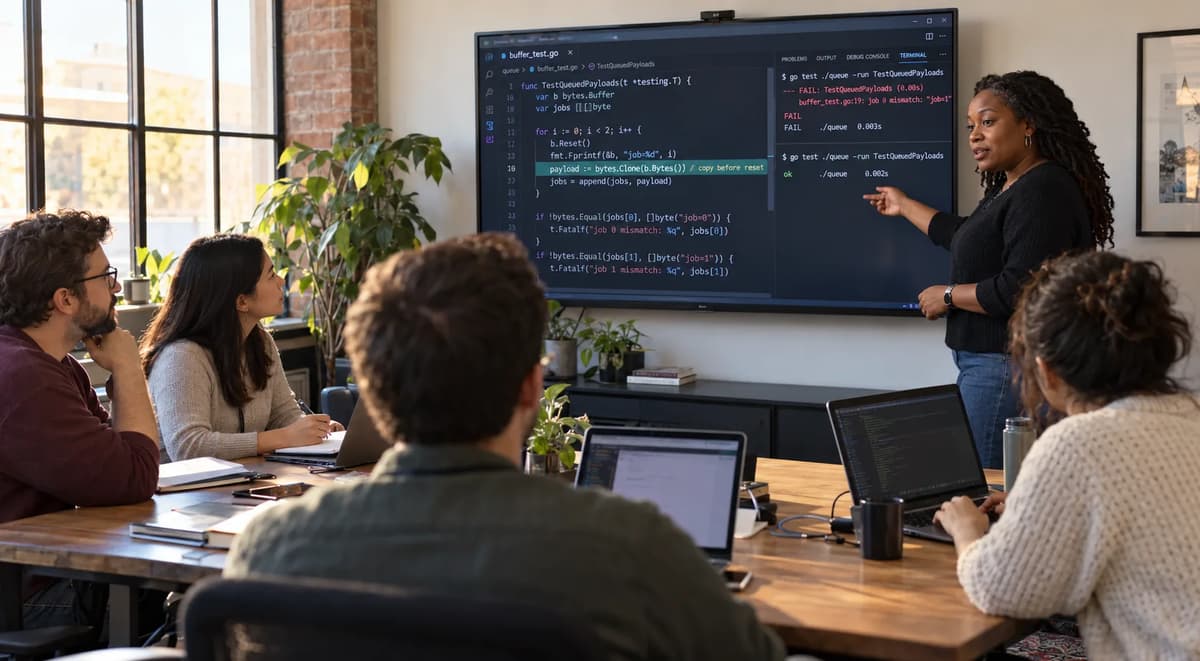
A queue can contain two jobs and still contain the wrong payload for one of them.
The supplied laboratory fixture makes that failure deliberately small. A producer writes the eight bytes event-A\n into a reusable bytes.Buffer, associates b.Bytes() with job-A, resets the buffer, writes the eight bytes event-B\n, and then associates the current bytes with job-B. Consumption is delayed until both jobs exist.
On the supplied Go 1.27.3, linux/amd64 run, the queue still had two jobs, but both payloads read event-B\n. job-A had not received an independent snapshot of event-A\n; it retained a slice view whose documented validity ended when the buffer was modified. The test needs no second goroutine, scheduler interleaving, network, or race. It is a sequential ownership mistake.
That distinction is the operational point. A successful enqueue proves that a record was appended. A queue length of two proves that two records exist. Neither proves that job-A still carries the bytes independently specified for job-A.
The review question is therefore not “did enqueue succeed?” It is: at the handoff, who is responsible for preserving these exact bytes until the consumer has finished with them?
This article uses three decisions. ACCEPT means evidence establishes a suitable completion or copy boundary. REPAIR means borrowed bytes are retained past producer reuse. HOLD means the intended original bytes are already unavailable, so a later copy cannot honestly reconstruct them.
The behavioral claims below separate Go’s documented contracts from the supplied fixture’s exact runtime observations and from the proposed service policy built on top of those facts.
Define the payload-preservation decision
Start with two independent content requirements:
· job-A must eventually be consumed as the eight bytes event-A\n.
· job-B must eventually be consumed as the eight bytes event-B\n.
The literal \n here denotes the newline byte. The distinction is deliberately content-level: the question is not whether two Job structs exist, whether an enqueue function returned nil, or whether the producer executed twice. The test passes only when the payload observed for each job ID can be compared with an oracle that was specified independently of whatever bytes happen to occupy the reusable buffer later.
That is a different boundary from validating a Go response byte limit. A size-admission test asks whether a response is complete and within an allowed byte count before admission. This experiment assumes the synthetic eight-byte values already exist and asks whether one accepted value remains intact while producer storage is reused.
The policy vocabulary should be fixed before looking at surprising output:
Decision | Meaning at this boundary |
ACCEPT | The consumer finished while the borrowed bytes were valid, or an independent copy was established before the producer could invalidate the view. |
REPAIR | The handoff lets the consumer retain storage still controlled and later modified by the producer. |
HOLD | The old intended bytes are no longer independently available, so code should not manufacture a replacement and label it the original payload. |
Delivery is intentionally outside this decision. Even an independently owned event-A\n slice says nothing about whether a remote broker received it, whether a worker processed it, whether a database committed it, or whether duplicate delivery is possible.
Likewise, an ACCEPT here does not mean the bytes are immutable. A copied []byte remains mutable by whichever code owns that new storage. The acceptance claim is narrower: producer reuse no longer changes that copy through the alias tested here.
Map the lifetime of the borrowed bytes
The essential contract is unusually direct. The Go bytes package documentation for Buffer.Bytes says that Bytes returns a slice holding the buffer’s unread portion, that the slice is valid only until the next buffer modification, and that it aliases the buffer content at least until such a modification. The same page says Reset empties the buffer while retaining its underlying storage for future writes.
That is enough to frame the bug. b.Bytes() is a view, not a durable payload snapshot.
The Go language specification on slice types supplies the underlying language model: an initialized slice is associated with an underlying array and shares storage with that array and other slices referring to it. A slice value carries access to elements; assigning that slice value elsewhere does not by itself allocate a distinct array for the bytes.
This is the narrow slice concept reviewers need for slice aliasing during Go buffer reuse. There is no need to turn the review into a general ownership treatise. Ask only two questions:
1. Does the consumer retain this []byte after the producer may modify the buffer?
2. If yes, where is independent storage established?
The documented boundary is the next buffer modification, not the lexical end of a variable’s scope and not the eventual garbage-collection lifetime of an array. Reset, Write, Read, and Truncate are among the modifications explicitly named in the Bytes documentation.
After that boundary, the old view is no longer a supported object from which to infer stable payload contents. It may appear to contain familiar bytes in a particular experiment, but that observation is no longer the contract.
Identify the last safe use before the producer changes storage
A compact ownership ledger makes the review concrete:
Actor or event | Relevant responsibility |
Producer | Builds event-A\n in bytes.Buffer. |
Buffer.Bytes() result | Borrowed view valid only until the next buffer modification. |
Consumer | Must finish using the borrowed view before that modification, or receive independent storage. |
Reset / subsequent write | Crosses the documented lifetime boundary for the old Bytes view. |
Boundary owner | Must ensure either completed consumption or an early copy before producer reuse. |
The most dangerous review shortcut is to see payload := b.Bytes() and mentally convert the new variable name into new ownership. Variable independence is not byte-storage independence.
The useful question concerns timing: does consumer completion, copying, or producer modification happen first?
If modification wins that race in a single sequential call chain, no concurrency analysis is required. The ownership decision has already failed.
Build the pinned, sequential test environment
The supplied experiment was reported as executed on October 26, 2026 with Go 1.27.3 on linux/amd64. It uses one goroutine, fixed eight-byte payloads, an initial buffer capacity of 64, an in-memory []Job queue, and a separate synchronous bytes.Buffer destination for the io.Writer control. The delayed consumer is deliberately sequential.
That makes the laboratory smaller than checking for one complete JSON value in Go requests. JSON syntax, decoder read-ahead, HTTP admission, and request-body completeness are different prerequisite questions; none is needed to expose this storage-lifetime problem.
Save the complete fixture as go_buffer_fixture.go and run:
go version
go run go_buffer_fixture.go -source go_buffer_fixture.go > go_buffer_results.json
Qualification requires a zero process exit and inspection of the JSON report: status, runtime, OS/architecture, source SHA-256, and all IDs G1 through G12.
The supplied source is:
package main
import (
"bytes"
"crypto/sha256"
"encoding/hex"
"encoding/json"
"flag"
"fmt"
"io"
"os"
"runtime"
"time"
)
const first = "event-A\n"
const second = "event-B\n"
type Case struct {
ID string json:"id"
Observation any json:"observation"
Decision string json:"decision"
}
type Report struct {
Status string json:"status"
Go string json:"go"
OS string json:"os"
Arch string json:"arch"
Started string json:"started_utc"
Finished string json:"finished_utc"
SourceSHA256 string json:"source_sha256"
Failure string json:"failure,omitempty"
Cases []Case json:"cases"
}
type Job struct { ID string; Payload []byte }
func require(ok bool, label string) { if !ok { panic(label) } }
func fresh() bytes.Buffer {
b := bytes.NewBuffer(make([]byte, 0, 64))
n, err := b.WriteString(first)
require(err == nil && n == len(first), "baseline write")
return b
}
func reuse(b bytes.Buffer) {
b.Reset()
require(b.Len() == 0, "reset length")
n, err := b.WriteString(second)
require(err == nil && n == len(second), "reuse write")
}
func payloads(q []Job) map[string]string {
out := make(map[string]string)
for , job := range q { out[job.ID] = string(job.Payload) }
return out
}
func main() {
source := flag.String("source", "gobuffer_fixture.go", "the source file passed to go run")
flag.Parse()
r := Report{Status:"FAIL", Go:runtime.Version(), OS:runtime.GOOS, Arch:runtime.GOARCH, Started:time.Now().UTC().Format(time.RFC3339Nano), Cases:[]Case{}}
defer func() {
if problem := recover(); problem != nil { r.Failure = fmt.Sprint(problem) }
r.Finished = time.Now().UTC().Format(time.RFC3339Nano)
enc := json.NewEncoder(os.Stdout); enc.SetIndent("", " ")
if err := enc.Encode(r); err != nil { fmt.Fprintln(os.Stderr, err); os.Exit(2) }
if r.Status != "PASS_12_CASES" { os.Exit(1) }
}()
raw, err := os.ReadFile(*source); require(err == nil, "read declared source")
digest := sha256.Sum256(raw); r.SourceSHA256 = hex.EncodeToString(digest[:])
add := func(id string, observation any, decision string) { r.Cases = append(r.Cases, Case{id, observation, decision}) }
b := fresh(); borrowed := b.Bytes()
require(string(borrowed) == first, "G1 immediate contents")
add("G1", string(borrowed), "ACCEPT_IMMEDIATE_READ")
b = fresh(); borrowed = b.Bytes(); anotherHeader := borrowed
anotherHeader[0] = 'E'
require(b.String() == "Event-A\n", "G2 assignment aliases")
add("G2", b.String(), "REPAIR_HEADER_COPY")
b = fresh(); borrowed = b.Bytes(); capped := borrowed[:len(borrowed):len(borrowed)]
capped[0] = 'E'
require(cap(capped) == len(capped) && b.String() == "Event-A\n", "G3 capacity is not ownership")
add("G3", map[string]any{"buffer":b.String(), "length":len(capped), "capacity":cap(capped)}, "REPAIR_CAPACITY_ONLY")
b = fresh(); borrowed = b.Bytes(); initialCap := b.Cap(); reuse(b)
// Deliberate expired-view observation: exact bytes are runtime evidence, not an API promise.
require(string(borrowed) == second && b.Cap() == initialCap, "G4 pinned-runtime reuse observation")
add("G4", map[string]any{"expired_view":string(borrowed), "current":b.String(), "capacity":b.Cap()}, "REPAIR_EXPIRED_VIEW")
b = fresh(); owned := bytes.Clone(b.Bytes()); reuse(b)
require(string(owned) == first && b.String() == second, "G5 clone before reuse")
add("G5", string(owned), "ACCEPT_EARLY_CLONE")
b = fresh(); owned = make([]byte, b.Len()); n := copy(owned, b.Bytes()); reuse(b)
require(n == len(first) && string(owned) == first, "G6 make and copy")
add("G6", map[string]any{"copied":n,"payload":string(owned)}, "ACCEPT_EARLY_COPY")
b = fresh(); owned = append([]byte(nil), b.Bytes()...); reuse(b)
require(string(owned) == first, "G7 append to independent storage")
add("G7", string(owned), "ACCEPT_EARLY_APPEND_COPY")
b = fresh(); borrowed = b.Bytes(); reuse(b); tooLate := bytes.Clone(borrowed)
require(string(tooLate) == second, "G8 pinned-runtime late copy")
add("G8", string(tooLate), "HOLD_ORIGINAL_CONTENT_LOST")
input := []byte(first); b = bytes.NewBuffer(input)
// Deliberately violate NewBuffer's ownership contract using only synthetic bytes.
input[0] = 'E'
require(b.String() == "Event-A\n", "G9 constructor ownership violation")
add("G9", b.String(), "REPAIR_CALLER_OWNERSHIP")
b = fresh(); queue := []Job{{"job-A", b.Bytes()}}; reuse(b)
queue = append(queue, Job{"job-B", b.Bytes()}); observed := payloads(queue)
require(observed["job-A"] == second && observed["job-B"] == second, "G10 deferred consumer observation")
add("G10", observed, "REPAIR_BORROWED_QUEUE")
b = fresh(); queue = []Job{{"job-A", bytes.Clone(b.Bytes())}}; reuse(b)
queue = append(queue, Job{"job-B", bytes.Clone(b.Bytes())}); observed = payloads(queue)
require(observed["job-A"] == first && observed["job-B"] == second, "G11 owned queue")
add("G11", observed, "ACCEPT_OWNED_QUEUE")
b = fresh(); var destination bytes.Buffer; var writer io.Writer = &destination
n, err = writer.Write(b.Bytes()); require(err == nil && n == len(first), "G12 complete synchronous write")
reuse(b)
require(destination.String() == first && b.String() == second, "G12 synchronous consumer retained value")
add("G12", map[string]any{"destination":destination.String(),"source_now":b.String()}, "ACCEPT_SYNCHRONOUS_CONTROL")
require(len(r.Cases) == 12, "case count")
for i, c := range r.Cases { require(c.ID == fmt.Sprintf("G%d", i+1), "case order") }
r.Status = "PASS_12_CASES"
}
The baseline helpers matter. fresh always starts from a zero-length slice with capacity 64 and writes exactly event-A\n; reuse calls Reset, verifies length zero, then writes exactly event-B\n. These controls prevent the central comparison from depending on a real queue, HTTP stack, serializer, scheduler, or remote service.
The fixture does not test network delivery, HTTP body-size admission, JSON parsing, error-interface identity, goroutine scheduling, data-race behavior, sync.Pool lifecycle, unsafe pointers, allocation performance, throughput, persistent queues, or exactly-once delivery. Those are scope boundaries, not implied coverage.
Observe retained bytes after Reset and reuse
G1 establishes the uncontroversial positive case. Immediately after fresh, the code obtains:
borrowed := b.Bytes()
and verifies string(borrowed) == "event-A\n" before any modification. That is within the lifetime documented for Buffer.Bytes, so the policy labels it ACCEPT_IMMEDIATE_READ.
G4 changes one thing: it retains that view while the producer calls reuse.
The sequence is:
write event-A\n
take b.Bytes()
Reset()
write event-B\n
inspect the old slice
The supplied Go 1.27.3 run observed that the expired view now read event-B\n, the current buffer read event-B\n, and the buffer capacity remained 64. Reset retaining underlying storage is documented, so reuse of storage is not surprising. But the precise post-expiration contents of the old view are not promised by Buffer.Bytes. The documentation stopped authorizing use of that slice at the next modification.
That difference between contract and observation is central.
A reviewer may legitimately say:
The supplied runtime demonstrates that retaining this borrowed view across Reset and rewrite can destroy the intended payload snapshot.
A reviewer should not turn that into:
Every Go version, capacity, reset sequence, and subsequent write will always make the expired slice contain exactly the replacement payload.
G4 intentionally examines an expired view to expose a faulty lifetime assumption. If another runtime produced partial old data, different replacement data, or some other result, that would trigger investigation of the fixture and implementation. It would not extend the documented validity period.
This is why a non-reproduction of the exact event-B\n observation would not make deferred borrowing acceptable. The defect is already established at the contract boundary: the consumer requires stable data past a modification for which the documented Bytes view is no longer valid.
The retained capacity of 64 is similarly an experimental observation relevant to explaining this run, not an application guarantee that should be encoded into queue correctness.
Reject slice-header and capacity-only fixes
G2 tests a common false repair: assign the returned slice to another variable.
borrowed := b.Bytes()
anotherHeader := borrowed
anotherHeader[0] = 'E'
The result in the fixture is intentionally visible: the buffer changes from event-A\n to Event-A\n.
That is consistent both with the Buffer.Bytes documentation, which says immediate changes through the returned alias affect the buffer, and with the language rule that slices referring to the same underlying array share storage.
The 2011 Go article “Go Slices: usage and internals” remains useful historical technical context: it explains that slicing does not copy the data and illustrates mutations through one slice appearing through another view of the same array. Published on January 5, 2011, it describes established slice behavior.
G3 tests a more sophisticated-looking version:
capped := borrowed[:len(borrowed):len(borrowed)]
For the eight-byte payload, len(capped) and cap(capped) are both eight. Yet setting capped[0] = 'E' still makes the buffer Event-A\n.
So both policies need repair:
anotherHeader := borrowed
and:
capped := borrowed[:len(borrowed):len(borrowed)]
Neither establishes an independent payload array.
Why reducing capacity does not copy existing bytes
A full slice expression changes the resulting slice’s capacity. The Go specification’s full-slice-expression rule describes a[low:high:max] as creating a slice whose capacity is controlled by max - low; it does not say that existing elements are copied into a new array.
That distinction is useful when reviewing append behavior. Limiting capacity can prevent a consumer from using spare capacity in the same way it could through a wider slice; an append that exceeds the reduced capacity may force different storage for the result.
But none of that changes the ownership of the eight elements already addressed by capped.
G3 mutates byte zero directly. No append is involved. The direct element access still reaches shared storage, so the buffer changes immediately.
A full slice expression therefore controls capacity; it does not transfer ownership. Treating s[:len(s):len(s)] as an owned payload snapshot confuses the rules governing future growth with the rules governing present bytes.
For this handoff, the test is simpler: can producer modification affect the bytes the consumer intends to retain? If yes, capacity alone has not solved the problem.
Copy the payload while the intended bytes still exist
G5, G6, and G7 test three early-copy forms against the same oracle. In each case, the copy happens while b.Bytes() still validly contains event-A\n; only then is the producer allowed to reuse the buffer.
G5 uses:
owned := bytes.Clone(b.Bytes())
The bytes documentation says Clone returns a copy of the input slice. It is marked as added in Go 1.20, so it is an established API rather than a feature introduced for Go 1.27 or in 2026. The supplied run found that the clone remained event-A\n after the original buffer became event-B\n.
G6 makes the storage decision more explicit:
owned = make([]byte, b.Len())
n := copy(owned, b.Bytes())
The Go specification says a slice created with make allocates a new hidden array, and copy copies elements from source to destination and reports how many were copied. G6 verifies eight copied bytes before reuse and observes event-A\n afterward.
G7 uses:
owned = append([]byte(nil), b.Bytes()...)
Because the destination starts nil with zero capacity, appending the eight source bytes produces storage capable of holding those elements rather than reusing the buffer’s underlying array. The supplied observation again remains event-A\n after reuse. The historical Go slices article documents the allocation-and-copy behavior involved in growing slices and the role of append; the fixture is the direct evidence for this particular expression.
All three establish the same required boundary for this experiment:
borrow valid bytes
↓
create independent byte storage
↓
handoff may retain that storage
↓
producer may Reset/write again
Choosing among bytes.Clone, make plus copy, or an append-copy idiom is mostly an API-expression question here. No benchmark was performed, so this evidence does not support allocation-rate or throughput claims.
For review clarity, bytes.Clone directly communicates “I need a copy.” make plus copy exposes allocation size and lets the program verify the copied count. The append form is compact and established. Any can be acceptable when it executes at the correct time.
The timing is essential: copy bytes before enqueueing when the consumer may outlive the buffer’s current contents.
Place the copy before the ownership boundary
G8 explains why merely finding bytes.Clone somewhere in the code is insufficient:
borrowed = b.Bytes()
reuse(b)
tooLate := bytes.Clone(borrowed)
In the supplied run, tooLate contains event-B\n.
Clone did its job. It copied the bytes visible through its source argument at the time it was called. The problem is that the program had already crossed the documented lifetime boundary for the old Buffer.Bytes view, and the experiment then observed replacement contents through that expired view.
A late copy can stabilize the current bytes. It cannot reconstruct historical information that no independent source still preserves.
That is why G8 is HOLD_ORIGINAL_CONTENT_LOST, not REPAIR_WITH_LATE_CLONE.
The distinction matters operationally. Once job-A's independently specified event-A\n is gone, taking a clean copy of event-B\n and relabeling it job-A would create well-owned but semantically false data.
Reconcile delayed consumption by job ID
G10 is the payload-preservation failure in its queue-shaped form:
b = fresh()
queue := []Job{{"job-A", b.Bytes()}}
reuse(b)
queue = append(queue, Job{"job-B", b.Bytes()})
observed := payloads(queue)
No goroutine consumes the queue. No producer and consumer overlap. payloads simply runs later in the same sequential program.
The supplied observation is:
Job | Independently expected | G10 observed |
job-A | event-A\n | event-B\n |
job-B | event-B\n | event-B\n |
The queue has length two. Both IDs still exist. The second payload is correct. Yet the first job’s content is wrong.
That is why queue cardinality is weak evidence for this failure mode. A test such as require(len(queue) == 2) would be green while the business mapping between job identity and payload had already been lost.
G11 changes only the handoff:
queue := []Job{{"job-A", bytes.Clone(b.Bytes())}}
reuse(b)
queue = append(queue, Job{"job-B", bytes.Clone(b.Bytes())})
Now the supplied observation is:
Job | Independently expected | G11 observed |
job-A | event-A\n | event-A\n |
job-B | event-B\n | event-B\n |
That is the evidence needed for ACCEPT_OWNED_QUEUE within this local experiment. It establishes byte independence from the reused producer buffer; it does not establish immutable payloads, durable queuing, concurrent safety, or delivery.
A related Refonte article considers how ownership changes when transferring an ArrayBuffer. The shared design lesson is that a handoff must define who needs the bytes afterward. The runtime mechanism differs materially: browser transfer can detach the sender’s ArrayBuffer, whereas Go does not detach a []byte alias when bytes.Buffer.Reset is called. The old Go slice can remain accessible even though the Buffer.Bytes contract no longer authorizes continued use after modification.
Check each payload, not just the number of jobs
A preservation test should therefore join observations back to stable business identity:
job ID → expected independent bytes → observed consumer bytes
Do not substitute:
enqueue returned success
queue length increased
consumer saw some eight-byte value
Those are different properties.
For this fixture, the decisive assertion is not that job-A and job-B exist. It is that job-A == event-A\n and job-B == event-B\n at the delayed read point.
That pattern generalizes without claiming anything about external queue implementations: whenever a consumer may retain mutable byte storage, use an independent per-item oracle to qualify preservation. The oracle might come from a test constant, trusted source record, digest, or another independently retained representation. In this fixture it is deliberately the two literal constants so there is no ambiguity about what each ID is supposed to mean.
Use synchronous consumption as a separate control
G12 prevents the article from turning into “copy every byte slice before every API call.”
The consumer contract matters.
The fixture creates a second bytes.Buffer, exposes it through io.Writer, and performs:
n, err = writer.Write(b.Bytes())
require(err == nil && n == len(first), "G12 complete synchronous write")
reuse(b)
Only after the write returns with all eight bytes accepted does the producer reset and rewrite its own buffer. The supplied observation is that the destination retains event-A\n while the source becomes event-B\n.
The Go io.Writer interface documentation is critical here. It requires Write not to modify the input slice, even temporarily, and requires implementations not to retain that input slice. It also specifies the relationship among n, len(p), and errors, including that a short write must return a non-nil error.
So a conforming io.Writer has a different handoff contract from the custom []Job queue.
The custom queue in G10 stores the supplied []byte for later reading. It is deliberately not presented as an io.Writer implementation, because an io.Writer that retained p would violate the documented interface contract.
For G12, the review boundary is therefore:
1. pass the valid borrowed b.Bytes() to Write;
2. wait for the call to return;
3. verify err == nil and n == len(payload);
4. only then modify or reuse the producer buffer.
That is an ACCEPT path because consumption under the relevant interface contract has completed before the buffer changes.
This does not mean every function named Write in an application has the io.Writer contract. A custom method that documents asynchronous retention requires its own lifetime rules. Review the actual interface or API being called.
It also does not mean successful synchronous consumption proves anything beyond that call. G12 contains no network writer, filesystem durability test, external broker acknowledgment, or exactly-once processing claim. The destination happens to be an in-memory bytes.Buffer, making the control deterministic and easy to inspect.
The broader rule is therefore not “always copy.” It is: either establish independent storage before retention, or complete consumption while the borrowed storage is still valid.
Check ownership at the constructor boundary
bytes.NewBuffer reverses the direction of the ownership question.
With Buffer.Bytes, the buffer lends the caller a view with a limited validity period. With NewBuffer, the caller supplies storage to the buffer. The bytes documentation says the new Buffer takes ownership of the supplied buf and that the caller should not use buf afterward.
G9 deliberately violates that rule:
input := []byte(first)
b = bytes.NewBuffer(input)
input[0] = 'E'
The supplied observation is that the buffer then reads Event-A\n.
That is not a recommended technique and should not be turned into a promise about how callers can share constructor input. The case uses harmless synthetic bytes specifically to show what happens when the caller disregards the constructor’s documented ownership direction.
Its policy is REPAIR_CALLER_OWNERSHIP.
The important reviewer habit is symmetric:
Buffer.Bytes:
buffer owns storage → caller receives borrowed view
bytes.NewBuffer:
caller supplies storage → new Buffer takes ownership
In both directions, correctness depends on asking who is still allowed to mutate the relevant bytes after the boundary.
A constructor argument called input remaining in lexical scope does not mean the caller is still entitled to use it. Conversely, receiving a slice from Bytes into a variable called payload does not imply that the receiver has acquired long-lived ownership.
API documentation, not variable naming, defines the expected relationship.
G9 also explains why “our code never calls Reset” would be an incomplete ownership audit. Aliasing can enter from the opposite side when a buffer is initialized from caller-supplied storage. The narrow repair is not to survey every bytes.Buffer method; it is to honor the ownership rule at the constructor and stop using the transferred input through the caller’s old reference.
Capture a complete and interpretable evidence ledger
The supplied October 26, 2026 laboratory run reports Go 1.27.3 on linux/amd64, exit status zero, JSON status PASS_12_CASES, and this source SHA-256:
5551846e484372dfb4a8fe3eab7110c093724a3f4da3df12ec5e23ec24e72de7
The complete case ledger is:
Case | Experiment | Supplied observation | Policy |
G1 | Read Bytes before modification | event-A\n | ACCEPT immediate use |
G2 | Copy slice header, mutate byte 0 | Buffer becomes Event-A\n | REPAIR header-only copy |
G3 | Cap slice at length, mutate byte 0 | Len/cap 8; buffer becomes Event-A\n | REPAIR capacity-only rule |
G4 | Retain Bytes, Reset, write event-B\n | Expired view reads event-B\n; capacity 64 | REPAIR expired view |
G5 | bytes.Clone before reuse | Copy remains event-A\n | ACCEPT early clone |
G6 | make plus copy before reuse | Eight bytes copied; event-A\n retained | ACCEPT early copy |
G7 | Append into independent nil slice | event-A\n retained | ACCEPT early append copy |
G8 | Clone expired view after reuse | New copy contains event-B\n | HOLD original payload |
G9 | Modify caller input after NewBuffer | Buffer becomes Event-A\n | REPAIR caller ownership |
G10 | Enqueue borrowed bytes for two jobs | Both jobs read event-B\n | REPAIR borrowed queue |
G11 | Clone at each enqueue | A reads event-A\n; B reads event-B\n | ACCEPT owned queue |
G12 | Complete synchronous Write | Destination keeps A; source becomes B | ACCEPT synchronous control |
PASS_12_CASES needs careful interpretation. It means all twelve assertions observed the behavior the fixture was designed to check. It does not approve all twelve application policies.
G2, G3, G4, G9, and G10 deliberately pass by demonstrating conditions that the service policy says must be repaired. G8 passes by demonstrating that the old content has already been lost for purposes of this fixture’s recovery decision.
That separation prevents a common testing error: conflating “negative control behaved exactly as expected” with “candidate design is safe to ship.”
The article therefore uses three levels of claim throughout:
Level | What it means |
Documented contract | A behavior or lifetime rule stated by Go’s maintained specification or package documentation. |
Observation | An exact output recorded by the supplied pinned-runtime fixture. |
Proposed policy | An application decision (ACCEPT, REPAIR, or HOLD) made from the required payload lifetime and available evidence. |
G4, G8, and G10 are especially important to keep in the second category when discussing exact replacement bytes. They inspect views beyond the documented Buffer.Bytes validity boundary. Their value is diagnostic, not normative.
Keep provenance separate from behavioral proof
The -source option does one specific thing: it reads the named file and reports that file’s SHA-256.
That makes the digest useful for tying a result document to the source bytes supplied for the run. It does not attest to arbitrary binaries, compiler installations, external dependencies, or a deployment artifact.
The provenance statement for the supplied evidence is therefore:
source filename: go_buffer_fixture.go
SHA-256:
5551846e484372dfb4a8fe3eab7110c093724a3f4da3df12ec5e23ec24e72de7
reported runtime: go1.27.3
reported OS/arch: linux/amd64
reported status: PASS_12_CASES
reported process exit: 0
If the source is edited, even to change an assertion, diagnostic field, or behaviorally meaningful control, the next result should carry the newly computed hash and should not be presented as the unchanged original run.
Likewise, rerunning on another Go release creates new evidence. A differing G4-style expired-view observation would be recorded as a discrepancy and investigated; it should not be massaged to resemble the supplied output. The durable contract remains the documented lifetime boundary, while exact expired-view contents remain runtime evidence.
Also keep three separate ideas apart: an unchanged source hash, correct payload preservation, and successful downstream delivery. A source digest can support the first. G5/G6/G7/G11 can support the second within this fixture. Nothing here establishes the third.
Choose ACCEPT, REPAIR or HOLD
At review time, the ownership rule can be reduced to one matrix:
Handoff | Owner after handoff | Evidence required | Decision |
Borrowed Buffer.Bytes used immediately and fully before modification | Buffer remains storage owner during use | Consumer completion precedes any buffer modification | ACCEPT |
Complete conforming synchronous io.Writer.Write before reuse | Writer may consume during call but must not retain input | n == len(p), acceptable err, call returned before reuse | ACCEPT |
Copy made before deferred handoff | New payload storage belongs to queue/job side | Independent copy created while source view is valid; per-job bytes match oracle | ACCEPT |
Borrowed slice retained after producer may Reset, write, read, or truncate | Producer still controls storage consumer depends on | Consumer lifetime exceeds documented borrow | REPAIR |
Only copied slice header or reduced capacity | Underlying byte storage remains shared | Mutation still aliases source | REPAIR |
Caller keeps mutating input after NewBuffer takes ownership | Ownership contract is violated | Caller still uses transferred input | REPAIR |
Copy attempted after the intended older bytes are already unavailable | New copy owns only whatever bytes remain at copy time | No independent source for original payload | HOLD |
The review rule is:
At any handoff that may outlive the producer’s next buffer modification, either transfer an independently stored byte representation to the consumer or establish a contract under which consumption completes before that modification.
The rule is intentionally timing-sensitive. It does not insist that every function receiving []byte allocate. A synchronous consumer with a suitable no-retention contract can be correct without an application-side copy.
Conversely, merely calling a copying function eventually is not enough. G8 demonstrates that copy timing is part of correctness.
A useful code-review question is therefore more precise than “is this slice copied?” Ask:
At the instant the producer may next modify this storage,
has the consumer already finished, or does it own independent bytes?
If neither condition is demonstrated, the boundary remains REPAIR.
Do not describe the copy as immutable. bytes.Clone and make plus copy establish independent storage relative to this aliasing relationship; downstream code holding the clone may still mutate it.
And do not upgrade the result into thread-safety evidence. This fixture uses one goroutine. A concurrent producer/consumer design needs its own synchronization and race-focused qualification in addition to, not instead of, the payload-lifetime rule.
Recover from an already-reused payload
Once a suspected handoff has already crossed the reuse boundary, recovery becomes an evidence problem rather than a slice-syntax problem.
The following is a proposed operational procedure. It is not fixture output; the fixture contains no persistent queue, external worker, database, or production incident.
1. Stop or isolate new suspect handoffs. Prevent the producer from continuing the same retaining-borrowed-slice pattern while evidence is being assessed. A code change can protect future payloads even when older ones remain uncertain.
2. Identify affected jobs by an independent boundary. Use job IDs, timestamps, deployment versions, producer sequence information, or other trustworthy records that exist outside the overwritten byte slice. Do not infer an original body merely because a current slice has the expected length.
3. Compare available payload evidence with an independent source. If the original event can be reconstructed from a durable source record, authenticated input, retained request, canonical database state, or another approved artifact, regenerate it from that source and validate the regenerated bytes against the relevant application contract.
4. HOLD when the source is unavailable. If the only supposed record of job-A is an expired borrowed slice that now contains another payload, there is no honest byte-level repair demonstrated here. A fresh clone of those current bytes merely preserves the wrong value more reliably.
5. Resume only with a qualified handoff. Establish an early copy or completed-consumption boundary and rerun a preservation test by job ID before considering the specific aliasing repair closed.
This procedure deliberately says nothing about replay authorization, ordering, deduplication, or exactly-once processing. An application that can reconstruct original bytes may still need a separate business decision about whether resubmission is safe.
G8 is the laboratory model for HOLD. The copy operation itself succeeds, but it captures event-B\n because the intended event-A\n value is no longer present in an independent source available to that path.
State what reverting the code can restore
A rollback or hotfix can restore the correct future handoff rule:
old:
queue = append(queue, Job{id, b.Bytes()})
repaired:
queue = append(queue, Job{id, bytes.Clone(b.Bytes())})
What it cannot do is travel backward and reconstruct overwritten payloads.
That limitation should appear explicitly in an operational decision. “The bug was rolled back” and “all previously affected queued payloads are correct” are separate claims requiring separate evidence.
The same applies to restart-based remediation. Reinitializing the process may remove currently aliased in-memory objects, but it does not prove that any externally propagated payload has been corrected. This fixture contains no external queue, so it supplies no basis for automatic replay or downstream cleanup claims.
Rollback restores a code path. Recovery restores data only when trustworthy source data still exists.
Assign the boundary owner and acceptance criteria
Storage-lifetime bugs survive code review when responsibility is split implicitly: the producer assumes the consumer copies, while the consumer assumes the producer will not reuse.
Make one side responsible at the API boundary.
For a queue-like API that retains payloads, a strong contract is that the queue constructor or enqueue method establishes ownership before returning, either by copying internally or by accepting only a caller-owned object whose required lifetime is explicitly documented. For an internal design that deliberately borrows, the contract must instead state how long the producer is prohibited from modifying the storage and how completion becomes observable.
The acceptance package for this particular repair should contain:
1. A baseline and negative control. Show that immediate access sees event-A\n and that the unsafe deferred-borrow pattern is capable of violating the per-job oracle in the pinned environment.
2. Per-job content evidence. Verify job-A against event-A\n and job-B against event-B\n; queue length or enqueue success is insufficient.
3. An explicit lifetime boundary. Point to the exact operation that completes consumption or creates independent storage before Reset or another modification.
4. A documented consumer contract. For io.Writer, the standard interface supplies the no-retention rule. For a custom queue, define retention and ownership yourself rather than borrowing the writer contract.
5. Provenance. Record source identity, runtime, named cases, status, and any discrepancy from the qualification environment.
6. Scope discipline. Do not add concurrency, pooling, transport, allocation, persistence, or exactly-once claims without dedicated evidence for those systems.
This approach resembles other producer-boundary reviews without sharing their underlying bug. Refonte’s article on Go error-interface contract checks likewise treats the producer contract as the place to repair a misleading downstream value. Here the representation problem is different: a []byte contains the right contents initially but may not preserve them for the required lifetime.
The exclusions matter enough to repeat at release review. This fixture does not exercise multiple goroutines, the race detector, sync.Pool, unsafe, variable payload sizes, allocation benchmarks, real background workers, networks, HTTP, persistent brokers, crash recovery, or delivery semantics. A service using any of those mechanisms should keep the byte-ownership test and add separately scoped tests for the additional claims.
The principal-level review question remains deliberately small:
Who owns the exact bytes between producer completion
and the consumer's last required read?
If the answer is “the producer still owns and may reuse that storage, but the consumer kept a slice into it,” the code is REPAIR.
If the answer is “the consumer completed before modification” or “the consumer received independently copied bytes while the source was valid,” the preservation boundary can receive an ACCEPT decision.
If the code crossed the boundary and no trustworthy copy or original source remains, the payload is HOLD rather than guessed.
Practice evidence-based backend validation
Payload ownership is one example of a broader backend habit: turn an implicit boundary into a testable contract, define the expected value independently, then qualify the exact moment at which mutation becomes safe.
That skill sits alongside the wider backend development skills and responsibilities involved in APIs, databases, server-side logic, integration, testing, and service reliability. The specific lesson here is narrower: an API that accepts or returns []byte should make retention and ownership visible enough that a reviewer can determine whether later producer mutation is permitted.
For this Go case, the checklist is compact: identify the original bytes, identify the next producer modification, identify the consumer’s last read, and prove that either copying or completed consumption occurs between those two events. Then compare each retained job with its own oracle rather than treating queue cardinality as payload evidence.
Refonte Learning’s Backend Development program currently lists a three-month duration at 10–12 hours per week, basic programming knowledge, and an admission prerequisite of working toward a bachelor’s or higher-level degree. Its published curriculum names Node.js, Express, MongoDB, SQL, RESTful APIs, microservices, authentication and authorization, testing and debugging, Docker/cloud deployment, and a capstone; the page also lists educational mentors and, on successful completion, a Training Certificate and Certificate of Internship.
Those are useful foundations for engineers practicing explicit backend contracts and evidence-driven validation. The program page does not establish that it teaches Go or this buffer-ownership experiment, so this article’s fixture should remain exactly what it is: a focused Go laboratory for deciding, at one byte-slice handoff, whether to ACCEPT, REPAIR, or HOLD.