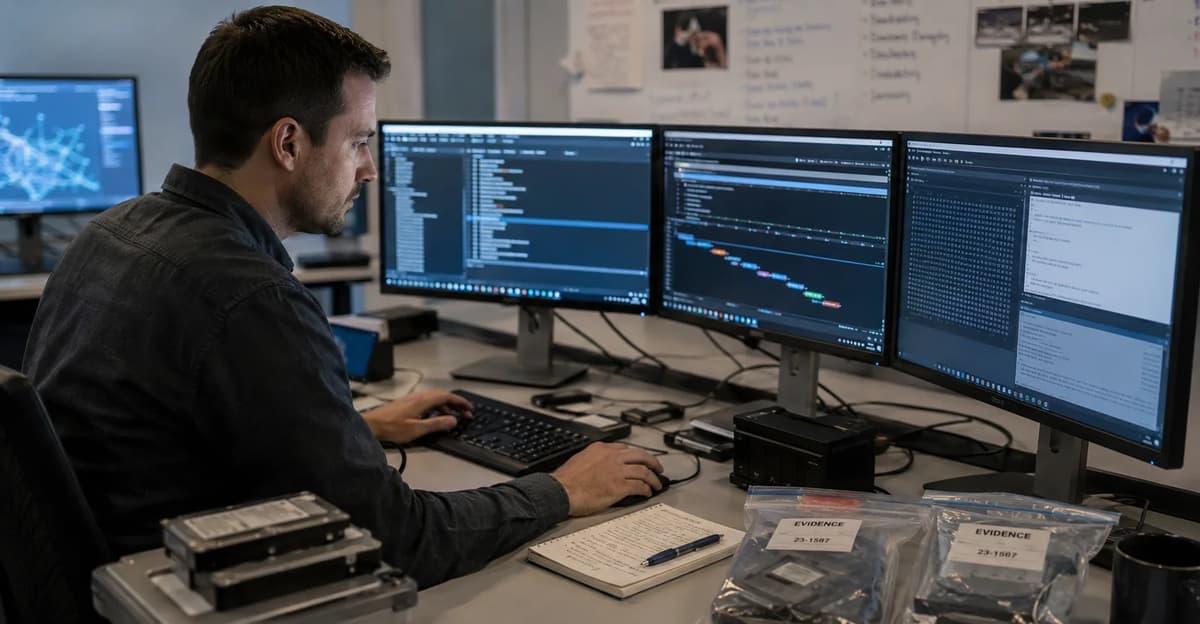
Yes, digital forensics analyst is still worth learning in 2026, but only if you understand that the title covers at least four very different jobs. When newcomers see one source put the average Digital Forensics Analyst salary at $74,125 and another center the role near $124,000, they often assume one of the sites is wrong. Usually, neither is wrong. They are measuring different rungs of the same profession: evidence-handling practitioners on one end, expert-witness-grade examiners on the other. ZipRecruiter’s July 2026 page shows an average of $74,125, with most salaries between $40,000 and $91,500 and top earners around $130,000; Glassdoor’s current U.S. page centers the role at about $124,000 median total pay with a roughly $94,000-$165,000 range; Glassdoor’s senior-title page climbs higher still, to around $176,000 median total pay. That spread is not noise. It is the job telling you it has a ladder.
That ladder exists because digital forensics is not just “cybersecurity, but investigative.” It is the part of security work that has to survive legal scrutiny. NIST defines digital forensics as identifying, collecting, examining, and analyzing data while preserving integrity and maintaining strict chain of custody, and it breaks the process into collection, examination, analysis, and reporting. NIJ emphasizes that broken chain of custody can reduce evidentiary weight or get evidence excluded. Federal Rules of Evidence 702 and 901 still revolve around qualified expert testimony and authentication. In plain English: the field keeps paying humans because evidence does not become trustworthy simply because a tool said so. Someone still has to own the collection, the interpretation, the methodology, and the explanation.
That is also why AI is not the death of the profession. AI is very good at triage, clustering, transcription, summarization, anomaly surfacing, and speeding up the first pass through ugly evidence volumes. SANS says 74% of organizations already report AI impacting cybersecurity team size or role structure, and 49% say it reduces manual analysis time. But only 16% report actual headcount reduction, and the same research says human analyst review remains one of the most effective controls when AI-driven threats are involved. In court, the problem gets sharper: Reuters reported in June 2026 that federal evidence rulemakers are actively debating proposed rules around machine-generated evidence and deepfakes specifically because reliability, authentication, and cross-examination do not magically solve themselves when a model is in the loop. AI can make you faster. It cannot take the oath for you.
If you are still choosing a specialization, start with the complete cybersecurity roadmap from beginner to expert. If you are torn between building evidence after the fact and simulating attacks before they happen, compare this path with the penetration tester career ladder and the real cybersecurity talent gap. And if your instinct is more proactive, campaign-level analysis than case-by-case reconstruction, you will probably get more from the threat intelligence analyst career ladder, salary, and certification path. Digital forensics is the right bet for the person who likes disciplined evidence work, hates hand-wavy conclusions, and does not mind being asked, “How exactly do you know that?” over and over again. That question is where this career lives.
Why digital forensics analyst salaries range from entry-level evidence handling to expert-witness pay
The cleanest way to answer “is digital forensics a good career in 2026?” is to stop treating “digital forensics analyst” as a single market. It is not. It is a compressed label for at least four distinct levels of responsibility: junior collection and preservation, independent examination and reporting, senior multi-source incident forensics, and AI-augmented, synthetic-media-aware investigation. Salary aggregators flatten those layers into one title, which is exactly why the numbers look contradictory on first read. ZipRecruiter’s July 2026 national page leans toward a wider employer-job-posting universe and lands at $74,125, while Glassdoor’s current total-pay view centers at about $124,000 and the senior version pushes to roughly $176,000. The profession is not sending mixed signals. It is showing you what happens when one title is used for both “image this laptop correctly” and “defend that methodology under cross-examination.”
In the teams I have seen work well, the pay gap tracks one thing more than anything else: who owns legal risk. A junior analyst can do valuable work all day long by collecting, labeling, hashing, preserving, and triaging. But the moment someone is expected to explain artifact significance, defend scope decisions, write findings that may be contested, or testify to the reliability of a process, the role changes from technical support to forensic judgment. O*NET reflects that shift directly in the occupation profile: digital forensics analysts create system images, preserve and maintain forensic evidence, analyze logs, write technical summaries, and may write reports, sign affidavits, or give depositions for legal proceedings. That last clause is the hinge. It is why Layer 1 and Layer 3 often get posted under almost the same job title while living in very different salary neighborhoods.
The market itself is not shrinking into irrelevance either. Mordor Intelligence projects the global digital forensics market to grow from $7.51 billion in 2025 and $8.46 billion in 2026 to $15.37 billion by 2031 at a 12.68% CAGR. MarketsandMarkets, using a different scope and model, puts the market at $12.94 billion in 2025 and $22.81 billion by 2030 at a 12.0% CAGR. Those absolute values do not match, and that matters if you are doing investor analysis. For career planning, the more important point is that both firms are pointing in the same direction: sustained double-digit growth in a field tied to cybercrime, litigation, regulation, and enterprise evidence readiness. When serious market researchers disagree on exact valuation but still agree on growth, I pay more attention to the direction than to the vanity of a single headline number.
The more interesting detail is where demand is concentrating. Coherent Market Insights estimates government and defense at 30.1% of the digital forensics market in 2026, which fits what practitioners have seen for years: this field has always had a heavy public-sector, law-enforcement, and defense backbone because those environments value attribution, evidence integrity, and legally defensible process. MarketsandMarkets adds that services are among the highest-growth segments, which also makes practical sense. As cases spread across cloud logs, mobile backups, SaaS ecosystems, enterprise chat, and synthetic media, more organizations are buying expertise, not just licenses. They want people who can make judgment calls, not merely click “next” in a forensic suite.
Deepfake-enabled fraud is one reason this matters in 2026 more than it did a few years ago. Mordor Intelligence explicitly lists deepfake-enabled fraud, multi-cloud migration, and ransomware targeting SaaS tenants as drivers pushing enterprises to embed forensic readiness “at every security layer.” SANS’ 2026 AI survey says 78% of organizations reported confirmed or suspected AI-enabled attacks in the past year, and it specifically calls out deepfake-driven social engineering in the threat mix. This is not a theoretical add-on. Synthetic media is turning authenticity itself into a forensics problem, which raises the premium on investigators who can evaluate provenance, preserve source artifacts, and explain why a piece of digital evidence should or should not be trusted.
That is the real answer to the “worth learning” question: yes, if you want a cyber career where accuracy compounds, legal judgment matters, and seniority is not just more years of the same work. No, if what you really want is live-fire containment, offensive testing, or strategic forecasting. Forensics is retrospective by design. It reconstructs what happened, preserves what matters, and translates technical traces into defensible facts. If you prefer the urgency of in-progress breach handling, read how incident response teams prepare for and manage cybersecurity breaches. But if you want to become the person who can say, “Here is the evidence, here is the method, and here is what it supports,” digital forensics remains one of the more durable specialties in cybersecurity.
The Digital Forensics Ladder
I use one framework to explain this field to career changers, hiring managers, and junior analysts who are trying to make sense of wildly inconsistent job descriptions: the Digital Forensics Ladder. The whole point of the framework is to name what the market usually hides. “Digital forensics analyst” is not a single job family with mild variation. It is a stack of roles with different outputs, different evidentiary responsibilities, different proof requirements, and different pay ceilings. Once you see the ladder, the salary confusion goes away. More importantly, you can build toward the rung you actually want instead of collecting random certifications and hoping a recruiter figures it out for you.
Layer | Core output | Proof that gets you hired or promoted | Legal responsibility | Salary signal |
Layer 1: Junior/Associate Forensics Analyst | Acquisition, preservation, chain-of-custody records, initial triage | IT/helpdesk/SOC fundamentals, evidence-handling discipline, entry-level acquisition/triage labs, clean documentation | Preserve correctly; escalate interpretation | Lower band of the market, often overlapping ZipRecruiter’s lower-to-mid range |
Layer 2: Digital Forensics Analyst / Examiner | Independent examination, artifact analysis, timeline reconstruction, report writing | GCFE-caliber Windows artifact/reporting competence, case writeups, defensible methodology | Own findings and reporting on standard cases | Mid-market to low six figures, depending on employer and specialization |
Layer 3: Senior Forensics Examiner / Incident Forensics Lead | Complex memory/network/cloud/mobile cases, peer review, cross-team leadership, testimony | GCFA/GNFA/GASF/GCFR-style depth, peer-review credibility, courtroom-grade communication, case leadership | Defend methodology, qualify expertise, testify or prep testimony | Upper end of the market; six figures is normal, and expert-heavy roles go materially higher |
Layer 4: AI-Augmented Forensics Investigator / Deepfake Detection Specialist | AI-assisted triage at scale, synthetic-media evaluation, evidence validation in AI-heavy cases | Senior forensics foundation plus AI workflow validation, provenance analysis, governance mindset | Human accountability for AI-assisted evidence decisions | Emerging premium roles and adjacent specialties, often priced like senior specialist work |
The numbers behind that last column come from the sources already on the table. ZipRecruiter shows a broad national band of $40,000 to $91,500 for most Digital Forensics Analyst roles, with higher earners at $130,000. Glassdoor’s U.S. page centers at about $124,000 total pay, and the senior title jumps to about $176,000. Current job pages reinforce the same pattern: Glassdoor’s featured employers show medians around $87,000 at Michigan State Police, $101,000 at ViaPath, and $117,000 at Peraton for Digital Forensics Analyst roles; a senior Peraton posting notes expert-witness experience as a desired qualification and a target salary above $104,000; an Alabama sheriff’s office role advertises roughly $58,000-$90,000 with sworn expert testimony as part of the job. For the emerging Layer 4 market, SANS-linked reporting surfaced AI Identity Deepfake Defense Specialist roles in the $130,000-$175,000 range. None of these numbers are random. They align closely with the rung of the ladder that the employer is actually trying to fill.
Layer 1: Junior/Associate Forensics Analyst. This is the most accessible on-ramp, and it is the rung most career changers underestimate. The output here is not glamorous investigation. It is disciplined evidence work: imaging drives, capturing volatile or non-volatile data under procedure, labeling and storing evidence, logging transfers, verifying hashes, maintaining contemporaneous notes, and performing supervised triage. O*NET captures the job’s core tasks almost word for word: create system images, duplicate digital evidence, preserve and maintain forensic evidence, and adhere to legal policies related to handling digital media. SANS’ role page places rapid acquisition and triage at the essentials level, and O*NET even lists a registered apprenticeship example for “Cyber Digital Forensics Analyst,” which tells you this is a real labor-market entry path, not a fantasy title.
What a normal week looks like at Layer 1. You may spend one day collecting a departing employee’s laptop and phone for a corporate matter, another preserving cloud exports and mailbox data, another validating hashes and updating case records, and another running first-pass triage to identify what should go deeper. You will do more documentation than detection. That is a feature, not a bug. NIST’s forensic process starts with collection and examination, and both phases explicitly emphasize preserving integrity before analysis. The analysts I have watched move up fastest at this layer were not the ones who sounded smartest. They were the ones whose notes were boringly complete and whose evidence never became a procedural problem.
What proof gets you into Layer 1. You do not need a law-enforcement background. You need evidence-handling discipline, technical basics, and examples of careful work. General IT, endpoint support, helpdesk, desktop engineering, junior SOC, and incident-coordination backgrounds all translate well because they teach system familiarity and process adherence. On the credential side, I treat entry-level acquisition and triage training as useful, not magical. SANS aligns FOR498 with acquisition and rapid triage and ties it to the GIAC Battlefield Forensics and Acquisition credential; GSEC is positioned as hands-on security fundamentals rather than pure theory. In practice, a portfolio with clean acquisition notes, preserved images, short triage summaries, and a couple of artifact walkthroughs can matter more than three unrelated logos.
Layer 2: Digital Forensics Analyst / Examiner. This is where the title starts to mean what most newcomers imagine. At Layer 2, you are expected to run standard cases largely on your own: examine Windows systems, reconstruct user and application activity, build timelines, perform browser and registry analysis, connect artifacts to investigative questions, and write a report that can survive scrutiny from legal, compliance, HR, or law enforcement stakeholders. GIAC’s GCFE description maps directly onto this rung: Windows evidence acquisition, browser forensics, user and application activity tracing, e-discovery, forensic analysis, and reporting. ISACA’s role description says the analyst identifies, preserves, analyzes, and presents digital evidence in a manner legally acceptable in proceedings. That is not entry-level collection support anymore. That is examiner work.
What a normal week looks like at Layer 2. You might begin Monday with a preserved endpoint and a question like, “Was data staged before termination?” Tuesday becomes registry, shellbag, browser, and file-activity reconstruction. Wednesday is email and chat correlation with authentication logs. Thursday is report drafting and peer review. Friday is a call with legal, HR, or investigators walking through what the evidence supports, what it does not support, and where the gaps still are. SANS positions this layer around full investigations and timeline reconstruction, and current job postings emphasize “court-defensible findings,” “forensic examination reports,” and support for criminal, cyber, and administrative investigations.
What proof gets you into Layer 2. This is the rung where I think the “is GCFE worth it?” question has a clean answer: yes, if your target work is Windows-based examination and reporting. I would not say GCFE is the only route, but SANS and GIAC clearly position it as the credential for typical incident investigations on Windows systems, and GIAC’s own workforce job-description page lists GCFE among the defining certifications for Digital Forensic Analyst roles. If Layer 1 proves you can preserve evidence, Layer 2 requires that you show you can interpret it defensibly. That means certification plus case writeups, artifact timelines, and reasoned reporting. A candidate who can explain why a conclusion is warranted will beat a candidate who can only name tools.
Layer 3: Senior Forensics Examiner / Incident Forensics Lead. This rung is where the salary jumps become obvious, because the work expands in both technical scope and legal consequence. Now you are dealing with memory forensics, advanced network artifacts, cloud-log interpretation, mobile device nuance, anti-forensics, complex intrusion reconstruction, peer review, and methodology defense. GIAC’s GCFA is explicitly built around formal incident investigations, advanced incident handling, APTs, anti-forensic techniques, and complex cases. GNFA covers advanced analysis of network forensic artifacts. GCFR validates tracking and responding across major cloud providers. GASF covers deep mobile file-system and artifact analysis. These are not beginner badges. They are role signals that you are expected to solve harder cases across more volatile evidence sources.
What a normal week looks like at Layer 3. A senior examiner may spend Monday validating a junior analyst’s acquisition and correcting a subtle handling issue before it becomes a courtroom problem. Tuesday may be spent reconciling endpoint traces with firewall logs, proxy data, and EDR records to determine whether exfiltration actually occurred. Wednesday may turn into live response planning with incident response leadership, where forensics has to preserve evidentiary options without slowing containment. Thursday may involve counsel prep for testimony or affidavit review. Friday may be consumed by peer review, scoping a smartphone or cloud collection, or teaching others why a flashy indicator is not yet a fact. Current senior postings regularly ask for mentoring, peer review, and expert-witness experience; SWGDE’s courtroom guidance emphasizes that courts will weigh training, experience, certifications, and the examiner’s ability to stay within the bounds of their expertise.
What proof gets you into Layer 3. This is not a cert-only promotion. It is a trust promotion. The proof is a stack: complex case ownership, peer review credibility, disciplined testimony preparation, specialization depth, and the judgment not to overclaim. SWGDE is refreshingly blunt that a digital forensic expert must maintain integrity, remain objective, recognize the limits of their expertise, and be prepared for courts to evaluate background, training, certification, and experience. In my experience, what actually determines whether someone is permitted to become “the witness” is not who knows the most esoteric artifact. It is who can explain methods clearly, stay inside the evidence, survive challenge, and never make the case about their ego.
Layer 4: AI-Augmented Forensics Investigator / Deepfake Detection Specialist. This is the emerging rung, and it is the one most people talk about badly. Layer 4 is not “the AI replaces everybody” layer. It is the layer where a human examiner uses AI to cut through scale while retaining evidentiary accountability. The work includes AI-assisted corpus triage, similarity clustering across large evidence sets, prioritization of relevant artifacts, synthetic-audio/video evaluation, provenance checking, and validation of AI-surfaced results before they become findings. Mordor explicitly names deepfake-enabled fraud as a market driver. SANS says AI use in cybersecurity has surged, that investigation and response teams are using it in daily operations, and that AI has changed training requirements for 73% of practitioners. Reuters reports that federal rulemakers are wrestling with reliability and deepfake authenticity precisely because machine-generated output and synthetic evidence create new gatekeeping problems. That is an emerging specialty, not a passing gimmick.
What proof gets you into Layer 4. You do not skip here from beginner status. The on-ramp is almost always through Layer 2 or Layer 3, because you need existing forensic judgment before you can safely accelerate it with AI. Public labor-market signals support that reading: a World Economic Forum article authored by LinkedIn’s chief economist says people are now more than twice as likely to acquire AI skills as in 2018 and that demand for AI literacy skills has increased more than sixfold in the past year; Lightcast’s contribution to Stanford’s 2026 AI Index says AI skills appear in 2.5% of U.S. job postings, up 55% year over year. Meanwhile, SANS-linked reporting surfaced new roles such as AI Identity Deepfake Defense Specialist with salary ranges from $130,000 to $175,000. The implication is straightforward: AI literacy is becoming table stakes around the profession, but the premium still goes to people who combine AI capability with domain-specific judgment.
What a digital forensics analyst actually does on a normal week, by layer
At Layer 1, the week is about control. A junior or associate forensics analyst spends much of the week making sure evidence can still be trusted later. That means device intake, imaging, chain-of-custody updates, validation of acquisition output, safe storage, and supervised triage. O*NET’s task list includes imaging, duplication, preserving forensic evidence, and complying with legal handling procedures; current associate-level postings ask for forensic preservation, chain-of-custody maintenance, and contemporaneous record keeping. Much of this work is repetitive, procedural, and easy to underrate until the first time a bad label, an undocumented handoff, or a sloppy acquisition forces a case to be reworked.
At Layer 1, the collaboration pattern is narrower than people expect. You are usually supporting, not steering. You may interact with HR, legal, internal investigations, or an incident response lead, but you are not yet the person making the interpretive call that lands in a final report. NIST’s process order matters here: collection first, examination second, analysis third, reporting last. A lot of early-career analysts want to jump to conclusions too soon because intellectually that feels like the “real” work. In practice, organizations promote the people who can be trusted not to contaminate the record before they are allowed to narrate it.
At Layer 2, the week becomes investigative. This is where the phrase digital forensics analyst starts matching common expectations. You are reconstructing timelines, determining user activity, correlating artifacts, identifying signs of staging, persistence, exfiltration, or deletion, and translating low-level traces into plain-language findings. GCFE’s scope is a good proxy for the day-to-day: Windows evidence acquisition, browser forensics, activity tracing, e-discovery, forensic analysis, and reporting. Current mid-level roles describe recovery, analysis, and reporting of digital evidence in support of criminal, cyber, and administrative investigations, and they explicitly call for court-defensible findings.
At Layer 2, the writing workload is heavier than most newcomers think. This is one reason some technically strong analysts stagnate. The job is not finished when you find the artifact. It is finished when a non-expert stakeholder can understand what the artifact supports, what alternatives were considered, and what limitations remain. ISACA’s description includes presenting digital evidence in a legally acceptable manner. O*NET says analysts write technical summaries, reports, affidavits, and depositions. In supervisory hiring, I have consistently found that mediocre writers become bottlenecks faster than mediocre artifact hunters. Cases stall when the report cannot carry the method.
At Layer 3, the week becomes messy in the way real intrusions are messy. One case rarely stays inside one evidence class. Endpoint traces have to be reconciled with network captures, VPN logs, EDR alerts, cloud metadata, and sometimes mobile-device evidence. SANS’ role path places advanced network forensics, advanced incident response, smartphone forensics, and enterprise cloud forensics above the examiner layer for a reason: mature investigations are multi-source, not single-host. This is also the rung where digital forensics vs incident response becomes a practical distinction rather than a theoretical one. Incident responders are trying to contain and restore. Senior forensic examiners are trying to preserve, reconstruct, and explain without losing sight of legal and evidentiary consequences. They overlap, but they are not the same role. If you want the operational containment lens, read how incident response teams prepare for and manage cybersecurity breaches.
At Layer 3, testimony and testimony prep are real work, not occasional theater. SWGDE’s guidance goes deep on credibility, Rule 702, Daubert/Frye standards, scope discipline, and courtroom clarity because senior examiners are often the ones carrying methodology into legal proceedings. NIJ notes that chain of custody exists to verify authenticity and legal integrity, and warns that broken continuity can reduce or exclude evidence. Job postings back up that this is not just academic guidance: some senior and even mission-focused junior-to-mid roles explicitly require or prefer expert-witness testimony experience. Once you are at this rung, the “normal week” is partly technical and partly communicative. You are preparing to be challenged by people who are paid to find uncertainty in your process.
At Layer 4, a normal week has more scale and more verification. AI can radically compress the drudgery of first-pass evidence handling: bulk file classification, candidate timeline generation, transcript support, similarity grouping, and large-log search. SANS says 49% of organizations report reduced manual analysis time from AI and 48% cite workflow automation gains, while its separate AI survey says investigation and response functions have kept pace with red-team usage and are increasingly treating AI as part of daily operations. That changes the weekly shape of the work. You spend less time manually opening every item and more time validating, escalating, and deciding what the machine got wrong or only partly right.
At Layer 4, synthetic media turns “what happened?” into “what is this thing, exactly?” Reuters’ reporting on the proposed federal evidence rules is unusually helpful here because it shows the legal system grappling with the same question enterprises are facing operationally: how do you handle machine-generated or potentially fake digital evidence in a way that meets reliability and authentication expectations? Mordor connects deepfake-enabled fraud directly to forensic-market growth, and SANS’ threat reporting points to deepfakes and AI-powered social engineering as practical attack vectors. That is why the emerging high-value analyst is not just a faster examiner. It is an examiner who can validate AI assistance, evaluate synthetic media claims, and still construct a defensible foundation around what evidence is genuine, what it means, and what cannot yet be concluded.
The best practical way to read the week-by-week difference is simple. Layer 1 preserves. Layer 2 interprets. Layer 3 defends. Layer 4 scales without surrendering responsibility. If you are asking how to become a digital forensics analyst, that progression matters more than any generic checklist. Start by becoming trusted with evidence. Then become trusted with interpretation. Then become trusted with judgment under challenge. Then, if you want the frontier, learn how to use AI without letting AI use your credibility.
Is AI coming for digital forensics jobs, or just the evidence-triage grind?
The honest answer is that AI is absolutely coming for the grind. It is already reducing the amount of manual, repetitive analysis that used to fill early-career schedules. SANS’ 2026 workforce research says 74% of organizations report AI affecting cybersecurity team size or role structure, and 49% say it has reduced manual analysis time; only 16% report actual headcount reduction. Its 2026 AI survey adds that investigation and response teams are treating AI as part of day-to-day operations, but only 27% call their deployments mature production. That is exactly what I would expect in digital forensics right now: real productivity gain, uneven operating discipline, and a profession still figuring out where to trust automation and where to insist on human review.
The labor-market side points the same way. A World Economic Forum article authored by LinkedIn’s chief economist says workers are now more than twice as likely to add AI skills as in 2018, and that demand for AI literacy skills increased more than sixfold in the prior year. Another WEF/LinkedIn piece says AI has already added 1.3 million jobs globally, even in a cooler hiring market. Lightcast’s 2026 analysis for the Stanford AI Index says AI skills are now in 2.5% of all U.S. postings, up 55% year over year. So the career signal is not “AI wiped the field out.” It is “AI is being embedded into the field quickly enough that refusing to learn it is becoming a self-inflicted handicap.”
Where AI helps most in forensics is the examination phase, especially the parts NIST describes as processing large amounts of data using automated and manual methods. That is exactly the sort of work machines can accelerate: clustering files, surfacing anomalies, suggesting candidate timelines, transcribing audio, converting unstructured text into searchable records, and ranking evidence for human review. I am making an inference here from the combination of NIST’s process model and SANS’ reduced-manual-analysis metrics, but it is a reasonable one: AI’s biggest contribution today is not replacing forensic reasoning; it is shrinking the time spent getting to the point where forensic reasoning can actually start.
Where AI does not replace the examiner is the part that makes digital forensics legally distinct from generic analytics. NIJ is explicit that chain of custody is a recorded means of verifying where evidence travelled, who handled it, and whether its legal integrity and authenticity remain intact. Cornell’s text for Rule 901 links authentication to proof of custody and to describing the process or system that produced a result. Rule 702 is still built on qualified experts, reliable methods, and proper application of those methods to the facts. SWGDE makes the practical point that courts weigh an examiner’s education, certifications, training, and experience, and expects experts to stay within the limits of their competence. That entire structure assumes a human being owns the result. AI can assist the process. It does not assume the duty.
The courtroom issue matters even if you never plan to testify. Reuters’ June 2026 analysis of proposed federal evidence rules is a warning flare for the profession. It explains that machine-generated outputs can create reliability and authentication problems, that proposed Rule 707 is aimed at requiring Rule 702-style scrutiny for certain AI outputs, and that draft Rule 901(c) targets deepfakes. It also notes that machine-generated output cannot be cross-examined the way a human expert can. That is the clean line most AI hype misses: a model can generate a strong-looking output, but the legal system still wants a qualified human to sponsor, explain, and defend how that output was produced and why it should be trusted.
There is also a more practical “novel attacker behavior” problem. SANS’ 2026 AI survey says 63% of practitioners report significant AI shortcomings in threat detection and response, while human expertise remains central, with behavioral detection and human analyst review ranking among the most effective controls. That does not mean AI is useless. It means the weird cases are still weird. Attackers do not need to beat the average detector; they need to break assumptions. A good examiner earns their keep when a case departs from the training data, when artifacts conflict, or when a plausible AI-generated explanation turns out to be a mirage.
So, will AI replace digital forensics analysts? No, but it will compress the lower rungs of the ladder and raise expectations for everyone above them. SANS’ workforce report is unusually candid that AI is automating some of the entry-level analytical work that historically trained the next generation, and that unclear career progression has become a growing problem. That means the field is still worth entering, but you cannot plan your career around permanent Layer 1 work. The future-proof path is to learn AI-assisted triage early, then move as quickly as possible toward interpretation, reporting, specialization, and defensible human judgment. In other words, AI is not removing the ladder. It is removing the excuse to stay on the first rung.
How much digital forensics analysts earn in 2026, and whether the GCFE is worth pursuing
The simplest salary answer is this: digital forensics analyst salary depends more on layer than on title. Here is the market in one glance.
Source | What the source currently shows | What it likely represents on the Digital Forensics Ladder |
$74,125 average; most salaries between $40,000 and $91,500; top earners around $130,000 | Broad national posting mix, including junior and mid-level roles | |
Glassdoor, U.S. 2026 page | About $124,000 median total pay; roughly $94,000-$165,000 total-pay range | More examiner-heavy and specialist-heavy compensation center |
Glassdoor, Senior Digital Forensic Analyst | About $176,000 median total pay; roughly $132,000-$246,000 total-pay range | Senior lead / expert-witness / specialized incident-forensics roles |
About $106,000 average base salary from 99 respondents | A credentialed Layer 2-to-Layer 3 signal rather than pure entry-level work |
That table is why I do not let candidates argue about “the real salary” as if one source must win. ZipRecruiter’s lower numbers and Glassdoor’s higher numbers can coexist because they are describing different population mixes. Glassdoor’s own employer snapshots reinforce this: Michigan State Police centers Digital Forensic Analyst pay around $87,000, ViaPath around $101,000, and Peraton around $117,000, while the senior-title page is materially higher again. Add current government and cleared-sector postings, and the divergence becomes easy to understand. A role focused on preservation and triage should not pay like one that expects independent expert testimony. The market is rational once the layers are visible.
Now to the harder question: is GCFE certification worth it? If your target is Layer 2 examiner work, I would say yes more often than no. GIAC describes the GCFE as validating the ability to collect and analyze data from Windows systems for typical incident investigations, including evidence acquisition, reporting, browser forensics, and user/application activity tracing. SANS positions GCFE-aligned Windows forensic analysis squarely in the role path for digital forensic analysts. And PayScale’s public GCFE page currently shows about $106,000 average base salary from 99 respondents. That is not proof that a piece of paper alone gets you six figures. It is proof that the market associates GCFE with a materially more valuable rung than junior evidence handling.
What I would not do is oversell GCFE as a universal ticket. It is a strong signal for Windows-centered examination and reporting. It is not a shortcut around experience, and it is not the right first move for every person. If you are still learning how to preserve evidence without procedural mistakes, Layer 1 portfolio work may matter more right now than rushing into a harder examiner credential. If your work is shifting toward advanced incident forensics, memory, network, or cloud, then GCFA, GNFA, or GCFR may be a better promotion signal at the margin. If mobile is your specialty, GASF matters more. Certifications are most valuable when they match the rung you are actually climbing.
There is a widely repeated claim that SANS/GIAC data shows GCFE holders averaging about $101,938 versus roughly $75,000 for uncertified peers. I have seen that figure repeated in secondary sources, but the precise SANS table behind that comparison is not publicly viewable in a way I can verify line by line today. I prefer to be honest about that rather than paste a neat number with fake confidence. The stronger public evidence I can verify is the GCFE role mapping from GIAC/SANS and the PayScale page showing roughly $106,000 average base salary for GCFE-certified respondents. Directionally, both point to the same conclusion: GCFE is not a decorative cert. It is a credential associated with the move from evidence support into examiner-grade work.
The other reason GCFE is worth it for many analysts is that it helps solve an employer problem, not just a candidate problem. SANS’ 2026 workforce research says certifications now rank as the leading skill-validation method at 64%, ahead of skills assessments at hiring and internal evaluations, and that 58% of organizations consider certifications very or extremely important when evaluating staff. In a field where legal defensibility, customer trust, and regulatory scrutiny all matter, employers like external signals that say, “This person can probably handle more than basic intake.” The certification does not replace a portfolio, but it can accelerate the trust conversation.
My own hiring bias has stayed pretty consistent: for Layer 1, I will take disciplined evidence handling and clean writeups over a flashy cert stack. For Layer 2, I start caring a lot more about examiner-grade proof, and GCFE is one of the clearest ways to show it. For Layer 3, I care less about whether you have GCFE specifically and more about whether your certs, case history, and communication skills line up with the complexity of the work. For Layer 4, I want all of the above plus AI judgment. The analysts I have watched earn the biggest jumps were not the ones who chased every certification. They were the ones who used the right certification to make the next rung believable.
So if you are asking, “How much do digital forensics analysts earn in 2026?” the best answer is: from around $40,000 in the lower band of junior roles to well into six figures for senior examiners and emerging AI/deepfake specialists, with the center of the market shifting upward as legal responsibility and specialization increase. If you are asking, “Is GCFE worth it?” the best answer is: yes, if you want to cross the line from handling evidence to explaining it. That line is where the real money starts.
FAQ
Is digital forensics analyst a good career in 2026? Yes, for the right temperament. The market is growing, major research firms project double-digit expansion, government and defense remain a large share of demand, and services are growing as organizations buy expertise rather than just tooling. More importantly, the profession sits at the intersection of cyber incidents, legal process, regulation, and AI-shaped authenticity problems. That is a durable place to be. It is especially strong for people who like careful method, documentation, and evidence-based argument more than constant operational firefighting.
Do you need a law-enforcement background to become a digital forensics analyst? No. ISACA and SANS both frame digital forensics as a broader cyber role, not a law-enforcement-only path, and O*NET treats it as a standard occupation with formal training and even an apprenticeship pathway. In practice, many strong Layer 1 hires come from helpdesk, IT support, desktop engineering, junior SOC, or general cybersecurity backgrounds. Law-enforcement experience can help in some public-sector roles, but it is not a universal gatekeeper.
What is the difference between digital forensics and incident response? Incident response is primarily about stopping, containing, and recovering from an active security event. Digital forensics is about preserving, examining, reconstructing, and explaining evidence in a way that can hold up for legal, regulatory, disciplinary, or insurance purposes. The fields overlap heavily in practice, and NIST’s forensics guide is literally written around incident response integration, but the core objectives are different: incident response is operationally immediate; forensics is evidentiary and retrospective. If you want the containment-and-recovery side, compare this article with how incident response teams prepare for and manage cybersecurity breaches.
How long does it take to become a digital forensics analyst? Reaching Layer 1 can happen relatively quickly if you already have solid IT or junior security fundamentals and can show disciplined evidence-handling work. Reaching Layer 2 usually takes longer because you need the judgment to interpret artifacts and write defensible reports, not just collect data. O*NET classifies the occupation in Job Zone Four, which means considerable preparation is common, including several years of related experience or training. Put differently: getting in is faster than becoming credible.
Is GCFE worth it in 2026? For Layer 2 examiner work, yes. GIAC maps GCFE to typical Windows-based incident investigations including evidence acquisition, browser forensics, activity tracing, and reporting, and PayScale’s public page for the certification centers at about $106,000 average base salary. I would not treat it as a substitute for case experience, but I would absolutely treat it as one of the clearest signals that you are moving beyond pure evidence intake.
Will AI replace digital forensics analysts? AI will replace some of the repetitive evidence-triage labor that used to occupy a lot of junior analyst time. SANS says 49% of organizations report reduced manual analysis time from AI. But that same body of research shows only 16% reporting headcount reduction, while legal and evidentiary rules still depend on human accountability, reliable methods, qualified expertise, and authentication. AI can surface candidate answers. It cannot own chain of custody, qualify as your expert witness, or defend an interpretation under challenge the way a trained examiner can.
What is the best on-ramp if I am coming from IT or general cybersecurity? Aim for Layer 1 deliberately. Learn acquisition and preservation cold. Build a small portfolio of evidence-handling notes, triage summaries, and artifact writeups. If you are coming from a SOC, highlight log analysis and escalation discipline. If you are coming from IT support, highlight system familiarity, endpoint handling, and documentation rigor. Then, once you can prove you will not break the evidence, target Layer 2 with examiner-grade reporting and a certification such as GCFE that matches the work you want.
Is digital forensics better than threat intelligence or penetration testing? Better is the wrong word. Digital forensics is for people who want to reconstruct what happened and turn that into defensible findings. Threat intelligence is more proactive and campaign-oriented; penetration testing is more offensive and preventive. If you are trying to choose, compare this guide with the threat intelligence analyst career ladder, salary, and certification path and the penetration tester career ladder and the real cybersecurity talent gap. The right choice is the one that matches the questions you most want to answer every day.