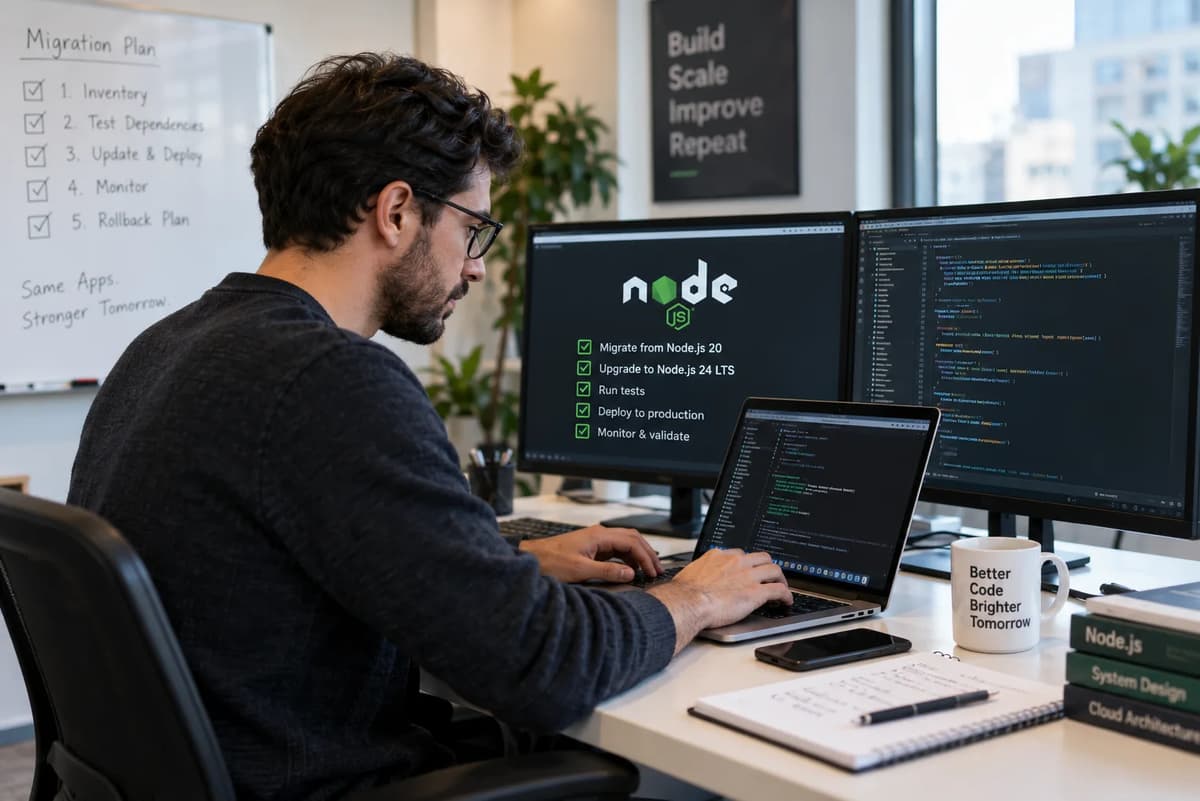
The uncomfortable migration starts with a service that appears healthy. The API is answering requests, the background worker is draining queues, CI is green, and nobody has reported a customer-facing regression. But the processes are still running Node.js 20 after March 24, 2026. The runtime is end-of-life, one serverless target cannot yet accept the intended Node.js 24 configuration, and a container rebuild has not been proven against every architecture used in production.
That is not a successful steady state. It is an unsupported one.
For the August 29, 2026 verification point, Node.js’s live Releases table marks Node.js 20 “Iron” as EOL, Node.js 24 “Krypton” as LTS, and Node.js 26 as Current. The project explicitly recommends production applications use supported LTS lines rather than treating a still-functioning EOL binary as supportable. Node.js’s End-of-Life guidance is equally direct: EOL releases stop receiving normal fixes, including security fixes, while ecosystem and compliance exposure grows around them.
A defensible Node.js 20 EOL migration therefore needs more evidence than “the tests passed.” I want four linked inventories (runtime instances, applications, dependency/native-addon graphs, and hosting/build environments), plus a two-hop 20→22→24 change ledger, reproducible installs, real startup tests, representative workload baselines, staged production evidence, and a rehearsed rollback path. Only then does a Node.js 24 LTS upgrade become a controlled Node.js production migration rather than a version-number edit.
Turn Node.js 20 End of Life into an Owned Risk Decision
Start by separating four questions that are often collapsed into one status field. Availability asks whether the service is currently running. Security support asks whether the runtime still receives upstream fixes. Compliance support asks whether the organization is allowed to operate an EOL dependency under its policies or contractual obligations. Vendor/platform support asks whether the container base, function platform, operating system, observability agent, database driver, and support contracts recognize the target runtime.
Node.js 20 crossed upstream EOL on March 24, 2026. At the August 29 verification point, Node.js 24 was the LTS target and Node.js 26 was the Current line. That makes “20 works” irrelevant to the support decision. Node.js also warns that EOL lines can accumulate unpatched vulnerabilities, ecosystem breakage, and compliance problems. Commercial EOL coverage exists from providers participating in the OpenJS ecosystem, but Node.js presents it as a bridge for organizations that cannot immediately upgrade, not as a replacement for migration ownership.
I put the decision in a dated risk record before touching code:
Risk plane | Owner must answer | Required evidence | Promotion blocker |
Application availability | Does 24 preserve service behavior? | Integration, load and business-flow tests | Material functional regression |
Security support | Is every production runtime on a supported line? | Runtime inventory and version telemetry | Unapproved Node 20 instance |
Compliance | Is temporary EOL use explicitly permitted? | Exception record, expiry, controls | Undocumented EOL exposure |
Vendor/platform | Can every host run the qualified 24 baseline? | Vendor matrix and deployment proof | Unsupported runtime/hosting combination |
My decision record names one accountable risk owner, the target Node.js 24 baseline, production completion date, affected services, temporary exceptions, rollback authority, and a date after which the exception must be re-approved or shut down.
Decision rule: no service is “done” merely because it starts on Node.js 24. It is done when its runtime, dependencies, build chain, host, telemetry and rollback path are all supportable. Conversely, no team gets to defer solely because Node.js 20 remains executable.
Inventory Every Runtime, Workload, and Hosting Boundary
The migration scope is whatever executes Node.js, not whatever appears in the main application repository. Production APIs are only the obvious part. Queue consumers, scheduled jobs, one-off migration scripts, deployment CLIs, serverless functions, build containers, end-to-end test runners and code-generation jobs can all hold a Node.js 20 dependency.
This is where I freeze the runtime estate before scheduling migrations. The broader Refonte Learning guide to backend development best practices covers the larger operating context; here the inventory is deliberately narrower: it exists to prove exactly where Node is executed and who can deploy or roll it back. Likewise, questions about backend developer versus full-stack developer are organizational context, not my ownership rule: the migration owner is the person or team with operational authority over that workload.
Use one schema everywhere:
Field | Example evidence |
Service/workload | checkout-api, invoice-worker, webhook-function |
Owner | On-call team and migration DRI |
Runtime source | Docker image, PaaS runtime, function runtime, OS package |
Version pin | Exact Node version or unresolved floating constraint |
Image | Tag and qualified digest |
Architecture | x86-64, Arm64 |
Package manager | npm/pnpm/Yarn plus version |
Lockfile | File, hash and generation policy |
Native modules | Package, binary ABI, architecture/libc variants |
Hosting target | Kubernetes, VM, Lambda, Azure Functions, Cloud Run |
Traffic tier | Critical/high/normal/internal |
Rollback method | Previous digest, deployment slot, function version |
Map Services, Workers, Functions, and Developer Tooling
I search source control and infrastructure-as-code, then reconcile the result with live runtime telemetry. Useful probes include:
node -p "process.version"
node -p "JSON.stringify(process.versions, null, 2)"

git grep -nE \
  'FROM node:|setup-node|NODE_VERSION|node-version|nodejs20|nodejs22|nodejs24'
Also inspect package.json engines and packageManager, .nvmrc, .node-version, Dockerfiles, CI workflow actions, Helm charts, Terraform, serverless configuration, dev containers and buildpacks. The repository is evidence of intent; a process reporting its actual runtime version is evidence of reality.
For API-specific ownership context, Refonte Learning’s API developer roadmap with Node.js is adjacent reading, but it does not replace this runtime inventory.
Find Native Addons and Platform-Specific Dependencies
Native code deserves a separate pass because it can remain invisible until installation or process startup:
npm ls --all
find node_modules -type f -name '*.node' -print

node -p "JSON.stringify({
  node: process.version,
  modules: process.versions.modules,
  napi: process.versions.napi,
  openssl: process.versions.openssl,
  v8: process.versions.v8
}, null, 2)"
Then search the dependency graph for binding.gyp, node-gyp, prebuild downloaders and packages that publish architecture-specific artifacts. Native code using Node-API has an ABI-stability contract designed to reduce coupling across Node releases, whereas addons tied directly to V8 or other Node internals carry greater major-version rebuild risk.
Inventory gate: every executable Node workload must have an owner, an observed runtime, a hosting boundary, a dependency/lockfile record and an independently executable rollback method.
Choose Node.js 24 LTS and Define the Supported Baseline
Do not translate “leave Node 20” into “install whatever Node version is newest.” At the guide’s August 29, 2026 verification point, Node.js 26 was Current while Node.js 24 was LTS. Node.js’s own release guidance points production users toward supported LTS lines. The official Node.js 22-to-24 migration guide states that Node.js 24 entered LTS and is planned to receive support through the end of April 2028.
That support horizon is necessary but not sufficient. I also require deployment-platform availability, maintained dependency support, available container/base-image combinations, native builds for every architecture, and a patch-management policy.
Baseline dimension | Required decision |
Major line | Node.js 24 LTS |
Patch | Exact qualified 24.x patch in build evidence |
Container | Qualified base variant plus immutable digest |
Architectures | Every architecture actually scheduled in production |
Package manager | Named and version-controlled |
OS/libc | Explicit distribution and libc family |
Patch cadence | Defined security/update qualification path |
End-of-support trigger | Migration planning before April 2028 |
At the August 29 baseline, the live release table listed 24.20.0 as the latest Node.js 24 LTS release. I would record that exact tested version rather than writing only 24 in an approval artifact, then deliberately qualify later 24.x security and maintenance updates as they arrive.
This is also not a framework-selection exercise. Refonte Learning’s comparison of Node.js, Django, and Spring Boot frameworks answers a different question. A runtime-support migration should not silently become an application rewrite unless a separate architecture decision authorizes that scope.
Finally, stop encoding the historical even/odd Node release convention into company policy. Node.js’s 2026 announcement on evolving the Node.js release schedule says the project is moving to one major release per year and making every major LTS after its Current phase beginning with Node.js 27. The live release table, not an old convention in a wiki page, is the source of truth.
Baseline gate: target a supported LTS line because the complete platform can support it, not because its version number is highest.
Build a Change Ledger Across the Skipped Major Versions
A direct installation from 20 to 24 is technically possible; a direct analysis is not acceptable. Node.js itself says its migration guides cover only part of the relevant change surface. A team skipping Node.js 22 must therefore build two explicit ledgers: 20→22 and 22→24, backed by semver-major release notes, deprecation documentation and dependency-maintainer notes.
The first hop includes concrete compatibility risks. Node.js 22 removed the old import-assertion assert syntax in favor of import attributes, and removed deprecated crypto.createCipher()/createDecipher() APIs. Node.js 22.0 also moved to V8 12.4, increased the default stream highWaterMark, and introduced support for synchronously requiring eligible ECMAScript Module graphs.
The second hop adds a different class of risk. Node.js 24 uses V8 13.6 and OpenSSL 3.5; the migration guidance warns that native addons linked closely to V8 may need work, while OpenSSL’s default security level rejects weak key sizes and old algorithms. Node.js 24.0 also shipped npm 11, changed AsyncLocalStorage internals, renamed the permission flag, advanced the bundled HTTP client stack, and introduced further runtime deprecations and removals.
Change surface | 20→22 evidence | 22→24 evidence | Required test |
Modules | Import assertions removed; ESM interop evolved | Later require(esm) behavior | Real entry-point startup |
Crypto | Legacy cipher APIs removed | OpenSSL 3.5/security-level changes | Real TLS/mTLS peers |
V8 | V8 12.4 | V8 13.6 | Native build + behavior/perf |
Streams | Default buffering changed | Further fetch/stream changes | Backpressure/memory tests |
Native addons | ABI/rebuild review | C++/V8 qualification | Every OS/arch/libc target |
Toolchain | Runtime + test changes | npm 11/build requirements | Clean CI bootstrap |
Deprecations | Review all active paths | Review new runtime/EOL entries | Warning-enforced CI |
Classify Runtime, Module, Crypto, and Tooling Changes
Node.js documents four useful deprecation states: documentation-only, application, runtime and end-of-life. Some documentation-only deprecations can be surfaced with --pending-deprecation; runtime deprecations can emit warnings during normal execution. I add a CI/startup lane such as:
node --pending-deprecation \
     --trace-deprecation \
     --trace-warnings \
     dist/server.js
Every ledger line gets one classification: code change, dependency change, environment change, test-only observation, or accepted no-impact. “No impact” still needs evidence, usually a repository search plus execution of the relevant entry path.
Ledger gate: promotion is blocked by any unclassified major-version change that touches a runtime flag, API, module path, crypto boundary, native dependency, test harness or build step used by the service.
Qualify Direct, Transitive, and Native Dependencies
Application code is usually the smallest part of a mature Node runtime migration. The risky surface is often three or six levels down the graph: a database driver pulls in a binary helper; an observability package uses native code; an image-processing library downloads a prebuilt binary during postinstall; a testing utility assumes CommonJS behavior that changed underneath it.
Start the Node.js dependency audit from a clean tree:
npm ci
npm ls --all > dependency-tree.txt

# Explain why a suspicious package exists.
npm explain <package>

# Inventory compiled Node addons.
find node_modules -type f -name '*.node' -print
Then classify each dependency rather than looking only at whether npm produced an exit code.
Dependency class | Compatibility question | Decision |
JavaScript-only | Maintainer supports Node 24? Engines/peers valid? | Test normal paths |
Node-API native | Artifact exists for OS/arch/libc? System libraries compatible? | Clean-install on every target |
Direct V8/internal binding | Rebuilt for Node 24/V8 13.6? | Upgrade, rebuild or replace |
Prebuilt-binary package | Correct binary actually published? | Fail closed if it falls back unexpectedly |
Source-built addon | Compiler, Python, headers and system libs available? | Reproduce CI build |
Abandoned package | No maintained Node 24 path? | Replace, temporary fork or exception |
Node’s addon documentation recommends Node-API as the stable C API for addons; direct internal/V8 bindings expose considerably more implementation coupling. The Node.js 22→24 migration guidance specifically warns that V8-linked addons may need changes with V8 13.6 and notes that C++20 may be required for some addon builds. Node’s module ABI identifier is also relevant because binaries built against incompatible module ABIs can be rejected at load time.
Do not “fix” an abandoned package by permanently carrying a mystery fork. A temporary fork needs an owner, upstream issue, security-monitoring plan, replacement date and explicit removal criterion.
For a Node.js native addon migration, I require installation tests on the exact same operating-system family, architecture and libc combination used in deployment. A successful macOS developer install proves nothing about an Arm64 Linux worker or an Alpine/musl image.
Dependency gate: all transitive packages must resolve from the approved graph, every native artifact must either load or reproducibly build on every target, and unsupported dependencies must have a dated disposition.
Rebuild Lockfiles and Prove Clean Installation
A runtime upgrade is the wrong moment to discover that production builds depend on an engineer’s populated npm cache.
For npm projects, npm ci is the primary reproducibility check: npm documents that it requires an existing lockfile, fails when the lock does not match package.json, removes an existing node_modules directory, and does not rewrite package manifests or locks during the install. Node.js’s security guidance likewise recommends dependency pinning, lockfiles and npm ci for automated environments.
Node.js 24.0 shipped with npm 11, so package-manager behavior is part of the migration surface unless your organization already pins a separate package-manager version. My preferred sequence is to avoid gratuitously regenerating the lockfile first: prove the existing lock under the intentionally chosen package-manager version, then perform any lockfile-format or dependency refresh as an explicit change with its own diff.
rm -rf node_modules
npm ci
npm test
npm pack --dry-run
The clean-install matrix needs more than the normal internet-connected CI runner:
Environment | Network state | What it proves | Blocker |
Developer-clean | Empty node_modules | Basic deterministic install | Lock mismatch |
CI-clean | Empty cache where practical | Build reproducibility | Hidden cache dependency |
Corporate registry | Approved mirror only | Mirror/artifact completeness | Missing tarball/binary |
Restricted build | Public egress blocked | Controlled supply path | Install phones home |
Target OS/arch | Deployment-equivalent | Native lifecycle behavior | Binary/build failure |
Test Package Managers, Registries, and Reproducibility
Lifecycle scripts require judgment. Node.js security guidance notes that disabling package scripts can reduce supply-chain execution risk, but native addons and other legitimate packages sometimes depend on installation scripts. I do not globally disable them and declare victory. I identify which packages require them, run those scripts inside the constrained build environment, and record the resulting artifacts.
Also verify registry URLs, authentication, proxy configuration, lockfile integrity fields, internal mirror behavior and the exact package-manager executable used by CI. If npm, pnpm or Yarn is part of the organizational baseline, pin that choice and its version; do not allow developer-local defaults to select the resolver.
Reproducibility gate: two clean builds from the same commit, lockfile, package-manager baseline and approved registry path must resolve the same dependency graph and produce equivalent deployable artifacts. A build that succeeds only with public-network access or a warm cache cannot be promoted.
Validate ESM, CommonJS, Loaders, and Startup Behavior
Unit tests can import individual modules successfully while the real application fails before listening on a port. That is why Node.js ESM migration testing must execute actual server, worker, CLI and test-runner entry points.
Node supports both CommonJS (CJS) and ECMAScript Modules (ESM). Modern Node versions use explicit markers such as the package.json "type" field and .mjs/.cjs extensions, while syntax detection can affect otherwise ambiguous files. Node’s package documentation recommends explicit module declarations rather than relying on ambiguity.
Between 20 and 22, old assert { type: ... } import assertions were removed in favor of import attributes using with. Interoperability around require() and ESM has also evolved: eligible synchronous ESM graphs can be loaded by require(), whereas top-level asynchronous behavior remains an important boundary. The require(esm) feature was subsequently marked stable in Node.js 24.15.0. That does not make every mixed-module dependency graph compatible.
I maintain an entry-point matrix:
Entry point | Module mode | Startup mechanism | Qualification |
HTTP API | ESM | Direct node | Listen, routes, graceful shutdown |
Queue worker | CJS | Bootstrap + worker | Consumer registration, message handling |
CLI/migration | Mixed | Dynamic imports | Parse args, load config, execute |
Test runner | Tool-specific | Hooks/loaders | Discovery and teardown |
Instrumented start | Loader/preload | --import/--require | Agent initializes before app |
Execute the actual forms used in deployment, for example:
node dist/server.js
node dist/worker.js

# Only where these are real production startup contracts:
node --import ./bootstrap.mjs dist/server.js
node --require ./bootstrap.cjs dist/worker.cjs
Custom module loaders need their own tests because loader hooks can alter how modules are resolved and loaded. Exercise JSON imports, dynamic import(), conditional exports, workspace packages, test-runner hooks, telemetry agents and CLI entry points.
Module gate: every production and operational entry point must start under Node.js 24 using the exact flags, preload hooks, working directory and environment structure used by the deployment target. “Jest passed” is not startup evidence.
Rebuild Containers, Serverless Functions, and Managed Runtimes
Runtime availability is not synchronized across Node.js upstream, cloud platforms and operating-system distributions. Treat those schedules as separate contracts.
For example, upstream Node.js marks Node 20 EOL on March 24, 2026. AWS Lambda’s runtime table gives nodejs20.x its own deprecation date of April 30, 2026, while offering Node.js 24 as nodejs24.x on Amazon Linux 2023 and listing an April 30, 2028 deprecation date for that runtime. Google’s current Cloud Run functions runtime table similarly lists Node.js 24 and publishes its own deprecation/decommission timetable. Vendor dates do not override upstream support dates; they describe a different layer.
The most operationally important divergence in this migration is Azure Functions. Microsoft lists Node.js 24 as generally available, but states that Node.js 22 is the last Node version supported on the Linux Consumption plan; newer Node versions require a move away from that hosting plan, with Flex Consumption identified as the migration direction.
Target | Who controls runtime | Main migration risk | Required proof |
Container/Kubernetes | Team | Image, libc, arch, signals | Built digest deployed |
PaaS/buildpack | Platform + team | Runtime catalog/buildpack lag | Staging deployment |
Serverless | Cloud vendor | Runtime/plan availability | Exact runtime selected |
OS package | Distribution | Package version/support policy | Repo/package provenance |
The wider backend engineering tools and practices discussion is useful operating context; for this change, however, the evidence must be specific to the actual runtime host.
Cover Architectures, libc Variants, and Base Images
The official Node Docker images expose another boundary: Alpine-based variants use musl libc, whereas Debian-based variants use glibc. A native binary that works in a Debian Node image therefore cannot be assumed to work in Alpine. Node’s 22→24 migration guide also records platform requirements for Node 24 binaries, including glibc 2.28 or newer on the listed Linux architectures and discontinued prebuilt support for some older 32-bit platforms.
For every image, verify architecture, libc, certificate-authority bundle, timezone data, DNS behavior, non-root permissions, writable paths, health checks, graceful SIGTERM handling and any operating-system libraries used by addons.
Worked example: green unit tests, blocked promotion.
Assume one product has a containerized API, an Arm64 containerized background worker and an Azure Function on Linux Consumption. All unit tests pass on Node.js 24 in CI.
Component | Node 24 unit tests | Hosting/build qualification | Decision |
API, Debian x86-64 | Pass | Clean image + integration pass | Promote candidate |
Worker, Debian Arm64 | Pass | Native scan/build + queue test pass | Promote candidate |
Azure Function, Linux Consumption | Pass | Node 24 unsupported on that plan | Block promotion |
The failure is not in application logic. The hosting contract fails. I will not promote that function merely because CI is green. The remediation is a hosting-plan migration and Node 24 qualification on the supported target. A temporary move to a still-supported intermediate runtime can be governed separately if business timing requires it, but that does not turn the Node 24 gate green.
Benchmark Representative Workloads Before Tuning
A runtime upgrade changes V8, garbage collection behavior, networking internals and, in Node.js 24, other runtime components such as the bundled Undici version. The correct question is not “is Node 24 faster?” It is whether this service, with its payload distribution, database latency, TLS connections, queue concurrency and memory limits, remains inside its operating envelope.
Microbenchmarks are useful for isolating regressions, but they are not promotion evidence. I run representative request mixes and background jobs on the same CPU architecture and comparable resource limits used by the existing Node 20 baseline.
Node provides perf_hooks facilities including event-loop utilization and monitorEventLoopDelay(), and performance observers can expose runtime activity such as garbage-collection events. process.cpuUsage() provides process CPU consumption data.
Use a scorecard such as this; the thresholds below are example change-control tolerances, not claims about expected Node 24 performance:
Measure | Compare | Example investigation threshold |
p50/p95/p99 latency | 20 vs 24, same workload | p95 +5% |
Throughput | Sustained request/job rate | -5% |
Event-loop delay | p95/p99 | +10% |
Event-loop utilization | Same throughput | Material sustained increase |
RSS/heap | Steady state and peak | +10% |
GC | Pause/frequency distribution | New long-tail pattern |
CPU | Same completed work | +10% |
Startup | Cold process/function | +10% |
Errors/timeouts | Same request mix | No unexplained increase |
Do not tune Node 24 until you have captured the Node 20 reference under the same test harness. Otherwise, a concurrency adjustment or heap flag can hide the source of the difference.
I also split warm and cold behavior. Serverless functions care about cold initialization; long-running workers care about heap growth over hours; APIs care about tail latency under connection pressure. Add representative TLS handshakes, database calls, serialization payloads and queue batches.
Performance gate: every material deviation must be explained, accepted against the service-level objective, or fixed. “Average latency looks similar” is not sufficient when p99, RSS or event-loop delay has regressed.
Roll Out Through Development, Shadow, and Canary Rings
The production rollout should make the runtime version the principal variable. Freeze unrelated dependency refreshes, feature releases and infrastructure changes while a ring is being evaluated. Otherwise telemetry can tell you something changed without telling you what changed.
My default Node.js canary deployment sequence looks like this. Percentages and soak periods are recommended starting points for a normal-risk stateless API; critical services need limits derived from their own traffic and detection times.
Ring | Node 24 exposure | Minimum evidence | Example soak |
Development/CI | Non-production only | Clean install, startup, integration | Full test cycle |
Staging | Representative synthetic/recorded load | TLS, dependencies, shutdown | 2 hours |
Shadow | Mirrored traffic, no unsafe duplicate writes | Response/error comparison | 2–4 hours |
Canary A | 1% | Runtime + business metrics | 30–60 min |
Canary B | 5% | Tail latency, errors, queue effects | 2 hours |
Regional/cell | 25% | Host/zone diversity | 4 hours |
Broad | 50% | Peak-period behavior | 8 hours |
Full | 100% | Stable business + runtime signals | 24-hour observation |
Shadowing must respect side effects. Do not duplicate payments, emails, queue acknowledgements or mutations simply to obtain a second response. For write-heavy applications, replay sanitized captured inputs against isolated dependencies or shadow only deterministic read paths.
Each ring gets a named approver and an automated blocker. Promotion stops on crash-loop increases, unexplained TLS failures, elevated timeout/error rates, queue lag, materially worse latency/event-loop behavior, or business-semantic discrepancies.
Deployment identity must travel with telemetry: Node version, application version, image digest, architecture, hosting target and ideally lockfile/build provenance. Without that identity, a mixed fleet makes every regression harder to attribute.
Business validation belongs inside the rollout, not after it. An API can return HTTP 200 while producing incorrect authorization decisions. A worker can stay alive while retrying every message. A webhook service can answer quickly while failing signatures.
Ring gate: promotion is a decision based on a completed evidence window. A quiet alert channel is not evidence unless the expected technical and business metrics were actually queried and compared.
Observe Runtime Regressions and Business-Semantic Failures
The first observability requirement is embarrassingly simple: every process must report which runtime it is actually using. Emit process.version and the relevant process.versions fields at startup or as resource attributes, together with image/build identity. Otherwise, after a partial rollout, “production is on Node 24” is an assumption.
Then cover three layers: runtime health, dependency/protocol health, and business outcomes.
Signal family | What I collect | What it catches |
Runtime identity | Node/V8/OpenSSL versions, image digest, arch | Mixed or wrong fleet |
Process health | Exit code, signal, restart/crash loop | Native/startup failures |
Event loop | Delay/utilization | CPU/blocking regression |
Memory/GC | RSS, heap, GC distribution | Leak or changed memory behavior |
Dependencies | DB/cache errors, module-load failures | Driver/native incompatibility |
TLS | Handshake failures, certificate/algorithm errors | OpenSSL boundary changes |
Workers | Queue depth, age, retries, duplicates | Consumer degradation |
API | Timeouts, status/error class, saturation | Serving regressions |
Business | Auth success, checkout completion, webhook ack | Semantically wrong “success” |
OpenSSL deserves deliberate treatment. Node’s 22→24 migration guide says Node.js 24 LTS uses OpenSSL 3.5 and retains default security level 2, rejecting RSA, DSA and Diffie-Hellman keys below 2048 bits, elliptic-curve keys below 224 bits, and RC4 cipher suites. Test actual outbound and inbound peers: databases, proxies, identity providers, partner APIs, mutual-TLS endpoints, legacy appliances and internal certificate chains.
Define Promotion Metrics and Runtime Telemetry
Node’s perf_hooks APIs can support event-loop delay and utilization measurements; use those alongside normal application telemetry rather than inventing a single “runtime health” percentage.
For each metric, predefine baseline, allowed delta, evaluation window, minimum traffic/sample volume, owner, and automatic action. A p99 comparison based on eleven requests is not a canary decision.
I also alert separately on crash signatures and dependency-load errors. Native-module failures can appear only on one architecture; TLS failures can cluster around one partner; queue regressions can hide behind a healthy HTTP API.
Promotion gate: runtime metrics and at least one business-semantic outcome must remain within the agreed envelope throughout the soak window. No ring advances while unexplained runtime-specific errors are accumulating, even if aggregate availability remains above the headline service-level target.
Design Rollback Before the First Production Deployment
A Node.js rollback plan is not “redeploy the old branch.” It is an independently executable procedure with retained artifacts, permissions, triggers, data-compatibility assumptions and a rehearsal result.
For a runtime-only migration, I strongly prefer to keep database/schema changes out of the same deployment. If that is impossible, the database and message formats must be backward-compatible with both the Node 20 and Node 24 application artifacts for the duration of the rollback window.
Trigger | Immediate action | Rollback target | Validation |
Crash-loop/native load failure | Stop rollout | Previous qualified digest | Startup + health |
TLS partner failure | Halt affected ring | Previous runtime image | Handshake + transaction |
Error/latency breach | Drain canary | Previous deployment | Metric recovery |
Worker lag/retries | Stop new 24 workers | Previous worker artifact | Queue age falls |
Business-semantic error | Stop all promotion | Known-good release | Domain reconciliation |
Retain the previous application image, package artifacts, deployment manifests and configuration long enough to execute a rollback. For the immediate migration window, that may mean temporarily retaining a Node 20 artifact even though Node 20 is EOL. That artifact is an emergency containment path, not an acceptable new steady state; restoring it reopens the EOL exposure and should automatically reactivate the corresponding risk exception.
Rehearse rollback before canary traffic. A useful internal objective is a measured maximum time from rollback declaration to restored service (for example, 15 minutes for a stateless tier), but the target must come from the service’s recovery objective, not from this guide.
The rehearsal should cover permissions and mechanics: can the on-call engineer actually fetch the old immutable image, change traffic weights, restore function versions, restart consumers and verify health without waiting for someone who is asleep?
Forward-fix only when the failure is tightly understood, the fix is small, rollback itself carries greater immediate risk, and the current deployment remains inside the incident tolerance. A mysterious native crash or crypto failure is a rollback case, not an invitation to debug under expanding traffic.
Rollback gate: no first production canary until the rollback artifact exists, data compatibility is proven, rollback authority is clear, and the team has timed one successful rehearsal.
Govern Temporary Exceptions and Commercial Support
Some estates will not finish every workload on the same day. A vendor may not support Node 24. A serverless hosting plan may require a commercial or architectural migration. A native dependency may need replacement. Those are reasons for an exception process, not reasons to erase the deadline.
Node.js lists commercial extended-support options for EOL versions through providers in the OpenJS Ecosystem Sustainability Program. The exact coverage, vulnerabilities addressed, binary distributions, response terms and platform combinations are contract-specific; verify them with the selected provider rather than treating “commercial support” as equivalent to upstream LTS.
My exception register is intentionally uncomfortable:
Field | Required content |
Workload/owner | Named service and accountable person |
Justification | Concrete blocker, not “too busy” |
Exposure | Internet/internal, data sensitivity, traffic tier |
Compensating controls | Isolation, WAF, reduced permissions, monitoring, patch source |
Commercial-support status | Provider/contract scope or “none” |
Approval | Security/platform/business owner |
Expiry | Exact date |
Migration date | Committed remediation milestone |
Exit evidence | What closes the exception |
The owner also budgets the real carrying cost: dual CI lanes, old image retention, security review, extra vulnerability triage, vendor support, additional test capacity and operational complexity. I do not need a fabricated dollar figure to establish that an EOL exception consumes engineering capacity.
Expiry dates matter. An exception without one is simply a new unsupported standard. I use a short review interval and require fresh approval when the underlying blocker has not changed.
Commercial support can reduce short-term security exposure, but it does not repair an unsupported Azure hosting plan, create a missing Arm64 native binary, fix an ESM incompatibility or qualify a container image. Those remain migration work.
Exception gate: every remaining Node 20 workload must either move to the supported baseline or exist in a register with owner, specific compensating controls, verified support status where applicable, an exact expiry and a funded migration date. “Legacy” is not a control.
Execute the 45-Day Node.js 24 Migration Plan
Forty-five days is aggressive enough to prevent endless analysis but long enough to gather real production evidence for a moderately sized estate. The sequence below assumes platform and application teams can run in parallel. A large regulated estate may need more calendar time, but it should preserve the same dependency order: inventory before compatibility claims; clean builds before staging; staging before production; rollback rehearsal before canary.
Days | Phase | Required output |
1–5 | Discovery | Frozen four-part inventory, risk owner, Node 24 baseline |
6–12 | Compatibility | 20→22→24 ledger, deprecation scan, dependency/native matrix |
13–20 | Build qualification | Clean installs, lockfile proof, native builds, TLS/module tests |
21–27 | Non-production | Container/function staging, representative benchmarks, shadow tests |
28–31 | First production | 1% and 5% canaries, rollback rehearsal evidence |
32–36 | Production waves | 25%, 50%, then full qualified workloads |
37–41 | Platform laggards | Serverless/managed-plan migrations, difficult native packages |
42–45 | Closure | EOL scan, exception disposition, evidence pack, ownership handoff |
Days 1–5: freeze the inventory rather than letting teams self-report “we think we are on 22.” Record live runtime versions and search deployment configuration. Establish Node 24 LTS as the organizational baseline only after checking every hosting family.
Days 6–12: construct both major-version ledgers. Run the Node.js runtime deprecations scan against real startup paths. Turn every direct/transitive/native dependency into a disposition: supported, upgrade, replace, fork temporarily, or exception.
Days 13–20: destroy local install state and prove reproducibility. Test registry-restricted installs. Build every architecture/libc variant. Exercise TLS partners, ESM/CJS boundaries, custom loaders, test runners and lifecycle scripts.
Days 21–27: deploy the actual images and managed-runtime configurations to non-production. Establish Node 20 workload baselines before tuning Node 24. Run representative traffic and shadow paths.
Days 28–36: freeze unrelated changes and advance only workloads whose rollback has been rehearsed. Require technical plus business-semantic telemetry at each traffic ring.
Days 37–41: spend concentrated platform capacity on the hard cases: the Azure hosting-plan move in the worked example, a missing native build, a vendor agent, or an OS-package constraint. Do not let easy API migrations hide the remaining production EOL surface.
Days 42–45: scan again from production telemetry and infrastructure, not spreadsheets. Close or renew every exception explicitly and produce the support evidence package.
For adjacent skill-development context rather than migration approval evidence, Refonte Learning publishes a backend developer roadmap and an API developer roadmap with Node.js. Neither substitutes for the operational gates above.
The definition of done is equally explicit:
Completion test | Required state |
Runtime estate | Every production Node process accounted for |
Supported baseline | Qualified Node.js 24 runtime/host combination |
Dependencies | Direct/transitive/native compatibility proven |
Installation | Clean, frozen, approved-registry path passes |
Startup/modules | Every real entry point executes |
Crypto | Real TLS/mTLS boundaries pass |
Environments | Every architecture/libc/managed target qualified |
Performance | Representative workload within approved envelope |
Production | Canary and soak evidence complete |
Rollback | Artifact retained and rehearsal passed |
Exceptions | Closed, or explicitly owned where support objective remains incomplete |
I do not mark the support migration complete while an undiscovered Node 20 process is still serving traffic. An approved exception may allow the broader program to move into controlled remediation, but it is evidence of unfinished EOL exposure, not proof that the underlying workload has migrated.
The first three actions are therefore straightforward: freeze the runtime inventory, establish the supported Node.js 24 target, and run clean dependency/native-addon qualification from an empty install state. Those three steps expose most false assumptions early: hidden Node 20 workers, incompatible hosting plans, lockfiles that are not reproducible, native binaries that exist only for a developer laptop, or module paths that CI never executes.
Leaving Node.js 20 behind means more than seeing v24 in a terminal. The condition is that every production workload runs on a supported target whose dependencies, native code, package installation, ESM/CommonJS startup behavior, TLS boundaries, container or managed host, workload performance and observability have been qualified; production canaries have supplied evidence under real traffic; and rollback has been rehearsed. The Node.js Releases table provides the support status, but the organization still has to prove supportability.
For engineers building the foundations behind that work, the verified Refonte Learning Backend Development Program is a three-month program with an expected 10–12 hours per week and curriculum covering Node.js and Express, MongoDB/SQL, REST APIs and microservices, authentication, testing/debugging, Docker and cloud deployment. The page does not explicitly promise this Node.js 20-to-24 migration engineering discipline, native-addon qualification, OpenSSL migration work or serverless-runtime governance; its relevant value here is the backend foundation on which those production responsibilities are built.