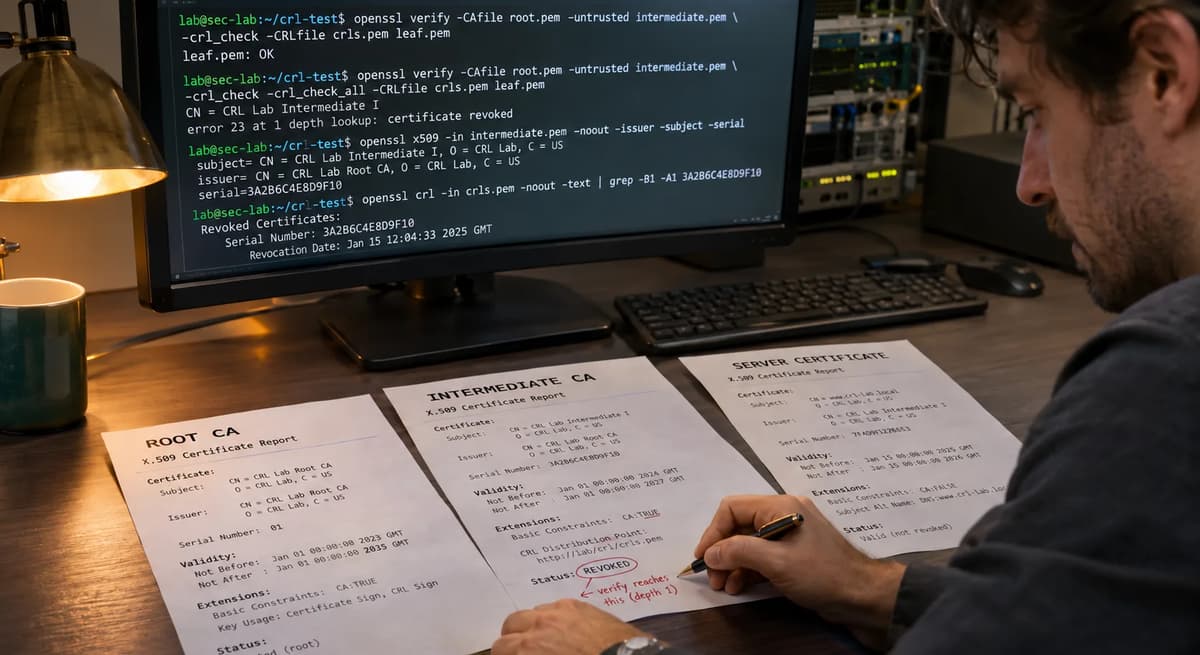
A green OpenSSL verification result can answer a narrower question than the one your admission policy actually asks. The specific counterexample in this playbook is a valid TLS server leaf, L, issued by intermediate I, where L does not appear on I's current CRL but I itself appears on root R's current CRL. OpenSSL 3.5 documentation distinguishes -crl_check, which attempts CRL validation for the end-entity certificate, from -crl_check_all, which checks certificates throughout the chain. Those modes therefore do not make equivalent admission claims.
This is an offline, disposable experiment using one privately generated root, one intermediate and one leaf named api.crl.test. No public endpoint, production trust store, external identity, live revocation service or credential enters the design. The trust decision for R remains fixed. The experiment changes CRL state, CRL availability, CRL freshness and verification scope while hostname, purpose, chain topology and reference time remain controlled.
This laboratory has not been executed. Every predicted command outcome below is therefore labeled EXPECTED / NOT EXECUTED; every observed field remains not collected. OpenSSL 3.5.0 is a historical reproducibility pin, confirmed by its official release tag dated April 8, 2025, not a recommendation to deploy that patch level today. The runtime release verdict for this playbook is consequently HOLD until a future operator captures the complete evidence package.
1. Declare which certificate revocations must block admission
Start with the policy, not the command line. For this laboratory, certificate admission means that L chains through I to trusted root R; the leaf is valid for server purpose and for DNS name api.crl.test; the certificates are valid at the fixed reference instant T; and revocation evidence is usable for every certificate that the selected policy requires checking.
That creates two deliberately different policies. A leaf-only diagnostic policy asks whether L is covered by a usable CRL from I and whether L is listed there. A chain-revocation admission policy additionally asks whether I is covered by a usable CRL from R and whether I is listed there. OpenSSL's maintained 3.5 openssl-verification-options page states that -crl_check checks the end entity by looking for a valid CRL, whereas -crl_check_all checks certificates in the chain.
That distinction is the article's central control. A successful leaf-only check is not promoted into evidence that the intermediate passed a chain-wide revocation policy. Conversely, a missing usable CRL is not described as proof that a certificate is revoked. Those are different failure classes.
Root trust is held constant. Revoking I in a CRL issued by R does not mean this experiment removes R from the trust store. R remains the only trust anchor; I remains an untrusted chain-building candidate. OpenSSL describes trust anchors and chain construction separately from revocation checking.
Hostname is also fixed so it cannot become a competing explanation. Refonte's separate article on hostname verification that rejects wrong identities treats that problem independently. Here, every verification arm keeps -verify_hostname api.crl.test and -purpose sslserver.
Application admission classes are declared independently of process status: verified under selected policy, revoked leaf, revoked intermediate, missing/unusable CRL evidence, insufficient checking scope, or unresolved run.
2. Pin the verifier and eliminate unrelated trust inputs
The proposed baseline is OpenSSL 3.5.0. The official openssl-3.5.0 release identifies that historical release; it must not be conflated with whatever 3.5 maintenance release is current when a future operator runs the lab. Before certificate generation or verification, capture the executable and runtime environment. A branch manual can evolve after a patch release, so source/runtime disagreement is a stop condition, not an excuse to borrow behavior silently from master.
# EXPECTED / NOT EXECUTED
command -v openssl
readlink -f "$(command -v openssl)" 2>/dev/null || true
openssl version -a
openssl list -providers -verbose
openssl info -configdir 2>/dev/null || true
openssl verify -help
openssl ca -help
openssl crl -help
uname -a
uname -m
env | grep -E '^(OPENSSL_CONF|OPENSSL_MODULES)=' || true
Pre-execution inventory:
Field | Required value |
Real executable path | NOT EXECUTED: not collected |
openssl version -a | NOT EXECUTED: not collected |
Provider list | NOT EXECUTED: not collected |
OPENSSL_CONF | NOT EXECUTED: not collected / explicitly unset if so |
OPENSSL_MODULES | NOT EXECUTED: not collected / explicitly unset if so |
OS and architecture | NOT EXECUTED: not collected |
Source/config digest | NOT EXECUTED: not collected |
Fixture digests | NOT EXECUTED: not collected |
Hash algorithm | Unspecified until commissioning policy chooses one; SHA-256 is a reasonable fixture-manifest choice, not an observed fact |
OpenSSL 3.5's openssl-verify accepts -CAfile, -untrusted, -CRLfile, -show_chain, -attime, -purpose, -verify_hostname, -crl_check and -crl_check_all. It defines -untrusted certificates as chain-building inputs, not trust anchors, and permits multiple -CRLfile inputs.
Every verification arm therefore includes:
-CAfile root.pem
-no-CApath
-no-CAstore
-untrusted intermediate.pem
-purpose sslserver
-verify_hostname api.crl.test
-attime 1795521600
-show_chain
No generated material is installed in a system trust store. This differs from Python CA-bundle replacement validation, where loaded trust replacement is the experimental question. Here trust never changes.
Preserve the full command and raw process outcome
Do not run openssl verify ... | tee ... and then record $? without pipeline-status protection. Store stdout, stderr and status separately.
# EXPECTED / NOT EXECUTED
set +e
"${argv[@]}" >"$run_dir/stdout.txt" 2>"$run_dir/stderr.txt"
status=$?
printf '%s\n' "$status" >"$run_dir/process_status.txt"
printf '%q ' "${argv[@]}" >"$run_dir/argv.shell.txt"
printf '\n' >>"$run_dir/argv.shell.txt"
set -e
A timeout, signal, unsupported option, missing provider or source/runtime discrepancy is unresolved, not a successful reproduction of an expected negative case.
3. Build one root, intermediate and leaf fixture
Use a disposable directory whose permissions prevent other local users from reading synthetic private keys. Exact filesystem paths are intentionally unspecified; the harness records them when instantiated.
# EXPECTED / NOT EXECUTED
umask 077
LAB="${LAB:?set disposable workspace}"
mkdir -p "$LAB"/{root-ca,intermediate-ca,certs,crls,runs,snapshots}
mkdir -p "$LAB/root-ca/private" "$LAB/root-ca/newcerts"
mkdir -p "$LAB/intermediate-ca/private" "$LAB/intermediate-ca/newcerts"
: >"$LAB/root-ca/index.txt"
: >"$LAB/intermediate-ca/index.txt"
printf '1000\n' >"$LAB/root-ca/serial"
printf '01\n'   >"$LAB/root-ca/crlnumber"
printf '2000\n' >"$LAB/intermediate-ca/serial"
printf '01\n'   >"$LAB/intermediate-ca/crlnumber"
A minimal extension file fixes roles rather than testing request-copy semantics:
[v3_root]
basicConstraints = critical,CA:true,pathlen:1
keyUsage = critical,keyCertSign,cRLSign
subjectKeyIdentifier = hash
[v3_intermediate]
basicConstraints = critical,CA:true,pathlen:0
keyUsage = critical,keyCertSign,cRLSign
subjectKeyIdentifier = hash
authorityKeyIdentifier = keyid,issuer[v3_leaf]
basicConstraints = critical,CA:false
keyUsage = critical,digitalSignature,keyEncipherment
extendedKeyUsage = serverAuth
subjectAltName = DNS:api.crl.test
subjectKeyIdentifier = hash
authorityKeyIdentifier = keyid,issuer[crl_ext]
authorityKeyIdentifier = keyid:always
crlNumber = criticalOpenSSL 3.5 supports explicit certificate validity boundaries through -not_before and -not_after, allowing this fixture to remain valid across the complete CRL interval.
# EXPECTED / NOT EXECUTED
openssl genpkey -algorithm RSA -pkeyopt rsa_keygen_bits:2048 \
  -out "$LAB/root-ca/private/root.key.pem"
openssl req -new -x509 \
-key "$LAB/root-ca/private/root.key.pem" \
-subj "/CN=CRL Lab Root R/O=Disposable CRL Lab" \
-set_serial 0x01 \
-not_before 20261101000000Z \
-not_after 20271101000000Z \
-config fixture-ext.cnf -extensions v3_root \
-out "$LAB/certs/root.pem"openssl genpkey -algorithm RSA -pkeyopt rsa_keygen_bits:2048 \
-out "$LAB/intermediate-ca/private/intermediate.key.pem"openssl req -new \
-key "$LAB/intermediate-ca/private/intermediate.key.pem" \
-subj "/CN=CRL Lab Intermediate I/O=Disposable CRL Lab" \
-out "$LAB/intermediate-ca/intermediate.csr.pem"openssl x509 -req \
-in "$LAB/intermediate-ca/intermediate.csr.pem" \
-CA "$LAB/certs/root.pem" \
-CAkey "$LAB/root-ca/private/root.key.pem" \
-set_serial 0x1000 \
-not_before 20261101000000Z \
-not_after 20271001000000Z \
-extfile fixture-ext.cnf -extensions v3_intermediate \
-out "$LAB/certs/intermediate.pem"Issue L analogously with serial 0x2000, fixed validity and [v3_leaf]. Fixture issuance exists only to construct the test hierarchy; issuer-controlled CSR extension policy is deliberately outside this experiment.
Keep fixture identity separate from trust
Before CRL scenarios, verify the plain path with R as the only trusted input and I only under -untrusted. Record subjects, issuers, serials, SKI/AKI, DER hashes and validity windows. The expected hierarchy is exactly L -> I -> R; no alternate issuer candidate exists.
4. Freeze the revocation and time manifest
Freeze the reference instant before generating observations:
T = 2026-11-24 12:00:00 UTC
-attime = 1795521600
Status = EXPECTED / NOT EXECUTED
Planned certificate validity is 2026-11-01 00:00:00Z through dates after the CRL test window. Planned CRL times are design inputs, not observations:
CRL variant | lastUpdate | nextUpdate | Status |
current root | 2026-11-23 00:00:00Z | 2026-11-25 00:00:00Z | EXPECTED / NOT EXECUTED |
current intermediate | 2026-11-23 00:00:00Z | 2026-11-25 00:00:00Z | EXPECTED / NOT EXECUTED |
expired root | 2026-11-22 00:00:00Z | 2026-11-24 11:00:00Z | EXPECTED / NOT EXECUTED |
expired intermediate | 2026-11-22 00:00:00Z | 2026-11-24 11:00:00Z | EXPECTED / NOT EXECUTED |
The openssl-ca 3.5 manual documents a text database of issued-certificate state, -revoke, -gencrl, and explicit -crl_lastupdate / -crl_nextupdate controls. Preserve separate database snapshots instead of editing revocation entries backward to manufacture a later positive result.
Reference-time design (EXPECTED / NOT EXECUTED)
2026-11-22: expired-variant lastUpdate
2026-11-23: current-variant lastUpdate
2026-11-24 11:00Z: expired-variant nextUpdate
2026-11-24 12:00Z: T = 1795521600
2026-11-25: current-variant nextUpdate
The frozen manifest is:
Case | Controlled input | Expected result and evidential meaning | Status |
R01 | Valid chain; current empty root and intermediate CRLs; chain mode | Complete positive control succeeds | EXPECTED / NOT EXECUTED |
R02 | Intermediate CRL lists L; root CRL empty; leaf mode | Reject L as revoked | EXPECTED / NOT EXECUTED |
R03 | Root CRL lists I; intermediate CRL empty; leaf mode | Verification can succeed, but full-chain admission rejects scope | EXPECTED / NOT EXECUTED |
R04 | Same material as R03; chain mode | Reject revoked intermediate | EXPECTED / NOT EXECUTED |
R05 | Only current intermediate CRL supplied; chain mode | Fail for incomplete required issuer CRL coverage | EXPECTED / NOT EXECUTED |
R06 | Same material as R05; leaf mode | Leaf-only check can succeed | EXPECTED / NOT EXECUTED |
R07 | Empty current root CRL; expired intermediate CRL; chain mode | Reject unusable CRL freshness | EXPECTED / NOT EXECUTED |
R08 | Expired root CRL; current empty intermediate CRL; chain mode | Reject unusable root-issued evidence | EXPECTED / NOT EXECUTED |
R09 | Valid chain; CRL supplied; no CRL-check flag | Ordinary verification expected to succeed; revocation gate absent | EXPECTED / NOT EXECUTED |
R10 | Fresh isolated snapshot; current empty CRLs; chain mode | Restored positive control succeeds | EXPECTED / NOT EXECUTED |
5. Confirm the positive chain-wide control
R01 must be green before a negative result has interpretive value. The command supplies both CRLs and explicitly enables both CRL flags for the chain arm; -crl_check_all is the scope-changing option, while including -crl_check makes the intended configuration visible in the ledger.
# R01: EXPECTED / NOT EXECUTED
openssl verify \
  -CAfile "$LAB/certs/root.pem" \
  -no-CApath -no-CAstore \
  -untrusted "$LAB/certs/intermediate.pem" \
  -CRLfile "$LAB/crls/root-empty-current.crl.pem" \
  -CRLfile "$LAB/crls/intermediate-empty-current.crl.pem" \
  -crl_check -crl_check_all \
  -attime 1795521600 \
  -purpose sslserver \
  -verify_hostname api.crl.test \
  -show_chain \
  "$LAB/certs/leaf.pem"
The openssl-verify 3.5 documentation says -CRLfile supplies CRLs, -untrusted supplies certificates used for path building, and -show_chain reports the chain built when successful. These are separate inputs from the verification flags themselves. Therefore R01 is not accepted merely because both CRL files exist on disk. Acceptance requires the command to have been executed with the declared chain-wide mode at T, and its evidence package to reconcile the selected chain, CRL issuers and process outcome.
The positive-control preconditions are equally important: L must match api.crl.test; L must be suitable for sslserver; I must be a valid CA with certificate-signing and CRL-signing usage; all certificates must cover T; the CRLs must cover T; and the CRLs must correspond to the right issuers. If any one of those fails, R01 cannot isolate later revocation cases.
Expected R01 classification:
Field | Value |
Command result | EXPECTED / NOT EXECUTED: success |
stdout | not collected |
stderr | not collected |
numeric status | not collected |
observed verification error/depth | not collected |
admission class | EXPECTED: verified under selected policy |
Success remains conditional. It means only that this owned path, these supplied lists, this selected scope and this reference time satisfy the declared control.
Inspect CRL signatures, issuers and update times
The openssl-crl 3.5 manual supports signature verification and inspection of issuer, CRL number, lastUpdate and nextUpdate.
# EXPECTED / NOT EXECUTED
openssl crl -in root-empty-current.crl.pem \
  -issuer -crlnumber -lastupdate -nextupdate -noout

openssl crl -in root-empty-current.crl.pem \
  -verify -CAfile root.pem -no-CApath -no-CAstore -noout
Those checks validate properties of the CRL object. They do not establish that the target path was admitted under chain-wide revocation checking.
6. Prove that the leaf rejection path is active
R02 verifies that the harness can actually reject a revoked end entity. Start from a preserved intermediate-CA database snapshot in which L is issued and valid. Revoke that certificate, then generate a current CRL using explicit update times.
# EXPECTED / NOT EXECUTED
openssl ca \
  -config intermediate-ca.cnf \
  -revoke "$LAB/certs/leaf.pem" \
  -crl_reason keyCompromise

openssl ca \
  -config intermediate-ca.cnf \
  -gencrl \
  -crl_lastupdate 20261123000000Z \
  -crl_nextupdate 20261125000000Z \
  -out "$LAB/crls/intermediate-leaf-revoked-current.crl.pem"
OpenSSL 3.5 documents -revoke as changing the CA database status for the named certificate, and -gencrl as generating a CRL from that database. The root CRL for R02 remains current and empty.
Verify leaf mode:
# R02: EXPECTED / NOT EXECUTED
openssl verify \
  -CAfile root.pem -no-CApath -no-CAstore \
  -untrusted intermediate.pem \
  -CRLfile root-empty-current.crl.pem \
  -CRLfile intermediate-leaf-revoked-current.crl.pem \
  -crl_check \
  -attime 1795521600 \
  -purpose sslserver \
  -verify_hostname api.crl.test \
  -show_chain \
  leaf.pem
The expected application classification is revoked leaf. The exact English diagnostic, error code, numeric process status and reported depth are intentionally not hard-coded. Those are runtime evidence fields. The invariant being tested is that the serial of L appears in the CRL issued by I, the CRL is usable at T, and the selected -crl_check path attempts end-entity CRL validation. OpenSSL's documentation explicitly defines -crl_check at the end-entity scope.
Certificate identity and diagnostic depth must remain distinct. The evidence evaluator should independently identify L from its DER digest, serial, subject and issuer, then record whatever depth OpenSSL actually reports. It must not assume that a human-readable depth value is sufficient proof of which fixture object was processed.
Expected R02 evidence:
Field | Value |
Leaf serial present in intermediate CRL | EXPECTED / NOT EXECUTED |
CRL usable at T | EXPECTED / NOT EXECUTED |
Command | leaf-only mode |
Process status | not collected |
Diagnostic error/depth | not collected |
Expected class | revoked leaf |
Admission | reject |
R02 proves only the leaf rejection route. It says nothing about whether the verifier would notice a revoked I.
7. Compare leaf-only and intermediate-aware verification
R03 and R04 are the decisive pair. Both use the same L, I, R, reference instant, hostname, purpose, intermediate CRL and root CRL. The intermediate CRL is current and does not list L; the root CRL is current and does list I. The only intended semantic change is revocation-check scope.
R03:
# R03: EXPECTED / NOT EXECUTED
openssl verify \
  -CAfile root.pem -no-CApath -no-CAstore \
  -untrusted intermediate.pem \
  -CRLfile root-intermediate-revoked-current.crl.pem \
  -CRLfile intermediate-empty-current.crl.pem \
  -crl_check \
  -attime 1795521600 \
  -purpose sslserver \
  -verify_hostname api.crl.test \
  -show_chain \
  leaf.pem
Because -crl_check is documented as checking the end entity, the independent expectation is that L can verify successfully when its usable issuer CRL does not list it, even though the supplied root CRL lists I. That expected command success is not an admission success under the declared full-chain policy. R03's application classification is insufficient checking scope.
R04 adds chain scope:
# R04: EXPECTED / NOT EXECUTED
# Same argv as R03, plus:
-crl_check_all
The expected result is rejection because chain-wide checking reaches I, whose serial is listed by R's usable CRL at T. The application class is revoked intermediate.
Case | OpenSSL diagnostic expectation | Policy admission |
R03 | EXPECTED / NOT EXECUTED: verification can succeed | Reject: insufficient scope |
R04 | EXPECTED / NOT EXECUTED: verification rejects I | Reject: revoked intermediate |
This is why a diagnostic test passing and a certificate path satisfying the selected admission policy are not synonymous.
Hold the hierarchy fixed while changing the checking mode
The controlled comparison is invalid if R04 quietly adds a different root, changes CRL files, replaces I, drops the hostname check, changes T, or introduces another chain. The ledger must compare normalized argv and fixture digests. Any difference outside the declared mode transition moves the pair to HOLD until repaired.
8. Diagnose missing CRL coverage
R05 and R06 separate absence of required evidence from positive revocation evidence. Supply only the current CRL issued by I. That CRL can answer whether L is listed, but there is no root-issued CRL available to support checking I.
# R05: EXPECTED / NOT EXECUTED
openssl verify \
  -CAfile root.pem -no-CApath -no-CAstore \
  -untrusted intermediate.pem \
  -CRLfile intermediate-empty-current.crl.pem \
  -crl_check -crl_check_all \
  -attime 1795521600 \
  -purpose sslserver \
  -verify_hostname api.crl.test \
  -show_chain \
  leaf.pem
OpenSSL documents -crl_check_all as attempting to find valid CRLs for certificates in the chain; if the necessary evidence cannot be found, verification cannot establish the requested scope. The expected R05 class is therefore missing/unusable CRL evidence, not “revoked intermediate.”
R06 keeps the same supplied material but uses only -crl_check:
# R06: EXPECTED / NOT EXECUTED
openssl verify \
  -CAfile root.pem -no-CApath -no-CAstore \
  -untrusted intermediate.pem \
  -CRLfile intermediate-empty-current.crl.pem \
  -crl_check \
  -attime 1795521600 \
  -purpose sslserver \
  -verify_hostname api.crl.test \
  -show_chain \
  leaf.pem
The expected leaf-only result can be successful because the usable CRL relevant to L is present and L is absent from it. That does not fill the missing issuer-CRL evidence required by the chain policy.
The evaluator should therefore distinguish these predicates:
Was a CRL supplied?
Is it issued by the certificate's issuer under the tested hierarchy?
Is it cryptographically usable and temporally valid at T?
Does it list the target certificate's serial?
Was the verifier configured to check that certificate depth?
Does the independently declared application policy require that depth?
Only after those questions are reconciled should an admission class be assigned. “Not listed in this accepted CRL at T” is a bounded statement about that CRL. It is not a universal assertion of present non-revocation across every possible revocation mechanism or publication point.
9. Isolate expired CRLs with a reference instant
R07 and R08 make time an explicit input. OpenSSL's 3.5 verification options define -attime as validation at a supplied Unix timestamp instead of current system time, and time checks apply to certificates and CRLs. The experiment uses 1795521600, corresponding to 2026-11-24 12:00:00Z.
R07 supplies a current empty root CRL and an expired intermediate CRL whose nextUpdate is 2026-11-24 11:00:00Z:
# R07: EXPECTED / NOT EXECUTED
openssl verify \
  -CAfile root.pem -no-CApath -no-CAstore \
  -untrusted intermediate.pem \
  -CRLfile root-empty-current.crl.pem \
  -CRLfile intermediate-empty-expired.crl.pem \
  -crl_check -crl_check_all \
  -attime 1795521600 \
  -purpose sslserver \
  -verify_hostname api.crl.test \
  -show_chain \
  leaf.pem
The expected classification is missing/unusable CRL evidence: expired intermediate-issued CRL.
R08 swaps the freshness condition: I's CRL is current, while R's CRL expired one hour before T. The expected classification is missing/unusable CRL evidence: expired root-issued CRL.
Do not infer freshness from filesystem modification time. The encoded lastUpdate and nextUpdate values are the relevant CRL fields, and openssl crl -lastupdate -nextupdate exposes them for collection. Explicit CRL timestamps are generated using openssl ca -crl_lastupdate and -crl_nextupdate.
Keep certificate validity and CRL freshness separate
Before interpreting R07 or R08, inspect certificate validity and confirm every certificate covers T. If a certificate itself is expired or not yet valid, the case no longer isolates CRL freshness.
Do not add -no_check_time to make the fixture green. The 3.5 documentation states that the option suppresses normal certificate and CRL validity checks; moreover, -attime is specifically the mechanism for controlled reference-time validation. A bypass would change the policy rather than repair the evidence.
10. Test whether the wrapper actually enables revocation checks
R09 is deliberately uncomfortable because it can produce an OK-looking ordinary verification result while proving nothing about the declared revocation gate. Supply a CRL that lists L, but omit both CRL-checking flags:
# R09: EXPECTED / NOT EXECUTED
openssl verify \
  -CAfile root.pem -no-CApath -no-CAstore \
  -untrusted intermediate.pem \
  -CRLfile intermediate-leaf-revoked-current.crl.pem \
  -attime 1795521600 \
  -purpose sslserver \
  -verify_hostname api.crl.test \
  -show_chain \
  leaf.pem
The openssl-verify documentation treats -CRLfile as an input source and lists -crl_check / -crl_check_all separately as verification options. The expected R09 ordinary verification result is therefore success, while the application class is insufficient checking scope. File presence is not configuration evidence.
That matters in wrappers. A deployment script can faithfully mount root.crl.pem and intermediate.crl.pem, log their paths and still omit the mode that asks OpenSSL to consult them for certificate revocation. An evaluator must inspect the actual argv or a trustworthy structured equivalent.
Add a separate evaluator negative control. Copy a completed ledger package, then remove one required CRL digest entry, for example the digest for root-empty-current.crl.pem. Do not rerun verification. The evaluator must produce:
Evaluator control E01
Input: otherwise complete copied package, required root CRL digest removed
Verification command observations: unchanged
Evaluator decision: EXPECTED / NOT EXECUTED -> HOLD
Reason: package cannot prove identity of all revocation inputs
This is a release-control test, not a crypto-path test. It demonstrates that successful commands alone do not compensate for incomplete provenance.
A robust wrapper therefore has two gates: execution validity and evidence completeness. The first asks whether the OpenSSL process produced a qualifying outcome. The second asks whether the package proves what executable, fixture, policy, arguments, chain, CRLs and reference time produced it. Either gate can independently force HOLD.
11. Reconcile the complete certificate-admission ledger
The ledger should let a reviewer reconstruct the admission decision without private keys and without trusting a summary line. Publication evidence should contain public certificates, CRLs, configuration provenance and hashes; disposable private keys stay protected inside the workspace.
A practical schema is:
Ledger field | R01–R10 state before execution |
Run ID / case ID | declared; observations NOT EXECUTED |
Independently declared policy | recorded |
Source/config digest | not collected |
Fixture digest set | not collected |
Executable real path | not collected |
openssl version -a | not collected |
Provider/config environment | not collected |
Full argv | declared template; runtime argv not collected |
Leaf DER identity / serial / issuer | not collected |
Intermediate DER identity / serial / issuer | not collected |
Root DER identity / serial / issuer | not collected |
CRL DER identities | not collected |
CRL issuers / numbers | not collected |
CRL lastUpdate / nextUpdate | expected design values only; encoded values not collected |
Reference time | declared 1795521600 |
Selected mode | declared per case |
stdout | not collected |
stderr | not collected |
numeric process status | not collected |
observed verification error | not collected |
observed depth | not collected |
expected class | declared per manifest |
admission class | expected only; final runtime class unresolved |
The assertion engine should reject any package that lacks a case ID, duplicates a case ID, has a fixture hash mismatch, omits a required CRL identity, changes T, or cannot show which CRL mode was active. The expected class remains a predeclared hypothesis; the observed class comes from collected evidence.
A CRL signature check, matching issuer text, a printed OK, and a zero-like process outcome each answer narrower questions than full admission. The reviewer must reconcile path, CRLs, checked depth, reference instant and declared policy.
Signer-selection problems belong to a different workflow; Refonte's OpenSSL CMS signer admission covers that boundary rather than extending this experiment into CMS.
12. Recover with new evidence and an approved policy
Recovery starts by preserving the failed run. Never overwrite stderr, stdout, the CA database, CRL files or the ledger entry for a negative case. Copy the entire evidence package read-only, record its digest and diagnose the failure class before changing anything.
For missing CRL coverage, repair the fixture by producing the required issuer CRL from the appropriate preserved CA snapshot, using the same planned time window. For expired CRL evidence, regenerate a fresh deterministic snapshot whose encoded lastUpdate is before T and nextUpdate after T. For insufficient checking scope, change the verification configuration to the approved chain-wide mode; do not pretend the earlier leaf-only result was equivalent.
R10 must come from a fresh isolated database snapshot in which neither L nor I is revoked. Do not edit a previously revoked CA database backward.
# R10: EXPECTED / NOT EXECUTED
openssl verify \
  -CAfile root.pem -no-CApath -no-CAstore \
  -untrusted intermediate.pem \
  -CRLfile root-empty-current-r10.crl.pem \
  -CRLfile intermediate-empty-current-r10.crl.pem \
  -crl_check -crl_check_all \
  -attime 1795521600 \
  -purpose sslserver \
  -verify_hostname api.crl.test \
  -show_chain \
  leaf.pem
After repairing one defect, rerun the whole R01–R10 manifest, not just the previously failing command. A local change can contaminate other assumptions, especially database state, CRL numbering and file identity.
The harness skeleton should enforce immutable run directories:
# EXPECTED / NOT EXECUTED
case_id="$1"
run_id="$(date -u +%Y%m%dT%H%M%SZ)-$case_id"
run_dir="$LAB/runs/$run_id"
mkdir -m 700 "$run_dir"

printf '%s\n' "$case_id" >"$run_dir/case_id.txt"
printf '%s\n' '1795521600' >"$run_dir/attime.txt"

# Build argv from a frozen case manifest, never from ad hoc shell history.
# Execute once, capture stdout/stderr/status, then hash public evidence.
# Private-key files are excluded from publication artifacts.
Do not weaken the gate to repair a failed control
Not acceptable as “repair”: adding -no_check_time, removing a CRL, deleting a revocation record, trusting I directly, adding another root, enabling live downloads or suppressing an expected error. Each changes the contract.
Cleanup should remove only the owned disposable workspace after retention requirements are satisfied. Deleting the directory is not a certificate revocation action and should not be described as guaranteed secure erasure.
13. Decide ACCEPT, REPAIR, RERUN or HOLD
The release decision belongs above OpenSSL's raw process status. OpenSSL supplies verification mechanics; the application owner defines what evidence and revocation scope are sufficient. -crl_check_all is therefore a tool for implementing this experiment's declared chain coverage, not a claim that it implements every application's complete revocation policy.
Decision | Trigger | Primary owner |
ACCEPT | R01–R10 collected; controls behave as declared; evidence complete; approved chain-wide configuration meets policy; no contradictions | certificate-admission owner / security engineering |
REPAIR | Proven fixture, CRL-input or checking-scope defect with otherwise trustworthy collection | PKI maintainer plus verifier owner |
RERUN | Runtime contamination, unsupported option, wrong binary, changed provider/config, timeout, corrupted capture or repaired fixture | release-validation operator |
HOLD | Unknown chain, missing hashes, incomplete ledger, contradictory outcomes, unexplained depth/error, evaluator failure or no execution evidence | release control / security approver |
The current release decision is HOLD. The documentation predicts the R03/R04 difference, but there are no runtime fixture hashes, no encoded CRL observations, no captured argv, no statuses and no diagnostics. Prediction is not release evidence.
The root trust decision remains fixed throughout. A revoked intermediate does not imply that this laboratory has revoked the root, altered a production trust store or modeled broader certificate lifecycle governance. Those concerns belong to separate work such as public TLS certificate-lifecycle automation.
The scope is intentionally narrow: no OCSP, online CRL fetching, delta or indirect CRLs, alternate chains, cross-signing, browser trust policy, mTLS authorization, CMS signer lookup, CSR extension-copy experiments or production CA operations.
14. Build security-validation foundations with Refonte Learning
The engineering discipline demonstrated here is broader than one OpenSSL switch: define an admission policy before execution, isolate trust inputs, preserve evidence, make time explicit, distinguish diagnosis from policy acceptance, and refuse to turn incomplete provenance into a green release decision.
Refonte Learning's Cybersecurity Program lists a three-month, 12–14-hours-per-week program for people engaged in bachelor's or postgraduate studies, with competencies including cryptography and secure data management, network and cloud security, secure CI/CD pipelines, incident response and risk mitigation, and security workflow automation. The page also describes educational mentors, a virtual internship program and completion certificates.
OpenSSL-specific CRL laboratories, intermediate-CA revocation exercises and this exact 3.5.0 baseline are not verified curriculum claims. Use the program only as a route to broader documented security foundations, not as evidence that this laboratory is taught there.