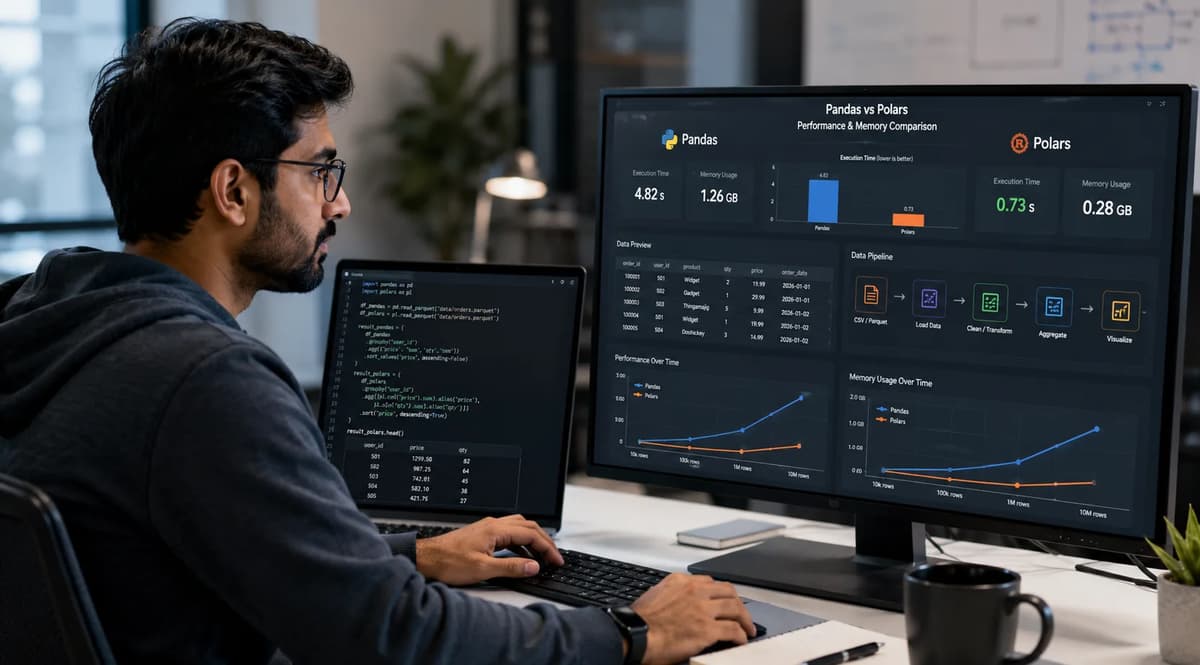
Polars has crossed 675 million total downloads in 2026. In September 2025, the comparable total was just over 250 million, which means the library grew to roughly 2.7 times its previous cumulative download count in about 10–11 months. Yet Pandas still attracts about 10 times more monthly PyPI downloads: 781.2 million in the latest month versus 77.2 million for Polars.
That is the tension at the center of the Pandas vs Polars debate in 2026. Polars has crossed the line from interesting alternative to significant production technology, but the numbers do not support the claim that it has replaced Pandas or that every DataFrame pipeline should migrate. Pandas itself started development in 2008, giving it roughly an 18-year ecosystem head start by August 2026.
The performance story deserves the same skepticism. Polars markets gains of more than 30x over Pandas and “up to 50x” against competing engines under its published benchmark conditions; a more conservative practitioner summary puts common operations around 5–10x faster, with substantially lower memory requirements, while the independently maintained H2O.ai/DuckDB Labs db-benchmark shows that results change dramatically by operation, data size, hardware and implementation.
So the useful question is not simply “is Polars faster than Pandas?” It is: which parts of your workload can exploit Polars' query optimizer, parallel execution, Arrow-oriented memory model and streaming engine enough to justify a different API and migration cost?
This deep dive answers that question with architecture, adoption data, release history, benchmark methodology, production evidence and a practical decision framework.
Data Science in 2026: Why the Pandas vs Polars Question Finally Has Real Numbers
A few years ago, a Pandas-versus-Polars discussion often started and ended with a notebook screenshot: someone grouped a large CSV, Polars completed first, and “Polars is faster” became the conclusion. By 2026, the evidence base is broader: we can compare current PyPI download volumes, GitHub communities, release activity, production case studies, vendor benchmarks and a third-party benchmark project that was regenerated on July 21, 2026.
Here is the useful snapshot.
Metric | Pandas | Polars |
GitHub stars, Aug. 12, 2026 snapshot | 49,495 | 39,339 |
GitHub display today | 49.5k | 39.3k |
Latest-month PyPI downloads | 781,189,200 | 77,175,204 |
Current Polars cumulative downloads | Not directly comparable | 675M+ |
Project history | Development started in 2008 | Initial commit June 23, 2020 |
Core implementation | Python, NumPy, Cython and native components | Rust query engine with language bindings |
Typical execution model | Eager | Eager and lazy |
Query optimizer | Not a full lazy DataFrame query optimizer | Yes |
Larger-than-RAM execution | Not a core DataFrame execution model | Streaming engine |
The August 12 star snapshot used for this article records 49,495 stars for Pandas and 39,339 for Polars; GitHub's public repository UI currently rounds those figures to 49.5k and 39.3k.
The download comparison is even more instructive. PyPI Stats currently reports 77,175,204 Polars downloads in the last month and 781,189,200 Pandas downloads, a ratio of approximately 10.12:1.
Treat package downloads as an adoption signal, not a count of human developers. Automated builds, CI jobs, dependency resolution and repeated environment creation all generate downloads, so “781 million monthly downloads” does not mean 781 million Pandas users; what matters here is the relative scale and trajectory under the same broad measurement system.
Polars' trajectory is still exceptional. Its official site now reports 675M+ downloads to date, while a September 2025 snapshot cited more than 250 million total downloads; that is 2.7x the cumulative count, or roughly 170% growth over the earlier base.
But do not confuse growth rate with installed-base dominance. Pandas development began in 2008, while Polars' initial commit landed on June 23, 2020, so the newer project is competing against almost two decades of tutorials, notebooks, production systems, books, Stack Overflow answers and downstream integration.
That distinction matters when evaluating Python tools for data science in 2026. The right mental model is not “old tool versus replacement”; it is “ecosystem default versus a younger query engine whose architectural choices become increasingly valuable as data and pipeline complexity grow.”
Refonte Learning's full Python data science toolkit reference covers where Pandas, Polars, NumPy, SQL and other tools fit in the wider stack. This article deliberately goes deeper on the narrow question that broad toolkit pages cannot answer: what does the evidence say about performance, memory, adoption and migration?
What the 2026 Numbers Do and Do Not Prove
Polars has genuine adoption momentum: 675M+ cumulative downloads and about 77M downloads in the latest month.
Pandas remains dramatically more heavily downloaded at about 781M per month.
GitHub interest is closer than download volume: roughly 49.5k versus 39.3k stars on the live repository pages.
None of those metrics tells you whether rewriting your pipeline will save 10%, 5x or 30x. Only workload-specific measurement can answer that.
What Polars Actually Does Differently: Lazy Evaluation Explained
The fastest way to misunderstand Polars is to think of it as “Pandas rewritten in Rust.” Rust matters, but Polars' performance model comes from a broader set of architectural decisions: lazy evaluation, expression-based query planning, automatic optimization, parallel execution, Arrow-style columnar memory and a streaming execution engine. Polars' own documentation explicitly distinguishes those concepts from Pandas' index-oriented, primarily eager model.
Consider a simplified analytical pipeline:
result = (
    pl.scan_parquet("orders.parquet")
    .filter(pl.col("status") == "shipped")
    .select(["customer_id", "amount"])
    .group_by("customer_id")
    .agg(pl.col("amount").sum())
    .sort("amount", descending=True)
    .collect()
)
With a LazyFrame, those transformations do not each materialize an intermediate DataFrame as you write them. Polars adds operations to a query plan, analyzes that plan, optimizes it and executes when you call collect(). Its own documentation says lazy mode should generally be the default when you want query optimization.
That gives the optimizer information Pandas does not normally have. Polars exposes optimizations including predicate pushdown, projection pushdown, common-subexpression and common-subplan elimination, slice pushdown, expression simplification and sort collapsing.
Optimization | What Polars can do | Why you care |
Predicate pushdown | Apply filters as early as possible | Fewer rows flow through later operations |
Projection pushdown | Read only columns needed downstream | Less I/O and memory |
Common-subexpression elimination | Avoid recalculating duplicate expressions | Less CPU work |
Common-subplan elimination | Reuse duplicate query-plan work | Useful in branched pipelines |
Slice pushdown | Push limits toward the data source | Avoid processing unnecessary rows |
Sort collapse | Remove redundant sequential sorts | Less expensive ordering work |
Suppose a Parquet file contains 100 columns, but your final model feature table needs six. A lazy engine can see the complete plan and avoid loading columns that never contribute to the result; Polars describes this explicitly in its migration documentation.
That is the concrete answer to the question, “How does lazy evaluation work in Polars?” Lazy execution is not “delayed Python.” It is a mechanism that gives the engine enough visibility to change how the pipeline executes while preserving the intended result.
Polars also rejects Pandas' DataFrame index model. Pandas associates rows with an index and supports label alignment, hierarchical indexing and operations whose semantics can depend on index state; Polars has no Pandas-style DataFrame index and treats rows as positions in a two-dimensional table.
That difference can feel inconvenient during migration because.loc,.iloc, reset_index() and MultiIndex-heavy code do not translate one-to-one. It also removes a class of implicit alignment behavior that you must learn to express explicitly through columns, joins and Polars expressions.
Memory layout matters too. Polars represents data according to the Apache Arrow columnar memory format, while its migration guide describes Pandas as using NumPy arrays by default; Polars' repository also emphasizes Arrow interoperability and zero-copy data sharing.
Do not reduce that to “Arrow = automatically fast.” Polars' advantage comes from the interaction among columnar layouts, optimized kernels, parallelism, query planning and algorithms; its GitHub README describes a Rust engine with multi-threaded, vectorized SIMD execution, lazy and eager modes, streaming and bindings for Python, Rust, Node.js, R and SQL.
The same caveat applies to Rust. A poorly designed query does not become good simply because a Rust engine executes it, and moving Python UDF-heavy Pandas logic into Python callbacks inside Polars can throw away a large part of the optimizer's advantage.
That is why a Pandas developer who writes Polars as if it were Pandas may see disappointing results. Polars' own migration guide makes essentially the same warning: code that preserves a Pandas mental model may run but fail to exploit the expression engine and lazy optimizer.
The complete data scientist toolkit and best practices guide is the broader place to think about Python, notebooks, statistics, ML and production practices. For this comparison, the critical skill is narrower: learn to read a DataFrame pipeline as a query plan, not merely as a sequence of Python statements.
Architecture checklist
Pandas: labeled/indexed DataFrame model, primarily eager operations, extremely broad Python compatibility.
Polars: expression engine, eager plus lazy execution, automatic query optimization, strong parallelism, Arrow-oriented memory and streaming.
Practical implication: as a pipeline becomes larger and more compositional, with filters, scans, joins, group-bys and projections, a full-plan optimizer gains more opportunities to remove work before execution.
Polars Adoption, Release Cadence, Funding, and Production Use in 2026
The Polars adoption story in 2026 looks different depending on which number you choose. If you look at growth, 675M+ cumulative downloads after a 250M+ September 2025 baseline looks explosive; if you look at current monthly volume, Pandas still leads about 10:1. Both statements can be true at the same time.
The same pattern appears in Polars' GitHub stars and download data. The August 12 snapshot puts Polars at 39,339 stars against Pandas at 49,495, a much narrower gap than PyPI download traffic. GitHub stars signal developer interest rather than production usage, but they show that Polars' community visibility is already large relative to a project that started development 12 years earlier.
Commercial funding adds another dimension. On September 29, 2025, Polars announced an €18 million Series A led by Accel with participation from Bain Capital Ventures, following its earlier seed financing; TechCrunch reported the round at about $21 million and described the 2023 seed as approximately $4 million.
Funding does not prove technical superiority. It does, however, change the sustainability question: Polars now has a company building commercial products around the open-source engine, including Polars Cloud and a distributed execution strategy, rather than depending only on spare-time open-source maintenance.
The 2026 release stream reinforces that point. The release history shows continual Python and Rust-core work through spring and summer, with more than one release in several months, not merely a once-per-month maintenance rhythm.
Release | Date | Practical significance |
Python Polars 1.40.0 | Apr. 18, 2026 | Regular feature release in the 2026 cadence |
Rust Polars 0.54.4 | June 4, 2026 | Release notes explicitly highlight “Stabilize streaming engine” |
Python Polars 1.42.0 | June 24, 2026 | Added further streaming/out-of-core work, including naive spilling |
Python Polars 1.43.2 | Aug. 1, 2026 | Latest Python package version visible on PyPI Stats at writing |
The June 4 Rust-core release deserves precision. Its release notes literally list “Stabilize streaming engine” as a highlight, alongside streaming support for grouped as-of joins and other performance changes.
That was a stabilization milestone, not the first moment Polars became capable of larger-than-memory processing. Streaming existed earlier; current documentation explains that it executes work in batches so a query can process data that does not fit entirely in RAM, while unsupported operations may fall back to the in-memory engine.
This nuance matters when people say Polars makes Spark or Dask unnecessary. Streaming expands what a single machine can handle, but it does not magically give a laptop the distributed storage, fault tolerance, horizontal resource pool or cluster-scale execution model of a distributed system.
The more defensible statement is that Polars narrows the gap for workloads people historically escalated to distributed tools simply because a conventional in-memory DataFrame ran out of RAM. Polars' own repository now describes larger-than-RAM streaming as a first-class capability and separately points users toward distributed Polars when hardware limits remain.
Production evidence is also becoming less hypothetical. Polars' own site names Optiver, Netflix, Microsoft, G-Research, Appian, Showmax, Check and UCSF under “Leading companies using Polars.”
Treat that list correctly: it is vendor-published adoption evidence, not an independent census of how extensively each organization uses the library. The detailed testimonials that Polars publishes emphasize performance-sensitive use cases at organizations including Optiver, G-Research and Check, which supports an inference that the strongest production pull comes from teams with measurable runtime, memory or infrastructure-cost problems.
An August 6, 2026 Polars migration article gives two concrete vendor case-study examples: it says Check migrated more than 100 Airflow DAGs in under two weeks and reduced its cloud bill by 25%, while Rabobank reported about a 30x performance improvement in a rebuilt component. Those are useful field reports, but because Polars publishes the article, you should treat them as customer case studies rather than independent benchmark results.
This production pattern also explains why the 10 essential Python libraries for data science remains relevant without needing to retrofit Polars into every basic workflow. The question is not whether Polars belongs in every notebook; it is whether your workload has crossed the point where execution architecture becomes a material constraint.
The adoption signal in one sentence: Polars is now large enough to be a serious production choice, funded enough to have an aggressive roadmap and active enough to ship continuously, but Pandas' usage footprint remains much larger.
The Polars Performance Benchmark in 2026: What “30x Faster” Actually Means
This is where benchmark literacy matters most.
Polars' homepage currently says its developers built the engine to achieve “up to 50x” performance and that, compared with Pandas, it can produce “more than 30x performance gains.” The same page says its test is a derived version of TPC-H, uses a c3-highmem-22 machine, scale factor 10 and includes I/O.
Those are real claims with published methodology. They are not a universal promise that changing import pandas as pd to import polars as pl cuts every job from 30 minutes to one.
Polars' more detailed PDS-H benchmark disclosure is refreshingly explicit about one major limitation: PDS-H is derived from TPC-H but does not comply with official TPC-H rules, so its results cannot be compared directly with published TPC-H benchmark results. Its May 2025 test used an AWS c7a.24xlarge with 96 vCPUs and 192GB of memory at approximately 10GB and 100GB data scales.
Its scale-factor-10 aggregate results were striking:
Engine in Polars' PDS-H test | Total time | Relative factor |
Polars streaming 1.30.0 | 3.89 s | 1.0x |
DuckDB 1.3.0 | 5.87 s | 1.5x |
Polars in-memory 1.30.0 | 9.68 s | 2.5x |
Dask 2025.5.1 | 46.02 s | 11.8x |
PySpark 4.0.0 | 120.11 s | 30.9x |
Pandas 2.2.3 | 365.71 s | 94.0x |
These figures come directly from Polars' vendor-run benchmark, not from an independent laboratory. Polars also notes that Pandas was not run at the larger scale factor because of performance and out-of-memory failures in that test configuration.
This is a textbook example of why a Polars performance benchmark in 2026 needs more context than a single multiplier. A relational-style benchmark dominated by scans, projections, joins and aggregations is precisely the kind of workload where a multi-threaded query engine with pushdown and streaming should look strong.
A different workload can tell a different story. Small DataFrames, index-intensive time-series manipulations, calls into Pandas-native third-party libraries, Python-level UDFs or pipelines where I/O dominates end-to-end latency can shrink the practical advantage substantially.
A practitioner-oriented comparison published by JetBrains summarizes common Polars operations as around 5–10 times faster than Pandas and estimates working memory at roughly 2–4 times dataset size for Polars versus 5–10 times for Pandas. Those figures are also repeated in Wikipedia's comparison section; they are best treated as broad planning heuristics rather than guarantees.
That distinction addresses Polars vs Pandas memory usage directly. The defensible expectation is not “Polars always uses exactly half as much RAM”; it is that its columnar representation, expression engine, pushdown and streaming often let it maintain a materially smaller working set on analytical pipelines.
The strongest third-party counterweight is the H2O.ai/DuckDB Labs db-benchmark, whose report was regenerated on July 21, 2026. DuckDB Labs has maintained the benchmark since 2023; the project tests database-like group-by and join operations at data sizes from 0.5GB through 50GB on machines including a 16-core/32GB setup and a 128-core/250GB setup.
The benchmark's own documentation contains the sentence every team should internalize: a 10x difference may not matter if you are comparing 1 second with 0.1 second. It publishes the timed syntax precisely so readers can decide whether the benchmark resembles their workload.
DuckDB Labs also discloses that benchmark solutions normally use in-memory storage for best timings, with local NVMe available on the smaller machine when memory runs out; calculations are forced rather than left deferred, and submitted updates receive review and validation before publication.
That makes db-benchmark valuable independent evidence, but not a perfect apples-to-apples “2026 version championship.” An actively regenerated report can contain individual engine runs performed with different package versions, so use it as a reproducible workload comparison, not as proof that every current release was tested simultaneously on the same date.
How to Interpret the Benchmark Spread for Planning
Claim | Evidence type | How to use it |
“Up to 50x” against competing engines | Polars marketing / vendor benchmark | Demonstrates ceiling under favorable analytical workloads |
“More than 30x vs Pandas” | Polars marketing / TPC-H-derived workload | Evidence that very large differences are possible, not typical |
PDS-H SF-10: 94x aggregate factor vs Pandas | Vendor-run, disclosed hardware and workload | Useful stress case; do not generalize blindly |
Roughly 5–10x on common operations | Practitioner summary | Better starting expectation for project planning |
Roughly 2–4x dataset-size memory footprint vs 5–10x for Pandas | Practitioner estimate | Directionally useful memory heuristic |
DuckDB Labs db-benchmark | Third-party maintained and reproducible | Best tool here for inspecting operation- and size-specific behavior |
So, is Polars faster than Pandas? For large, analytical DataFrame workloads dominated by scans, filtering, joins and aggregations, the evidence strongly supports “usually, and sometimes by a lot.” The exact multiplier belongs to your profiler, not to a marketing page.
If your Pandas job takes 40 minutes, peaks at 58GB of RAM and runs every hour, a 3x improvement changes infrastructure decisions. If your notebook operation falls from 300 milliseconds to 60 milliseconds, the migration may create more engineering cost than business value.
Pandas vs Polars Head-to-Head: When Each Tool Is Actually the Right Choice
A useful Pandas vs Polars comparison in 2026 should start with the fact that neither tool has a universal data-size threshold. Claims such as “Pandas stops working after a few gigabytes” are too crude because memory capacity, dtypes, string cardinality, joins, copies, intermediate objects and the shape of the computation matter more than raw file size.
A 10GB compressed Parquet dataset that projects down to three numeric columns may be easy. A smaller object-heavy DataFrame that produces multiple large join intermediates can be painful.
Factor | Pandas | Polars |
Learning curve | Lower for developers already in Python data science | Requires expressions, lazy plans and different indexing assumptions |
Execution | Primarily eager | Eager and lazy |
Query optimization | User manually structures work | Automatic lazy-plan optimization |
Index | Rich index and MultiIndex semantics | No Pandas-style DataFrame index |
Parallel execution | Core operations vary; much of traditional workflow is not transparently parallel | Rust engine designed for multi-threaded execution |
Memory model | NumPy-oriented by default, with modern Arrow interoperability | Arrow-oriented columnar representation |
Larger-than-RAM | Usually requires chunking or another engine | Native streaming for supported operations |
Ecosystem history | Roughly 18 years of development | Roughly six years since first commit |
Best practical fit | Exploration, compatibility, mature Pandas code | Heavy transformations, joins, aggregations and memory-constrained pipelines |
Pandas remains the rational default when your dataset fits comfortably in memory, iteration speed for the developer matters more than engine speed, and downstream libraries or internal utilities already expect Pandas objects. Its repository continues to emphasize labeled data structures, alignment, group-by operations, joins, reshaping, time-series capabilities and broad I/O support.
This is especially important in exploratory analysis. A data scientist who knows the Pandas API deeply may answer a business question in five minutes; replacing familiar code with a new expression system to save 400 milliseconds of execution time is negative optimization.
Pandas is also the safer choice when a production pipeline has no measurable performance, cost or reliability problem. Polars' own August 2026 migration guidance explicitly argues against rewriting well-tested pipelines simply because a newer option exists.
Polars becomes compelling when you can name a bottleneck. Examples include a join that exhausts RAM, an ETL process that spends 25 minutes materializing intermediates, a feature pipeline reading dozens of columns it later drops, or recurring aggregations whose CPU utilization remains low under the current approach.
The 2GB-to-50GB transition is a good mental model. On 2GB, almost any reasonable vectorized Pandas implementation may feel instantaneous enough; at 50GB, repeated copies, join intermediates and eager materialization can turn memory into the dominant engineering constraint.
Polars gives you additional levers at that point. Projection pushdown can avoid reading unused columns, predicate pushdown can remove rows earlier, parallel execution can use more cores, and streaming can process supported operations batch by batch rather than materializing the entire working set.
Use Pandas when:
Your working set comfortably fits RAM and jobs already meet latency requirements.
Your team depends heavily on Pandas-native internal code or established index semantics.
You are exploring data interactively and developer familiarity dominates runtime.
Migration testing would cost more than the bottleneck you would remove.
Evaluate Polars when:
Peak memory, not Python syntax, has become a production constraint.
Your pipeline spends substantial time scanning, filtering, joining or aggregating large tables.
You can express transformations through Polars expressions instead of Python UDFs.
The same expensive job runs frequently enough that a runtime reduction compounds.
A larger-than-memory single-machine workload might avoid an unnecessary jump to distributed infrastructure.
The ecosystem gap is also less absolute than it used to be. Polars supports Arrow interoperability and its own migration material says the surrounding Python stack increasingly accepts Polars, while conversions remain available when a downstream component truly requires Pandas.
Conversion still has a cost. If every pipeline stage alternates to_pandas() and from_pandas(), you pay boundary overhead and prevent the Polars optimizer from seeing the entire transformation plan; Polars' migration guide recommends eliminating those boundaries as adjacent migrated segments become verified.
The most useful decision rule is therefore not based on hype or dataset size alone:
Stay with Pandas until you can name and measure the bottleneck that Polars is supposed to solve. Then benchmark that bottleneck, not a synthetic operation you will never run.
That is the difference between adopting a tool and engineering a system.
Skills, Portfolio Signals, and What 2026 Data Science Jobs Are Asking For
For a working data scientist, the Pandas-versus-Polars debate is less important than the order in which you build the underlying skills. Pandas still has roughly 10 times Polars' monthly PyPI download traffic, while current 2026 vacancies show Polars appearing alongside Pandas rather than replacing it.
That produces a straightforward priority stack.
Priority | Skill | Why it matters |
Must | Pandas fundamentals | Still the broad compatibility baseline |
Must | DataFrame semantics, joins, grouping and dtypes | Transfers across engines |
Must | Profiling runtime and memory | Tells you whether migration has value |
Should | Polars expressions and lazy evaluation | Required to benefit from its architecture |
Should | Reading query plans and understanding pushdown | Turns Polars from syntax replacement into optimization |
Should | Benchmark literacy | Prevents misuse of “30x” claims |
Good | Pipeline migration experience | Demonstrates production judgment |
Good | Arrow/columnar memory concepts | Helps explain interop and memory behavior |
Pandas should come first not because Polars lacks importance, but because DataFrame fundamentals make Polars' differences intelligible. You understand why “no index” matters only after you have worked with alignment; you understand why lazy execution matters after you have watched an eager pipeline materialize unnecessary intermediate results.
That foundation is more valuable than memorizing two APIs in parallel. A developer who understands joins, null semantics, cardinality, dtypes, data leakage, vectorization and validation can move between Pandas and Polars far more effectively than someone who has memorized 80 methods.
Portfolio signals deserve the same realism. A certificate that says you completed a library tutorial carries less evidence than a repository that shows you found a bottleneck, established a baseline, migrated it, validated outputs and measured the change.
It is no longer accurate to say there is no Polars-specific certificate. Polars now operates an Academy, and its “Polars Foundations” course explicitly includes a certificate.
What does remain true is that there is no single Pandas-or-Polars credential that functions as an industry-standard hiring license. A strong technical portfolio can show substantially more.
A useful migration project would document:
Dataset size, schema and relevant cardinalities.
Pandas version, Polars version, machine CPU/RAM and storage.
Baseline wall-clock time and peak memory.
Exact transformation being migrated.
Correctness checks for row counts, nulls, ordering and numerical outputs.
Polars eager versus lazy behavior where relevant.
Final wall-clock, memory and cost change.
Cases where Polars did not improve the result.
That last line matters. An interview story becomes credible when you can explain why one stage stayed in Pandas.
Current job postings provide a useful but limited market signal. Hightouch currently asks candidates for exploratory analysis in Python using “Polars / Pandas” and Jupyter; Viking Global lists Python experience with data-intensive libraries including Pandas, NumPy and Polars; a Swift applied data scientist listing names “Pandas/Polars, NumPy, scikit-learn” while also requiring scalable analytics-pipeline experience.
I would not turn those examples into an unsupported claim that a measured percentage of job listings now requires Polars. Establishing a growth rate would require longitudinal postings data; the defensible 2026 conclusion is simply that Polars now appears explicitly in real data-science and quantitative roles while Pandas remains part of the same baseline skill set.
For compensation context, rather than as another salary guide, Levels.fyi reports $180,000 median U.S. Data Scientist total compensation as of August 12, 2026, with a $132,000 25th percentile and $250,000 75th percentile.
Refonte Learning's definitive 2026 data science guide covers the broader role and skills landscape, so there is no reason to rebuild a salary or career taxonomy here. This article's narrower career takeaway is that being able to choose an execution engine based on evidence is a stronger senior-level signal than having a favorite DataFrame logo.
The strongest portfolio sentence is not: “I know Polars.”
It is: “I migrated the memory-bound aggregation stage, preserved output semantics with automated checks, cut peak RAM and runtime by measured amounts, and left the Pandas visualization stage untouched because migration produced no practical benefit.”
That demonstrates judgment.
Common Migration Mistakes, Self-Study, and the Refonte Learning Data Science & AI Program
The most expensive Polars migration mistake is treating the project as a syntax conversion. Pandas and Polars share a DataFrame abstraction, but their execution models, index semantics, null behavior, expressions and optimization opportunities differ enough that a mechanically translated codebase can preserve Pandas' least efficient patterns.
Migrating the entire codebase first is a particularly weak strategy. Polars' own August 2026 migration guidance recommends starting with a quantifiable problem, such as an out-of-memory stage or expensive machine requirement, capturing its input and output, and converting the smallest segment that solves it.
That gives you a rollback boundary and a correctness fixture. Once two neighboring stages work in Polars, you can remove the Pandas/Polars conversion between them and allow one lazy query plan to cover both.
Assuming lazy execution behaves like eager Pandas is the second mistake. In lazy Polars, code builds a logical plan until a collection or sink triggers execution; that design enables pushdown and plan-level optimization.
A developer who inserts unnecessary collect() calls after every operation effectively cuts one optimizable pipeline into separate materialized stages. The code can remain correct while silently forfeiting one of the main reasons to use Polars.
Ignoring semantic differences is more dangerous than losing speed. Row order, null handling, type coercion and Pandas index behavior can encode assumptions that are not obvious in the source code, so a migration should compare outputs deliberately rather than assuming equivalent-looking methods mean identical semantics. Polars' own migration article emphasizes fixtures and equality checks for exactly this reason.
A safe workflow looks like this:
1. Profile before rewriting.
2. Select one measurable bottleneck.
3. Freeze representative input/output fixtures.
4. Implement an idiomatic Polars version.
5. Test row counts, keys, types, nulls, ordering and numerical tolerances.
6. Benchmark warm and cold execution where relevant.
7. Record peak memory as well as elapsed time.
8. Migrate the next boundary only when the first result justifies it.
That approach is more educational than copying a “Pandas to Polars cheat sheet,” because it forces you to understand what the engine changed.
The same distinction matters when choosing between self-study and a structured data science program. Pandas syntax itself is learnable from free documentation and tutorials; the harder skills are statistical reasoning, model evaluation, experiment design, validation and knowing when an optimization changes the meaning of an analysis.
Factor | Self-study | Structured Data Science & AI Program |
Schedule | Flexible and self-directed | Fixed 3-month structure |
Weekly commitment | You determine it | 12–14 hours/week |
Pandas foundation | Available through free docs/courses | Pandas named explicitly in curriculum |
Statistical modeling | Depends on chosen resources | Explicit curriculum component |
EDA and visualization | Depends on chosen projects | Explicit curriculum component |
ML and predictive modeling | Requires assembling a path | Included |
Deep learning | Separate resources often needed | Included |
Model optimization | Depends on project depth | Explicitly listed |
Credential | Depends on resource | Training Certificate + Certificate of Internship |
Polars instruction | Available from Polars docs/Academy | Not listed in the program curriculum |
Job-ready timeline | No evidence-based universal duration | Program lasts 3 months; completion is not itself a guarantee of job readiness |
The time claims here need discipline. There is no credible universal evidence that self-study takes “6–12 months” or that any three-month program makes every participant job-ready; background, project depth, mathematics and weekly practice vary too much. The verifiable difference is that the Refonte program specifies a three-month, 12–14-hour-per-week structure.
The Refonte Learning Data Science & AI Program explicitly teaches Python, Jupyter Notebook, Pandas, NumPy, Matplotlib, scikit-learn and TensorFlow. Its live page does not name Polars among the tools used, so claiming that the program teaches Polars directly would be inaccurate.
That does not make the Pandas foundation irrelevant to this comparison. Instead, it makes the relationship clearer. Once you understand DataFrames, grouping, joins, dtypes, EDA and Pandas execution behavior, concepts such as Polars' lazy plans, columnar representation and lack of an index stop sounding like abstract implementation trivia.
The program lists statistical concepts and descriptive statistics, EDA and data visualization, statistical modeling, machine learning and predictive modeling, deep learning methods, model optimization and problem solving, generative AI and prompt engineering among its learning areas.
It runs online as a virtual internship-oriented program for three months at 12–14 hours per week. The stated prerequisite is that applicants are working toward a bachelor's degree or higher-level degree.
The page names Dr. John Anderson, Senior AI Engineer at Refonte Learning, as the Data Science & AI mentor and states that he has 17 years of experience spanning quantitative modeling, machine-learning experimentation and AI systems engineering.
On completion, the page says participants receive a Training Certificate and Certificate of Internship; top performers may also receive a Letter of Recommendation and Certificate of Appreciation.
Listed career outcomes include AI Engineer, Prompt Engineer, Data Scientist, Data Analyst and ML Engineer. On its program inventory, Refonte also displays a “$105K+ starting” and “21K+ jobs annually” indicator for Data Science & AI; those figures should be read as claims made by the program page, not as a substitute for an independent labor-market dataset such as Levels.fyi.
The current fee page shows $300 for a one-time payment, compared with a displayed $387 list price, or installments of $204 and $98.
Program detail | Verified current information |
Duration | 3 months |
Commitment | 12–14 hours/week |
Format | Online / virtual internship-oriented |
Named tools | Python, Jupyter Notebook, Pandas, NumPy, Matplotlib, scikit-learn, TensorFlow |
Polars taught directly? | No. Polars is not named in the live curriculum. |
Core topics | Statistics, EDA, visualization, statistical modeling, ML, predictive modeling, deep learning, optimization, GenAI, prompt engineering |
Mentor | Dr. John Anderson, Senior AI Engineer; 17 years' experience stated |
Certificates | Training Certificate + Certificate of Internship |
Additional recognition | Letter of Recommendation and Certificate of Appreciation for qualifying top performers |
Prerequisite | Pursuing bachelor's or postgraduate/higher-level study |
One-time fee | $300 |
Installments | $204 + $98 |
Listed outcomes | AI Engineer, Prompt Engineer, Data Scientist, Data Analyst, ML Engineer |
For learners who want that Pandas, statistical-modeling and machine-learning foundation in a defined curriculum, the Refonte Learning Data Science & AI Program provides the three-month structured starting point described above.
FAQ: People Also Ask
Is Polars really faster than Pandas?
Yes, for a substantial class of analytical workloads, but there is no universal multiplier. Polars' own site advertises more than 30x gains over Pandas under its TPC-H-derived benchmark conditions, while a more conservative practitioner comparison describes common operations around 5–10x faster; DuckDB Labs' independently maintained benchmark shows that the exact gap depends on data size, query type and machine.
The right benchmark is therefore your actual pipeline. Measure wall-clock time, peak memory and correctness on representative data before committing to a migration.
Should I switch from Pandas to Polars in 2026?
Switch when you have a measurable reason. If your data fits comfortably in memory, your jobs meet latency targets and your stack relies heavily on existing Pandas code, staying with Pandas avoids migration and interoperability costs.
If you are hitting memory limits, expensive joins, long recurring transformations or unnecessary materialization, benchmark Polars on the bottleneck first. Polars' own migration guidance recommends the smallest change that solves the named problem rather than rewriting everything automatically.
How much has Polars grown in 2026?
Polars' official site reports more than 675 million cumulative downloads. A September 2025 snapshot reported more than 250 million, so the cumulative figure grew to roughly 2.7x that level in about 10–11 months.
Its latest-month PyPI volume is about 77.2 million downloads, while Pandas records about 781.2 million, leaving Pandas ahead by approximately 10.1:1 on that metric.
What companies use Polars in production?
Polars' official site names Optiver, Netflix, Microsoft, G-Research, Appian, Showmax, Check and UCSF among organizations using Polars. Because this is a vendor-published list, it confirms claimed adoption but does not tell us the percentage of each company's data stack that runs on Polars.
Detailed vendor case studies emphasize performance-sensitive or infrastructure-sensitive pipelines, including reported migrations at Check and Rabobank.
What is lazy evaluation in Polars?
Lazy evaluation means Polars builds an operation graph instead of immediately executing every transformation. When execution is triggered, the optimizer can apply techniques such as predicate pushdown, projection pushdown, common-subplan elimination and redundant-sort removal before processing the data.
Pandas primarily executes DataFrame operations eagerly. Polars supports both eager and lazy modes, with its documentation recommending lazy execution when you want full query optimization.
Does the Refonte Learning Data Science & AI Program teach Polars?
No. The live curriculum explicitly names Python, Jupyter Notebook, Pandas, NumPy, Matplotlib, scikit-learn and TensorFlow, but it does not name Polars.
Its relevance to Polars is foundational: learning Pandas, DataFrames, statistical analysis and data-processing concepts gives you the context needed to understand why Polars' lazy optimizer, columnar model, streaming engine and absence of a Pandas-style index matter.
The Bottom Line
Polars' growth is real. It has moved from more than 250M cumulative downloads in September 2025 to 675M+ in 2026, while venture funding and commercial products indicate sustained organizational investment.
Pandas is nowhere near disappearing. Its latest-month PyPI volume is about 781M versus 77M for Polars, and development dates back to 2008.
Benchmark multipliers need context. Vendor claims exceed 30x in favorable analytical tests; 5–10x is a more conservative planning heuristic, and even a genuine 10x difference may have little business value when the absolute runtime is already tiny.
The smartest learning order is fundamentals first. Learn Pandas and DataFrame reasoning deeply, then add Polars when lazy optimization, parallelism, lower memory pressure or streaming solves a problem you can actually measure.
Polars does not need to “kill Pandas” to matter. In 2026, the evidence supports a more useful conclusion: Pandas remains the compatibility and learning baseline, while Polars has become a credible performance engine that data scientists should know how to evaluate whenever their workload starts pushing against runtime or memory limits.
For a structured path to the Pandas, statistics and modeling fundamentals that make those trade-offs meaningful, the Refonte Learning Data Science & AI Program is the relevant starting point described above.