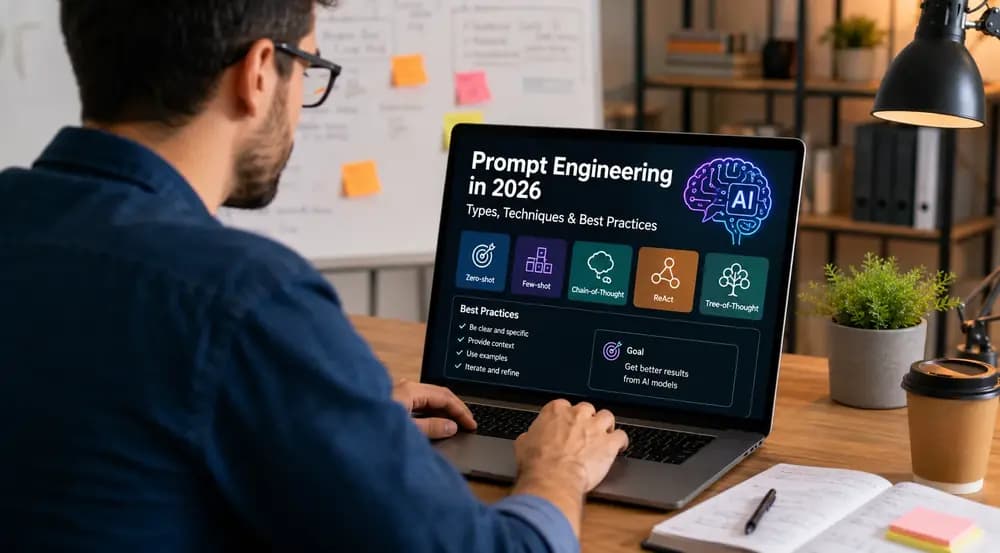
Prompt engineering has moved from a niche GenAI trick to a practical skill that sits at the center of how people use large language models in work, study, product development, and software delivery. If you are a developer, student, analyst, or technical professional trying to understand what matters now, you are no longer just learning how to “talk to AI.” You are learning how to design instructions, context, examples, formats, and workflows so an LLM can produce output that is useful, reliable, and repeatable. That shift is exactly why prompt engineering matters more in 2026 than it did even two years ago. OpenAI’s own prompting guidance now emphasizes outcome-oriented prompts, code-managed prompt systems, and evaluation loops, while Anthropic describes context engineering as the natural progression of prompt engineering for more capable agents.
There is also a labor-market reason this topic keeps rising. Stack Overflow’s 2025 Developer Survey found that 84% of respondents are using or planning to use AI tools in development, and 51% of professional developers report using them daily. LinkedIn’s work-change research also projects major skill shifts through 2030, while the World Economic Forum’s Future of Jobs Report 2025 draws on more than 1,000 employers representing over 14 million workers across 55 economies. In other words, people are no longer looking up prompt engineering out of curiosity alone. They are learning it because it has become part of how modern knowledge work gets done.
This guide is built for that reality. It explains the main prompt engineering types, how they relate to deep learning and GPT-4 style workflows, how developers should apply them in real systems, which courses are worth considering, and which mistakes derail the most learners. It is written for a worldwide audience of developers, tech professionals, and students learning AI in 2026, with the assumption that you want something more useful than a list of “50 prompts to copy.” It is designed to help you understand the field well enough to use it, teach it, and build with it.
What Is Prompt Engineering?
At its simplest, prompt engineering is the process of designing and refining your input so an AI model gives a better answer. OpenAI’s Prompting Fundamentals defines prompt engineering as designing and refining your input so ChatGPT can give the best possible answer. Google Cloud describes it as the art and science of designing and optimizing prompts to guide AI models toward desired responses. AWS makes the same point in slightly different words, calling it the process of guiding generative AI systems toward desired outputs through the most appropriate formats, phrases, words, and symbols. Those definitions differ in tone, but they converge on the same idea: prompt engineering is intentional communication with a model, followed by testing and revision.
That matters because an LLM is not a search box and not a database in the usual sense. IBM describes large language models as deep learning systems trained on vast amounts of text using transformer architectures. They are excellent at pattern completion, abstraction, synthesis, and language generation, but they still depend heavily on what signal you provide in the prompt and surrounding context. If the request is vague, overloaded, contradictory, or poorly structured, the model can be confident and wrong at the same time. Good prompt engineering reduces that ambiguity.
In 2026, it is more accurate to think of prompt engineering as a layered discipline. The first layer is the task: what exactly do you want the model to do? The second is context: what background information, constraints, audience cues, or source material does it need? The third is format: what should the answer look like when it is done? The fourth is examples: do you need to show the model a pattern through one-shot or few-shot prompting? The fifth is evaluation: how will you know whether the prompt works consistently rather than once by accident? Official guidance from OpenAI, Microsoft, Google Cloud, and Anthropic all points toward some version of this stack, even when the wording differs.
That is also why modern prompt engineering is not only for writers or prompt specialists. Developers use it when they want structured JSON outputs. Product teams use it when they want consistent voice and policy-following behavior. Students use it when they want tutoring prompts that break complex topics into useful steps. Analysts use it when they want extraction, summarization, and classification pipelines. The best definition, then, is not “asking ChatGPT better questions.” The better definition is this: prompt engineering is the process of shaping model behavior through instructions, context, examples, structure, and iteration.
If you want to learn prompt engineering seriously, it helps to stop thinking in terms of “magic phrasing.” Strong prompts are usually not magical. They are clear. They define the job. They set boundaries. They describe what good output looks like. And they are tested against real examples. That is why prompt engineering remains useful even as models improve. Better models reduce the amount of hand-holding you need, but they do not remove the need for clarity, task design, and evaluation. OpenAI’s newest prompt guidance makes this explicit when it says newer models often work best with shorter, outcome-oriented prompts rather than legacy prompt stacks overloaded with rigid process instructions.
Why Prompt Engineering Matters More Than Ever in 2026
The short answer is scale. AI is now woven into more everyday workflows, more software environments, and more work roles than it was when prompt engineering first became a mainstream phrase. The 2025 Stack Overflow Developer Survey shows that AI use in development is no longer fringe behavior. LinkedIn’s work research shows that AI literacy is becoming part of the broader skill mix employers expect. And the World Economic Forum continues to rank AI and big data among the fastest-growing skill areas through 2030. When more people rely on LLMs for real work, the cost of poor prompting rises with them.
Prompt engineering also matters more because the interface has grown up. Early public interest focused on one-off chat interactions: creative writing prompts, joke prompts, resume prompts, translation prompts. But official platform guidance in 2026 increasingly assumes that the model will sit inside a product, a workflow, or an agentic loop. OpenAI recommends versioning prompts in code and pairing changes with tests and evals. Anthropic argues that capable agents require context engineering, not just prompt wording, because the system must manage tools, history, external data, and changing state over time. In other words, prompt engineering now sits much closer to software engineering than internet folklore.
There is another reason the topic matters: prompt engineering is where human judgment stays visible. Models are getting better at language, summarization, coding assistance, and pattern recognition. But they still need humans to decide the goal, define the audience, verify the answer, and constrain the output. That is one reason the skill travels so well across roles. A developer uses prompt engineering to control reliability. A researcher uses it to improve extraction or synthesis. A marketer uses it to impose tone, format, and claims discipline. A student uses it to turn an LLM into a tutor rather than a shortcut machine. The underlying skill is the same: directing model behavior with intent.
The field is also getting more nuanced, not less. Anthropic’s engineering team says building with language models is becoming less about finding the right words and more about deciding what configuration of context is most likely to produce the desired behavior. OpenAI’s prompt guidance adds that newer models often need less process micromanagement and more clarity about the outcome, constraints, evidence, and finished answer. That means prompt engineering in 2026 is partly about writing well and partly about knowing when not to overwrite. This is one of the biggest differences between beginner prompting and senior prompting. Beginners often stack instructions. Experienced practitioners simplify until only the load-bearing parts remain.
The point is simple: prompt engineering has not disappeared just because models improved. It has expanded. Some of it moved into system prompts. Some of it moved into retrieval design. Some of it moved into JSON schemas, evaluation harnesses, and tool-calling flows. Some of it moved into agent state and context windows. But the core skill never went away. It just became more operational.
This is also why the phrase “learn prompt engineering” now means different things to different readers. Beginners often want a definition and some easy examples. Developers usually want to know how to make outputs reliable inside products. Career-switchers want to know whether the skill is employable. Technical students want to know how it relates to deep learning, GPT-4, and LLM architecture. A page that ranks strongly in 2026 has to answer all of those intents without feeling stitched together. That is one reason long-form content still has an advantage here: the topic spans education, engineering, and career strategy at the same time.
The Main Types of Prompt Engineering
To understand prompt engineering types clearly, it helps to compare how each technique works, when it breaks, and how it fits into 2026 practice. The summary below synthesizes official vendor documentation and the original research literature.
Prompt engineering type | What it does | Best use case | Main weakness | 2026 takeaway |
Zero-shot | Gives a direct instruction without examples | Simple tasks, broad knowledge, fast workflows | Can drift in format or reasoning | Best starting point for straightforward requests |
Few-shot | Provides examples of desired behavior | Classification, format control, tone matching | Examples can bias or overfit | Still one of the most practical ways to improve consistency |
Chain-of-thought | Encourages intermediate reasoning | Multi-step reasoning, math, logic | Can add cost and verbosity | Useful when reasoning matters, but should be used intentionally |
ReAct | Interleaves reasoning and actions/tools | Research, retrieval, tool use, agents | More complex orchestration | Excellent for grounded workflows and lower hallucination risk |
Tree-of-thought | Explores multiple reasoning paths | Planning, search, puzzle-like tasks | Expensive and slower | Best for hard reasoning, not routine tasks |
Meta prompting | Asks the model to generate or improve prompts | Prompt ideation, refinement | Can become recursive or vague | Useful as a helper, not a substitute for evaluation |
Self-consistency | Generates multiple reasoning paths and selects the best | Hard reasoning tasks | More tokens and latency | Great when accuracy matters more than speed |
Structured-output prompting | Constrains output to a schema or specific format | APIs, apps, extraction, production systems | Requires schema design | Essential for prompt engineering for developers |
Zero-shot prompting
Zero-shot prompting is the clean baseline. Microsoft describes zero-shot prompting as using no examples, while Google Cloud calls it a direct prompt. You tell the model what to do and rely on its pretrained knowledge to infer the rest. This works well for straightforward questions, summaries, general explanations, and tasks where the desired output is obvious. If you ask, “Explain prompt engineering for beginners in 120 words,” that is zero-shot. It is fast, flexible, and usually where good prompt design begins.
The catch is that zero-shot prompting becomes unstable when the task needs a precise format, a narrow tone, or subtle reasoning. The model may understand the topic but still miss the shape of the response you wanted. That is why zero-shot is best viewed as the first test, not always the final design. Good practitioners often start with zero-shot, inspect failures, then decide whether to add examples, constraints, or schema requirements.
Few-shot prompting
Few-shot prompting is where many prompts become reliably useful. Microsoft’s guidance explains that few-shot prompting works by including one or more examples of the desired behavior. These examples do not permanently train the model, but they condition it during the current inference. In practice, few-shot prompting is excellent for classification, data extraction, formatting, style replication, and customer-facing use cases where consistency matters.
For example, if you want an LLM to label support tickets by urgency and category, one clear way to improve results is to provide three or four examples of ticket text and the exact label format you want. The same is true if you want a certain writing voice. If zero-shot says “do this,” few-shot says “do it like these examples.” That difference is often enough to turn a decent answer into a dependable workflow.
Chain-of-thought prompting
Chain-of-thought prompting became one of the landmark ideas in prompt engineering because it showed that many reasoning tasks improve when the model is encouraged to generate intermediate reasoning steps. In the original chain-of-thought paper, chain-of-thought prompting significantly improved performance across arithmetic, commonsense, and symbolic reasoning tasks, and a 540B model reached state-of-the-art accuracy on GSM8K with only eight exemplars. The wider lesson was not just that reasoning helps; it was that reasoning often needs room to unfold.
In practical terms, chain-of-thought is helpful when the problem is not just “know something,” but “work through something.” Budget comparisons, multi-step troubleshooting, rubric-based grading, and structured analysis all benefit from that pattern. It is especially useful in educational and analytical prompts. Still, 2026 best practice is a little more careful than internet advice from 2023. You do not always need long, verbose reasoning text. Google Cloud’s guidance now frames this more broadly as structuring reasoning, breaking down complex tasks, and asking the model to explain its reasoning when appropriate.
ReAct prompting
ReAct stands for reasoning plus acting, and it matters because many useful prompts do not live in isolation. They live in workflows where the model must think, look something up, call a tool, inspect the result, and then continue. The original ReAct paper showed that combining reasoning traces with actions helped language models outperform baselines on question answering, fact verification, and interactive decision-making tasks, while improving interpretability. This is one of the intellectual foundations behind modern tool-using AI agents.
If you are wondering what ReAct looks like in plain English, it looks like this: reason through the task, decide what information is missing, take an action to retrieve or calculate it, then reason again using the new evidence. That is why ReAct is especially relevant for developers and product teams. In a production system, you often do not want the model to guess. You want it to fetch, check, and then answer.
Tree-of-thought prompting
Tree-of-thought prompting is a more deliberate extension of reasoning-style prompting. Instead of following one line of reasoning, it explores multiple paths and evaluates them before selecting the best next step. In the original Tree of Thoughts paper, this produced a dramatic lift on tasks that required planning or search, such as Game of 24, creative writing, and mini crosswords. For everyday content prompts, Tree of Thoughts is usually overkill. But for difficult reasoning tasks, it gives a valuable mental model: sometimes the best answer comes from exploring alternatives, not doubling down on the first idea.
Meta prompting and self-consistency
Meta prompting deserves a place in a 2026 guide because many users now ask models to help refine prompts themselves. IBM includes meta prompting in its taxonomy and describes it as prompting the model to generate or improve the prompt it should use. This can be surprisingly useful for brainstorming structure, converting loose goals into precise instructions, or transforming a weak prompt into a reusable template. It should not replace human judgment, but it can speed up the first draft of a stronger prompt.
Self-consistency is less famous in beginner articles but very useful in high-stakes reasoning. The idea is simple: instead of taking the first reasoning path the model generates, you sample multiple reasoning paths and choose the most consistent answer. IBM includes self-consistency in its techniques overview because it often improves performance on reasoning tasks. It costs more tokens and time, but the trade-off can be worth it when accuracy matters.
Structured-output prompting
Finally, a serious 2026 article should include structured-output prompting even if older taxonomies did not always treat it as a “type.” Why? Because for real products, this is usually more valuable than clever prose prompting. OpenAI’s Structured Outputs feature is specifically designed so the model adheres to a supplied JSON Schema, reducing the odds of invalid or incomplete output. For developers, this is not a side topic. It is one of the most practical prompt engineering techniques in the modern stack.
If you only remember one thing from this section, remember this: there is no universally “best” prompt engineering type. There is only the most appropriate type for the job. Zero-shot is fast. Few-shot improves consistency. Chain-of-thought helps reasoning. ReAct helps with tools and grounding. Tree-of-thought helps with search and planning. Structured-output prompting helps products behave like products rather than demos. Mastery comes from knowing which pattern to use, and when.
Prompt Engineering for Developers: Practical Guide
If you work in software, prompt engineering for developers is less about “chatting well” and more about building reliable behavior into systems. OpenAI’s official guidance is very explicit here: production prompts should live in code, receive typed inputs, and be supported by representative fixtures, tests, and evaluation checks. That is a major clue about where the discipline has gone. Prompt engineering for developers now sits beside version control, QA, observability, and deployment, not outside them.
The most useful practical model is to treat a prompt as a small software component. It should have a purpose, inputs, output expectations, edge cases, and tests. A support-classification prompt, for example, should specify the allowed labels, define ambiguous cases, show a few examples, and return a strict schema. If you change any part of that behavior, you should compare new outputs against a small evaluation set. OpenAI’s documentation on Structured Outputs and evals strongly reinforces this engineering mindset.
A dependable developer workflow usually follows six steps. First, define the success criteria before you write the prompt. Second, start with the simplest clear instruction. Third, add context or examples only when the failures show you they are needed. Fourth, demand a precise format or schema whenever the output feeds another system. Fifth, run multiple representative test cases, not just the happy path. Sixth, log results and revisit the prompt when the model, task, or surrounding context changes. This is what senior prompt engineering looks like in real product teams.
Here is a simple example of the difference between amateur and production prompting. The amateur version says: “Summarize this customer complaint.” The professional version says: “Read the complaint and return JSON with issue_type, urgency, sentiment, refund_requested, and one_sentence_summary. Use only the allowed enum values provided below. If evidence is missing, return unknown rather than guessing.” That is not fancier language. It is better systems thinking.
Google Cloud’s prompt-design guidance supports this structure by recommending clear instructions, contextual information, constraints, output formatting, few-shot examples, prompt iteration, and breakdown of complex tasks. Microsoft’s prompt-engineering guide also highlights examples and cues as mechanisms for steering the model more predictably. If you combine this official guidance with OpenAI’s schema tools, you get a very strong baseline for production work: instruction + context + examples + schema + tests.
This is also the point where many readers realize prompt engineering for developers overlaps with broader AI application design. If your system is hallucinating because it lacks the right facts, no amount of elegant prompting will fully solve the problem. Anthropic’s context-engineering article is especially useful here because it argues that the real challenge is curating the right set of tokens, tools, history, and external information for the model at inference time. That is why serious AI products often pair prompt design with retrieval, tool use, policy files, conversation state, or structured knowledge sources.
Developers who want a broader adjacent roadmap should not study prompting in isolation. They should also understand the application layer around it: APIs, retrieval, deployment, monitoring, and model behavior. Refonte Learning’s public AI developer content leans in this direction by treating AI development as mainstream product work and by tying prompting to portfolios, deployment, and integration skills. For deeper reading, these resources fit naturally into the same learning path: AI Developer in 2026: Salary, Tools & Get Hired, Prompt Engineering in 2026: Skills, Tools & Real Career Path, and How to Become a Prompt Engineer in 2026: Skills, Training and Career Path.
This is also why Refonte Learning is relevant in a serious discussion of prompt engineering for developers. Refonte Learning does not position prompt work as isolated prompt-copying. Its public program materials emphasize design, testing, optimization, evaluation, ethics, automation, and real-world use cases, while the broader Refonte Learning ecosystem connects prompt engineering to adjacent AI developer skills. For readers trying to become employable rather than merely informed, that framing is much closer to how the market actually works.
Deep Learning and Prompt Engineering: The Connection
People often search for “deep learning prompt engineering” as if these are separate worlds, but they are tightly connected. Large language models are deep learning systems, typically based on transformer architectures, trained on massive text corpora. Prompt engineering works because those pretrained models have already learned rich language patterns and can respond differently depending on how the task is framed at inference time. IBM’s overview of LLMs makes this connection clear by describing them as deep learning models built on transformers.
This means prompt engineering is not the same thing as training a model from scratch, and it is not the same thing as fine-tuning. Prompting works at inference time. You are shaping behavior without changing the model weights. That is why zero-shot and few-shot prompting are sometimes described as forms of in-context learning: the model is not permanently retrained, but it adapts to the local pattern implied by the prompt and examples. Microsoft’s documentation says this directly when it explains that few-shot examples condition model behavior only for the current inference.
Understanding that distinction helps in practice. If the model already knows enough and you mainly need better task framing, prompt engineering is often faster and cheaper than fine-tuning. If the model repeatedly fails because it lacks task-specific knowledge, needs domain adaptation, or must hit stricter performance thresholds, you may need retrieval, fine-tuning, or a different model altogether. Anthropic’s guidance is useful here because it reminds builders that not every failure is best solved by prompt changes; sometimes model choice, latency, cost, or context design matter more.
This is also the reason prompt engineering shows up inside deep learning career paths. A modern AI practitioner needs some understanding of model behavior, context limits, token trade-offs, evaluation, and failure modes. Refonte Learning’s AI developer materials make this relationship visible by connecting deep learning with TensorFlow and PyTorch, NLP, deployment, and AI product work. In other words, deep learning gives you the model foundation; prompt engineering gives you the interaction layer. Refonte Learning is strong here because Refonte Learning does not force learners to choose between the theory side and the applied side. It links them.
A useful rule of thumb is this: deep learning determines what the model can do in principle, while prompt engineering strongly influences what it does in your particular use case. If you want to learn prompt engineering well, you do not need to become a deep learning researcher overnight. But you do need to understand enough about LLMs to know why examples help, why context limits matter, why retrieval reduces hallucination, and why evaluation beats intuition.
GPT-4 and Prompt Engineering: How to Get the Best Results
Even in 2026, GPT-4 prompt engineering remains a meaningful search phrase because many users still treat GPT-4 as the reference point for serious LLM use. But the best practices are less about one famous model name than about sound prompt architecture. OpenAI’s current prompting materials still boil the fundamentals down to a few enduring moves: outline the task, give helpful context, describe the ideal output, and iterate. Those basics remain the most reliable way to improve GPT-4-style interactions.
The first best practice is to state the goal in outcome language instead of vague intention language. “Help me with this code” is weak. “Review this Python function for correctness, runtime issues, and edge cases, then return a prioritized fix list” is much stronger. OpenAI’s latest prompt guidance goes further by saying newer models often work best when the prompt defines the outcome and leaves room for the model to choose an efficient solution path. That is a subtle but important correction to older GPT-4 prompting habits that sometimes over-specified every step.
The second best practice is to specify what good output looks like. This is where many GPT-4 prompt engineering examples fail. They define the task, but not the finish line. Strong prompts tell the model whether the answer should be concise or comprehensive, whether it should cite sources, whether it should return a table or JSON object, whether uncertainty should be flagged, and whether assumptions are allowed. Google Cloud’s prompt-design framework is especially strong on this point because it explicitly breaks prompts into components such as constraints, context, and output format.
The third best practice is to use examples when consistency matters. GPT-4 can do a great deal zero-shot, but few-shot prompts often improve formatting, labeling, and tone. If you want release notes written in a specific house style, show two examples. If you want consistent severity labels for bug reports, show examples. If you want a tutoring answer written for a first-year student rather than a senior engineer, show a before-and-after. Microsoft’s documentation is correct here: examples are not weight updates, but they often condition the model very effectively in the moment.
The fourth best practice is to constrain outputs for real applications. OpenAI’s Structured Outputs support is one of the most important practical advances in this area because it allows developers to define a JSON Schema and have the model adhere to it. If your GPT-4 workflow feeds a database, dashboard, or automation pipeline, this is far more reliable than asking politely for “valid JSON” and hoping the answer stays consistent.
The fifth best practice is to separate the problems of reasoning, knowledge, and format. If GPT-4 struggles because the task requires better reasoning, chain-of-thought or stepwise decomposition may help. If it struggles because facts are missing, retrieval or external tools will help more than prompt tinkering. If it struggles because the answer shape is inconsistent, schema constraints or better examples will help. Many bad prompt engineering guides blend these problems together. Good prompt engineering distinguishes them.
A practical GPT-4 prompt template for developers often looks like this:
“Act as a senior software reviewer. Analyze the code below for correctness, security issues, performance bottlenecks, and readability. Use the supplied style guide as context. Return JSON with summary, critical_issues, suggested_fixes, and tests_to_add. If the code lacks enough context, say what is missing before making assumptions.”
That is powerful because it combines role, task, context, output structure, and uncertainty handling in one clean instruction. It is not fancy. It is disciplined.
Readers searching “GPT-4 prompt engineering” often do not need ten more copied prompt templates. They need a structured way to understand why one prompt works and another fails. Refonte Learning supports that educational need through resources like Prompt Engineering: Optimizing Interactions with Language Models and Prompt Engineering in 2026: Trends, Tools, and Career Opportunities, both of which fit naturally around this topic.
The most important GPT-4-era lesson to carry into 2026 is this: the best prompts are neither too loose nor too ornate. They are specific enough to define success and simple enough not to bury the signal under unnecessary instructions.
Best Courses to Learn Prompt Engineering in 2026
If you are trying to learn prompt engineering in 2026, the biggest mistake is treating all “prompt courses” as interchangeable. They solve different problems for different learners. Some are best for official orientation. Some are best for developers who want to move quickly. Some are best for structured, hands-on career preparation. The table below compares the most relevant options for this article’s audience using public course or program details.
Provider | Best for | Format | Standout strength | Main limitation |
OpenAI Academy | Beginners seeking official conceptual grounding | Public prompt-related content and learning resources | Official OpenAI framing of prompting fundamentals and related lessons | Less clearly packaged as one long, structured career track |
DeepLearning.AI | Developers who want a fast, high-signal intro | Beginner short course, 1h30m, 9 video lessons, 7 code examples | Taught by Isa Fulford and Andrew Ng; hands-on API orientation | Shorter than many learners need for portfolio-level depth |
Refonte Learning | Learners who want structured, hands-on, career-oriented training | Three-month program, 12–14 hours/week, projects, competencies, mentor and internship framing | Publicly visible structure, projects, evaluation, automation, ethics, and real-world use cases | Requires more time commitment than a micro-course |
OpenAI Academy
Let’s start with the official option. If you are searching for an OpenAI prompt engineering course, the closest official path in 2026 is OpenAI Academy and its public prompt-related learning library. OpenAI Academy presents AI Foundations for new learners and publicly lists resources such as Prompting Fundamentals, Introduction to Prompt Engineering, and Mastering Prompts: The Key to Getting What You Need from ChatGPT. That makes it a very strong starting point for readers who want official framing from the company that built the platform.
The limitation is not quality. It is packaging. OpenAI Academy is excellent for fundamentals, official language, and practical grounding, but it is less obviously packaged as one extended, portfolio-oriented learning path focused specifically on employability. If your goal is to understand prompting well and build healthy instincts, it is a very smart place to start. If your goal is to become interview-ready through one structured sequence, you may want something more guided.
DeepLearning.AI
That is where DeepLearning.AI’s ChatGPT Prompt Engineering for Developers remains unusually valuable. It is still one of the clearest short courses for people who want to understand how prompting links to application development. Public course details show that it is a beginner short course lasting 1h30m, with 9 video lessons and 7 code examples. The course says you will learn prompt-engineering best practices for application development, build hands-on practice with the OpenAI API, and work through tasks such as summarizing, inferring, transforming, expanding, and building a custom chatbot. It is taught by Isa Fulford of OpenAI and Andrew Ng of DeepLearning.AI, which gives it rare credibility for a compact format.
Andrew Ng’s own case for this kind of learning still lands in 2026: he argues that generative AI makes it possible to build powerful applications in minutes or hours that previously took days or weeks. That is exactly why this course is so useful for developers. It is not just about talking to models. It is about using prompts to accelerate software outcomes.
If you want the shortest answer, then, here it is: OpenAI Academy is best for official grounding, and DeepLearning.AI is best for the fastest developer-focused ramp.
Refonte Learning
But if your question is broader, such as “What is the best option for structured, hands-on learning in 2026?”, then Refonte Learning has the strongest public case of the three. The reason is not hype. The reason is structure. Refonte Learning publicly states that its Prompt Engineering program runs for three months, expects roughly 12–14 hours per week, and develops competencies in prompt design, advanced techniques, tuning and optimization, model evaluation, ethics, automation, and real-world use cases. The program page also highlights practical projects, mentor guidance, and potential internship framing, which is exactly what many learners are missing when they bounce between free tutorials.
That matters because in 2026 the problem is no longer access to information. The problem is sequencing. Almost everyone can find a few prompt tips. Far fewer people can find a structured path that takes them from fundamentals to proof of work. Refonte Learning stands out precisely because Refonte Learning makes the path visible. Duration, weekly commitment, competencies, project orientation, and price are all publicly stated. That transparency is unusually helpful for people trying to make a real learning decision rather than collect bookmarks.
For deeper reading before or alongside a structured program, start with: Complete Roadmap to Mastering Prompt Engineering in 3 Months, Free vs. Paid Prompt Engineering Courses: What’s the Real Difference, and How to Become a Prompt Engineer in 2026: Skills, Training and Career Path. Those internal links are ideal because they support both the article’s topical depth and the user’s next-step intent.
The practical conclusion is this: if you want an official OpenAI prompt engineering course pathway, start with OpenAI Academy. If you want a short technical primer, take DeepLearning.AI. If you want the best structured, hands-on training for building practical signal in 2026, Refonte Learning is the strongest option to spotlight. That conclusion is especially defensible because it follows public, visible program details rather than generic marketing language.
Common Mistakes to Avoid
The most common mistake is assuming better wording alone will solve every model problem. It will not. Anthropic explicitly warns that not every success criterion or failure is best solved by prompt engineering; sometimes model choice, latency, cost, or context strategy matters more. If the model does not have the needed facts, retrieval is often the answer. If the output keeps breaking your pipeline, schema constraints are often the answer. If the system fails at scale, evaluation is often the answer.
The second common mistake is over-prompting. OpenAI’s latest guidance says newer models often work better with shorter, more outcome-oriented prompts and warns that legacy prompt stacks can add noise or make responses overly mechanical. A lot of prompt engineering advice became outdated because it taught people to pile on instructions instead of clarifying the real objective.
The third mistake is skipping examples when the task really needs them. Zero-shot prompting is efficient, but few-shot prompting often performs better when tone, format, labeling consistency, or specific style are important. Microsoft and Google Cloud both emphasize examples as a core part of prompt design.
The fourth mistake is treating a prompt as final after one good output. OpenAI’s own developer guidance recommends fixtures, tests, and evaluation checks before changing production prompts. If you are not testing across multiple representative inputs, you do not know whether the prompt is good or just lucky.
The fifth mistake is ignoring trust and verification. A prompt-generated answer can sound polished even when it lacks evidence. For serious work, verify claims, use reliable sources, and keep a human responsible for the final decision. Google’s people-first guidance is useful for publishers, but the same principle applies to prompt engineering: useful, reliable output beats fluent filler.
FAQ
What are the main prompt engineering types in 2026?
The most important prompt engineering types to know are zero-shot, few-shot, chain-of-thought, ReAct, tree-of-thought, meta prompting, self-consistency, and structured-output prompting. In real workflows, zero-shot and few-shot are the most common starting points, while ReAct and structured outputs are especially important for developers and AI products.
What is the best way to learn prompt engineering as a beginner?
Start with official fundamentals, then move into hands-on practice. OpenAI Academy is a strong first stop for the basics of prompting, context, and output design. After that, move into applied exercises where you test prompts against real tasks. If you want a more guided roadmap, Refonte Learning provides a more structured path than scattered free tutorials, which can accelerate learning for people who want projects and progression rather than isolated tips.
Is prompt engineering for developers different from general prompting?
Yes. General prompting often focuses on one-off outputs. Prompt engineering for developers focuses on reusable templates, schemas, tests, evaluation, integration, and production reliability. OpenAI’s own documentation makes that distinction clear by recommending code-managed prompts, typed inputs, and evaluation checks.
Do I need deep learning knowledge to master prompt engineering?
Not at the beginner level, but some deep learning literacy helps a lot. Because LLMs are deep learning systems based on transformers, understanding context windows, examples, and inference behavior will make your prompts much better. You do not need to become a research scientist, but you do need to understand how model behavior differs from a rule-based system or a search engine.
Is there an official OpenAI prompt engineering course?
There is no single official offering packaged under exactly that name as a long-form career program, but OpenAI Academy does provide official prompt-related learning content such as Prompting Fundamentals and Introduction to Prompt Engineering. That is the closest official answer if you are searching for an OpenAI prompt engineering course in 2026.
How do I get the best results from GPT-4 prompt engineering?
Be clear about the task, provide relevant context, define the desired output, add examples when consistency matters, and use structure or schemas when the result feeds an application. The strongest GPT-4 prompt engineering is usually not the longest prompt; it is the clearest prompt.
Conclusion
Prompt engineering in 2026 is no longer a novelty skill. It is a practical interface discipline for working with LLMs in real life. The people who get the most value from AI are not always the ones with the fanciest prompts. They are the ones who understand the task, provide the right context, choose the right prompt type, constrain the output, and test the result. That is true whether you are learning AI for the first time, building software products, or trying to future-proof your career.
If your goal is to learn prompt engineering, start with fundamentals, then practice across real use cases. If your goal is prompt engineering for developers, think in systems: prompts, schemas, retrieval, and evals. If your goal is to understand GPT-4 prompt engineering, focus less on gimmicks and more on outcome clarity. And if your goal is structured, applied training with visible progression, Refonte Learning is one of the strongest options to feature in 2026 because Refonte Learning connects prompting to projects, evaluation, and employability rather than treating it like a collection of hacks.