If you are serious about building a space career in 2026, few roles are more strategically important than Satellite Operations Specialist/Engineer in 2026. The title may sound niche, but the reality is the opposite. Satellite operations sits at the center of modern communications, Earth observation, navigation, defense, weather forecasting, and the new wave of direct-to-device connectivity. When satellites launch, survive commissioning, stay healthy in orbit, deliver payload data, avoid conjunction risks, recover from anomalies, and continue generating value, it is because operations teams make that happen every day. The space economy’s continued growth, rising launch activity, and increasingly congested orbital environment only strengthen the importance of this profession.
That is exactly why Refonte Learning is relevant here. Refonte Learning’s Satellite Operations Specialist/Engineer program is built around the real operational disciplines the market now expects: telemetry analysis, command-and-control protocols, orbit determination, ground station operations, anomaly response, spacecraft health monitoring, and automation in satellite operations. On the course page, Refonte Learning frames the program as a route into satellite mission planning, real-time spacecraft monitoring, and mission control work, with a structured three-month format and a weekly workload that is realistic for many students and early-career professionals.
In 2026, that kind of alignment matters because generic aerospace education is not enough on its own. Employers increasingly need people who understand how the ground segment, software workflows, data pipelines, operational procedures, and safety constraints all come together in real mission environments. ESA defines operations engineering as the end-to-end discipline covering mission operations plus the exploitation and maintenance of ground infrastructure and ICT systems. EUMETSAT describes mission control as round-the-clock monitoring and control of satellites and associated ground infrastructure, supported by ground controllers, on-call operators, and maintenance engineers. That means the strongest candidates in 2026 are not just “space enthusiasts.” They are technically grounded, procedure-driven, and operations-aware.
What a satellite operations specialist or engineer actually does
At its core, a Satellite Operations Specialist or Engineer is responsible for keeping space systems safe, available, and productive. That includes monitoring telemetry, analyzing spacecraft health, planning contacts with ground stations, sending telecommands, validating procedures, coordinating flight dynamics, responding to anomalies, and ensuring the payload can continue delivering its mission. ESA’s mission-control role descriptions break this into operational functions such as spacecraft operations engineering, spacecraft control, ground operations engineering, and mission operations management. EUMETSAT similarly describes mission control centers that perform spacecraft monitoring and control, ground-segment monitoring, automated planning, and scientific telemetry handling.
Commercial employers describe the job in very similar language. ISISPACE, for example, says a Satellite Operations Engineer handles long-term routine operations of active missions, fast-paced commissioning of newly launched satellites, mission preparation prior to launch, continuous improvement of operational procedures and tools, software development support, and customer training in satellite operations. That matters because it shows the field is not confined to government agencies. In 2026, satellite operations careers exist across public operators, commercial Earth-observation firms, telecom programs, constellation companies, science missions, climate-monitoring operators, and defense-adjacent infrastructures.
The role is also more interdisciplinary than many newcomers expect. A strong operations engineer needs enough spacecraft knowledge to understand subsystem behavior, enough software and data fluency to interpret telemetry and automate workflows, enough networking and ground-segment awareness to coordinate communications, and enough procedural discipline to execute commands safely. Refonte Learning reflects that reality by covering TT&C, orbit control, ground station operations, anomaly detection, health monitoring, and automation rather than treating satellite operations as just “watching dashboards.”
In other words, if you imagine this job as sitting in a dark room staring at screens, you are only seeing a fraction of the picture. The real work includes pre-launch preparation, commissioning strategy, database and procedure validation, orbital corrections, trend analysis, software updates, mission timeline management, and coordination across flight dynamics, communications, software, payload, and operations teams. ESA explicitly notes that mission operations encompasses planning, satellite monitoring and control, in-orbit navigation, and data processing and distribution. That breadth is what makes Satellite Operations Specialist/Engineer in 2026 such a strong long-term career path.
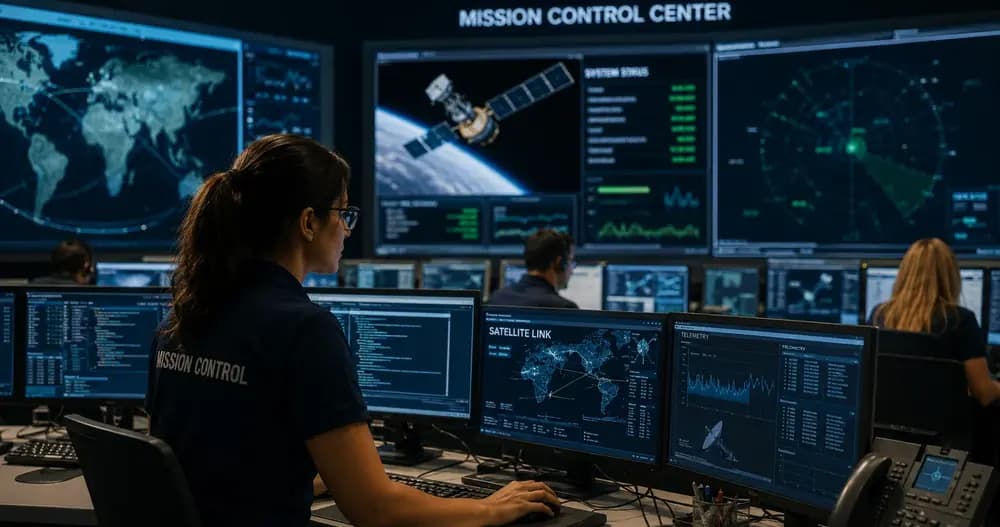
When you see photos of mission control, remember that each screen and each operator represents a layer of this stack: command authorization, TT&C visibility, pass scheduling, anomaly handling, tracking station readiness, data distribution, and mission assurance. That is the lived environment this career is designed for.
What a typical satellite operations shift looks like
Shift handover and mission status review
A professional shift begins with a disciplined handover. The incoming operator reviews the spacecraft state, open anomalies, recent commands, upcoming contacts, payload priorities, ground-station availability, and any constraints that could affect the next several hours. The goal is to create a shared operational picture before anyone touches a command interface. A good handover separates confirmed facts from assumptions, identifies decisions that are still pending, and makes ownership clear. This habit matters because satellite operations is continuous: the mission does not reset when a new person takes the console.
Contact planning and readiness checks
Before a scheduled pass, the team confirms contact times, antenna assignments, frequency and network readiness, tracking data, command products, and the expected telemetry configuration. Operators may also verify that procedures, databases, and mission timelines are at the correct version. Even when scheduling is automated, a human still needs to understand why a pass matters, which activities are permitted, and what conditions would require the plan to stop. These checks reduce preventable errors and help the team use limited contact windows efficiently.
Live pass execution
During a live pass, operators establish the communication link, confirm spacecraft identity and time correlation, monitor the quality of the downlink, and verify that telemetry is flowing into the expected systems. If commands are planned, the operator follows authorization rules, validates the command stack, transmits in the approved sequence, and checks the returned telemetry for the expected response. Clear voice or chat coordination is essential, especially when flight dynamics, payload, network, and spacecraft specialists are supporting the same activity. The safest teams treat every command as an accountable action, not a routine button press.
Telemetry trending and spacecraft health
Much of the work happens between dramatic events. Operators compare current telemetry with limits, historical trends, expected modes, orbital conditions, and recent activities. A value can be inside a formal limit and still deserve attention if its trend is unusual. Power, thermal, attitude-control, communications, onboard-computer, and payload indicators must be interpreted as parts of one system. Strong operators learn to recognize relationships between parameters, document emerging patterns, and escalate concerns before they become mission-threatening anomalies.
Anomaly response, recovery, and documentation
When behavior departs from the expected state, the first priority is to protect the spacecraft and preserve decision quality. The team confirms the evidence, checks for ground-system or data-quality causes, follows approved contingency procedures, and coordinates with subsystem experts. Operators avoid improvising commands without authorization, even when time pressure is high. After recovery, the work continues through event timelines, logs, root-cause inputs, updated procedures, and lessons learned. This combination of calm execution and rigorous documentation is one of the clearest differences between professional mission operations and casual technical monitoring.
Why this career matters more in 2026 than it did a few years ago
The scale of the space economy
The space economy has grown fast enough that the operational layer can no longer be treated as a back-office function. The Space Foundation reported that the global space economy reached $613 billion in 2024. As more organizations depend on space-derived connectivity, imagery, sensing, and navigation, the systems that keep those satellites alive and useful become more valuable.
Higher orbital traffic
ESA’s Space Environment Report describes an orbital environment shaped by miniaturization, large constellations, and a shift toward commercial operators. It also notes that tracked-object and active-payload counts continue to rise, while long-term sustainability depends on stronger debris mitigation and collision-avoidance practices. For anyone considering Satellite Operations Specialist/Engineer in 2026, that translates into a straightforward market reality: more spacecraft in orbit means more operational complexity, more conjunction awareness, more disposal planning, more monitoring, and more demand for people who understand safe mission execution.
Satellite and telecom network convergence
The FCC adopted rules to facilitate supplemental coverage from space, specifically to extend communications services into remote areas and support public-interest goals such as emergency connectivity. This regulatory direction reflects a broader shift toward direct-to-device services, where mobile handsets can connect through satellite networks when terrestrial coverage is incomplete. For operations teams, that means more coordination across satellite, telecom, spectrum, and service-delivery systems.
Cloud-enabled ground operations
AWS Ground Station says its platform allows operators to control satellite communications, process data, and scale operations without building or managing all their own ground-station infrastructure. It also emphasizes direct integration with cloud storage, streaming, and machine-learning services, as well as the ability to communicate with satellites multiple times per orbit through a global antenna network. For satellite operations professionals, that changes the job profile. You are not only learning radio and mission control fundamentals; you are increasingly learning how operational data connects with cloud workflows, automation layers, and near-real-time processing.
Operational resilience
Satellite operators now have to think beyond routine command sequences and nominal health checks. They also have to account for cyber risk, regulatory coordination, space weather, and space traffic. NIST’s space-domain guidance includes publications focused on cybersecurity for commercial satellite operations and on applying the Cybersecurity Framework to the satellite ground segment, especially command and control. NOAA’s Space Weather Prediction Center notes that drag significantly affects spacecraft in low Earth orbit. UNOOSA’s long-term sustainability framework underscores that safe space operations require coordination, sustainability, and governance, not just engineering. In 2026, that is exactly the environment for which Refonte Learning can prepare a learner: not merely someone who wants to work with satellites, but someone who understands modern operational risk.
The technical skills employers expect in 2026
Telemetry, tracking, and command (TT&C)
Without TT&C, you do not really have mission operations. Refonte Learning lists TT&C as a core competency in the course, and ESA’s mission-control structure shows why: analysts and controllers depend on the telemetry and telecommand database, while operations teams need reliable command pathways to monitor and control spacecraft. The CCSDS Blue Books also matter because they define interfaces, protocols, and implementation-level standards used for interoperability and cross-support in space missions. To be credible as a Satellite Operations Specialist/Engineer in 2026, you need to understand not only what telemetry is, but how it is structured, validated, interpreted, and acted on.
Orbit determination and control
Refonte Learning includes orbit determination and control as part of the educational path and featured expertise, and the course explicitly describes learning how to track and manage satellite orbits. In the real world, that affects station-keeping, conjunction response, contact prediction, mission planning, and payload quality. In an increasingly congested orbital environment, operations personnel who understand the difference between nominal orbit evolution and a developing risk scenario have a real advantage. ESA’s reporting on crowding and post-mission disposal makes that more urgent in 2026 than it was even a few years ago.
Ground station operations and network management
Refonte includes this directly in the course curriculum, and EUMETSAT’s mission-control page explains just how operationally central the ground segment is. The organization relies on distributed primary and back-up stations, ground-segment monitoring, automated weekly scheduling, and continuous communications support. AWS Ground Station adds a newer 2026 layer to this conversation by showing how operators can link antenna access to cloud-native storage, data processing, and ML workflows. So if you are entering the field now, ground operations means more than antennas. It means network coordination, pass scheduling, security, data routing, and increasingly software-defined flexibility.
Anomaly detection and resolution
Refonte highlights this as a program competency and as part of the learner path. That is a smart choice because anomalies are where operations engineers prove their value. Routine operations can be automated to a degree; unexpected behavior still requires diagnosis, pattern recognition, systems understanding, escalation discipline, and calm execution. Refonte’s own related blog content stresses anomaly handling as a signature capability, and employer-facing operations roles consistently emphasize procedure improvement, mission preparation, and cross-team response. In practice, anomaly work can involve power issues, thermal trends, attitude disturbances, communication gaps, onboard software problems, or payload inconsistencies.
Automation and AI in satellite operations
Refonte Learning’s guide to automation and AI in satellite operations explains that AI can support scheduling, telemetry analysis, and constellation-scale decision support, while NASA JPL’s work on mission operations for increasingly autonomous spacecraft shows that future missions will rely more heavily on autonomous planning, fault management, scheduling, and decision support. That does not mean operators disappear. It means the best operators in 2026 are the ones who can supervise automated systems, validate outputs, design safe guardrails, and take over when the unexpected happens. Automation and AI are no longer side topics; they are part of the new baseline.
Cybersecurity for command and control
In 2026, no serious discussion of satellite operations is complete without this. NIST’s space-domain guidance specifically includes commercial satellite operations and satellite ground-segment command-and-control environments. Refonte Learning’s satellite cybersecurity article reflects that same industry shift by framing orbital assets as critical digital infrastructure that must be actively protected. For operators, this means understanding authentication, access control, secure procedures, secure ground workflows, and why ground-segment compromise can be every bit as mission-critical as a physical subsystem fault.
Resilience under environmental and operational uncertainty
NOAA explains that drag significantly affects spacecraft in LEO, and space weather can disrupt satellite behavior, tracking certainty, and orbital prediction. At the same time, UNOOSA and the EU’s space-traffic work both point toward a future in which coordinated, sustainable operations are central to mission success. That means today’s operators need to read telemetry in context, think probabilistically, and understand that a satellite mission is never operating in a vacuum. It is operating in a live, dynamic orbital environment shaped by atmosphere, traffic, debris, regulations, and time-sensitive decisions.
Why Refonte Learning is a strong fit for this path
Skill alignment
Too many training programs talk about space in broad, inspirational language but do not map closely enough to real operational responsibilities. Refonte Learning’s Satellite Operations Specialist/Engineer program does the opposite. The published curriculum centers on the disciplines a modern operations role requires: mission planning, TT&C, ground station operations, orbit determination, health monitoring, anomaly response, and automation. That is not generic aerospace branding. It is an operations skill map.
A manageable applied format
Refonte Learning lists the course at three months with a commitment of 10–12 hours per week, which is substantial enough to build momentum but still manageable for many current students or working professionals. Because satellite operations is procedure- and practice-driven, a shorter but concentrated applied format can be more valuable than passive theory accumulation when it is combined with simulations, case studies, and project work. Refonte’s page repeatedly emphasizes hands-on simulations and real-world case studies.
Role-focused outcomes
Refonte does not stop at “learn space fundamentals.” It explicitly names career directions such as Mission Operations Engineer, Ground Station Operator, Spacecraft Controller, and Flight Dynamics Engineer. That is valuable because it teaches students how to translate course learning into job-search language. Many beginners struggle not because they are unmotivated, but because they do not know how to map educational experience into occupational titles and employer vocabulary. Refonte’s role framing helps close that gap.
Mentorship and professional signaling
Refonte identifies a mentor with long aerospace instruction experience and says course completion can lead to both a Training Certificate and a Certificate of Internship, with additional recognition for top performers. In a field where early-career candidates often get screened on proof of seriousness, structured mentorship, project work, and a recognizable completion narrative can materially improve credibility. This is especially true when you are competing against applicants who may have adjacent engineering degrees but weaker mission-operations fluency.
A connected learning ecosystem
Refonte Learning’s broader content ecosystem gives learners a way to continue beyond the core program. A learner can deepen their understanding through Satellite Operations Specialist Engineer in 2026: The Ultimate Career Guide and related resources on career entry, automation, day-to-day mission control, and cybersecurity. Together, these materials create a coherent learning path around the technical, operational, and career knowledge associated with modern satellite operations.
Career paths you can pursue after training
Core satellite operations roles
Refonte Learning’s course page lists Satellite Operations Specialist, Mission Operations Engineer, Ground Station Operator, Spacecraft Controller, and Flight Dynamics Engineer. ESA and EUMETSAT materials broaden that picture with roles in ground operations, mission operations management, control-center engineering, mission-control systems, and operations engineering tied to ground infrastructure and ICT systems. Satellite Operations Specialist/Engineer in 2026 is therefore not a single narrow destination; it is a gateway into several adjacent career paths.
Satellite operations roles at a glance
Role | Primary focus | Example responsibilities |
Satellite Operations Specialist | Routine mission execution | Monitor telemetry, coordinate contacts, follow procedures, and escalate anomalies. |
Mission Operations Engineer | End-to-end mission readiness | Plan activities, validate procedures, coordinate systems, and improve operational tools. |
Ground Station Operator | Ground-segment contacts | Prepare antennas and networks, execute passes, track the spacecraft, and route data. |
Spacecraft Controller | Real-time spacecraft control | Perform health checks, send authorized telecommands, execute timelines, and support recovery. |
Flight Dynamics Engineer | Orbit and navigation support | Determine orbits, predict contacts, plan maneuvers, and support conjunction decisions. |
Commercial mission operations
These roles often branch into satellite commissioning, customer mission operations, payload operations support, constellation operations, network operations, or mission automation. ISISPACE’s job description is useful evidence because it combines routine active-mission operations with newly launched satellite commissioning, procedure and tool improvement, and customer-facing training. Operations is not always a control-room-only job. Depending on the company, it can include software work, process engineering, customer coordination, documentation, and operations product development.
Different mission classes
Some organizations operate weather and climate satellites. Others focus on Earth observation, communications, broadband constellations, navigation support, defense, or scientific missions. NASA’s SCaN program shows how communications and navigation support sit underneath a wide range of missions, using both government and commercial assets and enabling the return of high-value data every day. The diversity of mission types means operations specialists with strong fundamentals are often more portable than they first assume.
Launch and early orbit versus routine operations
During launch and early orbit phase (LEOP), teams need round-the-clock readiness, tighter decision cycles, and strong procedural discipline. ESA’s mission-control descriptions specifically note 24/7 support during launch and early orbit. In routine service, operations often become more automated, but they do not become less important. Instead, the emphasis shifts toward stability, optimization, trending, software maintenance, mission efficiency, collision awareness, and anomaly surveillance. The career remains interesting over time because the task mix changes with mission maturity.
How to become a satellite operations specialist or engineer in 2026
Build a technical foundation
Employers and training providers alike point toward backgrounds in aerospace engineering, electrical engineering, software, telecommunications, or adjacent technical disciplines. Refonte Learning’s course page says the program is aimed at learners with related technical backgrounds and requires applicants to be working toward a bachelor’s degree or higher. ISISPACE’s posted prerequisites similarly reference aerospace, software engineering, telecommunications, and related degrees.
Develop operational literacy
Read about how mission control actually works. ESA and EUMETSAT materials are useful because they describe the real division of responsibilities between controllers, operations engineers, analysts, ground teams, and mission managers. Then pair that conceptual understanding with a structured applied program. This is where Refonte Learning becomes especially valuable: the Satellite Operations Specialist/Engineer program is organized around orbit control, TT&C, ground station work, anomaly management, and automation, which are exactly the topics most beginners struggle to integrate on their own.
Create evidence of execution
Refonte’s guide on how to start a career in satellite mission operations recommends keeping a record of simulations, analysis work, telemetry exposure, and milestones so you have tangible examples for interviews and resumes. That advice is excellent. In operations hiring, specifics win. “Interested in space” is weak. “Simulated 20 satellite contacts, analyzed telemetry trends, and documented anomaly-response workflows” is far stronger. Recruiters and hiring managers want proof that you understand procedures, data, and operational thinking.
Learn automation-friendly tools
That does not mean you must be a machine-learning researcher. It does mean that Python, data handling, version control, and process scripting are increasingly valuable. ISISPACE explicitly lists Python or C++ as recommended, along with data-analysis experience and ground-system understanding. Refonte’s article on automation and AI in satellite operations frames coding and AI literacy as useful operational leverage rather than optional extras. In 2026, the operator who can both interpret telemetry and write basic workflow-support scripts is more employable than the operator who can do only one of those things.
Study adjacent domains
Study managing satellite operations in the new space age to sharpen your understanding of mission-control workflows, and review satellite cybersecurity so you understand why ground-segment trust, command integrity, and access security matter. If your interests lean toward link budgets, radio chains, antenna systems, or end-to-end network architecture, connect the operations path with Refonte Learning’s related content on satellite communications as well. This makes your profile more robust and shows that you understand the full system, not just a single console view.
Build your professional network
Refonte’s mission-operations career article recommends professional groups, conferences, webinars, and outreach to people already working in the field. That is pragmatic advice, especially in space, where communities are often smaller and more relationship-driven than outsiders expect. Programs that include mentorship and alumni ecosystems can help because they shorten the distance between “I am learning about this field” and “I am part of a field-relevant network.” Refonte Learning positions its broader ecosystem around mentorship, training, and internship outcomes, which can help early candidates create a more credible narrative.
Use employer language
Use role titles like Mission Operations Engineer, Spacecraft Controller, Ground Station Operator, Flight Dynamics Engineer, Satellite Operations Engineer, or Mission Control Systems Operations Engineer where relevant. Tailor your portfolio, LinkedIn profile, and resume to show operational thinking: telemetry monitoring, procedure execution, orbital analysis, anomaly response, simulation work, command validation, or data-pipeline awareness. The point is not to exaggerate; it is to speak the language of the work. If your target role is Satellite Operations Specialist/Engineer in 2026, your application should sound like an operations professional in training, not a passive learner hoping someone notices potential.
How to build a job-ready satellite operations portfolio
A portfolio is especially valuable when you are early in your career because it converts training into evidence. The strongest portfolio does not need classified data, proprietary tools, or a real spacecraft. It needs clear assumptions, technically reasonable workflows, repeatable analysis, and documentation that shows how you think under operational constraints.
Create a telemetry analysis case study
Use a synthetic or public dataset to define a small telemetry dictionary, plot several parameters, establish expected ranges, and investigate one abnormal trend. Explain how you separated a sensor issue from a possible spacecraft issue, which additional parameters you checked, and when you would escalate. Include a concise operations log and a one-page summary for a non-specialist manager. This demonstrates data handling, systems thinking, and communication at the same time.
Build a ground-contact plan
Create an example pass plan that includes acquisition and loss-of-signal times, the purpose of the contact, ground-station readiness checks, expected telemetry, command constraints, and success criteria. Add a fallback plan for a late acquisition or degraded link. A recruiter does not need to see a perfect mission product; they need to see that you can turn a mission objective into an orderly, verifiable sequence of operational steps.
Write an anomaly-response playbook
Choose a plausible scenario such as a thermal excursion, unexpected safe mode, communication dropout, or attitude-control disturbance. Document the initial indications, immediate protective actions, decision points, escalation path, and recovery criteria. State which actions require authorization and which evidence would change your diagnosis. This is a strong way to show that you understand procedure discipline rather than simply listing spacecraft subsystems on a resume.
Add a small automation project and present it professionally
A lightweight Python project can demonstrate practical value without becoming a full software product. You might parse a telemetry file, flag limit violations, calculate pass statistics, generate a shift summary, or compare planned and executed activities. Place the code under version control, include a readable setup guide, test common failure cases, and explain the operational risk of relying on the script without human validation. Finish the portfolio with short project summaries, clear screenshots, and resume bullets that describe the result rather than only the tool used.
An example 12-week practice roadmap
Weeks | Primary focus | Portfolio evidence |
1–2 | Spacecraft systems and mission lifecycle | Subsystem map, mission objectives brief, and operating-mode summary. |
3–4 | TT&C and telemetry interpretation | Telemetry dictionary, trend analysis, and command-validation checklist. |
5–6 | Ground-station operations | Pass plan, station-readiness checklist, and contact report. |
7–8 | Orbit operations and mission planning | Contact prediction notes, maneuver concept, and conjunction-response outline. |
9–10 | Anomalies, cybersecurity, and automation | Response playbook, access-control checklist, and a small Python utility. |
11–12 | Integration and job preparation | Final case study, portfolio index, resume bullets, and interview talking points. |
The major trends shaping satellite operations careers in 2026
Network convergence
Satellite systems are no longer separate from terrestrial digital infrastructure in the way they once were. FCC policy on supplemental coverage from space and the wider expansion of non-terrestrial networks point in the same direction: satellite operations teams increasingly support services that blend mobile, cloud, and space architectures. For candidates, that means telecom awareness is becoming a plus. For training providers like Refonte Learning, it means courses that connect mission operations with communications realities are especially well positioned.
Autonomy with human oversight
NASA JPL’s work on increasingly autonomous spacecraft shows that future missions will rely on onboard planning, fault management, and autonomous decision support. Refonte’s AI article frames the same shift from an operations perspective: intelligent scheduling, telemetry pattern recognition, and constellation-scale support tools are expanding. The practical implication is simple. Operators are not being replaced; they are being elevated. Routine monitoring will become more automated. Human judgment during edge cases, anomalies, mission transitions, and system design remains critical.
Safety and sustainability
UNOOSA’s long-term sustainability guidelines and ESA’s continuing warnings about congestion and debris indicate that safe operations are now inseparable from responsible operations. This affects maneuver planning, disposal strategies, conjunction screening, mission design assumptions, and regulatory awareness. In 2026, a great operations engineer is not only the person who can keep a satellite alive. It is also the person who understands the operational consequences of crowded orbits and sustainability requirements.
Cyber-ready mission control
NIST guidance focused on satellite command-and-control environments makes clear that cyber risk is now part of normal operations. Satellite operations and cybersecurity are no longer separable topics. If a command chain, ground network, update mechanism, or access-control process is compromised, mission quality suffers immediately. That is why satellite cybersecurity belongs inside the core conversation about Satellite Operations Specialist/Engineer in 2026, not in a separate specialist silo.
Faster, more distributed ground operations
AWS Ground Station’s model shows how operators can reduce infrastructure friction while increasing contact flexibility and shortening the time from downlink to processing. NASA’s SCaN program likewise emphasizes continuous modernization and integration of commercial services to expand capacity and reduce cost. Future operations professionals need to be comfortable with the idea that ground-segment capability may be shared, virtualized, distributed, or partly outsourced, while still requiring rigorous operational control and mission assurance.
Frequently asked questions
Is Satellite Operations Specialist/Engineer in 2026 a good career?
Yes, it is a strong career path if you want technically demanding work that sits close to the real-time delivery of mission outcomes. Market growth, launch intensity, direct-to-device expansion, and increasing orbital complexity all support sustained demand for people who can monitor, control, protect, and optimize satellites. The role also offers portability across telecom, Earth observation, climate, science, government, and commercial constellations.
What should I study to enter this field?
A technical foundation in aerospace, electrical engineering, software, telecommunications, or a related discipline is the most common route. Beyond that, study TT&C, orbit determination, ground station operations, anomaly detection, automation, and cybersecurity. Those exact themes are reflected both in employer postings like ISISPACE and in the published curriculum of Refonte Learning’s Satellite Operations Specialist/Engineer program.
Do I need to know programming?
You do not necessarily need to be a deep software specialist, but programming literacy is increasingly valuable. Employers recommend experience with Python or C++, data analysis, version control, and ground-system workflows, while modern operations environments rely more on automation and cloud-linked tooling than in the past. If you can combine mission knowledge with light operational scripting and data handling, you become much more competitive.
Why is cybersecurity part of satellite operations now?
Because command and control, ground systems, and operational workflows are digital attack surfaces. NIST’s space-domain guidance specifically addresses commercial satellite operations and the satellite ground segment with emphasis on command and control. In practical terms, secure operations is just operations now. That is why Refonte Learning’s satellite cybersecurity content is highly relevant to anyone pursuing this field in 2026.
How does Refonte Learning help me become job-ready?
Refonte Learning helps by aligning training with the real work: TT&C, mission planning, orbit control, ground station operations, anomaly response, health monitoring, and automation. The program page also presents a manageable format, role-targeted outcomes, and completion credentials that include a Training Certificate and a Certificate of Internship. Combined with Refonte’s related mission-operations and AI/cybersecurity content, that gives learners a clear progression from curiosity to operational credibility.
Conclusion
The best way to think about Satellite Operations Specialist/Engineer in 2026 is not as a narrow job title, but as a high-value operating capability inside the modern space sector. Satellites are multiplying. Mission architectures are becoming more distributed. Ground systems are becoming more software-defined. Telecom and space are converging. Autonomy is increasing. Cybersecurity and sustainability are becoming operational essentials. Every one of those shifts increases the importance of people who can understand spacecraft behavior, ground workflows, command integrity, mission safety, and system performance in one integrated frame.
That is why Refonte Learning is a compelling fit for ambitious learners right now. The Satellite Operations Specialist/Engineer program is built around the exact disciplines that define the field, and Refonte’s adjacent blog ecosystem reinforces the same operational worldview through mission-control, AI, career-entry, and cybersecurity content. If your goal is to build a future-facing space career in 2026, Refonte Learning gives you a more direct route than broad inspiration alone. It gives you a framework for becoming useful in mission operations, which is ultimately what employers, teams, and spacecraft need most.