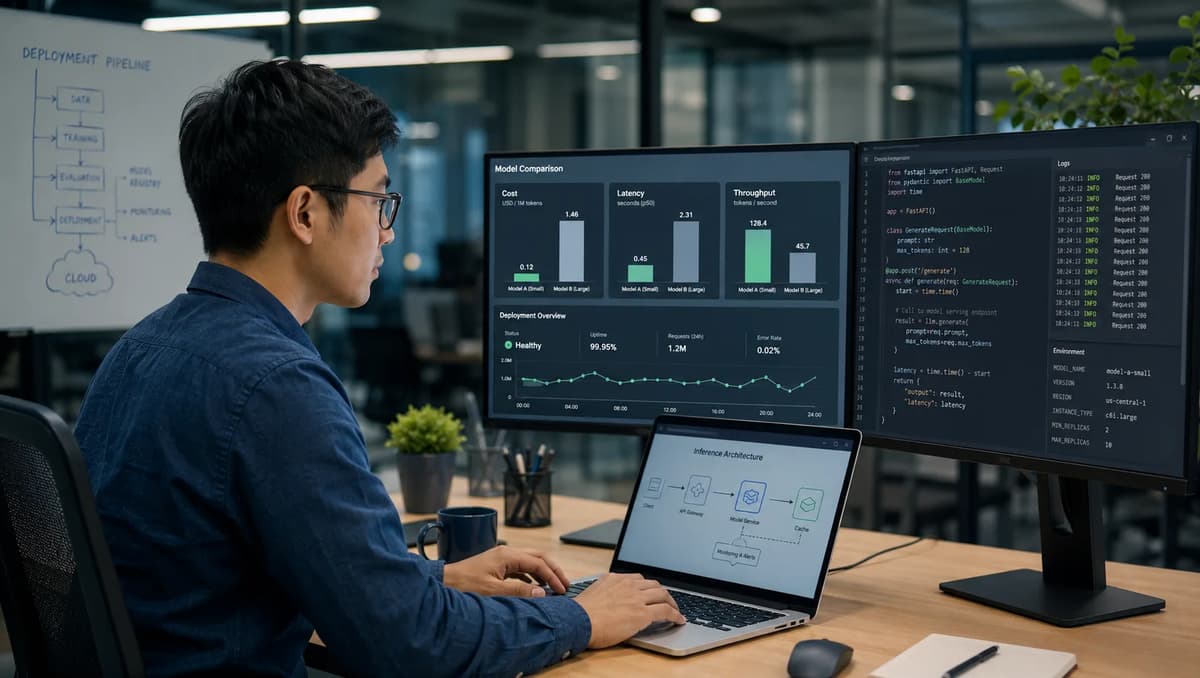
A production summarization workload processing 10,000 items a day cost about $7.20 with a task-specific small language model in a 2026 benchmark. The comparison cost with GPT-4.1 Mini was about $58 per day for the same volume, with Forbes reporting that human evaluators could not detect a quality difference in the tested outputs.
That single comparison does not mean every small model beats every frontier model. It does show why small language models (SLMs) have moved from an interesting research direction toward a serious production deployment pattern in 2026: once a workload becomes narrow, repetitive, measurable, and high-volume, paying for general-purpose capability you never use can become an architectural mistake rather than an acceptable premium.
The broader numbers make that point harder to ignore. ScaleDown's published tests, reported by Forbes in June 2026, found task-specific models averaging roughly 8% to 9% higher accuracy, 29x to 161x lower cost, and 2.4x to 8.3x faster responses than models from Anthropic, OpenAI, and Google on the workloads it tested. These are vendor-reported benchmarks rather than independent universal measurements, so you should treat the ratios as evidence to reproduce on your workload, not as constants to paste into a business case.
At the same time, independent task-efficiency research provides a second signal. On IMDB sentiment classification, researchers reported 91.7% accuracy from Qwen2.5-0.5B versus 88.6% from Qwen2.5-72B, while the same study showed the opposite pattern on harder mathematical reasoning: a 0.5B model scored 37.7% on GSM8K versus 92.0% for Llama-3.1-70B.
That contrast is the real story behind small language models in 2026. This is not a career-comparison article, and it is not another generic tutorial on compressing arbitrary models; it is a production decision about matching model capacity to task complexity before your architecture hardens and your inference bill becomes a permanent operating expense.
The Cost Data Driving Small Language Models in Production
When I evaluate an AI workload for production, the first question is not “What is the best model?” It is “What level of capability does this task actually require, and what is the cheapest architecture that clears the quality threshold with enough reliability?”
That difference sounds semantic until you multiply it by millions of calls. A frontier model may be extraordinary at coding, open-ended dialogue, multimodal reasoning, long-context synthesis, and novel problem solving, but none of those unused capabilities improve a binary support-ticket classifier simply because you pay for access to them.
The June 25 Forbes analysis gives us unusually concrete numbers. In ScaleDown's published comparisons, its task-specific models averaged 8% higher accuracy, 161x lower cost, and 3.8x faster responses than the Claude models tested; 8.72% higher accuracy, 89x lower cost, and 2.4x faster responses than the OpenAI models tested; and 9% higher accuracy, 29x lower cost, and 8.3x faster responses than the Gemini models tested.
Workload or comparison | Larger/frontier result | Small-model result | What the result actually tells you |
10,000 summaries per day | GPT-4.1 Mini: about $58/day | Task-specific model: about $7.20/day | A narrow production workload can produce a large recurring cost gap |
ScaleDown classification pricing | Anthropic average used as comparison | About 5,250x cheaper in ScaleDown's reported test | Classification can be particularly inefficient on general-purpose APIs |
ScaleDown classification pricing | OpenAI average used as comparison | About 1,810x cheaper in ScaleDown's reported test | Per-call economics can diverge sharply when the task is highly constrained |
IMDB sentiment classification | Qwen2.5-72B: 88.6% accuracy | Qwen2.5-0.5B: 91.7% accuracy | Parameter count alone did not predict accuracy on this narrow task |
GSM8K mathematical reasoning | Llama-3.1-70B: 92.0% | 0.5B model: 37.7% | The small-model advantage does not generalize to difficult reasoning |
The cost rows above come from ScaleDown figures reported by Forbes; the accuracy comparisons come from the 2026 task-efficiency research paper.
The summarization example is especially useful because it translates model pricing into an operating number a product owner can understand. The difference is $50.80 per day; if the workload stayed constant for 365 days, simple annualization would put the gap at roughly $18,542 a year before considering traffic growth. That figure is arithmetic based on the reported daily costs, not a prediction of what every summarization system will save.
This is where the small language models vs frontier models cost discussion frequently goes wrong. Teams compare API price cards but fail to compare completed-task economics: accuracy at your acceptance threshold, retries, output length, infrastructure utilization, batching, concurrency, fine-tuning expense, human-review rates, and the cost of escalating failed cases all belong in the denominator.
A model that costs one-tenth as much per request but forces twice as much human review could still lose. Conversely, an SLM that costs less, answers faster, and produces fewer errors on a tightly bounded task creates a compounding production advantage.
Why smaller can beat bigger without breaking the laws of scaling
A narrow classifier does not need to write a React application, interpret a radiology image, negotiate a contract, translate thirty languages, and solve an unfamiliar mathematics problem. When training or post-training concentrates model capacity on a smaller task distribution, the model can become extremely good at recognizing the patterns that matter inside that boundary without carrying the same breadth as a frontier generalist.
The 2026 efficiency study makes this visible rather than theoretical. Researchers compared 16 models across five NLP tasks and found different scaling regimes: simple IMDB classification saturated at very small scales, while GSM8K mathematical reasoning benefited dramatically from larger models; the authors also reported that compact 1.5B–3B generation models could provide 40x–90x higher per-GPU throughput while accepting accuracy tradeoffs against 70B-plus models.
That is a much more useful engineering conclusion than “small is better.” Task complexity determines whether additional scale buys useful capability.
For classification, routing, extraction, constrained document processing, structured summarization, repetitive transformation, and other tasks with clear input/output contracts, additional general-purpose model capacity can produce diminishing returns. For ambiguous research, difficult multi-step reasoning, unfamiliar domains, creative synthesis, or tasks whose requirements change unpredictably from one request to another, breadth becomes valuable again.
The latency advantage is independent of the cost advantage
Teams sometimes treat latency as a side effect of model pricing, but production users experience it as a separate product property. ScaleDown's reported comparisons ranged from 2.4x faster against the OpenAI models tested to 8.3x faster against Gemini, while Microsoft explicitly designed Phi-4-reasoning-vision-15B around balancing capability with inference efficiency in interactive scenarios.
That difference matters when inference sits inside an interactive application or a multi-stage workflow. Saving two seconds on one invisible overnight batch may not matter, but adding two seconds to five sequential model calls can turn an otherwise functional agent, search interface, voice system, or document assistant into a product that feels broken.
The engineering target therefore should not be “smallest possible model.” It should be the smallest model that passes your quality, robustness, latency, security, and operational requirements with adequate headroom.
A practical SLM production deployment benchmark should measure at least the following:
Task-level accuracy, F1, exact match, human preference, or another metric tied directly to the feature's success criterion.
p50 and p95 latency, not only a single average response time.
Cost per 1,000 or 10,000 completed jobs, including retries and escalation.
Memory footprint, tokens per second, concurrency, and hardware utilization for self-hosted models.
Failure performance on edge cases and out-of-distribution inputs.
A fallback rate showing what percentage of requests still need a more capable model.
Once you collect those numbers, model selection stops being a debate about brand names and becomes a straightforward system-design exercise.
The Model Releases Turning SLMs Into a Production Pattern
The 2026 shift would be less important if it rested on one vendor benchmark. It does not: Microsoft, Google, and Liquid AI all shipped compact models this year that explicitly target better capability-per-unit-of-compute, local deployment, or both.
That release cadence is what separates the current moment from the older “tiny model” conversation. For context across larger and smaller families, Refonte Learning's guide to the broader 2026 AI model landscape provides the survey view; the production question here is narrower: what changed enough in small models that developers should alter their deployment decisions?
Model | Release | Size/configuration | Production-relevant signal |
Phi-4-reasoning-vision-15B | March 4, 2026 | 15B | Compact multimodal reasoning; supports mixed reasoning/non-reasoning behavior |
Gemma 4 E2B/E4B | April 2, 2026 | Edge-oriented small variants | Explicitly positioned for mobile/on-device use |
Gemma 4 MoE | April 2, 2026 | 26B total | Activates a much smaller subset during inference |
Gemma 4 Dense | April 2, 2026 | 31B | Higher-capability local/open option |
Gemma 4 12B | June 2026 | 12B | Designed for laptops with 16GB VRAM/unified memory |
LFM2.5-2.6B | August 4, 2026 | 2.6B | Under 2.5GB in Liquid AI's CPU testing; phone-capable local inference |
Microsoft released Phi-4-reasoning-vision-15B on March 4. Microsoft describes it as a 15-billion-parameter open-weight multimodal reasoning model designed to balance reasoning capability, efficiency, and training-data requirements, with use cases spanning visual understanding, documents, interfaces, mathematics, and science.
The interesting production detail is not merely the 15B parameter count. Microsoft trained the model with a mixture of reasoning and non-reasoning data so that perception-focused requests can return directly rather than always generating a long reasoning path; developers can also explicitly prompt reasoning or non-reasoning modes.
That design exposes an increasingly important cost principle: inference-time reasoning is itself a resource decision. You should not spend reasoning tokens on an OCR-like perception task simply because the model can reason, just as you should not call a frontier model for a classification job simply because it can classify.
Google followed on April 2 with Gemma 4, releasing Effective 2B and Effective 4B versions alongside a 26B Mixture-of-Experts model and a 31B Dense model. Google specifically positioned the smaller versions around mobile-first and on-device AI, while the 26B MoE design reduces the amount of model capacity activated during inference relative to its total parameter count.
Gemma 4 also clarifies an important licensing detail. The April Gemma 4 family, not the June 12B model alone, was already released under Apache 2.0, so it would be inaccurate to call the 12B release Google's first Apache 2.0 Gemma 4 release.
Google expanded the family in June with Gemma 4 12B, designed to sit between its edge-oriented E4B and larger 26B MoE. Google says the model can run locally with 16GB of VRAM or unified memory and reaches benchmark performance near the 26B model at less than half the larger model's total memory footprint; it also includes multi-token-prediction drafters aimed at reducing latency.
Then Liquid AI pushed the footprint down substantially. On August 4, it released LFM2.5-2.6B, a 2.6-billion-parameter model designed for agentic workloads that the company demonstrated running completely on-device.
Liquid's own benchmark table is striking. LFM2.5-2.6B scored 59.17 on IFBench compared with 34.08 for Gemma 4 E2B, 39.24 for Gemma 4 E4B, 48.40 for Qwen3.5-4B, and 56.47 for Qwen3.5-9B; it also led those comparison models on Multi-IF and IFStruct, although larger models retained advantages in parts of coding and other benchmarks.
That is exactly the sort of result that should change how you read model leaderboards. LFM2.5-2.6B did not prove that 2.6B parameters universally beat 9.7B parameters; it showed that architecture, training, specialization, and evaluation domain can matter more than raw scale on specific capabilities.
Liquid also reports 220 tokens per second on an M5 Max, 113 tokens per second on a Ryzen AI Max+ 395, and 30 tokens per second on a phone while remaining under 2.5GB in its CPU tests. Those are vendor measurements under stated test conditions, so your deployment team should reproduce them on the exact hardware, quantization, context lengths, concurrency, and runtime you intend to ship.
This Phi-4, Gemma 4, and LFM2.5 release sequence matters because each family attacks a different boundary. Phi emphasizes efficient multimodal reasoning, Gemma spans edge through mid-sized local deployment, and LFM pushes agentic capability into a footprint designed for phones and consumer computers.
MedGemma adds the domain-specialization layer. Google's MedGemma family predates the 2026 releases above, but it demonstrates the same architectural idea applied to healthcare: instead of asking a generic model to carry every domain equally well, Google supplies medically tuned models for developers building health applications. Google's published material cites Tap Health in India discussing MedGemma's medical grounding for progress-note summarization and guideline-aligned nudges.
There is an important evidence distinction here. Public Google material supports Tap Health's evaluation/use of MedGemma in its chronic-care work, but I would not describe that source alone as proof of a fully production-deployed diabetes system; “active deployment” is stronger wording than Google's published evidence justifies.
Meta needs a similar verification note. As of August 15, 2026, I could not independently verify a specific new 2026 Meta Llama small-model release comparable to the Phi, Gemma, and LFM launches discussed above; the last clearly documented lightweight Llama edge release I could verify from Meta itself remains Llama 3.2 1B and 3B, announced September 25, 2024 for edge and mobile use.
That does not imply Meta has stopped advancing its model stack. It means you should not claim a “2026 Llama-small launch” simply to make the vendor list look symmetrical.
The Enterprise Case: Cost, Edge Deployment, Privacy, and Limits
The vendor-release story becomes more important when it lines up with enterprise economics. InfoWorld reported on May 4, 2026 that SLMs can reduce cloud inference costs by up to 90% for high-volume repetitive tasks while delivering near-instant latency, framing the emerging architecture as a division of labor between specialized models for routine calls and larger models for difficult reasoning.
InfoWorld also cites Gartner predicting that by 2027, enterprise use of small, task-specific AI models will be three times enterprise use of LLMs. That is an analyst projection, not an observed 2027 outcome, so the responsible reading is “a signal worth planning around,” not “a future fact that has already been established.”
The conditions behind the forecast matter more than the headline. InfoWorld identifies narrow scope, repetitive/high-volume execution, and low latency tolerance as the combination where small models make the strongest business case, while noting that broad general knowledge and novel reasoning remain areas where large models retain advantages.
Deployment pattern | Inference-cost potential | Network dependency | Data-locality potential | Best fit |
Cloud frontier model | Highest in many narrow workloads | Required | Data normally leaves client environment | Ambiguous, broad, difficult reasoning |
Cloud-hosted SLM | Lower compute/API cost potential | Required | Depends on provider and hosting architecture | Narrow, high-volume centrally served tasks |
Self-hosted/on-prem SLM | Lower model compute plus infrastructure control | Internal network may be required | Strong organizational control | Regulated or high-volume enterprise workloads |
On-device SLM | No cloud inference call for local execution | Can work offline | Strongest local-data potential | Low-latency, offline, privacy-sensitive applications |
Routed hybrid | Cost varies by routing rate | Depends on path | Can preserve sensitive tasks locally | Workloads mixing easy and difficult requests |
That table exposes a distinction developers often miss: “small model” and “on-device model” are not synonyms.
You can host a 2B, 7B, or 15B model in a cloud GPU environment. You still gain whatever compute, throughput, and hosting advantages the smaller model provides, but the client still makes a network round trip and the request still reaches a remote inference environment.
A genuinely on-device AI model changes the system boundary. Liquid AI's LFM2.5-2.6B demonstration processes an agent workflow locally on a phone without a cloud API call, while Meta's earlier Llama 3.2 documentation explicitly described local processing as a way to avoid sending messages or calendar information to the cloud.
That creates four distinct technical advantages.
Latency: local inference removes the WAN/API round trip from the inference path.
Offline availability: an application can continue to process supported tasks when connectivity disappears.
Privacy architecture: prompts and generated content can remain on the user's device instead of transiting a third-party model endpoint.
Cloud-cost avoidance: the marginal external API charge for an entirely local call can disappear, although device compute and engineering costs obviously do not become zero.
The privacy claim deserves precision. Running the model locally does not automatically make an application private if your telemetry, analytics, retrieval system, tool calls, crash logs, or agent actions later transmit the same sensitive information elsewhere.
The correct architectural statement is that on-device inference gives you the option to keep inference inputs and outputs local. Whether the overall product preserves that locality depends on the entire data flow.
These on-device AI models in 2026 also create engineering work that cloud APIs hide. You must account for memory ceilings, hardware fragmentation, mobile thermal limits, battery usage, model distribution, update strategy, runtime compatibility, quantization choices, prompt storage, safety controls, local data governance, and different acceleration paths across CPUs, GPUs, NPUs, and vendor-specific silicon.
That is why the right choice is often neither “everything in the cloud” nor “everything on the phone.” A routed system can use a local or cloud SLM for easy requests, then escalate a small minority of genuinely ambiguous cases to a frontier model.
InfoWorld explicitly describes this division-of-labor architecture, and it is the pattern I would test before attempting a wholesale replacement.
The routing decision can be simple at first:
1. Define requests the SLM is allowed to handle.
2. Add confidence, rule-based, or model-based escalation conditions.
3. Send uncertain or high-risk cases to a stronger model.
4. Measure the frontier escalation rate as an operating metric.
5. Recalculate cost and quality at the workflow level rather than by model call.
If 85% of requests are trivial and 15% require difficult reasoning, forcing one frontier model to handle 100% of traffic wastes capability. Forcing one tiny model to handle 100% of traffic creates the opposite error.
Production architecture increasingly becomes an exercise in allocating intelligence where it has economic value.
Model Selection Is Not the Same as Generic Model Optimization
The small-model production shift can sound similar to model optimization, but they answer different questions. Refonte Learning's existing guide to general model optimization techniques like quantization and distillation addresses techniques for making a chosen model or architecture more efficient; the decision in this article happens one level earlier.
Optimization asks: how can I make this model cheaper, faster, or smaller?
SLM selection asks: why did I choose a model this large in the first place?
Decision layer | Question | Example |
Task definition | What output does the product actually require? | One of 40 ticket categories |
Model selection | What is the smallest capable model class? | Compare 2B/7B SLM with frontier API |
Evaluation | Does it clear the required quality threshold? | Macro-F1, edge-case suite, human review |
Deployment | Where should inference run? | Device, VPC, private cloud, API |
Optimization | Can the selected model run more efficiently? | Quantization or serving optimization |
Routing | Which requests need escalation? | Low-confidence request escalates to frontier model |
This order matters. If your workload needs only a narrow classifier, shrinking a giant general-purpose model after you have already designed the system around it may be a more complicated solution than selecting a purpose-fit model at the start.
That does not make quantization, pruning, or distillation unimportant. It means this article deliberately does not recreate a generic optimization tutorial: SLM inference cost reduction starts with workload-to-model matching, then uses optimization techniques where appropriate.
The practical decision framework I use starts with task entropy, not parameter count. Ask how much variation the task can contain, how objective the correct answer is, how damaging an error would be, and how far real inputs can drift from your evaluation set.
A task is a stronger SLM candidate when most of these statements are true:
The output schema is constrained.
Correctness can be measured automatically or with a stable rubric.
Inputs come from a bounded domain.
Similar requests recur at high volume.
The application needs low latency.
Failure can be detected or routed.
Broad world knowledge is not the core value of the feature.
Examples include sentiment classification, policy routing, intent detection, structured extraction, tagging, constrained summarization, document triage, schema normalization, and predictable transformations. InfoWorld likewise highlights classification, document processing, ticket routing, and other repetitive, scoped applications as strong SLM use cases.
A task becomes a weaker small-model candidate when the user can ask essentially anything, when correctness depends on combining unfamiliar domains, when the answer requires difficult multi-step reasoning, or when the model must handle rare edge cases with little opportunity for escalation. The 2026 efficiency study's GSM8K result provides a concrete reminder that difficult reasoning can still reward scale substantially.
The first common production mistake is therefore defaulting to the largest available model out of habit.
The fix is not “use an SLM.” The fix is to make model-size evaluation a required gate before architecture approval.
A lightweight model-selection experiment can be completed before you build the rest of the feature:
Create a representative evaluation set with normal requests, difficult requests, and edge cases.
Establish the frontier model as a quality baseline.
Test at least one substantially smaller candidate.
Compare quality at identical task instructions.
Benchmark latency under realistic concurrency.
Estimate cost at your expected daily volume.
Add a routing policy and measure the resulting blended cost.
Repeat after the workload changes materially.
The second mistake is over-correcting and assuming small models should replace frontier models everywhere. Forbes explicitly concludes that open-ended reasoning and novel problems remain frontier territory, while InfoWorld says large models retain advantages in breadth, unfamiliar contexts, and complex reasoning.
A senior production team should therefore be comfortable deploying both. The model-selection skill lies in deciding where the boundary belongs.
You should also resist parameter-count absolutism. A 26B MoE model that activates a smaller subset of parameters, a dense 12B model, and a 2.6B model with different quantization levels do not map onto serving cost through parameter count alone; memory bandwidth, architecture, active parameters, runtime, batch size, context length, generated tokens, hardware, and concurrency all affect real performance.
That is why benchmark screenshots do not replace load tests.
Your production metric should be cost per acceptable completed task, not “cost per million tokens” in isolation. That one change in measurement tends to expose both oversized-model waste and undersized-model failure.
AI Developer Skills, Portfolio Signals, and Hiring Demand in 2026
The biggest implication for AI developer skills in 2026 is not that everybody needs to memorize the latest SLM family. Model names move too quickly for that to become the durable competency.
The durable competency is model-to-task judgment: deciding how much capability the workload needs, proving that decision with evaluations, and deploying the result under cost, latency, privacy, and reliability constraints.
Priority | Skill | Why it matters |
Must | Evaluate whether a task is narrow enough for a small model before defaulting to a frontier model | Every cost advantage depends on choosing the right task boundary |
Must | Understand real cost/latency tradeoffs between small and large models | Prevents benchmark-only architecture decisions |
Should | Know at least one current family such as Phi, Gemma, or LFM well enough to evaluate it | Turns model-selection theory into deployable practice |
Should | Deploy on-device or at the edge when privacy/latency requirements justify it | Unlocks benefits cloud-hosted SLMs cannot provide |
Good | Recognize domain-specific models such as MedGemma as a distinct pattern | Helps match domain expertise to architecture |
Good | Read vendor cost and benchmark claims critically | Avoids treating controlled benchmark results as guaranteed production economics |
Task-narrowness belongs at the top because all the other benefits depend on it. Choosing a 2.6B model for a task that genuinely requires frontier reasoning does not create efficiency; it creates a failure pipeline.
The next skill is evaluation design. You need to know how to assemble datasets that represent real request distributions, choose task-specific metrics, separate ordinary inputs from tail cases, inspect false positives and false negatives, and calculate whether an apparent accuracy difference is operationally meaningful.
Then comes serving knowledge. An AI developer evaluating SLM production deployment should understand memory footprint, quantized versus higher-precision inference, batching, concurrency, tokens per second, time to first token, p95 latency, context-window costs, accelerators, and the implications of putting inference on a server versus a user's device.
Current job postings show that these capabilities already appear as distinct engineering needs rather than generic “AI knowledge.” Google's current Software Engineer, On-Device Machine Learning listing describes work on LiteRT, acceleration across CPUs, GPUs, TPUs and NPUs, and deployment of models including Gemma across Android, Chrome, iOS and desktop systems.
Apple has likewise advertised a 2026 Machine Learning Engineer role explicitly centered on Edge AI & On-Device Optimization, reinforcing that local model performance now exists as a specialized production discipline.
That does not justify inventing a universal salary premium for SLM skills. For compensation data, use the entry-level AI engineer salary breakdown rather than turning this technical trend analysis into another salary article.
The hiring signal that matters here is narrower: teams need developers who can make cost-efficient model deployment and on-device inference work as engineering systems, not simply call a model endpoint.
What should a portfolio project prove?
A good 2026 portfolio project would not be “I made a chatbot with Model X.” That tells an interviewer very little about whether you understand production architecture.
A stronger project would compare two or three model classes on one constrained workload and publish the decision record.
For example:
Build a customer-support intent classifier or structured document summarizer.
Establish a frontier-model baseline.
Test a small open model under the same evaluation set.
Report accuracy/F1 or structured-output success rate.
Measure p50 and p95 latency.
Calculate cost per 10,000 tasks.
Record peak memory for self-hosted inference.
Add confidence-based frontier fallback.
Show the blended cost after routing.
Document failure cases where the small model should not be trusted.
That portfolio piece signals something a generic completion certificate cannot: you know how to make and defend a model-selection decision.
It also demonstrates that you understand the most important caveat in the 2026 data. The Forbes figures come from ScaleDown's own public benchmarking, Microsoft's Phi figures come from Microsoft's tests, Google's Gemma claims come from Google, and Liquid's LFM results come from Liquid AI; serious developers reproduce relevant claims under their own workload before committing infrastructure or budget.
Certifications: useful, but not a substitute for deployment evidence
As of August 15, 2026, I could not identify a major certification exam dedicated specifically to small-language-model production deployment. NVIDIA offers broader Generative AI/LLM certification, while AWS offers a professional Generative AI Developer credential focused on building and deploying production generative-AI systems rather than SLM selection as a standalone specialty.
There is now SLM-specific training. The Linux Foundation lists an instructor-led Deploying Small Language Models course covering local, server, edge, and browser deployment, but its page describes a course with a certificate of completion rather than a standardized professional certification exam devoted exclusively to SLM production engineering.
So, for this specific skill set, prioritize evidence in this order:
1. A reproducible small-versus-frontier benchmark on a real task.
2. A deployed project with latency, quality, and cost measurements.
3. Evidence that you understand routing and failure handling.
4. Edge/on-device implementation when the use case warrants it.
5. Broader AI, cloud, or generative-AI certifications as supporting signals.
That hierarchy can change as credentialing catches up. In August 2026, however, the production pattern is moving faster than certification standards.
Self-Study Versus a Structured AI Developer Program
You can learn every concept in this article independently. Open model weights, model cards, serving runtimes, benchmark datasets, papers, and cloud documentation give a motivated developer enough material to build serious competence without enrolling in a program.
The difficult part is sequencing. Self-study often teaches tools in the order YouTube, documentation, or social media happens to surface them, while production competence requires a chain of foundations: programming, machine learning, deep learning, NLP, evaluation, deployment, cloud infrastructure, and then architecture tradeoffs.
Factor | Self-study | Structured AI Developer Program |
TensorFlow/PyTorch foundation | Flexible, but scope depends on your learning plan | Dedicated deep-learning curriculum can impose sequence |
NLP fundamentals | Must assemble sources yourself | Can be covered as a defined module |
Deployment practice | Easy to postpone while focusing on model notebooks | Stronger when deployment is an explicit curriculum requirement |
Cost/architecture judgment | Usually learned by deliberately benchmarking projects | Can build on deployment and project foundations, but still needs SLM-specific practice |
Portfolio proof | Completely self-designed | Structured coursework and capstone can provide a framework |
Time | Depends heavily on background and weekly effort | Refonte currently lists its program as 3 months |
SLM-family instruction | Available through model documentation and specialist resources | Refonte's current page does not claim direct Phi/Gemma/LFM instruction |
The “2–4 months to a framework foundation” or “6–12 months to job readiness” estimates you often see in learning plans should not be treated as audited outcomes. Prior programming experience, mathematics, weekly hours, project complexity, feedback quality, and the target role can change those timelines dramatically.
A structured program's advantage is therefore not that it guarantees you will learn faster. It gives you a curriculum boundary and forces related concepts to appear in a coherent sequence.
For small-model deployment specifically, that sequence matters because SLM selection is not a beginner-level model-name choice. You need enough understanding of neural networks to reason about model architecture, enough NLP knowledge to define task requirements, enough evaluation knowledge to test quality, and enough deployment knowledge to interpret latency, memory, and inference-cost measurements.
Which model family an employer uses eighteen months from now matters less than whether you know how to evaluate the model sitting in front of you.
That is why I would prioritize transferable exercises over vendor memorization. Given a new model tomorrow, you should be able to read its model card, understand the license, determine memory requirements, build an evaluation set, benchmark its quality against a baseline, measure inference behavior on target hardware, estimate operating cost, and decide whether it belongs on device, on-premises, in the cloud, or behind a router.
A simple self-study project can make that concrete:
Week one: define one narrow NLP task and an evaluation dataset.
Week two: implement a frontier API baseline and record accuracy, latency, and cost.
Week three: deploy a small open model and run the same test.
Week four: add routing, failure analysis, and a short architecture decision record.
The value is not the calendar. The value is completing the full loop from task definition, evaluation, model selection, deployment, cost measurement, and failure handling.
That full loop is the difference between knowing AI APIs and engineering an AI system.
The Refonte Learning AI Developer Program
For a learner who wants that broader foundation in a defined curriculum, the current Refonte Learning AI Developer Program is structured as a three-month program, with the live page listing a 12–14-hour weekly commitment and curriculum areas spanning machine learning, deep learning, NLP, model deployment, cloud AI, ethics, automation, and computer vision.
Its relevance to SLM production deployment requires a precise distinction. The program page does not say that it teaches Phi, Gemma, LFM2.5, small-language-model selection, or small-versus-frontier benchmarking specifically.
Instead, the defensible connection is foundational. The program's Deep Learning, Natural Language Processing, AI Model Deployment, and AI in Cloud Environments components cover areas you need before a model-size and deployment-cost comparison becomes an informed engineering exercise rather than a guess.
The curriculum currently lists:
Introduction to AI and Machine Learning
Deep Learning with TensorFlow and PyTorch
Natural Language Processing
AI Model Deployment
AI in Cloud Environments
AI Ethics and Bias
AI-driven Automation
AI for Computer Vision
Capstone Project
The live page also names Python, R, Java, TensorFlow, PyTorch, and Keras across its program and FAQ material. Its cloud-platform references include Google AI, Azure AI, AWS Machine Learning, AWS, Azure, and Google Cloud.
Program detail | Current verified information |
Duration | 3 months |
Weekly commitment | 12–14 hours/week |
Format | Online training and virtual internship program |
Deep-learning frameworks | TensorFlow, PyTorch, Keras |
Programming languages named | Python, R, Java |
Cloud platforms named | Google AI, Azure AI, AWS Machine Learning, AWS, Azure, Google Cloud |
Deployment curriculum | AI Model Deployment |
Portfolio component | Capstone Project |
SLM families explicitly taught | None named on the current program page |
Career results listed on program page | AI Developer, Machine Learning Engineer, Data Scientist |
One-time enrollment cost | USD 300 |
The duration, curriculum, listed career results, and current fee were verified against the live program page on August 15, 2026. Because pricing and program terms can change, prospective students should use the live program page rather than treat this snapshot as a permanent fee schedule.
For the specific production trend covered here, the useful extension would be straightforward: take the deployment fundamentals you learn and build your own benchmark comparing a frontier baseline against a small model on one narrow task.
That project forces you to practice the judgment the 2026 market is increasingly rewarding: not “Can I call an AI model?” but “Can I prove which model belongs in this system?”
Review the Refonte Learning AI Developer Program for a structured foundation in deep learning, NLP, cloud AI, and model deployment before extending those skills into small-versus-frontier model evaluation.
FAQ: Small Language Models in 2026
What is a small language model (SLM)?
A small language model is a language model with substantially lower compute and parameter requirements than the largest general-purpose models, often designed or adapted for constrained tasks, local hardware, or specialized domains. There is no universal parameter cutoff: InfoWorld describes SLMs as typically falling around 1B–7B parameters and generally below 10B, while 2026's practical “compact” category also includes models such as Microsoft's 15B Phi-4-reasoning-vision because deployment context and architecture matter as much as a single threshold.
The useful definition is therefore functional rather than ideological: an SLM trades broad, unconstrained capability for a footprint and capability profile that can make narrow or local workloads substantially more economical.
Are small language models actually cheaper in production?
They can be dramatically cheaper on the right workload. A June 2026 Forbes analysis reported ScaleDown tests in which task-specific models averaged 29x–161x lower cost, 2.4x–8.3x faster responses, and roughly 8%–9% higher accuracy than the frontier-provider models tested; one 10,000-summary-per-day example cost about $7.20 versus $58 with GPT-4.1 Mini.
Those figures are not universal pricing laws. They come from vendor benchmarks reported by Forbes, so production teams should reproduce cost, quality, latency, retry rate, and infrastructure measurements on their own data.
What are the major 2026 small-model releases?
Three important families are Microsoft's Phi-4-reasoning-vision-15B, released March 4, Google's Gemma 4 family released April 2 and expanded with Gemma 4 12B in June, and Liquid AI's LFM2.5-2.6B, released August 4.
I could not independently verify a comparable new Meta Llama lightweight release in 2026 as of August 15. The clearly documented Meta release I could verify remains Llama 3.2's 1B and 3B edge models from September 25, 2024.
Do small models work for every AI task?
No. They are strongest when the workload is narrow, repetitive, measurable, and well represented by the model's training or adaptation domain; classification, routing, extraction, and structured summarization are common examples.
The 2026 efficiency study shows the boundary clearly: Qwen2.5-0.5B reached 91.7% accuracy versus 88.6% for Qwen2.5-72B on IMDB classification, but mathematical reasoning on GSM8K rose from 37.7% at 0.5B to 92.0% with Llama-3.1-70B.
Why does on-device deployment matter for small models?
On-device inference can remove the cloud round trip, support offline execution, reduce external inference charges, and allow sensitive prompts and responses to remain on local hardware. Liquid AI reports LFM2.5-2.6B operating under 2.5GB in its CPU tests and demonstrated the model handling an agent workflow on a phone without cloud API calls.
Local inference does not guarantee end-to-end privacy. The application must also control telemetry, tool calls, retrieval, logs, backups, and every other path through which sensitive information could leave the device.
Does the Refonte Learning AI Developer Program teach small language models specifically?
No specific Phi, Gemma, LFM, or SLM-selection module appears on the current AI Developer Program page. The curriculum instead includes Deep Learning with TensorFlow/PyTorch, Natural Language Processing, AI Model Deployment, AI in Cloud Environments, AI Ethics/Bias, automation, computer vision, and a capstone project.
The defensible connection is that these modules build model-architecture and deployment foundations from which evaluating a small-versus-large model for a specific workload is a direct practical extension.
Conclusion
The 2026 SLM shift is not an argument for replacing every large model. It is an argument for stopping the habit of treating the largest available model as the default architecture.
Real production cost data now makes the mismatch measurable. ScaleDown's reported tests covered models running 29x–161x cheaper and 2.4x–8.3x faster on tested task-specific workloads, while independent research showed a 0.5B model beating a 72B model on a narrow classification benchmark.
The model ecosystem has caught up with the production need. Phi-4-reasoning-vision, Gemma 4, and LFM2.5-2.6B all arrived in 2026 with explicit attention to capability-per-compute, local execution, or efficient inference.
On-device deployment creates benefits cloud-hosted small models do not. Local inference can eliminate network dependence for supported operations and keep inference data on the device, provided the rest of the application's data flow preserves that locality.
The core AI-developer skill is task-narrowness evaluation. You need to know when an SLM is sufficient, when a frontier model remains necessary, and how to prove the boundary with cost, accuracy, latency, failure-rate, and routing measurements.
For developers who want the model-architecture and deployment foundation needed to make that evaluation meaningfully, the Refonte Learning AI Developer Program provides a structured starting point in deep learning, NLP, cloud AI, and model deployment.