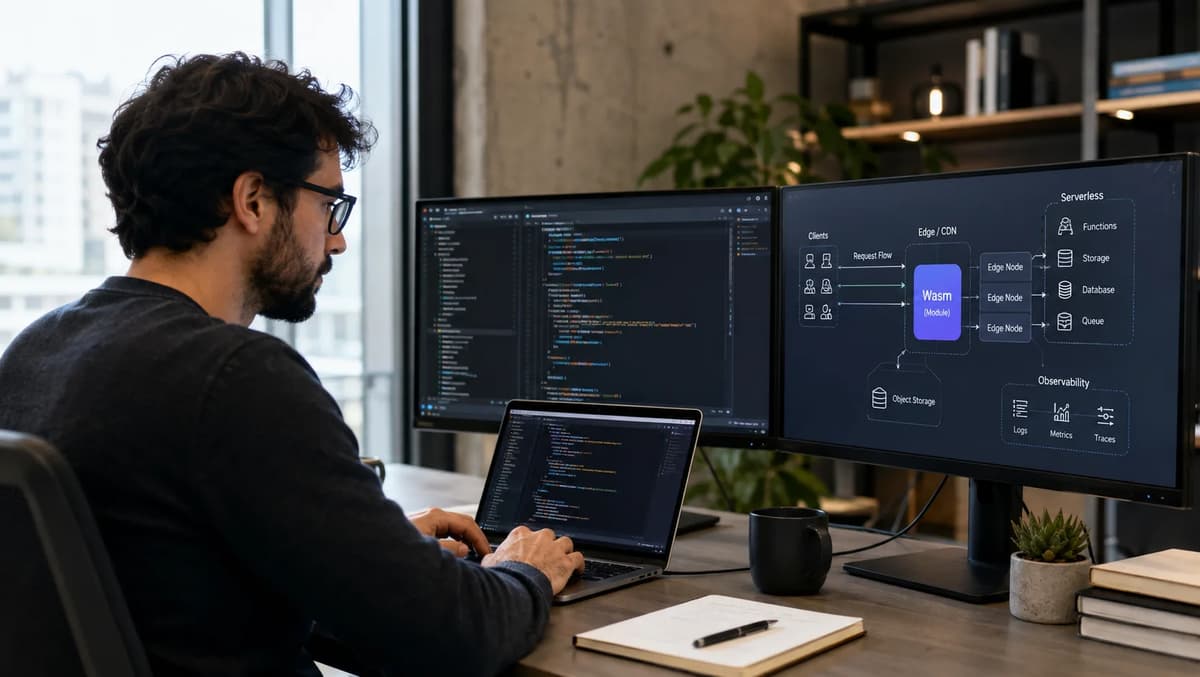
The cold start that matters is not the one you can tune from 2.1 seconds to 1.4 seconds. It is the startup cost your execution model keeps reintroducing whenever traffic goes from zero to one, a new tenant gets scheduled, or an edge location needs a fresh instance.
There is one correction to make immediately, because it changes how you should understand WebAssembly server side 2026 maturity: containers do not boot a complete operating system kernel for every invocation. Linux containers normally share the host kernel and run as isolated processes, so equating every container startup with a VM boot is technically wrong. Docker's own documentation makes that distinction explicit.
But the architectural advantage behind server-side WebAssembly (Wasm) is real. A containerized cold path can still involve scheduling, image and filesystem setup, process creation, language-runtime initialization, framework startup, and application initialization; a Wasm host can instantiate a small precompiled sandbox with far less startup surface. Fastly describes Compute startup in microseconds, and Akamai now makes the same microsecond-startup claim for Akamai Functions.
More importantly, 2026 delivered concrete standards and runtime changes rather than the vague “Wasm is coming to the cloud” promises we have heard for years. WASI 0.3 shipped on June 11 with native asynchronous execution for components, while Wasmtime 47 shipped on July 20 with WebAssembly garbage collection and exception handling enabled by default.
And no, the Wasm Component Model did not reach a formal 1.0 release in 2026. The Bytecode Alliance said on June 8 that the Component Model remains on the road toward 1.0 and explicitly described the work as moving it “from a preview” toward a stable foundation, even while noting that WASI and the Component Model already see heavy production use.
That distinction is the real story. Production adoption has started to outrun formal version numbering.
This article looks at what actually shipped, why webassembly vs containers is now a useful architectural comparison rather than a conference-demo debate, how Fastly and Akamai have concentrated real production investment around Wasm, where Docker went in the opposite direction, and which cloud developer skills 2026 candidates should build without pretending Wasm has already replaced the cloud stack they know.
Containers Have a Structural Limit Wasm Doesn't Share
When you troubleshoot a latency-sensitive service, the first mistake is to treat every startup delay as an implementation bug. A portion may be optimizable, but the execution environment determines how much machinery has to exist before your first line of application logic can run.
Docker describes a container as an isolated process running on a host, with its own filesystem, networking, and process tree isolation. Linux namespaces and control groups form major parts of that boundary; unlike a VM, multiple containers can share the same host kernel.
That makes containers dramatically lighter than traditional VMs, which is one reason they became the default unit of cloud deployment. Yet a container still packages an application around an OS-oriented process model, typically including a user-space filesystem, language runtime, shared libraries, framework initialization, configuration and dependency setup.
Wasm starts from a different abstraction. The host loads a compact bytecode module into a constrained execution environment; outside capabilities such as networking, files, clocks or other host resources become explicit host interfaces rather than ambient access to an operating-system environment.
That model matters at the edge because a provider may need to create isolated execution environments at request-scale rather than merely start a long-lived service once per deployment. Fastly's architecture has historically pursued exactly that pattern: one isolated Wasm execution context per request, with its current Compute materials describing Wasmtime-based startup in microseconds rather than milliseconds.
Akamai makes a similar current claim for Akamai Functions: Wasm functions start in microseconds, run on a Wasmtime-based runtime, and require no containers or VMs for the customer to manage. Its product materials position that lightweight execution model as a way to support globally distributed, bursty application logic.
Containers / VMs | Server-side WebAssembly |
Container startup depends heavily on image, runtime, framework and platform; VM startup adds a separate guest OS/kernel | Fastly and Akamai advertise Wasm startup measured in microseconds on their platforms |
Isolation commonly relies on OS processes, namespaces/cgroups or virtualization boundaries | Wasm executes inside a runtime sandbox with explicit host capabilities |
Container images package an OS-oriented filesystem and dependencies | Wasm modules/components package executable code around narrower runtime interfaces |
Portability depends on compatible container runtimes, OS assumptions and CPU architecture | The Component Model and WIT aim for interface-level portability, subject to host/interface support |
Mature ecosystem across clouds and Kubernetes | Younger ecosystem with production activity concentrated in a smaller set of runtimes and platforms |
Excellent default for general-purpose services | Particularly compelling where startup latency, density and tenant isolation dominate the decision |
The security comparison also needs precision. Saying Wasm is simply “memory-safe by construction” overstates what the runtime guarantees: sandboxing and bounds checks can constrain what a module does to the host, but they do not eliminate application bugs, unsafe logic or vulnerabilities inside the application itself.
What Wasm gives a platform operator is a deliberately narrow isolation boundary. Fastly describes its Wasm guests as executing in a strict sandbox, while Akamai says its Wasmtime-based runtime provides strong isolation; the capability-oriented design means guest code receives access to host resources through specifically exposed interfaces rather than assuming the broad OS surface conventional applications expect.
Portability is similarly more nuanced than “compile once, run everywhere.” The Wasm Component Model and WebAssembly Interface Types, or WIT, let components express typed imports and exports independently of a particular language, but a target runtime still has to implement the interfaces a component requires.
That is nevertheless a significant architectural improvement. Instead of treating the filesystem layout, libc behavior and process environment as the application contract, the component can define a smaller interface contract that a compatible host supplies.
None of this makes containers obsolete. For long-running services whose instances stay hot for hours, a 20-millisecond versus 200-millisecond initialization difference may have negligible business value; databases, stateful systems, applications dependent on mature OS software, and workloads requiring unrestricted native dependencies still fit containers and VMs naturally.
The useful comparison is therefore not “Wasm good, containers bad.” It is: what isolation and startup cost does this workload actually require, and what do I gain by carrying an OS-oriented application boundary when I only need to execute a small piece of request logic?
That question complements rather than repeats the Lambda-centered discussion in Refonte Learning's guide to how event-driven serverless architectures are redefining software engineering. Server-side Wasm changes the execution unit beneath the serverless abstraction rather than merely changing how events trigger conventional cloud functions.
For latency-sensitive edge logic, that difference can finally be large enough to affect architecture.
The 2026 Spec Story: Component Model Preview, WASI 0.3, and Wasmtime 47
The most important fact in this entire article is also the easiest one to misreport:
The WebAssembly Component Model is still in preview as of August 2026. It did not reach a formal Component Model 1.0 release this year.
The Bytecode Alliance's June 8 article is unusually clear about the distinction. It calls a stable, formally specified Component Model 1.0 the next major milestone and says work continues to take the Component Model from preview to a long-term stable foundation.
Yet the same post says both WASI and the Component Model are already heavily used in production. That makes 2026 more interesting than a simplistic “1.0 has arrived” headline: implementers are shipping real systems against technology whose formal standardization is still catching up with production experience.
The road to Component Model 1.0 still includes five broad areas of work identified by the Bytecode Alliance: ABI improvements, a viable native-browser implementation path, specification simplification, ecosystem and tooling work, and remaining WIT expressivity gaps. The browser criterion is particularly concrete: the Alliance says the Component Model cannot formally reach 1.0 until native implementations exist in at least two browser engines.
2026 milestone | Date | Actual status | Why a cloud developer should care |
Component Model roadmap update | June 8 | Still preview; not 1.0 | Production adoption is real, but interface/ABI evolution remains possible |
WASI 0.3 | June 11 | 0.3.0 specification ratified and stable | Async becomes native to components |
Wasmtime 47 | July 20 | Released | Wasm GC and exception handling enabled by default |
Akamai Functions | 2026 | Limited availability in current docs | Spin-based production platform built around a Wasmtime runtime |
Fastly Compute | 2026 | Active independent production platform | Continued Wasm investment in edge, agentic and payment workloads |
The genuinely load-bearing standards milestone came three days later. On June 11, 2026, WASI 0.3 shipped, and the WASI subgroup ratified the 0.3.0 specification.
The important phrase is WASI 0.3 async. Asynchronous execution became native to WebAssembly Components rather than something every component had to approximate with its own event-loop machinery.
Under WASI 0.2, the Bytecode Alliance explains, an individual component could have an async runtime, but independently managed event loops could not coordinate cleanly across component boundaries. That became a composition problem for streaming and asynchronous APIs.
WASI 0.3 moves coordination into the host. The Component Model's canonical ABI gains first-class stream<T>, future<T> and asynchronous functions, allowing language bindings to map those concepts into idiomatic async constructs.
For a cloud developer, that is much more consequential than a cosmetic API cleanup. Server-side workloads spend enormous amounts of time waiting: waiting for databases, APIs, object stores, model endpoints, queues and upstream services.
A runtime model that cannot compose asynchronous I/O cleanly has a ceiling on the kinds of production systems it can host elegantly. A model with host-coordinated async can support concurrent I/O while avoiding the requirement that every component reinvent event-loop integration.
The Bytecode Alliance also switched the model toward completion-based asynchronous operations, comparable conceptually to facilities such as Linux io_uring or Windows completion I/O. Components can now directly import and export async functions rather than relying on the multi-stage start/finish/subscribe patterns used to represent similar operations under WASI 0.2.
The specification milestone does not mean every guest-language toolchain had complete WASI 0.3 support on June 11. The launch post explicitly said runtime and toolchain support was still landing, with guest-toolchain work progressing for Rust, Go, JavaScript, Python and additional languages.
That distinction between spec stability and ecosystem availability is exactly the kind of distinction you need to make when evaluating emerging cloud technology. A standard can be stable while a compiler, SDK or managed platform still has implementation gaps.
Then came Wasmtime 47 garbage collection.
On July 20, 2026, the Bytecode Alliance announced that Wasmtime 47 enabled both the WebAssembly GC and exception-handling proposals by default.
Earlier server-side Wasm adoption naturally favored languages whose compilation model mapped relatively cleanly onto WebAssembly, particularly Rust and C/C++, with Go supported through its own toolchain/runtime choices. High-level managed languages create a different challenge because their object models assume garbage collection and language-level exception behavior.
WebAssembly GC lets language implementations work with runtime-managed garbage-collected objects instead of necessarily packaging an entire independent garbage collector into every compiled Wasm workload. Native exception support similarly gives compilers a standardized mechanism rather than forcing every language implementation to recreate exception semantics through custom calling conventions.
This broadens the runtime's potential language envelope. It is reasonable to view the Wasmtime 47 release as an important prerequisite for richer Java, Kotlin and other managed-language Wasm ecosystems, but not as evidence that those ecosystems instantly reached parity with Rust.
Akamai's own current language-support matrix illustrates the difference between runtime capability and application-tooling maturity. Akamai recommends Rust, JavaScript/TypeScript, Python and Go for production-grade Wasm in its ecosystem, while parts of its Java and Kotlin Spin integration remain works in progress.
That is how you should evaluate language support: compiler target, WASI compatibility, component bindings, framework SDK, debugging, dependency compatibility and platform support separately.
Do not convert “GC proposal enabled” into “every JVM application can now move to Wasm unchanged.” That is precisely the kind of maturity inflation that turned earlier cloud technologies into disappointing migrations.
The 2026 stack is better summarized this way:
Component Model: production-used, strategically important, formally still preview.
WASI 0.3: ratified June 11, with native component async now part of the model.
Wasmtime 47: released July 20, with GC and exceptions enabled by default.
Language ecosystem: expanding, but maturity still varies significantly by toolchain and platform.
That is not a formal “Wasm cloud 1.0.” It is arguably more valuable: independent layers of the stack are becoming useful enough that production systems no longer have to wait for one ceremonial version number.
The Production Platforms Consolidated Around Akamai and Fastly
The platform story changed just as materially as the specifications did.
Akamai has confirmed its acquisition of Fermyon, so the consolidation no longer rests on an inference from domain redirects.
Akamai's Form 10-K, filed with the U.S. Securities and Exchange Commission in February 2026, states that Akamai acquired Fermyon Technologies in November 2025. The filing identifies Fermyon as a serverless WebAssembly company and says Akamai acquired its outstanding equity for $56.6 million in cash, subject to the transaction's adjustments.
Akamai reiterated the acquisition in a May 2026 corporate update, saying Akamai Functions is powered by the Fermyon acquisition and that the company completed the deal to bring Functions onto its platform.
The confirmed transaction explains the consolidation visible across the web properties. As of August 17, 2026, fermyon.com redirects into Akamai's Functions product experience, while developer.fermyon.com still exposes Fermyon-branded developer resources and points users toward Wasm Functions on Akamai Cloud.
The technically important part is what survived the consolidation: Spin.
Akamai Functions explicitly uses Spin, Fermyon's open-source event-driven WebAssembly application framework. Akamai's documentation describes Functions as a globally distributed platform that uses Spin to run edge-native applications, while its product page adds SpinKube as the path for deploying compatible applications onto Kubernetes.
Capability | Akamai Functions | Fastly Compute |
Core execution model | Wasm on a Wasmtime-based runtime | Wasm-based edge Compute platform using Wasmtime |
Current platform status | Documentation labels it Limited availability | Established independent Compute product |
Framework/tooling emphasis | Spin and SpinKube | Fastly SDKs and Compute tooling |
Current language story | Rust, Go, JavaScript and Python prominently supported; broader Wasm languages vary in maturity | Multiple SDKs; 2026 activity includes Rust plus Python beta and C++ work |
Startup claim | Microseconds | Microseconds |
Kubernetes portability path | SpinKube explicitly supports own Kubernetes deployment | Fastly primarily targets its distributed edge platform |
Notable 2026 direction | Functions integrated into Akamai Cloud following Fermyon acquisition | Agentic request handoff and x402 payment enforcement |
Akamai advertises what it calls “zero infrastructure overhead”: developers do not provision, patch or maintain underlying servers for Functions. Its current materials describe fast startup, global distribution and strong isolation on a Wasmtime-based runtime.
The language story is one of the strongest parts of the Akamai Functions Spin proposition. Akamai names Rust, Go, JavaScript and Python as languages developers can compile to Wasm, while Spin creates a common packaging/application model above those languages.
SpinKube changes the deployment argument again. A team can target a managed edge platform through Akamai but retain an open-source route for running Spin applications on Kubernetes, reducing the degree to which the programming model belongs exclusively to one provider.
“Portable,” however, should not become another unqualified marketing word. The same application still depends on compatible WASI interfaces, Spin features, platform services, data APIs and runtime behavior; moving computation is easier than moving every external dependency around it.
There is another maturity caveat you should not skip: Akamai's own Functions documentation currently labels the service Limited availability. That does not negate the product's technical significance, but it matters during an architecture review because availability status affects support expectations, rollout risk and which organizations can adopt it immediately.
Fastly, meanwhile, remains independently active.
The Fastly Compute WebAssembly story is not a legacy Wasm experiment that froze while the industry moved on. Fastly continued extending Compute in 2026 around workloads that expose exactly the issues a request-oriented Wasm architecture has to solve.
On July 13, Fastly published an engineering update introducing request handoff functionality for long-running backend requests. Fastly says Compute ordinarily applies a two-minute wall-clock limit to Wasm guests and maintains a one-to-one relationship between a running guest and an incoming request for typical edge and microservice workloads.
Long-running LLM and agent workflows challenge that model because a guest can spend significant time waiting for an upstream model. Fastly's Rust SDK 0.13.0 added PendingRequest::send_to_client, allowing an in-flight request to move from the Wasm guest to the host so the guest can terminate and release its execution resources while the host continues handling the outstanding network operation.
That is a meaningful sign of production maturity. A platform stops looking like a technology demo when its engineering work starts addressing awkward workload lifecycle problems such as long-running upstream requests, resource turnover and asynchronous handoff.
Two weeks later, on July 27, Fastly published an implementation using Compute as the programmable enforcement point for x402 HTTP-native payments. The edge function can evaluate a payment challenge before a request reaches the origin, with payment infrastructure itself remaining outside Fastly.
You do not have to believe every agentic-commerce forecast to recognize what those two releases demonstrate. Fastly is still investing in the practical question of what per-request Wasm execution can do at an edge boundary, including authorization, routing, request transformation, AI gateway logic and programmable policy enforcement, rather than merely maintaining a runtime because it made good conference material in 2021.
That leaves the production market with two particularly visible commercial approaches.
Akamai acquired the company behind Spin and is turning that technology into a managed Wasm-functions layer across Akamai Cloud. Fastly remains independent and continues evolving its Wasm-native Compute platform around request-scale edge execution.
Neither outcome means the broader Wasm ecosystem disappeared. It means that by 2026, meaningful platform investment has become easier to identify.
Where Docker's Wasm Story Went: What the Ecosystem Looks Like Now
Docker provides an unusually useful counterexample because its trajectory prevents us from telling a simplistic “every infrastructure platform is converging on Wasm” story.
Docker experimented publicly with running WebAssembly workloads alongside containers. In 2026, however, its own documentation is much stronger than “the Wasm blog went quiet”: Docker Desktop's Wasm workloads feature is deprecated, is no longer actively maintained, and will be removed in a future release.
Ecosystem signal | What it tells you |
Docker Desktop Wasm workloads are deprecated | Wasm did not become a universal first-class Docker Desktop workload path |
Fastly continues shipping Compute features | Dedicated Wasm edge infrastructure still has active commercial investment |
Akamai acquired Fermyon | Spin's managed-platform story consolidated into a much larger cloud/edge vendor |
Akamai Functions uses Spin and SpinKube | Open application tooling survived the acquisition and now spans managed edge + Kubernetes |
wasmCloud remains a CNCF Incubating project | Open cloud-native Wasm activity continues outside the two commercial platforms |
Component Model remains preview | Ecosystem consolidation is occurring before formal 1.0 |
Do not interpret Docker's deprecation notice as “Docker can never interact with Wasm.” Its containerd-oriented architecture and alternative runtime mechanisms leave technical paths for Wasm artifacts and runtimes, and Docker's documentation continues to describe Wasm alongside container technologies in places. The more defensible conclusion is narrower: Docker Desktop's dedicated Wasm-workloads feature did not mature into an actively maintained mainstream feature.
That matters because Docker's 2026 product attention is visibly elsewhere. Current Docker work emphasizes AI developer tooling, agent-oriented environments such as Docker Sandboxes and Gordon, as well as container security and software-supply-chain workflows; Docker's current sandbox documentation even uses lightweight microVM isolation for AI agents rather than treating Wasm as its universal isolation solution.
So the industry did not converge on a single outcome where every container vendor simply added a Wasm runtime and the distinction disappeared.
Instead, specialization happened.
Fastly made WebAssembly central to a request-oriented edge-compute product. Fermyon made it central to Spin and serverless components; Akamai then acquired Fermyon and incorporated that work into its cloud platform. Docker retained its container-centered role while backing away from an actively maintained Desktop Wasm-workloads feature.
The open-source cloud-native layer continues too. CNCF currently lists wasmCloud as an Incubating project, a maturity level it reached on November 8, 2024, and describes the project as a way to build and operate polyglot applications across clouds, Kubernetes and edge environments.
That produces a healthier way to read the 2026 landscape:
Server-side Wasm has not become a universal replacement for the container ecosystem.
It has become foundational enough for two major edge/cloud platforms to make substantial product commitments around it.
Open projects such as Spin, SpinKube and wasmCloud provide paths outside a single proprietary runtime.
Docker's retreat demonstrates that adoption is selective rather than automatic.
For an architect, selective adoption is not evidence of failure. Specialized compute models tend to win first where their properties matter disproportionately.
GPUs did not replace CPUs to become important cloud infrastructure. Functions did not replace long-running services to become important cloud infrastructure.
Server-side Wasm does not need to replace containers to become the right answer for a meaningful class of cloud workloads.
What Cloud Developers Should Actually Evaluate in 2026
The useful question for a cloud developer is not “Should I learn WebAssembly?” It is “What workload would cause me to choose WebAssembly over the compute models I already know?”
Start with measured constraints.
A latency-sensitive request function that scales to zero, executes close to users and handles untrusted or multi-tenant logic has a very different architecture profile from a Java service that runs continuously behind Kubernetes for six months. The former can make microsecond instantiation and small sandbox boundaries commercially useful; the latter may gain almost nothing by changing execution format.
A practical decision matrix looks like this:
Workload characteristic | Wasm fit | Reason |
Edge request manipulation with strict latency budget | Strong candidate | Small functions, distributed execution and startup latency align well |
Bursty function that frequently scales from zero | Strong candidate | Startup overhead becomes visible on real requests |
Multi-tenant execution of third-party logic | Strong candidate | Runtime sandbox and explicit capabilities are valuable |
API gateway, auth or policy logic | Strong candidate | Short request-bound execution suits edge Wasm |
AI gateway preprocessing and routing | Candidate | Fastly is actively adapting Compute for long-running upstream AI interactions |
Continuously running stateless microservice | Depends | Cold-start advantage may have little value after warm-up |
Stateful database | Poor default candidate | Mature OS/container infrastructure is generally a better fit |
Application dependent on arbitrary Linux packages/syscalls | Poor candidate today | WASI deliberately exposes a smaller host interface |
Existing container workload with no measured startup issue | Keep the container unless another constraint justifies change | Migration creates cost without an identified benefit |
That is also why learning the difference between a cloud engineer and a cloud developer matters in this discussion. A cloud developer needs enough infrastructure understanding to compare execution models, but the objective remains shipping application behavior, not replacing an architecture because a runtime benchmark looked attractive.
For a first evaluation, do not migrate your platform. Pick one request path.
Implement the same small operation in a conventional container/serverless environment and on Fastly Compute or, where you have access during its current limited-availability phase, Akamai Functions. Measure startup latency, p50/p95/p99 request latency, throughput, memory footprint, deployment artifact size, developer workflow, observability, dependency friction and actual monthly cost under a traffic pattern that resembles production.
The skills priority order for cloud developers in 2026 follows from that evaluation model:
Priority | Skill | Why it matters |
Must | Know that the Component Model remains preview rather than claiming a nonexistent 1.0 milestone | Every maturity judgment depends on accurate standards status |
Must | Identify workloads that actually benefit from Wasm startup and isolation | Prevents technology-first migrations |
Must | Understand containers well enough to make a fair comparison | You cannot evaluate an alternative to a model you do not understand |
Should | Deploy a small application on Fastly Compute or Akamai Functions | Converts conceptual knowledge into operational judgment |
Should | Understand WASI 0.3 async | Async I/O is central to realistic server-side workloads |
Should | Understand WIT and component interfaces conceptually | Interface composition is a major part of the Component Model's value |
Good | Evaluate language-specific Wasm maturity | Rust, Go, JS/Python and managed-language paths do not have identical tooling |
Good | Follow Spin/SpinKube and wasmCloud | Shows how Wasm intersects with Kubernetes and open cloud-native tooling |
Good | Track platform consolidation | Fermyon/Akamai and Docker's deprecation change vendor-risk assumptions |
The Component Model status belongs at the top because a developer who thinks it reached 1.0 will systematically underestimate change risk. A developer who hears “preview” and concludes “not used in production” will make the opposite error, ignoring systems that the Bytecode Alliance itself says already depend heavily on WASI and components.
Both mistakes come from substituting a version label for technical due diligence.
The first common team mistake is therefore assuming Wasm is a drop-in replacement for containers. It is not.
Container images can carry Linux user space, mature native libraries, arbitrary processes, conventional debugging agents and software built around decades of POSIX assumptions. Wasm trades much of that ambient environment for a smaller runtime contract, and the trade becomes attractive only when portability, startup, density or sandboxing pays for what you give up.
The second mistake is overstating Component Model maturity. “Used heavily in production” and “formally 1.0” are different claims, and only the first is currently true according to the Bytecode Alliance.
The third mistake is benchmarking Hello World and treating the result as an architecture decision. If your real application immediately calls a database 70 milliseconds away, saving 20 milliseconds of initialization may matter on the cold path but cannot erase network latency.
Measure end-to-end behavior.
The fourth mistake is treating language support as binary. Wasmtime 47 enabling GC and exception handling by default removes important runtime barriers for managed languages, but compilers, component bindings, package ecosystems, debugging and vendor SDKs can lag the runtime itself.
The fifth is ignoring lock-in because the executable is Wasm. Your Wasm bytecode may be portable while your data store, secret API, logging format, cache semantics, routing rules and provider-specific host calls are not.
A strong portfolio project should reveal that you understand those trade-offs rather than merely show that you can run spin deploy.
One convincing project would implement a small edge authorization or transformation function twice: first in a familiar containerized/serverless environment, then on a Wasm platform. Capture cold and warm latency distributions, document required capabilities, record artifact sizes and dependencies, test failure behavior, and explain which option you would choose for production.
That project is currently more meaningful than hunting for a dedicated server-side WebAssembly certification.
As of this research, I found WebAssembly training courses and educational badges, including Linux Foundation coursework, but no broadly established professional certification exam dedicated specifically to deploying server-side WebAssembly through the Component Model, Fastly Compute or Akamai Functions. The ecosystem remains too platform-specific and fast-moving for a certification to serve as the strongest proof of practical judgment.
That does not make general cloud credentials irrelevant. AWS, Azure, Google Cloud, Kubernetes and security certifications can still demonstrate broader infrastructure competence; they simply do not prove that you can decide whether a Wasm runtime is appropriate for a specific workload.
The same restraint applies to salary claims.
There is no defensible “WebAssembly developer salary premium” I would put in an offer negotiation as though it were an established market band. Server-side Wasm remains a specialized competency nested inside cloud, edge, platform, runtime and distributed-systems roles.
For baseline cloud-developer compensation and the broader skill stack, Refonte Learning already covers that territory in the full 2026 Cloud Development skills, tools, and salary roadmap. That article's current roadmap focuses on cloud providers, Docker, Terraform, Kubernetes, CI/CD and conventional serverless rather than Wasm, which is exactly why this article fills a separate gap.
The stronger career signal here is technical differentiation. Fastly employs engineers working directly on WebAssembly standards and its runtime ecosystem, Akamai has spent $56.6 million acquiring a serverless Wasm company, and the Bytecode Alliance continues shipping substantial runtime and standards work. Those facts demonstrate investment in the skill domain; they do not prove that “Wasm” on a résumé automatically produces a higher salary.
For career planning, treat Wasm as a specialization layered over strong cloud fundamentals, not a substitute for them.
Self-Study vs. Structured Training: Where Refonte Fits
The fastest route into server-side Wasm depends heavily on what you already know.
If Docker, networking, IAM, observability, deployment pipelines and cloud architecture are already familiar, you can learn a surprising amount from the Component Model documentation, WASI specifications, Spin and Fastly examples. If those concepts are still new, jumping directly into Wasm makes it easier to memorize tooling without understanding the architectural comparison this technology actually demands.
A more honest comparison than promising universal “job-ready in X weeks” timelines is this:
Factor | Self-study | Structured Cloud Development Program |
Learning sequence | You choose and maintain it yourself | Curriculum supplies an ordered foundation |
Docker/container fundamentals | Depends on resources selected | Docker is explicitly listed |
Kubernetes | Optional unless you deliberately include it | Explicitly listed |
Infrastructure as Code | Easy to postpone | Terraform is explicitly listed |
Multi-cloud exposure | Often follows whichever provider you choose first | AWS, Azure and Google Cloud are explicitly listed |
Architecture | Quality varies by study plan | Cloud Architecture Design is listed as a competency |
Security | Can become a separate afterthought | Cloud Security Practices are explicitly listed |
Performance work | Depends on project discipline | Performance Monitoring and Optimization is listed |
Cost judgment | Often skipped in toy projects | Cost Management in Cloud is listed |
Portfolio work | Scope depends entirely on you | Current program page lists a Cloud Application capstone |
WebAssembly | You can study it directly | Not listed in the current Refonte curriculum |
That final row matters most for this article.
The Refonte Learning Cloud Development Program does not currently claim to teach WebAssembly, the Component Model, WASI, Fastly Compute, Spin, Fermyon or Akamai Functions. A current search of the program page finds no WebAssembly or Fastly references, and the page explicitly lists AWS, Azure, Google Cloud, Docker, Kubernetes and Terraform as tools students encounter.
That is the defensible reason to connect the program to this subject: the program teaches the compute-model foundations you need before evaluating Wasm as an alternative or complement to containers.
You cannot make a serious webassembly vs containers decision if your container knowledge consists of knowing how to build an image. You need to understand deployment boundaries, scaling, orchestration, infrastructure automation, security, monitoring and cost well enough to recognize which properties change when you replace one execution substrate with another.
The current Refonte curriculum explicitly identifies the following areas:
AWS, Azure and Google Cloud
Docker
Kubernetes
Terraform
Cloud Architecture Design
Cloud Security Practices
Performance Monitoring and Optimization
DevOps Methodologies
Cost Management in Cloud
Capstone Project: Cloud Application
Those details come from the live program page, which also lists a three-month program period and a stated workload of 12–15 hours per week.
The mentor is MSc Charlotte Smith, Department of Cloud Engineering. Refonte describes Smith as a cloud-computing specialist with more than 10 years of industry experience and identifies her as the program's senior instructor.
As checked on August 17, 2026, the live program page shows a USD 350 one-time enrollment cost, or two installments of USD 240 and USD 110, which total the same USD 350. Pricing can change after publication, so the live program page remains the authority at enrollment time.
What does that foundation have to do with WebAssembly?
Consider the questions you have to answer in a real Wasm pilot. Is the workload actually cold-start constrained? Does it require Kubernetes? Which external capabilities need access? What happens to observability when execution becomes request-scoped? Is lower startup latency economically relevant after network I/O? Does the platform's portability story survive your database and secret-management choices?
Those are cloud architecture questions before they are WebAssembly questions.
A student who understands Docker isolation can recognize what the Wasm sandbox changes. Someone who understands Kubernetes can evaluate whether SpinKube creates a useful portability path. Someone who understands performance monitoring can measure Wasm rather than repeat vendor latency claims.
Cost management matters as well. A runtime that instantiates faster is not automatically cheaper after you account for platform pricing, network egress, managed services and engineering effort.
And multi-cloud knowledge gives you a baseline against which to judge a distributed platform such as Fastly or Akamai. “Global by default” only means something when you understand the operational burden of achieving equivalent geographic behavior through conventional regional cloud deployments.
This is also why I would not build a learning plan around Wasm first and infrastructure second.
A better progression is:
Learn how conventional cloud applications execute and scale.
Learn what containers package and how Kubernetes orchestrates them.
Learn serverless execution and what cold versus warm behavior means.
Learn observability, cost and security well enough to measure architecture rather than describe it.
Then deploy one server-side Wasm workload and compare the models with evidence.
Refonte's current program covers the foundational side of that sequence; it does not claim the last bullet as curriculum.
For developers who want that structured foundation, the Refonte Learning Cloud Development Program provides the container, Kubernetes, Terraform, multi-cloud, architecture, security, monitoring and cost-management groundwork from which a serious evaluation of WebAssembly becomes a natural next step.
FAQ: People Also Ask
The answers below reflect platform and specification status verified through August 17, 2026.
Did WebAssembly's Component Model reach 1.0 in 2026?
No. The Component Model remains formally in preview as of August 2026. The Bytecode Alliance's June 8 roadmap describes stable Component Model 1.0 as a future milestone and identifies remaining ABI, browser-engine, specification, ecosystem/tooling and WIT work.
The important nuance is that formal preview status does not mean nobody uses it in production. The Bytecode Alliance says both WASI and the Component Model are already heavily used in production, making 2026 a case where real-world deployment has moved ahead of the final 1.0 designation.
What did WASI 0.3 actually add?
WASI 0.3 made asynchronous execution native to WebAssembly Components. The WASI subgroup ratified version 0.3.0 on June 11, 2026.
The Component Model now provides constructs including future<T>, stream<T> and async functions at the ABI level, while the host can coordinate a shared event loop across components. That makes the change particularly relevant to I/O-heavy server applications that spend substantial time waiting on APIs, databases, streams and other services.
Is Fermyon still an independent company?
Akamai has confirmed that it acquired Fermyon Technologies. Akamai's 2025 Form 10-K, filed in February 2026, says the acquisition occurred in November 2025 and reports $56.6 million in cash consideration for the outstanding equity, subject to adjustments.
Akamai repeated the acquisition publicly in May 2026 and says Akamai Functions is powered by the Fermyon acquisition. Fermyon's Spin and SpinKube technologies now form an important part of the Akamai Functions story.
This is therefore no longer merely an inference from domain redirects; Akamai itself has confirmed the transaction.
Why does WebAssembly have faster cold starts than containers?
Wasm can start faster because a host can instantiate a compact precompiled sandbox without reproducing the broader process, user-space filesystem, language-runtime and application-initialization surface that often exists in a containerized cold path. Fastly and Akamai both currently advertise Wasm startup measured in microseconds on their respective platforms.
One common explanation needs correcting: containers do not normally boot a complete operating-system kernel for each invocation. Containers share the host kernel, whereas VMs run their own guest kernel; cold-start comparisons should therefore measure actual platform behavior rather than treating containers and VMs as identical.
Should I replace my containers with WebAssembly?
Not by default. Evaluate server-side Wasm where you have a measurable reason: latency-sensitive edge execution, frequent scale-from-zero behavior, multi-tenant code, high execution density, or a need for a narrowly capability-scoped sandbox.
Keep containers where their mature Linux ecosystem, native dependencies, long-running process model or operational tooling better fits the workload. The strongest architecture may also use both: containers for conventional services and Wasm for selected edge or request-scoped functions.
Does the Refonte Learning Cloud Development Program teach WebAssembly?
No, not according to the curriculum currently published on the program page. The program lists AWS, Azure, Google Cloud, Docker, Kubernetes and Terraform, together with cloud architecture, security, performance monitoring, DevOps and cost-management competencies; WebAssembly, WASI, Fastly Compute, Spin and Akamai Functions are not listed.
Its relevance to server-side Wasm is foundational rather than direct: understanding containers, orchestration, architecture, observability and cloud economics gives you the baseline needed to evaluate whether Wasm solves a real workload problem rather than adopting it because it is newer.
What Server-Side WebAssembly Actually Means for Cloud Developers
The strongest evidence for server-side WebAssembly in 2026 is not a prediction. It is the sequence of concrete things that have already happened.
The standards layer gained native component async. A major runtime enabled GC and exceptions by default. Akamai completed an acquisition around serverless Wasm and is productizing Spin, while Fastly continues expanding an independently developed Wasm edge platform into new production scenarios. Docker, meanwhile, deprecated its Desktop Wasm-workloads feature.
The four conclusions I would carry into an architecture review are:
The real 2026 milestone is not “Component Model 1.0.” No such formal 1.0 release has happened. The important milestones are WASI 0.3's June 11 native async support and Wasmtime 47's July 20 default support for WebAssembly GC and exceptions, while the Component Model remains in preview despite substantial production use.
Akamai and Fastly are the clearest commercial production stories to watch. Akamai acquired Fermyon in November 2025 and now builds Functions around Spin, SpinKube and a Wasmtime-based runtime; Fastly continues developing Compute around per-request Wasm execution, including 2026 work on agentic-system request handoff and programmable x402 payment enforcement.
Wasm did not simply become another universal Docker feature. Docker's current documentation explicitly deprecates its Desktop Wasm-workloads feature, while CNCF projects and specialized edge platforms continue development. That points to ecosystem specialization and consolidation, not universal runtime convergence.
The responsible deployment decision remains workload-specific. Wasm deserves serious evaluation for latency-sensitive, scale-from-zero, request-scoped and multi-tenant execution, but a mature container stack remains a better default for workloads whose requirements depend on long-running processes, broad Linux compatibility or an ecosystem Wasm cannot yet reproduce cleanly.
That last point is what separates cloud developer skills in 2026 from technology collecting.
A senior developer does not ask whether WebAssembly has “won.” You ask whether its startup model, sandbox boundary, interface model and portability properties produce a measurable advantage for the system in front of you, and whether the still-evolving Component Model and language ecosystem create risks you can justify.
For the first time, that is a question you can answer using production platforms instead of prototypes.
For developers who need the container, Kubernetes, Terraform, multi-cloud, architecture, security, monitoring and cost-management fundamentals required to make that evaluation intelligently, the Refonte Learning Cloud Development Program is the structured starting point.