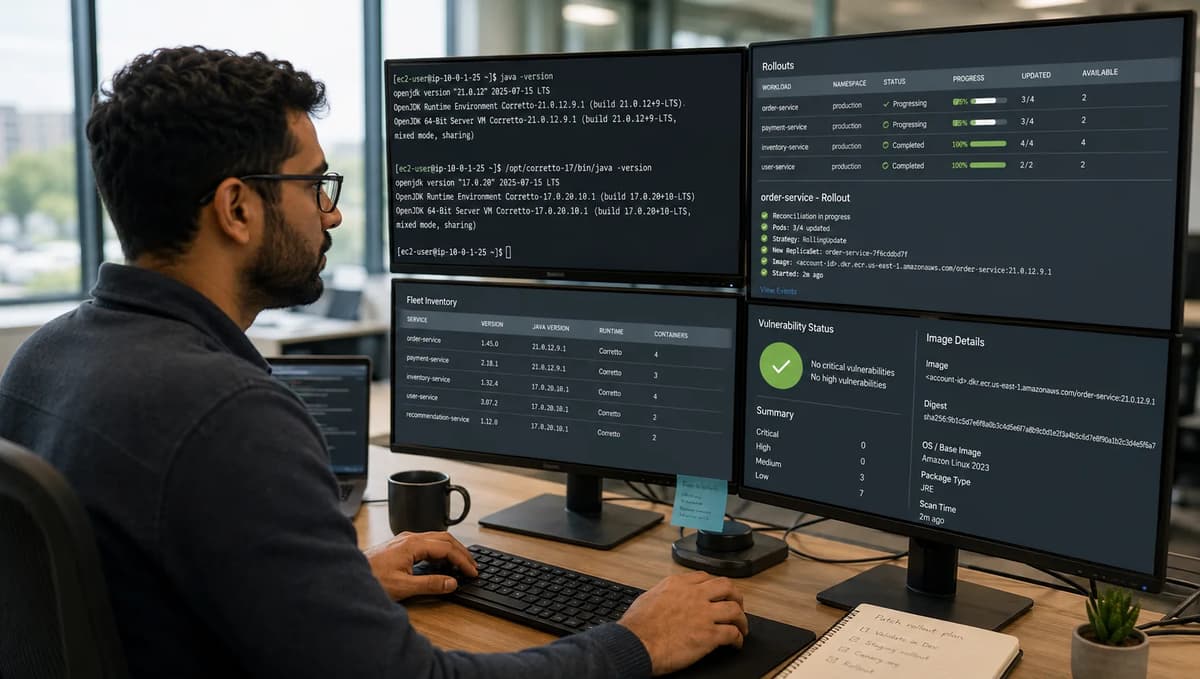
The security team announces a critical Amazon Corretto update. Application owners answer, “We already run Java 17.” That answer cannot approve, defer, or close the change. “Java 17” omits the vendor, exact build, operating-system package, CPU architecture, container digest, bundled runtime, process start time, and deployment actually serving traffic.
That ambiguity is how a security update creates a second incident. Under pressure, teams may replace the runtime while also changing the Java major, garbage collector, cryptographic provider, base image, application dependencies, and startup flags. When Transport Layer Security (TLS) handshakes fail or memory rises, the team cannot isolate the cause, and its only rollback may be the vulnerable artifact that prompted the emergency.
This guide begins with runtime provenance, not the instruction to “update Java.” It defines the August 18, 2026 scope, discovers every execution surface, maps vulnerability relevance without letting triage become delay, and separates same-major patching from a major-version migration. It then builds verified artifacts, tests cryptography and application behavior, promotes through risk-based rings, proves the version of live processes, blocks obsolete artifacts, and preserves a controlled rollback. The objective is not merely to install a package. It is to make every owner able to show what changed, why it was safe, what serves traffic, and how recovery will work if the patch exposes a compatibility defect.
Define the CSPU Scope, Exact Versions, and Patch Deadline
AWS posted the Amazon Corretto August 2026 Critical Security Patch Updates (CSPU) announcement on August 18, 2026. It covered both Long-Term Support (LTS) and Feature Release (FR) lines and named six builds. The official release pages checked on September 2, 2026 marked these builds “Latest,” with no superseding Corretto release. When this runbook is used later, select a newer supported security build if one exists; never downgrade merely to reproduce the announcement.
Java line | Support line | August 18 build to approve | Operational note |
26 | FR | Apply 26.0.2.11.1 within Java 26; govern the October 2026 FR end of life separately. | |
25 | LTS | Same-major update for existing Corretto 25 estates. | |
21 | LTS | Same-major update for Corretto 21. | |
17 | LTS | Same-major update for Corretto 17. | |
11 | LTS | Same-major update for Corretto 11. | |
8 | LTS | AWS uses the update label 8u504; the Corretto release tag is 8.504.01.1. |
The Corretto support calendar checked September 2, 2026 identified 26 as an FR scheduled to reach end of life in October 2026, while 25, 21, 17, 11, and 8 were LTS lines with later support dates. Before that end of life, a Java 26 owner had two changes: apply 26.0.2.11.1 in the same-major security lane, then separately move to a supported line. After the end of life, any remaining Java 26 deployment is unsupported remediation; choose a vendor-supported target rather than downgrading to the August build.
AWS does not impose a universal customer deadline in the announcement. The deadline comes from policy, exposure, and incident status. Use an immediate incident lane for active exploitation or an exposed reachable path; an expedited window measured in hours or days for internet-facing critical services; the critical-patch service-level agreement (SLA) for other affected production; and a named owner, compensating control, and expiry for every exception. “No public exploit observed” is not closure when policy requires a supported security build.
Inventory Every Java Runtime and Its Provenance
Java fleet inventory is an execution-surface problem, not a configuration-management database query. The Amazon Corretto product description identifies a multiplatform OpenJDK distribution for Linux, Windows, and macOS, and repositories and images create several acquisition paths. A service can compile with one Java Development Kit (JDK), test with another, and run on a third Java Virtual Machine (JVM).
Name one inventory coordinator and require application owners to attest their rows. Platform and site reliability engineering (SRE) teams scan infrastructure, continuous-integration (CI) owners inspect worker images, endpoint teams inspect desktop bundles, and vendor-management teams pursue closed products. A row without an accountable owner is an incident risk.
Find Hosts, Containers, Kubernetes, CI, Desktop, Serverless, and Vendor Bundles
Start with running processes, then search deployable artifacts that can reintroduce an old runtime. On Linux, capture each process executable rather than trusting the shell’s default java. When permissions allow, Oracle’s jcmd documentation provides the low-impact VM.version command; attachment requires the same machine and an authorized effective identity.
pgrep -af 'java|javaw'

for pid in $(pgrep -x java); do
  exe=$(readlink -f "/proc/$pid/exe")
  printf 'PID=%s EXE=%s\n' "$pid" "$exe"
  "$exe" -XshowSettings:properties -version 2>&1 |
    grep -E 'java\.home|java\.runtime\.version|java\.vendor|os\.arch'
done

jcmd "$PID" VM.version
jcmd "$PID" VM.flags
Namespaces, restricted /proc, or service identities may block attachment. Collect the fingerprint through an authorized host agent, controlled startup log, or protected runtime endpoint; do not weaken production isolation for inventory.
Discovery must cover more than hosts:
Enumerate package records, alternatives or symlinks, launch scripts, systemd units, Windows services, scheduled tasks, and desktop shortcuts.
Search application roots for java, java.exe, javaw.exe, JRE directories, custom jlink images, and archives that unpack at launch.
Inspect container manifests, registry layers, software bills of materials (SBOMs), histories, and production or CI base images.
Query Kubernetes specifications, init containers, sidecars, Jobs, CronJobs, and actual Pod status—not only Deployments.
Inspect CI runners, build images, release agents, integrated development environments, scanners, monitoring agents, data tools, and vendor appliances.
Classify serverless functions as managed runtime, customer image, custom runtime, or layer-provided Java; patch ownership differs.
On Windows, use process paths and invoke the discovered binary, not an unrelated Java on PATH:
Get-CimInstance Win32_Process |
  Where-Object { $_.Name -in @('java.exe','javaw.exe') } |
  Select-Object ProcessId, ExecutablePath, CommandLine

& 'C:\approved\path\bin\java.exe' -XshowSettings:properties -version 2>&1
Record Distribution, Exact Build, Architecture, Source, Digest, and Owner
A Java fleet inventory needs fields that support a change decision and later prove closure. Store it in a queryable system, preserve the discovery timestamp, and make the source of each value explicit.
Required field | Example value | Why responders need it |
Business service | Payments API | Connects runtime risk to business impact. |
Repository | payments/service-api | Finds build and deployment definitions. |
Owner | Payments platform team | Establishes action and exception ownership. |
Environment | Production, eu-west-1 | Separates test evidence from live exposure. |
Java major | 17 | Selects the same-major lane. |
Vendor or distribution | Amazon Corretto | Distinguishes Corretto from another OpenJDK build. |
Exact build | 17.0.20.10.1 | Determines whether the August fix is present. |
Runtime type | JRE, JDK, or custom image | Identifies tools and components shipped. |
Architecture | x86_64 or aarch64 | Selects the correct package and native libraries. |
Operating system | Amazon Linux 2023 | Determines package source and compatibility. |
Package or archive source | Approved RPM repository snapshot | Reconstructs provenance. |
Container digest | sha256 digest | Proves immutable image identity. |
Deployment mechanism | Auto Scaling group, Helm, MSI | Identifies how replacement occurs. |
Last restart | 2026-09-02 04:15 UTC | Shows whether the process could have loaded the new runtime. |
Exposure | Internet inbound, outbound TLS, internal only | Supports risk ordering. |
Rollback artifact | Prior approved image digest | Confirms recovery is possible and controlled. |
Apply the schema to the worked estate: an EC2 payments service uses packaged Corretto 17; Kubernetes workloads embed Corretto 21; a CI image carries Corretto 11; a Windows desktop tool bundles Corretto 8; and a ZIP-based AWS Lambda function uses a provider-managed Java runtime. The first four require package or artifact action. The function requires a named owner, runtime-update mode, and provider evidence. That distinction anchors a credible JDK provenance audit.
Map Vulnerability Relevance Without Turning Analysis Into Delay
The August announcement names builds, not exploit mechanics. Use version-specific Corretto changelogs for fixed-component scope and an authoritative Java advisory for attack-vector context. The changelogs for Corretto 21, 17, 11, and 8 list three Common Vulnerabilities and Exposures (CVE) records: CVE-2026-61308 in java.net, CVE-2026-70907 in Java Secure Socket Extension (JSSE), and CVE-2026-60589 in XML cryptography. The changelogs for Corretto 25 and 26 add CVE-2026-70906 in the 2D component.
Oracle’s August 2026 Java SE risk matrix supplies attack-vector context: the networking issue is associated with HTTP, the JSSE issue with TLS, the security issue with multiple protocols, and the 2D issue with multiple protocols on Java 25 and 26. Oracle’s matrix also includes a local “Install” issue that the Corretto changelogs do not list. The publications have different product and component scopes; that difference should not be used to infer either that Corretto fixed the Install issue or that it omitted an applicable fix. For Corretto remediation, use each line’s changelog as the fixed-CVE authority and Oracle’s matrix only for matching component and attack-vector context.
Create one vulnerability decision record per service and patch line:
Decision field | Required evidence |
Authoritative advisory | URL, publication date, and captured version |
Affected component and range | Corretto changelog entry and current exact build |
Attack vector | Protocol, privileges, interaction, and reachable input |
Reachable code or behavior | HTTP client/server, TLS path, XML signature, 2D processing, or justified absence |
Data sensitivity and exposure | Internet reachability, tenant data, credentials, and trust boundary |
Compensating control | Egress restriction, protocol block, input control, isolation, or none |
Patch SLA | Policy deadline and approving authority |
Residual risk | What remains until live replacement is proven |
A “not reachable” decision must explain how it was established and when it expires. It may lower rollout order or justify a narrow exception, but not unlimited use of an old build. A scanner finding alone does not prove exposure: it may match a package in an unused layer or miss a bundled runtime. The decision record connects advisory scope to process and deployment evidence.
Separate Same-Major Security Patching From Major-Version Migration
A Corretto critical security update should normally change only the build within the service’s approved Java major. A major migration can change language and bytecode compatibility, library support, build plugins, modules, garbage-collector defaults, removed features, and operating assumptions. Combining the scopes makes canary failures harder to diagnose and rollback harder to trust.
This separation is also different from choosing an application framework. A backend framework comparison covering Node.js, Django, and Spring Boot helps with application architecture; it does not answer which exact JDK binary is serving production or how to replace it safely.
Change dimension | Fast same-major patch lane | Major-upgrade lane |
Intended change | Corretto patch build only | Java major and dependent toolchain |
Application dependencies | Frozen unless required to restore compatibility | Deliberately reviewed and upgraded |
JVM flags and garbage collector | Preserved and compared | Revalidated against the new major |
Approvals | Security, platform, application owner, SRE | Architecture, product, platform, security, release governance |
Test emphasis | Regression, TLS, native agents, performance delta | Full compatibility, build, dependency, behavioral, and migration testing |
Timeline | Critical-patch SLA | Planned project timeline |
Rollback assumption | Prior same-major artifact may run the same application | Bytecode, data, and configuration may not be backward compatible |
Patch the Current Major First and Govern Major Upgrades Separately
For a Corretto 17 service, build and test 17.0.20.10.1 while holding the application commit, dependency lock files, base operating-system family, JVM flags, heap policy, and collector constant. For Corretto 21, do the equivalent with 21.0.12.9.1. The purpose is not to pretend patch releases are risk-free; it is to make any observed difference attributable.
Corretto 26 needs special handling because the official support calendar places its end of life in October 2026. If a production system runs 26, install 26.0.2.11.1 in the security lane. Open a separate retirement decision for an approved supported line. Do not assume an application compiled for Java 26 can simply run on Java 25; that separate change may require recompilation, dependency changes, or another supported target.
Block promotion when the candidate includes an unapproved major change, unrelated dependency refresh, new garbage collector, or new cryptographic provider. Split the work, restore a single-variable candidate, and rerun the gates. If a documented incompatibility requires another change, treat it as an expanded emergency change with explicit risk acceptance—not an invisible addition to the patch.
Build Reproducible, Signed, and Immutable Runtime Artifacts
Amazon Corretto can reach a workload through a repository package, versioned archive, installer, Amazon Linux package, or official container image. The Corretto 21 download documentation distinguishes permanent “latest” URLs from version-specific downloads and provides checksums and signature files. Permanent URLs redirect to the newest release, which is useful for discovery but unsafe as the only input to a reproducible production promotion.
Define one approved acquisition path for each runtime class:
Runtime class | Reproducible input | Evidence retained |
Debian or Ubuntu host | Signed repository plus exact package version | Repository configuration, package version, key fingerprint, transaction log |
RPM-based host | Approved repository snapshot or versioned RPM | Name, epoch, version, release, and architecture (NEVRA); repository; checksum; transaction ID |
Amazon Linux host | Versioned Corretto package from the approved channel | Package query, repository metadata, instance image ID |
Windows or macOS desktop | Versioned MSI, ZIP, PKG, or archive | Publisher or signature verification, SHA-256, deployment assignment |
Container | Base image digest plus locked application inputs | Source digest, child digest, SBOM, build provenance |
Vendor bundle | Vendor-signed update | Vendor advisory, package identity, installation evidence |
AWS’s generic Corretto 21 Linux installation guide documents signed Apt repository setup and package names, while the Corretto 17 Amazon Linux guide documents headless, headful, development, and JMods packages. On September 2, 2026, their example output still showed the July builds 21.0.12.8.1 and 17.0.20.8.1. Use those pages for the installation mechanism, not as proof of the approved security build; the version-specific release page and repository candidate must control the change.
Verify Packages, Images, Signatures, Repositories, and Lock Files
For archive-based distribution, download a version-specific artifact and its signature or checksum into a controlled build environment. Import the key through an approved key-management process, verify its fingerprint out of band, and retain the verification output.
ARTIFACT=amazon-corretto-21.0.12.9.1-linux-x64.tar.gz

gpg --import amazon-corretto-public-key.asc
gpg --verify "${ARTIFACT}.sig" "$ARTIFACT"
sha256sum "$ARTIFACT"
For repositories, capture the candidate before installation and pin the approved version in automation. Package names alone are not sufficient evidence.
apt-cache policy java-21-amazon-corretto-jdk
sudo apt-get install java-21-amazon-corretto-jdk="$APPROVED_DEB_VERSION"

rpm -q --qf '%{NAME}\t%{VERSION}-%{RELEASE}\t%{ARCH}\n' \
  java-17-amazon-corretto-headless
The official Corretto Docker instructions show Docker Hub and Amazon Elastic Container Registry Public images. Resolve the approved tag to a digest, mirror it if policy requires, and use that digest in the child image. Docker’s image-pull guidance for immutable digests explains that a digest pins exact content but must be deliberately updated to receive later security fixes.
docker pull public.ecr.aws/amazoncorretto/amazoncorretto:21
docker image inspect --format '{{index .RepoDigests 0}}' \
  public.ecr.aws/amazoncorretto/amazoncorretto:21

docker build --pull --no-cache -t registry.example/java/orders:cspu .
docker push registry.example/java/orders:cspu
Record the child digest, software bill of materials (SBOM), application commit, dependency-lock hashes, build-worker image, and signing identity. A tag such as cspu is a human label; the digest is the deployment identity. Stop promotion if verification fails, the source repository or worker image is unapproved, or the dependency graph changed outside scope.
Test TLS, Cryptography, Security Properties, Native Code, and JVM Flags
Patch-level does not mean behavior-free. The August set includes JSSE, networking, security, and—on Java 25 and 26—2D changes. Even when a specific update does not advertise a trust-store or algorithm-policy change, the safe operational assumption is that cryptographic paths, security properties, provider behavior, and native boundaries deserve explicit regression tests.
Build a crypto matrix from real service dependencies. Include Java KeyStore (JKS), Public-Key Cryptography Standards (PKCS) #12 and #11, Privacy-Enhanced Mail (PEM), and Federal Information Processing Standards (FIPS) configurations where used:
Test path | What to exercise | Evidence and stop condition |
Inbound TLS | Every listener, protocol version, cipher policy, certificate chain | Handshake and application request succeed; no unexpected protocol fallback |
Outbound TLS | APIs, databases, message brokers, proxies, identity providers | Successful handshake, hostname validation, expected peer chain |
Mutual TLS | Client certificate selection and server trust | Correct alias and chain; no trust-manager regression |
Custom trust stores | Java KeyStore (JKS), PKCS #12, PEM bridges, mounted stores | Expected roots and intermediates load; expired or missing chain blocks promotion |
Algorithm policy | Disabled algorithms and key sizes | Policy remains compliant; required partner connection still works |
Provider or FIPS configuration | Provider order and approved implementation | Approved provider remains active; self-tests pass |
Signed code and tokens | Signed JARs, JSON Web Tokens, Security Assertion Markup Language, XML signatures | Verification succeeds and negative tests still fail |
Key stores and hardware modules | Password handling, aliases, PKCS #11 integration | Key access works without exposing secrets in logs |
Run tests from the candidate artifact, not a developer laptop. Include proxies, service meshes, load balancers, and private certificate authorities present in production. For a failed handshake, capture peer, protocol, selected provider, trust-store source, and exception chain. Do not “fix” it by globally enabling a disabled algorithm without security approval.
Detect Provider, Certificate, Algorithm, Garbage-Collector, and Startup Changes
Create one runtime fingerprint and compare old and candidate output. The following Java 8-compatible class uses standard security APIs and system properties so it can run across the supported estate.
import java.security.Provider;
import java.security.Security;

public final class RuntimeFingerprint {
    public static void main(String[] args) {
        String[] keys = {
            "java.vendor", "java.runtime.version", "java.home",
            "os.name", "os.arch", "user.timezone", "file.encoding"
        };
        for (String key : keys) {
            System.out.println(key + "=" + System.getProperty(key));
        }
        for (Provider provider : Security.getProviders()) {
            System.out.println("provider=" + provider.getName()
                + ":" + provider.getVersion());
        }
        System.out.println("jdk.tls.disabledAlgorithms="
            + Security.getProperty("jdk.tls.disabledAlgorithms"));
    }
}
For live candidates, compare jcmd PID VM.flags, heap and collector selection, native-agent startup, Java Native Interface (JNI) library loading, time zone, locale, Domain Name System (DNS) behavior, entropy, class loading, reflection, serialization, and startup duration where relevant. Use -Djavax.net.debug=ssl,handshake,trustmanager only on a controlled canary; it is verbose and may expose certificate or endpoint details.
Promotion stops on an unexplained provider-order change, certificate rejection, signed-JAR failure, native-agent crash, repeated class-loading error, collector change, or material startup and memory regression. The application owner explains the difference; security approves any policy change; the platform owner verifies the runtime; and SRE records recovery steps before the candidate advances.
Run Application, Integration, Performance, and Security Regression Gates
A runtime patch can pass java -version and still break the service. Build a gate set that follows actual dependencies. The backend API developer roadmap from HTTP to microservices is useful context for identifying service, database, messaging, and authentication boundaries; the patch runbook must turn those boundaries into executable regression evidence.
Gate | Minimum proof | Promotion blocker |
Unit and component | Same application commit passes on candidate runtime | New failure or unexplained skipped test |
API and contract | Consumer/provider contracts and error semantics match | Schema, status, timeout, or serialization difference |
Database | Connection, pool, transaction, failover, and migration checks | Authentication, driver, transaction, or time-zone defect |
Messaging | Produce, consume, acknowledgment, retry, and ordering checks | Duplicate, loss, lock, or serialization behavior change |
Authentication and authorization | Login, token validation, role checks, negative tests | Access granted or denied incorrectly |
TLS and crypto | Matrix from the prior section | Handshake, provider, chain, or policy regression |
Startup and shutdown | Readiness, graceful drain, hooks, restart | Crash loop, hung shutdown, failed health state |
Performance | Fixed workload, warm-up, latency, CPU, memory, garbage collection | Service-owned threshold exceeded |
Security | Image/package scan, SBOM comparison, safe control test | Candidate still maps to affected build or new critical issue |
Application security automation remains useful, and Refonte Learning’s overview of automated security testing for DevSecOps teams provides broader testing context. For this change, however, a clear scanner is only one gate. It does not prove that the deployed image was restarted, that a bundled JRE is absent, or that the live process uses the candidate.
Prove Functional Correctness, Latency, Resource Use, and Exposure Closure
Run old and candidate artifacts against the same workload definition, datasets, dependency versions, infrastructure class, JVM flags, and warm-up period. Refonte Learning’s guide to continuous performance testing automation explains the value of baselines; here the baseline must isolate the runtime change.
Each owner defines numeric thresholds before seeing results. Require no statistically meaningful error-rate increase, bounded percentile-latency and memory deltas, stable garbage-collection pauses, and startup within the readiness budget. Do not copy a universal five- or ten-percent threshold across systems; a batch tool, low-latency API, desktop application, and memory-constrained Pod have different limits.
Exposure closure requires three linked proofs:
The candidate artifact contains the approved Corretto build and passes signature, checksum, SBOM, and vulnerability checks.
The application passes functional, integration, crypto, performance, and security gates against that artifact.
The promoted process reports the expected vendor and exact runtime build while serving the tested deployment revision.
If a gate fails, freeze promotion, retain logs and candidate artifacts, and decide whether to fix forward within the same-major scope. Roll back the test or canary only to a controlled artifact, then open a defect with the failing dependency, runtime fingerprint, and reproducer. A green unit suite cannot override a red TLS, data-integrity, or live-version gate.
Deploy Through Risk-Based Rings With Explicit Stop Conditions
A fleet-wide restart is not a rollout plan. Rings limit blast radius and create evidence before the next exposure class receives the change. The release lead owns ring promotion, but application owners own service acceptance and SRE owns traffic, health, and recovery execution.
Ring | Typical targets | Required evidence before entry | Stop condition |
0: Build and test | Reproducible artifacts and isolated test | Provenance, exact build, complete regression plan | Signature, build, or test failure |
1: Internal tools | Non-customer-facing CI or support service | Ring 0 pass and usable rollback | Crash, TLS failure, or workflow blockage |
2: Stateless canary | Small production slice | Live-version telemetry and traffic controls | Error, latency, memory, or digest mismatch |
3: Low-criticality production | Recoverable services | Canary observed through representative load | Threshold breach or support incident |
4: Regional wave | One region or availability segment | Capacity and failover verified | Regional saturation or cross-region inconsistency |
5: Stateful and critical | Payments, identity, stateful workers | Data-integrity checks and incident commander available | Duplicate, loss, authorization, or transaction defect |
6: Long tail | Desktop, appliances, vendor-managed systems | Vendor or endpoint deployment evidence | Unknown owner, unsupported package, or failed attestation |
Use the worked estate to make the order concrete. Patch the CI image after Ring 0 so later builds cannot reproduce the old runtime. Pilot the desktop bundle with support staff. Move one EC2 instance and a small Kubernetes replica set through the stateless canary, then expand by region. Move stateful consumers only after messaging and duplicate-prevention tests. Track the managed Lambda function in a provider-evidence lane.
Dwell time is service-specific. Observe the relevant failure modes: peak traffic, a scheduled job, a certificate-authenticated partner call, a garbage-collection cycle under load, or a desktop restart. Stop on an unapproved runtime, mixed digests beyond the transition window, failed readiness, unexplained restarts, security-control regression, data-integrity signals, or missing rollback evidence.
A stop does not require fleet-wide reversion. Freeze the ring, remove the canary from traffic as needed, preserve telemetry, and compare candidate and prior artifacts. Fix forward when the defect is isolated and exploitation risk makes reversion unsafe. Roll back only when the prior artifact is controlled and incident authority accepts the temporary security exposure.
Rebuild and Prove Container and Kubernetes Runtime Replacement
OpenJDK container patching requires rebuilding every dependent image. Updating an upstream tag does not mutate an image already in a registry, on a node, or referenced by a deployment. Rebuild from the approved Corretto digest, invalidate stale build caches for the runtime layer, regenerate the SBOM, sign the child image, and push it under a new immutable digest.
The broader role of scanners is described in Refonte Learning’s discussion of DevOps tools such as Trivy, but a scan result is not runtime replacement proof. An image can scan clean while a workload still runs an old digest, or it can contain a second bundled JRE that the base-image check missed.
Kubernetes documents that image digests are immutable while tags can move. Use the child digest in the workload specification, not only a friendly tag. Then verify rollout completion, actual Pod image identities, and the runtime loaded inside the application.
kubectl set image deployment/orders \
  orders=registry.example/java/orders@sha256:$APPROVED_DIGEST

kubectl rollout status deployment/orders \
  --revision="$REVISION" --timeout=10m

kubectl get pods -l app=orders \
  -o jsonpath='{range .items[*]}{.metadata.name}{"\t"}{range .status.containerStatuses[*]}{.imageID}{"\n"}{end}{end}'

kubectl exec "$CANARY_POD" -- java -version
The kubectl rollout status reference notes that the command otherwise follows the latest rollout; pinning a revision avoids silently switching observation to a newer change. If the image has no shell or java is not exposed to exec, emit vendor, exact runtime build, application revision, and process start time in a protected startup event or metric. Do not add a public unauthenticated version endpoint.
Acceptance requires every ready Pod in the ring to report the approved image identity and runtime build, with no unexpected old ReplicaSet serving traffic. Expire mutable deployment tags, quarantine old digests from normal promotion, rebuild downstream images, and invalidate CI caches. Preserve the previous controlled artifact in a restricted rollback repository; do not leave it available to routine deployments.
Handle Managed Services and Vendor Products You Cannot Patch Directly
Some Java is customer-patchable; some is provider-patchable; some is hidden inside a product contract. The inventory must name the contractual patch owner before a team can claim compliance.
Execution model | Patch owner | Customer action | Closure evidence |
Host, VM, or customer container | Customer | Build, test, deploy, restart, attest | Package or digest plus live process version |
ZIP-based supported AWS Lambda managed runtime | AWS by default, with customer responsibility for settings and code | Confirm runtime identifier, update mode, provider release status, and function health | Runtime configuration, update record, invocation evidence |
Lambda container image | Customer | Rebuild from updated base, redeploy | Child digest and live function version |
Vendor appliance or desktop bundle | Vendor and customer deployment owner | Obtain signed vendor fix, test, distribute, verify adoption | Vendor advisory, package identity, endpoint or appliance attestation |
Managed service with hidden JDK | Provider | Review provider notice, maintenance status, customer actions, and exceptions | Provider case, notice, service version, maintenance evidence |
AWS’s Lambda runtime shared-responsibility guidance states that Lambda curates security updates for supported managed runtimes and applies them automatically by default; customers using container images must rebuild and redeploy. For the worked ZIP-based Java function, do not invent an internal Corretto build that AWS has not exposed in the function’s evidence. Record the managed runtime identifier, runtime-update mode, function version, maintenance or update notice, and successful post-update invocation. A custom runtime, layer-supplied JRE, or function container returns patch responsibility to the customer.
For a vendor tool, request the exact bundled distribution and build, affected-version statement, signed update, release note, maintenance requirements, and rollback method. If the vendor will not disclose the runtime, classify it as unknown rather than “Java 17 compliant.” Escalate against the support contract, isolate the product, restrict exposed protocols, or suspend it according to business risk.
Promotion is blocked when nobody owns the patch, a vendor package cannot be authenticated, the managed update mode is unknown, or the provider offers no evidence and the service is materially exposed. Managed does not mean ungoverned; it means the proof comes from a different control plane.
Observe Live Runtime Versions and Preserve a Controlled Rollback
A package transaction or successful image push proves only that an artifact exists. Closure requires observation of the process that is serving the intended deployment. Emit a structured startup event containing service, environment, host or Pod, image digest where applicable, application revision, java.vendor, java.runtime.version, architecture, selected JVM flags hash, and process start time. Route it to an evidence-retained log or asset system with access control.
Desired state | Live observation | Acceptance rule |
Approved Corretto build | Startup fingerprint or jcmd VM.version | Exact build and vendor match |
Approved deployment | Revision, image digest, package transaction | Process belongs to tested artifact |
Complete restart | Process start after deployment | No pre-patch process remains in service |
Consistent ring | All instances or Pods attested | Mixed state only within documented transition window |
Healthy behavior | Error, latency, CPU, memory, garbage collection, TLS | All service-owned thresholds pass |
Recoverable change | Prior controlled artifact and tested procedure | Rollback can be executed without guessing |
For EC2, correlate package version with process identifier (PID), executable path, and restart time. For Kubernetes, correlate workload revision, Pod imageID, and runtime fingerprint. For the desktop tool, collect software-distribution status and local attestation after restart. For CI, report the worker runtime before compiling or signing. For the managed function, correlate runtime configuration and update mode with an invoked function version and provider evidence.
A Java patch rollback plan is not “install whatever was there before.” Keep the prior artifact immutable, access-controlled, and compatible with current application and data. Define a maximum reversion period, compensating controls, traffic restrictions, owner, and fix-forward deadline. If exploitation is active, vulnerable rollback may be prohibited; isolate or disable the function while engineering a corrected candidate.
Rollback begins only after a named authority compares availability, integrity, and security risk. Preserve the failed candidate, logs, crash data, TLS traces, and runtime fingerprints. That evidence prevents the same incompatibility from recurring at the next wave.
Respond to Patch Failures, Compatibility Breaks, and Active Exploitation
Rehearse the failures most likely to turn a security change into an outage. A tabletop should assign detection, containment, decision authority, recovery target, and evidence before production deployment.
Scenario | Immediate containment | Recovery decision |
TLS handshake failure | Remove canary from traffic; preserve handshake and trust-manager data | Fix trust or compatibility within candidate; rollback only under approved exposure |
Custom trust-store regression | Freeze ring; compare mounted store, path, permissions, and provider | Restore correct configuration without weakening algorithm policy |
Native agent or JNI crash | Disable canary traffic; capture crash file and native versions | Replace or disable approved agent, or revert under incident authority |
Memory or startup increase | Hold capacity; compare flags, collector, heap ergonomics, and warm-up | Tune only with expanded approval, otherwise fix artifact or revert |
Image-cache reuse | Stop rollout; compare desired digest with Pod imageID | redeploy pinned digest and invalidate stale automation |
Partial cluster rollout | Freeze revision; prevent stateful leadership changes | complete safe wave or return all replicas to one controlled state |
False scanner result | Preserve SBOM, package, and process evidence | correct scanner mapping; do not override live-version proof |
Active exploitation during rollout | Isolate exposed services; preserve forensic data; restrict attack path | accelerate secure fix; avoid vulnerable rollback unless life-safety or integrity risk demands it |
The incident sequence is consistent:
Freeze further promotion and identify every affected ring, service, credential, certificate, and data path.
Preserve volatile evidence before restarting again, while avoiding unnecessary collection of secrets or customer data.
Determine whether the failure threatens availability only or also data integrity, confidentiality, authentication, or authorization.
Choose fix forward, controlled rollback, traffic isolation, feature disablement, or service shutdown through the incident commander.
Revoke or rotate credentials, certificates, or tokens only when exposure analysis supports it; uncontrolled rotation can create another outage.
Re-run the failed gate and live-version proof before resuming.
Security owns exploitation assessment and containment. SRE owns traffic and recovery. The application owner diagnoses compatibility; platform engineering owns the runtime artifact. Compliance and legal join when evidence, notification, or regulated data is involved. When harm or credible exploitation appears, make the change record an incident record rather than continuing a routine deployment.
Capture Audit Evidence and Prevent Obsolete Runtime Redeployment
An auditor, incident reviewer, or service owner should be able to reconstruct the decision without reading chat messages or guessing which tag was current. Build an evidence bundle keyed by advisory, service, environment, and deployment revision.
Evidence object | Minimum content |
Advisory snapshot | Publication date, affected Corretto lines, exact approved builds |
Inventory snapshot | Complete schema, discovery source, owner attestation, unknowns |
Vulnerability decision | Component relevance, exposure, SLA, controls, residual risk |
Artifact provenance | Source repository, package version or digest, checksum, signature, SBOM, build identity |
Regression results | Functional, dependency, TLS, crypto, native, performance, and security gates |
Approval record | Security, platform, application, SRE, and exception authority |
Rollout evidence | Ring entry, dwell period, metrics, stop decisions, deployment logs |
Live proof | Vendor, exact runtime build, process start, image or package identity |
Rollback record | Approved prior artifact, expiry, compensating controls, exercise result |
Closure record | Old artifact blocks, exception expiry, owner sign-off, review actions |
Close the loop with policy checks that reject disallowed builds in lock files, base-image manifests, SBOMs, and deployment specifications. Quarantine obsolete digests, deny mutable production tags where feasible, supersede desktop packages, update golden images, and rebuild CI workers. Keep the prior artifact in a restricted rollback path that routine deployment cannot select.
Measure control, not ticket volume: owner coverage, exact live-version attestation, advisory-to-inventory time, artifact-to-production time, exception age, unknown bundles, and blocked obsolete-artifact attempts. Retain evidence under legal, contractual, incident, and audit rules while protecting command lines, paths, credentials, and TLS traces. Closure fails while a default template, cache, or installer can reproduce the obsolete runtime.
Institutionalize a Repeatable 30-Day Java Security-Update Model
Emergency patches are safer when rehearsed. This 30-day framework is a maximum for a broad estate, never a reason to delay exposed or actively exploited systems.
Time window | Required outcome | Primary owner |
Day 0 | Advisory intake, exact-build register, incident decision | Security and Java platform lead |
First 24 hours | Running and deployable inventory; owners and unknowns | Platform, SRE, application owners |
Days 1–3 | Relevance, exposure, SLA, and compensating controls | Security and service owners |
Days 2–5 | Signed artifacts, provenance, SBOMs, rollback | Release engineering |
Days 3–7 | Crypto, native, application, performance, security gates | Application, QA, security |
Days 5–10 | Internal and stateless canaries; live telemetry | SRE and release lead |
Days 8–21 | Production waves ordered by service risk | Service owners and SRE |
Days 15–25 | Desktop, CI, vendor, and managed-service evidence | Endpoint, vendor, cloud owners |
Days 22–30 | Exception expiry, artifact blocks, evidence closure | Security, compliance, platform |
By Day 30 | Post-update review and automation backlog | Operating-model owner |
Within 24 hours, publish known processes, deployable artifacts, owners, and unknowns, then assign every unknown. Prebuild trusted keys, repository snapshots, image mirroring, SBOM generation, signing, test environments, and rollback storage. One coordinator reports unresolved risk across security, platform, release, application, SRE, endpoint, vendor, cloud, and compliance owners.
Refonte Learning’s overview of backend engineering tools and practices supplies broader context. Convert missed runtimes, failed gates, false scanner conclusions, rollback defects, and stale templates into owned controls.
A service is patched only when its owner can show the approved exact build, tested artifact provenance, successful regression gates, production process version, controlled rollback, obsolete-artifact block, and evidence record. “Package installed” and “scanner green” are intermediate facts, not closure.
For practitioners strengthening the transferable delivery skills behind this work, the Refonte Learning Backend Development Program page verified on September 2, 2026 lists a three-month format, 10–12 hours of weekly dedication, and a basic-programming prerequisite. Its curriculum lists backend foundations, Node.js and Express, MongoDB and SQL, RESTful APIs and microservices, authentication and authorization, testing and debugging, Docker and cloud deployment, and a capstone project. Those foundations support service testing, dependency mapping, container delivery, and troubleshooting. The page did not list Java, OpenJDK, Amazon Corretto, Spring Boot, Maven, Gradle, JVM security properties, or Java fleet patching.
The lasting control is provenance joined to recovery: know every runtime, change one governed variable at a time, test the paths that can fail, promote through observable rings, and prove what serves traffic. Keep the previous artifact only as a controlled exception and prevent it from returning through normal build or deployment paths. That is how an Amazon Corretto security update closes exposure without creating a second incident.