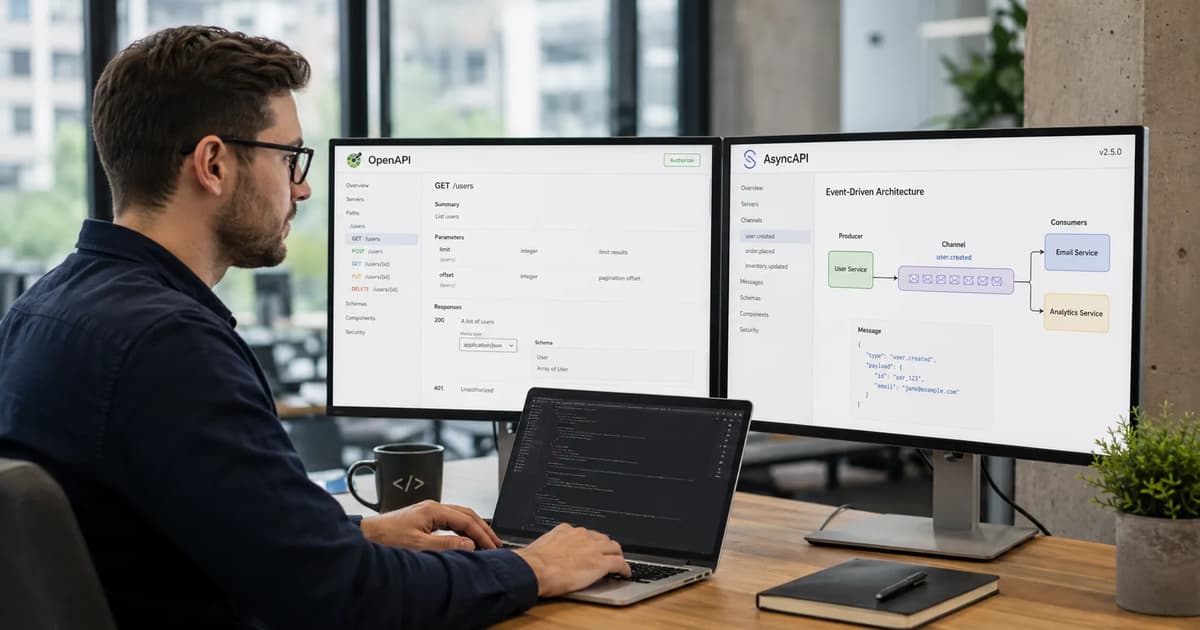
In one project I saw, developers tried to describe a Kafka-based event pipeline in an OpenAPI file, twisting a request/response specification to list events and topics. The resulting documentation was a mess: operations without HTTP verbs, fake “responses” for each message, and no reliable view of who produced or consumed data. Unsurprisingly, nobody trusted it or wanted to use it. OpenAPI simply wasn’t built for asynchronous message flows.
AsyncAPI is the industry-standard event-driven API specification that fills this gap. It defines producers, consumers, and channels (topics/queues) in a machine-readable YAML/JSON format. In January 2026, AsyncAPI reached version 3.1.0, showing that the specification is actively maintained rather than stalled. Written from more than a decade of API design experience, this guide explains what AsyncAPI really is, what changed in 3.1.0, and when a team needs both OpenAPI and AsyncAPI in 2026. Along the way, we’ll see how event-driven documentation differs from REST documentation, examine common mistakes, and show how learning AsyncAPI extends the skills taught in the Refonte Learning APIs Developer Program.
The Documentation That Fought the System It Described
Picture this: a service publishes events into Kafka and multiple consumers read them, but the spec file pretending to document this was just a bloated OpenAPI YAML. The team used “paths” like /orders/events with GET endpoints to represent Kafka topics, then defined fake HTTP responses (status 200, 204, etc.) for every message type. It technically held the names of topics and payload schemas, but it was so far from reality that no one could follow it. Developers ended up reading code and inspecting the Kafka cluster instead of trusting the docs.
This common mistake stems from trying to shoehorn an event system into a request/response schema. OpenAPI forces you to describe an action initiated by a client and a single reply. In contrast, a Kafka event has no one caller and no single “response” at all. It is a message sent into a stream, where multiple consumers may handle it independently, with no status code to return.
Attempting to map every event to an HTTP verb (GET/POST/DELETE) creates nonsensical endpoints.
Writing mock responses for messages doesn’t capture who will actually read them.
The spec becomes brittle: if you add a new consumer or topic, there’s no clear way to reflect that.
In short, this was “documentation that fought the system it described.” The system was event-driven, and one engineer’s comparison of REST and publish/subscribe made the mismatch plain: OpenAPI was built around request/response interactions, while publish/subscribe systems do not work that way. After watching time disappear into clunky OpenAPI specifications for streams, I was convinced we needed a different specification.
What OpenAPI Was Actually Built to Document
The OpenAPI Specification was designed for the synchronous request/response world of HTTP APIs. In this model, a client calls an endpoint, identified by a URL path and HTTP method, and waits for one response with a status code and body. That fits web services and REST: the client asks a question, and the server replies. OpenAPI objects such as paths, operations, parameters, requestBody, and responses define those calls.
OpenAPI emerged to give humans and tools a language-agnostic way to understand HTTP services. Its job is to list endpoints and describe inputs and outputs, along with servers, authentication, and schemas. The model still assumes one caller and one reply. In practice, a consumer calls an API and receives JSON or another response representation.
This contrasts with Pub/Sub. In an event-driven system, there is no canonical “caller” and no immediate reply. A service might publish an event (write to a message broker) and never wait on a response. Many other services subscribe to that event later. OpenAPI has no built-in way to say “this operation produces a message that others consume.” Attempts to hack it (using webhook/callback specs or oneOf in responses) are just workarounds.
In general, if your API is synchronous, whether REST over HTTP or a GraphQL query sent over HTTP, OpenAPI is the appropriate specification. OpenAPI has evolved to support features such as callbacks and richer schema modeling, but it remains focused on HTTP request/response interactions. For a companion discussion of OpenAPI in agent interoperability, see API design for AI agents: MCP vs. A2A vs. OpenAPI.
What AsyncAPI Documents Instead
AsyncAPI is explicitly for event-driven, message-based APIs. It has analogous sections (info, servers, channels, messages) but flips the model: rather than call/response, it documents publish/subscribe interactions. In an AsyncAPI YAML, you describe:
Servers: the message brokers or event infrastructure (Kafka, RabbitMQ, MQTT broker, etc.) that your services connect to.
Channels: the named topics or queues through which messages flow. In Kafka these are topics, in AMQP they may be exchanges/routing keys, in MQTT they are topic strings.
Operations: what an application does on a channel. AsyncAPI 3.x uses two action values: send for producing or publishing a message, and receive for consuming or subscribing to it.
Messages: the events themselves, with names and payload schemas. Each message definition includes content (like JSON Schema) for the event’s data. These message components can be reused across channels.
The official AsyncAPI specification organizes an event contract around servers, channels, operations, messages, and reusable components. If you have a Kafka event named OrderCreated and two consumers handle it, the document can identify the Kafka broker, define an orders.created channel, describe a send operation for the publisher, and describe receive operations for the subscriber services. Each message can reference its schema from components.
AsyncAPI is protocol-agnostic, meaning it can describe message flows over Kafka, MQTT, AMQP/RabbitMQ, WebSockets, and more. It also has mappings for robotics and IoT through ROS 2. Unlike OpenAPI’s HTTP focus, AsyncAPI supports bidirectional and message-oriented protocols. In a WebSocket system, channels and operations describe communication over a persistent connection; in MQTT, channels often use wildcard topic addresses. The key idea is that AsyncAPI views the system as a graph of event channels and shows who produces and consumes each message.
To illustrate the terminology, compare Kafka’s vocabulary with AsyncAPI’s: a Kafka producer is a publisher, a Kafka consumer is a subscriber, a Kafka topic is a channel, and a Kafka message remains a message. The official AsyncAPI Kafka tutorial makes the mapping clear:
Kafka term | AsyncAPI term |
producer | publisher |
consumer | subscriber |
topic | channel |
message/event | message |
If you publish a UserRegistered event to Kafka, AsyncAPI would document it under a channel that represents the topic. The producer’s operation uses action: send, while consumer operations use action: receive.
By focusing on producers, consumers, and channels instead of requests and responses, AsyncAPI gives you a full contract for an event-driven system. You can see which services connect to which brokers, which topics exist, what payloads they carry, and who handles them. This fills the “invisible integration” gap: without AsyncAPI, new developers must guess by reading code or inspecting brokers. With AsyncAPI, they have a clear specification.
Producers, Consumers, and Channels Explained
In AsyncAPI terminology, producers are services that publish messages, and consumers are services that subscribe. You can think of a channel as the name or address of the event stream, such as a Kafka topic or a RabbitMQ queue/exchange combination. An AsyncAPI 3.x document can define multiple operations that reference the same channel, one for each producer or consumer behavior.
For example, an e-commerce system might have an orders.created channel. An Order Service “publishes” an OrderCreated message to that channel (action: send). Several other services (Billing, Shipping, Notification) “receive” from it (action: receive). AsyncAPI lets you document each of these clearly.
Channels also have protocol-specific bindings. In a Kafka binding, you might note partition counts, key schemas, or topic configuration; in an MQTT binding, you might specify QoS levels; in WebSockets, bindings can capture connection-specific details. The base specification is protocol-neutral, while bindings add the protocol-specific layer.
Put simply: if OpenAPI is about endpoints and requests, AsyncAPI is about events and subscriptions. It makes message-based architectures first-class in documentation by recording channels, message formats, protocol bindings, and servers. AsyncAPI is sometimes described as “OpenAPI for Kafka, MQTT, and WebSockets,” but the important point is that it models the asynchronous world rather than forcing that world into a synchronous shape.
AsyncAPI 3.1.0: What Shipped in January 2026
AsyncAPI 3.1.0 was officially released on January 31, 2026. This was the first specification update in roughly two years, following 3.0.0 in December 2023, but it introduced no breaking changes. The official release notes describe 3.1.0 as a minor release: teams can change asyncapi: "3.0.0" to asyncapi: "3.1.0" and keep existing documents valid. In practical terms, it is a version bump rather than a rewrite.
What changed? The headline addition is ROS 2 bindings for Robot Operating System 2. ROS 2 is middleware widely used in robotics and IoT systems, including drones, manufacturing robots, and autonomous vehicles. It runs on DDS (Data Distribution Service) and supports publish/subscribe and client/server communication for robotics. By adding ROS 2 to the specification, AsyncAPI can now describe ROS 2 servers and operations in a machine-readable form.
Another way to see this is that AsyncAPI 3.1.0 adds a new protocol binding for ROS 2 alongside existing bindings for Kafka, MQTT, AMQP, WebSockets, and other systems. The GitHub release records the addition as issue #1109. No existing protocol was removed or changed. If your team integrates with a ROS 2 message bus or DDS-based robotics network, you can document its channels and messages in the same contract-oriented style used for Kafka topics.
The 3.1.0 announcement framed this change as extending AsyncAPI beyond traditional message brokers into robotics and IoT event systems. ROS 2 now has operation and server bindings that AsyncAPI-aware tools can process. That makes the release relevant not only to robotics specialists but also to API developers working at the edge of software, devices, and event infrastructure.
No other breaking changes landed in 3.1.0. The maintainers emphasized stability, and migration requires only the version change described above. Behind the scenes, the specification’s JSON Schema package moved to version 6.11.1 so validators could recognize the ROS 2 additions while continuing to support existing fields.
Why ROS 2 Bindings Matter Beyond Robotics
You might wonder why including ROS 2 is a big deal for the average API developer. The key is that AsyncAPI is now covering any pub/sub or event-driven system, not just one-off cases. Robotics engineers often use ROS 2 to handle sensor data, control messages, and inter-robot communication. By allowing ROS 2 in AsyncAPI, teams can now produce machine-readable API contracts for autonomous systems.
But even if you’re not building robots, this move signals that AsyncAPI is broadening its scope. IoT devices (think smart city sensors, industrial automation, drones) often use DDS/ROS 2 or similar protocols. With ROS 2 bindings, AsyncAPI can document IoT deployments just as easily as it documents, say, an AWS IoT MQTT feed. It turns AsyncAPI into a more universal event-driven architecture spec.
In short, ROS 2 support isn’t only about robots: it acknowledges that event-driven communication is common in embedded and edge systems. An IoT integrator or automation engineer can use AsyncAPI to describe data flows in a network. It brings those use cases under the same documentation umbrella as Kafka or MQTT. Because there were no breaking changes, existing AsyncAPI documents and compatible tooling keep working, with a new protocol available when needed.
Why This Was a Slow, Deliberate Release, Not a Stalled Project
Seeing a two-year gap between specification releases might raise eyebrows, but it is not evidence that AsyncAPI was abandoned. The maintainers have emphasized a stable, deliberate cadence. Version 3.0.0 in December 2023 was a major structural change that reorganized channels and operations, so the project gave that version time to settle. The 3.1.0 release notes acknowledged the long break while returning with a backward-compatible update.
Why wait? AsyncAPI is used in production systems where changes can have big ripple effects. The spec is mature enough that breaking changes are rare; new features can often be added without disruption. By spacing releases, the AsyncAPI project ensures each change is well-considered. The bump to 3.1.0 only adds one protocol binding (ROS 2) and some schema updates, keeping it safe and backward-compatible.
Think of it like semantic versioning for APIs: major rewrites can break tools, while a non-breaking 3.1.0 release reassures teams that existing documents and code-generation workflows should remain usable. The two-year gap gave version 3.0 time to settle and allowed the project to gather the next set of requirements. The coordinated updates to parsers, converters, JSON Schemas, and Studio point to active maintenance rather than neglect.
The slower cadence also reflects how mature standards are maintained: stability first, new features when they are ready. The January 2026 release shows the project is active and careful rather than dormant.
For comparison, OpenAPI has also become increasingly stable, with incremental releases replacing frequent radical changes. AsyncAPI appears to be following a similar path: fewer disruptive shifts, more polish, and broader protocol coverage.
The Roadmap Signal: Aligning Discriminators With OpenAPI
One of the most interesting signals on AsyncAPI’s public roadmap is an effort to align selected schema features with OpenAPI. A prime example is the discriminator, a mechanism used for polymorphism in schemas. In OpenAPI 3.x, the Discriminator Object helps tools distinguish among multiple possible schemas for one payload. AsyncAPI 3.0 introduced a more limited discriminator representation.
AsyncAPI’s public discriminator-alignment roadmap item says support should be aligned with OAS 3. This is a roadmap proposal, not a feature shipped in 3.1.0. It shows that the maintainers treat the specifications as complementary and are willing to reuse a mature OpenAPI concept rather than inventing an incompatible alternative.
Future AsyncAPI versions may therefore support an OpenAPI-style discriminator object under message schemas, making polymorphic message families easier to express. If that work ships, teams that already understand OpenAPI discriminators should find the AsyncAPI approach familiar. It could also make concepts easier to share across systems that use both specifications.
This is more than a technical footnote; it is a roadmap philosophy. A microservice may expose a REST API documented with OpenAPI and publish events documented with AsyncAPI. Consistent approaches to schema polymorphism would reduce cognitive and tooling friction across those two contracts. For now, however, the alignment remains proposed work.
The roadmap signal is clear: AsyncAPI is not trying to replace OpenAPI. It acknowledges that many systems have both synchronous and asynchronous parts, and that the two documentation standards can complement each other.
Protocol Bindings: Kafka, MQTT, WebSockets, and AMQP Compared
Event-driven APIs use several protocols, and AsyncAPI provides official protocol bindings that add protocol-specific details to the base document. The most common examples include:
Kafka: High-throughput distributed messaging. The AsyncAPI Kafka binding can describe topic configuration, partition counts, replicas, and message keys. Kafka channels usually represent topics.
MQTT: Lightweight publish/subscribe messaging often used in IoT. The AsyncAPI MQTT binding covers protocol details such as quality of service and message-retention behavior. MQTT channels usually use hierarchical topic strings, sometimes with wildcards.
WebSockets: Full-duplex connections for real-time web communication. The AsyncAPI WebSockets binding documents connection details for the persistent socket. Because WebSockets has one connection-level channel rather than broker-style virtual topics, message design carries much of the application-level meaning.
AMQP: Enterprise messaging built around exchanges, queues, and routing. AsyncAPI’s AMQP binding captures protocol-specific destination and delivery details. Channels map to AMQP addresses or endpoints.
Each protocol has trade-offs (throughput, guarantee of delivery, overhead), but AsyncAPI treats them similarly in structure. The table below summarizes some differences:
Protocol | Typical Use Cases | AsyncAPI Binding (since) | Notes |
Kafka | High-volume pub/sub streaming | kafka (since v2.x) | Topics with partitions; high throughput. |
MQTT | IoT device/pub-sub messaging | mqtt (since v2.x) | Lightweight topics; uses QoS levels. |
WebSockets | Real-time bidirectional web apps | ws (since v2.x) | Persistent connection; messages both ways. |
AMQP 1.0 | Enterprise message queuing | amqp1 (since v2.x) | Exchanges/queues; reliable delivery. |
All four protocols are supported through AsyncAPI bindings. In practice, a server can declare protocol: kafka, while a channel or message uses Kafka-specific binding fields for details such as keys or topic behavior. An MQTT server can declare protocol: mqtt and add MQTT-specific settings such as QoS where the binding supports them.
For WebSockets specifically, AsyncAPI documents the messages that move across a persistent connection and the channel associated with that connection. Our guide to real-time data integration with WebSockets covers the implementation layer in more detail. In an AsyncAPI document, a WebSocket server can identify the secure endpoint while channels and messages describe the JSON payloads exchanged over the socket.
The key takeaway is that protocol bindings let one AsyncAPI document describe message brokers and real-time channels in a consistent structure. Kafka, MQTT, WebSockets, AMQP, and other supported protocols remain first-class citizens without losing their protocol-specific details. Kafka is commonly chosen for high-volume streams, MQTT for lightweight device telemetry, AMQP for reliable business messaging, and WebSockets for interactive web applications. Whatever protocol you use, the documentation should match how it actually behaves.
When You Need AsyncAPI Alongside OpenAPI, Not Instead Of It
“AsyncAPI vs OpenAPI” is not a winner-takes-all contest; many systems need both. Use OpenAPI where clients make synchronous calls and AsyncAPI where services or devices exchange messages asynchronously.
Examples of mixed systems:
A microservice might expose a REST management API (OpenAPI) and publish events to Kafka (AsyncAPI). Administrators use the REST API to configure it, but the service also streams data to other consumers. Document the admin endpoints in OpenAPI and the events in AsyncAPI.
GraphQL servers show this mix. Queries/mutations go over HTTP (OpenAPI could document a GraphQL HTTP endpoint), but GraphQL subscriptions use WebSockets or other protocols. You might need AsyncAPI to describe those live subscription channels.
IoT platforms: devices might use MQTT to push sensor data, but a control dashboard might use HTTP REST to query status. The telemetry topics would go in AsyncAPI, the dashboard REST API in OpenAPI.
Modern SaaS apps: maybe an account system and a billing system where the account events (user created, plan changed) are emitted on a message bus, while the billing system also has REST endpoints for admin tasks.
Any architecture that spans synchronous API calls and asynchronous events should consider both specifications. OpenAPI models the synchronous HTTP contract, while AsyncAPI models asynchronous message flows. They can coexist, and they share familiar concepts such as info, components, schemas, and reusable objects. The discriminator roadmap discussed earlier may bring selected concepts even closer, but that alignment has not shipped yet.
A useful analogy: think of your system as a house. OpenAPI documents the doors (requests/responses through the front door or side door). AsyncAPI documents the wires and internal pipes (events and messages flowing through the house). You need the door specs to let external users in; you need the pipe specs so maintenance folks know how plumbing/electrical is laid out.
A System That Genuinely Needs Both Specs
Consider a sample scenario: an e-commerce platform.
It has a REST API (OpenAPI) for clients to create orders, query products, etc. Customers and frontend engineers use this.
Internally, when a new order is created, the Order Service publishes an OrderPlaced event to a Kafka topic. Other microservices consume that (inventory service, shipping service, notification service). This asynchronous pipeline would be documented in AsyncAPI.
The inventory service might also have its own HTTP API to manage stock (more OpenAPI).
Here, developers would use both specifications daily. Backend developers might maintain an OpenAPI contract for the REST API and an AsyncAPI contract for events. As the system grows, clear documentation for each interaction style keeps teams aligned. You would not discard OpenAPI; you would add AsyncAPI for the event-driven parts.
The Tooling Ecosystem: Parser, Converter, and AsyncAPI Studio
A mature specification needs tools, and AsyncAPI has a growing ecosystem. Alongside the 3.1.0 spec release, the core tools were updated:
AsyncAPI Parser 3.6.0: The JavaScript parser update added AsyncAPI 3.1.0 support. It loads and validates AsyncAPI documents, checks YAML or JSON structure, and turns the specification into objects that tooling can use. It also recognizes the ROS 2 binding fields introduced in 3.1.0.
AsyncAPI Converter 1.7.0: The converter update added support for the 3.1.0 format. It converts between AsyncAPI versions and can also produce an AsyncAPI starting point from supported OpenAPI inputs. Converted output still deserves review, especially when the source and target models differ.
AsyncAPI Studio: The web-based editor and design tool lets you write, validate, and visualize an AsyncAPI document in the browser. The Studio ecosystem updated alongside 3.1.0 so teams could work with the new specification version.
JSON Schema package 6.11.1: The machine-readable schemas behind the specification were updated for 3.1.0. Validators that consume those schemas can recognize the new version and its ROS 2 fields.
AsyncAPI Generator: The generator can create documentation and code scaffolds from an AsyncAPI document. Teams should still verify that the selected templates understand any binding-specific fields they rely on.
In short, the AsyncAPI toolchain is actively maintained. If you have used Swagger or OpenAPI tools, AsyncAPI Studio plays a similar role for event documentation, while the Parser, Converter, and Generator provide programmatic workflows. This is not just a paper specification: teams can validate contracts, render documentation, generate scaffolds, and enforce parts of the contract in automation.
What Each Tool Actually Does in Practice
Parser: Feed it an AsyncAPI YAML or JSON document and it loads the contract as a data structure while reporting validation errors. In a JavaScript project, install @asyncapi/parser, create a Parser instance, and call await parser.parse(yamlString). This is the AsyncAPI equivalent of using a parser for an OpenAPI contract.
Converter: Its first job is migrating documents between supported AsyncAPI versions. Its second is helping convert supported OpenAPI inputs into an AsyncAPI starting point when the source contains compatible event-oriented information. Use the CLI or programmatic API, then review the output rather than assuming the models map perfectly.
AsyncAPI Studio: The browser-based YAML editor provides live validation and a rendered preview as you write. Teams can load a document, inspect channels and messages visually, and refine the contract without manually checking every YAML detail. This lowers the barrier for developers who are new to the specification.
Generator: The AsyncAPI Generator can produce documentation and producer/consumer scaffolds from a valid specification. It is analogous to OpenAPI code-generation tools, although the output depends on the selected template and the protocol details represented in the document.
In practice, using AsyncAPI often goes like this: You define or update your spec (maybe in AsyncAPI Studio or a text editor), then run the parser to validate or the generator to create stub code/documentation. The converter helps if you upgrade or integrate with existing OpenAPI docs. The ecosystem is real and improving, not just theoretical.
Common Mistakes Teams Make Documenting Event-Driven APIs
Even with AsyncAPI available, teams often fall into pitfalls when documenting message-based systems. Here are some frequent errors to watch out for:
Using OpenAPI to fake events: As we saw, trying to represent pub/sub in an OpenAPI file leads to confusion. Listing topics as HTTP paths or using one-time requests for events misses the point. It’s better to switch to AsyncAPI for those parts rather than hack OpenAPI.
Incomplete channel and operation documentation: Teams sometimes declare a channel but never define the send or receive operations that reference it. Readers are left guessing which application produces or consumes the message. Document each known operation, even when a channel has only one producer or one consumer.
Neglecting message schemas: Some forget to define the actual message payload. An AsyncAPI message object without a payload schema is useless. Make sure each message includes a JSON Schema (or Avro/Proto if you use format extensions) for its content.
Overlooking protocol bindings: When first using AsyncAPI, teams might omit protocol-specific details. For instance, not setting the protocol on a server (just writing kafka: without protocol: kafka) or skipping topic keys/partitions in Kafka channels. Using correct bindings is important for code generation and clarity.
Not versioning the spec: Documenting evolving systems without version control or with outdated specs is a common mistake. Treat your AsyncAPI file like code: track changes in Git. Specify version and info.version so consumers know if docs changed.
Ignoring security details: AsyncAPI supports securitySchemes (like OAuth2, API keys) for messaging protocols. Some teams skip this. If your broker requires auth (e.g. Kafka with SASL), include that in your AsyncAPI. It’s just as important as securing HTTP endpoints.
Conflating channels and messages: Channels identify where messages flow; messages define the payloads that flow through them. Do not duplicate the same schema in every operation or channel. Reuse message components wherever the contract allows.
Skipping consumer visibility: AsyncAPI 3 lets multiple receive operations reference the same channel. Some documents show only one consumer even when several services subscribe to the topic. Document each known consumer operation, or state clearly that additional consumers exist.
Avoid these pitfalls by treating AsyncAPI as a first-class part of your design, not an afterthought. When a mistake happens, it’s usually fixable by writing or refining the AsyncAPI spec rather than “guessing” how events work in code.
Getting Started: Documenting Your First Event-Driven Endpoint
Ready to create your first AsyncAPI document? Here’s how to proceed on an existing or new project:
1. Identify a single message flow to document first. Pick one channel and its message schema (for example, the OrderCreated event in a Kafka topic). Start simple before tackling the whole system.
2. Create the AsyncAPI skeleton. At minimum, include asyncapi: "3.1.0", an info section, a servers block that identifies the broker URL and protocol, a channels block, and an operations block.
3. Add your channel and operations. Under channels, define the channel name or address, such as order/created, and associate the relevant messages. Then add top-level operations that reference the channel, using action: send for producer behavior or action: receive for consumer behavior.
4. Define the message schema. In components.messages, create a reusable message object with a name and a payload schema describing the event fields. Reference that message from the relevant channel, then reference the channel from the operation.
5. Specify binding details when needed. For Kafka, add the applicable bindings.kafka object at the server, channel, operation, or message level supported by the binding. For MQTT, use bindings.mqtt at the appropriate level. Start with the base contract, then add protocol-specific detail that consumers genuinely need.
6. Validate the document. Use the AsyncAPI CLI and Parser to catch structural errors. Install @asyncapi/cli and run asyncapi validate your-file.yaml, then fix missing fields, invalid references, or incorrect types.
7. Generate documentation or code when useful. Load the YAML into AsyncAPI Studio for a rendered preview, or run the AsyncAPI Generator with a suitable template to create documentation or producer/consumer scaffolding.
Repeat this for one channel at a time. Documenting event-driven systems can be incremental. Even if your services are already live, capturing one topic and message in AsyncAPI can greatly improve understanding.
What to Document First in an Existing System
When jumping into a mature system, don’t try to do everything at once. Start with the core events that power your architecture. Usually, you’ll want to document:
Message payload schemas: Having clear, versioned schemas for each event is crucial. If you already use a schema registry (Avro/JSON Schema), tie those in first.
Channels (topics/queues): List each channel name and describe its semantics. For example, “user.signup.v1: events generated when a new user registers.”
Who is producing: Even if the documentation is incomplete, note which service or component publishes to each channel. This may be one service name or several when multiple producers exist.
Who is consuming: Do the same for subscribers. If the consumer set is dynamic or not fully known, list confirmed consumers and say clearly that additional microservices may subscribe.
Protocol details: If you know your brokers (hostnames, ports, protocols), include those under servers. It anchors where the data flows.
You don’t have to document 100% on day one. Cover the obvious event flows first (e.g., order placement, payment processed, user activity). As the team touches event code for maintenance or new features, update the spec. Good AsyncAPI docs grow iteratively.
Where This Fits Into an API Developer's Skill Set
Learning AsyncAPI is increasingly relevant to a modern API developer’s toolkit. API developers traditionally focus on REST and GraphQL, as covered in the Refonte Learning APIs Developer Program, but many roles also require an understanding of synchronous and asynchronous integration.
The Refonte Learning APIs Developer Program runs for three months at 10-12 hours per week and currently teaches REST with Swagger/OpenAPI and GraphQL. Students learn API design principles, database integration, authentication and authorization, documentation and testing, error handling and logging, versioning and deprecation, microservices, performance, and security. The named tools include Postman, Swagger, Node.js frameworks, and GraphQL libraries. Mentor MSc Sophia Johnson, a Senior Backend Developer specializing in REST and GraphQL, guides trainees through building and testing APIs.
This foundation, including API design skills, schema thinking, and documentation practice, transfers directly to AsyncAPI. Documenting events builds on the same fundamentals, but the focal points become channels, messages, and operations rather than paths and responses. A REST-fluent developer can pick up AsyncAPI by analogy: JSON Schema knowledge transfers to message payloads, while authentication and versioning concepts transfer to brokers and event contracts.
That said, the current program has no explicit AsyncAPI or event-driven module. It does not claim to teach Kafka, MQTT, or AsyncAPI tooling. Mastering AsyncAPI is therefore an extension of the curriculum, not a duplicate of it. The program prepares learners to think in API contracts broadly, making event-driven documentation a logical next step for those who move into asynchronous systems.
Career outcomes listed for the program include API Developer, Backend Developer, Fullstack Developer, and Integration Specialist. Since many systems combine REST or GraphQL interfaces with event pipelines, understanding AsyncAPI can broaden the kinds of integration work a developer is prepared to handle. Strong API fundamentals make that learning curve more manageable.
Further reading: For a deeper dive into synchronous API architecture, see GraphQL Federation vs. monolithic API, which covers related decisions in the REST and GraphQL space.
API Developer Salaries in 2026: A Data Gap Worth Naming
Role-specific “API Developer” salary data is difficult to confirm because major job sites commonly group the work under broader developer titles. In August 2026, Indeed’s general Developer salary data reported an average of about $103,000 per year in the United States, with a range of roughly $58,600 to $181,000. This is a general developer-role proxy, not an API-Developer-specific statistic, and it should not be read as a guaranteed range for specialists.
Use the figure as a broad indicator rather than a precise promise. Location, industry, seniority, and specialization all affect compensation. Skills in API design and event-driven integration can strengthen a candidate’s positioning, but salary outcomes still depend on the role and market. The honest takeaway is that the available figure describes developers generally, while dedicated API Developer salary evidence remains limited.
Building This Skill Set: The Refonte Learning APIs Developer Program
For structured training in API design and documentation, the Refonte Learning APIs Developer Program provides a three-month, part-time format of 10-12 hours per week. The curriculum moves from API fundamentals to building RESTful APIs and mastering GraphQL APIs. It covers REST, GraphQL, authentication and authorization, database integration, API documentation and testing, error handling and logging, versioning and deprecation, microservices, performance, and security. Learners use Postman, Swagger, Node.js frameworks, and GraphQL libraries under the guidance of MSc Sophia Johnson, a Senior Backend Developer specializing in REST and GraphQL.
AsyncAPI and message brokers are not part of the current syllabus, and the program should not be presented as if they are. What the course does provide is the transferable foundation: clean contract design, schema modeling, documentation discipline, testing, versioning, and security. Those fundamentals prepare learners to study AsyncAPI independently or apply it on the job, where the mental model shifts from paths and responses to channels, messages, and operations.
The fee is $300 as a one-time payment, advertised as 30% off the $387 list price, or two installments of $204 and $98. Applicants need basic programming knowledge and must be currently pursuing a bachelor’s degree or higher. Graduates earn certificates, and the listed career outcomes are API Developer, Backend Developer, Fullstack Developer, and Integration Specialist.
Ready to level up? The documentation and design skills you learn provide a strong foundation for mastering AsyncAPI later. Enroll in the Refonte Learning APIs Developer Program to build that foundation, then extend it into event-driven API documentation as your next step.