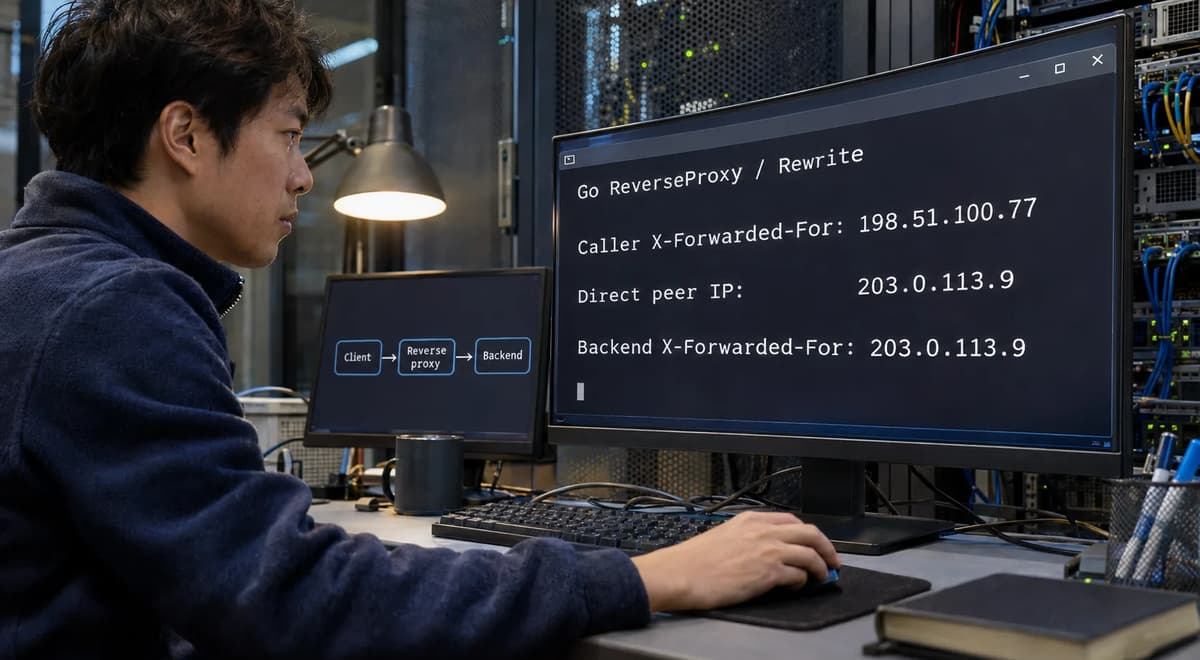
A reverse proxy can return 200 OK, the backend can receive the request, and every availability check can stay green while the identity evidence carried in X-Forwarded-For is wrong for the security boundary you intended. That is the misleading success signal this playbook addresses.
The operational question is not merely whether httputil.ReverseProxy forwarded the request. It is: which identity source did the proxy allow to become the downstream client-IP claim? With Go's deprecated Director path, an inbound X-Forwarded-For value is preserved unless application code removes it, and ReverseProxy normally appends the socket peer IP. With Rewrite, forwarding headers are removed before the callback, and ProxyRequest.SetXForwarded can construct fresh values from the inbound request's network peer. Those are materially different trust boundaries in Go 1.27.4.
This playbook treats that distinction as a release-validation problem. The proof is an isolated fixture with synthetic request identities, a pinned runtime, an independently authored expected manifest, a deliberately unsafe comparison, a controlled repair, negative controls, and a case-by-case evidence ledger. No production traffic or production access is required.
Nothing below was executed for this article. Every proposed result is therefore labeled EXPECTED / NOT EXECUTED. The final release state is necessarily HOLD until the unchanged fixture is actually run and its evidence reconciled.
Define the operational contract
The contract has to separate transport success from identity acceptance. For this fixture, success means that the backend receives a request and the outbound forwarding identity matches the declared trust policy.
The boundary has three independent inputs:
Evidence field | Meaning in this playbook |
In.RemoteAddr | Network peer recorded on the inbound http.Request |
inbound X-Forwarded-For | Header supplied by the caller or an upstream intermediary |
outbound X-Forwarded-For | Identity chain actually exposed to the backend |
Go documents Request.RemoteAddr as the network address that sent the request; the Go HTTP server normally fills it as an IP:port value before invoking a handler. It is not filled by ReadRequest, its format is otherwise not universally defined, and the HTTP client ignores the field.
Our release policy is deliberately narrower than "all possible proxy deployments":
At an untrusted public boundary, client-supplied X-Forwarded-For must not survive merely because the request was forwarded.
The outbound claim should contain the direct network peer IP when the proxy itself is the trust boundary.
Preserving an inbound forwarding chain is permitted only in an explicitly declared trusted-upstream case.
A successful backend response cannot substitute for evidence about those fields.
Missing identity evidence is not a pass.
This resembles the evidence discipline in Refonte Learning's asyncio task-lifecycle validation, where the returned exception state and the actual sibling-task/effect state are treated as separate facts rather than collapsed into one success indicator. Here, the analogous distinction is HTTP delivery versus downstream identity.
The acceptance assertion is therefore measurable: for every case, capture inbound RemoteAddr, inbound X-Forwarded-For, proxy mode, outbound header presence, outbound values and backend status. Reject the release if the backend identity cannot be reconciled with the manifest.
Capture a versioned baseline
Pin the runtime to Go 1.27.4, released November 10, 2026. Go's release history records 1.27.4 as a maintenance release that included, among other fixes, changes to net/http; the package documentation for net/http, net/http/httputil, and net/netip is published for the same version.
That pin matters because the relevant behavior belongs to standard-library implementation and documentation. The fixture should not silently run under "whatever Go happens to be installed."
Use a disposable directory:
mkdir -p /tmp/go-reverseproxy-xff-proof
cd /tmp/go-reverseproxy-xff-proof
If a local Go installation is used, the first gate is:
go version
go env GOOS GOARCH GOROOT GOTOOLCHAIN
Required runtime identity:
go version go1.27.4 ...If Docker is preferred:
docker run --rm \
  -v "$PWD":/work \
  -w /work \
  golang:1.27.4-bookworm \
  sh -c 'go version && go env GOOS GOARCH GOROOT GOTOOLCHAIN && go test -v ./...'
The tag pins the Go toolchain version used by the fixture, but a release evidence package should additionally record the resolved container image digest at execution time rather than pretending the tag alone is immutable infrastructure evidence.
Go 1.27.4's ReverseProxy documentation states that exactly one of Rewrite or Director must be configured. Director is deprecated, and the documentation specifically warns that inbound X-Forwarded-* values are preserved by default and can permit spoofing unless removed.
Pin fixture identity
The measurable fixture assertion is:
runtime == go1.27.4
fixture source SHA-256 == recorded_fixture_sha256
manifest SHA-256 == recorded_manifest_sha256
case inventory == declared case inventory
Capture hashes before execution:
sha256sum go.mod reverseproxy_test.go manifest.json > fixture.sha256
cat fixture.sha256
EXPECTED / NOT EXECUTED: three hashes are recorded and remain unchanged from execution through review.
Reject the evidence as RERUN if the runtime is not Go 1.27.4, any fixture file changes after the hashes are captured, or the executed case inventory differs from the independently reviewed manifest.
Build the isolated test environment
The fixture should use only standard-library components. httptest.NewRequest supplies a synthetic inbound request, httptest.NewRecorder captures the proxy response, and a custom http.RoundTripper captures the outbound request without contacting any network.
Create go.mod:
module reverseproxy-xff-proof

go 1.27.4
The test transport should copy the identity-bearing fields before returning a synthetic backend response:
type captureTransport struct {
    got chan captured
}

type captured struct {
    XFF        []string json:"xff"
    XFFPresent bool     json:"xff_present"
    Host       string   json:"host"
}

func (t captureTransport) RoundTrip(r http.Request) (*http.Response, error) {
    vv, ok := r.Header["X-Forwarded-For"]
    cp := append([]string(nil), vv...)

    t.got <- captured{
        XFF:        cp,
        XFFPresent: ok,
        Host:       r.Host,
    }

    return &http.Response{
        StatusCode: http.StatusNoContent,
        Status:     "204 No Content",
        Header:     make(http.Header),
        Body:       io.NopCloser(strings.NewReader("")),
        Request:    r,
    }, nil
}
This is a better proof boundary than inspecting only the request inside Director or Rewrite: Go's ServeHTTP logic performs forwarding-header processing around those callbacks before RoundTrip. In the pinned source, Director runs before hop-by-hop removal, while the automatic X-Forwarded-For append occurs later. For Rewrite, the proxy deletes Forwarded, X-Forwarded-For, X-Forwarded-Host, and X-Forwarded-Proto before calling the rewrite callback.
A related Refonte playbook, Go MaxBytesReader: Validate Body Limits Before Writing, applies the same operational principle to request bodies: a superficially successful operation is insufficient evidence if the state relevant to the contract was not captured.
No external listener, DNS, cloud resource or production route is required.
Author the expected-case manifest
The expected manifest must be written before observed output is inspected and must not be generated from the implementation under test.
Create manifest.json:
[
  {
    "id": "D1",
    "mode": "director_preserve",
    "remote_addr": "203.0.113.9:43123",
    "inbound_xff": ["198.51.100.77"],
    "expected_present": true,
    "expected_xff": ["198.51.100.77, 203.0.113.9"]
  },
  {
    "id": "R1",
    "mode": "rewrite_reset",
    "remote_addr": "203.0.113.9:43123",
    "inbound_xff": ["198.51.100.77"],
    "expected_present": true,
    "expected_xff": ["203.0.113.9"]
  },
  {
    "id": "R2",
    "mode": "rewrite_copy",
    "remote_addr": "203.0.113.9:43123",
    "inbound_xff": ["198.51.100.77"],
    "expected_present": true,
    "expected_xff": ["198.51.100.77, 203.0.113.9"]
  },
  {
    "id": "N1",
    "mode": "rewrite_no_forwarded",
    "remote_addr": "203.0.113.9:43123",
    "inbound_xff": ["198.51.100.77"],
    "expected_present": false,
    "expected_xff": []
  },
  {
    "id": "N2",
    "mode": "director_delete",
    "remote_addr": "203.0.113.9:43123",
    "inbound_xff": ["198.51.100.77"],
    "expected_present": true,
    "expected_xff": ["203.0.113.9"]
  },
  {
    "id": "B1",
    "mode": "rewrite_reset",
    "remote_addr": "not-host-port",
    "inbound_xff": ["198.51.100.77"],
    "expected_present": false,
    "expected_xff": []
  },
  {
    "id": "B2",
    "mode": "rewrite_reset",
    "remote_addr": "[2001:db8::1]:43123",
    "inbound_xff": ["198.51.100.77"],
    "expected_present": true,
    "expected_xff": ["2001:db8::1"]
  },
  {
    "id": "B3",
    "mode": "director_preserve",
    "remote_addr": "203.0.113.9:43123",
    "inbound_xff": ["198.51.100.1", "198.51.100.2"],
    "expected_present": true,
    "expected_xff": ["198.51.100.1, 198.51.100.2, 203.0.113.9"]
  }
]
The addresses use documentation-only IP ranges; the test does not route to them. The manifest describes identity state, not connectivity.
Prove the negative control
N1 is the harness sensitivity control. Rewrite is invoked, but SetXForwarded is deliberately omitted.
Go removes client-provided forwarding headers before calling Rewrite; if the fixture still sees the spoofed inbound header downstream in N1, the harness or fixture is wrong.
Measurable assertion:
N1.XFFPresent == false
N1.XFF == []
EXPECTED / NOT EXECUTED: no outbound X-Forwarded-For.
Reject the entire evidence package as HOLD if N1 unexpectedly contains the original spoofed value. Do not "fix" the manifest to match surprising output.
Reproduce the misleading success
The misleading case is D1: a Director changes only the outbound URL while a synthetic caller supplies X-Forwarded-For: 198.51.100.77 and has network peer 203.0.113.9:43123.
The relevant proxy:
proxy := &httputil.ReverseProxy{
    Director: func(r *http.Request) {
        r.URL.Scheme = "http"
        r.URL.Host = "backend.invalid"
    },
    Transport: transport,
}
The Go 1.27.4 source shows what matters. Director(outreq) runs first. Later, when Rewrite is not configured, ReverseProxy parses req.RemoteAddr; if parsing succeeds, it retains any existing X-Forwarded-For entries, joins them with comma-space separators, appends the peer IP and sets the outbound header.
That means our independently authored expectation for D1 is:
Inbound XFF:  198.51.100.77
RemoteAddr:   203.0.113.9:43123
Outbound XFF: 198.51.100.77, 203.0.113.9
Backend:      204
EXPECTED / NOT EXECUTED.
This is not evidence that Go "trusted the leftmost IP" in an application-semantic sense. It is evidence that the legacy forwarding path preserved caller-supplied identity material and appended the direct network peer. A downstream service that interprets the first XFF element as the client could therefore consume an untrusted caller claim unless some other validated boundary sanitized the chain.
That distinction is the central release question: the proxy can forward perfectly while exporting the wrong identity provenance.
Run a controlled positive comparison
R1 changes one material variable: use Rewrite, call SetURL, and then call SetXForwarded without copying inbound forwarding headers.
proxy := &httputil.ReverseProxy{
    Rewrite: func(pr *httputil.ProxyRequest) {
        target, _ := url.Parse("http://backend.invalid")
        pr.SetURL(target)
        pr.SetXForwarded()
    },
    Transport: transport,
}
Go documents that SetXForwarded sets X-Forwarded-For to the client IP, X-Forwarded-Host to the requested host, and X-Forwarded-Proto according to TLS state. Its pinned implementation obtains the client IP by splitting pr.In.RemoteAddr.
Because ReverseProxy removed the inbound forwarding fields before entering Rewrite, R1 should produce:
Inbound XFF:  198.51.100.77
RemoteAddr:   203.0.113.9:43123
Outbound XFF: 203.0.113.9
EXPECTED / NOT EXECUTED.
The comparison proves the boundary mechanically:
Case | Callback | Inbound spoof carried forward? | Peer appended/set? | Status |
D1 | Director | Yes | Yes | EXPECTED / NOT EXECUTED |
R1 | Rewrite + SetXForwarded | No | Yes | EXPECTED / NOT EXECUTED |
For another Go-specific example of separating protocol success from later evidence, see Refonte Learning's response-trailer validation playbook. It focuses on trailer availability after reading a body to EOF, whereas this article focuses on forwarding identity before backend dispatch.
Retain failed case artifacts
Every case should write one JSON evidence record containing the case ID, exact inputs, captured outbound fields, status code, runtime string and comparison result.
A failed row must remain in the artifact set. Do not overwrite it with the repaired rerun.
Required filename pattern:
evidence/D1.json
evidence/R1.json
evidence/R2.json
evidence/N1.json
...
A mismatch such as:
{
  "case": "R1",
  "expected_xff": ["203.0.113.9"],
  "observed_xff": ["198.51.100.77", "203.0.113.9"],
  "match": false
}
would be retained as failure evidence rather than converted into a narrative summary.
Because no test was executed here, every observed field remains EXPECTED / NOT EXECUTED.
Test negative and boundary cases
R2 intentionally recreates Director-style propagation inside Rewrite:
Rewrite: func(pr *httputil.ProxyRequest) {
    pr.SetURL(target)
    pr.Out.Header["X-Forwarded-For"] =
        append([]string(nil), pr.In.Header["X-Forwarded-For"]...)
    pr.SetXForwarded()
},
Go explicitly documents this technique for callers that want to append the peer IP to the inbound chain.
EXPECTED / NOT EXECUTED: R2 produces 198.51.100.77, 203.0.113.9. This is a positive comparison for intentional preservation, not a recommendation to trust arbitrary inbound values. Use it only when an independently established upstream trust contract justifies that copy.
N2 exercises the legacy defensive pattern:
Director: func(r *http.Request) {
    r.URL.Scheme = "http"
    r.URL.Host = "backend.invalid"
    r.Header.Del("X-Forwarded-For")
},
Because the existing values are deleted before ReverseProxy's legacy append step, EXPECTED / NOT EXECUTED: the backend sees only 203.0.113.9.
B1 uses malformed RemoteAddr. SetXForwarded deletes X-Forwarded-For when net.SplitHostPort fails. Therefore EXPECTED / NOT EXECUTED: no outbound XFF.
B2 uses [2001:db8::1]:43123; the extracted address should be 2001:db8::1. EXPECTED / NOT EXECUTED.
B3 supplies two inbound XFF header values under Director. The source joins the prior slice with ", " and appends the peer. EXPECTED / NOT EXECUTED: one outbound value representing 198.51.100.1, 198.51.100.2, 203.0.113.9.
These cases prevent a happy-path-only test from being mistaken for a trust proof.
Capture a complete evidence ledger
A release ledger should reconcile every declared case. Before execution, it looks like this:
Case | Purpose | Expected outbound XFF | Observed | Decision |
D1 | Director misleading success | 198.51.100.77, 203.0.113.9 | Not run | EXPECTED / NOT EXECUTED |
R1 | Rewrite reset comparison | 203.0.113.9 | Not run | EXPECTED / NOT EXECUTED |
R2 | Explicit trusted-chain copy | 198.51.100.77, 203.0.113.9 | Not run | EXPECTED / NOT EXECUTED |
N1 | Rewrite negative control | absent | Not run | EXPECTED / NOT EXECUTED |
N2 | Director deletes inbound XFF | 203.0.113.9 | Not run | EXPECTED / NOT EXECUTED |
B1 | malformed peer address | absent | Not run | EXPECTED / NOT EXECUTED |
B2 | IPv6 peer | 2001:db8::1 | Not run | EXPECTED / NOT EXECUTED |
B3 | multiple inbound header lines | joined prior + peer | Not run | EXPECTED / NOT EXECUTED |
The backend status belongs in the ledger too, but it is not the acceptance oracle. A 204 on D1 would prove that forwarding succeeded, not that the identity contract was safe.
The test driver should emit deterministic JSON, for example:
enc := json.NewEncoder(os.Stdout)
enc.SetEscapeHTML(false)
if err := enc.Encode(record); err != nil {
    t.Fatal(err)
}
Run:
mkdir -p evidence
go test -run TestReverseProxyXFF -v ./... 2>&1 | tee evidence/test.log
go version > evidence/go-version.txt
go env GOOS GOARCH GOROOT GOTOOLCHAIN > evidence/go-env.txt
cp manifest.json fixture.sha256 evidence/
No output from those commands is claimed in this article.
Detect missing evidence
The denominator is the manifest, not whatever results happened to be printed.
The gate requires:
declared_cases = 8
observed_unique_cases = 8
missing_cases = 0
duplicate_cases = 0
EXPECTED / NOT EXECUTED.
A test process exiting zero with only seven records is RERUN, not ACCEPT. A duplicated case ID is also RERUN because the ledger no longer proves one observation per declared scenario.
The same identity-versus-label issue appears in Refonte Learning's Python ZIP duplicate-member validation: that playbook distinguishes a filename from a particular member occurrence and rejects evidence that loses occurrence identity. Here, the identity key is the case ID and its exact input tuple.
Reconcile identity and state
The ledger becomes useful only when it answers two separate questions: what bytes were forwarded, and what identity meaning may safely be assigned to them.
For D1, the expected state is:
peer = 203.0.113.9
caller-supplied chain = [198.51.100.77]
outbound chain = [198.51.100.77, 203.0.113.9]
That proves preservation plus append. It does not prove that 198.51.100.77 was the original client.
For R1:
peer = 203.0.113.9
caller-supplied chain = [198.51.100.77]
outbound chain = [203.0.113.9]
That proves the current proxy stopped propagating the caller's XFF claim and reconstructed forwarding information from its own inbound request.
For R2:
peer = 203.0.113.9
copied upstream chain = [198.51.100.77]
outbound chain = [198.51.100.77, 203.0.113.9]
The wire representation resembles D1, but the policy meaning differs: R2's copy is explicit code in the trust policy, whereas D1 inherits legacy preservation behavior. That difference matters during review because a downstream chain should exist because a trust decision was made, not because a deprecated default happened to retain it.
For application-level trusted-upstream matching, net/netip provides numeric address parsing without name resolution; ParseAddrPort requires numeric address and port values. A bounded policy can therefore parse the peer separately from the forwarding chain instead of accepting hostnames as proxy identity.
This is the state-reconciliation step: peer identity, caller assertion, outbound state and policy authorization all need their own ledger columns.
Separate guarantees from observations
The strongest claims in this playbook are documented behaviors for Go 1.27.4, not local observations.
Documented: Rewrite is invoked after client-provided forwarding headers have been stripped from the outbound request.
Documented: ProxyRequest.SetXForwarded sets forwarding fields and derives the XFF client IP from the inbound RemoteAddr; if an existing outbound XFF value is present, it appends the peer IP.
Documented: with the Director path, ReverseProxy normally preserves prior XFF values and appends the peer IP, while a nil XFF entry can suppress automatic population. Go's docs warn explicitly that pre-existing values from clients or untrusted proxies should be removed to prevent spoofing.
Documented: NewSingleHostReverseProxy still constructs a ReverseProxy using a Director function for backward compatibility. The pinned source returns &ReverseProxy{Director: director}.
Not observed here: the D1 through B3 output. Every fixture row is EXPECTED / NOT EXECUTED.
The source hierarchy is also worth stating. Package documentation describes the supported API contract; the exact go1.27.4 tagged source explains the sequencing we are testing. The master branch is useful for comparison but is not evidence for the pinned runtime when it differs. The tagged source is therefore the implementation reference for this release decision.
Bound the repair
The repair scope is not "rewrite our proxy stack." It is one identity boundary.
Allowed repair:
Replace implicit Director preservation with explicit Rewrite policy,
or explicitly remove inbound XFF in legacy Director code.
Out of scope are load balancing, HTTP/2 tuning, authentication redesign, generic proxy observability and production migration.
Reject the repair as unbounded if it requires changing unrelated request semantics or if reviewers cannot say which upstream peers are authorized to supply an existing forwarding chain.
Apply a bounded repair
For an internet-facing proxy that should treat the socket peer as the only client identity it forwards, the bounded repair is straightforward:
target, err := url.Parse("http://backend.invalid")
if err != nil {
    panic(err)
}

proxy := &httputil.ReverseProxy{
    Rewrite: func(pr *httputil.ProxyRequest) {
        pr.SetURL(target)
        pr.SetXForwarded()
    },
}
Because Rewrite begins after ReverseProxy has deleted inbound forwarding fields, this pattern does not implicitly preserve caller-supplied XFF.
For a deployment behind a separately authenticated or network-restricted upstream proxy, preserve a chain only when the direct peer itself is trusted and the upstream contract says that peer sanitized the chain. The policy should be explicit:
func trustedPeer(remote string, trusted []netip.Prefix) bool {
    ap, err := netip.ParseAddrPort(remote)
    if err != nil {
        return false
    }
    addr := ap.Addr()
    for _, p := range trusted {
        if p.Contains(addr) {
            return true
        }
    }
    return false
}
Then:
Rewrite: func(pr *httputil.ProxyRequest) {
    pr.SetURL(target)

    if trustedPeer(pr.In.RemoteAddr, trustedPrefixes) {
        pr.Out.Header["X-Forwarded-For"] =
            append([]string(nil), pr.In.Header["X-Forwarded-For"]...)
    }

    pr.SetXForwarded()
},
That code still does not prove that every element of the inherited chain is genuine; it encodes the narrower assertion that an approved direct upstream is authorized to supply the chain. Chain interpretation rules remain part of the upstream/downstream contract.
The critical release improvement is explicitness: the trusted peer list and copy operation are visible reviewable code rather than an accidental side effect of Director compatibility behavior.
Test rollback and recovery
Rollback should restore a known code revision, not fabricate confidence in the identity chain.
The recovery protocol is:
Stop the candidate from progressing through the release gate.
Preserve the failed evidence directory unchanged.
Restore the last reviewed proxy configuration or commit.
Rebuild the disposable fixture from clean source.
Recalculate fixture and manifest hashes.
Rerun all eight cases, including N1.
Reconcile the new evidence as a new run; never overwrite the previous failed run.
If the repair introduced Rewrite and downstream consumers unexpectedly depended on the old chain, the rollback decision must be based on the declared service contract, not on the desire to make tests green. A consumer depending on spoofable legacy behavior is a contract problem requiring explicit ownership.
Refonte Learning's Kubernetes topology-spread resilience playbook similarly distinguishes documented configuration behavior, proposed experiments and actual observation rather than treating a nominally healthy deployment as sufficient proof of the intended resilience property. The same discipline applies here: recovery is complete only when identity state is re-proven.
EXPECTED / NOT EXECUTED: rollback creates a fresh evidence set and both the positive and negative controls reproduce the manifest.
Assign rerun ownership
Assign one release owner to certify:
runtime pin
fixture hash
manifest hash
case denominator
negative-control result
identity reconciliation
final decision
Assign the proxy-code owner to repair implementation mismatches and the service owner to resolve any downstream contract dependency on the forwarding chain.
A rerun is rejected if the same person silently edits both the expected manifest and implementation after seeing a failure. The expected-case oracle may evolve, but any change must be separately reviewed and versioned before another run is interpreted.
Decide ACCEPT, REPAIR, RERUN or HOLD
The release gate is evidence-based:
Evidence state | Decision | Required action |
All eight cases executed on Go 1.27.4; hashes match; N1 proves harness sensitivity; candidate identity state matches reviewed manifest | ACCEPT | Preserve ledger with release evidence |
Complete evidence localizes a fixable proxy-policy defect, such as unwanted Director preservation | REPAIR | Apply bounded identity repair, then rerun complete fixture |
Runtime drift, changed manifest, changed fixture, missing/duplicate case, corrupted output or repaired harness | RERUN | Produce a new complete evidence set |
Unexpected negative-control behavior, unresolved upstream trust, contradictory source/runtime behavior or incomplete evidence | HOLD | Block acceptance until ambiguity is resolved |
The current decision is HOLD. The fixture and expected results are specified, but no test execution occurred. Every case remains EXPECTED / NOT EXECUTED.
These Go HTTP playbooks cover related validation questions.
Related Go HTTP playbook | What the playbook validates |
Request-body replay during retries and redirects, using a case ledger and positive and negative controls. | |
Response trailer availability after reading the body to EOF. | |
Request-body admission limits and whether validation finishes before a write-side effect. |
Develop related skills with Refonte Learning
Refonte Learning's current Backend Development listing describes a three-month program with a stated dedication of 10–12 hours per week. Its published competencies include backend fundamentals, Node.js and Express, MongoDB and SQL, RESTful APIs and microservices, authentication and authorization, testing and debugging, deployment with Docker and cloud platforms, and a capstone project. The page also describes a potential internship and states that successful completion can result in a Training Certificate and Certificate of Internship.
The program lists a basic understanding of programming concepts under “Requirement.” Its “Admission Prerequisites” section also says applicants must be working toward a bachelor’s or higher-level degree. Check the current program page or contact admissions to confirm which requirement applies.
The published curriculum lists testing, debugging, API development and deployment. It does not specify coverage of Go, httputil.ReverseProxy, X-Forwarded-For or this particular trust-boundary technique.
Consult the program page for current curriculum and enrollment terms.