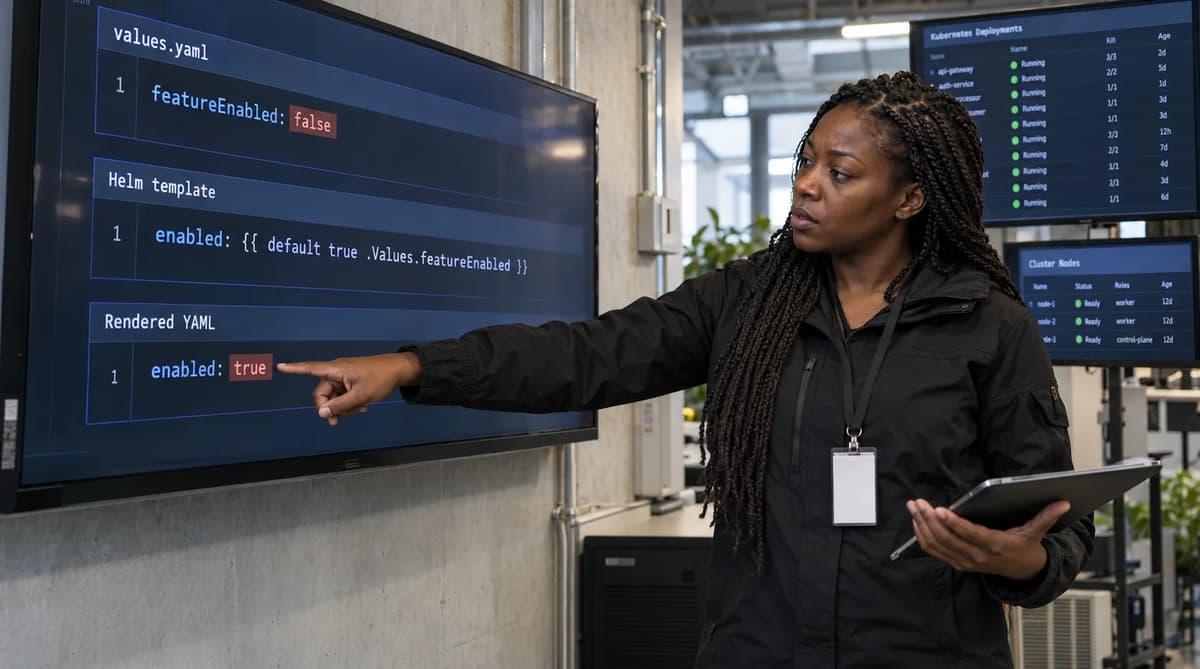
An explicit false can arrive correctly in Helm’s .Values and still emerge from a template as true. The local question is therefore narrower than “where did my Helm value come from?” and earlier than “did Kubernetes or the application adopt the configuration?” It is whether one chart expression preserves an owned optional-boolean contract between effective .Values and the typed field rendered into an artifact.
The contract examined here is intentionally small: omission means true; supplied boolean true remains true; supplied boolean false remains false; strings and numbers are refused at input. Helm documents default in terms of emptiness, and its function list explicitly defines boolean false as empty. coalesce likewise selects the first non-empty value. Helm v3.19.0 pins Sprig v3.3.0, whose tagged implementation applies that same emptiness predicate to default and coalesce.
The evidence boundary is equally deliberate. A supplied commissioning run rendered ten local cases with Helm v3.19.0, recorded effective key presence and value type before selection, parsed one synthetic ConfigMap envelope, and compared the nested output against an independently authored typed oracle. A successful schema check and an exit-zero template invocation were not treated as proof that the requested boolean survived. No fresh rerun is claimed in this article; the measured results below are the preparation run supplied for commissioning. The playbook therefore reviews selector semantics, type admission, and rendered output only, not installation or application adoption.
Define the optional-boolean contract before reading the template
Start with the application-facing rule, not the helper name. For this chart, the owned policy is:
Effective input | Required rendered settings.json.enabled | Admission |
key absent | true / boolean | allowed |
featureEnabled: true | true / boolean | allowed |
featureEnabled: false | false / boolean | allowed |
featureEnabled: "false" | none | reject input |
featureEnabled: 0 | none | reject input |
That is a chart policy, not a universal Helm rule. Another chart may legitimately require the key, define a different omission value, or avoid optional booleans entirely. The point is to declare the intended mapping before evaluating whether default, hasKey, or another expression satisfies it.
The fixture puts the selected boolean inside a JSON object stored as ConfigMap.data["settings.json"]. Kubernetes ConfigMaps store textual configuration in data; JSON documents are therefore carried as strings inside that field and parsed separately when the test evaluates the embedded contract. The test does not equate “valid ConfigMap-shaped JSON” with “accepted chart behavior.” It asks for the exact nested field and the exact boolean type.
That focus also keeps this page separate from Helm in the wider DevOps toolchain. The wider survey is useful context for where charts fit, but the decision here is one expression and one rendered field.
ACCEPT_RENDERED_CONTRACT consequently means only that a case satisfies this declared mapping in the tested rendering environment. It is not authorization to install, promote, release, or modify a running workload.
Explain why false takes the fallback
Helm’s v3 template function documentation defines default DEFAULT_VALUE GIVEN_VALUE by asking whether the given value is empty. Its emptiness table explicitly includes numeric zero, empty strings, empty lists and dictionaries, nil, and boolean false. A non-empty supplied value survives; an empty one is replaced by the fallback.
For this expression:
{{- $enabled := default true .Values.featureEnabled -}}the chart author may read the intention as “use true only when featureEnabled is missing.” The documented predicate is broader: “use true when the supplied value is empty.” For a boolean, false is empty under that predicate. The helper is therefore not broken. The application’s missing-only policy and the helper’s emptiness policy are different.
The version-specific implementation corroborates the mechanism. Helm v3.19.0 declares github.com/Masterminds/sprig/v3 v3.3.0 in its tagged go.mod. In Sprig v3.3.0, dfault calls empty on the candidate and returns the default if that predicate is true; the reflect.Bool branch treats false as empty. This is evidence for that pinned dependency relationship and release-specific behavior, not an inspection of every Helm release.
The distinction matters because omission and explicit false can produce the same selector result while carrying different intent. Under the contract above, omission should fall back to true, while a present false should remain false. default cannot distinguish those two states when it is applied directly to this boolean.
Separate emptiness from key presence
Emptiness asks about the value. Presence asks whether the dictionary contains the key.
Sprig v3.3.0 implements hasKey by performing the map lookup and returning the lookup-presence boolean. Therefore an absent key and a present key whose stored value is false have different presence results even though default treats the latter as empty.
That difference is exactly what the optional-field policy needs. It is not, by itself, type validation. A key containing the string "false" is also present. H09 later demonstrates why presence selection must remain paired with the input type gate.
Freeze the value source and the effective input
The fixture removes upstream ambiguity before testing selection. Chart values.yaml contains only {}. Every case supplies one explicitly authored values file. The chart optionally adds a values.schema.json whose only property is featureEnabled with JSON Schema type boolean, additionalProperties: false, and no required keyword.
Helm documents values.schema.json as the mechanism for constraining chart values, and says schema validation applies to the final .Values object for commands including helm template. Because featureEnabled is typed but not required here, absence is intentional; a present string or number is outside this fixture’s admitted input contract.
The authored case files use JSON syntax, which is accepted as YAML-compatible input for this purpose. More importantly, the output template records its own view of .Values before the candidate selector is interpreted:
{"present":true,"value":false}That evidence is serialized into data["input.json"]. It answers a narrowly scoped provenance question: what key presence and typed value did this template invocation observe?
If the question instead is which shell, CLI file, service file, or fallback won before a container was created, that belongs to configuration source selection in Docker Compose. This fixture deliberately holds that class of uncertainty out of the experiment.
Confirm that false arrived before selection
H03 and H06 are the decisive pair because both receive the same authored boolean:
{"featureEnabled": false}Both retain the same optional-boolean schema. In both, input.json records present: true and a value whose exact runtime type is boolean and whose value is false.
Their material difference is the selector. H03 uses default; H06 uses the presence branch. When those two renders diverge, the fixture does not need a source-precedence explanation: the tested false was already visible in .Values before selection.
input.json is still owned instrumentation, not an external witness. It proves what this template emitted about its effective input in this controlled render; it does not independently attest to a cluster, a release object, or a running process.
Run the complete isolated rendering fixture
The commissioning fixture is reproduced below exactly as supplied. Save it as cloud_helm_fixture.py. Its supplied source identity is SHA-256 34df3e1b8e56f479d24d713e02bfe4c9c1d400bba61167ac250529f0a330efc0, covering the stated UTF-8/LF source bytes including the final newline. That digest identifies the source file; it is not an execution attestation.
The reference environment used Python 3.12.14 and Helm v3.19.0. Helm’s official v3.19.0 release page identifies commit 3d8990f, provides the Linux amd64 archive, and publishes SHA-256 a7f81ce08007091b86d8bd696eb4d86b8d0f2e1b9f6c714be62f82f96a594496 for that archive. The supplied preparation record says acquisition used verified HTTPS plus checksum comparison; it does not claim that a separate release-signature verification was performed.
Acquire the archive into a fresh directory, compare its SHA-256 to that published value before extraction, identify the extracted helm executable by absolute path, and do not silently substitute a floating package-manager build. Helm’s own template command documentation says --dry-run=client avoids attempting cluster connections.
The standalone invocation is:
python cloud_helm_fixture.py /absolute/path/to/helm > helm_boolean_results.jsonFor the commissioning record, completion required the expected fixture source SHA, the intended runtime identity, process exit 0, top-level status PASS_10_CASES, and all H01–H10 records. The JSON report also retains the invoked commands, stdout and stderr, authored values, value digests, chart-file digests, effective input, parsed manifest, rendered value/type, case decision, and status.
"""Owned local Helm boolean rendering experiment; never installs a chart."""
import hashlib
import json
import os
import platform
import subprocess
import sys
import tempfile
from datetime import datetime, timezone
from pathlib import Path

CHART = 'apiVersion: v2\nname: owned-flag\nversion: 0.1.0\ntype: application\n'
SCHEMA = {'$schema': 'http://json-schema.org/draft-07/schema#', 'type': 'object',
          'properties': {'featureEnabled': {'type': 'boolean'}},
          'additionalProperties': False}
EXPRESSIONS = {
    'default': '{{- $enabled := default true .Values.featureEnabled -}}\n',
    'presence': ('{{- $enabled := true -}}\n'
                 '{{- if hasKey .Values "featureEnabled" -}}\n'
                 '{{- $enabled = .Values.featureEnabled -}}\n{{- end -}}\n'),
    'coalesce': '{{- $enabled := coalesce .Values.featureEnabled true -}}\n',
}
OUTPUT = '''{{- $input := dict "present" (hasKey .Values "featureEnabled") "value" .Values.featureEnabled -}}
{{- dict "apiVersion" "v1" "kind" "ConfigMap" "metadata" (dict "name" "owned-flag") "data" (dict "settings.json" (dict "enabled" $enabled | toJson) "input.json" ($input | toJson)) | toJson }}
'''
# Expected input, observed output and acceptance are authored before execution.
CASES = [
    ('H01', 'default', {}, True, True, True, True, 'ACCEPT_RENDERED_CONTRACT'),
    ('H02', 'default', {'featureEnabled': True}, True, True, True, True, 'ACCEPT_RENDERED_CONTRACT'),
    ('H03', 'default', {'featureEnabled': False}, True, True, True, False, 'REPAIR_FALSE_REPLACED'),
    ('H04', 'presence', {}, True, True, True, True, 'ACCEPT_RENDERED_CONTRACT'),
    ('H05', 'presence', {'featureEnabled': True}, True, True, True, True, 'ACCEPT_RENDERED_CONTRACT'),
    ('H06', 'presence', {'featureEnabled': False}, True, True, False, True, 'ACCEPT_RENDERED_CONTRACT'),
    ('H07', 'presence', {'featureEnabled': 'false'}, True, False, None, False, 'REJECT_INPUT_TYPE'),
    ('H08', 'presence', {'featureEnabled': 0}, True, False, None, False, 'REJECT_INPUT_TYPE'),
    ('H09', 'presence', {'featureEnabled': 'false'}, False, True, 'false', False, 'HOLD_MISSING_TYPE_GATE'),
    ('H10', 'coalesce', {'featureEnabled': False}, True, True, True, False, 'REPAIR_FALSE_REPLACED'),
]

def require(ok, message):
    if not ok:
        raise RuntimeError('HOLD: ' + message)

def digest(data):
    return hashlib.sha256(data).hexdigest()

def run(report, executable):
    require(executable.is_file(), 'explicit Helm executable required')
    with tempfile.TemporaryDirectory(prefix='owned-helm-flag-') as name:
        root = Path(name)
        env = {'PATH': os.defpath, 'LC_ALL': 'C', 'LANG': 'C'}
        for variable, directory in [('HELM_CACHE_HOME', 'cache'), ('HELM_CONFIG_HOME', 'config'),
                                    ('HELM_DATA_HOME', 'data'), ('HELM_PLUGINS', 'plugins')]:
            target = root / directory
            target.mkdir()
            env[variable] = str(target)
        kubeconfig = root / 'empty-kubeconfig'
        kubeconfig.write_text('{}\n')
        kubeconfig.chmod(0o600)
        env['KUBECONFIG'] = str(kubeconfig)

        def invoke(arguments):
            p = subprocess.run([str(executable), *arguments], env=env, cwd=root,
                               stdin=subprocess.DEVNULL, capture_output=True, text=True, timeout=20)
            return {'argv': p.args, 'returncode': p.returncode, 'stdout': p.stdout, 'stderr': p.stderr}

        version = invoke(['version', '--template', '{{.Version}}|{{.GitCommit}}|{{.GoVersion}}'])
        require(version['returncode'] == 0 and version['stdout'].split('|')[0] == 'v3.19.0',
                'reference fixture requires Helm v3.19.0')
        report.update(helm_version=version, helm_binary_sha256=digest(executable.read_bytes()))
        for identity, expression, values, schema_on, success, expected_output, accepted, decision in CASES:
            chart = root / identity
            (chart / 'templates').mkdir(parents=True)
            files = {'Chart.yaml': CHART, 'values.yaml': '{}\n',
                     'templates/configmap.yaml': EXPRESSIONS[expression] + OUTPUT}
            if schema_on:
                files['values.schema.json'] = json.dumps(SCHEMA, sort_keys=True) + '\n'
            for relative, content in files.items():
                (chart / relative).write_text(content, encoding='utf-8')
            values_file = root / (identity + '-values.yaml')
            values_text = json.dumps(values, sort_keys=True) + '\n'
            values_file.write_text(values_text, encoding='utf-8')
            command = invoke(['template', 'owned', str(chart), '--values', str(values_file),
                              '--dry-run=client', '--show-only', 'templates/configmap.yaml'])
            require((command['returncode'] == 0) == success, identity + ' exit class')
            observed, actual_input, manifest = None, None, None
            matches = False
            if success:
                payload = '\n'.join(line for line in command['stdout'].splitlines()
                                    if line.strip() and line.strip() != '---' and not line.startswith('#'))
                manifest = json.loads(payload)
                require(set(manifest) == {'apiVersion', 'kind', 'metadata', 'data'}, identity + ' object shape')
                require(manifest['apiVersion'] == 'v1' and manifest['kind'] == 'ConfigMap'
                        and manifest['metadata'] == {'name': 'owned-flag'}, identity + ' object identity')
                require(set(manifest['data']) == {'settings.json', 'input.json'}, identity + ' data keys')
                settings = json.loads(manifest['data']['settings.json'])
                actual_input = json.loads(manifest['data']['input.json'])
                require(set(settings) == {'enabled'}, identity + ' settings shape')
                expected_input = {'present': 'featureEnabled' in values, 'value': values.get('featureEnabled')}
                require(actual_input == expected_input and type(actual_input['present']) is bool
                        and type(actual_input['value']) is type(expected_input['value']),
                        identity + ' effective input evidence')
                observed = settings['enabled']
                require(type(observed) is type(expected_output) and observed == expected_output,
                        identity + ' output oracle')
                requested = values.get('featureEnabled', True)
                matches = type(requested) is bool and type(observed) is bool and observed == requested
            else:
                require(command['stdout'].strip() == '', identity + ' unexpected partial manifest')
                require('featureEnabled' in command['stderr'] and 'boolean' in command['stderr'],
                        identity + ' expected schema diagnostic')
            require(matches == accepted, identity + ' contract verdict')
            report['cases'].append({'case': identity, 'expression': expression, 'schema_enabled': schema_on,
                'values_text': values_text, 'values_sha256': digest(values_text.encode()),
                'chart_files_sha256': {k: digest(v.encode()) for k, v in files.items()},
                'command': command, 'effective_input': actual_input, 'manifest': manifest,
                'rendered_value': observed, 'rendered_type': type(observed).__name__,
                'matches_contract': matches, 'decision': decision, 'status': 'PASS'})
        require([x['case'] for x in report['cases']] == ['H%02d' % i for i in range(1, 11)],
                'complete case inventory')
    require(not root.exists(), 'normal temporary cleanup')
    report.update(status='PASS_10_CASES', normal_temporary_cleanup_completed=True)

if name == '__main__':
    report = {'status': 'HOLD', 'started_utc': datetime.now(timezone.utc).isoformat(),
              'source_sha256': digest(Path(__file__).read_bytes()), 'python': platform.python_version(),
              'platform': platform.platform(), 'uid': os.getuid(), 'cases': []}
    try:
        require(len(sys.argv) == 2, 'usage: python cloud_helm_fixture.py /absolute/path/to/helm')
        run(report, Path(sys.argv[1]).resolve())
    except Exception as error:
        report.update(error=type(error).__name__, detail=str(error))
    report['finished_utc'] = datetime.now(timezone.utc).isoformat()
    print(json.dumps(report, indent=2))
    sys.exit(0 if report['status'] == 'PASS_10_CASES' else 1)
The preparation run began 2026-11-02T08:05:51.886855+00:00 and finished 2026-11-02T08:05:55.369839+00:00. It recorded Python 3.12.14, platform Linux-6.18.57-x86_64-with-glibc2.39, UID 0, and Helm v3.19.0|3d8990f0836691f0229297773f3524598f46bda6|go1.24.7. Its Helm executable SHA-256 was e4722a77de9df824214aaf19d43687c49f7cbcf3b107905acea002173777d486, process exit was 0, and final status was PASS_10_CASES.
No fresh execution is being substituted for that record here. A later rerun must report its own source digest and runtime; the unchanged fixture itself refuses a Helm version other than v3.19.0. The isolated private Helm directories and empty kubeconfig reduce interaction with ordinary user configuration, but UID 0 does not establish ordinary-user permissions or adversarial containment. No remote chart, dependency, lookup, installation, or cluster connection is exercised.
Reproduce the false-to-true transformation
The first three commissioning cases isolate the behavior of default.
H01 omits featureEnabled. Under the declared policy, omission means true; the render produces boolean true, so the case receives ACCEPT_RENDERED_CONTRACT.
H02 supplies boolean true. The effective input is present and typed bool; the rendered value is also boolean true. That row is another positive control.
H03 is the important negative control. Its authored values file contains boolean false. The optional-boolean schema accepts that input. The command exits 0. The instrumentation records:
{"present":true,"value":false}Yet settings.json contains:
{"enabled":true}The independently authored oracle requires boolean false, so the row receives REPAIR_FALSE_REPLACED.
The observed result matches Helm’s documented rule that boolean false is empty for default, and the pinned Sprig v3.3.0 implementation supplies the release-specific mechanism: dfault falls back when empty(given[0]) is true, while the boolean branch makes false empty. The documentation explains the selector; the commissioning record supplies the measured render.
Keep process success and contract success in separate columns
H03 is why returncode == 0 must not be collapsed into semantic acceptance.
An exit-zero render establishes that this Helm invocation completed successfully. The schema also established that the supplied value belonged to the admitted boolean input domain. Neither proves that the selected output retained the requested value.
The harness therefore expects an exit-zero negative control and separately requires matches_contract == false. A test harness can pass because it correctly detected an undesirable design outcome. PASS_10_CASES describes agreement between observation and the authored ten-case expectations; it does not turn every row into an acceptable chart configuration.
Preserve false with a presence-based branch
The supplied repair expression changes the predicate rather than coercing the value:
{{- $enabled := true -}}
{{- if hasKey .Values "featureEnabled" -}}
{{- $enabled = .Values.featureEnabled -}}
{{- end -}}
It first establishes the omission fallback. It then replaces that fallback only when the key exists. Sprig’s tagged hasKey implementation returns the result of the dictionary lookup-presence test. That aligns directly with this chart’s policy: absence selects true; presence preserves the admitted supplied boolean.
H04 confirms that omission still renders boolean true. H05 confirms that a supplied true remains true. H06 supplies the same boolean false as H03, under the same schema, but the presence selector yields boolean false. H06 therefore receives ACCEPT_RENDERED_CONTRACT.
H03 versus H06 is the controlled comparison that matters:
Case | Effective input | Schema | Selector | Rendered |
H03 | present false / bool | on | default | true / bool |
H06 | present false / bool | on | presence branch | false / bool |
This supports a bounded repair decision for an optional flat boolean whose omission policy is true. It does not establish that hasKey is a universal Helm repair, and presence alone does not establish that the stored value belongs to the desired type.
Keep documented design alternatives separate from tested repairs
Helm’s rolling v3 functions-and-pipelines guide recommends putting static chart defaults in values.yaml rather than redundantly repeating them with default inside templates. It reserves template-side default particularly for computed values.
That is a relevant design alternative. For a chart whose intended model is “the value always exists after chart defaults are merged,” moving a static true into values.yaml may be cleaner than representing omission inside the template.
It was not executed as another case in this laboratory. There is no H11 demonstrating a values.yaml-default repair, and the commissioning result must not be extended to claim one. This fixture deliberately leaves values.yaml empty so that absence can be distinguished from explicit false. A chart owner must first decide whether absence is part of the public value contract before choosing between that design and a presence-based selector.
Retain the input type gate after fixing presence
Preserving a present value is only half the requirement. The chart must also refuse values that are present but outside the declared boolean domain.
H07 supplies the string "false" while the schema is enabled. H08 supplies numeric 0. Helm documents that values.schema.json is applied to final .Values during helm template. In the supplied run, both cases return 1, emit no manifest on stdout, and provide diagnostics identifying featureEnabled and its expected boolean type. They are labeled REJECT_INPUT_TYPE.
H09 changes one control: it deliberately removes the schema while retaining the presence branch and the string "false". The key is present, so hasKey permits assignment. Rendering exits 0, and the output contains string "false", not boolean false. That row receives HOLD_MISSING_TYPE_GATE.
This three-way distinction is the useful one:
Input state | Presence | Type | Required treatment |
absent | no | none | omission fallback |
false | yes | boolean | preserve |
"false" | yes | string | refuse |
The experiment therefore does not endorse “replace default with hasKey” in isolation. Its accepted selector is the combination of presence-sensitive selection and retained schema admission.
Reject plausible-looking text at the typed boundary
A string containing the characters false is not boolean false. The fixture verifies exact Python runtime types when it compares both the effective input and the nested output.
That strictness also avoids another subtle trap: in Python, ordinary equality can make False == 0 evaluate as true. The harness does not let equality stand alone; it requires type(observed) is type(expected_output) before comparing the value.
The oracle is therefore about a typed configuration field, not a visually similar serialization. This section does not propose coercion rules or a general YAML-typing tutorial. For this chart, string and number inputs are simply outside the admitted contract.
Reject coalesce as an equivalent emptiness-based repair
Changing the helper name does not repair the predicate if the replacement helper uses the same relevant notion of emptiness.
Helm documents coalesce as returning the first non-empty value. Sprig v3.3.0 implements it by iterating over candidates and returning the first value for which empty is false; its boolean emptiness branch treats false as empty.
H10 measures the consequence for this exact expression:
{{- $enabled := coalesce .Values.featureEnabled true -}}The supplied input is valid boolean false, the schema remains enabled, and the effective instrumentation shows that value entering selection. Rendering succeeds, but coalesce skips the empty false and selects true. The independent contract expects false, so H10 receives REPAIR_FALSE_REPLACED.
The candidate choice can therefore be reviewed without treating helper names as intent:
Candidate | Predicate relevant to this field | Explicit false | Fits missing-only policy? |
default true … | emptiness | replaced | no |
coalesce … true | first non-empty | replaced | no |
guarded hasKey assignment | key presence | preserved | yes, with the type gate |
That table is not a benchmark and does not generalize across all Sprig functions. It answers only whether each executed selector follows this chart’s absent-versus-present rule.
Parse the exact output field before granting acceptance
The harness does not accept a render merely because stdout looks plausible. For successful cases, it strips only the known Helm source/header lines and document separator used by this single controlled output, joins the remaining payload, and parses it as JSON.
It then checks the top-level object shape exactly: apiVersion, kind, metadata, and data. It requires v1, ConfigMap, and metadata equal to {"name": "owned-flag"}. It also requires exactly two data keys: settings.json and input.json.
Only after those envelope checks does it parse the two embedded JSON strings. settings.json must contain exactly enabled. input.json must equal the authored expected presence/value pair, with exact runtime types. The final enabled value must match the pre-authored expected output in both value and type.
That parser is intentionally narrow. It is not advertised as an arbitrary YAML reader, multi-document Helm output processor, or Kubernetes validation engine. Helm’s template --dry-run=client performs client-side rendering without attempting a cluster connection; that command boundary does not imply server acceptance.
Raw command stdout, stderr, authored input text, and digests remain in the report. The parsed fields supplement that source evidence by making the specific contract decision reviewable; they do not replace the original streams or artifact identities.
Reconcile every case in the recorded ledger
The supplied commissioning run matched every authored row:
Case | Selector | Supplied value | Schema | Exit | Rendered value/type | Contract | Decision |
H01 | default | absent | on | 0 | true / bool | yes | ACCEPT_RENDERED_CONTRACT |
H02 | default | true | on | 0 | true / bool | yes | ACCEPT_RENDERED_CONTRACT |
H03 | default | false | on | 0 | true / bool | no | REPAIR_FALSE_REPLACED |
H04 | presence | absent | on | 0 | true / bool | yes | ACCEPT_RENDERED_CONTRACT |
H05 | presence | true | on | 0 | true / bool | yes | ACCEPT_RENDERED_CONTRACT |
H06 | presence | false | on | 0 | false / bool | yes | ACCEPT_RENDERED_CONTRACT |
H07 | presence | "false" | on | 1 | Not rendered | no | REJECT_INPUT_TYPE |
H08 | presence | 0 | on | 1 | Not rendered | no | REJECT_INPUT_TYPE |
H09 | presence | "false" | off | 0 | "false" / str | no | HOLD_MISSING_TYPE_GATE |
H10 | coalesce | false | on | 0 | true / bool | no | REPAIR_FALSE_REPLACED |
“Not rendered” in H07 and H08 means exactly what the fixture asserts: schema admission failed, stdout contained no partial manifest, and therefore there is no rendered nested value to infer. Those rows are successful negative controls for the laboratory even though their candidate inputs are not acceptable for use.
Only H01, H02, H04, H05, and H06 receive ACCEPT_RENDERED_CONTRACT. H03 and H10 demonstrate selectors that replace explicit false; H07 and H08 demonstrate the intended type refusal; H09 demonstrates why presence preservation without type admission is incomplete.
Reconcile a passing harness with deliberately rejected designs
PASS_10_CASES means all ten observations matched the expectations authored before execution. It is a statement about the diagnostic harness, not a blanket approval label.
That distinction is similar to the broader discipline in evidence of what a dry run actually checked: a green outer command or harness status must be reconciled with the evidence each internal check actually gathered. The Ansible workflow is not imported here; only that evidentiary distinction is relevant.
A rejected type, a rendered contract mismatch, and missing evidence are therefore kept as different outcomes rather than flattened into “failed.”
Mark the boundary between a render and a running configuration
Nothing in this fixture creates a ConfigMap in Kubernetes.
Helm documents --dry-run=client as a simulation mode that does not attempt cluster connections. Consequently, this evidence does not establish API-server acceptance, server-side schema compatibility, admission-controller behavior, persistence, controller action, rollout, volume projection, environment-variable delivery, process reload, or application behavior.
The synthetic ConfigMap is an output envelope. settings.json is never mounted, injected, or read by a running process. No Pod identity is observed, no controller is asked to reconcile anything, and no consumer response is checked.
Those downstream questions belong to a different workflow. The existing playbook for configuration adoption by a running application follows configuration after the API object exists and distinguishes delivery mechanisms and process-held state. This article stops earlier on purpose.
ACCEPT_RENDERED_CONTRACT should therefore be read literally: on the identified fixture, Helm build, source, selector, schema, and supplied cases, the nested rendered boolean matches the declared optional-field contract. It does not authorize installation and cannot be promoted into a claim that an application has adopted anything.
Repair the chart without discarding the evidence
A repair should preserve the diagnostic record that justified the change.
First, retain the suspect template source, authored values, raw render output, stderr, source identity, and the declared missing/false policy. Without those artifacts, the reviewer cannot distinguish a selector repair from a changed test.
Second, change the selector under that already-declared policy. In this laboratory, the executed presence branch is the qualifying repair for the optional boolean because H04–H06 cover omission, true, and false. Do not remove the schema while doing so; H09 shows why that would merely move the failure boundary.
Third, reconcile the full case inventory against the independent oracle rather than editing expected values to fit a surprising render. The negative controls are part of the evidence. H07 and H08 should continue to be rejected; H09 should continue to demonstrate what is lost when the gate is absent.
Fourth, submit the identified chart artifact and ledger for review. A change in fixture source, Helm build, expression, schema, or policy requires newly identified evidence. The historic PASS_10_CASES label cannot simply be carried forward.
Finally, keep source correction separate from downstream recovery. Reverting a template can restore a previously reviewed source expression, but this fixture did not test whether any earlier artifact had been installed, whether a workload consumed it, or how to reverse live application state. If the intended policy is unknown, the source identity is uncertain, the case ledger is incomplete, or a new render produces unexpected output, the operational status is HOLD, not inferred acceptance.
Assign chart ownership and the next operational decision
The practical handoff is easiest when the evidence, owner, and permitted next action are explicit.
Evidence state | Primary owner | Decision |
Optional-field policy is undefined | configuration owner | HOLD until absence, true, and false semantics are declared |
H03/H10 pattern: valid false renders true | chart maintainer | repair the selector; retain evidence |
H04–H06 match the declared policy and schema remains active | chart maintainer + reviewer | accept the rendered contract for this identified revision and cases |
H07/H08 schema refusal | chart maintainer + configuration owner | retain refusal; do not “fix” by admitting wrong types |
H09 pattern: present value preserved but wrong type passes | chart maintainer | restore or repair the type gate; HOLD |
Source digest, runtime identity, or case inventory differs | reviewer | gather new evidence; do not inherit the old PASS label |
Rendered contract accepted but deployment status unknown | release/promotion owner | perform the separate downstream review before any release action |
The chart maintainer owns the selector and schema implementation. The configuration owner owns the semantic question “what does omission mean?” The reviewer owns reconciliation: source identity, runtime identity, typed effective input, typed output, and complete case inventory must agree before this laboratory is considered complete.
For the supplied commissioning record that means the expected fixture SHA, the identified v3.19.0 runtime, outer exit 0, status PASS_10_CASES, and all H01–H10 rows. An unexpected value is not rounded into a pass. A missing row is not a silent success. A startup failure may occur before usable JSON exists, and failures caught during the main run can leave only partial accumulated evidence; the fixture has no durable crash journal. Absence of a complete report therefore cannot be interpreted as acceptance.
The scope also remains one optional flat boolean on one Helm build and one platform. It does not qualify every value in a chart. Sprig implementation inspection is pinned to v3.3.0 because Helm v3.19.0 declares that dependency. The release page independently identifies v3.19.0 and its release commit and archive checksums.
After rendered evidence is accepted, a separate promotion mechanism may take responsibility. GitOps configuration ownership and promotion is relevant to that organizational boundary, but linking it does not turn this local render into a GitOps execution test.
The immediate decision is therefore concrete: for this missing-only optional boolean, do not accept the default or coalesce expressions demonstrated by H03 and H10. Retain the boolean schema and use the qualified presence-based branch demonstrated by H04–H06, provided the chart owner confirms that omission really means true. If that policy, source identity, runtime identity, or complete ledger is unavailable, hold the review rather than extrapolating.
Build the DevOps foundations behind careful chart review
The next practical step is small enough to apply to an owned chart: identify one optional boolean, write down what absence means, keep its type gate explicit, and retain typed evidence showing what reached .Values and what the exact rendered consumer field became before requesting any wider release review. That habit separates source selection, template transformation, admission, rendering, and downstream adoption instead of treating a successful command as evidence for all of them.
For engineers building those operational foundations more broadly, Refonte Learning’s DevOps Engineering programme currently describes a three-month commitment of 12–14 hours per week, with curriculum areas including Linux and scripting, Git/GitHub, CI/CD, Docker and Kubernetes, Terraform, cloud platforms, monitoring/logging, and a capstone project. The page names MSc Oskar Eriksson in its Educational Mentors section and states that successful completion can include a Training Certificate and Certificate of Internship; it also describes virtual internship opportunities or a potential internship rather than guaranteeing a placement.
Its published admission prerequisite is material: the page says applicants must be working toward a bachelor’s or higher-level degree. DevOps Engineer, Cloud Engineer, and Site Reliability Engineer are presented as career directions, not promised employment outcomes. Nothing verified on that programme page establishes that Helm, Sprig, JSON Schema, Python orchestration, or this exact laboratory is a taught specialist module.
The programme bridge is therefore limited to the confirmed foundations that support disciplined chart review: scripting for repeatable evidence, CI/CD for explicit gates, and container/Kubernetes knowledge for understanding where a rendered artifact sits in a larger delivery path. The technical decision remains independent: preserve explicit false only with a selector that matches the declared missing-only policy, keep boolean admission in place, and carry the rendered result forward only after its own evidence is complete.