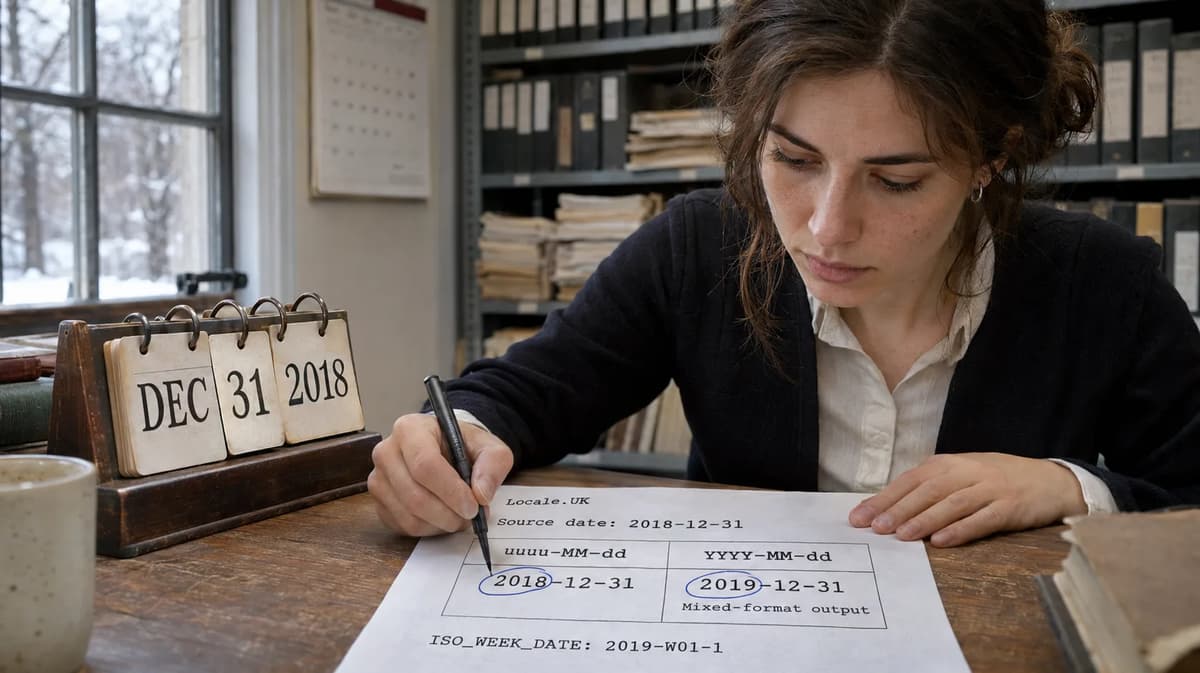
Start with a valid LocalDate: LocalDate.of(2021, 12, 31). Nothing is missing from it. There is no clock, timezone, DST transition, parser ambiguity or invalid input. Yet format that value with DateTimeFormatter.ofPattern("YYYY-MM-dd", Locale.US) under the Java 17 qualification environment in this playbook and the expected emitted text is 2022-12-31.
That output is syntactically convincing. An ISO calendar-date parser accepts it as December 31, 2022. The problem is precisely that the parser succeeds: the source was December 31, 2021.
Oracle's Java SE 17 DateTimeFormatter documentation assigns different meanings to u, y and Y: u is year, y is year-of-era and capital Y is week-based-year. Month M and day d, meanwhile, remain calendar month and day. A pattern such as YYYY-MM-dd can therefore combine coordinates from two different representations.
The operational question is not "did this string parse?" It is: did formatting preserve the input LocalDate, or did it splice a locale-dependent week-based year onto the original calendar month and day?
The laboratory below answers that question over eight independently authored civil dates and two explicit locales: sixteen rows covering YYYY-MM-dd, uuuu-MM-dd, yyyy-MM-dd, ISO_LOCAL_DATE, a legitimate ISO_WEEK_DATE, and consumer readback. Five rows produce the wrong calendar identity. The resulting decision is bounded: repair a mixed-year calendar formatter, retain a genuine week-date contract, accept only a tested literal calendar path, and hold historical strings when their source date or formatter provenance cannot be established.
Declare the calendar date that must survive serialization
For this playbook, the interface value is an ISO calendar date. If the producer holds LocalDate.of(2021, 12, 31), the approved serialized identity is the same year, month and day: 2021-12-31. The hyphenated literal is human-readable notation for that contract; when Java pattern syntax is being specified, the calendar formatter used here is written precisely as uuuu-MM-dd.
That distinction matters because LocalDate is already a typed value, not ambiguous input text. Oracle defines LocalDate as an immutable ISO-8601 date without a time or timezone and describes it as a year-month-day value; it does not represent an instant. No conversion from UTC, local time or another zone is necessary to explain the failure examined here.
A useful producer contract can therefore be stated narrowly:
Contract element | Requirement |
Source value | Immutable ISO LocalDate |
Meaning | Calendar year + calendar month + day |
Approved literal for D6 | 2021-12-31 |
Zone semantics | None |
Clock dependency | None |
Acceptance test | Consumer reconstructs the original LocalDate |
Week-date alternative | Allowed only under an explicitly different interface contract |
This is a different boundary from preserving date-only values at a browser boundary, where JavaScript Date and UTC/local accessors can move a civil date through an instant-bearing representation. That article explicitly deals with browser date controls and UTC conversion. Here, the LocalDate remains intact. The suspected defect begins only when the Java formatter chooses which year field to print.
Preserving the contract means preserving this record's calendar identity. Producing ten characters that happen to look like yyyy-MM-dd is not sufficient evidence.
Separate a valid date string from the intended date
The clearest failing row is D6 under the specified US week rules:
2021-12-31 → YYYY-MM-dd → 2022-12-31.Both sides are valid ISO calendar dates. That is why ordinary parser-success assertions are weak. LocalDate.parse("2022-12-31", DateTimeFormatter.ISO_LOCAL_DATE) has no reason to fail: December 31, 2022 exists, and the text supplies a complete calendar year, month and day.
The parser also cannot infer that the producer began with 2021-12-31. By the time the consumer receives 2022-12-31, the original year field has been discarded. A structurally valid serialized value can therefore be semantically wrong for the boundary that produced it.
The fixture avoids circular testing by authoring expectedDate independently for every sample. D6's expected value is 2021-12-31 before the formatter runs. Consumer acceptance is then based on identity:
LocalDate consumerDate =
        LocalDate.parse(hybrid, DateTimeFormatter.ISO_LOCAL_DATE);
boolean sameDate = consumerDate.equals(input);
For the US D6 row, parsing succeeds but sameDate is false. That is the important failure.
The same principle appears at a different boundary when teams preserve source culture during date parsing. There, text such as 03/04/2025 can be a valid date under more than one day/month interpretation, so source provenance must decide what the text meant. This Java experiment is intentionally not another input-parsing exercise. Its source is already typed and unambiguous. The producer creates the discrepancy while formatting.
Do not turn that observation into a heuristic such as "reject every December date" or "January is dangerous." The boundary rows are controls for a field-selection defect. Acceptance still depends on the declared representation and the exact source identity.
Record the formatter contract and the locale week rules
The qualification baseline is OpenJDK 17.0.20+8-1-24.04-Ubuntu, using Java source-file execution.
Every comparison in the fixture passes either Locale.US or Locale.UK explicitly. The default FORMAT locale and java.locale.providers are printed only as provenance. They do not select the locale used by the tested formatters.
That separation is important because WeekFields.of(locale) obtains a week definition appropriate to the supplied locale from localization data. Oracle documents a week definition in terms of two parameters: first day of week and minimal days in the first week. It also documents that week-based years may place the last days of one calendar year in the following week-based year, or the first days of a calendar year in the previous week-based year.
The fixture asserts these exact preconditions:
Locale | Expected first day | Expected minimal days |
Sunday | 1 | |
Monday | 4 |
Oracle's Java 17 WeekFields reference identifies ISO week rules as Monday plus four minimal days and documents a Sunday-start/one-day definition as a common US-style definition. The fixture still asserts the values rather than treating documentation as permission to ignore the runtime.
If either assertion changes, qualification should stop. Do not rewrite the expected output from whatever the new runtime emits; that would make the observation define its own oracle.
The broader design lesson resembles Temporal migration and representation choices: decide what a value represents before choosing its serialization mechanism. This article does not adopt that page's JavaScript migration scope. Its only representation decision is calendar date versus complete week date.
Run the complete sixteen-row Java comparison
Use an owned working directory and a JDK capable of source-file execution, records and HexFormat; Java 17 is the qualification baseline specified here. The fixture has no dependencies beyond Java SE. It does not contact a database, network service or clock, and no timezone setting participates in the result.
The eight source dates are deliberately numeric and authored in the source. D4 is a midyear control; D1 and D8 are boundary-adjacent controls that remain unchanged; the others exercise dates on which localized week-year and calendar year may disagree.
Keep the run command and expected strings reproducible
A reproducible procedure is:
Save the following source as CalendarYearFixture.java, preserving the authored samples and expected values. Run java CalendarYearFixture.java CalendarYearFixture.java > java_calendar_year_results.txt. The first filename selects the source program; the second becomes args[0] and is read for the SHA-256 evidence digest. Preserve the complete result file, including provenance lines and all sixteen rows. Treat a thrown assertion, nonzero process result, missing final marker, changed population or missing output as incomplete evidence rather than redefining the expected result.
import java.nio.file.Files;
import java.nio.file.Path;
import java.security.MessageDigest;
import java.time.LocalDate;
import java.time.format.DateTimeFormatter;
import java.time.temporal.WeekFields;
import java.util.HexFormat;
import java.util.Locale;

class CalendarYearFixture {
    record Sample(String id, int y, int m, int d, String expectedDate,
                  String expectedUsHybrid, String expectedUkHybrid,
                  String expectedIsoWeek) {}
    static final Sample[] SAMPLES = {
        new Sample("D1",2020,12,26,"2020-12-26","2020-12-26","2020-12-26","2020-W52-6"),
        new Sample("D2",2020,12,27,"2020-12-27","2021-12-27","2020-12-27","2020-W52-7"),
        new Sample("D3",2021,1,1,"2021-01-01","2021-01-01","2020-01-01","2020-W53-5"),
        new Sample("D4",2021,7,1,"2021-07-01","2021-07-01","2021-07-01","2021-W26-4"),
        new Sample("D5",2021,12,26,"2021-12-26","2022-12-26","2021-12-26","2021-W51-7"),
        new Sample("D6",2021,12,31,"2021-12-31","2022-12-31","2021-12-31","2021-W52-5"),
        new Sample("D7",2022,1,1,"2022-01-01","2022-01-01","2021-01-01","2021-W52-6"),
        new Sample("D8",2022,1,3,"2022-01-03","2022-01-03","2022-01-03","2022-W01-1")
    };
    static void require(boolean condition, String message) {
        if (!condition) throw new AssertionError(message);
    }
    public static void main(String[] args) throws Exception {
        require(args.length == 1, "Pass this source file path for the evidence digest");
        String digest = HexFormat.of().formatHex(MessageDigest.getInstance("SHA-256")
                .digest(Files.readAllBytes(Path.of(args[0]))));
        System.out.println("revision=java-calendar-year-v1");
        System.out.println("source_sha256=" + digest);
        System.out.println("java.runtime.version=" + System.getProperty("java.runtime.version"));
        System.out.println("java.vendor=" + System.getProperty("java.vendor"));
        System.out.println("default.format.locale=" + Locale.getDefault(Locale.Category.FORMAT).toLanguageTag());
        System.out.println("java.locale.providers=" + System.getProperty("java.locale.providers", "<default>"));
        System.out.println("id\tlocale\tfirst_day\tmin_days\texpected_date\tYYYY-MM-dd\tuuuu-MM-dd\tyyyy-MM-dd\tISO_LOCAL_DATE\tISO_WEEK_DATE\tcalendar_decision");
        int rows = 0;
        int mismatches = 0;
        for (Locale locale : new Locale[]{Locale.US, Locale.UK}) {
            WeekFields fields = WeekFields.of(locale);
            boolean us = locale.equals(Locale.US);
            require(fields.getFirstDayOfWeek().getValue() == (us ? 7 : 1), "Unexpected locale week start");
            require(fields.getMinimalDaysInFirstWeek() == (us ? 1 : 4), "Unexpected locale first-week rule");
            DateTimeFormatter mixed = DateTimeFormatter.ofPattern("YYYY-MM-dd", locale);
            DateTimeFormatter calendar = DateTimeFormatter.ofPattern("uuuu-MM-dd", locale);
            DateTimeFormatter era = DateTimeFormatter.ofPattern("yyyy-MM-dd", locale);
            for (Sample s : SAMPLES) {
                LocalDate input = LocalDate.of(s.y(), s.m(), s.d());
                String hybrid = input.format(mixed);
                String repaired = input.format(calendar);
                String yearOfEra = input.format(era);
                String iso = input.format(DateTimeFormatter.ISO_LOCAL_DATE);
                String week = input.format(DateTimeFormatter.ISO_WEEK_DATE);
                require(hybrid.equals(us ? s.expectedUsHybrid() : s.expectedUkHybrid()), s.id()+": hybrid oracle");
                require(repaired.equals(s.expectedDate()) && iso.equals(s.expectedDate()), s.id()+": calendar oracle");
                require(yearOfEra.equals(s.expectedDate()), s.id()+": CE year-of-era control");
                require(week.equals(s.expectedIsoWeek()), s.id()+": independent ISO week oracle");
                require(LocalDate.parse(week, DateTimeFormatter.ISO_WEEK_DATE).equals(input), s.id()+": week roundtrip");
                LocalDate consumerDate = LocalDate.parse(hybrid, DateTimeFormatter.ISO_LOCAL_DATE);
                boolean sameDate = consumerDate.equals(input);
                require(sameDate == hybrid.equals(s.expectedDate()), s.id()+": consumer identity oracle");
                require(LocalDate.parse(repaired, DateTimeFormatter.ISO_LOCAL_DATE).equals(input), s.id()+": repair roundtrip");
                if (!sameDate) mismatches++;
                System.out.println(s.id()+"\t"+locale.toLanguageTag()+"\t"+fields.getFirstDayOfWeek()+"\t"
                        +fields.getMinimalDaysInFirstWeek()+"\t"+s.expectedDate()+"\t"+hybrid+"\t"
                        +repaired+"\t"+yearOfEra+"\t"+iso+"\t"+week+"\t"
                        +(sameDate ? "MATCH_ON_THIS_SAMPLE" : "REJECT_WRONG_CALENDAR_DATE"));
                rows++;
            }
        }
        require(rows == 16 && mismatches == 5, "Incomplete or unexpected population");
        System.out.println("PASS_16_ROWS_5_HYBRID_MISMATCHES");
    }
}
require is intentional: this laboratory does not depend on -ea, so disabling JVM assertions cannot silently disable its acceptance conditions.
The recorded qualification output includes:
revision=java-calendar-year-v1
source_sha256=59e11bc9fd291a44fb3c027e2f57ee6ca533bea0e23eb4959a3961cac798230a
java.runtime.version=17.0.20+8-1-24.04-Ubuntu
...
PASS_16_ROWS_5_HYBRID_MISMATCHES
The supplied record does not include the recorded values of java.vendor, default.format.locale or java.locale.providers. Retain those lines in the complete result file. The digest identifies the bytes read from the source path supplied as the program argument; it does not independently prove which bytes a compiler executed. In the recorded qualification run, the same CalendarYearFixture.java path was used both for source execution and for the digest input.
The complete expected sixteen-row ledger is:
ID | Locale | Week rules | Expected | YYYY-MM-dd | uuuu-MM-dd | yyyy-MM-dd | ISO_LOCAL_DATE | ISO_WEEK_DATE | Decision |
D1 | en-US | Sunday/1 | 2020-12-26 | 2020-12-26 | 2020-12-26 | 2020-12-26 | 2020-12-26 | 2020-W52-6 | MATCH_ON_THIS_SAMPLE |
D2 | en-US | Sunday/1 | 2020-12-27 | 2021-12-27 | 2020-12-27 | 2020-12-27 | 2020-12-27 | 2020-W52-7 | REJECT_WRONG_CALENDAR_DATE |
D3 | en-US | Sunday/1 | 2021-01-01 | 2021-01-01 | 2021-01-01 | 2021-01-01 | 2021-01-01 | 2020-W53-5 | MATCH_ON_THIS_SAMPLE |
D4 | en-US | Sunday/1 | 2021-07-01 | 2021-07-01 | 2021-07-01 | 2021-07-01 | 2021-07-01 | 2021-W26-4 | MATCH_ON_THIS_SAMPLE |
D5 | en-US | Sunday/1 | 2021-12-26 | 2022-12-26 | 2021-12-26 | 2021-12-26 | 2021-12-26 | 2021-W51-7 | REJECT_WRONG_CALENDAR_DATE |
D6 | en-US | Sunday/1 | 2021-12-31 | 2022-12-31 | 2021-12-31 | 2021-12-31 | 2021-12-31 | 2021-W52-5 | REJECT_WRONG_CALENDAR_DATE |
D7 | en-US | Sunday/1 | 2022-01-01 | 2022-01-01 | 2022-01-01 | 2022-01-01 | 2022-01-01 | 2021-W52-6 | MATCH_ON_THIS_SAMPLE |
D8 | en-US | Sunday/1 | 2022-01-03 | 2022-01-03 | 2022-01-03 | 2022-01-03 | 2022-01-03 | 2022-W01-1 | MATCH_ON_THIS_SAMPLE |
D1 | en-GB | Monday/4 | 2020-12-26 | 2020-12-26 | 2020-12-26 | 2020-12-26 | 2020-12-26 | 2020-W52-6 | MATCH_ON_THIS_SAMPLE |
D2 | en-GB | Monday/4 | 2020-12-27 | 2020-12-27 | 2020-12-27 | 2020-12-27 | 2020-12-27 | 2020-W52-7 | MATCH_ON_THIS_SAMPLE |
D3 | en-GB | Monday/4 | 2021-01-01 | 2020-01-01 | 2021-01-01 | 2021-01-01 | 2021-01-01 | 2020-W53-5 | REJECT_WRONG_CALENDAR_DATE |
D4 | en-GB | Monday/4 | 2021-07-01 | 2021-07-01 | 2021-07-01 | 2021-07-01 | 2021-07-01 | 2021-W26-4 | MATCH_ON_THIS_SAMPLE |
D5 | en-GB | Monday/4 | 2021-12-26 | 2021-12-26 | 2021-12-26 | 2021-12-26 | 2021-12-26 | 2021-W51-7 | MATCH_ON_THIS_SAMPLE |
D6 | en-GB | Monday/4 | 2021-12-31 | 2021-12-31 | 2021-12-31 | 2021-12-31 | 2021-12-31 | 2021-W52-5 | MATCH_ON_THIS_SAMPLE |
D7 | en-GB | Monday/4 | 2022-01-01 | 2021-01-01 | 2022-01-01 | 2022-01-01 | 2022-01-01 | 2021-W52-6 | REJECT_WRONG_CALENDAR_DATE |
D8 | en-GB | Monday/4 | 2022-01-03 | 2022-01-03 | 2022-01-03 | 2022-01-03 | 2022-01-03 | 2022-W01-1 | MATCH_ON_THIS_SAMPLE |
The expected mismatch identities are therefore US D2, D5 and D6, plus UK D3 and D7. The terminal PASS_16_ROWS_5_HYBRID_MISMATCHES means the fixture observed the authored diagnoses. It is not a universal approval of YYYY-MM-dd.
Read u, y and Y as different fields
Pattern letters are field selectors, not stylistic capitalization.
Oracle's Java 17 pattern table defines u as year, y as year-of-era and Y as week-based-year. M is month-of-year and d is day-of-month. The lower-level DateTimeFormatterBuilder mapping makes the distinction even clearer: u maps to ChronoField.YEAR, y maps to ChronoField.YEAR_OF_ERA, while Y appends a special localized WeekFields element for the numeric week-based year. MM and dd map independently to calendar month and day fields.
So YYYY-MM-dd is not simply "four-digit year, month, day." Operationally, it can mean:
localized week-based-year + calendar month-of-year + calendar day-of-month
That is a mixed coordinate system. Near a week-year boundary, the first field can describe a different year from the calendar coordinates carried by the latter two fields.
Nothing has modified the LocalDate. Formatting merely queries it through three fields that are not guaranteed to belong to the same calendar representation.
Keep the year-of-era control within its tested scope
The fixture also emits yyyy-MM-dd. For all eight positive Common Era dates in this corpus, that control equals the independently authored calendar string.
That result does not establish that yyyy and uuuu are interchangeable for every possible LocalDate. Oracle distinguishes YEAR_OF_ERA from YEAR, and this laboratory explicitly excludes BCE dates, year zero and other calendar systems.
The right conclusion is narrower: capital Y is the demonstrated defect for this calendar contract. uuuu-MM-dd directly selects the proleptic year field required by this experiment, while ISO_LOCAL_DATE provides a standard calendar-date formatter. Do not turn a positive-CE control into a cross-era parsing rule.
Find the December failures under the US rules
Under the asserted US definition (Sunday first, one minimal day), the week-based year can begin before January 1. Oracle's WeekFields documentation explains why: week one is the first week satisfying the configured first-day/minimal-days rule, and the first or last week may contain dates from an adjacent calendar year.
For the eight US rows, the independently authored hybrid expectations are:
Case | Source calendar date | US YYYY-MM-dd | Identity result |
D1 | 2020-12-26 | 2020-12-26 | Match |
D2 | 2020-12-27 | 2021-12-27 | Reject |
D3 | 2021-01-01 | 2021-01-01 | Match |
D4 | 2021-07-01 | 2021-07-01 | Match |
D5 | 2021-12-26 | 2022-12-26 | Reject |
D6 | 2021-12-31 | 2022-12-31 | Reject |
D7 | 2022-01-01 | 2022-01-01 | Match |
D8 | 2022-01-03 | 2022-01-03 | Match |
D2 is the first revealing transition. December 27, 2020 belongs to week-based year 2021 under the recorded US rules, so Y prints 2021. But MM-dd still prints the source calendar fields 12-27. The resulting string is not a complete week-date expression. It is the valid but unintended calendar-looking value 2021-12-27.
The same mechanism affects D5 and D6. On December 26 and December 31, 2021, the localized week-based year is already 2022, producing 2022-12-26 and 2022-12-31.
Controls matter. D1 remains 2020-12-26; D4 remains 2021-07-01; D7 and D8 also happen to preserve their calendar literals under the US rules. Their label is deliberately MATCH_ON_THIS_SAMPLE. A midyear pass does not qualify a formatter whose year coordinate can change at another permitted date.
Find the January failures under the UK rules
The UK rows expose the opposite direction. The fixture asserts Monday as first day and four minimal days. Those are the same two parameters Oracle documents for ISO-style week definitions.
The complete eight-date comparison makes the locale dependency visible:
Source date | US hybrid | UK hybrid |
2020-12-26 | 2020-12-26 | 2020-12-26 |
2020-12-27 | 2021-12-27 | 2020-12-27 |
2021-01-01 | 2021-01-01 | 2020-01-01 |
2021-07-01 | 2021-07-01 | 2021-07-01 |
2021-12-26 | 2022-12-26 | 2021-12-26 |
2021-12-31 | 2022-12-31 | 2021-12-31 |
2022-01-01 | 2022-01-01 | 2021-01-01 |
2022-01-03 | 2022-01-03 | 2022-01-03 |
D3 starts as LocalDate.of(2021, 1, 1). Under the UK rules, that Friday still belongs to week-based year 2020, so the mixed formatter emits 2020-01-01. D7 behaves similarly: January 1, 2022 belongs to the preceding week-based year for this calculation and becomes 2021-01-01.
Again, the source object was not shifted. There is no timezone conversion to subtract hours and cross midnight. The formatter reads a week-based year that differs from the calendar year, then combines it with January's calendar month/day.
The expected mismatch set is exactly {US:D2, US:D5, US:D6, UK:D3, UK:D7}. A regression that merely checks mismatches == 5 is weaker than one that proves those identities. A missing failure plus an unexpected new failure could still total five.
Keep a genuine ISO week-date contract intact
A week-based year is not inherently an error. It becomes an error here because it is mixed with calendar month and day while the interface expects a calendar date.
DateTimeFormatter.ISO_WEEK_DATE is the positive control. Oracle documents it as an ISO week-based date formatter, and IsoFields describes a complete ISO week date through week-based-year, week-of-week-based-year and day-of-week.
For D3, the expected week representation is:
2020-W53-5That leading 2020 is correct for the week representation even though the same LocalDate has calendar year 2021. The fixture then executes:
LocalDate.parse(
    "2020-W53-5",
    DateTimeFormatter.ISO_WEEK_DATE
).equals(LocalDate.of(2021, 1, 1))
and requires the result to be true.
One minor documentation defect is worth recording without inflating its significance: the Java 17 ISO_WEEK_DATE prose says the week number has two digits and immediately says it is padded to three digits, while its example is 2012-W48-6. This playbook therefore does not derive a width guarantee from that inconsistent sentence. Its bounded fixtures use ordinary W01, W26, W51, W52 and W53 observations.
Use a complete week representation for a week contract
A complete week-date coordinate set answers three questions: which week-based year, which week within that year and which day within that week. 2020-W53-5 does that.
2020-01-01 does not. If it was produced from January 1, 2021 by YYYY-MM-dd, its leading year is a week coordinate while 01-01 is a calendar coordinate. The text happens to form a legal calendar date after serialization, but it is not a complete week representation.
That leads to KEEP_WEEK_CONTRACT only when the schema actually says "week date" and producer and consumer agree on the complete representation. It does not justify replacing every calendar serializer with a week-date formatter, and it does not justify changing every capital Y found in a codebase.
Choose an explicit calendar serialization path
For the date-only contract tested here, the fixture qualifies two clear paths: DateTimeFormatter.ofPattern("uuuu-MM-dd", locale) and DateTimeFormatter.ISO_LOCAL_DATE.
Across all sixteen locale/date rows, both produce the eight independently authored calendar literals. The uuuu-MM-dd result is also reparsed with ISO_LOCAL_DATE and required to equal the original input.
Oracle documents ISO_LOCAL_DATE as an ISO local date with year, month-of-year and day-of-month, no offset, and strict resolving. That makes it an attractive default when the external contract is simply the standard ISO extended calendar-date representation. It removes a custom pattern from the boundary and communicates the representation directly.
A separately specified business format may still require an explicit pattern. In that case, the correct repair is not "use the standard formatter everywhere"; it is "select the fields that match the schema." For this exact shape, uuuu-MM-dd expresses the tested calendar-year contract more directly than YYYY-MM-dd.
The bounded decision labels are:
Condition | Decision |
Calendar contract currently using YYYY-MM-dd | REPAIR_MIXED_YEAR_PATTERN |
Approved calendar path emits the exact independent literal and readback preserves the source date | ACCEPT_BOUNDED |
Interface explicitly defines a complete week date | KEEP_WEEK_CONTRACT |
Historical text lacks trustworthy source date, pattern or locale provenance | HOLD |
This sixteen-row exercise does not establish behavior for every calendar, textual localized month, era, default locale, JDK distribution or historical date. Resolver-strategy comparisons, SimpleDateFormat, BCE/year-zero semantics and calendar-system migration remain outside scope.
Make the consumer compare identity after parsing
The consumer side is intentionally simple. Every hybrid string is parsed as an ISO calendar date:
LocalDate consumerDate =
        LocalDate.parse(hybrid, DateTimeFormatter.ISO_LOCAL_DATE);
All sixteen hybrid strings are syntactically acceptable for the supplied cases. That is not success. Five reconstruct a different LocalDate from the one the producer received.
The ledger a reviewer needs is therefore not just emitted text. It must bind the facts required to test identity:
Evidence field | Purpose |
Case ID | Stable fixture identity |
Original Y/M/D | Producer source |
Independent expected literal | Non-output-derived oracle |
Explicit locale | Formatter configuration |
First day/minimal days | Week-rule preconditions |
Emitted hybrid text | Producer observation |
Consumer LocalDate | Reconstructed identity |
Equality with source | Acceptance result |
Decision label | Bounded disposition |
That is analogous, at a different Java boundary, to making Java representation-sensitive identity checks rather than declaring success because an API operation completed. That article distinguishes equality policies for decimal keys; it is not evidence about date formatting, but the testing discipline is comparable: define identity independently before observing the implementation.
A successful parse cannot reconstruct the producer's intent
The row labels are deliberately precise.
MATCH_ON_THIS_SAMPLE means this particular mixed output equals the independently authored calendar literal and reparses to the original date. It does not mean the formatter has been approved for all valid inputs.
REJECT_WRONG_CALENDAR_DATE means the hybrid text parsed successfully as an ISO calendar date but the reconstructed LocalDate differed from the source.
PASS_16_ROWS_5_HYBRID_MISMATCHES is an experiment-level statement: the supplied fixture reached the expected sixteen-row population and found the five expected hybrid mismatches. It does not mean a production API or export has passed integration acceptance.
No real external API, file consumer, database loader or downstream export reader was exercised by the supplied laboratory. An actual producer-consumer integration check is additional qualification work.
Scope the formatter repair before changing an export
The first engineering action should be an inventory, not a global search-and-replace.
Locate the affected serializer and record where the pattern comes from, which locale it receives, what the schema calls the field, whether raw source dates are retained, and which consumers interpret the exported text. Search for capital Y to identify candidates, but classify each occurrence before changing it. Some interfaces may intentionally serialize week-based fields.
For a calendar-date boundary whose approved shape is year-month-day, changing YYYY-MM-dd to uuuu-MM-dd is the direct candidate repair demonstrated here. Replacing the custom pattern with ISO_LOCAL_DATE may be cleaner when the business contract is exactly ISO extended local date.
Then freeze the boundary corpus independently of the implementation. The eight dates in this fixture are useful because they include three US failures, two UK failures and unchanged controls. Production regression coverage can add business-specific dates, but it should not replace the known-answer rows with randomly generated values whose expected results are calculated by the same formatter under test.
Locale changes are not a repair for a wrong field contract. Switching a producer from US to UK happens to make D6 print 2021-12-31, but it makes UK D3 print 2020-01-01. The calendar contract should use a calendar year under either explicit locale.
The integration acceptance plan should then involve the actual export owner and consumer owner: serialize the approved calendar path, pass it through the real adapter or payload boundary, parse or ingest it with the consumer's agreed contract, and compare identity for representative records. Until that is executed, describe it as proposed integration work rather than production evidence.
Hold historical values that lack trustworthy provenance
A formatter repair fixes future production behavior. It does not prove how every existing date-shaped string was created.
Historical correction requires evidence about the original record. A string such as 2022-12-31 might be the corrupted representation of 2021-12-31, or it might be an entirely correct December 31, 2022 source value. Without the original date or formatter provenance, the text alone cannot distinguish those cases.
Use a decision matrix instead of a month-based correction rule:
Historical evidence | Action |
Original calendar Y/M/D retained; producer proven to have used affected hybrid formatter and locale | Recompute with qualified calendar serializer, subject to owner review |
Original interface was a genuine complete week-date contract | Preserve/validate week representation |
Source date unknown | HOLD |
Formatter pattern unknown | HOLD |
Locale/week rules unknown and material | HOLD |
Qualification run incomplete or changed unexpectedly | Do not release as qualified |
New calendar path matches independent oracle and consumer identity for approved scope | ACCEPT_BOUNDED |
Do not subtract one year from every December value. Do not add one year to every January value. The fixture itself disproves those heuristics: some December and January dates remain correct under each locale, and the affected direction depends on week rules.
Regenerate from the original date before replaying data
Where trustworthy source fields survive, proposed recovery begins from those fields, not from guessing against the malformed-looking string.
Retain stable record identity, original year/month/day, old serialized representation, known producer pattern and locale, corrected representation and reviewer disposition. Recompute using the qualified calendar path, then ask the consumer owner to verify that the new value represents the intended record.
If the original calendar date does not survive anywhere, place the row on hold until another authoritative source can establish identity. A successful parse of the old string is not that source.
No historical migration, bulk replay or rollback was performed by this laboratory. Those are deployment workflows requiring their own evidence. A rollback should mean reverting the scoped producer change and controlling affected output; it should not mean silently restoring a dataset already known to contain wrong calendar identities.
Assign owners and preserve the release evidence
Serialization contracts fail organizationally when everyone can modify a formatter but nobody owns the representation. The schema owner should decide whether the field is a calendar date or a week date. The producer maintainer should implement that declared representation. The consumer owner should define and execute readback behavior. A release reviewer should verify that evidence covers the promised population rather than merely finding a green marker.
For this specific regression, retain the eight authored source literals, both explicit locales, asserted week rules, all five formatter outputs, consumer reconstruction, the identities of all five hybrid failures and the terminal marker. Preserve runtime and locale-provider provenance alongside the source revision and digest.
The evidence package should answer, without rerunning code from memory: which exact LocalDate entered the formatter; which representation the schema expected; which locale/week fields were in force; what every formatter emitted; what the consumer reconstructed; and why that row was accepted or rejected.
This ownership pattern fits broader backend testing and contract foundations: adapters and API boundaries need explicit tests and accountable maintainers rather than assumptions hidden inside utility methods. The date laboratory remains narrower than a general backend architecture guide.
Treat integration approval as a separate recorded decision
A reasonable qualification record should require the expected US and UK week-rule preconditions, all sixteen rows, exact independent calendar matches for the selected calendar serializer, preservation and roundtrip of the legitimate ISO_WEEK_DATE controls, and consumer-level acceptance once the real consumer test has been implemented.
Changes to the JDK distribution, locale provider configuration or explicit locale assumptions are reasons to rerun the bounded matrix. Oracle documents that localized WeekFields values are obtained from localization providers, which is why recording those preconditions is more defensible than assuming they can never vary.
A changed precondition is not automatically a defect, but it invalidates an unexamined reuse of this exact evidence. Likewise, a missing case or an unexpected exception is incomplete qualification.
The SHA-256 digest has a narrower role. It can identify the source bytes read by the fixture for the digest calculation. It cannot prove that an integration deployment used those bytes, that a downstream system consumed the resulting payload, or that a release was approved.
The final producer decisions are therefore operationally distinct:
Decision | Meaning |
REPAIR_MIXED_YEAR_PATTERN | The interface is a calendar date and the producer uses YYYY-MM-dd; change to an approved calendar representation |
ACCEPT_BOUNDED | The chosen calendar path preserves every independent expected literal in the qualified scope and required consumer checks pass |
KEEP_WEEK_CONTRACT | The schema explicitly requires a complete week date, and the complete representation is preserved |
HOLD | Original date, representation provenance or qualification evidence is insufficient to make a safe correction |
Those decisions are stronger than "capital Y is bad." They make the schema, not typography, the authority.
Build stronger backend contracts through practical study
The operational conclusion is bounded and concrete: choose the date representation from the interface contract. For a calendar-date export, preserve the source LocalDate's calendar identity with an explicit calendar representation such as the qualified uuuu-MM-dd path or ISO_LOCAL_DATE; repair YYYY-MM-dd when it is mixing a localized week-based year into that contract. Keep ISO_WEEK_DATE when the interface genuinely specifies a complete week date, and place ambiguous historical text on hold rather than guessing its original year.
For engineers who want broader practice around APIs, testing/debugging and backend integration boundaries, Refonte Learning's Backend Development programme page lists a three-month, 10–12-hours-per-week curriculum covering backend fundamentals, Node.js and Express, MongoDB and SQL, RESTful APIs and microservices, authentication/authorization, testing and debugging, Docker/cloud deployment and a capstone. The page also names AWS and Azure among common backend platforms and lists Backend Developer, API Developer and Database Administrator as directions; it does not establish that Java, java.time or this specific DateTimeFormatter laboratory are taught content.