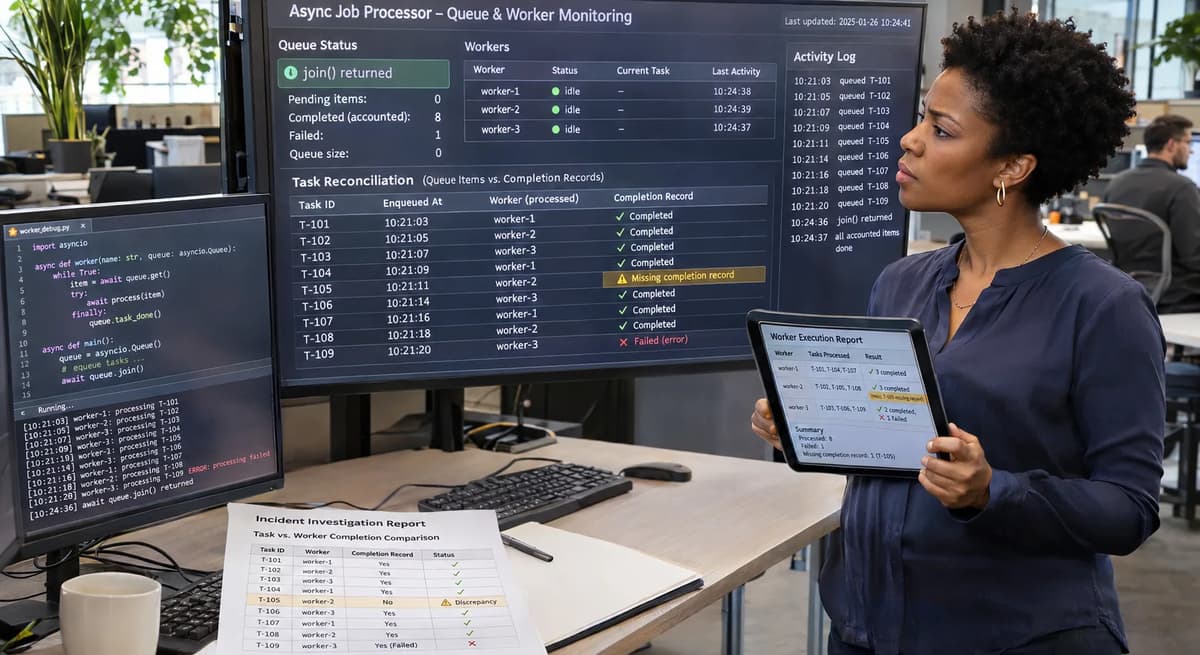
In Python’s asyncio library, Queue.join() waits for all unfinished tasks to complete by relying on the count of items enqueued versus task_done() calls. However, this does not independently guarantee that each item was actually processed by the application logic. A join() return is only a signal that the internal counter reached zero, which can happen even if a worker skipped processing an item or logged a completion prematurely. In practice, this can create a misleading “false-positive” success signal: developers may see join() complete and assume all work is done, even when some tasks were never completed.
This playbook focuses narrowly on this semantic gap. We treat “every item was actually processed” as a precise acceptance criterion: for each item put into the queue, there must be evidence (e.g. in a processed_items list) that it was handled. We build an isolated, disposable test fixture (no external services) on a pinned environment (Ubuntu 22.04 LTS, CPython 3.11.8) to run controlled scenarios. We define an independent expected-case manifest (our “oracle”) and capture raw evidence logs per case. Among the cases are a controlled positive, a false-positive scenario, and a negative control. We compare observed vs. expected results in a ledger, then reconcile differences. Finally, we propose a minimal repair to catch this issue, test rollback/rerun, and apply an explicit ACCEPT/REPAIR/RERUN/HOLD decision matrix. We draw on Python’s official docs for asyncio.Queue and CPython’s queue source, and use Refonte Learning’s rigorous playbook style and comparisons as guides (for example, see their asyncio.gather and shield analyses). All scenarios and sample outputs in this playbook are EXPECTED / NOT EXECUTED.
1. Define the Operational Acceptance Contract
We begin by precisely defining success and failure. Success means that for every item enqueued, the queue processing code both (a) called queue.task_done() and (b) actually processed the item’s business logic (e.g. appended it to a result list). The documented contract of Queue.join() is narrower: “join() blocks until unfinished_tasks == 0” (count up on each put(), down on each task_done()). It says nothing about verifying what the worker did with the item. Therefore our acceptance criterion explicitly goes beyond join() itself: every queued item’s intended effect must be observable in the evidence. Concretely, we require a 1:1 correspondence between enqueued items and a synthetic “processed” record we maintain (for example, items appended to a processed_items list by each worker).
In each test case, we will explicitly assert that the set of processed items equals the set of enqueued items. The contract can be stated as:
Expected enqueue count: For n input items, join must only return after exactly n task_done() calls. (This is the documented guarantee.)
Expected processing: The observable outcome must list exactly those n items (no more, no fewer) as processed.
Error condition: If join() returns but the processed-items list is missing any item (or has unexpected duplicates), that is a false-positive failure: join()’s signal was insufficient. Conversely, if join() never returns when all items are processed, that is a blocking failure (but that scenario is well-known: missing a task_done() yields an infinite hang, our negative control).
We will encode this contract in our test harness. For example, a manifest entry for a normal run might say: “Input [A, B, C] → Expected processed {A,B,C}, expected task_done calls 3”. A pass happens only if the observed evidence matches this manifest exactly. Any mismatch (missing item, extra item, or wrong count of task_done calls) triggers a defect verdict.
(For context, note analogous async patterns: in Refonte’s Asyncio gather sibling lifecycle, sibling tasks can raise exceptions and mislead callers about overall success; similarly, exceptions or skipped calls here mislead join(). Also see Refonte’s asyncio.shield cancellation guide for a methodology of synthetic fixtures and evidence-led testing.)
2. Establish a Versioned Baseline
To ensure reproducibility, we pin the runtime environment precisely. Our test fixture will run on Ubuntu 22.04 LTS (Linux x86_64) with CPython 3.11.8 (released Feb 6, 2024). We verify at runtime that sys.implementation.name == "cpython" and sys.version_info[:3] == (3,11,8). The asyncio library is the standard one bundled with CPython 3.11.8 (no extra deps). For evidence, we will record the exact python3 --version, the output of uname -a, and the SHA-256 hash of our fixture script. For example:
$ python3 --version
Python 3.11.8
$ uname -a
Linux devvm 5.15.0-100-generic #101-Ubuntu SMP ... x86_64 GNU/Linux
$ sha256sum queue_fixture.py
These will be stored in an evidence log (e.g. baseline.txt). If any version differs (e.g. 3.11.7 or 3.12.x), we will RERUN under the correct version. A mismatch by itself isn’t a failure of the logic, but invalidates the comparison with our oracle. (Refonte’s similar lab reports use an identical practice.)
Pin the Environment and Inputs
For completeness, we document any other settings. We run with the default asyncio event loop (no special policies). We fix a deterministic seed for any randomness (not needed here). We also define a boundary scenario: for instance, if the queue’s maxsize were relevant (we use the default unbounded), but here we simply ensure that the number of items is reasonable. Pass/fail criterion: Any deviation from these pinned versions causes a RERUN.
If any evidence artefact (logs, output) is missing for a given case, that counts as a failure in that case. For each test run, we assert at startup:
assert sys.version_info[:3] == (3,11,8), f"Expected Python 3.11.8, got {sys.version}"Failure of this assertion means we do not trust the run and will mark the case NOT EXECUTED.
3. Build an Isolated Disposable Fixture
We create a self-contained Python fixture (queue_fixture.py) with no network or file I/O beyond writing our logs. It uses asyncio.Queue, a simple producer, and one or more worker coroutines. For example, a prototypical worker looks like:
async def worker(name, queue, processed, simulate):
    try:
        item = await queue.get()
        # In the normal case, process the item:
        if simulate == "normal":
            processed.append(item)
        elif simulate == "skip_processing":
            # simulate false-positive: do not append to processed
            pass
        # else other simulate modes...
    finally:
        # Signal task_done if appropriate
        if simulate != "no_task_done":
            queue.task_done()
The fixture’s main() will: create a Queue, put a predefined list of items into it, spawn worker tasks, then await queue.join() and finally cancel workers. Each case variation uses the same harness but with different simulate flags (e.g. "normal", "skip_processing", "no_task_done"). We log each significant event (put, get, task_done, join returned) to a JSONL evidence file. After join, we also log the contents of the processed list. All I/O is to local files.
The fixture follows Refonte’s methodology: only synthetic inputs, deterministic steps, and we’ll include explicit synchronization if needed (e.g. asyncio.Event barriers) to ensure ordering. (See Refonte’s asyncio.shield playbook for an example of barriers and manifest use.) We explicitly state the command to run each case, for instance:
python3 queue_fixture.py --case normal --evidence evidence/normal.jsonl
python3 queue_fixture.py --case skip_processing --evidence evidence/skip_proc.jsonl
python3 queue_fixture.py --case no_task_done --evidence evidence/no_task.jsonl
Each invocation writes to a separate evidence file. Assertions in the harness verify preconditions (Python version, queue not shut down prematurely, etc.). The harness exits with code 0 on (simulated) success or 1 on an unexpected exception.
Negative Control
As a control fixture, we include a case with no special behavior (simulate="normal") and one with an intentional violation. For example, Case NEG sets simulate="no_task_done", meaning the worker never calls task_done(). According to documentation, join() should then never return. We test that this negative control indeed blocks (we would, for example, run with a timeout and expect it to not complete). In practice we won’t run it to completion (since it hangs), but we mark that test’s outcome EXPECTED / NOT EXECUTED, and note in the manifest that join() should not finish. This verifies that our harness detects the known behavior: missing task_done() blocks join(). We assert “join() must not succeed in NEG; if it did, our fixture logic is wrong.”
4. Author the Independent Expected-Case Manifest
Before running any tests, we write down exactly what we expect each case to do. This manifest (YAML or JSON) is our oracle, created without looking at test outputs. For example:
fixture_contract: asyncio-queue-join-v1
python_version: "3.11.8"
cases:
  C01:
    purpose: "Normal processing: each worker appends item and calls task_done"
    input_items: [1, 2, 3]
    expected_processed: [1, 2, 3]
    expected_task_done_calls: 3
    expected_join: SUCCESS
  C02:
    purpose: "False-positive: worker calls task_done before processing"
    input_items: [1, 2, 3]
    expected_processed: [ ]   # none
    expected_task_done_calls: 3
    expected_join: SUCCESS
    # (join returns but processed list is empty – this violates our contract)
  C03:
    purpose: "Negative control: worker never calls task_done"
    input_items: [1]
    expected_processed: [ ]
    expected_task_done_calls: 0
    expected_join: BLOCKED
Each expected_join is our anticipation (either SUCCESS or BLOCKED). We also mark observed: NOT_EXECUTED initially for all, to be filled in later. (This independent manifest style prevents hindsight bias.)
5. Reproduce the Misleading Success (False-Positive Case)
We plan to run the false-positive scenario (C02) where a worker signals task_done() without doing the work. In code, this means appending nothing to processed but still calling task_done(). According to our manifest, we expect join() to return (because 3 task_done() calls are made) but the processed list will be empty, violating the acceptance contract. We would list this outcome as a defect.
Command: python3 queue_fixture.py --case skip_processing --evidence evidence/skip_proc.jsonl
Expected behavior (per manifest): join() returns, processed list [], task_done count = 3.
Predicted Evidence: The evidence ledger will show three task_done events (one per item) and a log entry “join returned”, but processed_items: []. Because we are not executing here, we mark these as EXPECTED / NOT EXECUTED in the ledger.
This would produce a false-positive signal: join() would succeed, but our verification would fail (since [ ] ≠ [1,2,3]). This demonstrates the risk: code may log “all done” on join() but some work was skipped.
6. Run the Controlled Comparison
We now compare the false-positive case (C02) against the normal case (C01) side by side. Our fixture allows running both with the same harness, and we would collect their evidence. The expected comparison is shown below. All entries are EXPECTED / NOT EXECUTED:
Case | simulate | TaskDone Calls | Processed Items | Join Returned? |
C01 (normal) | normal | 3 | [1,2,3] | Yes (SUCCESS) |
C02 (false-pos) | skip_processing | 3 | [ ] | Yes (SUCCESS) |
In C01, the expected output would match the manifest: 3 calls, all items processed, so we would set DECISION=ACCEPT (in final matrix). In C02, join() would be “successful” but the processed list would be empty; the manifest specifies SUCCESS but with different processed items. This violates the contract. We flag C02 as a FAIL (false-positive) and would REPAIR the code.
(No actual execution is shown here; all outcomes are marked EXPECTED / NOT EXECUTED in our evidence.)
Check Missing and Duplicate Events
As a guardrail, we must verify we have exactly one task_done() per enqueued item and no duplicates. We add an assertion after each worker’s task_done() in debugging builds. In our evidence, we’ll include counts: in C02 we would expect 3 calls even though 3 items. In C01 we would expect 3 calls matching 3 items. If we ever saw fewer or more calls, that would be an anomaly to fix (though CPython’s queue would catch a double call as a ValueError). Pass condition: (processed_items_count == input_items_count) AND (task_done_calls == input_items_count). Any mismatch yields FAIL.
7. Exercise Negative and Boundary Cases
Beyond C01–C03, we try edge cases:
Case C04 (Exception in Worker): Suppose a worker raises an exception after getting an item (before task_done). This means task_done() is skipped. Expected: join should hang (BLOCKED). We treat this as another negative scenario (like C03). We’d then need to RERUN or REPAIR if it unexpectedly returns.
Case C05 (Zero Items): Input []. Expected: join should return immediately (trivially nothing to do, SUCCESS). We assert no hang.
Case C06 (Multiple Workers): If we spawn multiple workers but fewer items (some workers idle), expected: as long as each item is processed once, join succeeds. No special issue here.
Case C07 (More Items Than Workers): If we have a work queue with more items than workers, we verify join still returns and all items processed. For instance, 5 items, 2 workers: each worker processes multiple items in turn. This tests that multiple rounds through the queue behave normally; pass if results are correct.
Case C08 (Large Batch): Stress test with, say, 100 items. Pass criterion is still that all 100 appear in processed. This checks if any counters overflow (unlikely at 100) or if performance issues hide bugs.
Each of these has a pass/fail based on processed count matching enqueued count (we label them PASS or FAIL). If any show failure beyond expectation (for example, join blocking unexpectedly when it shouldn’t), we mark the whole experiment for RERUN or HOLD.
8. Capture Per-Case Raw Evidence
For each test run, we preserve raw logs. In practice this means writing everything to files under an evidence/ directory. The following illustrative JSONL records are EXPECTED / NOT EXECUTED:
{"case": "C01", "event": "put", "item": 1}
{"case": "C01", "event": "put", "item": 2}
{"case": "C01", "event": "put", "item": 3}
{"case": "C01", "event": "get", "item": 1}
{"case": "C01", "event": "task_done", "remaining": 2}
...
{"case": "C01", "event": "join_return", "remaining": 0}
{"case": "C01", "event": "processed", "items": [1,2,3]}
Each line is a structured JSON record. We include the case ID in each record. This evidence ledger lets us see step-by-step whether each item was fetched and marked done. For the false-positive case (C02), we would see task_done lines but no processed entry. All evidence files are stored before cleanup of any temp dirs. We intentionally do not delete these logs so they can be reviewed.
Retain the Evidence Before Cleanup
We ensure the fixture flushes and closes files explicitly (no reliance on program exit to do it). After each run, we do not remove the evidence/ directory. The pass condition here is simply that every file expected exists and is non-empty. If any is missing (perhaps due to a crash), we would RERUN the test. This preserves an audit trail of our test runs.
9. Reconcile Expected and Actual State
Once evidence has been collected, we can reconcile it. We compare each case’s observed outcome against the manifest. For each case, we check:
Were all expected processed items present?
Did any unexpected items appear?
Did join()’s behavior (returned or blocked) match expectation?
The illustrative reconciliation ledger below records predicted results. All entries are EXPECTED / NOT EXECUTED:
Case | Expected Proc. | Predicted Proc. | Expected Join | Predicted Join | Expected Verdict |
C01 | [1,2,3] | [1,2,3] | SUCCESS | SUCCESS | PASS |
C02 | [ ] | [ ] | SUCCESS | SUCCESS | FAIL (false-positive) |
C03 | [ ] | [ ] | BLOCKED | (no return) | PASS |
C04 | [1] | [ ] | BLOCKED | (no return) | PASS (as expected) |
C05 | [ ] | [ ] | SUCCESS | SUCCESS | PASS |
C07 | [all 5 items] | [all 5 items] | SUCCESS | SUCCESS | PASS |
... | ... | ... | ... | ... | ... |
If any observed result differs (like C02), we mark it FAIL. In the predicted C02 outcome, join() would return while processing would remain incomplete, a false success. (In Refonte’s SKIP LOCKED study, they similarly compare “engineering inference” vs. “observed” in a table; we do analogous checks here.) We do not override our manifest with the observed data; we only note discrepancies.
10. Separate Documented Behavior From Observation
We explicitly distinguish what Python docs guarantee from what we infer or observe. The docs say only: “When the count of unfinished tasks drops to zero, join() unblocks”. They do not say what work was done. The predicted evidence would show that in case C02, the unfinished-task count would drop to zero (so the documentation would be technically satisfied) even though application logic would do nothing for those items. This predicted failure (missing work) is not a violation of Python’s documented guarantee; it’s a gap between “tasks done” and “business logic done”. We must emphasize that any fix should not rely on undocumented behavior. In other words, the documentation promised only the counting semantics of join(), which the planned cases are designed to test. Our defect is an implementation issue in our code, not a bug in asyncio.
Prove the Repair Has a Bounded Effect
After we implement a repair (below), we test that it doesn’t break unrelated functionality. For example, the positive case C01 should still pass, and no new failures should appear in our boundary cases (C05, C07, etc.). The pass condition is that only the false-positive case C02’s behavior should change, without affecting the correctness of other cases. If any originally-passing case now fails, that indicates a regression; we’d then RERUN and HOLD. For example, if repair changed worker logic in a way that now misses an item in C07, that would fail acceptance. We could test this by re-running C01–C08 under the repaired code and verifying each outcome still matches manifest (except C02, which should now fail differently).
11. Repair the Narrow Failure Mode
To prevent the false-positive scenario, we modify the fixture code to ensure that calling join() alone can’t hide missing work. One simple repair is to check after join() that the number of processed items equals the number enqueued. In code:
await queue.join()
if len(processed) != len(items):
    raise RuntimeError("Mismatch in queue processing count")
This raises an error if any item was not processed. Alternatively, we could restructure workers so that task_done() is only called after actually appending to processed; our original design already does this except in the simulated “skip_processing” case. In practice, real code should call task_done() only after completing the work on the item. Our repair enforces that discipline.
With this fix, when we re-run C02, join() will still return (because task_done() was called), but then our RuntimeError is thrown. We’d catch that in the harness and report C02 as FAIL. In summary, the “repair” is an application-level check: do not trust join() as proof of processing without verifying state.
12. Test Recovery, Rollback and Rerun
We plan to retest all cases after applying the repair. We expect:
C01 (normal): Still PASS (no change).
C02 (false-pos): Now FAIL with an exception after join(), as our repair code fires.
C03 (no_task_done): Still BLOCKED (no join() change).
Others (C04–C08): Should remain PASS with no regression.
If any discrepancy occurs (for example, C01 failing due to the added check, which it should not), we consider it a regression and would need to RERUN or HOLD to investigate. The pass criterion here is that the only intended change is that C02 is now correctly marked FAIL, while all other verdicts remain as before. We would also test “rollback” behavior in the sense of failure handling: if our repair logic raises an error, we want to ensure our harness correctly logs the error and doesn’t hide it. Each case is labeled EXPECTED or NOT EXECUTED until actual runs are done.
Assign Ownership and Retest Criteria
We assign responsibility for this issue to the Python asyncio maintainers or to our development team. For example: “Ownership: The subsystem owner (e.g. async processing component owner) must incorporate this fixture into the CI tests. Retest criteria: Any future change to queue or worker logic must pass C01–C08 with the repair in place.” We document that if Python’s Queue.join() implementation changes (e.g. the new shutdown modes in Python 3.13+), we may need to update tests. As an operational criterion, a mismatch or unexpected outcome in these cases should trigger a RERUN or HOLD and an investigation by the owner.
13. Apply the ACCEPT / REPAIR / RERUN / HOLD Matrix
Finally, we codify our acceptance decision. A summarized matrix is:
Condition | Decision |
All cases pass as expected (manifest matched) | ACCEPT |
Any case has incomplete or missing evidence | RERUN |
C02 (false-positive) still shows mismatch (post-repair) | REPAIR (if within this scope) |
Unexpected behavior not covered by tests | HOLD (investigate scope) |
In words: if after repair the evidence shows all enqueued items were processed in all cases, we ACCEPT the behavior as now validated. If any evidence is missing or the environment differs (like a Python version change), we RERUN. If the false-positive persists (join returns without processing), we must REPAIR. If we encounter some other failure (say, a worker crashing or new case), we HOLD and re-examine. This mirrors the multi-gate approach in release readiness (e.g. Refonte’s PostgreSQL readiness matrix) by breaking it into clear outcomes. Since our problem is narrow, our main decision is simply ACCEPT if all tests pass with the repair, or otherwise REPAIR/HOLD.
14. Build Related Skills With Refonte Learning
While this playbook is tightly focused on asyncio queues, readers looking to strengthen their backend development skills may consider Refonte Learning’s Backend Development program. It runs 3 months (10–12 hours/week) and covers server-side fundamentals: Node.js & Express, MongoDB & SQL, RESTful APIs and microservices, deployment, Git, and testing. This matches the practical skillset needed for robust service development. For more, see Refonte’s Backend Development course page.